Seville in October: an evening trip on the river Guadalquivir. As night falls, the reflections of the city lights walz gracefully over its waters.

A response to this week’s WordPress photo challenge: Graceful
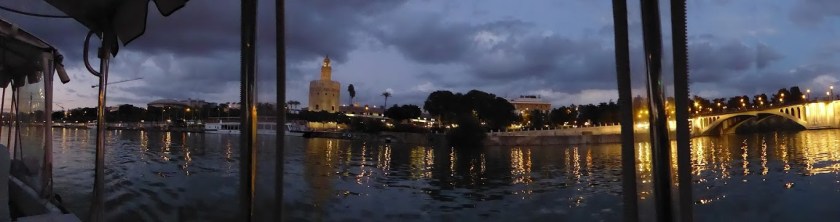
Seville in October: an evening trip on the river Guadalquivir. As night falls, the reflections of the city lights walz gracefully over its waters.
A response to this week’s WordPress photo challenge: Graceful
I have another blog apart from this one. My other site records some of my family’s history, in a rather anecdotal fashion. Its readers are mainly not the same people as those who read this one. So just for once, I’m going to share a post from ‘Notes on a family’. I love my Great Aunt Blanche’s autograph album from 1903. I think you might too.
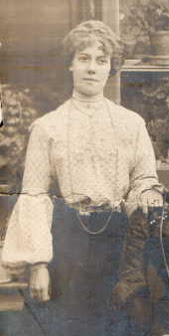 Blanche Pickard in about 1903.
Among my family treasures is an autograph book, dating from about 1903. It has no signatures from the famous, or even local notables. Instead, it’s a record of young people enjoying themselves at the turn of the 20th century.
The book belonged to my grandmother’s sister, Blanche. In 1903 her father Arthur was a clothier’s salesman, and she was a tailoress, a machinist. Most of their friends worked in the textile industry in some capacity. They were ordinary working people, and not educated to a high level – though she and her sister were still at school at the ages of 12 and 14, according to the 1891 census.
Blanche and her friends had autograph books. They sometimes amused themselves in their spare time by filling the pages of each others’ volumes. Here’s hers. I’ve left out all the pages that simply had improving quotations from…
View original post 87 more words
‘Ambience’: this week’s WordPress Photo Challenge.
I felt stuck. In my head, I rummaged through my photo collection. I discarded foggy moody atmospheric mornings like this one. I rejected bright summer meadows and crisp snowy winter walks as not quite projecting the ambience I want to think about on this dismal January day.
Here’s what I’ve chosen. It’s an image that’s more than six years old now, but it sums up much of what we loved best about our years in France.

Our walking group had played its part in organising a walk for ramblers from all over the region. We’d arranged signage, helped sponsors set up their stall, marshalled the event, walked ourselves, and handed out certificates at the end before the visiting walkers departed. Now we could relax.
Here we are in the mediaeval town square in Mirepoix, unwinding over a good and copious meal with plenty of wine. The sun is shining. The afternoon stretches lazily ahead of us. We’re among friends. This is an ambiance chaleureuse at its finest.
I only made one New Year’s Resolution this year, which is one more than I usually make. This year, I would not buy any more second-hand books from charity shops – my main sources for all kinds of serendipitous purchases – till I’ve read almost every unread book on our own shelves.
Well, that worked. It’s January 13th and I’ve just spend £3.75 on this little lot, culled from the charity shops of Ramsbottom, just up the road from where Ellie lives.

Ramsbotton is a post-industrial once-upon-a-mill town, a nice little market town with a whiff of artsiness about it. It has a cute little heritage railway: you can catch an East Lancashire steam train on high days and holidays. There are lots of independent shops, great coffee shops and restaurants. As a side-line, it does a fine line in charity shops with book departments that are a cut above the average, and I spent a happy hour or two browsing this afternoon before the boys came home from school.

I’m in Bolton this week because on Monday Ellie had her second operation, her mastectomy. It went well, thanks, and she’s recovering at home. Her dad and I took turns to manage-a-patient and manage-a-dog and manage-the-twins . The worst job is definitely getting the boys up in the morning. They’re just like their mum used to be when she was 11.
Look! Here is a post of mine from more than three years ago. It could have been written to fulfil this weeks’s WordPress photo challenge: Names
Almost ten years ago now, I had my Indian Adventure, when I travelled first of all with a small group of like-minded English travellers, and then solo round southern India. That’s when I started blogging, using TravelBlog, though I later transcribed it onto WordPress which may be more user-friendly.
The culture shock of arriving in Bangalore with its constant traffic noise, its motor horns, its street-cattle, its monkeys, its people, its eagles and vultures wheeling overhead is unforgettable.
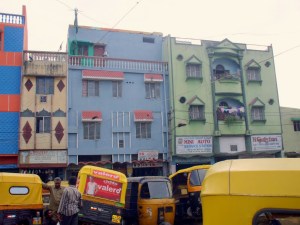
Arriving in Pondicherry some three weeks later was just as much of a jolt. Suddenly I was transported (after a motorway journey which included goats grazing on the central reservation) to colonial era France. Here were policemen in kepis, elegant public buildings, corner shops selling baguettes and croissants.

My guesthouse was a charming 19th century throwback which would have been totally at home on the French Riviera.
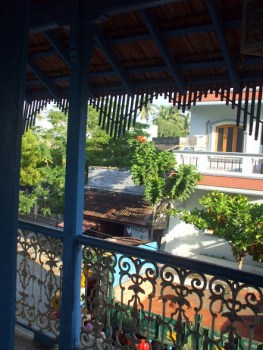
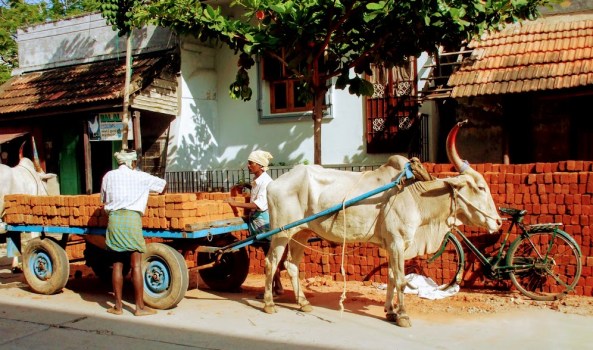
Yet I was undoubtedly in India. There was a spot of building work going on outside my bedroom window. Here’s the delivery wagon:
Here’s a more up-to-date delivery lorry:

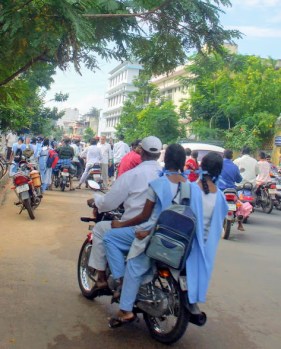
Here’s the school run:
And here’s the beach:

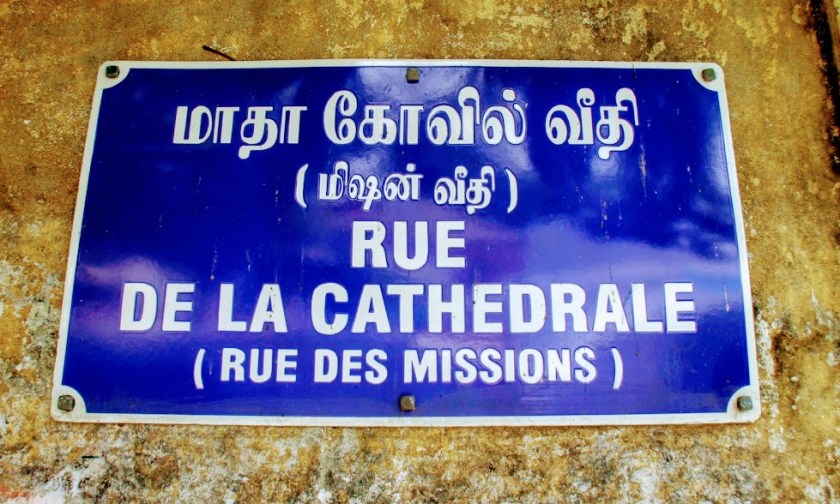
Here though is the photo which answers this week’s WordPress photo challenge: ‘Names’. A street sign which represents the many-faceted cultural references of what I thought of as my favourite Indian city.
In a couple of days I plan to re-blog an old post of mine which has something further to contribute to the ‘Names’ theme.
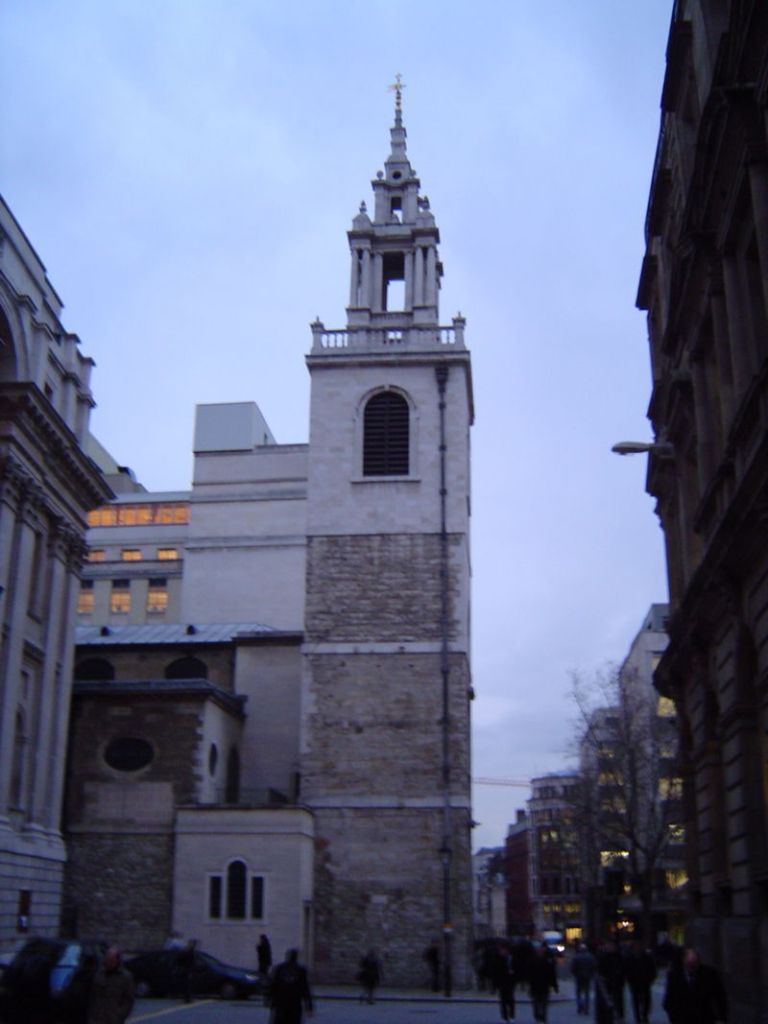
St. Stephen’s Walbrook is built in the shadow of Saint Paul’s Cathedral, rather hidden away down the narrow street which gives it its name. After the Great Fire of London in 1666, Sir Christopher Wren designed no fewer than 51 churches to replace those that had been lost in the four-day conflagration. Saint Stephen’s was his first, and the one where he tried out ideas later realised on a grander scale in the cathedral.
I visited it while I was in London the other week. This was Wren’s own parish church – he lived at Number 15, Walbrook. It’s the very first English church to have a domed ceiling in the Baroque style, such as Wren had seen in churches he’d visited in France and Italy, and it enhances the feeling of airiness and space.
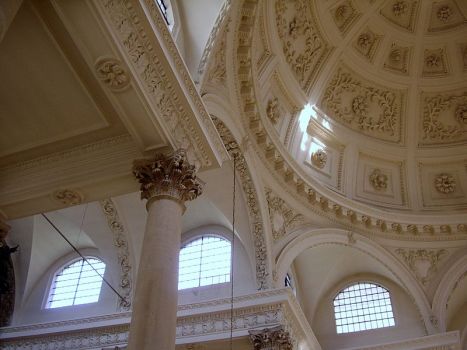
I liked this church immediately. On a grey, cheerless day, light poured in through the immense arched windows, glazed with translucent glass as in Wren’s day. Back in those early days, he’d had oak box pews installed, and the Victorians had later replaced the plain glass with richly coloured stained glass windows, which limited the light entering the building and was contrary to Wren’s own wish to have a classical, rather than a Gothic-inspired church. Fine woodwork dates from Wren’s day. Here is the pulpit and its magnificent tester.

Then came World War II. A bomb plummeted through the roof. The church was saved from destruction because the bomb didn’t explode. But the interior was ravaged, the glass shattered. Restoration of the church proved controversial. Wren’s own desire to have plain glazing was respected, but his box pews are no more. Light-coloured wooden seating now surrounds a monumental white polished marble altar, the work of Henry Moore. It has been placed in the centre of the church, immediately beneath the dome.

This must now be a magnificent, as well as an intimate space in which to worship, or listen to a concert. Yet the congregation had to battle for several years against diehards who tried to vandalise both windows and altar, objecting to what they saw as a desecration of a historic church.

I got chatting to the verger, who was sweeping the floor as I arrived. He told me about the topsy-turvy lives of City of London churches. Almost nobody lives in the city these days, so Thursday is the new Sunday, with worshippers consisting of the working population, and retired folk from the suburbs who return to support the church they’d loved in earlier years.
He told me that Samaritans, the 24 hour telephone support service for the depressed, those contemplating suicide, began here when its founder Chad Varah, was minister here.
I’d popped in originally as I was exploring the part of the city my grandfather would have called home in his childhood. His house is no more – everything in his street was destroyed in the Blitz. This church is near enough to his home that he may have visited it from time to time, though his family’s own church is likely to have been All Hallows by the Tower, the oldest church in London. That will be my next port of call in search of his roots, next time I am in the city.
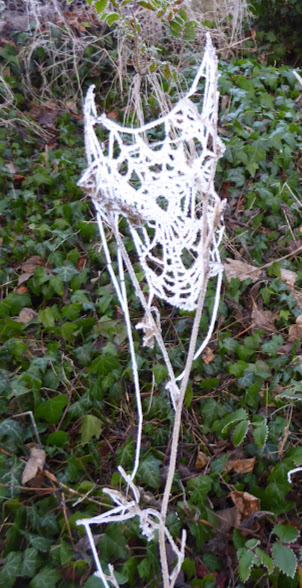
Google spiders’ webs and you’ll find any number of scientific articles celebrating the resilience of the silken strands that spiders produce Not only is the silk stronger than steel, it’s springy and elastic. The design of the web ensures that even when a strand is broken, the overall formation remains sound.
I found a spider’s web on a recent cold and frosty morning. By rights such a delicate structure should have collapsed under the weight of its coating of thick icy rime. It hadn’t. It’s the perfect candidate for this week’s WordPress photo challenge: resilient.
And here are a few more shots from a cold and frosty morning in North Yorkshire:


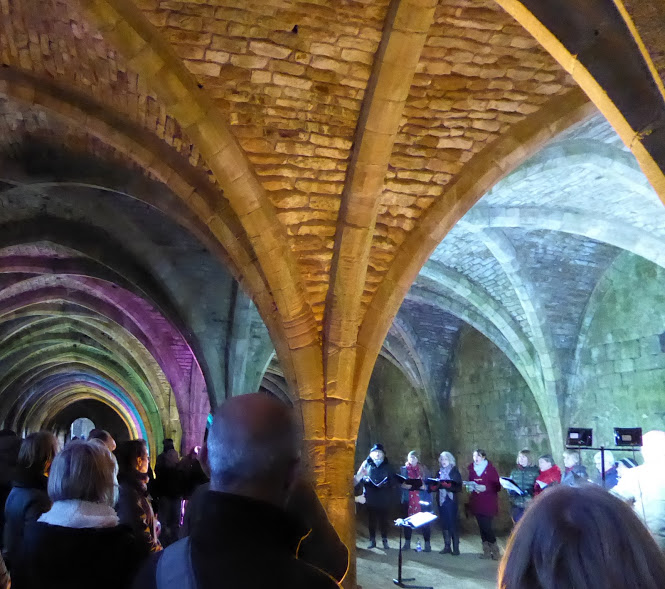
A coldish afternoon. Evening’s drawing in at Fountains Abbey, and our little choir is due to sing there. Not in the roofless ruined abbey, but in their former storage area, their cellarium, as vaulted as any church, and as atmospheric, with its wide colonnaded chamber and its vibrant acoustics. Local choirs vie for the privilege of a singing spot there around Christmas, knowing that audiences will be generously appreciative, and that the cellarium will give the very best account of the choir’s music making. Generally performers choose favourite Christmas carols that the audiences know and love.
Not us. Our director, Nicky, makes interesting choices. We sing early carols that the monks themselves might have known, such as the Coventry Carol and Ave Maris Stella. We sing music known to a secular mediaeval audience – the rousing songs of taverns, feasting and wassailing, such as Gaudete, The Boar’s Head Carol and the Gloucestershire Wassail.
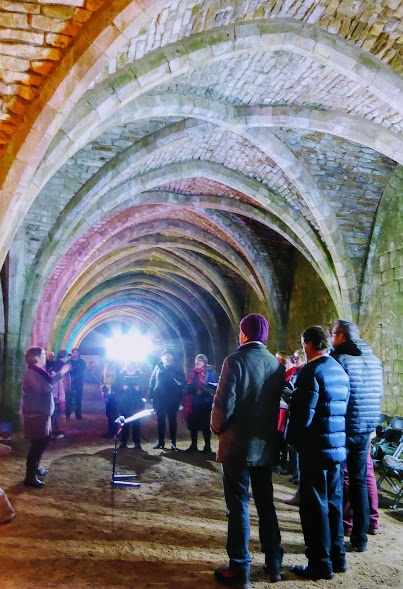
We sing winter songs from Lapland – a yoik to call the reindeer in, and a seal woman’s lament. A spiritual, a modern Hungarian take on Alleluia – the variety continues….. but we finish off with a traditional favourite – Ding dong merrily on high.
We’re delighted. We get through with no disasters, and we’re exhilarated at the way the acoustics of the cellarium enhance our music-making. The audience pays us pretty compliments. We want to come back again next year.

Happy New Year to you all. Let’s hope for a better 2017.
 On Christmas day I posted a scene from our days living in the Ariège. I felt very nostalgic for the Pyrenees, for snowy peaks silhouetted against clear blue skies, for cold clear air.
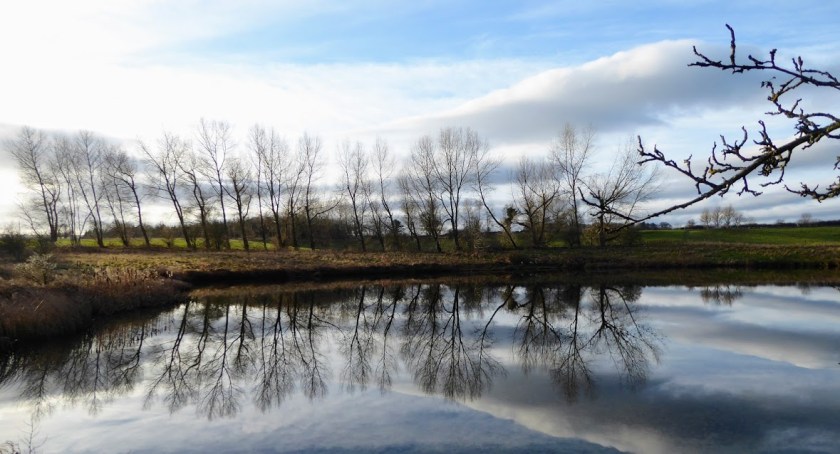
Today gave me the chance to remember that our countryside, though so very different, has its own charms and pleasures. We walked from nearby Masham and past the gravel pits of Marfield, now home to water birds of every kind: though only Canada geese and a few proud swans got a look in this morning.
We passed stands of ancient oaks, saw stark lines of skeletal trees marching along the horizon, watched the sky turn from Pyreneen blue to moody grey and purple then back to cheerful blue again. Sheep in late pregnancy cropped the short grass. We stopped to chat with fellow walkers walking off a calorie-laden Christmas. The River Ure was never far away. A pretty good morning’s work, actually.


 From Pyrenees to Pennines
You must be logged in to post a comment.