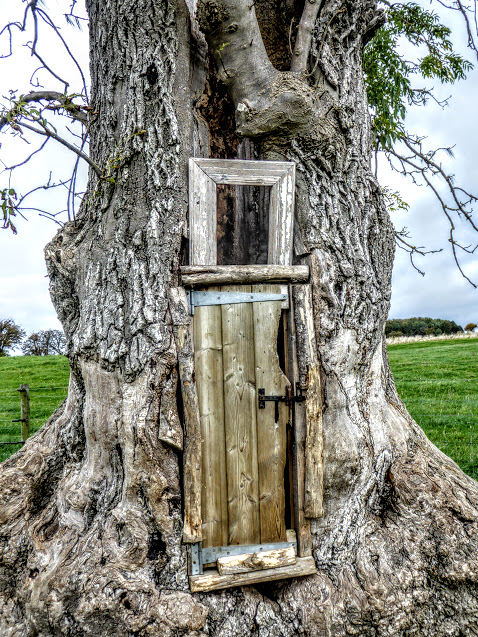
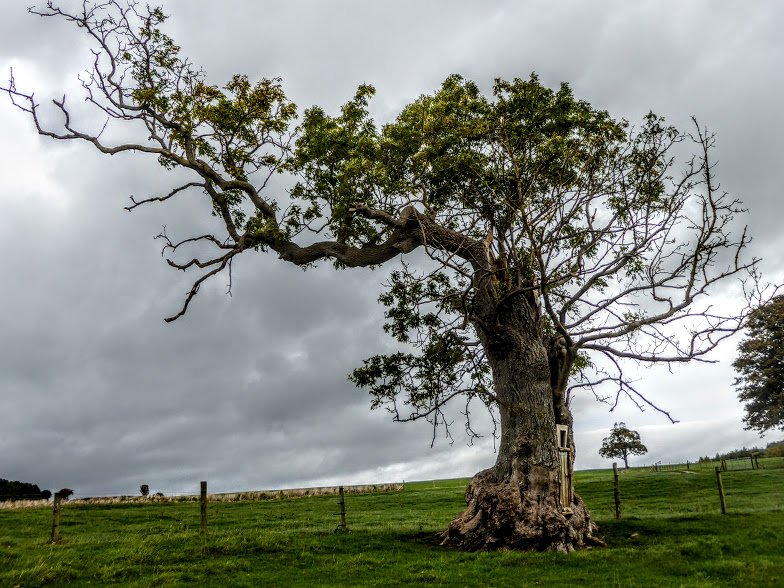
If you go walking in Wensleydale: if you go for a walk from Jervaulx to Jervaulx via Thornton Steward, you’ll come across this tree home, at the edge of a field, commanding views over the valley.
It’s pretty much in the middle of nowhere, but I always like to imagine a doting grandfather, tall and rangy from a tough life’s farming and probably reminiscent of the BFG, lovingly creating a little refuge for his grandchild in this hollow tree.
I couldn’t fit in it, neither could you. Perhaps the grandchild is too big now. It’s all a question of scale after all.
Many of you ask me how my daughter’s getting on. Well, her treatment is over, and her hair is growing apace. She’s decided to prove how well she’s doing by training to do the London Marathon next year, to raise money for Worldwide Cancer Research, and help fund further research into oesophageal cancer.
A few weeks ago, I did a deal with my son. My angry, grieving, difficult son. It wasn’t a deal I wanted to do, and – in many ways – it felt like a pact with the devil. I told him that if he would engage with a course of counselling, then I’d do what he’d been asking for, and start to look for a new partner.
I knew that it would take several weeks to sort out my son’s head, and, through counselling, he’d probably realise that his problems were not going to be easily solved by my acquiring a substitute for his dad. I wasn’t ready for a relationship, and was otherwise muddling along as a double – not single – parent, but at my wits’ end.
Both boys have been desperate to see me happy again – and that, they believe, means for me to be married…
Our friends from Laroque d’Olmes are with us. They’ve visited us in Yorkshire before, and are big fans, both of the friendliness of the locals, but more especially of the landscapes, whether dramatic or domestic, that we’ve been able to show them.
The other day it was the turn of Wharfedale, whose dramatic landscape was sculpted first of all by the glaciers of the Ice Age. Since then, the River Wharfe and its tributaries have created waterfalls and river cliffs, cut gorges and deposited patches of sand and shingle on riversides. We couldn’t show our friends the underground landscape of passages, caves, pools, streams, waterfalls, stalagmites and stalactites: but on a day such as we had on Sunday, with the sun shining and the sky a startling shade of blue, who cared?
We took them to Kettlewell, and on a walk worth doing for the names of the features we passed. You go up Dowber Gill, and pass the Five Sisters waterfall. Then it’s on to Providence Pot and the old lead mine workings, up to Hag Dyke: Great Whernside’s just further on.
We finished our day at Grassington, having a quick look at the dramatic waterscape at Linton Falls.
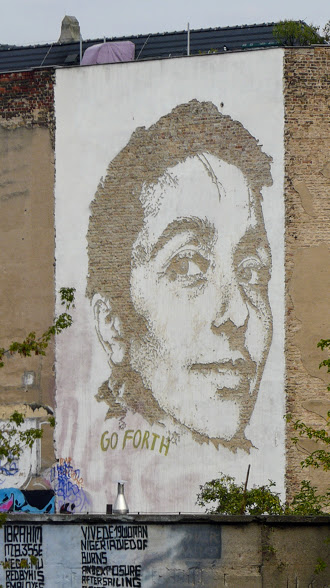
Berlin is the home of street art and creative graffiti. If you’ve been following my posts, you’ll already have glimpsed the East Side Gallery: though that is planned and curated.
Away from the city centre, street art is so much a part of Berlin life that walking tour companies vie with each other to show visitors the edgiest and grittiest current manifestations of this vibrant art form. Even big companies climb on the band wagon. Back in the early years of this century, Nike paid for this piece.
I didn’t realise this is a Nike advert. So that didn’t work then…..
Somehow, global companies making use of a movement powered from the bottom up seems slightly to be missing the point.
Using spray cans; re-purposed fire extinguishers; transfers from images shot in night clubs, applied to city walls then doused in glitter, street artists come out at dead of night to brighten up favourite haunts. Bands of graffiti artists have thousands of followers on YouTube.
You, like me, can simply be a curious pedestrian in the streets of Berlin. Can you spot the example of yarn bombing?
I’m in London, doing a spot of childminding for two-year old William. But after all that city living in Poland and Berlin, my inner Country Mouse needed some attention.
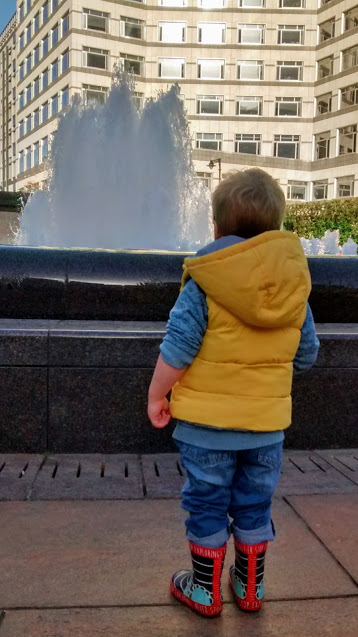
A city farm then. This turned out to be a Good Idea. It involved an exciting trip through the waterways and futuristic high-rise building sites on the route of the Docklands Light Railway. It involved, in the smart business district of Canary Wharf, an exciting intermittent fountain that commanded William’s rapt attention for many minutes.
William and the fountain at Canary Wharf.
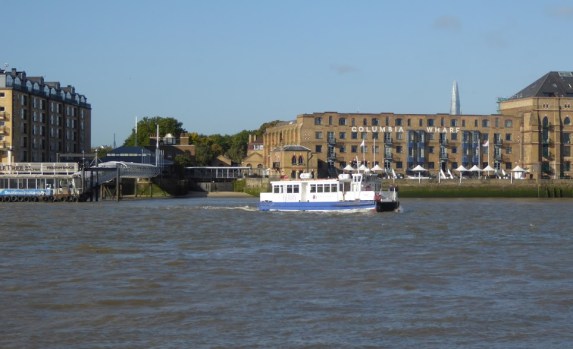
It involved a ferry crossing to get us from one side of the Thames to the other. ‘Did you see the seal?’ said one of the crew. No, we didn’t, but it turns out they’re rather common.
The ferry goes from Canary Wharf to the far side, back and forth, all day.
And it involved a saunter along the Thames views. Then we arrived. Surrey Docks City Farm. Path, through parkland and with riverside.
The view from Surrey Docks Farm.
It’s a farm, but not as we know farms here in North Yorkshire. The animals are behind fences, and the crops are in beds rather than fields. But it’s nicely ramshackle, in a good way, and a real piece of countryside among the high-rise. William and I befriended sheep: monster woolly breeds from the South Downs and from Oxford, quite unlike their rangier northern cousins. Donkeys requested loving pats on the back. Here was the biggest sow ever. Ducks were a-dabbling, up tails all. Goats played King of the Castle to increasingly complicated rules, jostling each other off the heights: and hens busied themselves policing the entire site.
A few goats having fun.
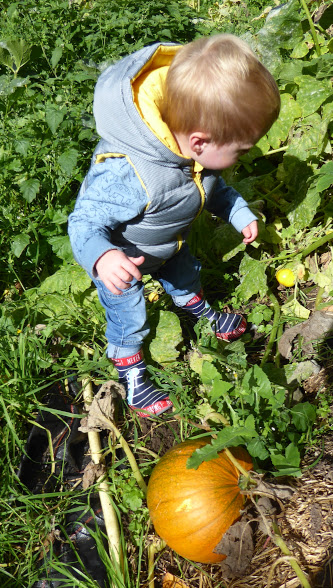
William was, if anything, even more interested in the vegetables. Those gourds! They were long, thin, and taller than him. Those pumpkins! So big, so h-e-a-v-y. And the long leaves of the cavolo nero! So tough, so leathery, and such an intense shade of dark green.
William holds a pumpkin inspection.
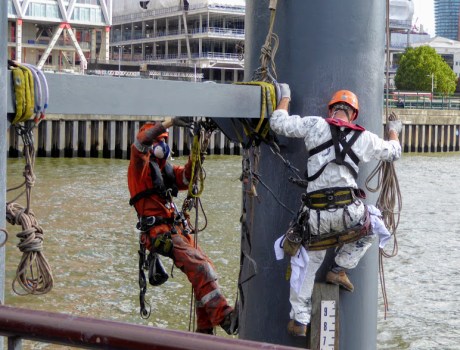
Everything in the cafe is home-made. So we had lunch there – an enormous lunch – before retracing our steps. The ferry was still as exciting, and there were workmen hanging off the gangway onto the boat, doing unimaginably interesting things.
Maintenance work on the jetty.
The fountain as entrancing as first time round. By the time our train journey was over, William was fast asleep.
We’re just back from our holiday – that epic journey through Poland and to Berlin. It feels like the beginnings of a voyage of discovery into a so far almost unknown part of my family history. And I may have a post or two to share still. You have been warned.
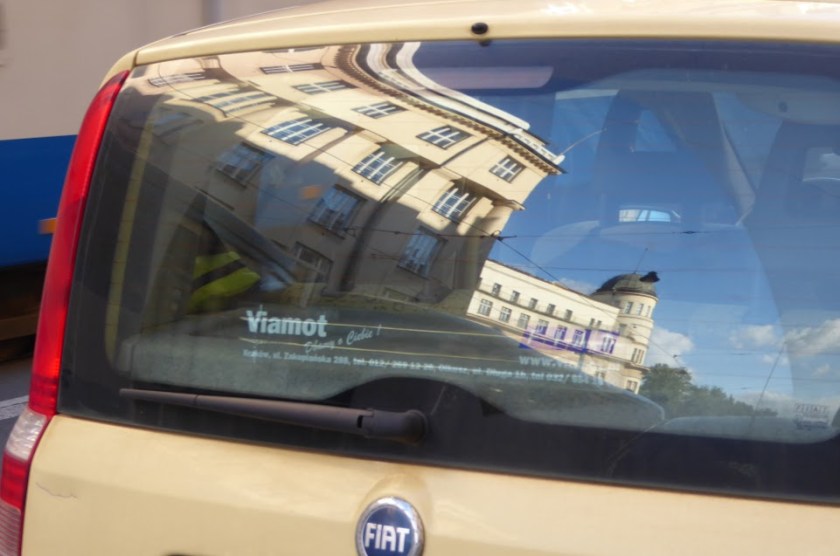
But here’s just a bit of fun. Walking down a street in Krakow the other day, I spotted the streetscape behind us reflected in the window of this car. Here it is:
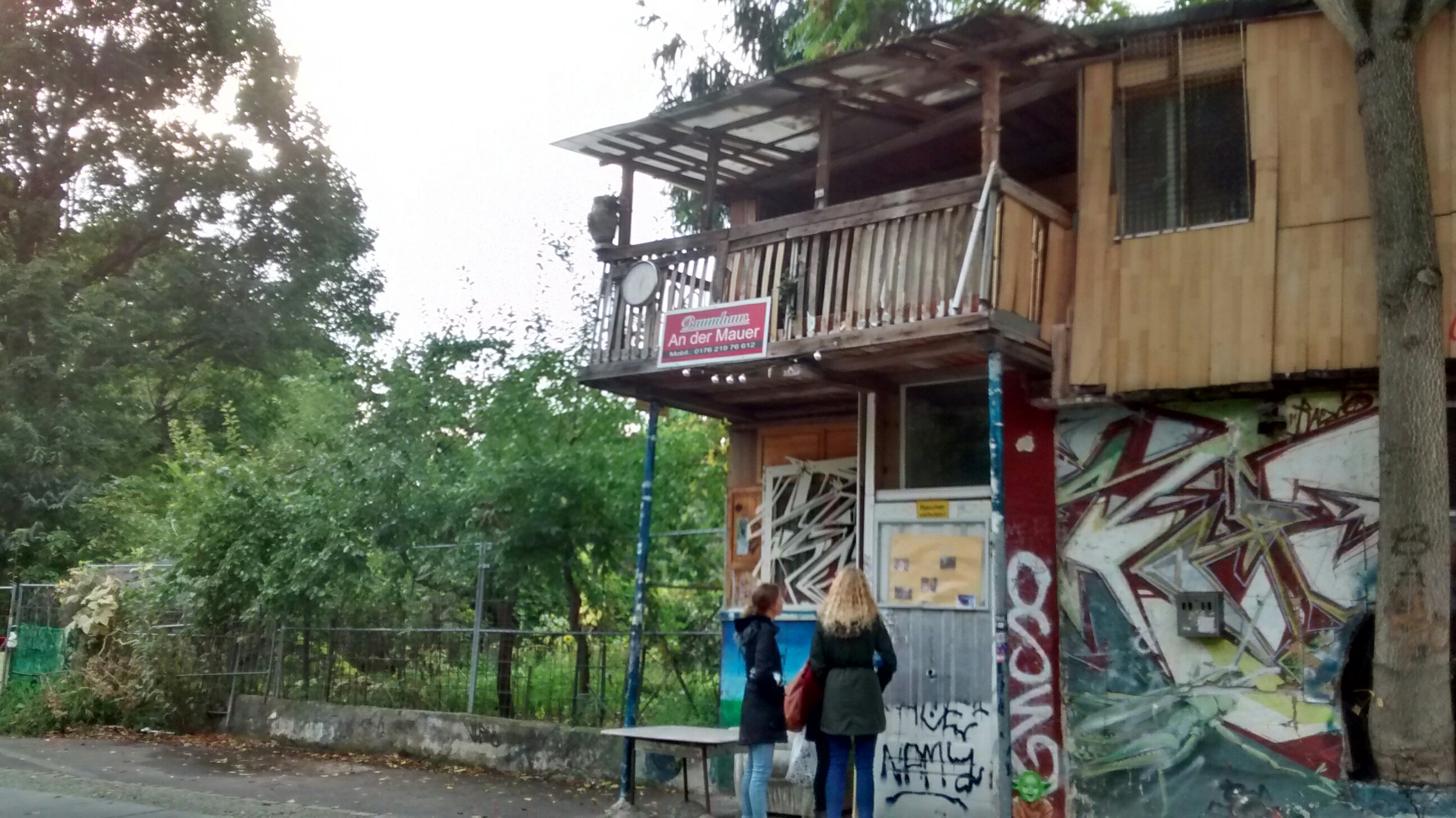
Quite suddenly and unexpectedly, one night in 1961, Berlin became a divided city. At first there was merely barbed wire fencing, then a wall. It was all done in such a hurry that mistakes were made. One tiny part of Kreuzberg that belonged to the Eastern sector got isolated in the West. The Americans – for it was in their zone – could do nothing about this unremarkable patch. It became an unloved and unlovely rubbish dump.
Then along came Osman Kalin, an immigrant Turk. He wanted a vegetable patch. He cleared the land and started to plant seeds. As his patch became productive, he gave vegetables to schools, to the local church, to anyone in need. He cobbled together a rather ramshackle tree house. He became something of a local hero.
Initially, the East didn’t mind. But when East Berliners successfully started to tunnel under his patch and escape he came under suspicion. The authorities came to interrogate him, and he welcomed them in his usual hospitable way. They gave up and left him alone.
In 1989, the Wall fell. A newly united Berlin City Council began to see Osman’s ramshackle domain as an embarrassment. They gave him notice to quit. The local and wider community was horrified. 25,000 people signed a petition demanding he be allowed to go on growing his vegetables.
He stayed. He’s 95 now, and doesn’t work so much on his vegetable patch, though his son does. He lives in a flat nearby rather than in the tree house. He’s still a much-loved local hero.
I heard this story on a walking tour offered by Alternative Berlin Tours, led by the remarkable and endlessly interesting Dave. Very highly recommended.
Here we are in Berlin. Before we arrived, I imagined that even some thirty years after the fall of the wall dividing east from West Berlin, we’d be able to tell which zone we were in. The east would still be full of Stalinist architecture, and look, well, shabbier, surely?
The Plus Hotel, once a school of textile design.
No. Not at all. We’re staying in a cracking looking hotel and hostel that used to be a textile school. We learnt that we were along the road from the East Side Gallery. An art gallery? That’s nice.
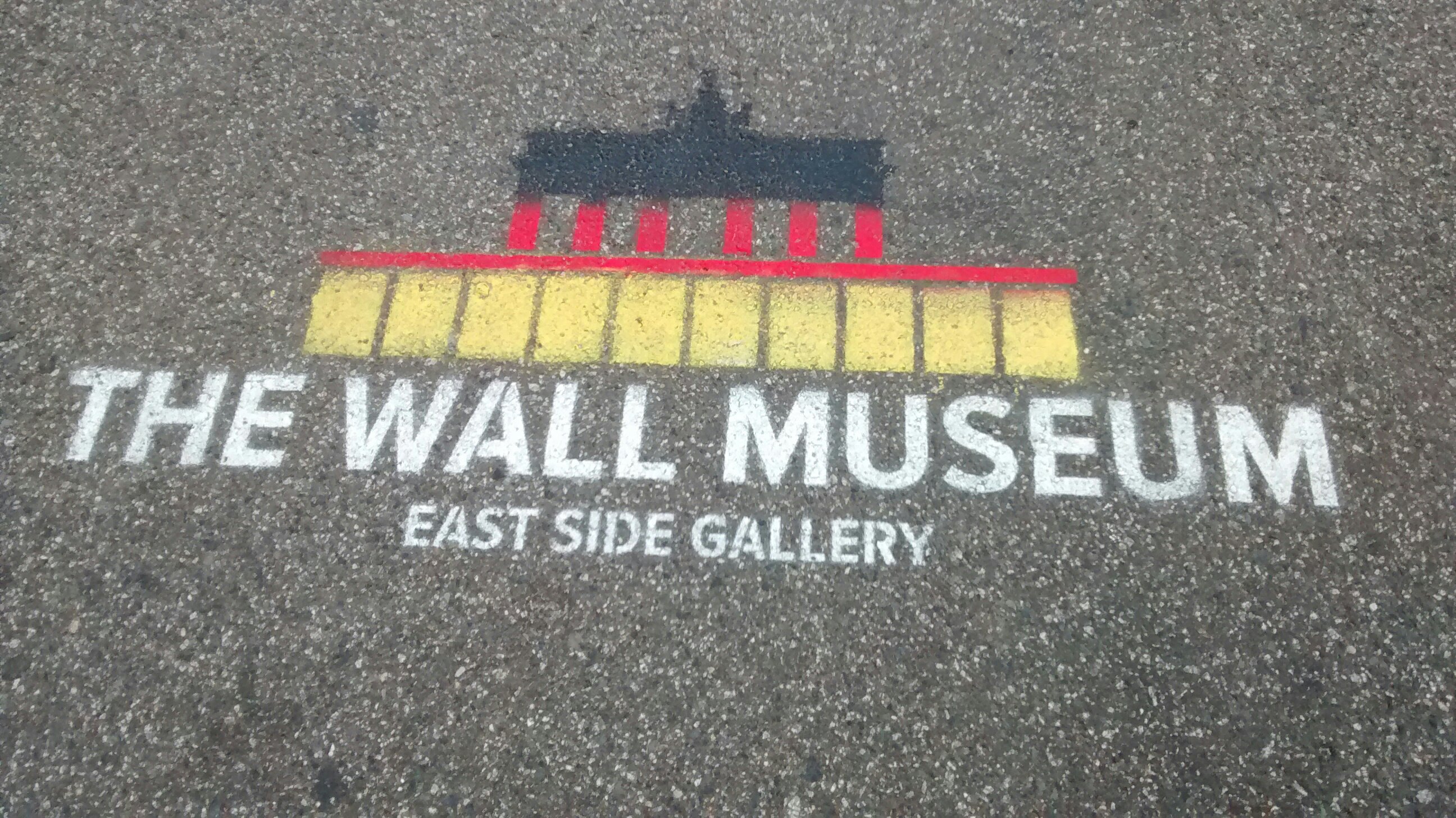
You’ll find your way to the ‘gallery’ by following the stencilled signs on the pavement.
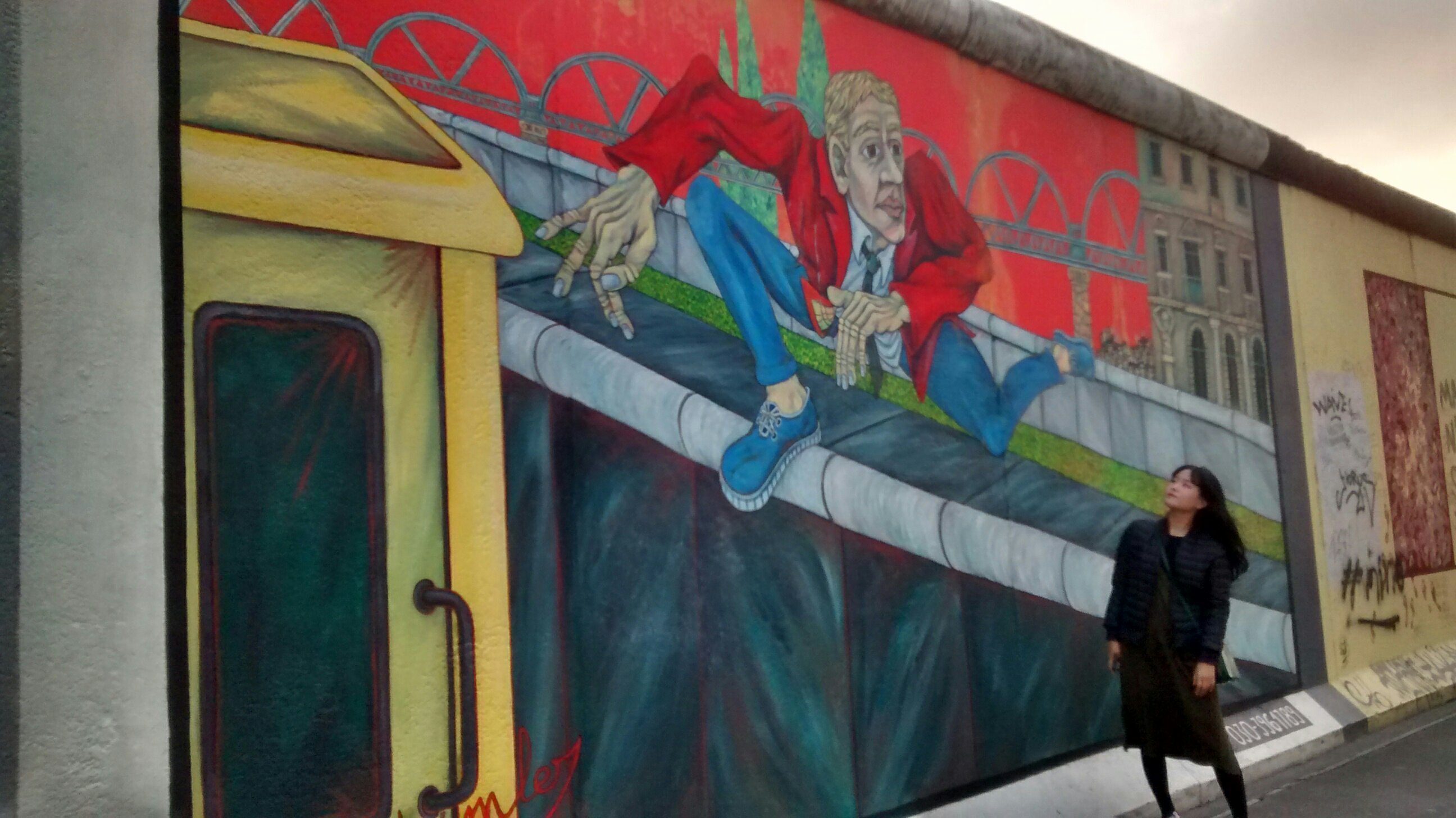
But this is a gallery like no other. The canvas on which the invited artists worked is the wall, the actual Berlin Wall. Walk along the streets which line the route of what’s left of the wall and you’ll see painting after commissioned painting with the artist’s own thoughts provoked by the wall and its demise. It’s angry, gritty, colourful, and provokes conversation among passers by. We plan to return tomorrow for a more considered visit.
By train, we’ve travelled from Gdansk to Krakow, from Krakow to Warsaw, and now we’re on the train from Warsaw to Berlin. In all, that’s some 1400 km.
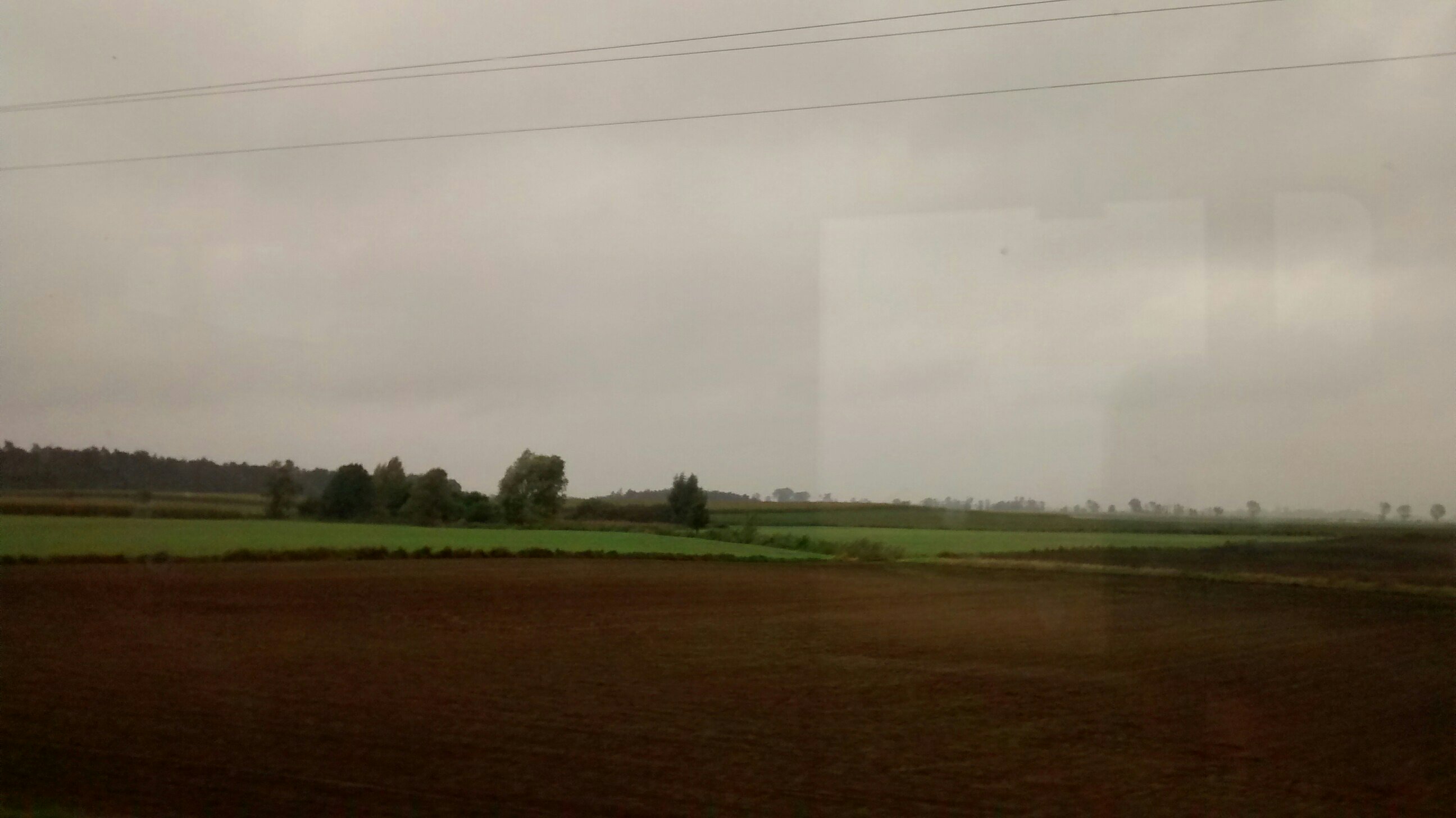
What is astonishing me is that the countryside is almost all the same. It’s flat, flat, flat. Long narrow unboundaried fields – and gosh, Polish cows don’t need fencing in – are interspersed with swathes of forest.
No wonder that that throughout history, invading armies have been able to march unimpeded across the land, conquering as they went. Hitler’s tanks, Stalin’s tanks all had a pretty easy ride here.
Just now, we’ve been passing through flatlands of long, wide peaceful lakes. And we’re drawing closer to Poznan, near to which my father was born, to a farming family. I feel surprisingly emotional.
View from the train window, almost anywhere in Poland.
I’m glad I went to Auschwitz. I’m still processing what I saw, what I heard. Most of you will know the histories of the dreadful death camps.
The weather was appalling today. Double speed windscreen wipers on the way there. I was cold and wet. But I was well-clothed and shod, I’d had a good breakfast, and soon I’d be warm and dry. The inmates of Auschwitz and Auschwitz-Birkenau had their one and only pair of never-washed louse-infested pyjamas and next to no food inside them. They wouldn’t be going somewhere cosy for a change of clothes and a nice hot drink in a couple of hours.
I’ll just share two vignettes. Imagine a long narrow room, with a display case on each side running the length of the room. Each is filled with human hair. This hair comes from the heads of women and girls exterminated in the gas chambers of Auschwitz. A very small proportion of the total. This is the hair of some 80,000 women.
In the next, similar room are shoes. Thousands of shoes. They belonged to some of the thousands of murdered Jews.
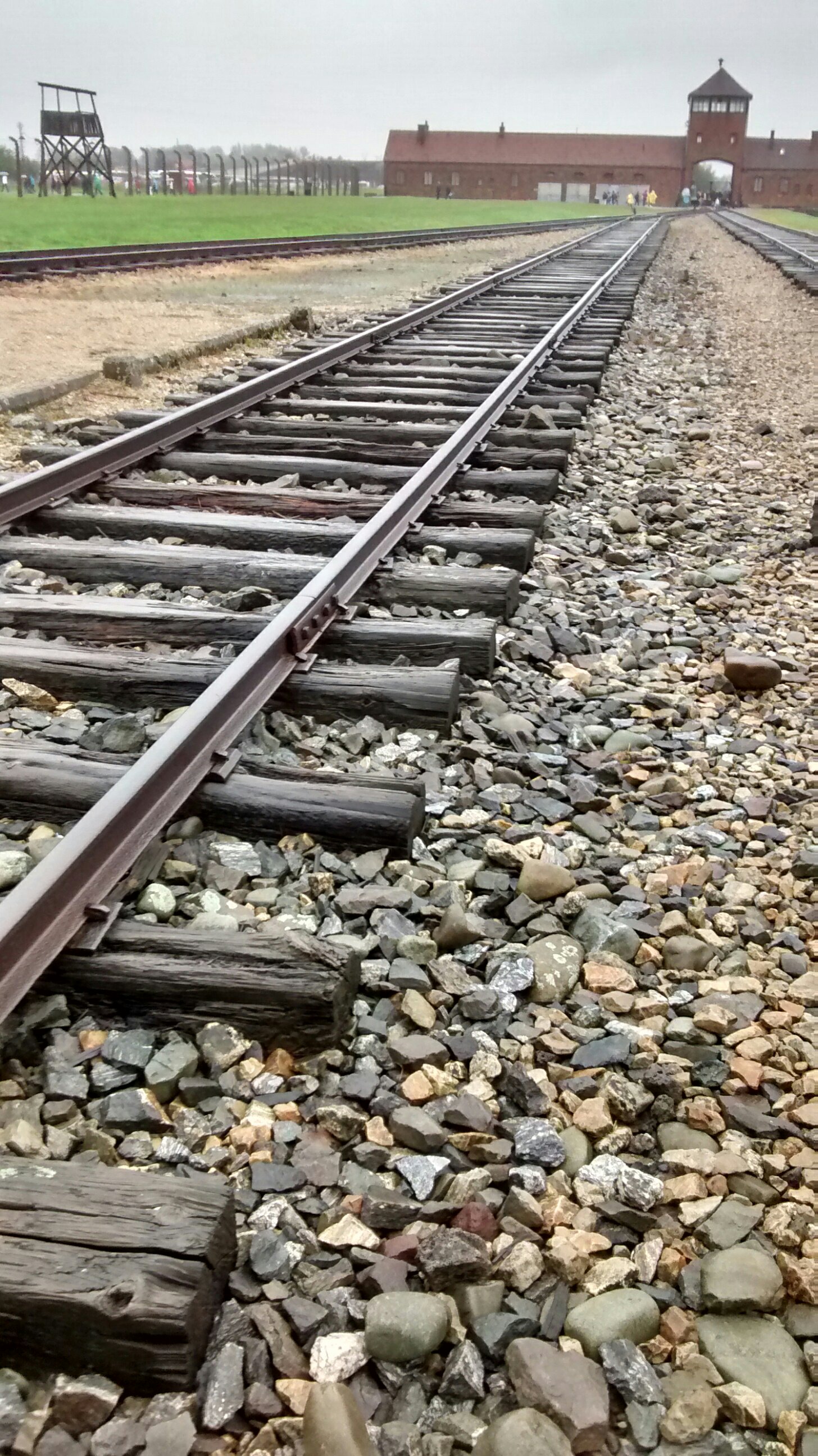
I took no photos in Auschwitz. It seemed disrespectful to take snapshots of those glimpses of real lives, real tragedies. I’ll just include one familiar image of Auschwitz-Birkenau, with the train lines which transported people to their almost certain deaths.
I’m glad to have gone because I left with a certain feeling of optimism. The custodians of these camps and the guides who bring those dreadful days back to life are passionate about sharing the stories, to try to make sure, against the odds, that they are never repeated. Our young guide told us he had been trained by an Auschwitz survivor. He clearly saw his job as no ordinary responsibility.
Today, and every single day, thousands of visitors take these lessons away with them.
My visit there does deserve a more considered post. Just – not yet.










You must be logged in to post a comment.