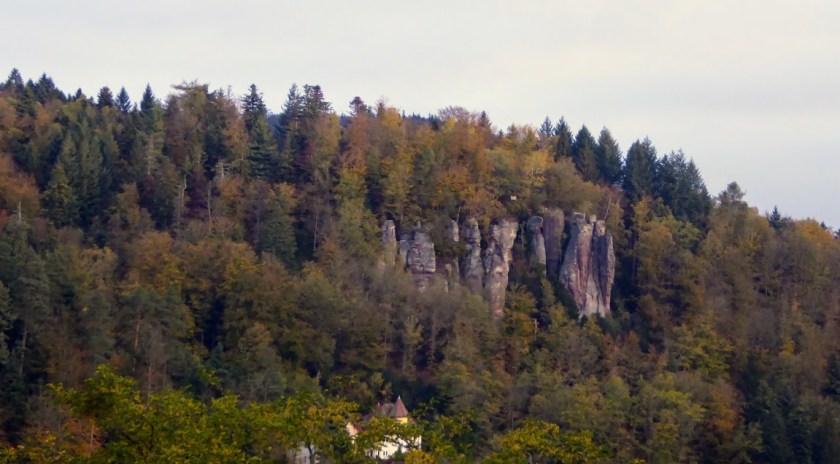
This bulky cliff of long thin fang-like rocks that we could see last week from our Black Forest hotel while on our European Escape piqued our interest. So on our last afternoon, while Malcolm was having a rest, I set off to explore.
I had only the most basic of maps: but this is Germany, land of the Walker’s Waymark. Once I knew I was off to Falkenstein, there was no problem. I yomped up to the woods outside town, turned right, and set forth.
I even tried to get a little lost, but however hard I tried, I was never far from a reassuring sign pointing me onwards to my chosen destination.
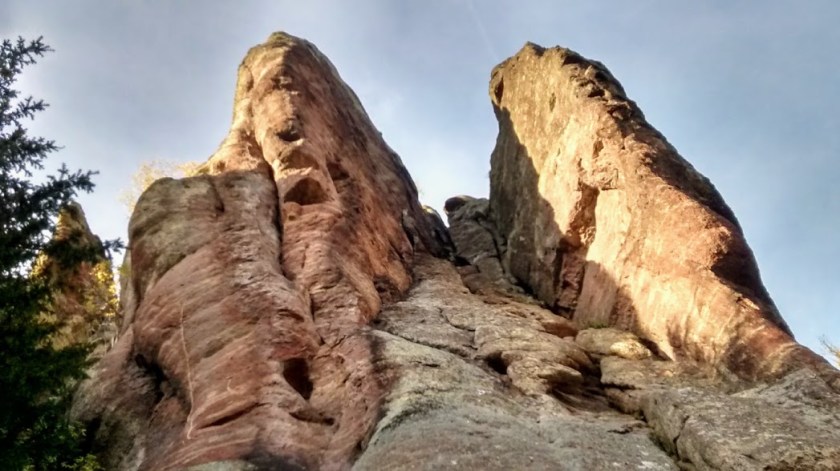
Once there, I found I couldn’t have more than a peek at a time. That solid mass of rock visible from our hotel was never once in full view. Instead, one, two, possibly three peaks at a time pointed skyward from my path below. Here they are.
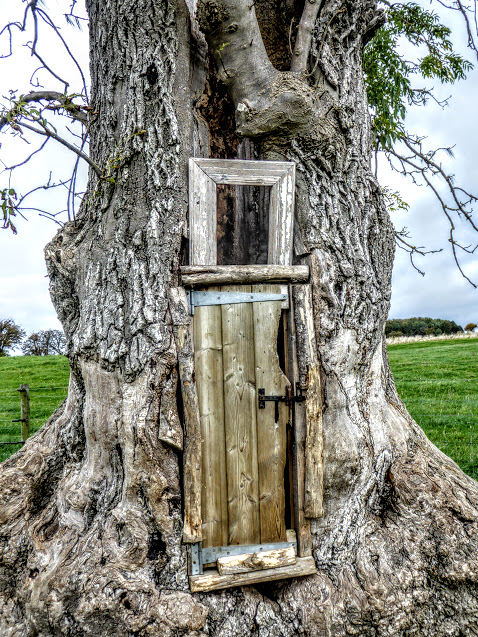
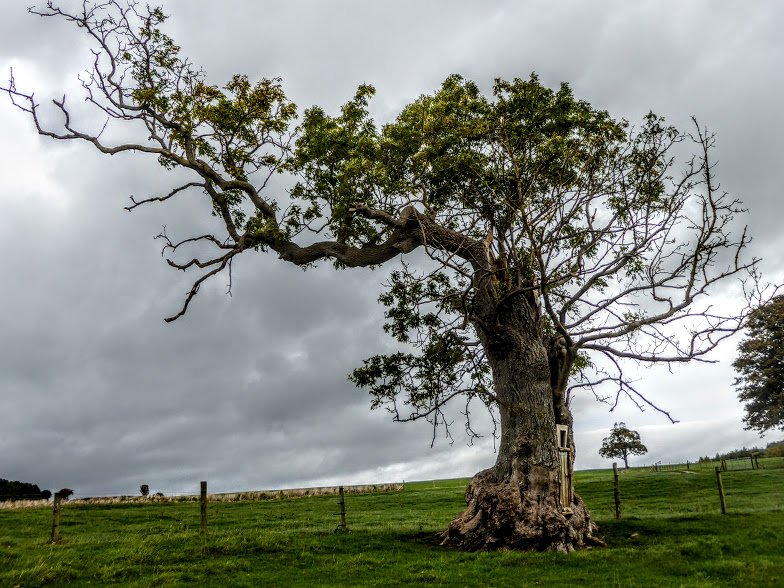
If you go walking in Wensleydale: if you go for a walk from Jervaulx to Jervaulx via Thornton Steward, you’ll come across this tree home, at the edge of a field, commanding views over the valley.
It’s pretty much in the middle of nowhere, but I always like to imagine a doting grandfather, tall and rangy from a tough life’s farming and probably reminiscent of the BFG, lovingly creating a little refuge for his grandchild in this hollow tree.
I couldn’t fit in it, neither could you. Perhaps the grandchild is too big now. It’s all a question of scale after all.
This time 54 years ago – more or less – I was sitting my O Level in Geography. Among other things, we studied the economic geography of England, interpreting Ordnance Survey maps, and a little elementary geology.
The Pennine Way near Gargrave.
Our walk the other day would have made an excellent field trip. We were over in West Yorkshire, and our route from Gargrave took in sections of the Pennine Way, and quite a stretch of the Leeds and Liverpool canal.
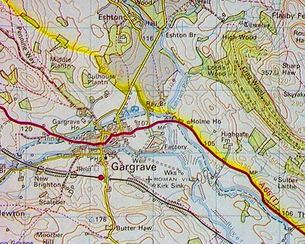
A section of an OS map showing the area round Gargrave (from the BBC website).
Map-reading wasn’t our problem, because John and Pat were competently leading us onwards. The hills weren’t a problem, because the slopes were relatively gentle. They were the drumlins which are a feature of the area.
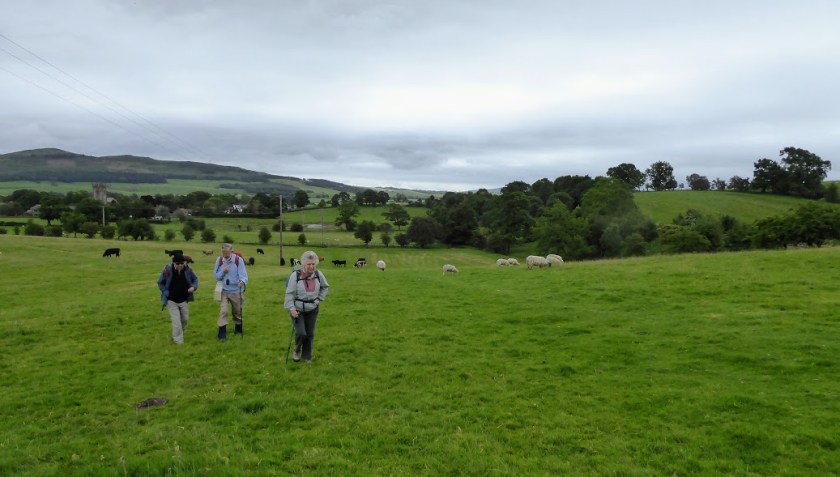
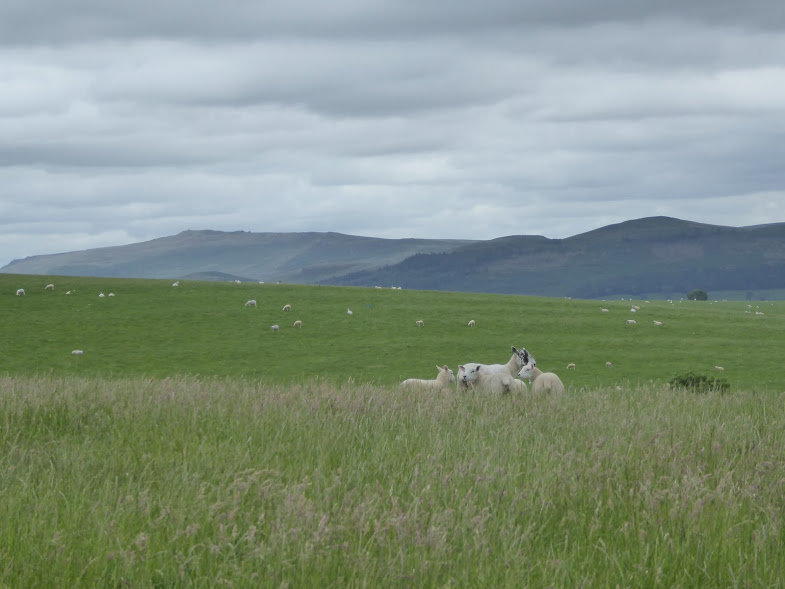
We’re walking over drumlins. The Pennines are over there in the distance.
O Level question: What are drumlins? Drumlins are elongated hills of glacial deposits. They can be 1 km long and 500 metres wide, often occurring in groups. They would have been part of the debris that was carried along and then accumulated under an ancient glacier. The long axis of the drumlin indicates the direction in which the glacier was moving. The drumlin would have been deposited when the glacier became overloaded with sediment.
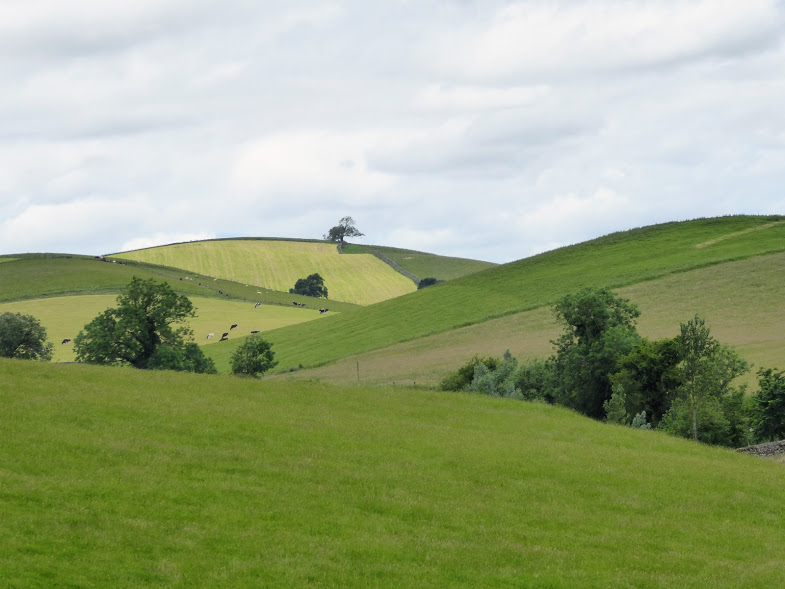
Here are drumlins. Drumlins as farmland.
We walked through fields of cows, fields of sheep, and through woodland, emerging at lunchtime on the banks of the Leeds and Liverpool Canal.
O Level question: What is the Leeds and Liverpool Canal, and why was it built? The Leeds and Liverpool Canal is a canal in Northern England, linking the cities of Leeds and Liverpool. Over a distance of 127 miles, it crosses the Pennines, and includes 91 locks on the main line. It was built from 1770, and allowed textiles to be sent from the woollen towns of Yorkshire for export from Liverpool. Liverpool also required coal to fuel its manufacturing and shipping industries.
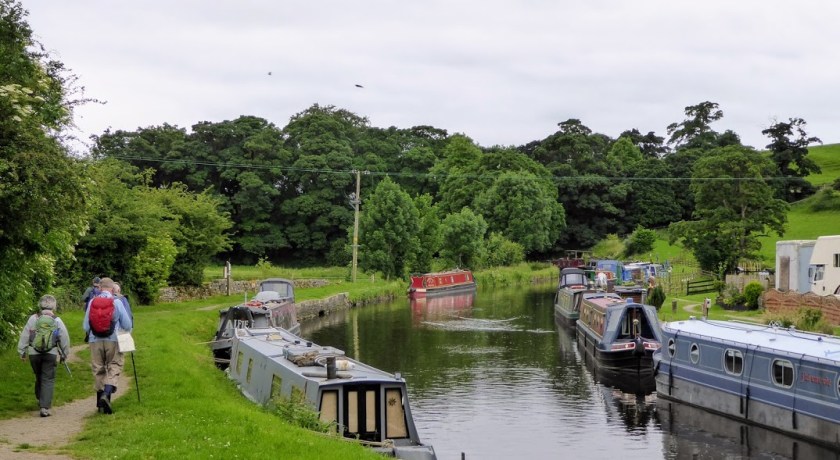
Our first view of the Leeds and Liverpool canal at East Marton.
What an industrial thoroughfare it was then. Busy, dirty barges and narrow boats piled with goods moved between Yorkshire and Lancashire, where now there are only bucolic scenes and holidaymakers enjoying tranquil holidays slowly wending their way along the canal.
We watched as boats rose or descended through one, two, three, four, five, six locks to reach a different level of the canal. We marvelled at a section of our route along the canal towpath. We, and the canal itself, were travelling along a viaduct, and far below us were fields and a river. I couldn’t organise photographic proof. Soon after, we were back in Gargrave.
A view of some of the locks.
A lock gate slowly letting out water to lower a narrow boat to the stretch below.
So there we have it. If only I’d done that walk when I was 16. I would hardly have had to do any geography revision at all.
The canal towpath. No longer a scene of industry and commerce.
It was the summer solstice this week. It was also, for three days only in the north of England, summer.
So let me whisk you back eighteen months, to a crisp and clear January day when I took myself off to walk for a couple of hours or so, looking upwards rather than at my surroundings. Skyscape succeeded skyscape. These changing skies perfectly illustrate this week’s WordPress Photo Challenge: transient.
I’ve been in Bolton this week. It’s week eleven of Ellie’s chemo treatment. Five more to go. This type of chemotherapy works in three week cycles, and week one each time is usually particularly tough. So I went over to do a few in loco parentis duties.
Extracting the boys from their beds in the morning, and re-inserting them there at a reasonable time each night count as challenging tasks. Ben doesn’t do mornings. All the other household stuff I can take in my stride.
There’s just one task that was never part of my life before this year. Walking Brian, who’s no longer a puppy, but not exactly a mature and restrained adult dog either. I don’t think I’ll ever be a real dog fan, but I did enjoy being exercised by this particularly amiable and boisterous dalmatian. Where to go? Through the woods and round the reservoir? Yes please! Or across the extensive parkland just over the way there? Yes please! And can we go, NOW? Can’t wait!
Go Brian!
Two hours might mean four or five miles to me, but ten or more to him as he dashes ahead, back and forth. There are grasses and herbs to nibble; a river to ford; interesting smells to investigate. There are regular doggie chums to greet, and others whom he’s never met. Will they want to play? Brian hopes so. He surges up the steep paths beside the river bank. He leaps into muddy pools. He fords the river – once, twice. He looks for branches to lug about for a while. And he sprints, zooms, bolts and bounds ahead, back, east and west. His joie de vivre is infectious.
Once home, he flops gratefully down, pleased to be left alone to doze for a while. It’s a dog’s life.
And lo! Now they have a six-programme series in the bag, waiting to be transmitted in May and June, on …… the Nidderdale Way, all 53 miles of it. She invited me to be part of the last leg, together with Chris and John.
Let me tell you how it works. We walk. We chat. Lucy walks beside us with her muff-on-a-stick, recording little and often. Clare stops from time to time and paints evocative word pictures of the scenery, the sights, smells and sounds, the passers by. She chats to us about everything from geology, to history, to walking, to long-lost industries, to living near Nidderdale.
Lucy records Clare describing the countryside.
We see our local landscape through fresh eyes. Instead of its being the backdrop to our daily lives, it becomes vivid again, and we remember the wonder and the intense pleasure we experienced when it was new to us too.
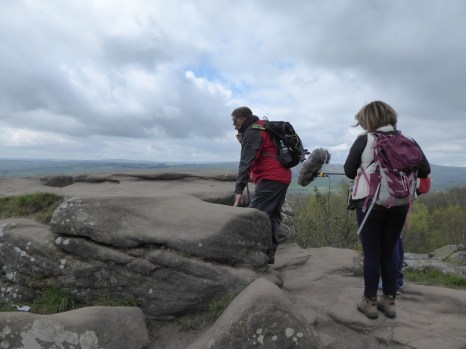
Lucy pursues John for a soundbite at Brimham Rocks.
Clare loves people. At Brimham Rocks, where we insisted she take a detour, she chatted to children with their families and took part in their photos. Later, she hung over a drystone walls and talked to a farmer. She patted dogs and enjoyed a few moments with their owners.
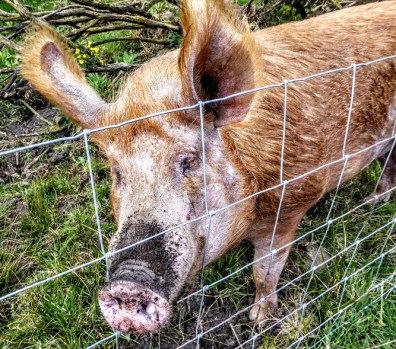
Clare even interviewed this pig. Well, she grunted for her, anyway.
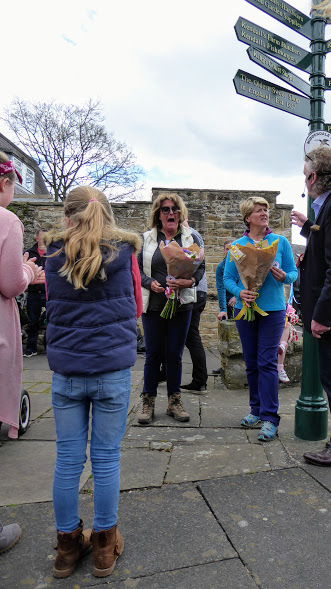
Just as well she’s good at this sort of thing. When we arrived at Pateley Bridge, she became a sort of stand-in for the Queen. She was whisked from shop to shop, always leaving with a little local speciality -a pork pie, some home-made fudge. With Lucy, she was given a newly-minted badge for completing the entire Nidderdale Way. They got flowers, a book by a local historian, hugs and handshakes galore, and repaid all this attention with genuine interest and friendship. Pateley Bridge by the way is in the thick of preparing for the Tour de Yorkshire 2017, which goes through the town – and past our front door – on Saturday 29th April.
A shop prepares for the Tour de Yorkshire.
Another photo opportunity in Pateley Bridge.
Flowers, badges, and a round of applause for Lucy and Clare.
Please listen to this series when it comes out: it’s available as a podcast even if you don’t live in the UK. The first programme will be on BBC Radio 4 on 18th May, and the programme featuring our team will be transmitted on Thursday 22nd June. You’ll make immediate plans for a holiday in Nidderdale after you’ve listened.
The shadow of a drystone wall on a stretch of road near Blazefield.
I’m having a busy week. I’ve got far too much to do to take a day out walking with friends.
Except that on Tuesday when I woke up, the sun was already bright and the sky was clear. We haven’t had days like that in a while. And John, who always knows a good walk, had planned to take us near Thruscros Reservoir. The jobs could wait.
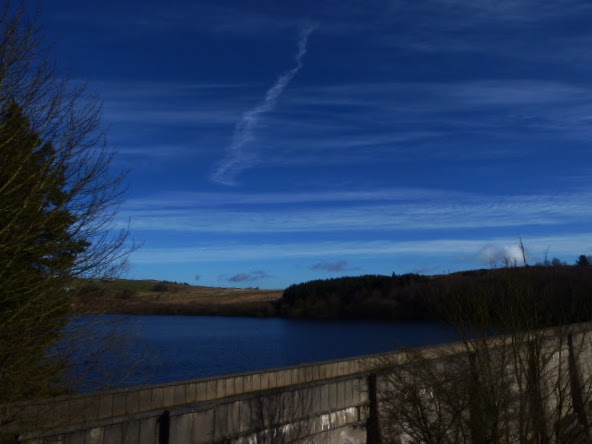
Here’s the reservoir, offering a home to wildlife, and panoramic views to us, while supplying clean water to the population of Leeds.
We walked through woodland and through Daleside pasture with moorland views beyond.
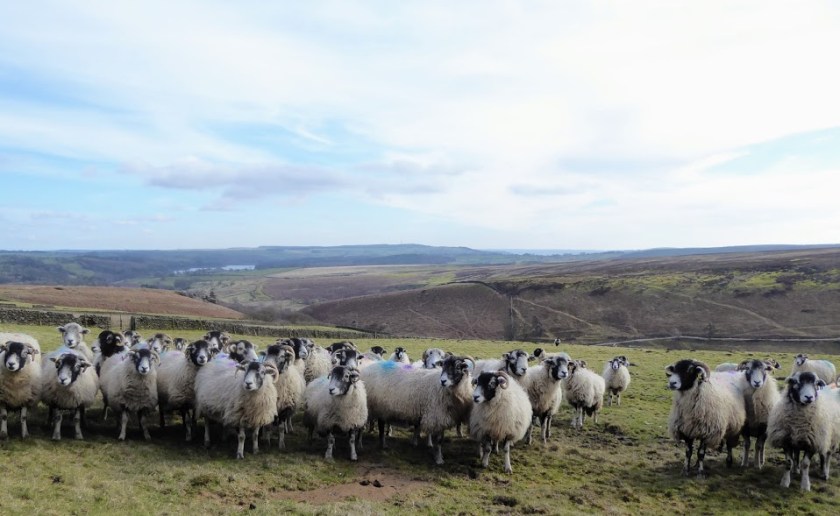
And at lunchtime, we found a sunny drystone wall to rest our backs against as we picnicked. The local sheep were interested. Picnics mean tasty snacks, perhaps. They organised a mass silent and peaceful demonstration for food. We resolutely ignored them, and finally they mooched off to nibble at their pastureland once more.
The morning had been all uphill, which meant the afternoon was all downhill (well done, John!). Soon we were at the reservoir again. A fine day’s walking was had by all. And my jobs remain uncompleted.
Since writing my last post, I’ve discovered that my friend Janet Willoner has written a wonderful piece describing a murmuration of starlings, in Melissa Harrison’s equally wonderful anthology ‘Winter’. Here’s the link.
The road we could have taken to Scar House Reservoir
I love Colsterdale. It may be my favourite Yorkshire dale. It’s an isolated area, tucked away, north-west of Masham. Not a single main road goes through it. There are no traffic jams here, just local cars (4x4s are useful), vans and tractors.
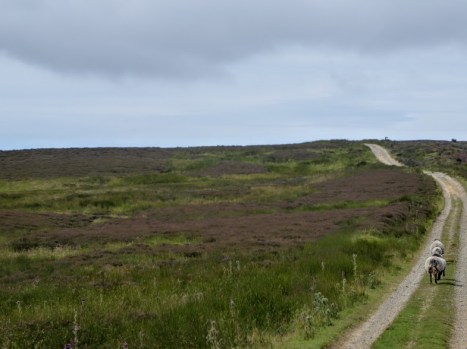
Walking these tracks, be prepared to share your route with a few sheep.
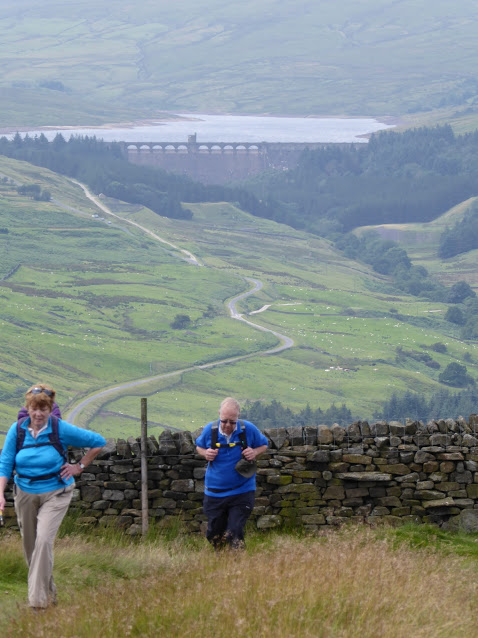
There are routes though. Ancient routes forged as long ago as the 14th century, when there was a long-gone coal mine here, or more recently by stockmen driving their flocks over the harsh moorland landscape. These days, it’s hikers and ramblers who are more likely to use these tracks. Perhaps they’re completing the Six Dales Trail, or finding out the history of the Leeds Pals. Perhaps, like us, they’re enjoying a walk from Leighton Reservoir, and enjoying long distance views of Scar House Reservoir.
I felt stuck. In my head, I rummaged through my photo collection. I discarded foggy moody atmospheric mornings like this one. I rejected bright summer meadows and crisp snowy winter walks as not quite projecting the ambience I want to think about on this dismal January day.
Here’s what I’ve chosen. It’s an image that’s more than six years old now, but it sums up much of what we loved best about our years in France.
Our walking group had played its part in organising a walk for ramblers from all over the region. We’d arranged signage, helped sponsors set up their stall, marshalled the event, walked ourselves, and handed out certificates at the end before the visiting walkers departed. Now we could relax.
Here we are in the mediaeval town square in Mirepoix, unwinding over a good and copious meal with plenty of wine. The sun is shining. The afternoon stretches lazily ahead of us. We’re among friends. This is an ambiance chaleureuse at its finest.
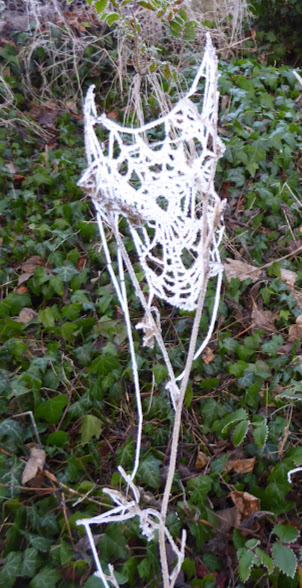
Google spiders’ webs and you’ll find any number of scientific articles celebrating the resilience of the silken strands that spiders produce Not only is the silk stronger than steel, it’s springy and elastic. The design of the web ensures that even when a strand is broken, the overall formation remains sound.
I found a spider’s web on a recent cold and frosty morning. By rights such a delicate structure should have collapsed under the weight of its coating of thick icy rime. It hadn’t. It’s the perfect candidate for this week’s WordPress photo challenge: resilient.
And here are a few more shots from a cold and frosty morning in North Yorkshire:
















You must be logged in to post a comment.