Off to Harrogate today, via Knaresborough, which has just been voted Best Dressed Town ahead of the Tour de France. It’s done a fine job. The whole town is festooned with bunting: not the signature knitted-yellow-jersey bunting favoured all over the rest of the district, but hundreds upon hundreds of white T-shirts, decorated by the schoolchildren of the town. It all looks very festive, and combined with a yellow bike trail to send you bike-spotting down every street and in every shop window, it’s made for a fine community effort. I still have a soft spot for red-spotted Hawes however, which we visited last week. But Knaresborough’s Mayor has tricked out his house in red spots too.
Knaresborough’s spotted house on a busy corner.
Harrogate though. What a shock. We were diverted away from West Park Stray, and once we’d parked up, we discovered why. This usually car-filled thoroughfare was a pedestrian-only zone. No, that’s not true. There were no cars, but instead, huge articulated lorries, buses, media vehicles from all over Europe, Tour de France vehicles so large that no ordinary parking place could accommodate them. There was even an immense lorry whose purpose was to offer, at just the right moment, 3 rows of tiered seats for about 3 dozen spectators. All this circus came from the Netherlands, Belgium, Italy, Germany…. but above all, from France.
All around us, busy teams of workmen and women, technicians, electricians, craftspeople, media types rushed busily around, talking in the main in French. We spotted registration plates from Val-de-Marne; le Nord; Pas-de-Calais; even the Haute Garonne, the next door département to the Ariège. And suddenly, I was assailed by homesickness. It was just like being back in France. There was even a marquee filled with one particular team of workers sitting down together and sharing a midday meal. That really whisked us back. We wandered about, listening in, and engineering conversations with any French type taking a breather. England’s nice, we’re given to understand, but our motorways are a nightmare. We know.
But this immense team is only one of several. There are others in Leeds, in York, in Sheffield, Cambridge and London, the other five towns where the three English stages begin or end. I’d never previously understood quite what an industry the Tour de France really is.
Local teams from Harrogate itself had already uprooted many of the town’s pride and joy, its colourful flower-beds, in favour of providing viewing platforms for spectators who want to see the Race finish there on Day One. I expect it was the right decision. No self-respecting flowers could survive the expected onslaught, and the beds that remain look particularly magnificent.
Decking and emptied flower beds await the crowds.
Another delivery of crowd barriers,
Then they have to be distributed….
Temporary seating goes up.
More seating solutions.
Tour de France vehicle.
And another. This is just one vehicle.
And another…
Some of our new French friends!
Everything stops for lunch. C’est la France.
A more homely sight at the church on the opposite side of the road.
And as we leave, mobile traffic signs.
When we’d looked around for a while, we nipped into a supermarket for some odds and ends we’d forgotten. This is what the fresh produce department looked like……….
One more shopping day before le Tour…..
Normal life has been suspended, for one weekend only.
Back in the shopping quarter, Duttons for Buttons celebrates le Tour … entirely in buttons.
Even isolated houses in the country get in on the act.
Cheerful bunting in Addingham
Little knitted jersey bunting in Ripley
Red white and blue bunting; yellow, green, white and spotted bunting; multi-coloured bunting: that’s what you’ll see as you pass through the Tour de France communities of West Yorkshire, and Craven and Richmondshire in North Yorkshire. Here in Harrogate District, and in Hambleton too, it’s those jolly little knitted jumpers in all the Tour-jersey colours that are festooned round town.
Follow the signs to follow the route.
We know, because yesterday we got up betimes, had a healthy breakfast, packed maps and drinking water and set forth to Ride the Route for Day One of the Tour de France. On our bikes? Not likely, though many people are doing exactly that. We took the car, because the whole circuit is 195 km. long. The Tour riders will get that done in not much more than 5 hours. We were out of the house for 9 hours.
Leeds celebrates the Tour de France with a series of cheerful banners.
We didn’t quite do the lot. From Leeds, the riders will take it steadily till they get to Harewood House, between Leeds and Harrogate, and that’s where the race will begin in earnest. So that’s where we began too, though unlike the competitors, we couldn’t ride through Harewood’s grounds. So join us as we begin our own Tour, not far from Pool-in-Wharfedale.
A cheerful bike at Pool-in-Wharfedale
A butcher’s window in Otley.
On the route in Wharfedale.
Skipton Castle sports a yellow jersey.
The route near Skipton, warning the road will be closed on the day.
The road near Rylstone.
An easy stretch of the route.
Climbing towards Kettlewell ….
….. and descending again.
The scenery here is the gently rolling countryside of lush fields and woodlands that characterise Lower Wharfedale: it’ll break the riders in gently. Through Otley and Ilkley, our winding road took us through quiet pretty villages on into Skipton. Now we approach the Yorkshire of soaring fells and dramatic limestone scenery whose fields are bounded by dry stone walls. The area round Kettlewell used to be important for lead mining. These days sheep and tourists – walkers and cyclists – provide the village’s income. Unlike the cyclists, we paused for a leisurely lunch at the King’s Head. Fabulous food, with friendly service. Very highly recommended, but perhaps not if you have to ride ever upwards over the fells after you’ve eaten.
Kettlewell. Look for that Tour jersey up there on the hillside.
As you travel northwards, then westwards from Kettlewell to Hawes, via Buckden, Thoralby, Aysgarth and Bainbridge, you’ll be climbing through increasingly dour and empty hillsides. I love their severe beauty, and relish too the occasional descent into the valleys where once again the road passes through glades of trees leading to picture-postcard villages.
The road near Buckden.
Only sheep for several miles.
The climb continues.
A novel way of advertising cheese: on the side of a hay bale.
Bainbridge welcomes the Tour.
A house outside Bainbridge welcomes the Tour.
Then Hawes. Hawes has taken its duties as Gatekeeper to Buttertubs pass, where the King of the Mountains will gain his crown, very seriously. The King of the Mountains gains a red-spotted jersey for his efforts, and Hawes has become a red-spotted town for the duration. Bunting, shop fronts and decorations, even whole houses have been painted white with large red spots. The effect is very jolly and festive, and Hawes, it’s clear, plans to have a great Tour.
A friendly French welcome at Hawes.
The Mulberry Bush welcomes the Tour….
… selling a right Yorkshire T shirt….
… and King of the Mountain mugs.
A house in Hawes.
Bunting in Hawes market.
But then it’s Buttertubs. There are few more dramatic roads in England. It climbs sharply, but there are sudden descents, unlooked-for tight corners and mile after mile of uninterrupted moorland view. If I were a Tour Groupie, this is where I’d want to be to watch on 5th July. At its highest point, the road can be seen as it swings right, left, up and down for many a mile. This is where those riders will be put to the test. But it’s not over at the bottom. Because here, the road chases round unexpected corners, bounces over small ancient bridges, darts in and out of woodland, narrows rapidly as it skirts past hamlets…. they won’t be able to relax for a second.
The road towards Buttertubs.
Welcome to the King of the Mountains!
Another fine welcome on the road from Hawes to Buttertubs.
Buttertubs.
The road at the top.
A cyclist rides the route.
By the time the riders reach Reeth, they’d feel entitled to a bit of down-time. But no. There’s another long moorland slog before, at Leyburn, civilisation kicks in once more. The villages become more frequent, the countryside softer and sweeter. We trundled in our car back home to North Stainley, having done the home-to-Harrogate stretch first thing in the morning on the way to Harewood.
A challenging descent in the village of Reeth …..
…. not over yet. Another moorland climb before Leyburn.
And at Leyburn, even the Parish Church joins in the fun.
We were left with an impression of how the Tour has fired the imagination of many communities through which it will pass. Not all of course, but many have seized the opportunity to build on the opportunity the Tour provides. They’ve involved everyone from the youngest to the oldest in generating understanding of aspects of French life, or of sport and cycling, of promoting the Arts in the widest sense, and in bringing the whole community together quite simply to have fun together, both in the period leading up to the Tour and on the day itself. Our own village is a case in point: more of that later. The once-in-a-lifetime opportunity the Tour presents means that it’s more eagerly anticipated here even than in France, where for years it’s been an important part of the summer calendar. Those people who’ve shuddered with dislike and arranged to go away for the duration may come to think they’ve missed out on something quite special, and uniquely enjoyable.
A cheerful corner in the next village along, West Tanfield.
Malham: a place that sums up Yorkshire scenery and countryside, and a geology lesson in a landscape.
We – the Ripon Ramblers – had come to walk from Malham to the cove which shares its name, then on to the Tarn and then make a circuit of the way back to the village. It’s a longish car trip for us to get there, but we thought it was worth it to enjoy the wild and rocky scenery with views far across dry-stone wall enclosed fields to the Dales beyond.
Once cultivated fields are now given over to grass and sheep.
Malham Cove is a large curved limestone cliff at the head of a valley across which water used to tumble as a glacier melted above it. The stream that once cascaded over the cliff now disappears, like so many others in this land of porous limestone, into Water Sinks about a mile away.
The cove looks rather like an imposing and curtained castle wall or amphitheatre from which vegetation clings precariously. It’s immense, and however often you visit, it never loses its power to impress. We approached it walking along Malham Beck, a pretty stream which jostles and bubbles out of the cove, before we slogged up the 400 irregular rough-hewn stone steps alongside the cove which are part of the Pennine Way. It’s a tough climb, but rewarded every step of the way by seeing the Cove from ever-different viewpoints.
Malham Cove
Another view
The limestone pavement at the top
Wild thyme – and a few buttercups – thrive here.
Gillian – our leader for the day – surveys the view.
The path we tackled after our break
At the top, you’ll want to rest. We had our coffee-stop on the limestone pavement which carpets the area. That glacier all those years ago scraped and polished the limestone, and over the centuries, rain has niggled away at the soluble rock to divide the pavement into large irregular slabs called ‘clints’ and ‘grykes’. It sounds grey and sombre. But in fact there’s a rich diversity of tiny lime-loving plants such as wild thyme, limestone bedstraw, common rock-rose and bloody crane’s-bill – don’t you love those traditional names for these colourful flowers? . Above us, skylarks trilled, and the landscape before us rewarded our efforts.
A view from the path
After our pause, we continued along narrow rough and rocky pathways before hitting more open ground on our path to Malham Tarn. This is the highest lake in England, a shallow lake which, though surrounded by limestone, is itself on a bed of slate. It’s rather boggy round here. Pick your picnic spot, which you’ll be sharing with quite a lot of cows, with care or you’ll stand up after you’ve eaten, as I did, feeling distinctly damp.
Malham Tarn
Much more open landscape after that. We continued to climb… and descend, climb… and descend, always with those open views, and sheep or sturdy Belted Galloway cattle for company. Suddenly, the climbing was over. Before us was a landscape of ancient stone barns, of sheep enclosed in equally ancient narrow and irregular fields bounded by dry stone walls, and an unremittingly steep grassy path leading down to the valley and Malham, with its welcome tea shops. There’s so much more to explore here. But that will be for another day
The climb continues
Looking back towards Malham Tarn.
More limestone pavement.
Belted Galloway calves survey the scene.
It’s all downhill from here.
Still rocky here, but softer Daleside landscape over there.
Ancient barns, ancient walls.
A Swaledale sheep as gate-keeper.
A final glance at the hills and ancient field systems.
A stained glass window in Harrogate by Caryl Hallett celebrates the TdF
After seven years of living in France, we reckoned we were old hands at le Tour de France. It had gone past our house twice – once west-east, once east-west, and jolly exciting too, for roughly 30 seconds, which is all it takes for the competitors to go whizzing past… though there’s the no-small-matter of the caravan, and all its extraordinary vehicles full of excitable young women (only gorgeous young females and the occasional hunk need apply) flinging forth key rings, baseball caps, sweets and so on to the crowds scrabbling around for these souvenirs of the day.
And this year, for the third time in our lives, the Tour is going past our house again: because in 2014, for one year only, the Tour de France begins in Yorkshire, aka God’s Own Country. It’s quite a coup for Yorkshire tourism, as it’s an opportunity to showcase this wonderfully scenic area as a tourist destination to a world glued to its TV sets for the duration of the Tour.
Even letting agents are getting Tour de France fever.
Yorkshire has been going Tour mad for weeks – no, months. One of the earliest signs was last November, when the Harrogate Advertiser asked readers to knit little TdF jerseys to be strung as bunting in local streets. 3,000 jerseys should cover it, they reckoned. We now known that there are well over 10, 000 of them – yellow, green, white-with-red-spots, in Harrogate District alone, and who knows how many in the county as a whole, or down south when the riders complete the Cambridge to London stage? You can see them strung in shop windows, along house railings, swagged along churches, between public buildings or threaded through the branches of trees.
Outside a church in Killinghall
House railings in Killinghall.
… and a Ripon shop.
Then there are the yellow bikes. There are town trails to discover the dozens of yellow-painted bikes deposited round towns, in gardens, along country roads, in shop windows…. I’m sure many will be around months after the event, but many more will have been cleaned up and shipped off to various projects in Africa.
Yellow bikes: suspended from a pub…
…along railings….
… or simply along the roadside.
Our own community, North Stainley, has had Rural Arts working with the children at the Primary School to produce their own interpretations of impressionist paintings, and these are now on display round the village. The pond has got its own Monet style bridge with LED waterlilies for the duration. There are two new sculptures inspired by the Tour, and there’s a whole programme of social events. Every village and town along the route is involved in providing fun for residents and visitors alike on the weekend of the Tour. The description of choice seems to be ‘Le Grand Départy’. Please groan if you want to….
A splendid feat of engineering at North Stainley: Frank Bailey’s ‘Rotation Franco’ The wheels revolve in different directions.
North Stainley’s symbol, a stag, this time made of bicycle parts.
North Stainley’s take on Monet’s waterlilies.
Tour de France banner at the Primary School, North Stainley
The Folies-Bergere meets Betty’s. One of North Stainley’s impressionist pictures.
..and another ‘Impressionist’ picture
Roads along the route have been repaired and revamped, presumably to the detriment of the road maintenance programme of all highways not on the TdF course. Traffic islands in towns have been replaced by moveable versions, so they can be shifted from the road for The Big Day. Anyone with open land and the means to provide sanitary and other arrangements, from farmers to schools with big playgrounds, is offering camping or parking facilities for the duration. The French may well look askance at this degree of organisation, because over there it’s fine to turn up and park your camper van on any spare bit of mountainside that you can find. Here however thousands and thousands of would-be spectators all have to cram themselves along some 400 km. of route, as opposed to the 3,500 km available in France. Our village alone has been told to expect up to 7,000 spectators, the next village along, 10,000. The logistics are a nightmare, and forward planning essential.
These signs suddenly appeared at the end of last week.
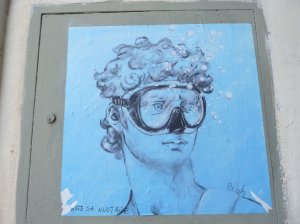
We hadn’t been in Florence long before we found this image, posted on the side of a building, on a gas box door.
Then we found another.
Then two more.
This slideshow requires JavaScript.
Each one is an iconic symbol of Italian art – Florentine art in particular – and each one is equipped with a diving mask.
We realised something was up when we saw that every one was signed ‘Blub’, with a slogan ‘L’arte sa nuotare’ – Art knows how to swim.
We needed to get back to England before we could find out more, courtesy of Google of course.
‘Blub’ is, apparently, more than one person. S/he is not available for interview, but will make the occasional statement. Blub says that they’ll never deface buildings, only paste their images on gas box doors. They aim to help beautify and improve the streetscape of Florence.
And why is each of the subjects shown under water? Well, because for Blub, water is a symbol of obstacles in life, of the challenges we all face. But art swims on and survives regardless.
‘L’Arte sa nuotare’ is a movement that’s spreading, apparently. Last spotted in Barcelona. Time for us to plan another visit to see Emily, then?
Meanwhile, here are the answers to a quiz you might have set yourself .
What are the originals of the pieces illustrated above?
First view of Piazza del Duomo on the evening we arrived
We’ve just come back from a few days in Florence. How could I send you picture-postcard views that are in any way better than ones you’ve seen a thousand times already in art books, travel guides – and postcards ? Well, I can’t, obviously, so I shan’t even try. Let me just give you a flavour of the city as it seemed to us for these few days in early June.
The Ponte Vecchio is crammed with tourists from morning till night. But even here, you can find a bit of peace if you try.
We’d gone because I’d had an e-mail offer of cheap fares from a Certain-Irish-Airline-We-All-Love-To-Hate. I discovered we could get from Leeds-Bradford to Pisa and back, the two of us, for £100. We booked. We found a last-minute deal on a hotel in nearby Florence. We booked. We found we’d chosen well. Despite being near the station, normally never a great part of town, this place was clean, well-appointed, cheerfully friendly, and within walking distance of almost everything – perfect in fact. The weather was perfect too. Sunny, cloud-free, and gradually getting hotter.
A little Lambretta van: Italy’s answer to France’s 2CV
The ubiquitous push-bikes: all parked up on Piazza della Signoria
The ubiquitous motor bikes: all parked up for the night.
Malcolm had never been to Florence, but once upon a time, I knew it well. Once upon a time – more than 45 years ago in fact – I’d had two extended periods in the city working as an au pair between school and university. I’d had plenty of time to explore the city, and to learn the language. I’ve had plenty of time in the intervening years to forget both. In fact a few years ago, when we went to another part of Italy, I found that whenever I opened my mouth to speak Italian, French came tumbling out….
I was pleased, so pleased, that this time, my Italian returned: haltingly at first, but getting better each time I had another go. A couple of times though, it would have been to my advantage to converse in French – there were French guests at the hotel. But guess what? No French words beyond the most basic could be prised from my lips. I seem to be strictly a one-language-at-a-time sort of person.
Drying the washing.
Watching the world go by.
A little window over a little courtyard.
We soon learned that our visit wasn’t going to work as expected. We’d always planned a mix of visiting some of the tourist hotspots with time at some of the less well-visited sites. After a chaotic afternoon at the Uffizi, pre-booked at what we had hoped was a quieter time, the hotspots got pretty much junked.
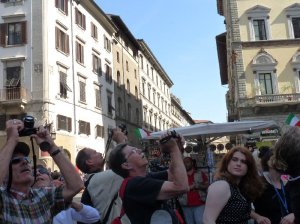
Here’s why the hot-spots got junked: so I could use my camera in peace……
The sheer numbers of visitors and the noise got us down, and my best memories of the Uffizi this time are of those moments spent on the relatively quiet roof terrace, looking down on the Florence skyline.
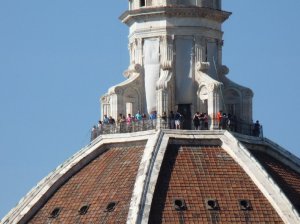
From one busy place to another. That’s a view of the cupola of the Duomo, seen from the Uffizi.
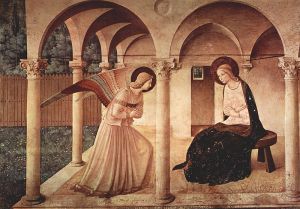
I wanted to share the Museum of San Marco with Malcolm. When I was in Florence in the 1960s, this was one of my favourite places. Back in the mid 1430s, the monk whom we know as Fra Angelico took on the task of painting the cell of each monk with a devotional image: often the Annunciation or Crucifixion. The monastery, even though now a museum, is a tranquil place where it’s still possible to be quiet and reflective, and to be moved and inspired by Fra Angelico’s interpretations of the familiar Bible stories .
One of Fra Angelico’s interpretations of the Annunciation, at the Museo di San Marco. Wikimedia Commons.
At first, we had a similar experience at the church of Santa Maria Novella. But as the morning more on, the crowds increased, and the levels of noise: we were shocked by the difference we noticed between our first moments in the almost-empty church, and the later ones when the building was filled with people busily moving around and talking.
At peace in Santa Maria Novella early in the day.
Christ in limbo, painted by Bonaiuto between 1365 and 1367
A bucolic scene painted by Uccello in the so-called Green Cloister.
But what’s the point of going to Italy if you don’t spend time enjoying food? There’s the magnificent Mercato Centrale, where every morning you can join the locals as they buy fruit, vegetables, fish, meat and cured meats and cheeses. It’s crowded here too, and vibrantly noisy, but that’s OK. Get your shopping bag out and join in!
Ham, salami and other cured meats
Dried funghi, whole stallsful of them.
Tripe, much loved by the Florentines. Try it ‘alla Fiorentina’. You might just enjoy it.
Tomatoes, more tomatoes, and so much else….
… and mushrooms…
… and courgettes, often sold with their flowers, because these too are delicious.
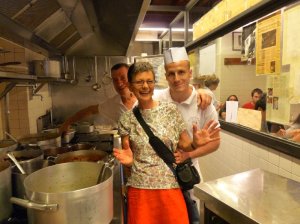
And then go over the road to Trattoria Mario for lunch. It used to feed students and local workers, and now tourists are added into the mix: Not the sort of tourists who expect a watered down ‘typical Italian’ menu, and translated into English or Russian , but ones who are happy to join a table where locals are already tucking into the daily specials. I was swept into the kitchen to watch the team cooking in an impossibly small space: here’s a photo. Such fun, and such good food.
The kitchen at Mario’s
Malcolm and another prospective customer inspect the menu.
Another busy lunchtime at Mario’s.
And here’s the kitchen stove.
The next day we headed over to the other side of the river, the Oltrarno, to Porta San Frediano. This is an area of craftspeople, working people, and strictly no tourists. And that’s where we found Trattoria Sabatino, and immediately felt at home. It’s the sort of place we used to like so much in France: simple food, well cooked, and served to local workers in their lunch break. As in France, the early customers were all men, but later, women, and even children appeared too.
The city walls near Porta San Frediano.
A busy tripe stall near Porta San Frediano.
The easy way to haul cement to the top of a building.
A back street near the church of San Frediano.
Once a church, now a neighbourhood restaurant.
You might think this is simply a 14th century palazzo. In fact it’s teh consulate of Burkina Faso.
We strolled past the Palazzo Pitti, and found these musicians playing to welcome EU delegates to a dinner there.
A quiet courtyard in a busy street.
Monument to the Italian Resistance in WWII, in Piazza Santo Spirito.
We spent our evenings on the other side of the river too, opposite Santa Croce. That’s where we found two bars, the same but different. Buy a drink in one of these places and it’ll cost you. But all of a sudden, it seems a good idea after all. Because trays and trays of food and nibbles appear, and they’re for you, the customers, to eat – and eat – and eat, if you wish, without handing over any more money.
The Ponte Vecchio at dusk.
Sunset over the Ponte Vecchio. I don’t know who this fellow is.
Young people at dusk on the Arno.
The Palazzo Vecchio at night.
The Uffizi and Ponte Vecchio by night.
The shops on the Ponte Vecchio all shuttered for the night.
A narrow street leading to the Palazzo Pitti.
A shrine on a residential building.
Another view of the Palazzo Vecchio.
And of course we spent time exploring those narrow medieval streets, where tall buildings shelter you from the glare of the sun. We people-watched in sunny piazzas over shots of strong espresso. We hung over the parapets of the many bridges over the Arno to enjoy the views and the sunsets. And the sun became hotter with each passing hour. We relished nearly every moment of our stay. But next time, we might go off season. February might be good.
In the end though, I have to give you one picture postcard. Here is the Duomo, seen from the path towards Piazzale Michelangelo.
We woke up to rain. So the question was – to walk today, or not to walk today? Malcolm said ‘no’. I, albeit reluctantly, said ‘yes’, and went off to join the Ripon Ramblers at our Ripon rendez-vous. It was still raining on and off, and as we struggled into cagoules and overtrousers in the car park at Grassington, the rain was definitely more on than off.
A moody sky as our walk begins.
Limestone scenery of the Dales.
Mountain pansies
Dry stone walls, a lonely tree.
All that remains of the rain.
Glaciation had its effect on the landscape, scouring the rock, and leaving deposits too.
Curlews on the skyline
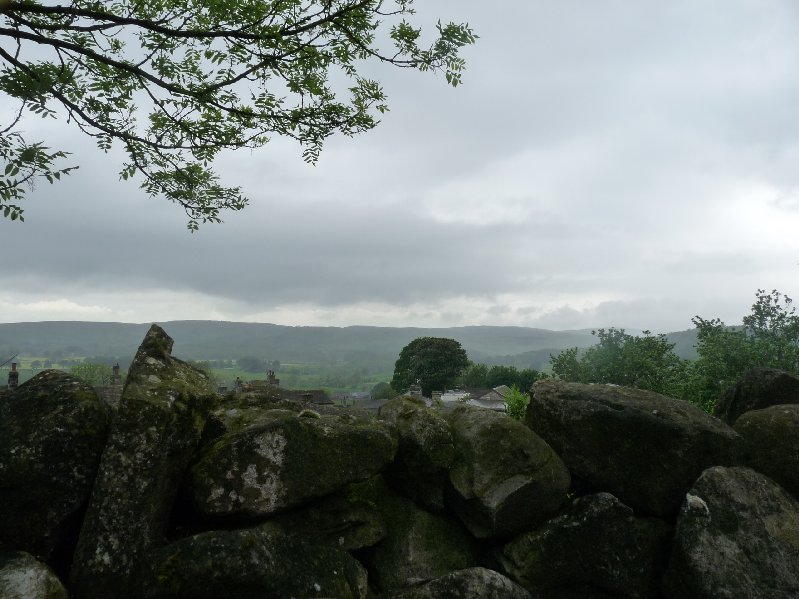
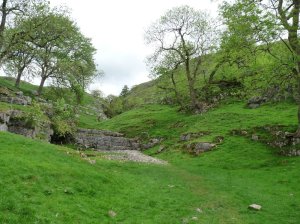
You can see from the pictures that it was grey and forbidding. But these conditions lasted ten whole minutes. Then a breeze picked up and blew away the black clouds. Our Dalesway views became clearer and brighter. We spotted curlews on the skyline. We scrambled down a narrow ravine on our way to Conistone that reminded me of walking in the Gorges de la Frau back in the Ariège. And it was lunch-break time in picturesque Conistone itself.
The Gorges de la Frau look-alike.
Not easy.
But soon over
That’s all it was: a dried stream bed.
Conistone.
Another view of the village…..
…and the road leading out.
Our path continued
A barn unconverted for housing.
A meadow.
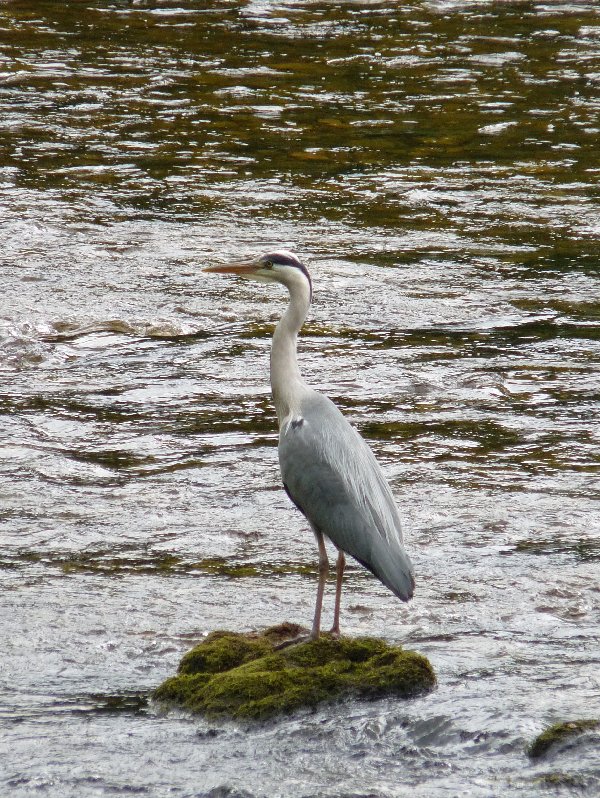
We spent the afternoon working our way back towards Grassington. There was a country lane, paths through fields bright with meadow flowers, and a long wooded section high above the River Wharfe. The prize here was the sight of a heron patiently fishing. He didn’t fly away as we came into view, but remained still, quiet, awaiting his fish dinner. Finally however, we passed too close, and he flew reluctantly away.
The patient heron
And then it was nearly time for us to end our walk, and claim our reward of a pleasant few minutes sitting out in the sunshine of a café courtyard, with toasted teacakes and a cuppa. We felt smugly satisfied that we’d braved the rain. What rain?
Grassington again. Journey’s end. And look. Blue sky!
One of the things I noticed about Ripon as soon as we started to get to know it is how many fine examples there are of what you might call civic signage. Then I came across a blog, by Simon Hawkesworth, a Lancastrian whose interest is in letterforms. In fact his blog is called City of Letters. Here’s what he discovered when he visited Ripon.
He wrote this post on his blog. Now I don’t have to: enjoy
I’m not fully adapted to country life yet. Forward planning – or lack of it – is my failing. I haven’t yet learned to anticipate whether we’ll need more milk, potatoes or whatever before the next planned trip to The Great Metropolis (aka Ripon), and quite often find myself grubbing around at the back of the cupboard for acceptable substitutes.
Saturday, though, is the day we treat ourselves and buy the paper. There’s enough reading material there to get us through several days, and the sports section, discarded immediately, is perfect for any number of little jobs such as lining the rubbish bin. And yet today we had no excuse to visit Ripon, so would we have to go without our newspaper?
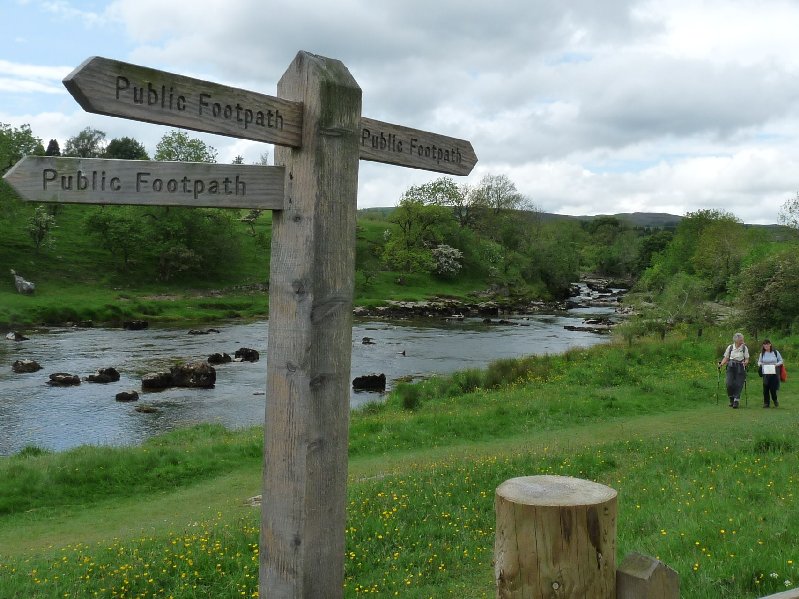
Well, no, there is another solution, but we have to reckon on leaving the house for well over an hour to complete the three and a half mile walk. The round trip to the paper shop involves leaving home along the path through the woods, walking along the riverside path to Sleningford Mill caravan site, dallying by the weir for a few minutes, battling along the narrow path now surrounded by chest-high spring flowers, and finally reaching the bridge at West Tanfield.
The shop in the village is where you’ll find most things. There’s food, drink, first aid and stationery – and a Post Office. There’s a community board where today I found news of someone selling chilli plants – I’ll be buying some of those . And there are newspapers. I bought our weekly fix. Then I set off home by a different route. Out of the village on the road, up the hill, turn right at a farm gate. The path here’s been slightly diverted, because the farmer’s made wide beetle banks to boost the number of farmer-friendly insects and spiders on his land. Through several fields of sheep, who come to inspect me, and along the drive of Sleningford Park, a country house. A final yomp along paths running alongside fields of wheat and barley, and I’m home once more.
It wasn’t quick. But I came home refreshed by the birdsong I’d heard; the sight of birds, rabbits, squirrels and sheep I’d passed; the flowers I’d spotted on the paths, different already from the ones I’d spotted only a few days ago; and all those country smells, from wild garlic to sheep dung to spring flowers. I’d had a better morning, I reckoned, than if I’d either gone without, or jumped in the car to grab a newspaper at the petrol station four miles away.
A man walks in to the bakery with a tray of eggs, newly laid by his hens. He’s ‘paid’ in bread. A woman comes with a bag of rosemary from her garden: she too receives bread, still warm from the oven. Over there, at the back, another woman is steadily getting an enormous batch of scones ready for the oven, while in another corner, someone else is weighing out the ingredients to make biscuits.
Margaret Number 3 makes scones
We’re in the market town of Bedale (population four and a half thousand). More specifically, we’re at Bedale Community Bakery (or ‘Bread Actually’), tucked away behind the railway bridge next to the Big Cow Little Sheep educational farm. This is no ordinary baker’s shop. For a start, though there’s a busy team at work throughout the day, there are few paid staff. This is a not-for-profit community venture.
The generously-seeded multi-seed bread has just gone into the oven.
The sourdough moulds have finished their work for the day.
And here are rolls, ready to buy.
The bakers are paid – they’re the ‘bread and butter’ of the organisation after all. Then there’s hands-on Chairman Carol, and Sarah who seems to be involved in everything. But all the biscuits, cakes, scones – the non-bread items – are made by a willing team of volunteers managed by retired baker Alan. From today, Malcolm and I are part of that team.
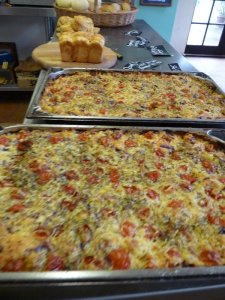
Focaccia in waiting.
It was a wonderful experience. From the first moment, we were expected to roll our sleeves up and turn to. But the friendly welcome, the team spirit, the willingness to share and help each other, the generosity of spirit shown by everyone there made for an unforgettable first morning. Malcolm washed up and sliced cakes into even portions, and I helped Margaret ( ‘Not another Margaret, there’s three of you now’) make an entire batch of about 210 Anzac biscuits, bake them, cool them, and package them for sale in cellophane sacks of 6, closed with yellow ribbon. There was focaccia to part-prepare for the just-about-to-start Bedale BAMfest. There was more washing up, and sweeping and cleaning. And time for a coffee-stop of course.
Two Margarets make Anzac biscuits.
Anzac biscuits partly packaged…..
…. and ready for sale.
They’re seeking to build up the customer base. There’s a country house, a high-end hotel or so, and various other outlets who like the quality and range that the bakery offers. There are locals of course, who know a good thing when they find it, because there are always samples of the bread to taste, people around to discuss ingredients and recipes, and a constantly changing repertoire. Today there was multi-seeded bread; cheese, chilli and – oh, crumbs, I’ve forgotten what else – sourdough; rosemary and black pepper; cheese, chive and onion bread; harvester loaves….. and so on and so on. This is Slow Food at its best, made with locally sourced flour from Crakehall Watermill with not a single flour improver, and proved gently over several hours to develop the flavour. Recipes are carefully tested and recorded, and every opportunity is taken to use seasonal flavours and ingredients offered from the community: a glut of fruits or herbs, as well as those eggs and that rosemary.
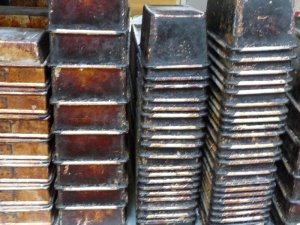
Off-duty loaf tins.
I hope there’s plenty more to tell about this place. We think it’s worth the 16 mile round trip to volunteer here (and be ‘paid’ in bread), but others come from much further afield: Redcar, the home of one of the team, is nearly 40 miles away, and Saltburn, where another lives, 50 miles. We all appreciate good bread, and recognise a worthwhile project which offers the chance to learn new skills in a supportive and ‘can-do’ environment.


























 From Pyrenees to Pennines
You must be logged in to post a comment.