It starts at the airport. No standing for ages in an untidy queue waiting to struggle your way onto your place in the ‘plane. You, your partner and baby are ushered forward, taken onto the aircraft like minor dignitaries and shown to your seats where the emergency procedures are explained.
At your destination, everyone’s prepared to make friends with you, help you in every way they can.
Out at a restaurant, your baby will be the star of the show. He may be passed round for a series of cuddles while you get on with your meal .
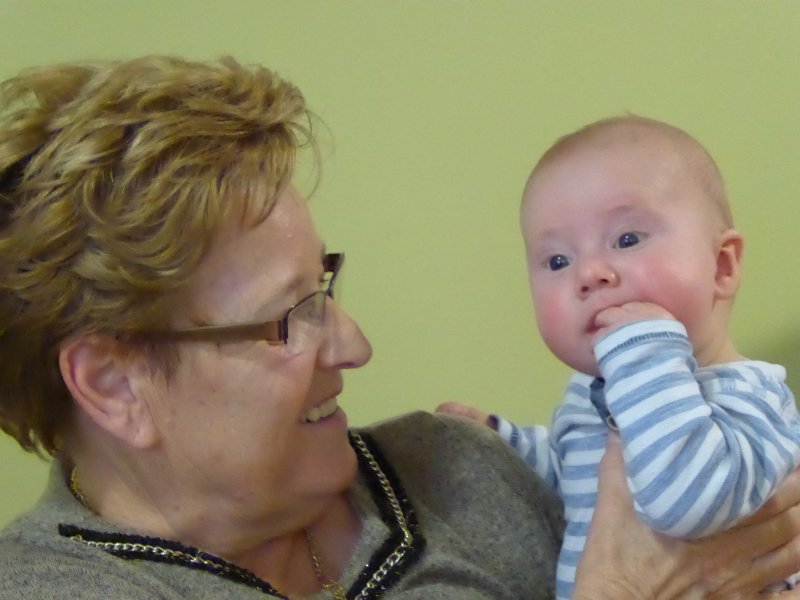
William in a restaurant with his Spanish would-be Granny, who made every attempt to add him to her existing collection of 8 grandchildren.
If you have the sense to travel with two sets of the baby’s grandparents, you may only get a chance to spend quality time with your infant after bedtime and before breakfast. This may mean you see him mainly round about 3.00 a.m. , but you can’t have everything
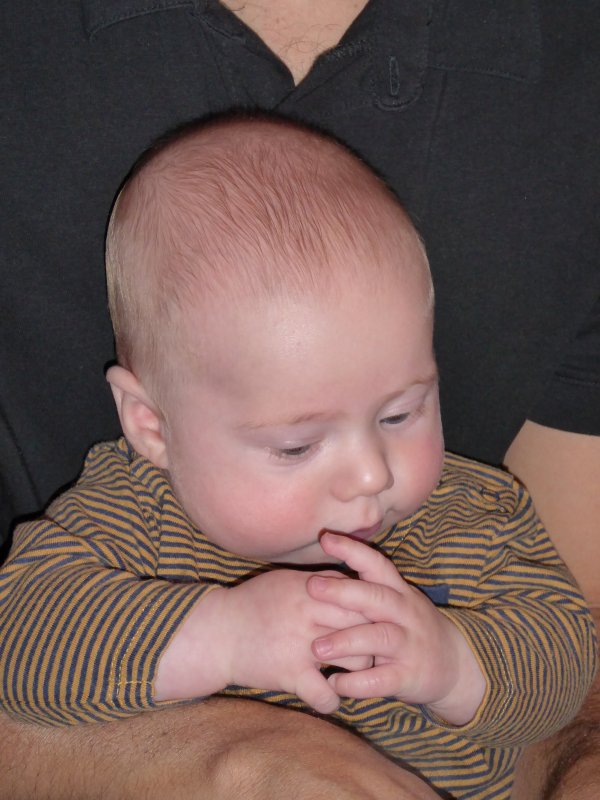
So that was how our holiday in la Rioja, Spain, worked out. We’d gone there with three-month-old William, his mum Sarah and dad Tom (my son), and Sarah’s parents. Daughter Emily and her boyfriend Miquel joined us from Barcelona for the weekend too. We’d chosen an area unknown to us all, which seemed worth exploring. Our base was a tiny hamlet, El Villar, whose only claim to fame is that there are dinosaur prints, lots of them, all over the place. You’ll find them by looking out for life-sized models of Tyrannosaurus Rex and similar ranging round the area. But we spent time wandering round the extraordinarily folded and buckled landscape of hills and mountains and the tiny villages perched on the slopes. There were vultures, soaring high above us on the thermals as they searched for their next meal. There were ancient towns and churches. There were Spanish lunchtimes, lazy affairs that started at 2.00 or so and carried languidly along till 4.00 or later. There were evenings of fiercely competitive card games in which the best (wo)man didn’t always win
This slideshow requires JavaScript.
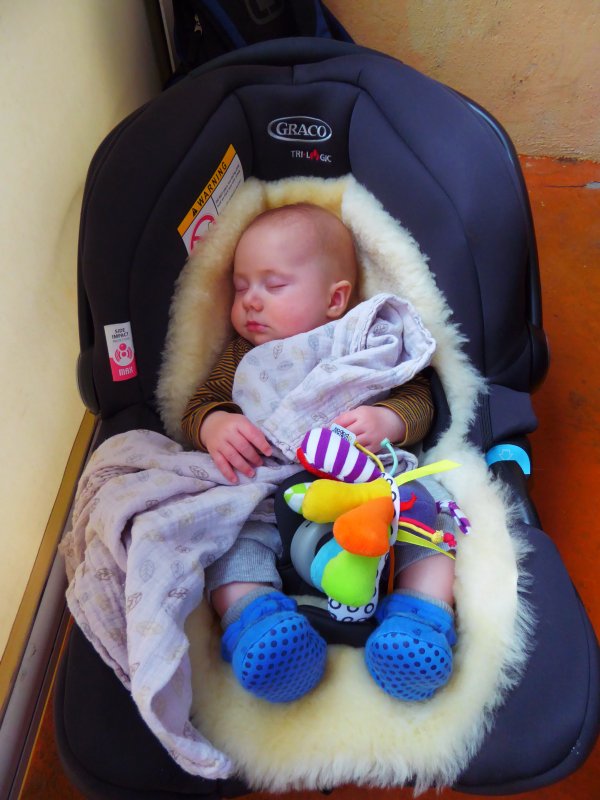
Most of all though, there was William. He was the centrepiece of a holiday in which an extended family had the chance simply to spend time together, getting to know each other better, and having fun. Babies make good holiday companions.
‘A minster is a church that was established during Anglo-Saxon times as a missionary teaching church, or a church attached to a monastery. A cathedral is the seat of a bishop (his seat, or throne, is called a cathedra).’
So that sorts that one out. We’ve been wondering what makes York and Beverley minsters, when one is in effect a cathedral, and the other a parish church: both are equally magnificent.
West Towers, Beverley Minster: Wikimedia Commons
Over the years, we’ve visited York Minster many times. But Beverley, tucked away in the East Riding of Yorkshire, in the flatlands of the Wolds, was unknown to us both. An outing organised for some National Trust volunteers at Fountains Abbey & Studley Royal put that right this week.
Beverley itself is a lovely town, founded way back in the 700s by St. John of Beverley, who was a scholar, a healer and a holy man. He built the monastery which became the nucleus of the town, and indeed of the minster. Even by the 1100s this church had been rebult several times, especially after a serious fire in 1188. Then it was all to do again in 1213: the tower they had built was too ambitiously large, and collapsed. But later, the building was yet again in a bad way:
‘The Minster as we have it today owes much to the work of the great 18th Century church architect Nicholas Hawksmoor. By the early 18th century the church was in a bad state – decaying and neglected. Worse, the north wall of the north transept – built on a marsh, don’t forget – was listing badly: it had actually leaned four feet into the street.
Hawksmoor was called in to advise how to save the building. The roof of the north transept was removed, and a wooden cradle, designed by York joiner William Thornton, was fixed around the wall. Then, over a period of 11 days, using ropes and pulleys, the entire wall – 200 tonnes of stone – was pulled back upright.’.
Do follow the link to the article in The York Press from which this quotation is taken. It’ll give you an excellent potted history of this wonderful building. And it’ll introduce you too to the Minster’s very special tower. Toil up the 113-stepped spiral staircase and you’ll find a Georgian treadmill, used to open up a ceiling boss over the nave to enable workmen to haul materials into the roof area. You’ll find graffiti, some more than 200 years old, scratched into the plain glass of the rose windowsby the men who’ve worked up here over the centuries.
The treadmill used to lift the ceiling boss
View once the ceiling boss is lifted.
Lifting the ceiling boss.
Graffiti
More recent graffiti.
Ancient beams in the Minster.
So here is a serene and beautiful building which has so much to offer: a fascinating ecclesiastical and architectural history, wonderful stonework and stained glass, misericords to investigate.
The Minster could keep you happily exploring all day. But Beverley has another church, St. Mary’s, which is one of the great parish churches of England, and it too provides a lesson in mediaeval church architecture.
Monarchs of England.
There are traces of its early years, when it was first built in 1120, but wander round, and you can see how the nave, side aisles and chancel date from the 13th century, the truly wonderful west front from the 14th century, the glorious painted wooden roof, and the choir stalls with their misericords from 1445. You don’t know what a misericord is? It’s a ledge projecting from the underside of a hinged seat in a choir stall, which when turned up, gives support to someone standing through the long, long moments of a mediaeval church service. Not normally on public display, they’re often whimsical, drawing on folk traditions, or slightly imperfect knowledge of exotic beasts. Here’s an elephant from St. Mary’s. And here are minstrels atop a carved pillar. And a 13th century rabbit, thought to be the inspiration for Tenniel’s illustration of the White Rabbit in Alice in Wonderland.
After all that, there was no time left to explore Beverley. We’ve decided that’s a pity. We’ll be back. But however much time we spend in the town, we’ll be sure to revisit both the Minster and St. Mary’s: both are very special places
The days are getting shorter. The nights are getting longer. We grumble every time we notice another milestone passed, another hour in which it’s no longer possible to enjoy sun and light and – daytime. Ten o’clock. Nine o’clock. Eight o’clock. And now we’ve reached 7 o’clock. Winter’s on its way.
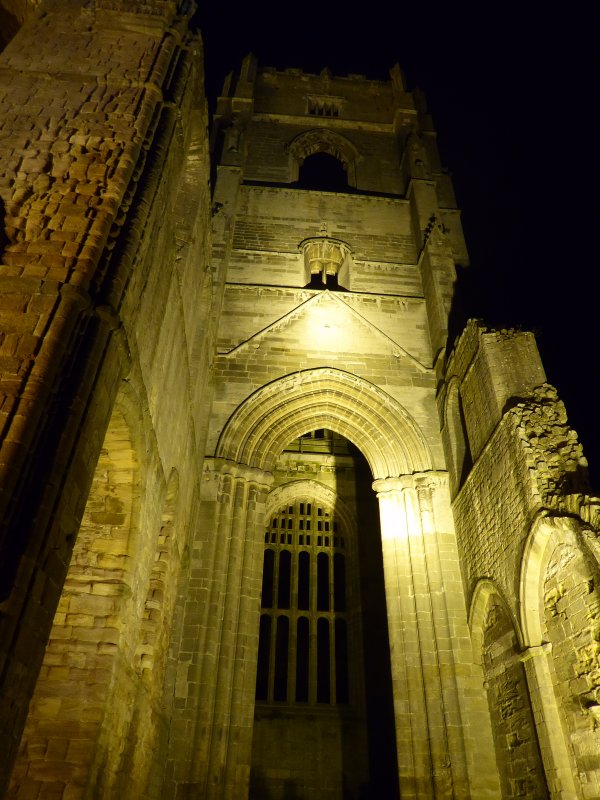
But there are consolations in that diminishing light. Yesterday for instance. As darkness started to blot Fountains Abbey from view, floodlighting blazed over the buildings, enhancing well-known silhouettes against the night sky. Places grown familiar to me over the past months presented themselves fresh and new. The structure and proportions of those arches! Those solid yet soaring columns, supporting unimaginable weight! That vaulting in the cellarium! No mediaeval monk would have had the least experience of the power of modern lighting to illuminate every corner of the abbey they knew so well from a lifetime spent within its confines. Yet last night, I felt closer to them, and to their spiritual concerns and way of life than I do as I enjoy the abbey site by day.
Glancing upwards to Huby’s Tower.
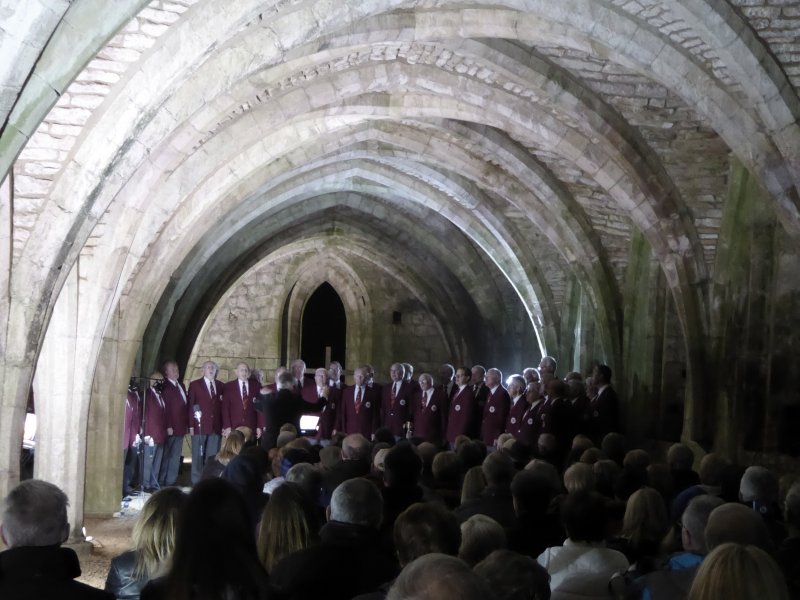
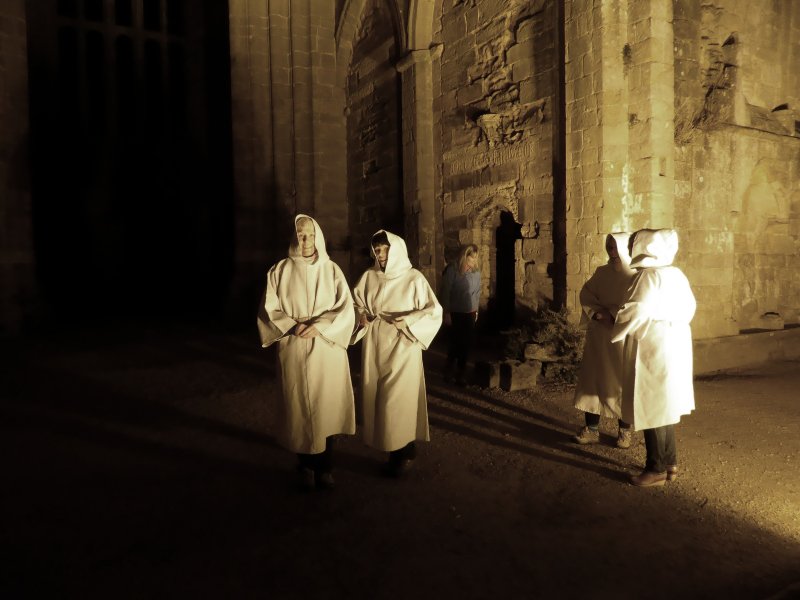
The place was busy though. I was there as one of my duties as a regular volunteer there*. Dressed as a monk, I first of all spent an hour or so with families, taking them round the site while talking about the daily routine of those silent choir monks, from their first act of worship at 2.00 a.m. to their eighth and final one at an early bedtime. And then I stayed dressed in those robes as night fell, the floodlighting came on, and Saddleworth Male Voice Choir assembled in the cellarium to perform in the gathering darkness. The acoustics of the place are exceptional, bringing a power and mystery to the voices of the singers, affecting listeners and performers alike: everyone present knew they were witnessing something special.
Performing in the cellarium
As for me and my fellow ‘monks’. Well, we answered questions, We tried to persuade children to join us at 2.00 a.m. Vigils (Did any of them come? I don’t know. I was asleep at the time). We were on call as local colour for all kinds of photo opportunities.
Monks by night.
As the music finished, we all walked up the hill, away from the Abbey, to street lights, a car journey back home, and 21st century life. It had been good, very good, to have an hour or two away from all that, in touch with life in simpler times.
Fountains Abbey by night,
*I keep promising to tell you more about life as a National Trust volunteer at Fountains Abbey and Studley Royal. And I will, I will.
According to my daughter and son-in-law, there’s an old Chinese proverb that says that guests, like fish, begin to smell after three days.
According to our friend Kalba, it’s Benjamin Franklin who coined exactly the same phrase.
Either way, received wisdom is that nobody can put up with house guests for more than a very few days without losing their patience, their good humour, and the friendship.
Our Ariegeois friends have just proved all that wrong. They stayed ten days, and it was wonderful. Though pretty exhausting, it was nothing but pleasure to spend an extended period with friends whom we value, but see far too little, and a fantastic chance to showcase Yorkshire – or a tiny portion of it anyway.
In my last post, I did a whistle-stop tour of our first few days together. Here’s how the rest of the holiday went….
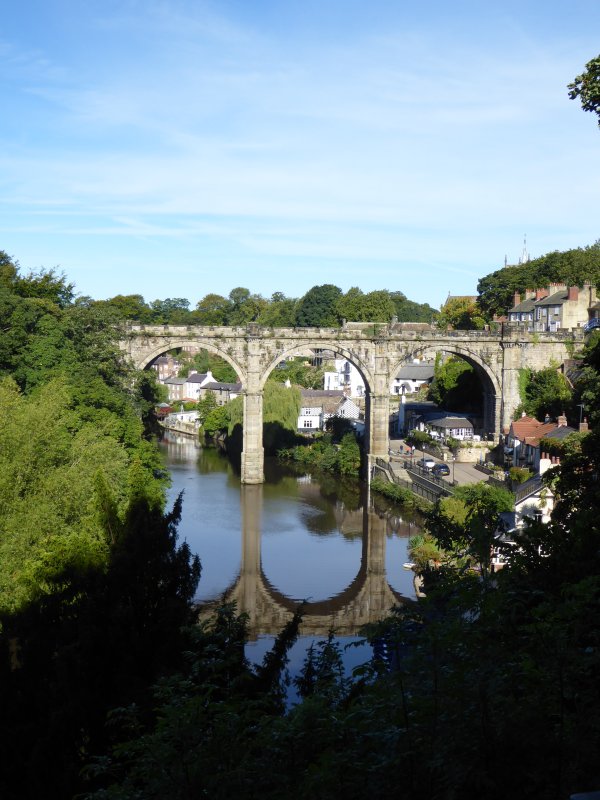
Knaresborough, with its wonderful 19th century railway viaduct spanning the River Nidd…
Knaresborough Viaduct.
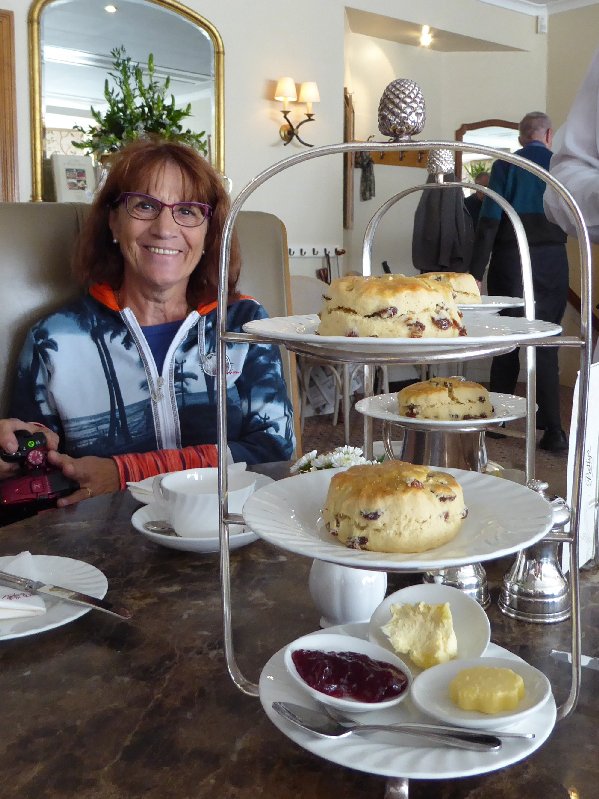
An obligatory coffee-stop at Betty’s, Yorkshire’s most famous tea room…..
Christine and a plate of Betty’s scones.
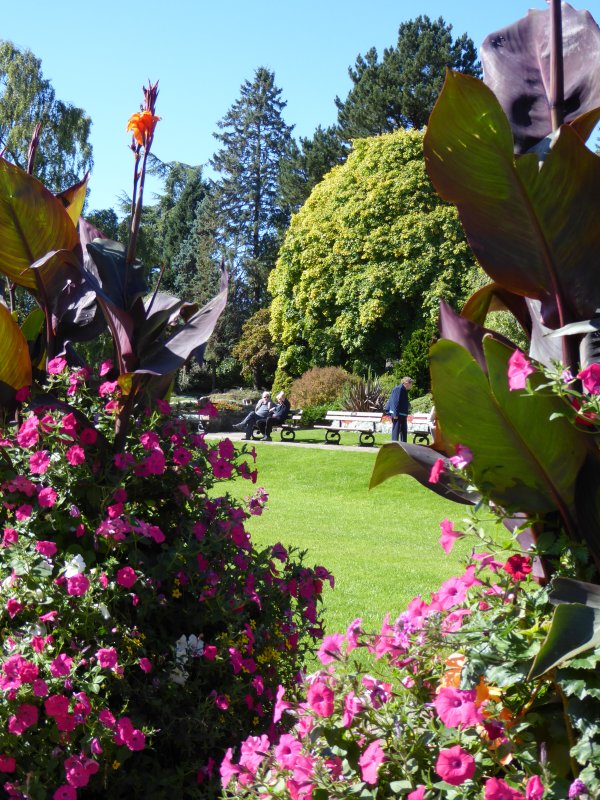
A meander round the Valley Gardens in Harrogate…..
The Valley Gardens
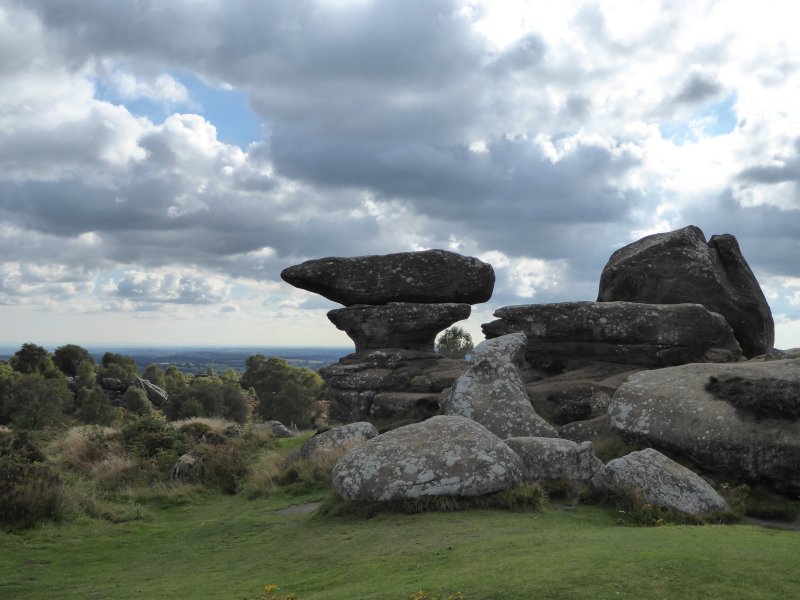
A trip to the fantastic geological outcrops of Brimham Rocks…
Brimham Rocks.
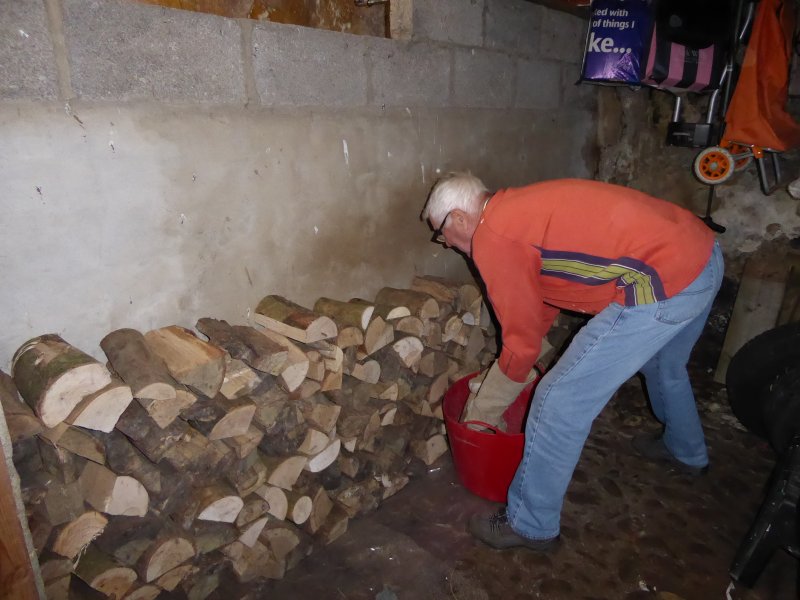
A day when our friends more than paid for their board by taking charge and getting our wood delivery for the winter shifted and sorted……
Max making a fine job of stacking the wood.
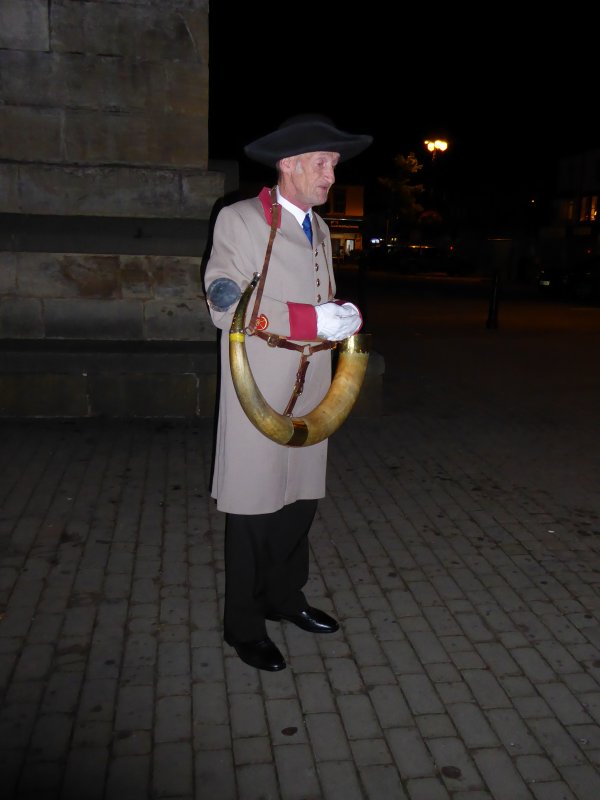
An evening with Ripon’s Wakeman, who since AD 886, has ‘set the watch’ to guard the citizens, sounding his horn at 9.00 p.m. every evening – every single day, whatever the weather, whatever the circumstances…..
The Wakeman and his horn.
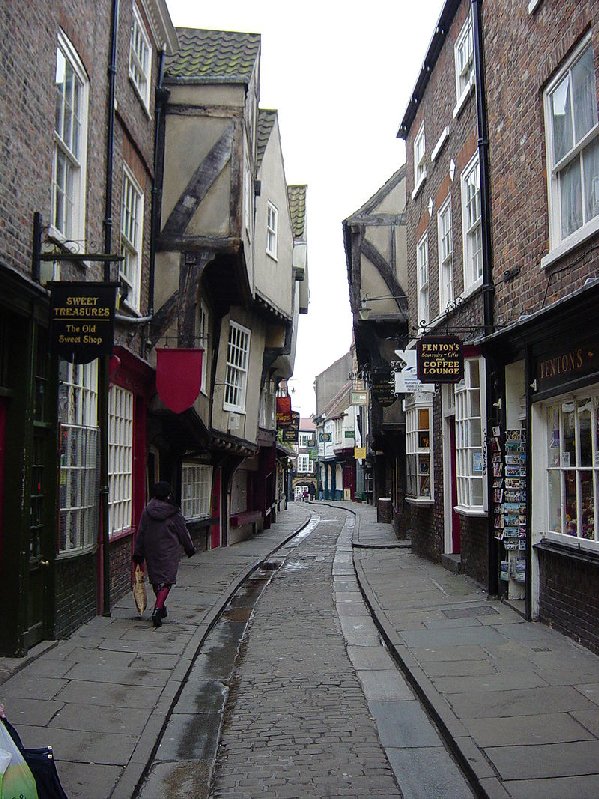
A trip to York…..
The Shambles, once the street where all the butchers were, now a tourist Mecca. Wikimedia Commons.
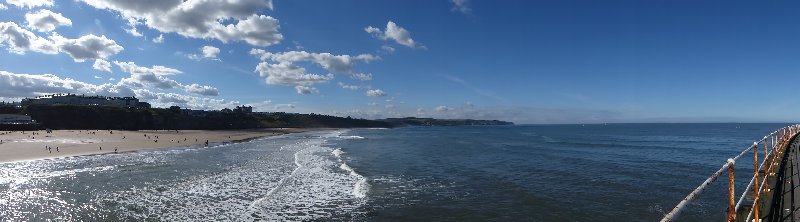
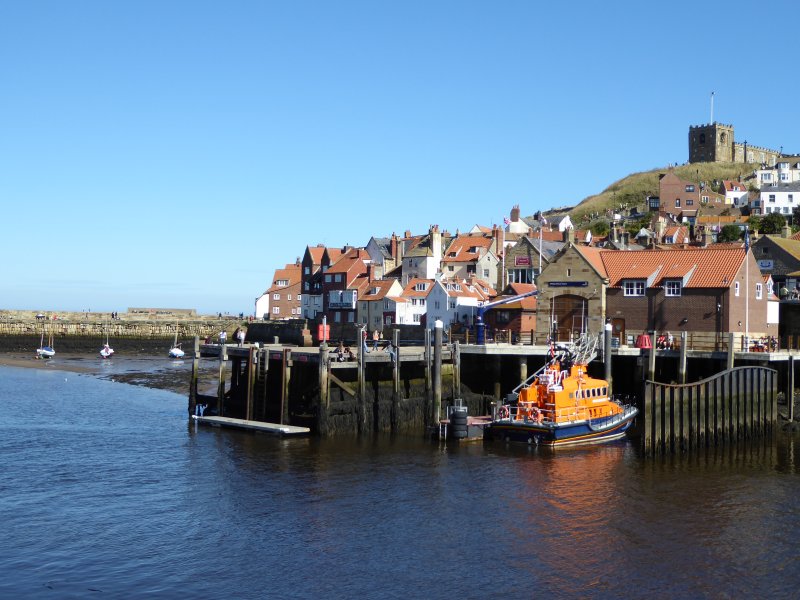
A day in Whitby, fishing port, tourist destination, jet-mining town, and home of Dracula’s author, Bram Stoker…… Oh, and we ate fish and chips. Of course.
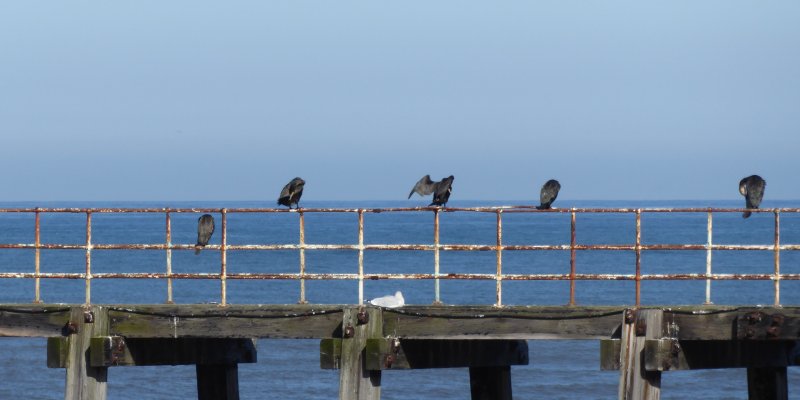
The harbour at Whitby……….. and a line of cormorants.
Goodness me. Christine and Max, our French friends from our days in Laroque arrived on Saturday, and it’s only Tuesday today. Look what we’ve crammed in….
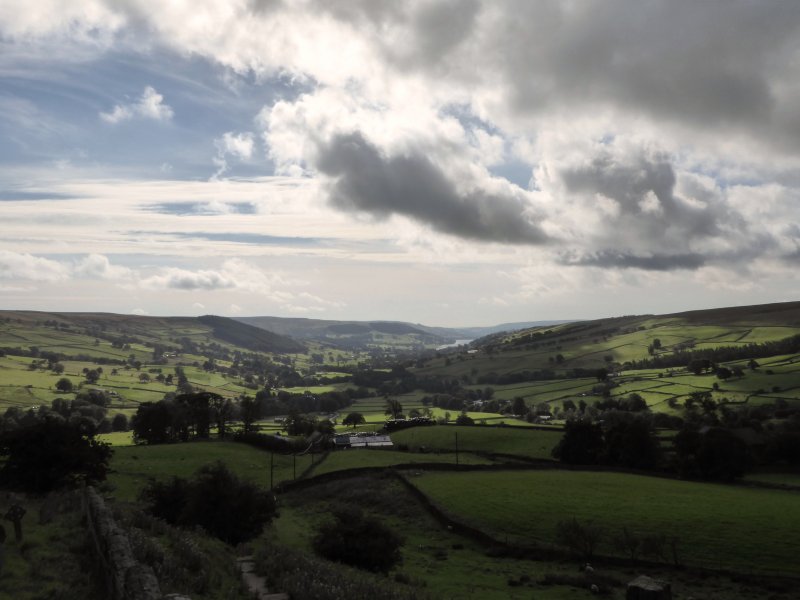
An orientation session in Nidderdale, taking in a few views….
The view from Middlesmoor, Nidderdale.
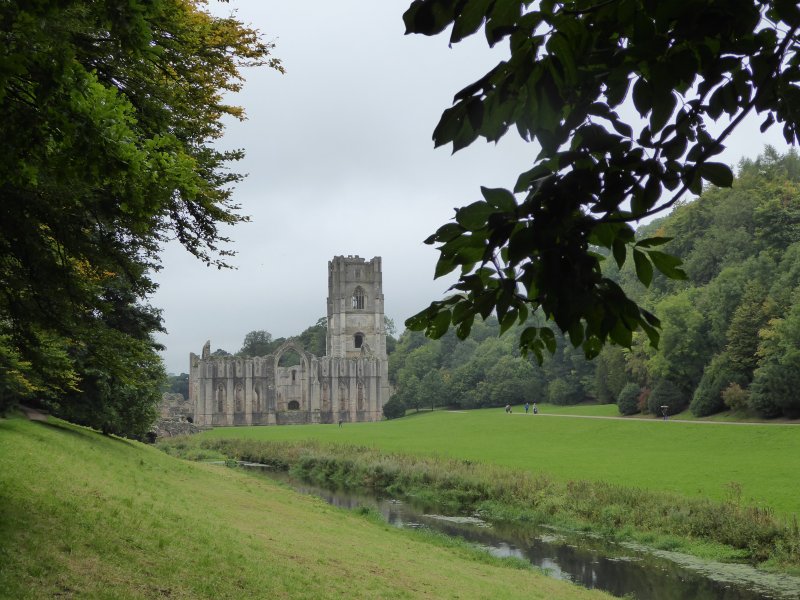
A peaceful morning at Fountains Abbey and Studley Royal……
Fountains Abbey.
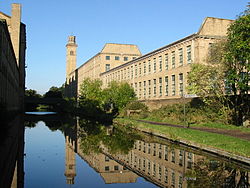
A visit to another UNESCO World Heritage Site, Salts Mill in Saltaire……
Salts Mill, Saltaire (image courtesy of Wikimedia Commons)
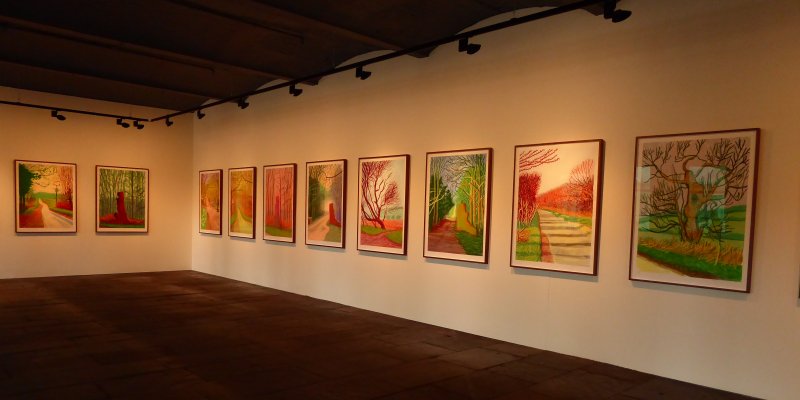
…. where we enjoyed David Hockney’s Arrival of Spring exhibition, featuring the Yorkshire Wolds…
David Hockney at Salts Mill.
The Five Rise locks at Bingley: a narrowboat was making its slow upward progress through the five locks as we arrived…
All five of the Five Rise locks at Bingley.
A mooch round Haworth, home to the Brontë sisters….
Peeking through a doorway in Haworth.
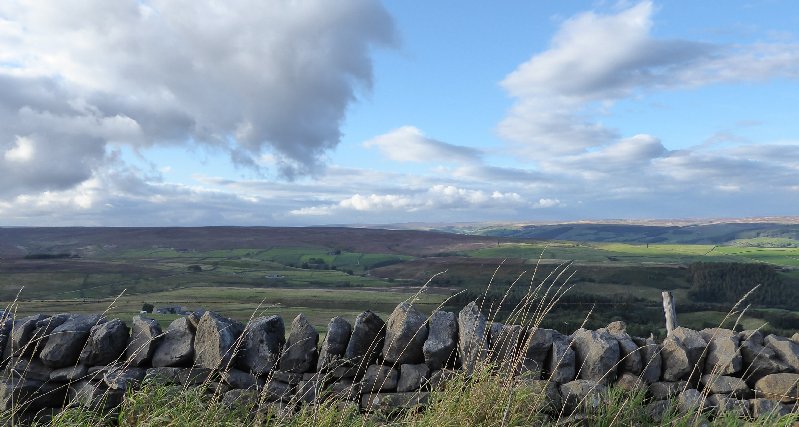
And views, views, always vast, always bounded by drystone walls, always different.
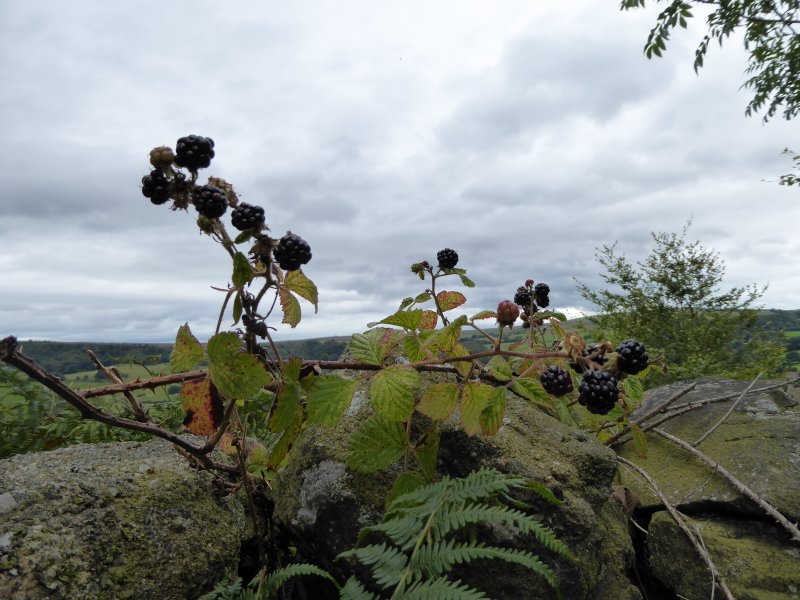
Blackberries in a landscape, ready to be picked and eaten.
I’m not a fashionable forager. You won’t find me back in the kitchen preparing to fry hogweed, or blitzing ground-ivy into my mayo. I’m a bit conventional, and I stick with what I know. A month or two back it was elderflowers for cordial. Just now the blackberry season is in full swing, and cob nuts are there if you know where to look. Friends with big gardens invite me to forage beneath their apple and pear trees for windfalls, and as soon as the first frosts strike, I’ll be looking for sloes to make a batch of sloe gin, and maybe I’ll make some rosehip syrup too..
I like to look for mushrooms too, though I’m only confident to identify two or three kinds of fungi at most. There are field mushrooms for the taking at the bottom of the garden.
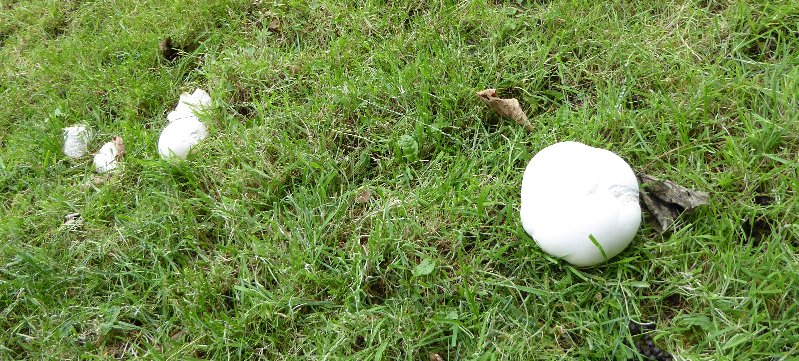
Refugees from the sports pitch? Or puffballs?
But last Thursday I was out walking with a friend when we saw something that put any existing evening meal plans on hold. Over there in the corner of that meadow – look! A white football, miles from any football pitch or recreation ground, with a tennis ball alongside, and a couple of golf balls next to them too. Except we knew they weren’t lost property accidentally abandoned by sportspeople . They were puffballs, those extraordinary giant white mushrooms which have no open cap with spore-bearing gills. And they are barely attached to the ground, with no apparent stem. My friend didn’t want them: she’s married to an amateur mycologist and sees quite enough of mushrooms without eating the wretched things, thank you. But I did. I reorganised my rucksack to accommodate the football and the tennis ball , and left the golf balls to grow up to be footballs in their turn.
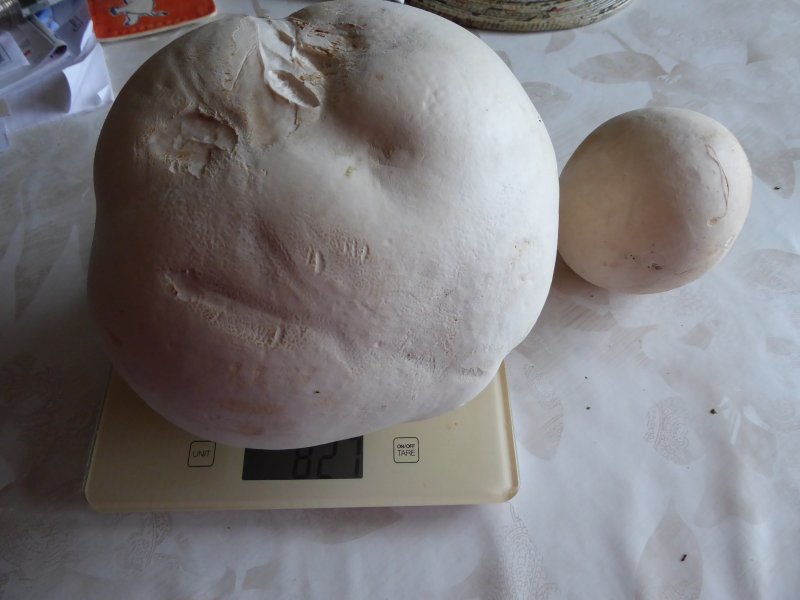
My pack seemed unexpectedly heavier for the last mile or two of our walk. It was hardly surprising. My football weighed in at 827 grams – well over 1 1/2 lb. It made a wonderful supper, fried in thick slices in butter with lardons and parley and lemon zest, with just a hint of garlic. I gave a big chunk to friends who had us round to forage for apples and plums the next day, and the rest made a vast vat of soup. Who said there was no such thing as a free lunch?
Here’s our bigger puffball, on the scales and weighing in at 827 grams.
‘Food for Free 2’ to distinguish it from a post I wrote in April 2011, when I did indeed join in foraging for some rather odd items of wild food
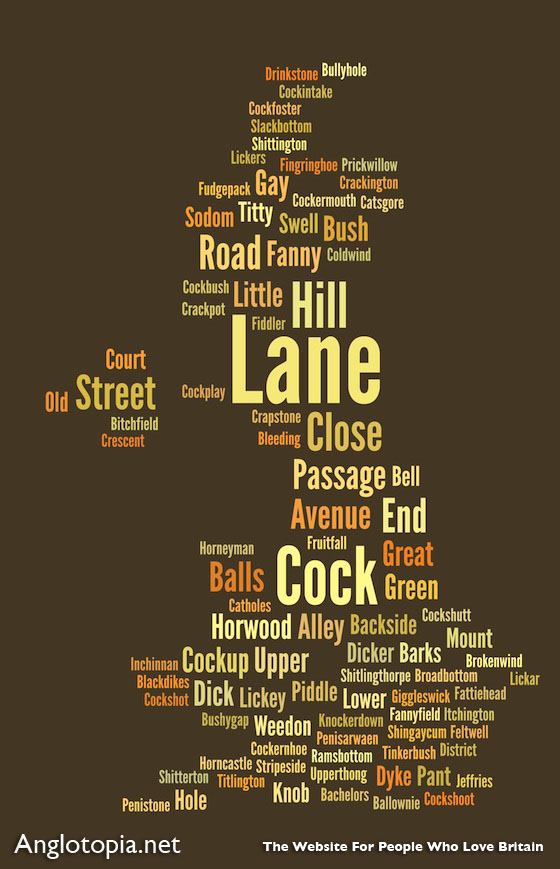
What could be more fun than pottering round the back roads of England on a sight-seeing outing? Even more memorable than charming village greens, ancient market towns, and ever-changing scenery are certain English place names.
Image courtesy of anglotopia.net
What about Affpuddle (Dorset), Barton-in-the-Beans or Burton-le Coggles (both in Lincolnshire), Dirty Gutter (Staffordshire), Dirdle Door and Gussage St. Michael (both in Dorset), Great Cockup (Cumbria), Lower Slaughter and Tomtit’s Bottom (both in Gloucestershire), Oh Me Edge (Northumberland), Ryme Intrinseca (Somerset), Sheepy Parva (Warwickshire) or Wyre Piddle (Worcestershire)? Or dozens and dozens of others.
Somehow, the names themselves give a clue about where in the country they’re situated, to those of us born and bred here. Yorkshire, for instance, often has a gritty edge to the names of its towns and villages, which are characterful, rather than pretty. Blubberhouses is where the houses by the bubbling streams were found: Grimwith was the wood haunted, once upon a time, by ghosts and goblins. And Arncliffe never used to be simply a well known landmark beloved of rock climbers and ramblers, but was instead the eagle’s cliff.
These place names should intrigue us. As elsewhere, those in Yorkshire reveal a history in which migrants from Celtic, Viking and Saxon lands, from Rome and from France populated the teritory, making homesteads and small holdings in a landscape which was not always welcoming.
Long before the Romans, the whole area was dominated by a powerful Celtic tribe, the Brigantes. They could be found in Ireland too, and even the Greek geographer Ptolemy had heard of them. They gave us place names still important round here: Pen-y-ghent – one of the Three Peaks – reminds us that to the Celts, ‘penno‘ meant ‘hill‘. They named three rivers too: the Nidd (‘brilliant‘), the Wharfe (‘winding‘) and the Ure (‘strong’, or ‘sacred‘).
The Romans had a large presence in Yorkshire – especially in York itself – and we live quite near another large and important settlement, Aldbrough. They left artefacts, buried settlements, fragments of their long straight roads, but here in Yorkshire, no place names.
When the Romans left, Eastern England was the destination of waves of invaders from Germanic peoples we now know collectively as Anglo-Saxons. They came, they conquered, they settled. They made homes – ‘hams‘ -for themselves (Clapham), and farms: ‘tun’ means farmstead (Horton). They made clearings in the woodland (‘leys’), and small towns grew up – Leyburn. They were the first to identify Yorkshire as a large geographical entity, and divided the area into Thyrdings, which we later called Ridings. Read all about it in the Anglo-Saxon Chronicle of 1065!
During the same period, Vikings also came from Scandinavia. We think of them swashbuckling their way across the land, raping and pillaging and laying waste to all in their path. But the fact that 2/3 of settlement names in Yorkshire can be traced back to Old Norse tells a different story. The Vikings too wanted land on which to settle and make a living. Their names include terms like ‘slack‘ (‘hollow‘), keld (‘spring‘), ‘gill‘ (‘ravine‘) and ‘foss‘ (‘waterfall‘). In particular, those very many settlements whose name includes ‘– thorpe‘(‘outlying farmstead‘), ‘– thwaite‘ (‘clearing‘) and ‘– dale‘ (‘valley‘) betray their Viking origins.
And then it was 1066 and All That. The Normans came and they conquered. In particular, Wiilliam conducted a campaign of ‘harrying of the north’, systematically devastating the countryside in order to isolate and destroy his enemies. Unsurprisingly, there is little French influence on Yorkshire place names – apart from that left by the monks. Several Cistercian Abbeys in Yorkshire have left their names behind: Jervaulx (that means ‘by the River Ure‘) and Rievaulx (‘the valley of the river Rye’), as well as Fountains Abbey – ‘font‘ meant ‘spring‘ in Norman French, and the area on which the abbey is built is rich in water sources.
So by this time, most settlements in Yorkshire had acquired the names by which we recognise them now. Here are a few of my favourites. Enjoy their names, enjoy their meanings, and maybe add a few more of your own favourites?
Appletreewick (pronounced ‘Aptrick‘): dairy farm by the apple tree. (OE)
Arkengarthdale: the valley where Arkil (ON personal name) had his enclosure.
Buttertubs: perhaps named after the potholes used by the farmers to cool their butter on the way to market.
Conistone Cold: the King’s farm exposed to the cold (ON &OE)
Crackpot: the crevice where crows nest (ON & ME)
Giggleswick: Gikel’s (OE personal name) dairy farm.
Gordale: the dirty valley or the valley covered in manure: (ON &ON/OE)
Hardraw: the shepherds’ row of cottages (OE)
Ingleton: the farm on the hill (OE)
Langstrothdale: the valley with a long stretch of marsh overgrown with brushwood (OE &ON)
Muker: small cultivated field (ON)
Settle: a dwelling place (ON)
Swinithwaite: a clearing made by burning (ON)
Trollers Gill: troll’s arse ravine (ON &OE)
Whernside: the hillside where querns (millstones) were found (ON)
ON – Old Norse
OE – Old English
ME – Middle English
The landscape of Buttertubs, only a little tamed since Viking times.
* Faggergill: the ravine in a sheep enclosure (ON)
^ Scaleber: The hill with the shieling (hut or high pasture) (ON& OE)
I’m not so blinkered as to believe that Yorkshire has all the best bits of scenery. I’ve had days to recharge the soul in every English county from south to north, from west to east, enjoying stirring uplands, gentle verdant hillsides, sky-filled flatlands, slowly-flowing rivers and tranquilly tinkling streams, and the constantly-changing views from the beach at the seaside.
All the same, what we saw whilst out walking today gave every picture postcard of anywhere outside the Yorkshire Dales a run for its money.
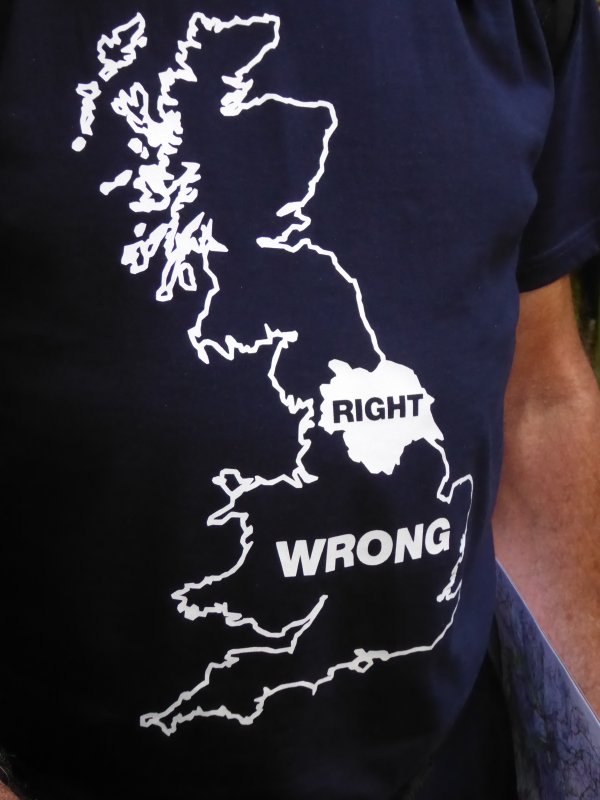
John’s view of Yorkshire, as described on his T-shirt, is the correct one.
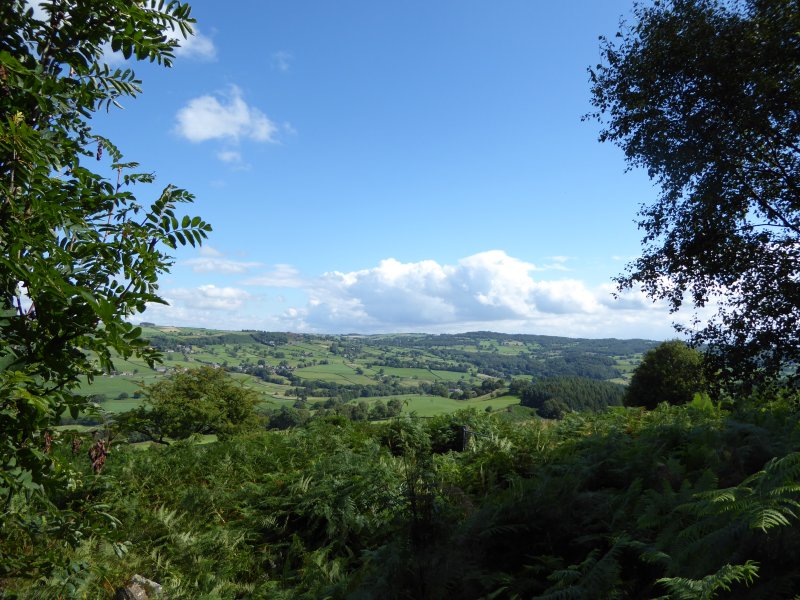
From Pateley Bridge, set in the heart of Nidderdale (Area of Outstanding Natural Beauty), we energetically panted and clambered through Guisecliff Wood, whilst looking down at the village of Glasshouses below. We emerged, puffing for breath at the top, One way, we could look across the Daleside landscape of ancient field systems and stone-built settlements, to the vale of York beyond.
Looking across towards the Dales.
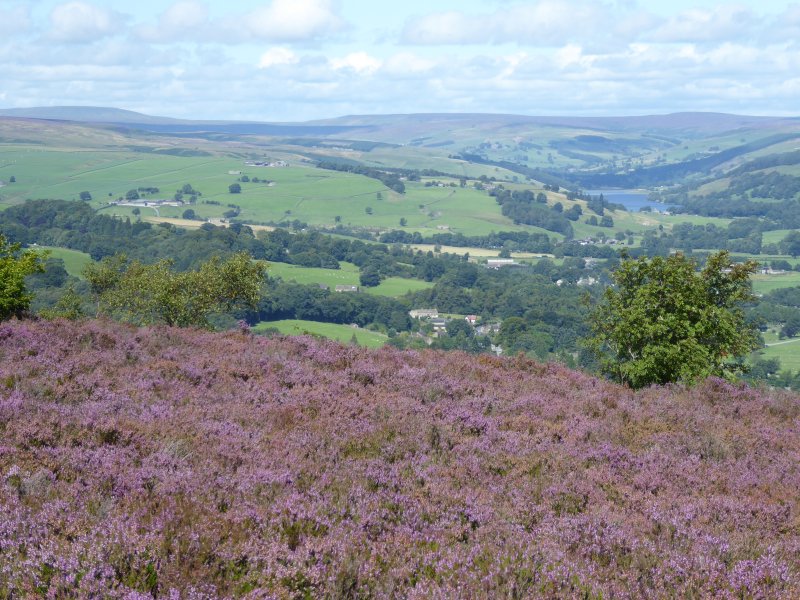
The other way were the moors, no longer bleak, because this is heather time. We breathed in the intoxicating smell that I like to buy potted up as rich, almost peaty flavoured heather honey. We stared, almost mesmerised at those carpets of blooms stretching away from us, mile after mile: not lilac, not lavender, not violet nor damson – simply that special low-key subtle purple that only heather can deliver.
Marching through the heather.
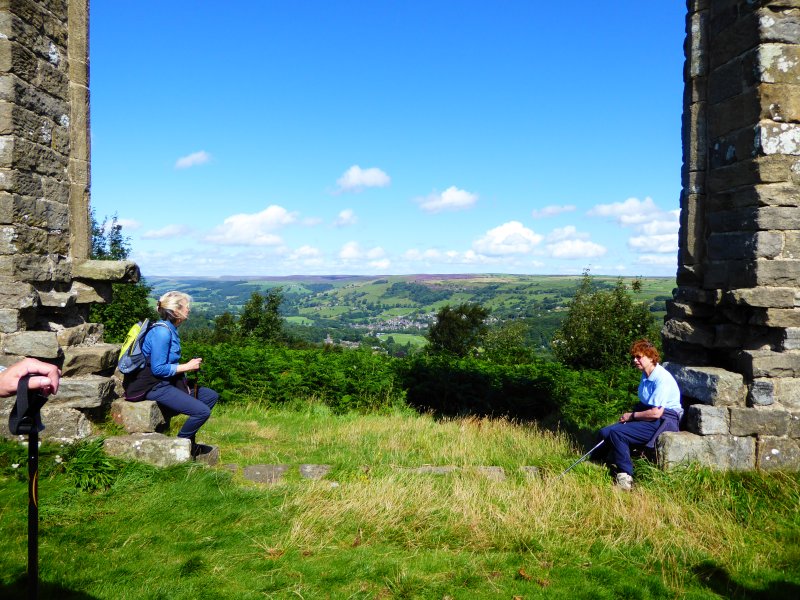
Past Yorke’s Folly: it’s said it was built in 1810, commissioned by the local landowner, John Yorke of Bewerley Hall, who was casting about for some means to keep his labourers in employment in a time of economic depression. These men received a shilling and a loaf of bread a day for their efforts.
Yorke’s Folly: a resting place for weary walkers to enjoy the view.
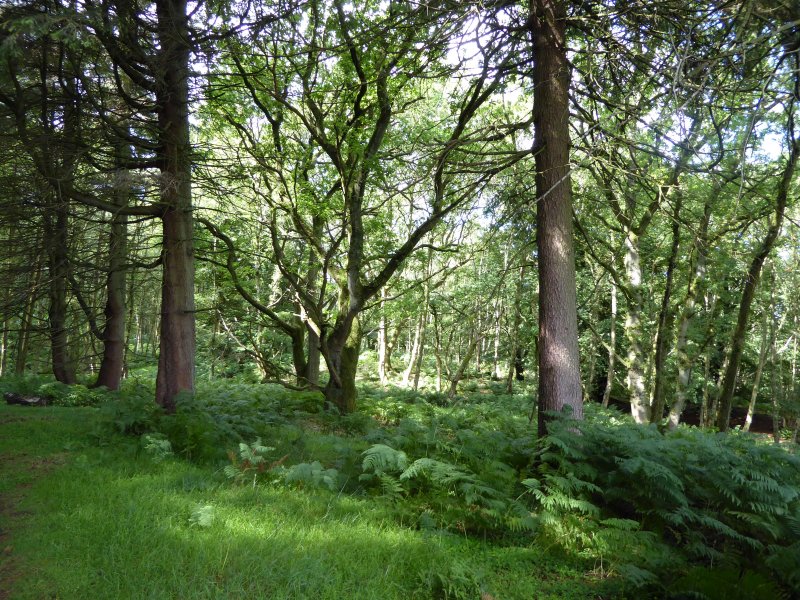
Then it was back to woodland again – very English woodland, with a full green canopy, not yet ready to turn to autumnal colours. Skrikes Wood, Nought Bank, Fishpond Wood.
Skrikes Wood.
Then back along a few final paths before returning to Pateley, and a very welcome pub lunch.
Regular readers will know I’m a huge fan of Rachel Roddy, and her tales of life and cooking in Rome, as told in her blog ‘rachel eats’. Well, here she is in Sicily. And if you’re reading this under a sullen English August sky, you might like to take a virtual trip with me, and join her there.
Hello. We are in Southeast Sicily in a town called Gela. I have written a piece about this for the FT Weekend magazine, which is beautifully illustrated by Luke Best. If you would like to read it, here is the link. More here soon – R












You must be logged in to post a comment.