This composite image of my walk was automatically generated by Google. I think it’s grasped the sweep of this landscape quite well.
A sortie to find some carved Pictish stones on what might once have been a royal fort, followed by a climb to visit a local landmark, the obelisk to the Reverend Samuel Rutherford seemed like a plan for a late afternoon last week. It was only a three and a half mile walk after all.
What I hadn’t taken into account was that this is rough, undulating landscape, and entirely beautiful. It demands we take the time to stand and stare. So I did.
Trusty’s Hill proved to be a chance for a first viewing of the Rutherford Monument, as well as an opportunity to peer at Pictish carvings. This site was the site of an ancient fire so fierce that the stone there vitrified. The hill might, round about 600 AD, have been a citadel. It was certainly a fine vantage point from which to view what could once have been the lost Scottish kingdom of Rheged.
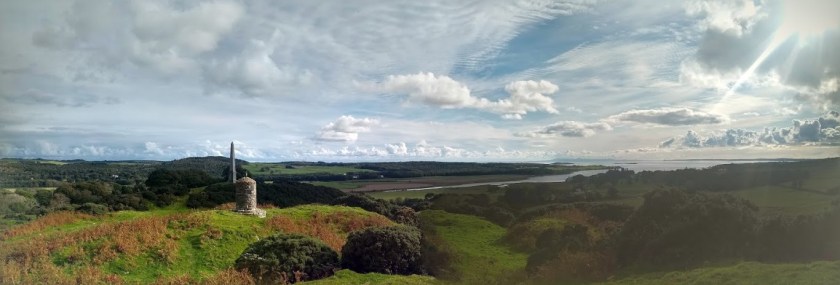
The view from Trusty’s Hill
Pictish symbols…
… and more, clearly visible at the top of the hill.
Onwards to the Rutherford Monument, built by grateful parishioners to honour the memory of a priest who, though an academic, a thinker and a teacher, cared for his flock in practical as well as spiritual ways and who was constantly at odds with the establishment to the extent that he was awaiting being tried for treason at his death. These days, there’s a Millennium Cairn, detailing all the ministers of Anwoth and Girthon since 1560 , and a trig point on two adjacent hills. All three provide splendid views to the Fleet estuary far below and the hills beyond.
This composite image of my walk was automatically generated by Google. I think it’s grasped the sweep of this landscape quite well.
Looking towards the hills…
Looking towards the Fleet Firth…
The clouds became quite dramatic.
Another view of the Firth
Looking down from the Monument.
… and up to the Monument.
Another view from the Cairn.
And a view from the Trig point.
Looking down from the Trig point.
Then it was down, down through a wooded trail to reach Anwoth Church, now roofless and ruined, before coming back to Gatehouse of Fleet along a quiet county track.
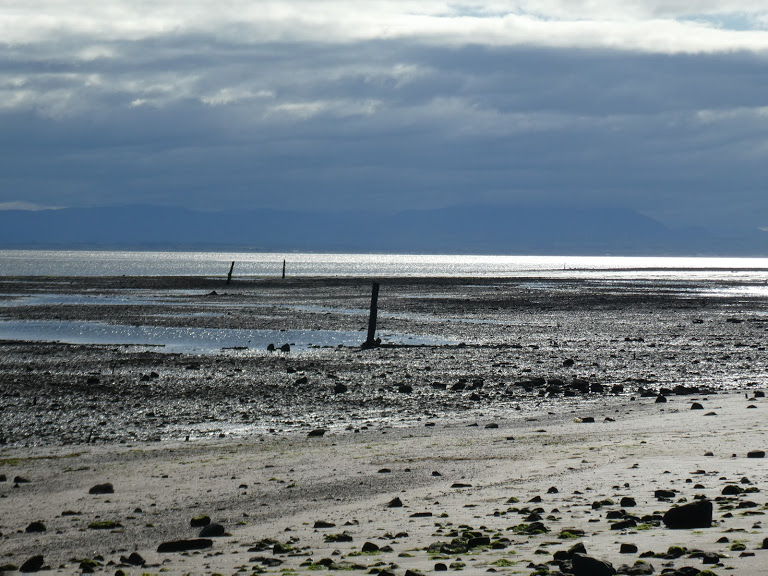
Dumfries & Galloway is our new favourite place. We felt as though we’d discovered it and had it all to ourselves. We explored the wildly beautiful and seemingly remote Cairnsmore of Fleet National Natural Nature Reserve. We found ancient cairns. We slogged up hills for the sake of views over the Solway Firth. And we enjoyed the beaches. We’ll take a virtual seaside trip today: there’s not a fairground ride, amusement arcade or kiss-me-quick hat in sight. There’s not even a chippie. Just us, the rocky shore, and the sea, advancing or retreating with the tide.
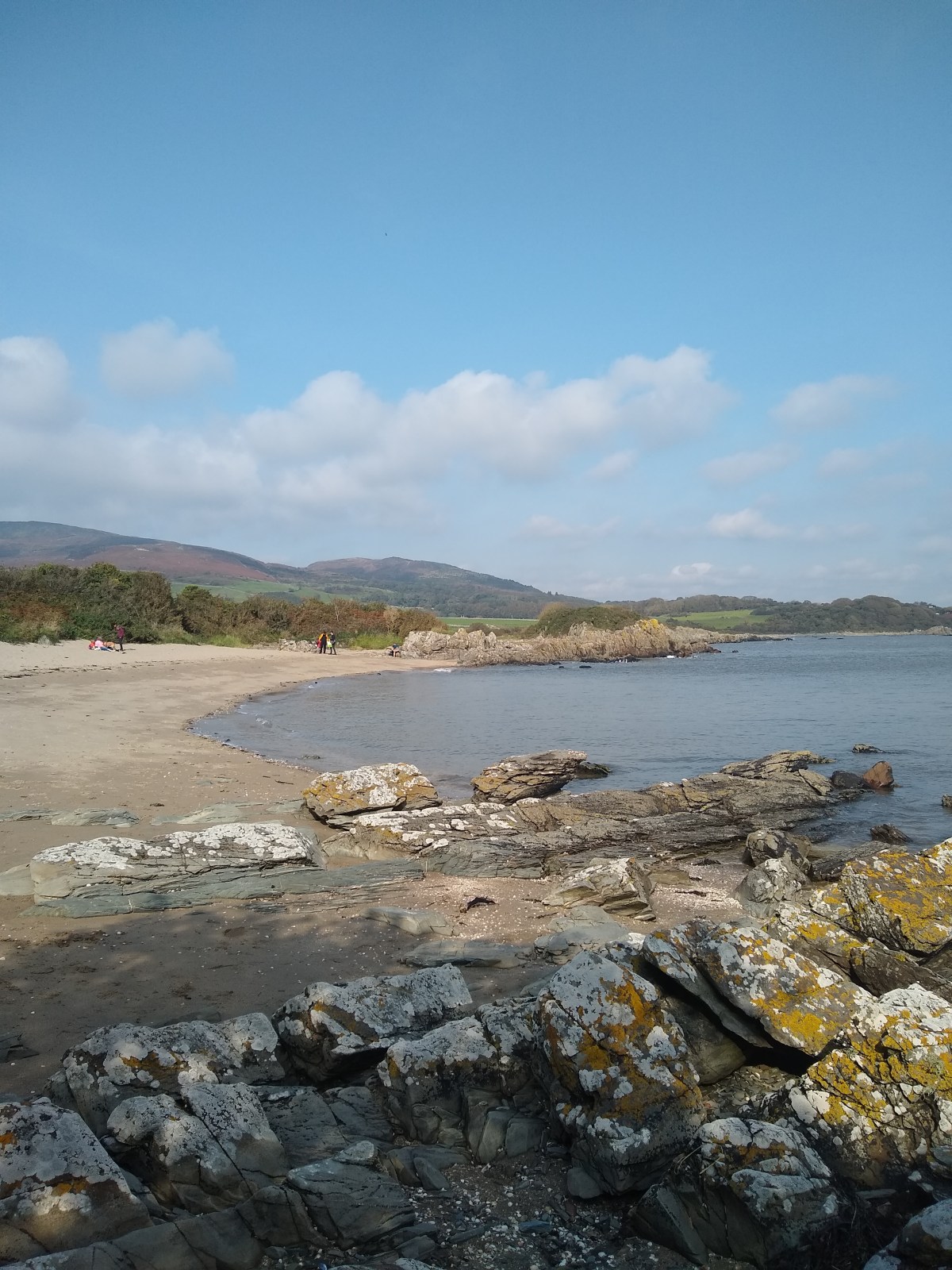
Let’s begin at Mossyard Bay. I sent you a postcard from there just last Thursday.
A rocky shore
So many shells.
The tide’s just gone out.
There’s sand as well as rock.
This seemingly ancient labyrinth was constructed in 1990 on a small island that develops every time the tide comes into Mossyard Bay.
Plants cling to any dry shard of rock.
Near Mutehill, Kirkudbright, early one morning.
Finally, Carsethorne, near Dumfries. It’s a small hamlet now, but it used to be a busy port, shipping people to Liverpool, to the Isle of Man and to Ireland on their way to a new life in the New World.
‘Having a wonderful time’. That’s what you say on postcards, isn’t it? But it’s true. Here we are in Dumfries and Galloway. This is Mossyard. Near Gatehouse of Fleet. Stories later, once we’re back home.
In her Photo Challenge this week, Jude asks us to look upwards, and shoot our subject from below.
Somehow this instruction reminded me of the first period of lockdown, when staying isolated and close to home was fresh and new: when we country-dwellers had the small pleasures of watching the spring unfold. Each day’s main event was watching the subtle changes in the nearby verges and fields, and in the trees and clouds.
With no job-plus-childcare to juggle, no worries about actually losing an income, this simple period, when the spring weather was almost unfailingly sunny and warm, was a time of some happiness.
Since then, things have fallen apart somewhat. Compliance, and confidence in the government’s competence and probity plummets, and nobody regards the prospect of a long hard winter ahead with anything better than disaffected resignation if they’re lucky, real fear if they’re not.
For one day only then, let’s look upwards – and backwards – to the spring 0f 2020.
Sheep – always sheep round here .. near Masham …
… near Tanfield, with her lamb …
…and another sheep and lamb in Tanfield.
Spring catkins.
Spring grasses in a field near West Tanfield.
And crops, long before the recent harvest.
And cow parsley … everywhere.
Poppies sneak a prime spot on the bridge at West Tanfield.
Poppies in a nearby field in early summer.
This thrush was our constant background summer during the month of May.
Our neighbours aren’t sure if this is Basil or Brenda, the resident woodpgeons.
The red tops blazed next week’s news: ‘A September Scorcher! 30º!’
Anyone living north of Watford Gap, or west of Slough knew better than to believe it, because only south-east England counts if you’re a London-based hack. We Yorkshire types needed to read the small print to discover that northerners could merely expect pleasant warmth, a gentle breeze and no rain whatsoever. Which was fine for a Sunday walk in Wensleydale.
On the way over there, it rained. Getting ready for the walk, it rained. The wind snatched urgently at our waterproofs and blew our hair in our eyes. Mist rose from the valley bottom. Grey cloud descended and thickened.
We didn’t mind. The rain soon stopped: it was warm, and those grey skies made for moody, atmospheric scenery. But our friend Gillian, who’d planned the walk, doesn’t know the meaning of the word ‘stroll’ and had us battling boggy paths, and huffing up rough pastureland on semi-vertical hillsides. We took it in good part.
But what rewards. We had the constant backdrop of the Wensleydale hills. Semerwater glittered at us from a distance: but close up, insistent waves rushed constantly towards our toes.
Semerwater.
Semerwater.
I don’t know who these two bikers are. But they enjoyed the view too.
We had a march along a Roman road. And at the end, blue skies, sunshine, and a relaxing cup of tea on the village green at Bainbridge.
The Roman Road.
This week’s photo challenge is to make use of empty, unoccupied space in our pictures : to make it part of the story. As I walked yesterday, I tried to use negative space: in this case, mainly the sky.
This is not the week to get out and about with my camera looking for Unusual Points of View for Jude’s Challenge. Here’s why: *
The view from the bedroom window.
She’d like us to shoot something often photographed, but choose a less usual point of view. I thought I’d combine it with a mini-break for us all.
Let’s go to Bamberg. The old town there, a UNESCO World Heritage site, largely built on the rivers Regnitz and Main, between the 11th and 19th centuries can easily keep you busy and charmed for several days. You can visit the main sites here.
But we have a job to do – Jude’s challenge.
This week's assignment - take a picture of a frequently photographed subject like a flower or a person's face from an unusual POV. How can you create an out-of-the-ordinary shot?
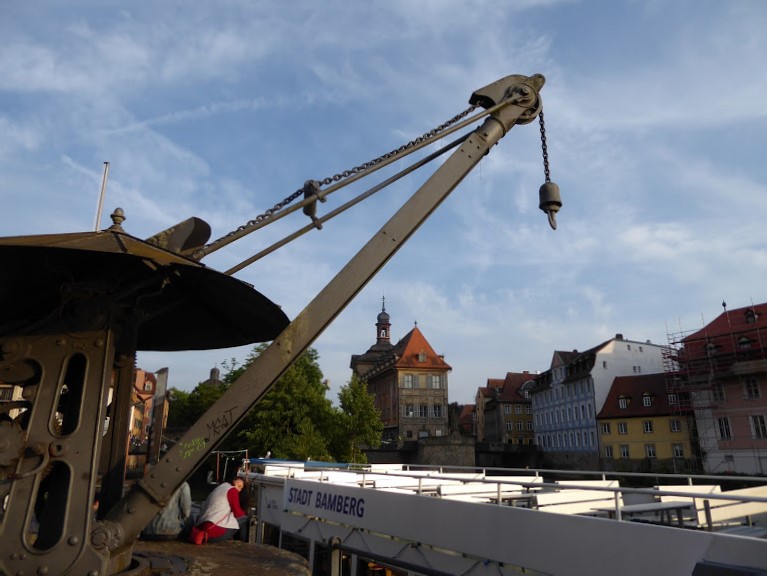
We’ll wander along the river to get a different view of the much photographed Old Town Hall.
A view of the Old Town Hall from the riverside of the Old Town.
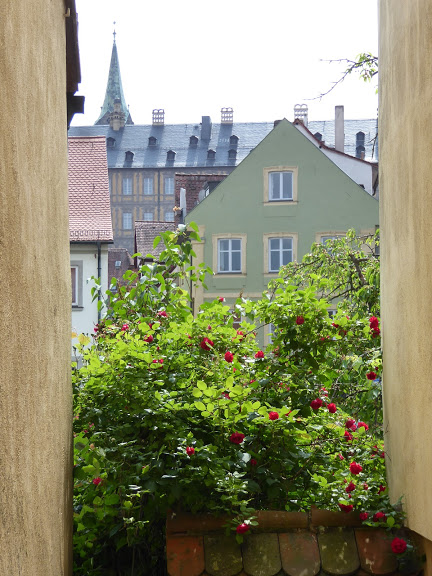
Another view of the Old Town, seen from the comfort of a bar.
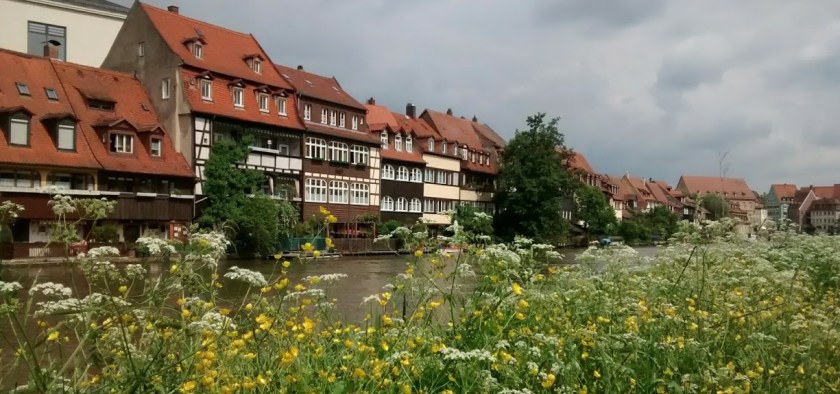
Little Venice, seen from the opposite bank of the river.
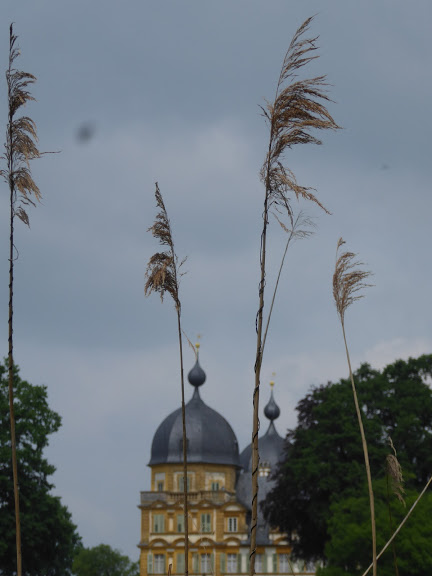
In the afternoon, we’ll go out of town and take a trip toSchloss Seehof. It was built as a palace and hunting lodge for one of the Prince-Bishops of Bamberg between 1684 and 1695. I wanted to capture the idea of this stylish palace being very much a place-in-the-country.
A view from the parkland.
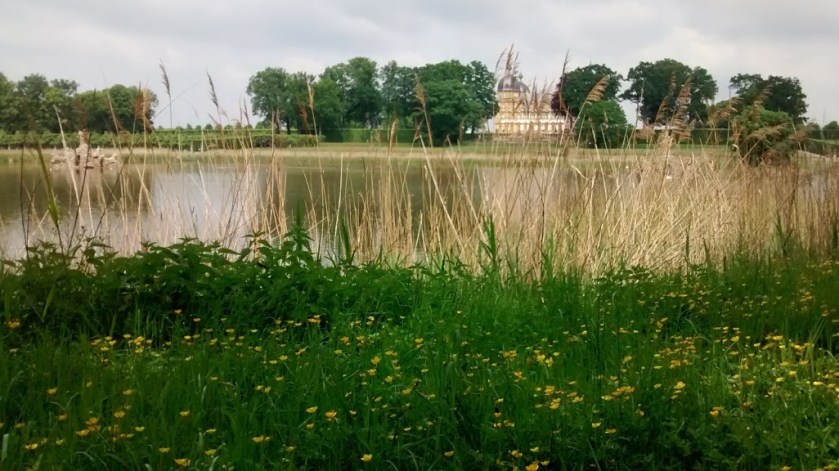
Some of the parkland has become a nature reserve, with ponds and wetland. That’s the side of the palace I wanted to show here.
A short trip, I’m afraid. But with travelling being so difficult nowadays, short, sweet and virtual is probably the way forward.
I was casting around wondering what to post for this week’s Lens-Artists Challenge, Labour of Love. And I remembered a wonderful experience I had when I lived in France, when I was part of a small team invited to cook an English school dinner for a local primary school. Truly, the experience was a Labour of Love, as it was for the charismatic school cook, each and every day. My memories of this special day are entirely positive and happy.
September 26th 2012
‘School dinners, school dinners….
‘School dinners, school dinners.
Iron beans, iron beans.
Sloppy semolina, sloppy semolina –
I feel sick, get a bowl quick.’*
Do you remember this cheery ditty from your days eating school dinners? Only if you’re British, I suppose. And most right-thinking French men women and children would be quite prepared to believe that all English food is just like that.
Not the mayor of Villeneuve d’Olmes, where Découverte de Terres Lointaineshas taken its Yorkshire exhibition this week. Back at the planning stage, he’d told us about their school caterer, M. Feliu, who uses almost entirely organic or local ingredients, and who likes to introduce the children to the cooking of other countries every time the excuse arises.
We met M. Feliu at La Freychède. We worked together to produce a menu (Cheap. Tempting to the young French palate. Three courses that work with the kitchen facilities to hand. Conforming to nutritional standards).
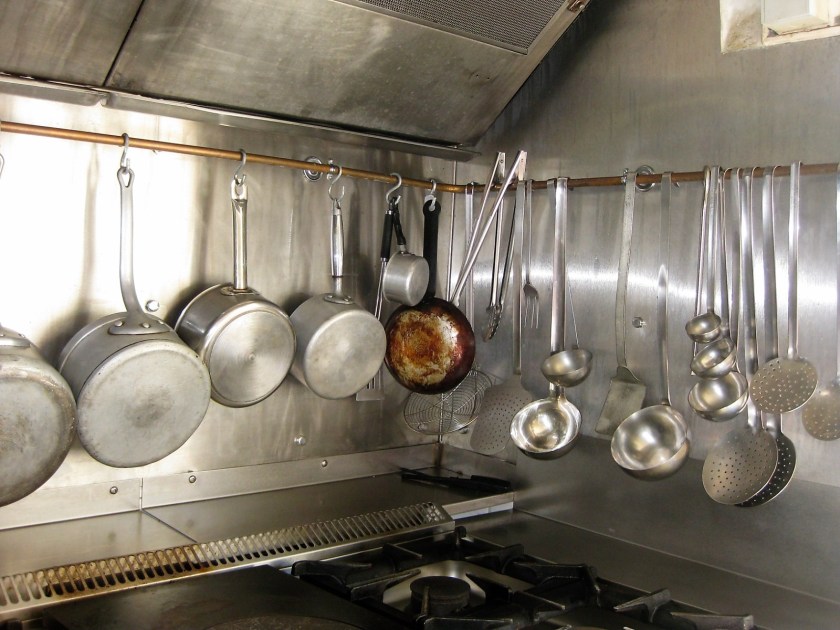
The school kitchen.
This is what we came up with:
Crudités with beetroot chutney
Macaroni cheese with green salad
Blackberry and apple Betty with custard.
Yesterday was the day. I turned up at 10.00 with my English friend and colleague Susie to find the work almost done. All we had left was to churn out batons of carrot, black radish and cucumber for the first course, which was not, let’s face it, Awfully British. But it had to fit in with other considerations as above.
M. Feliu in full chef’s garb.
Me, in what passes for full chef’s garb.
Susie, ditto. I can’t remember what the face-mask was for in pre-Covid times.
11.00: The prepared and cooked food was heaved into insulated containers, and transported by van to one of the local schools.
Catering-sized ovens.
Catering sized macaroni cheese.
Delivery-time.
11.30. Ditto with van number 2. This batch was sent off to Villeneuve d’Olmes, with me following.
12.00. Children arrived at the canteen. One of the helpers, Pascale, spoke good English. ‘What’s your name?’ she’d say to each child in English. When she had her reply, they could go in, and sit down at one of the circular tables, tinies in one room, and juniors in another. I joined a table of lively 7 year olds.
Part of the week’s menu.
The dining room awaits …
The children file in.
One of the staff told me the rules that the children expect to follow:
Take turns to serve the dishes of food to everyone at table.
Wait till everyone’s served before beginning to eat.
Try everything.
You can have the portion size you choose. Once it’s on your plate though, you have to eat it.
Everyone accepts this and we all sat together, eating and chatting. The children chomped their way through all the crudités, they even enjoyed the chutney, whose sweet and sour taste is not an automatic choice round here.
Once cleared away, bread appeared on the table – this is France after all.
Raw veg go down just fine.
It wouldn’t be France without bread on the table …
… or salad.
Two more children served the macaroni cheese and the salad. Most of us came back for seconds.
We sang ‘Happy Birthday’ – in English – to a birthday girl.
I gave an impromptu talk on the food on offer.
The blackberry and apple Betty was served. Yum! How could it fail? Gently cooked fruit with a crunchy crust of soft breadcrumbs crisped in golden syrup and butter, with obligatory custard, of course.
Then the children cleared their tables, stacking dirty plates and glasses neatly for washing up, before going off to play.
Macaroni cheese….
,,, and apple betty with custard.
I was so impressed. The children here learn that the midday meal is so much more than a pit-stop. The expectations, reinforced daily, are that this is a moment to spend with friends, a time to share, to think about the needs of others, and to appreciate the food on offer. The occasion lasted well over an hour.
I’ve woken up feeling unaccountably gloomy this morning. Is it the fine but insistent rain? Is it the spike in Covid figures that seems to presage what this winter may be like? I don’t know, but Positivity seem to be called for, and a Virtual Day Out in the Sun.
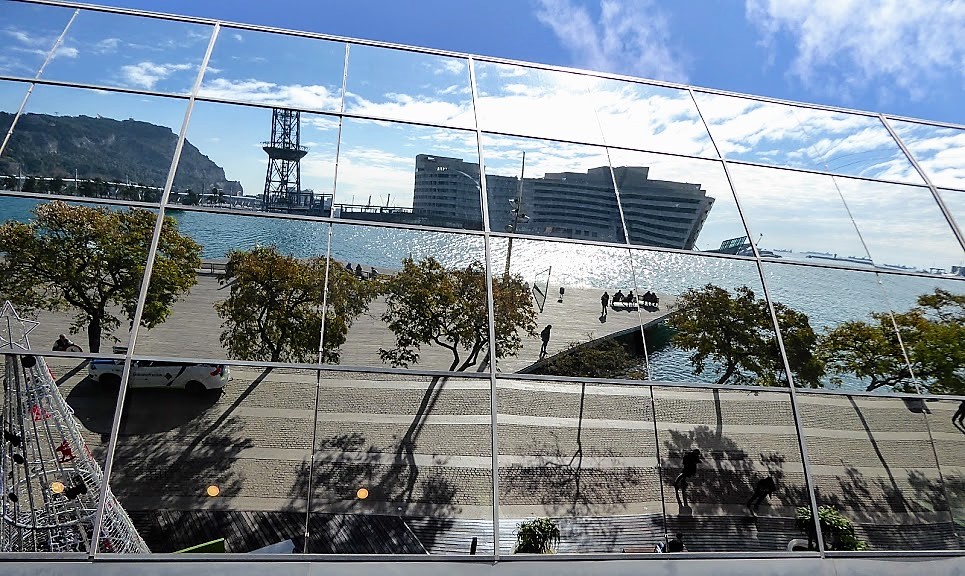
Let’s go to the seafront in Barcelona, and have a look at a very up-beat window with varied viewpoints.












You must be logged in to post a comment.