Corrèze: our home for the week

Corrèze.  It’s a town in the Département de la Corrèze.  With a name like that, you’d think it would be Chief Town.   But no, that’s Tulle, a city just down the road.  Corrèze has fewer than 1200 inhabitants and is reached up a winding forest-flanked road with no dual carriageway in sight.  It’s the River Corrèze, flowing through the edge of the town that gives it, and the département,  its name .

It’s one of dozens of beautiful and ancient towns and villages in the region, but it hasn’t made the A Team.  It’s not been designated one of the most lovely villages in France, and I hope it’s grateful for that.  The ones that have, like Collonges-la-Rouge are tourist meccas.  Doing a spot of DIY or trying to relax in your garden if you live there must be a real pain, with rubber-neckers down every street and alleyway throughout the summer.

Though it is popular with tourists, it’s not a must-see destination.  And yet just look at its historic town centre.

It’s been around since the 9th century, but it really started to grow when it became one of the convenient stopping places for pilgrims on their way through the Limousin to Santiago de Compostela in Spain.  The Auberge opposite Sharon and Andrew’s house still offers dormitory accommodation to pilgrims.

The town was largely neglected by the big events in history, though the English burned it down in the 100 years war.  The French Revolution passed it by, but sadly not the First World War.  The town never really recovered from losing 100 of its young men.  Its war memorial makes for affecting reading, recording the deaths of two, three, even four young men from the same families.

Part of the memorial to the fallen of WW1.

Just enjoy a few pictures from the old historic centre of this town, which has supplied all our needs all week without our needing to travel further than the country paths surrounding it.  There’s far more I could show you. It’s a thoroughly civilised place to be.

In which a fellow-blogger invites us to the Corrèze

Blogging has been an enriching experience for me.  It’s made me write, observe, record the moment with my camera.  It’s brought me a whole community of blogging ‘friends’ (you know who you are: I love the contact I have with you).  And some of those virtual friends have become real friends.  There’s Kathryn, who with her husband, has a holiday home in the village near where we lived in France: we’ve seen them both at home and away.  There’s Ros, who once contacted me to tell me she enjoyed my posts: she’s been a good friend for several years now.

And there’s Sharon.  She started to follow me when we moved to France, because it was her dream too.  We’ve returned to England.  She and Andrew moved to France just under a year ago, to Corrèze in the Limousin, but we’d already met a couple of times before this.  We followed their progress in their new life through their blog, and recently, she announced they needed help.  They had to go away for a week or so without their dog Mortimer. Dog sitter required.  We applied.  We got the job.  And here we are.

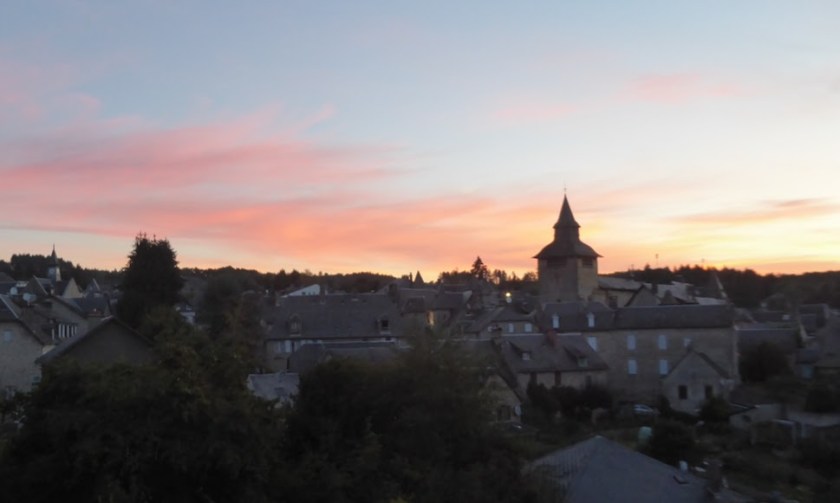
Corrèze has seduced us completely.  Here’s the view of the town from their garden.

Corrèze, as seen from Sharon and Andrew’s garden

I’ll want to share our discovery of this place, settled since the 9th century alongside the River Corrèze.  But for now, come with us on our walk with Mortimer on this misty moisty morning (it was 30 degrees yesterday – but that was yesterday) through the quiet countryside.  The conditions prevent my showing the gently rising and falling hillsides, thickly forested, with meadows between for the Limousin cattle, so important in the area’s economy.  But it’s lovely: relaxing and restorative. Corrèze and its history tomorrow!

This place is an oasis of peace and tranquility.  Let’s enter it into the RDP Daily Challenge: oasis.

Ragtag Tuesday – and Wednesday! A feast with orange accompaniments

I let myself off posting yesterday, Tuesday, because we were concluding a drive all the way from Yorkshire England, to the Limousin, France – all but 800 miles in two days.  You’ll hear why in my next post.  Just now, I’ll tell you about our Monday stop-over.

Les Hayons is a transport caff in Normandy, pure and simple.  We love it.  Truckers from all over this part of northern France aim to end their working day here.  They’ll have a quick wash, a drink, then head for the restaurant – refectory style tables where they can sit down among old friends and new and talk over the events of their solitary day pounding along the motorway.

I’m justifying an out-of-focus shot by hiding behind data protection. No trucker can be identified I think.

They’ll help themselves from a buffet-style first course, then there’s a choice of about a dozen home-cooked main courses – copious, traditional tasty food washed down with as much wine or cider as you want.  After that, a cheese board – local unpasteurised cheeses from the farms down the road, and finally ice cream or some such for pud.  The cheery noisy atmosphere, the decently cooked if simple feast puts us in holiday mood every time we eat there.

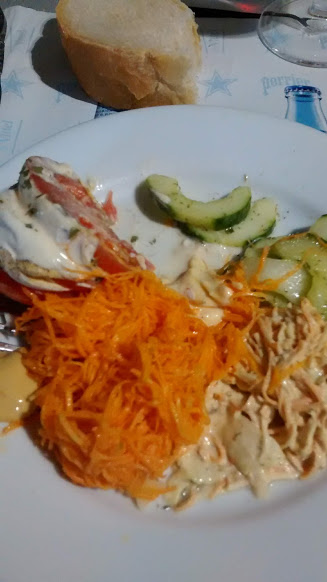
With so much food on offer, it seemed wisest to begin the meal with a simple bright orange carrot salad.

We stayed the night there too.  Maybe that wasn’t quite such a good plan.  The truckers stay in their well-appointed cabins built into their lorries.  The days of their needing a trad. bed in a trad. simple hotel room are over.  So, lacking a bed in a truck, we chose their former hotel instead.  Which was fine.  But though the truckers were all tucked up for 9.00 p.m.  or 10.00 p.m. that was because they were ready for the off at 4.30 a.m.  or 5.00 a.m.

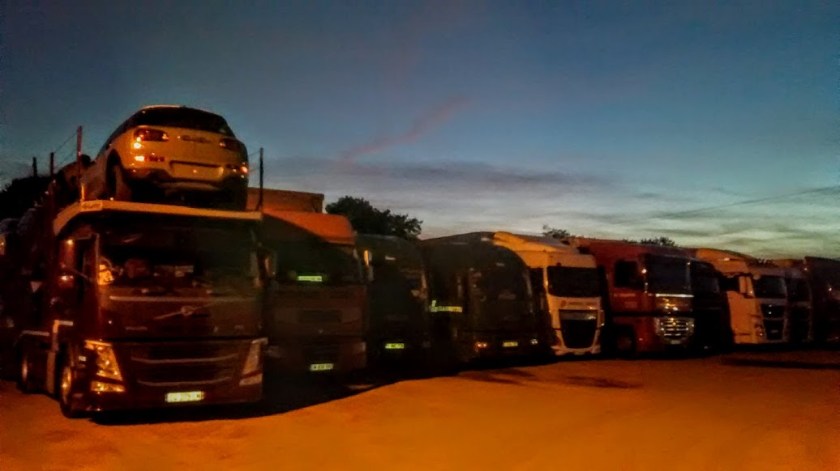
Our alarm call was the sound of revving engines and heavy tyres crunching across gravel. We too were ready to roll at 6.30 a.m.  And barely a truck was still there.  Look at the scene the evening before.  Scores of trucks, neatly lined up in auditorium sized parking lots, protected by the orange glow of sodium lighting.

And we shared breafast in the bar with men in orange: workmen ready to go on shift and face the rigours of the day in their hi-viz clothing.  Life at our next destination is very different.

The RDP challenges for Tuesday and Wednesday this week were ‘orange’ and ‘feast’ respectivly.  Two birds with one stone.

Snapshot Saturday: ending where I began

This is the last Snapshot Saturday.  WordPress has decided to discontinue its weekly photographic challenges.  I’m a bit sad about this.  It’s been fun tussling with choosing images for each week’s idea, and through it, I’ve ‘met’ fellow-bloggers and made virtual visits to all parts of the globe.

This week, we’ve been invited to bow out by posting our all-time favourite shots.  That’s far too difficult.  Instead, I’m taking you to the Ariège in France, where my blogging journey began when we lived there for some years, and offering you some favourite shots from there.


Click on any image to view full size.

Off to the EU

We’re in mainland Europe again, briefly. Our two Labour MEPs for Yorkshire and Humberside host a group visit to the European Parliament every now and then. So we had to sign up. Last chance saloon.

And after a night on the high seas, a day in a coach, here we are. Not in Strasbourg, not even in France, but nearby, in Germany, in the Black Forest. Watch this space.

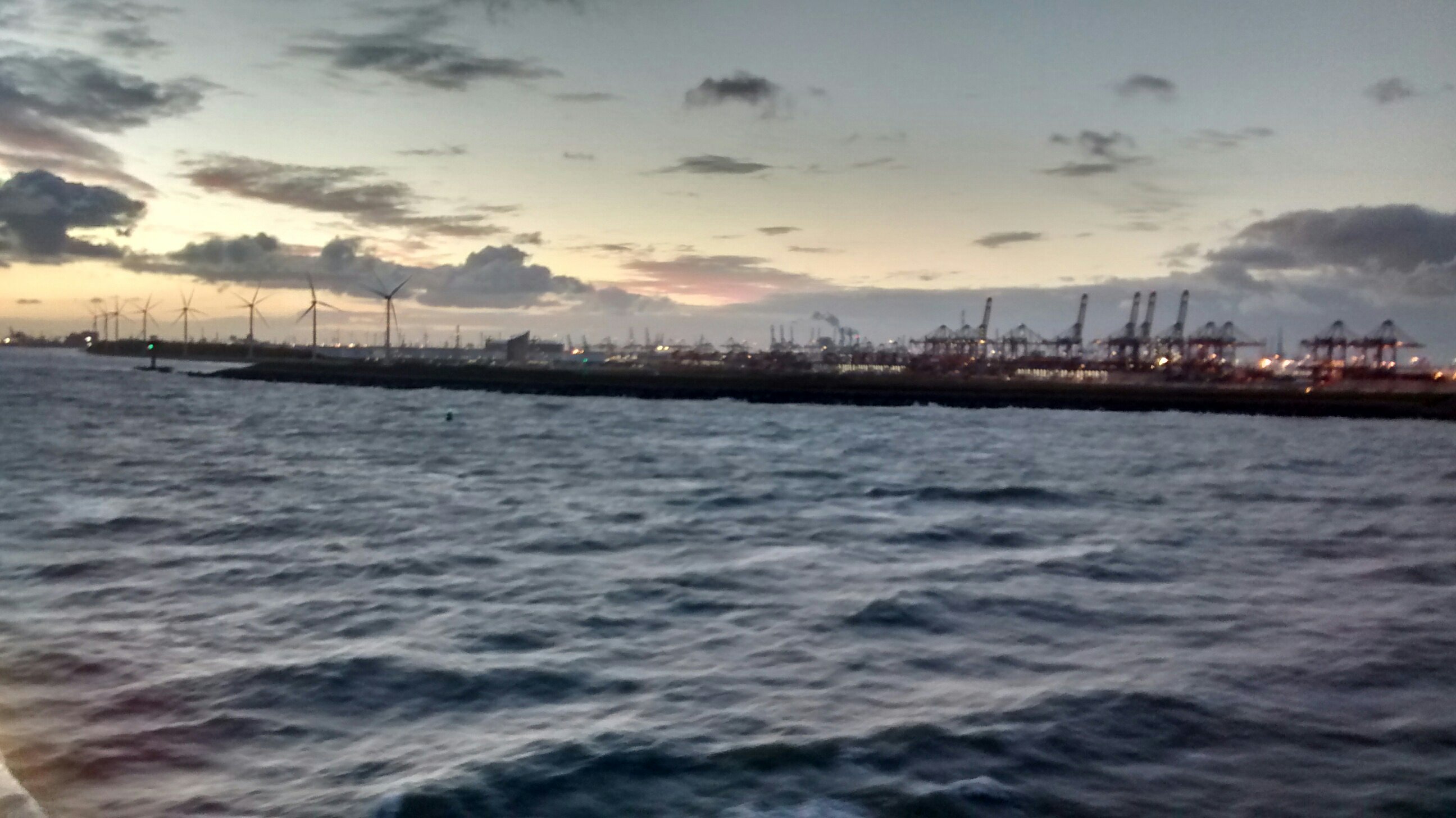
Approaching the port of Rotterdam at dawn yesterday.

Snapshot Saturday: a truly turbulent yet transient sunset

We had quite an arresting sunset the other night.  As with all sunsets, it was evanescent: here at one moment and gone the next.  I’ll show it to you at the end of the post, together with the rainbow that briefly accompanied it in a rainless sky.

That sunset though reminded me of another sunset, even more dramatic, which we experienced in France in February 2014.  Evanescent it might have been.  But it’s etched in my memory forever.

Sunset seen from the church at Laroque d’Olmes.
The moment is almost over.

Now then.  Here’s our English sunset, from just a couple of weeks ago.   Which do you prefer?

A response to this week’s WordPress Photo Challenge: Evanescent.

Snapshot Saturday: Danger! Death by chilli

M. Chilli’s chillies

When we lived in France, the easiest way to persuade a French friend that you did not have their interests at heart was to produce a spiced dish, especially one with chillies in.

‘Oh, we love spicy food’, declared Henri and Brigitte when we broached the subject of cooking them a curry.  All the same, we were careful.  We dished up a korma so mild that it barely qualified as spiced at all.  ‘Ouf!’ exclaimed Henri, after the first tentative mouthful – ‘are you trying to kill us?’

With this in mind, it was a huge surprise to us when one Friday in Lavelanet market, we came upon a man with a stall full of chillies.  Orange chillies, yellow chillies, green chillies, purple chillies, fresh chillies, dried chillies.  He had no customers at all.  So he had time to chat to us, and explained that he’d come to love chillies, and to be passionate about seeking out new varieties, growing and using them.  He was one of two such growers in France.  We bought from him.  He had other English customers.  The French?  Not so much.


Jean Philippe Turpin and his stall at Mirepoix market.

That was five years ago.  After relying on northern Europeans to bail him out, slowly but surely he started to attract a few French customers too.  He’s still in business.  Perhaps, despite the danger represented by a Red Savina chilli rated 500,000 on the Scoville scale, he hasn’t managed to kill anybody off yet.

M. Chilli’s smallholding, devoted exclusively to chillies, chillies, and more chillies.


This post responds to this week’s WordPress photo challenge: ‘Danger!’


My University assignment

Here I am, still slaving away at Blogging 101, the University of Blogging.  I’m beginning to get a bit on edge when I fire up the laptop in the morning, because I know Senior Lecturer and Course Director Michelle W will have sent out yet another assignment requiring us to tweak and tinker with our blogs, and generally bring them up to scratch.  I even played hooky the day before yesterday, and the day before that.  Doesn’t she know I have a LIFE to lead?

However, here I am again, back in the University Libary (aka our study).  Today we have to write a post.  And it’s to be inspired by a blog we found yesterday, a blog new to us, which we felt moved to comment on.

I discovered Katherine Price.  She can write in a way that takes me to her world, her street, her little stretch of the Thames and help me to savour with her the local trees and the daily rhythms of the birds, whether a clamour of rooks, or a solitary kingfisher streaking past.  The first post I read was a bit of a hymn to staying put and not moving on, a hymn to her home in suburbia.

And it got me thinking about where I live now, and where I used to live… and the time before that… and the time before that.  It reminded me of a post I wrote almost 5 years ago, and I thought it was maybe time to revisit it and re-work it.

I spent my childhood in London: population 8.5 million.

Then I went to University in Manchester: population 2.5 million.

A few years later I was living in Leeds: population 751,000.

And then we moved to Harrogate: population 76,000.

Then we went to France and I started a blog. We lived in Laroque d’Olmes with about 2,500 other people.

And now we’ve come back to England, and we live in North Stainley.  This is a village whose population is about 730.

Can you see a pattern here?

Everwhere I’ve lived has seemed special at the time.  I used to relish all that a big city could offer, whether the museums, cinemas, or the huge choice of shops.  As I moved onwards and downwards, I remembered instead and with some horror the crowds, the dirt, the general busy-ness of the place before.  Good heavens, even Laroque, not big enough to support a range of shops, much less a cinema or a swimming pool seems rather exotic compared with the facilities in North Stainley (a village hall, a church, and a pub,  to be re-opened in early spring). We’ve traded cinemas for a film on Saturdays once every 6 weeks in the village hall, and shops for the chance to buy eggs from the farm not far from here.  And this blog is where I often report on what we discover as we explore our local countryside .

I’ll leave you with a quiz: can you identify each of the places I’ve lived in from these images?

Saint-Valery-sur-Somme

Here’s a town we Brits should know.  It’s where 1066 And All That really began.  William of Normandy and his troops set sail from here, landed on the English south coast and won the Battle of Hastings.  William became King of England, introduced a whole new French vocabulary into the English language (‘Pork or beef, madam?’), and his brother Odo commissioned the first strip cartoon, the Bayeux tapestry, to record and commemorate the event.  Later though, in 1431, the English held Joan of Arc captive here, before conveying her to Rouen to be burnt at the stake.

En route from France to England: a detail from the Bayeux Tapestry (Wikimedia Commons)

Even without those compelling reasons to make a pilgrimage, Saint Valery is worth a detour.  It was and is a harbour and a fishing town with a picturesque mediaeval centre.  Like many pretty towns on the coast, it’s popular with writers and artists: Victor Hugo, Jules Verne, Alfred Sisley and Edgar Degas  all had homes here, and we spent a pleasant day exploring, poking round the (rather touristy) Sunday market, choosing a restaurant-stop, and generally enjoying the pleasures of a seaside town.

While we were there, something special happened.  After lunch (moules, what else?) we wandered down to the beach.  There, on the other side of the estuary, were sheep, paddling.  Dozens of sheep, scores of sheep, hundreds of sheep.  They’re unique.  They’re bred from English Suffolk and Hampshire sheep, and they spend their lives grazing the salt marshes., which gives them a highly regarded flavour, rich in mineral salts, and the name ‘Estran salt meadow lamb’.  The life of those sheep, and their shepherds, and sheep dogs, is an energetic one.  They have to keep moving each and every day to avoid getting stuck in the damp and boggy sand.  Their shepherds keep an eye on them, oiling their feet to prevent foot rot, and every night the flock returns to pens with fresh straw via a special tunnel under the road.

Sheep grazing at the estuary.

Before we left, we wandered through the harbour, and up to the Chapelle des Marins, a neo-Gothic building, built on the site where the hermit-saint Gualaric, who gave his name to the town, once lived.  It’s a good place from which to say ‘Goodbye’ to the town and get some final views of the bay.

Farmland outside Saint-Valery-sur-Somme.

The sea, the sea

We’ve just had a brilliant few days away.  First of all in Norfolk, then the Baie de Somme.  I’ve realised I love the sea.  Not sun-kissed beaches, though.  Not  ‘miles and miles of golden sand….’ *.  Definitely no lying around sun-bathing for me, and building sandcastles is only fun for the first ten minutes.

No, I love the kind of seaside we’ve enjoyed this week.  In north Norfolk, we seemed to be on the coast whenever it was low tide, squinting at the distant sea in retreat, as it left behind belts of shingle, mud, scrubby dunes and sand.  We’d get a convincing work-out crunching along a stony,pebbly beach, taking in the views across a flat but ever-changing landscape in subtle shades of mossy greens, grey and beige, and across a sea foaming white as it crashed to the shore, but with its own varied palette of bands of blue and grey from the shore to the distant horizon. The sky went in for moody tones, too, rather than clear summery blues, with feathery scudding clouds chased along by the rather challenging winds.P1200181

We weren’t there just for the landscape though. Birds come here to live and breed, and as birds of passage too.  There are supposed to be as many as 420 species here.  We knew that while the birds are nesting they are less visible than at some other times of the year.  Though we’ve just got ourselves pairs of binoculars, we haven’t yet got the skills to identify everything we see.  But we still wanted to be down on the seashore, every chance we got.

Then it was the Baie de Somme, a mere 90 minutes from Calais.  We all know about the Somme and the bloody, ceaseless, pointless battle that took place some distance inland during WWI, in 1916.  But the Somme estuary is a peaceful place.  Like north Norfolk, it’s an area of marshland, water and sky.  It offers fresh, brackish and salted water as a rich habitat for a huge variety of birds – and seals. We weren’t very successful bird watchers here either, but it didn’t stop us trying.

*’…in Whitley Bay, Northumberland’.  Travel slogan, Whitley Bay,   February 1964