The other day we got this postcard in the post. It’s from a friend, deciding against constant Social Media communication in favour of something a little more personal. It’s a lovely idea which I plan on copying. There’s just one problem. We can’t read the signature, and we don’t recognise the handwriting – who does any more in these days of emails?
We had to go to Middlesbrough for an appointment the other day, so we thought we’d stay and explore.
Middlesbrough is what’s known as a ‘post-industrial town’. Once, its steel and other heavy industry and its port brought wealth (to some), employment, and attendant grime and looming industrial architecture. Now, it’s reliant on newer technologies, engineering and the presence of the university developed in the 1990s from the older Polytechnic.
But its landscape is still an industrial one, as is that of the surrounding towns: Billingham, Stockton, Redcar. Could it be true that the RSPB had developed a Nature Reserve here, on its outskirts?
It could. RSPB Saltholme. Though it was hard to believe, as we navigated along roads edged by towering chimneys, great metal hangars, clattering unseen machinery.
But in the end, there it was, among the industrial flatlands – wetlands actually, punctuated by shallow lakes and pools. We’d arrived.
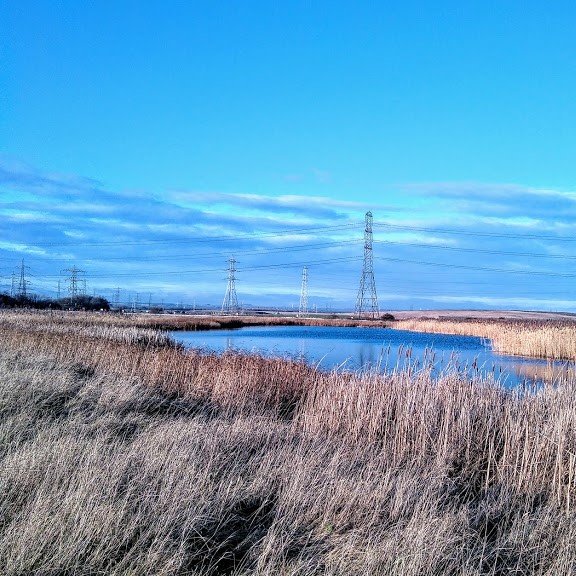
Light-providing pylons stride purposefully across the landscape behind the reserve.
But the birds had left. How silly of us not to remember. At our local nature reserve, Nosterfield, the birds regularly knock off at lunchtime, only reappearing towards dusk. Who knows where they go?
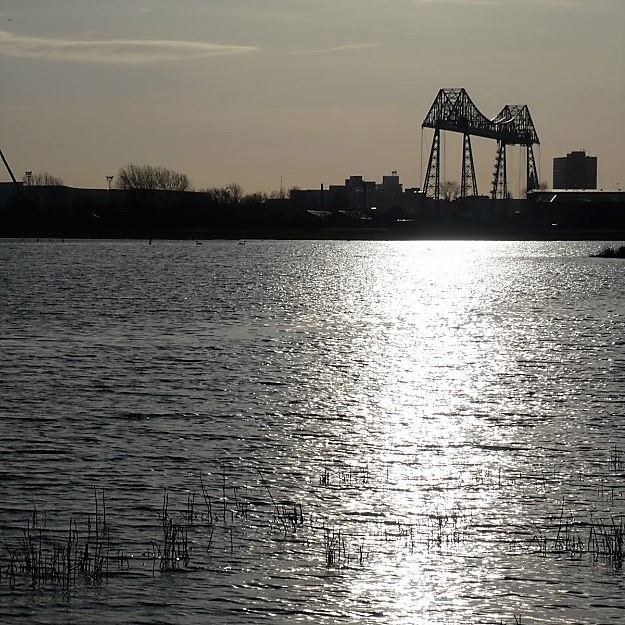
Sunlight plays across the bird-free water. There’s the Tees Transporter Bridge dominating the skyline.
Never mind. We enjoyed a peaceful walk. We got a moment of drama when flocks of birds DID appear, swirling and swooping above the lake. It was quite likely that they were taking evasive action from a resident peregrine falcon hunting for a meal. Drama over, they disappeared once more.
A peregrine-inspired panic?
We enjoyed our time in this peaceful oasis. We explored trails that ended in well-equipped hides.
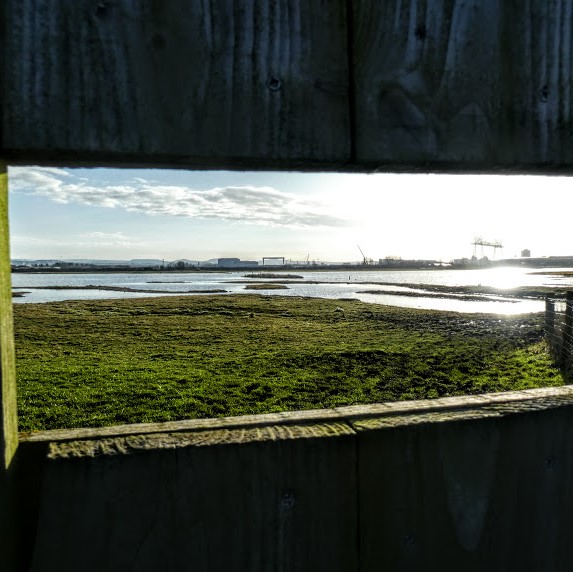
Sky-light, lake-light from the hides.
We studied noticeboards with information about what better-informed visitors had spotted that very day. We passed fields with the inevitable large numbers of greylag geese. And towards the end, we were rewarded with just a few sightings: some shelducks feeding; a shoveler or two; a few swans and a very distant heron.
Greylag geese.
Helpful signage.
Helpful what-we-have-spotted board. We did not contribute.
Shelducks feeding.
Shoveler grooming.
Reedbeds.
But we enjoyed our afternoon. A near-empty wetland, with its unusual backdrop of an industrial past and present, and the never-out-of-sight Tees Transporter Bridge made for a fine afternoon’s walking … and there was even a café.
We love a walk along the South Bank in London. It reminds us of happier times, when during the 2012 Olympic Games, London was for a time the capital of the world: inclusive, happy, welcoming, proud. The South Bank was full of festivity, fun, food, friendliness and foreigners – all welcome.
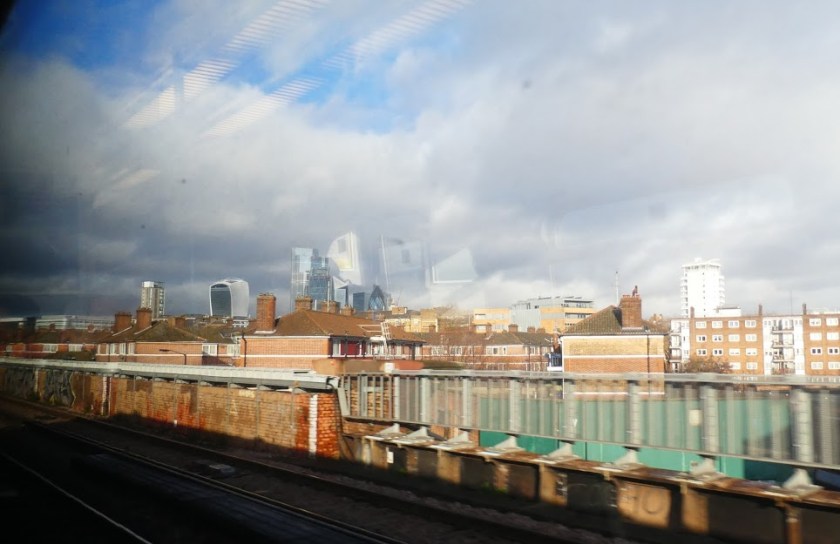
We’ll begin our ‘walk’ on the train into town. Now then. Baffled by the window, it’s hard to pick out which are the city-centre monoliths, and which their reflections.
Not far from London Bridge Station.
We arrive at London Bridge. Here’s street art under the bridge by Nathan Bowen.
Union Jack Dripping by London Bridge: Nathan Bowen.
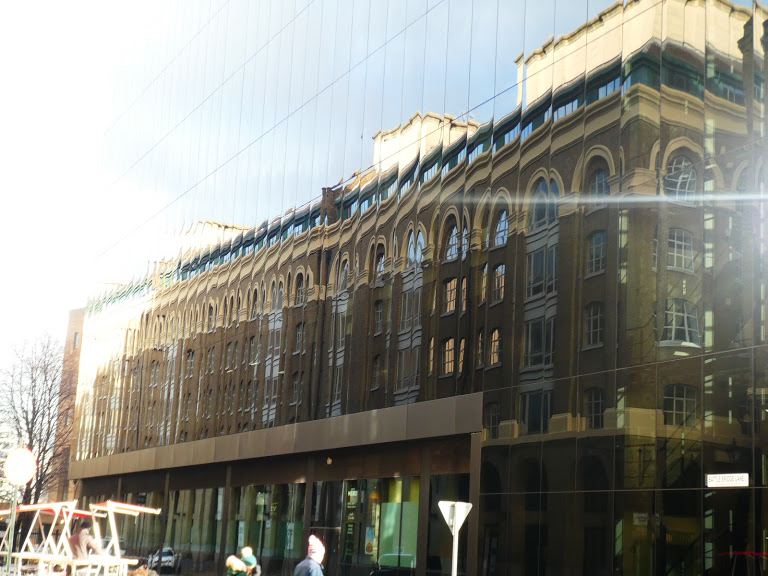
Long-established buildings reflected on new facades.
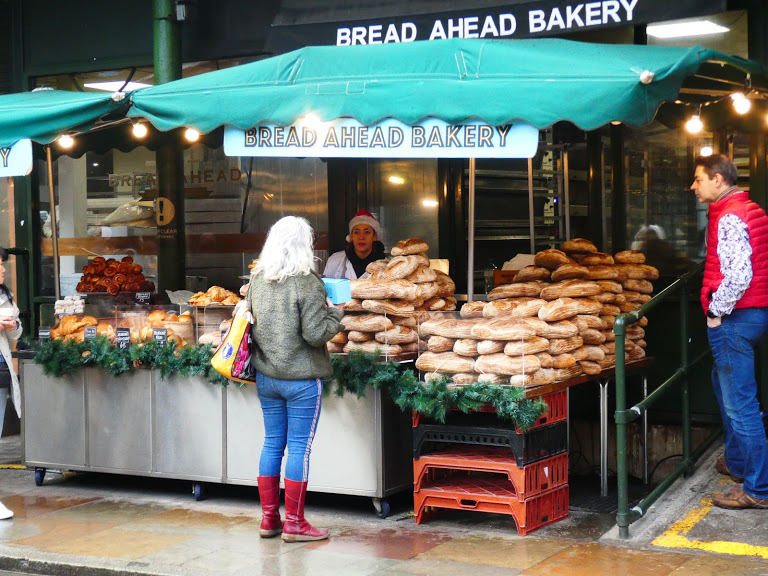
Borough Market. Is it too early for lunch? Sadly, yes. Just looking, then.
Buying bread at Borough Market.
And all those buildings, new and old juxtaposed, on the opposite side of the Thames.
Ah! This is fun. This is Zoë’s moment. A Bubble Man, providing unalloyed joy to dozens of children. And to Zoë.
Time for a coffee-stop (no cake, Jo). We dive into a narrow alley, which opens up to this: we’re not so far from Shakespeare’s Globe here.
But just as we’re getting a little tired of walking, the rain starts. The team divides. The younger members head off for a spot of retail therapy at South Bank’s Winter Market. The oldest and the youngest join forces and return to London Bridge on the river bus. For us, our winter walk of sights is at an end.
Not quite. Back at Hither Green, this is what awaited us just outside the station.
It’s time for a visit to my French archive once more – any excuse to get out of post-election UK. Come and enjoy a traditional British Christmas, as explained to the residents of the small town next to ours when we lived in France.
December 6th, 2011
A ‘So British’ Christmas in Lavelanet
A good old-fashioned English Christmas has come early to Lavelanet. To the library (oops, mediathèque) to be exact. The librarian there enjoys children’s literature, and is a bit of an Anglophile. So she’s mounting a small festival of English Children’s literature featuring everyone from John Burningham and Quentin Blake to – of course – Charles Dickens and Beatrix Potter.
What a disappointment I am to her. I can’t produce a pretty tea set awash with rosebuds, and she can’t believe I really don’t like tea very much: and that when I do drink it, I decline to add milk.
She’s wheeled in Découverte des Terres Lointaines to help with all the activities for schools, retirement homes, and the general public. And DTL have wheeled me in as Consultant on All Matters English. Together we’ve chosen recipes and we’re baking biscuits and cakes and we’ve planned craft activities round, for instance, our ‘so British’ Christmas cards. But said cards must contain no bible-story references. No stables, cribs, angels or Three Wise Men. French schools are strictly laïque – secular – and our friends were astonished to learn that even the mantelpieces of committed atheists are likely to feature Christmas cards from friends, showing church stained glass windows or the Star of Bethlehem.
From tomorrow, I’ll be reading stories in English, helping pull crackers (an unknown treat), and unpacking – many times – a stocking which dear old Father Christmas has delivered to me early.
A satisfyingly bulging stocking.
My other job is to correct the misapprehensions learnt from French websites and children’s books about England. Who knew that the English enjoy tucking in to a huge plate of oysters at the beginning of Christmas dinner? Or that all British schoolchildren have a free bottle of milk every morning? Margaret Thatcher abolished that back in the early 70’s. And Sylvia misunderstood me, and thought we served stewed cherries, not sherry sauce, with our Christmas pudding (cherries – sherry: easy to confuse when you speak no English). And so on.
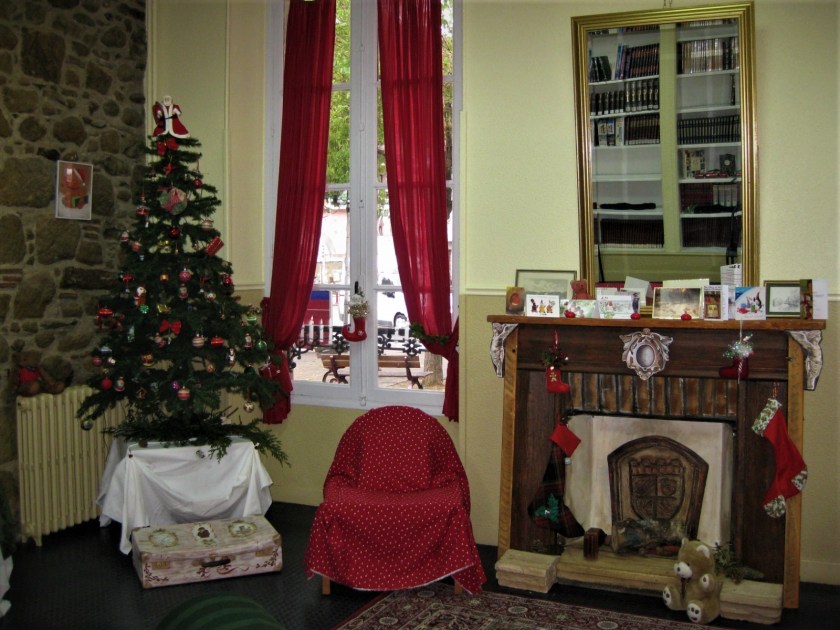
But it’s been fun transforming the community room in the library into an impossibly cosy snug, full of Christmas cheer. Let’s see what ‘le tout public’ think, when we open the doors tomorrow.
Ever since our holiday in Korea, I’ve wanted to make kimchi. Every house had its earthenware kimchi jar, or jars, with various kinds of pickled vegetables fermenting happily away within.
This week I had a cabbage mountain, and two days ago, had the perfect excuse to get started, even though, strictly, it wasn’t the right sort of cabbage. I watched this YouTube video by Maangchi, who’s the Korean cook to watch if you want to acquire a bit of know-how. You can watch it too, but if you don’t feel like it, here’s my summary underneath.
Between soaking chopped cabbage, salting it for long hours; cooking and cooling a sauce base; preparing and processing onions, garlic, ginger; chopping piles of vegetables finely and adding Korean chilli flakes; mixing the lot together; packing it into an airtight container – you won’t be doing much else between breakfast and a very late lunch.
One chopped cabbage.
Two chopped onions, garlic, ginger …
Ground rice and water ‘custard’, with added processed vegetables.
Mix it all up, really thoroughly.
… and bung it in a jar.
Press down well, and … wait … patiently
Now … now it’s beginning to ferment. Sour already, it’ll become more pungent as the days and weeks go by. Try a bit? If it’s your first time you may not like it. But you may come to love it: fermented, sour, spicy, soft yet crunchy, it’s a meal in its own right or a fine addition to a simple plate of rice or noodles. Just as well I made a lot. It was a bit of a palaver.
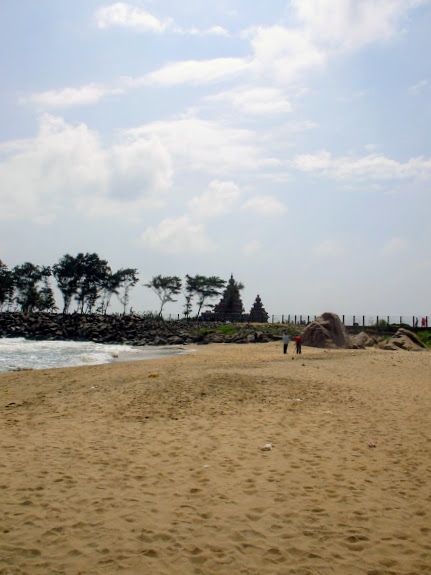
Picture a perfect tropical beach. The palm trees. The white sand. The sun in a cloudless sky above a calm blue sea. That’s Mamallapuram. Now look just behind the beach. Are those statues, monuments?
Beach at Mamallapuram with the Shore Temple in the background.
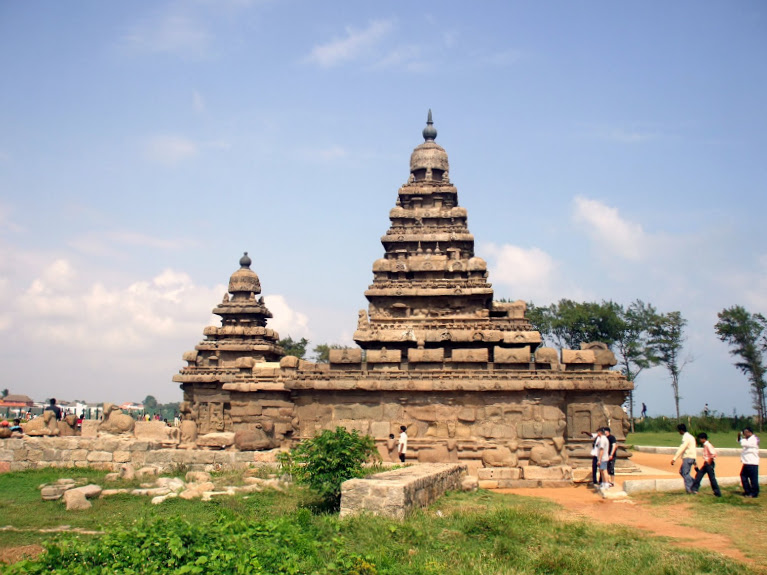
Yes, they are. This town was once a thriving international port. The Chinese came here. The Romans came here. Sailors and traders from around the known world came here. An 8th century text describes how ‘the ships rode at anchor bent to the point of breaking, laden as they were with wealth, big-trunked elephants and gems of nine varieties in heaps‘.
Shore Temple, Mamallapuram
And so it was that just before this time, King Navasimharavan and his successor Rajasimharavan built a series of magnificent temples portraying the events of a great Hindu epic Mahabharata. There are pavilions. There are shrines shaped as temple chariots. There are imposing carved elephants. Here: you can wander round as I did, together with many Indian Sunday trippers. I simply enjoyed these monumental carvings, without going deeply into their history. I was quite simply too exhausted by then.
The Shore Temple.
Sunday afternoon at the Five Rathas
Later I ambled round town. I bought soap and a toothbrush – remember, I hadn’t planned to spend the night here when I left The Hotel from Hell in Chennai. I got a few more souvenirs to take home. I ate on the open terrace of a sheltered restaurant, finding easy company in fellow-travellers. It was a perfect day. My last day. I’d be getting up in the morning to go back to Chennai, pack, get to the airport and … fly home.
Quite suddenly and unexpectedly, one night in 1961, Berlin became a divided city. At first there was merely barbed wire fencing, then a wall. It was all done in such a hurry that mistakes were made. One tiny part of Kreuzberg that belonged to the Eastern sector got isolated in the West. The Americans – for it was in their zone – could do nothing about this unremarkable patch. It became an unloved and unlovely rubbish dump.
Then along came Osman Kalin, an immigrant Turk. He wanted a vegetable patch. He cleared the land and started to plant seeds. As his patch became productive, he gave vegetables to schools, to the local church, to anyone in need. He cobbled together a rather ramshackle tree house. He became something of a local hero.
Initially, the East didn’t mind. But when East Berliners successfully started to tunnel under his patch and escape he came under suspicion. The authorities came to interrogate him, and he welcomed them in his usual hospitable way. They gave up and left him alone.
In 1989, the Wall fell. A newly united Berlin City Council began to see Osman’s ramshackle domain as an embarrassment. They gave him notice to quit. The local and wider community was horrified. 25,000 people signed a petition demanding he be allowed to go on growing his vegetables.
He stayed. He’s 95 now, and doesn’t work so much on his vegetable patch, though his son does. He lives in a flat nearby rather than in the tree house. He’s still a much-loved local hero.
I heard this story on a walking tour offered by Alternative Berlin Tours, led by the remarkable and endlessly interesting Dave. Very highly recommended.
An entry for Six Word Saturday. In her post, Debbie too has chosen to celebrate the fall of the Berlin Wall

























 From Pyrenees to Pennines
You must be logged in to post a comment.