Korea Kalling

We did something like this in 2011. We kissed our daughter Emily ‘Goodbye’ and waved her off as she set off for Barcelona, to become a teaching assistant for a year in a Catalan primary school. She ended up spending more than four years there, and now she’s a fully-fledged English teacher with a flat in Barcelona, fluency in Spanish, a circle of friends, and a happy life .

But this morning, after her three week break in the UK, we waved her off again. She’s off to South Korea this time, to its second city, Busan. She’ll be teaching English in a school there, for one year only. Or so she says…. Read what she has to say about it in her blog, currently called ‘Speaking Spanglish’ – I imagine it will have a name-change quite soon.

savagearts's avatarSpeaking Konglish

Four years ago, I moved to Spain. In the UK, I had wanted to become a teacher. Applying for jobs and schemes usually had the same result though – ‘looking for someone with experience’. How can you get that experience if you can’t get the job in the first place? However, I soon saw a light shining at the end of a tiny tunnel. A conversation assistant in a Spanish school: great! That’ll give me something to pop on my CV. I’ll go back after a year.

Four years later, and there I still was. TEFL-qualified, experienced, and loving it. Barcelona is full of charms, and I am incredibly glad of my decision to move there. It helped me learn a language, blend into another culture, and taught me so many things.

Four years ago, I was also looking down other small tunnels, in the maze of life. One such…

View original post 316 more words
From Jervaulx to Jervaulx – in the mud


Jervaulx9thFeb2016 072

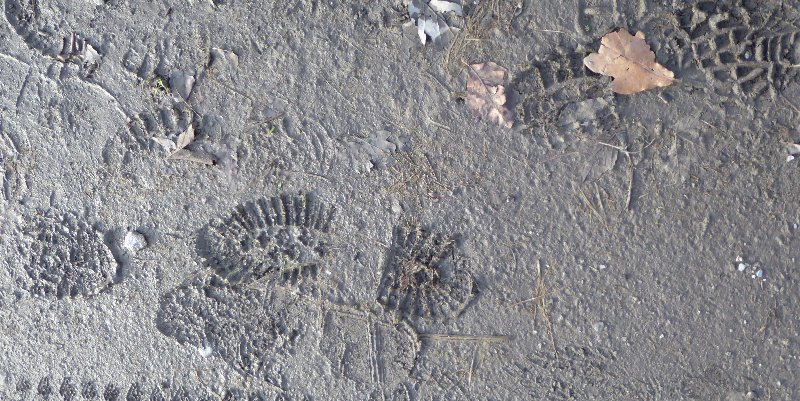
I first walked from Jervaulx to Jervaulx last April, and wrote about it here.  However, I failed to lead my fellow ramblers along the same route later that month as I’d said I would, because it rained…. and rained.  I’d promised them the walk though, and today was the day: bright, sunny, blustery – a perfect winter hike.  Except for one thing.  Those floods that have dominated British news this winter are still making their presence felt.

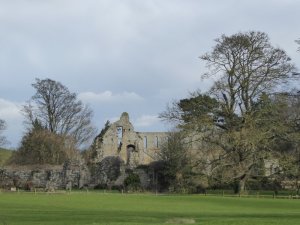
The ruins of Jervaulx.

Our route today didn’t take us through pastureland.  Sheep aren’t very good at being knee-deep in mud. It took us through soggy fields, and past lake after lake after lake: waters that simply were not there last time I took this route.  It was all very pretty.  Less pretty was the scene at stiles.  Look at us skidding and sliding, trying to pick the shallower puddles as we waited out turn to get from one field to another.

We’re British though, always plucky in adversity.  We soldiered on, sometimes a little weary of heaving mud-crusted boots along sticky, sludgy paths.  But nobody fell over, nobody lost their sandwiches in the mud.  Everybody enjoyed those vistas over the Dales, the starkly beautiful skeletal outlines of winter trees, the blue skies, dappled with characterful cloud.  Were we glad to have made the effort?  Well, I was, and I think my steadfast and dependable companions were too.

Happy Christmas!

Christmas in January.

It was Christmas Day last Saturday (30th January).  You hadn’t realised?  Were you having a fairly normal-for-January sort of day?  I expect you were.  You’re not a member of our family, who this year, felt entitled to celebrate the festival on a day that suits us, even though we’d ‘done’ Christmas in December, just as you did.   We take our cue from the Queen , who has an official birthday in June in addition to her actual birthday in April.

We had our reasons.  The London Team had spent their Christmas in Gloucestershire with Sarah’s parents.  The Barcelona Team had spent Christmas in Barcelona with Miquel’s mum.  The Ripon team had spent Christmas In Bolton with  Ellie, Phil and the twins.  Now we wanted to have Christmas with each other.

So we did.  The Christmas tree was pressed into service.  The Christmas cards re-appeared.  Father Christmas briefly came back on duty and made sure that stockings were filled with gifts.  Presents materialised under the tree.  We even perpetuated a new tradition, begun only last year, of being ill for the duration.  Last year, Malcolm and I had flu.  This year, Sarah took to her bed within two hours of arrival, though she managed to surface on ‘Christmas Day’.  William streamed with cold and was generally off-colour the whole time, and Emily and I coughed and wheezed.

Christmas dinner featured all the trimmings … but no turkey, no goose, nothing like that. The English teams had already done all that on December 25th, and Team Barcelona was pining for a really good British banger.  So that’s what we had.   Thanks, Geordie Banger Company.

The crackers featured appalling jokes, just as they should, and even more appalling novelties (floppy plastic golf tees, anybody?).  William was entranced by the flaming of the Christmas pudding.  And in the best tradition of all family Christmases with a baby in tow, playing with noisy, rustly wrapping paper and discarded ribbon offered the best fun of all.  There’s a lot to be said for doing good things twice.

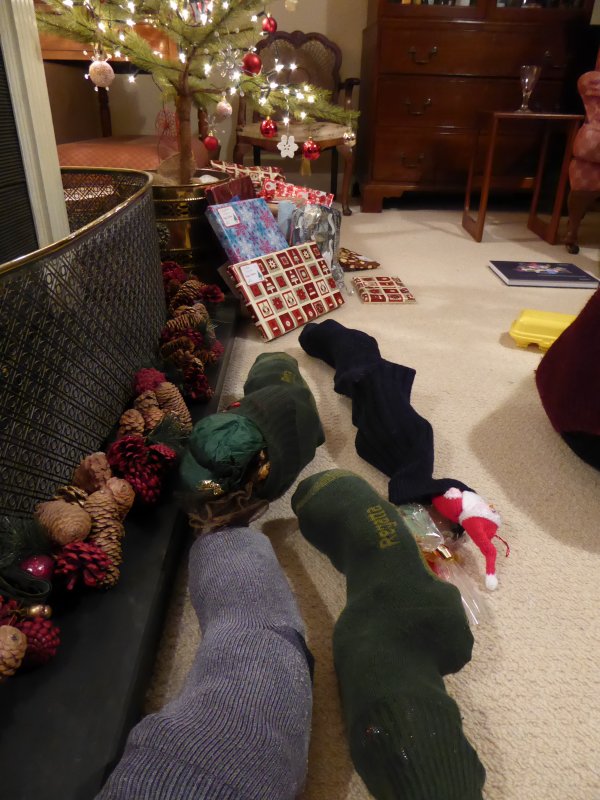
Father Christmas appears to have dumped all the stockings in rather a hurry.

Let Nature take its course

Step out into the garden, and the countryside beyond at the moment, and you’ll find snowdrops doing what they do best in January – piercing the barren earth, colonising grassy patches, nestling under trees and marching across gladed hillsides.  Untroubled by unseasonal weather, their inner clocks direct them to grow, multiply, and cheer us all up in an otherwise gloomy, un-festive sort of month.  That’s Nature for you: ordered, seasonal and predictable.

A farmer's field? Or Sleningford-by-the-sea?
A farmer’s field? Or Sleningford-by-the-sea?

But Nature has another face.  Come with me beyond the garden, past the fields slickly shimmering with surface water, to the banks of the River Ure.  Just two minutes walk from here, it makes a wide sweeping curve away from its route from West Tanfield, and (normally) meanders gently into Ripon. That was before this winter, this rain, this unending water.

Once the rains came, and once it reached town, the River Ure rather wanted to swamp people’s gardens and make a bid to enter their houses.  Recently-built flood defences put paid to that idea.  The River Ure took its revenge on us, or more specifically, on the farmer whose fields adjoin us.  Up in the hills, waters from streams and rivulets in the Dales cascaded into the Ure, which gushed and surged along its course, rising higher and higher, tearing at the banks, ingesting great clods of earth and forcing them downstream.  The water levels are falling now.  The damage remains.

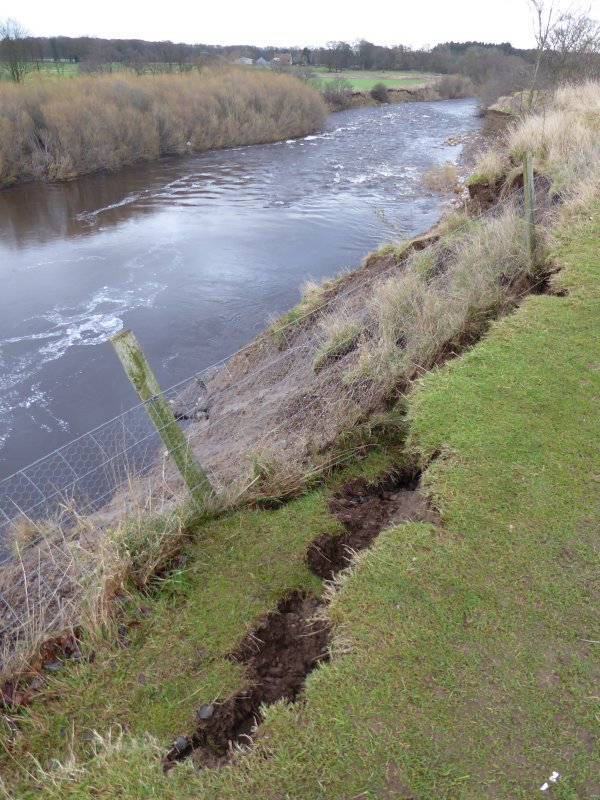
The River Ure seizes the land.

Look.  Here’s a chain link fence which marks  a pathway running along the edge of the farmer’s field.  It should be on terra firma, with a nice grassy margin between the fence itself and the river bank.  Now it has nothing to hold onto.  The bank has been snatched away, and the fence is hanging crazily and directly over the swelling waters below.  The earth has slipped, and continues to slip.  The farmer is losing his field, and the river is changing course.  There’s not much anybody can do about it.

We’ll watch the water awhile, and frighten ourselves witless at the prospect of falling in and being swept mercilessly away. Then we’ll wander back though the woods, and enjoy the snowdrops and aconites once more.  Nature takes its course.

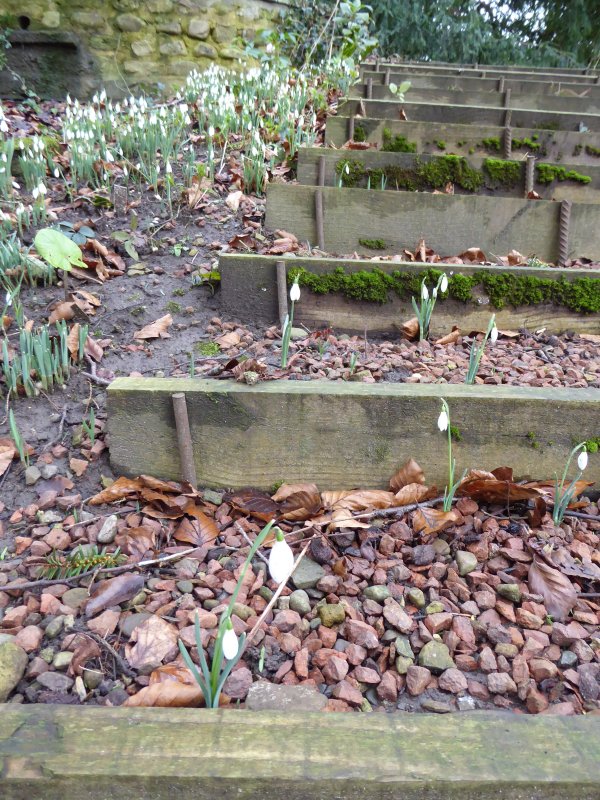
The steps through the woods.

Bischofsbrot

The other day, apropos a post I’d written on my blog, Notes on a family, an old school friend, Gillian,  sent me this message.

‘I still have your mum’s recipe for fruit cake with chunks of dark chocolate in it – to die for !’

What could she have meant?  So I thought.  Then I thought some more.  And suddenly I remembered.  Bischofsbrot.

I remembered helping my mother make this cake from time to time:  not often, it was expensive.  I remember chunks of chocolate, nuts, cherries, dried fruit… lots of eggs.  And I wanted to make it again.  Like Gillian, I liked it – a lot.  I hunted through my mother’s old notebook, crammed with recipes from old friends or clipped out of the paper.  Nothing doing.  None of my own recipe books helped out.  I turned to the net, and found a few there, but none of them seemed quite right.  I settled on this one, because it was at least measured in grams rather than the dreaded cups, and here it is.

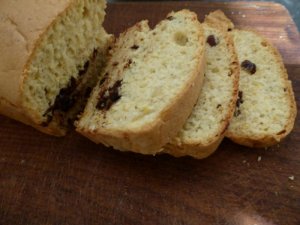
We’ve just eaten a slice each.  I’m not happy.  It’s nice enough, but it’s not startling me with memories of what the cake, bright with jewelled candied fruits, nuts and satisfying chunks of dark chocolate, ought to taste like.

It doesn't even look right. Not happy.
It doesn’t even look right. Not happy.

I need help.  Gillian?  You claim to have the recipe!  Stephan over in Germany?  Heidi, half-German pâtissière extraordinaire with friends who bake with you in the Clandestine Cake Club? Patty, with your German heritage?  Sarah, adventurous seeker after new recipes? Someone must have the definitive version, the one that will summon up that long-forgotten taste from childhood.  I can’t even get a straight story about this cake.  Is it German?  Or Austrian? Is it a cake for Christmas?  Or something else?  So many different stories.   Someone must be able to put me right.  Get in touch. This is becoming urgent.  I want Bischofsbrot, and I want it now.


That family tree of mine

My goodness.  What a can of worms I opened when I decided to research a  bit of family history.  Originally, I simply planned to gather together all the stories, legends, bits of fact and fiction that all families accrue around themselves and record them in my new blog ‘Notes on a family’.  But then, you can get a free trial period of a fortnight on Ancestry UK, so why not take things a little further?

I think the site may have sucked me in, just as it wanted to.  Sleuthing around, tracking my family through the generations has been quite a lot of (frustrating) fun.  But all  that’s for the other blog.  Here’s where I wanted to tell you about some of the incidental  stuff I’ve found.

Did you know, for instance, that the census recorders used to have to note anybody they found who could be described as:

  1. Deaf and dumb
  2. Blind.
  3. Lunatic
  4. Imbecile, feeble minded.

I remember that my mother told me that when she was a child, the use of such terms as ‘moron’, ‘imbecile’ and ‘idiot’ was quite normal and not necessarily offensive, while my father, never known for his political correctness, had no problem in winding down his car window to yell ‘cretin’ at any passing jay-walker.

One of the shocks is just how large my ‘family’ is, potentially.  My grandfather was one of ten, his father one of nine.  Add in their spouses, their children, and their children’s spouses and children, and sudenly you’re wondering if the person you hold a door open for at the library might be your seventh cousin, five times removed.

And then all those wonderful occupations.  My grandmother’s family came from the textile districts of Yorkshire and Lancashire, so whole streets full of people worked at the busy mills.  But nothing as dull as ‘Mill worker‘ will do as a job description.  Try these: *‘worsted spinner’; ‘overlooker, stuff factory’; ‘stuff weaver’; ‘scribbling overlooker’ (what?), ‘woollen piecer’.  An entire road’s worth of houses were inhabited by people had jobs such as these.  Just occasionally, someone else got thrown into the mix. ‘Lamplighter’; ‘washerwoman’; ‘Roman Catholic priest’, as well as the odd ‘domestic servant‘, a young girl of 15 to 20, usually.

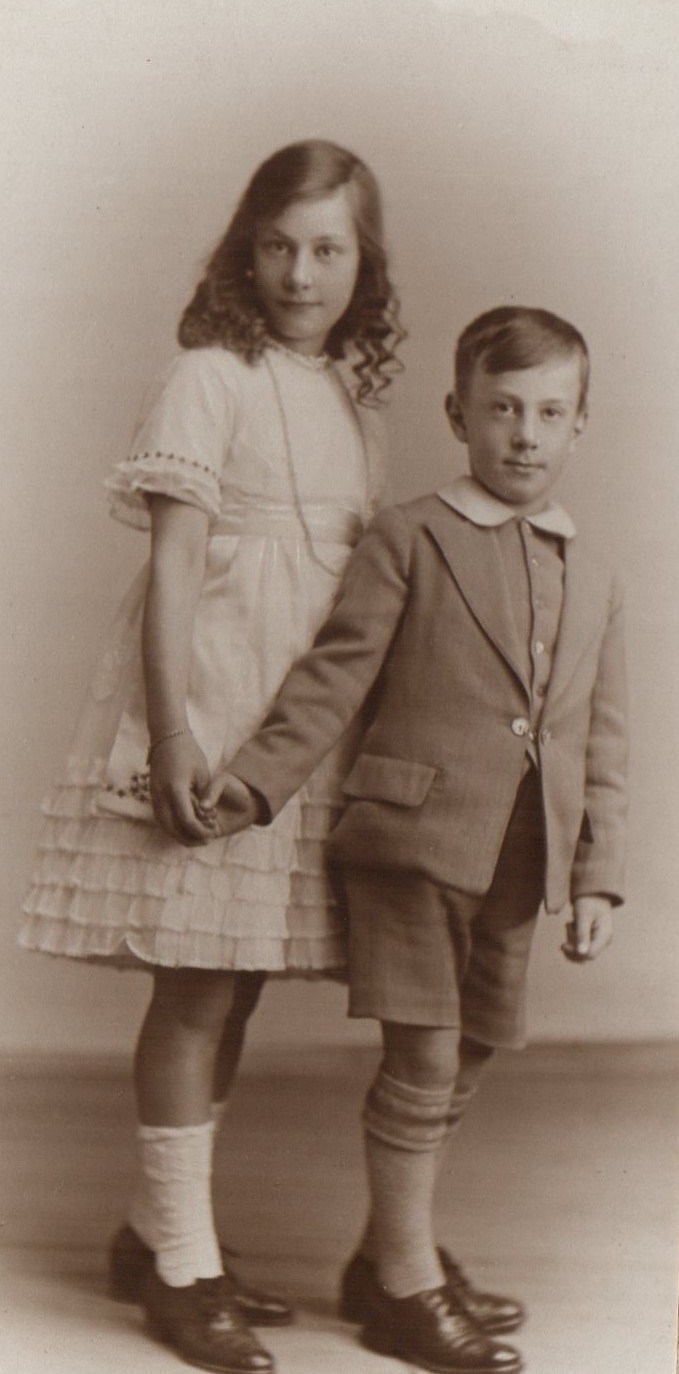
I couldn’t think how to illustrate this piece.  Then I remembered a couple of old family albums, full of photos I have no possible means of identifying.  Let’s give them their last outing.


  • These are for you, Kerry.

My University assignment

Here I am, still slaving away at Blogging 101, the University of Blogging.  I’m beginning to get a bit on edge when I fire up the laptop in the morning, because I know Senior Lecturer and Course Director Michelle W will have sent out yet another assignment requiring us to tweak and tinker with our blogs, and generally bring them up to scratch.  I even played hooky the day before yesterday, and the day before that.  Doesn’t she know I have a LIFE to lead?

However, here I am again, back in the University Libary (aka our study).  Today we have to write a post.  And it’s to be inspired by a blog we found yesterday, a blog new to us, which we felt moved to comment on.

I discovered Katherine Price.  She can write in a way that takes me to her world, her street, her little stretch of the Thames and help me to savour with her the local trees and the daily rhythms of the birds, whether a clamour of rooks, or a solitary kingfisher streaking past.  The first post I read was a bit of a hymn to staying put and not moving on, a hymn to her home in suburbia.

And it got me thinking about where I live now, and where I used to live… and the time before that… and the time before that.  It reminded me of a post I wrote almost 5 years ago, and I thought it was maybe time to revisit it and re-work it.

I spent my childhood in London: population 8.5 million.

Then I went to University in Manchester: population 2.5 million.

A few years later I was living in Leeds: population 751,000.

And then we moved to Harrogate: population 76,000.

Then we went to France and I started a blog. We lived in Laroque d’Olmes with about 2,500 other people.

And now we’ve come back to England, and we live in North Stainley.  This is a village whose population is about 730.

Can you see a pattern here?

Everwhere I’ve lived has seemed special at the time.  I used to relish all that a big city could offer, whether the museums, cinemas, or the huge choice of shops.  As I moved onwards and downwards, I remembered instead and with some horror the crowds, the dirt, the general busy-ness of the place before.  Good heavens, even Laroque, not big enough to support a range of shops, much less a cinema or a swimming pool seems rather exotic compared with the facilities in North Stainley (a village hall, a church, and a pub,  to be re-opened in early spring). We’ve traded cinemas for a film on Saturdays once every 6 weeks in the village hall, and shops for the chance to buy eggs from the farm not far from here.  And this blog is where I often report on what we discover as we explore our local countryside .

I’ll leave you with a quiz: can you identify each of the places I’ve lived in from these images?

A post for a fellow-blogger.

I’m at university this week. The University of Blogging. This seat of learning, which has no rector, no library and confers no degrees, runs a programme regularly hosted by WordPress,and aims to bring together people who from all over the world, keen to hone their writing and presentation skills, and to help each other to Write a Better Blog.

Today’s assignment:  
Publish a post you’d like your ideal audience member to read.
I’ve chosen to write for one of you.  We haven’t met. We don’t live on the same continent.  But we’re ‘blogging friends’ who enjoy one another’s posts and often say so. You say you like the posts I write about walking in the Yorkshire Dales.  I like the posts in which you too describe your walks, often more extensive than mine, taking place over several days. You stride beside me – virtually of course – as I tramp along the leaf mould paths of a dappled English woodland.   I stop to gaze across the green and undulating hills  at the lattice work of ancient fields, divided by drystone walls, and share the view with you courtesy of my camera.
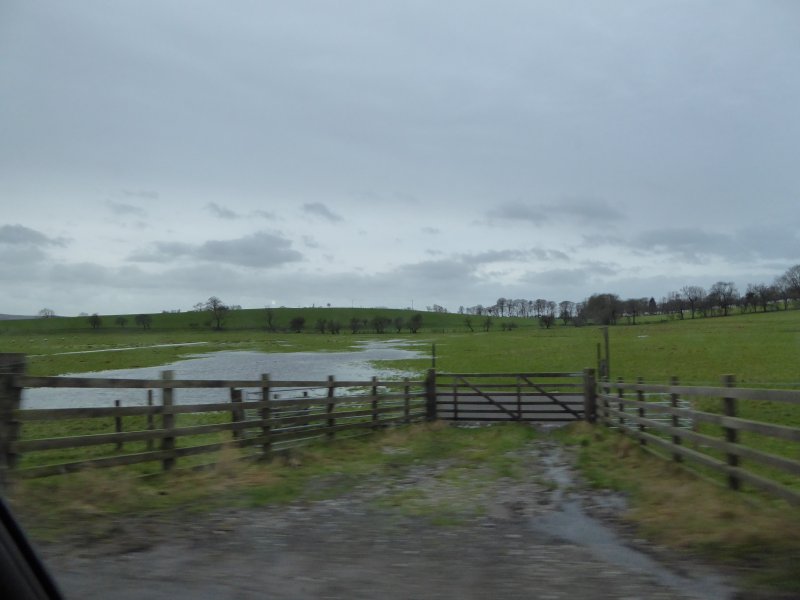
Except… I haven’t.  Not lately.  Those floods I wrote about a couple of weeks ago are an ever-present danger to some.  And even for those who haven’t had flooded homes  to contend with, the weekly rhythm has changed.  Walking is quite simply not on.  The other day, fed up with the lack of exercise, I took myself off to walk along country roads instead.  I’d not been going ten minutes when I met a deep trough as wide as the road, as deep as my ankles, and as long as… well, I don’t know.  It went beyond the next bend, anyhow, and I went home.  The fields are home to seagulls who bob about on the choppy waters.  The paths are streams.  The streams are rivers.  And the rivers are seas.
i) Quiz question: which is the path, and which the brook?
ii) This, I’m afraid, is a path.
iii) Brian-from-Bolton simply can’t stand getting his paws muddy.  He’s urging me home – NOW.
But I’m keen to get out and about again as soon as I can.  And I hope you’ll come with me, in a virtual sort of way, when I report back.
Bolton&BrianJan2015 048
A typical field. And not half as bad as some.

Notes on a family

I’ve been writing this blog, firstly as ‘Life in Laroque‘, and later, when we returned to England, as ‘From Pyrenees to Pennines‘ for eight years now.  I’m beginning to feel the ‘brand’ is becoming a little tired, and that I may no longer post quite so regularly.

But I shan’t stop writing.  I’m planning to start a blog that  I’ll call ‘Notes on a family‘, which will mainly be for family members to read.  I can’t think it will attract many followers from further afield.

Mine is a relatively small family.  As a child, I had no brothers, no sisters, no grandparents, no aunts, and only one uncle, whom I met once.  Obviously then, no cousins either.  I didn’t mind.  I listened to my schoolfriends moaning about the torments of having a brother,  how annoying their sisters were, and how embarrassing they found their Uncle Norman and Auntie Elaine, and took their comments at face value.

img019
This makes me feel very old. It’s my mother with her younger brother. Such a period piece.

One of my regrets when my mother died was that I’d asked her so little about her family.  Her father, for instance, who’d died when she was 19.  He was one of 8 siblings born to a poor London family.  Alone among those siblings, he was sent to Grammar School, which can’t have been at all easy.  He won a scholarship to Cambridge, where he did exceptionally well, and became a parish priest.  What’s the story there?  I shall never know now.

My father too.  He came from Poland during World War II.  His family were well-to-do landowners at one point, but his father died when he was 12. Because his mother remarried and I don’t know what her new surname was, I have no means of tracing any family members there.

But there are leads I can follow, and I have started to do so.  My new blog will not be organised chronologically.  Rather I’ll tell tales as they occur to me, recount results of research when I have any successes.  Here’s the first post.

Flood

December in the north of England has been the month of the flood. Until Boxing Day, it was Cumbria that saw all the action, with some communities flooded out not once, not twice, but three times.  They were told to stand by for more on Boxing Day.  They readied themselves…. and nothing happened, because the torrential rains prophesied swept south and east of them, firstly into Lancashire, and then Yorkshire

We were staying with my daughter’s family in that part of Greater Manchester that used to be in Lancashire.  They live near a Nature Reserve through which Bradshaw Brook passes.  I’d say ‘flows’, but such a phrase is normally far too active a description for this narrow little watercourse.

This was Bradshaw Brook yesterday.

ChristmasBolton2015 029
Bradshaw Brook, Boxing Day 2015

We were due to travel home from their house to ours, in Yorkshire.  Highways England, the BBC, and motoring organisations all had conflicting information on their websites.  But they all agreed that our usual route, a scenic drive over the Pennines, was largely impassable.

It would have to be the motorway.  Longer, duller, but surer.  We’d not long been travelling when we noticed that traffic on the other carriageway was at a complete standstill, for miles…and miles.  It was only when we got home that we found out that a 20′ sinkhole had opened up near Rochdale.  So much for safer-by-motorway…..

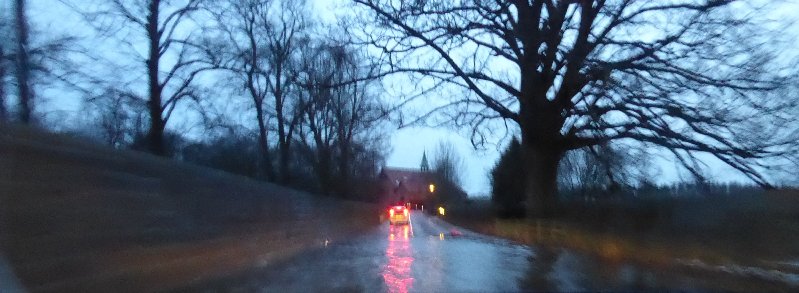
Where to leave the motorway though, for the final few miles home?  There were floods in Leeds, floods near Harrogate – there were sure to be floods in Boroughbridge too.  What about Knaresborough?  It turned out there were floods near there too, as we discovered when warning notices turned us back on the road we’d come on, and sent us back by several miles to look for another route.  Familiar fields had turned into lakes, deep and almost unfordable road-side puddles were unavoidable.

ChristmasBolton2015 045
This doesn’t look too bad. Trust me. It’s deep.

We’re lucky.  We were flood-tourists on our journey home, gawping at rivers-become-seas, and roads-become-rivers.  Our home wasn’t flooded, nor will it be.  Others aren’t so fortunate.  They’re either contemplating the devastation of their own home or business – or both, or anxiously shoring up the front door with as many sandbags as they can lay their hands on, in anticipation of the days ahead, when the forecast continues to be grim.  We could all do with a bit of an old-fashioned winter cold snap, with a touch of frost, but positively no rain.

FASR&Ripon27Dec2015 025
You see that bridge, centre left? That’s a bridge over the River Ure, in Ripon. This lake in the foreground is not a lake, but open ground at the edge of the city, favoured by dog-walkers and children.