A third Christmas with cancer as an unwelcome guest. Regular readers of my blog know my son-in-law died of cancer after living with it for two tough years. Regular readers also know that his widow, my daughter, got her own cancer diagnosis only weeks after his death. Regular readers have read some of her feisty, angry, witty pieces about this wretched disease. They know that her initial hopes : ‘Breast cancer is NO BIG DEAL’ vanished in the face of evidence of more and larger tumours. She faced more invasive tests and scans. Friday was results day.
A month ago, news that she will need a mastectomy, probably six months of chemotherapy, and perhaps radiotherapy as well would have pitched her, and all of us into a pit of helpless gloom. Now it’s a reprieve. Now we can face 2017 hopeful that after all this she will live, will see her twins grow up, will continue to be an important part of the lives of all her friends and family.
I don’t feel like glibly heading this post ‘Snapshot Sunday’ as I usually do. But this week’s theme, ‘New Horizon’ is relevant. My daughter – all of us – have a new horizon to work towards as her treatment seeks to return her to a cancer-free future.
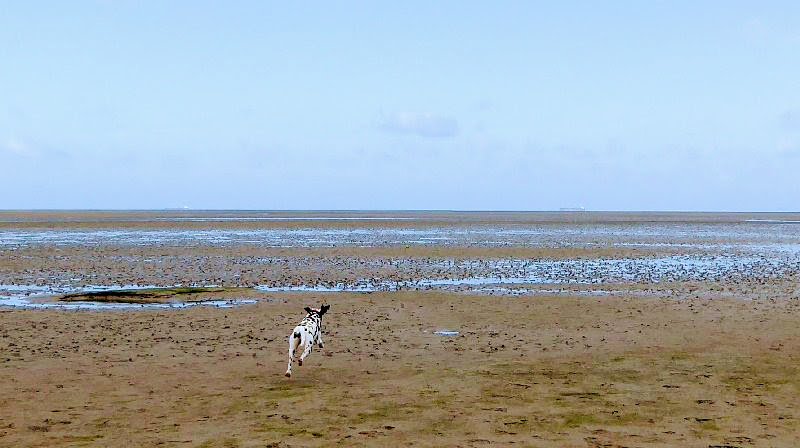
Ellie and the boys’ dog Brian dashes towards the horizon in Anglesey in August, just before Ellie’s diagnosis.
Now let’s see. Did we go to Burton Constable or Constable Burton the other day?
Oh, do keep up. Burton Constable is a stately home in Yorkshire, whereas Constable Burton is … a stately home in Yorkshire. And they have nothing whatever to do with one another.
Let’s start again. Constable Burton Hall is a fine country house not far from us in North Yorkshire. It’s not open to the public, though its wonderful gardens are.
This is Burton Constable
Burton Constable Hall is a fine country house hidden away not far from the city of Hull in East Yorkshire. This is a town whose dismal reputation may be salvaged next year when it becomes the UK City of Culture.
‘From Hull Hell and Halifax may the good Lord deliver us’. In mediaeval times, this was the Yorkshire thieves’ litany. Nobody wanted hell; nor Halifax with its unique gibbet, a savage early guillotine; nor Hull, with its notorious gaol. People unfairly use the prayer to this day, even if they don’t expect to suffer or die there, though neither city deserves it. We’re bound to make a trip or two to Hull next year, so I’ll tell you all about it, then.
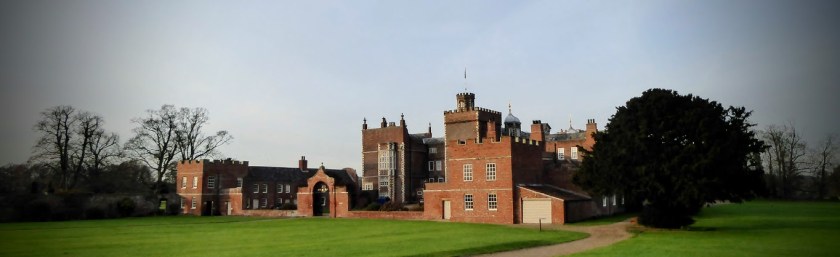
And this is its facade.
Meanwhile. Burton Constable. It has a long and complicated history dating far further back than the Elizabethan exterior which you first see suggests. The oldest part of the house dates back to the 12th century, when a pele tower was built to protect the inhabitants of the village of Constable Burton during the lawless reign of King Stephen. Remodelled in Elizabethan times, it had several further makeovers, and its interior has a lovely 16th and 17th century Long Gallery – for strolling through. Then in the 18th century the interior was largely brought up to date with the latest designs and plasterwork from the likes of top-flight names such as Robert Adam and Giuseppe Cortese. Capability Brown – who else? – landscaped the grounds.
It’s fallen on hard times though. Imagine the expense of keeping such a property in good order. The whole estate and grounds are now managed by a charitable trust while the family lives in an apartment in one of the wings. Repairs and restoration are slow and on-going.
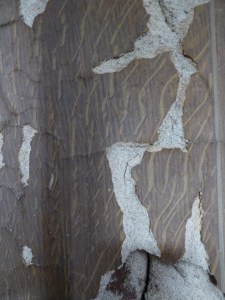
Behind the scenes. Imitation woodwork in need of restoration.
I’ll just give you a taste of some of the charms of the place:
A Cabinet of Curiosities, with imperfectly stuffed creatures such armadillos; scientific instruments; fossils and other curios.
Spot the armadillo
A desk full,of curiosities.
The cabinet includes some of the collections of Ralph Thoresby. We know about Ralph Thoresby if we’ve lived in Leeds
A 19th century Chinese room, inspired by the Brighton Pavilion. Here be dragons.
Pure silk wall covering.
Elegant displays of Chinese porcelain.
There’s simpler, more rustic Chinese ware on display too.
The Long Gallery with its specially designed bookcases.
Just the place for a stroll – the Long Gallery.
The house joiner made these made-to-measure bookcases during the Jacobean period
And oddly, in the Great Barn, the skeleton of a whale washed up in nearby Holderness, which inspired Herman Melville to write ‘Moby Dick’.
The back end of Moby Dick.
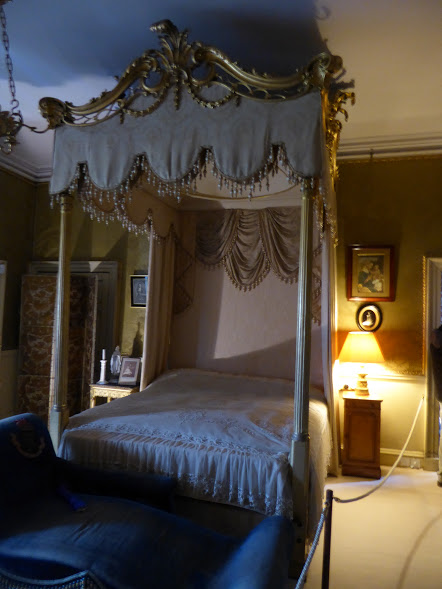
With a succession of fine rooms – from the Blue Drawing Room to the Gold bedroom, and tantalising glimpses of life below stairs, this is a place to spend the entire day. The staff love an interested visitor, and repay your interest with history and gossip from the glory-days of the house.
The Gold Bedroom.
Rules below stairs.
The back stairs don’t need to be elegant.
A working kitchen.
We’ll be back in the summer, to join one of the tours to explore the hidden secrets of this place.
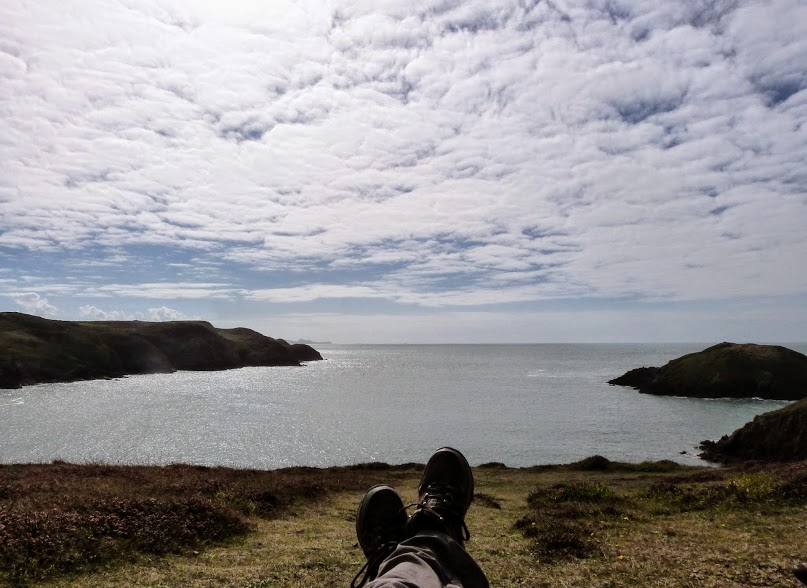
A moment of relaxation on the Pembrokeshire Coastal Path.
It’s said that if you walk every inch of the Pembrokeshire Coastal Path, all 186 miles of it, you’ll have climbed the equivalent of Mount Everest. I can believe it. No sooner have you climbed one limestone cliff than you’re plunging down towards a bay; up again to a volcanic headland; down again to an estuary, or to a beach frequented only by seals and seabirds.
We didn’t do all 186 miles when we were there two summers ago. But we did enough to know that after a hard climb in bright sunshine with the wind behind us, we’d truly relax when we threw ourselves onto the springy turf to catch our breath and enjoy the seascape spread before us.
This week’s challenge is to respond to the word ‘relax’. Look here to see more posts.
Have you ever had a flutter on who might win the Grand National or The Derby? If you have, there’s a very good chance that the horse you fancied might have trained at Middleham.
Middleham’s a small town in Wensleydale of 800 or so inhabitants. You’ll notice its fine castle (Richard III stayed here) even before you get there.
Middleham Castle
And when you arrive, you’re as likely to see – no, you’re likelier to see – horses rather than pedestrians. The principal industry of this little place, since about 1730, is training horses. There are some 15 training establishments in town, and each of them may have up to 150 horses or more, aiming to be among the next generation of racehorses.
Every day clusters of riders take their charges up onto The Gallops to exercise and train them. We citizens who come to the area to walk and take in the views have to play second fiddle, at least during morning exercises.
Who cares? On Thursday, we were happy to share the views and skyscapes with such magnificent beasts as we strode across the moorland.
Later on, we walked through Coverdale, past Tupgill, upwards through the tiny hamlet of Caldbergh along wild and little-frequented tracks. Then it was sheep who were obliged to share their pastureland with us. They were sure we’d have mangel-wurzels to offer them and hurried towards us. We hadn’t. They were unimpressed.
We left them to it. We had a walk to finish, preferably before lunchtime. And we rather hoped for something more appetising to eat than mangel-wurzels.
I’m quietly proud of this photograph. It was taken on holiday when our boys were about four months old, and I’d asked my husband to get a picture for posterity. It’s never been in the family album, but not because I care if people are offended by a photo of my tits doing the job they were designed for (hell, I’d tandem feed anywhere – once, I even propped up the children against my nipples on the window ledge of an overhead walkway at a service station on the M6, having fed them earlier that day during church communion.) I didn’t give a shit as long as the boys were nourished, but I simply couldn’t bear for anyone to look at the photo and think I’d chosen the hideous fabric on that sofa.
I’ve blurred out my face – not because I’m embarrassed, but because the two little generic-looking blond…
Photo challenge: ‘It’s not this time of year without…..’. It’s holidays and celebrations that WordPress seems to have in mind in setting this challenge, but this is November, and we don’t do Thanksgiving in England. We do dark nights that begin at four o’clock. We do gusting rain that snatches the remaining leaves from the trees. We do fog that rises from the river. Nothing much to celebrate at all. Except …. except that it can turn out differently.
Read on.
Sunshine after rain at Studley Royal
I was in a bad mood when I got up. My shoulder hurt – a lot. The sky was steel-grey, the temperature steel-cold, and I was supposed to be leading a walk. This was going to be No Fun At All, because although no rain was forecast, we’d had two days of full-on deluge. I just knew that virtually the entire circuit would be a mud-bath.
I trudged off to our rendez-vous with ill grace. Once there though, I started to cheer up. The prospect of good company for the day is always a positive start. We set off. The ground was unexpectedly firm, the clouds started to lift and the sun to shine. Soon we were making a coffee-stop outside 14th century Markenfield Hall.
Coffee stop in front of Markenfield Hall.
Then it was through woods and across open fields (still no mud) to find a lunch spot overlooking Fountains Abbey, still framed with russet Autumn leaves.
Sandwiches, sunshine and Fountains Abbey.
After lunch, a muddy farm, where we attracted the interest of the locals.
Calves closely inspected us as we squelched past. Yes, this farmyard was very muddy indeed.
And an uplifting final couple of miles, with grazing red deer, light-reflecting ponds and surrounded by a final burst of Autumn colour.
Here is the parkland of Studley Royal. Can you see the red deer in the distance?
William has Christmas sorted. He doesn’t know it, but he’s going to become a home-maker and possibly a shopkeeper.
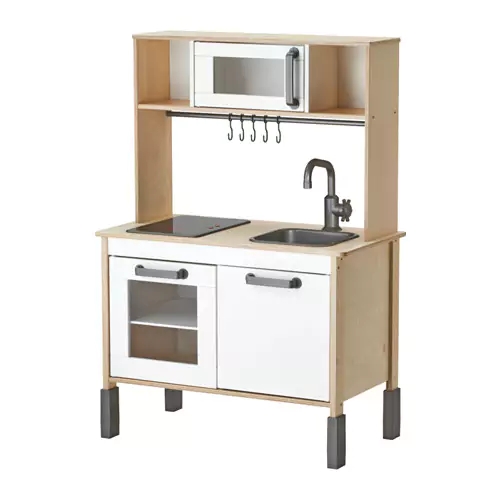
By December 25th, William, my grandson, will be almost 18 months old. Time to learn how to keep house, then. His parents are planning to give him his very own kitchen. Here it is:
Play kitchen (IKEA Duktig)
It’s very different from the affair my son and his sisters had when they were small. Their appliances were fashioned from sturdy boxes and painted to look rather like the simplest of student kitchens.
His other grandparents are planning to stock this ultra-smart 2016 kitchen with pots and pans, teacups and plates. And my son, William’s dad, remembered that when he was small, I supplied him with home made play-food. He’s asked me to make a larder full for William.
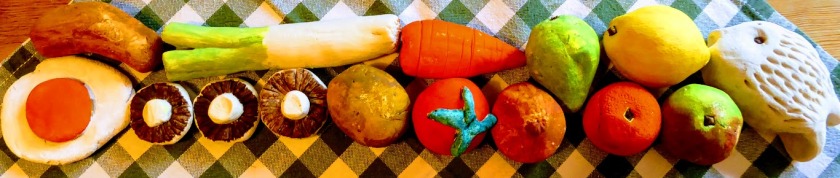
So here we are. For the past week or so, I’ve been kneading salt dough, and fashioning food of all kinds to bake in the oven, paint and then varnish.
If you call to see William in January, he may offer you a meal of fish and chips, sausage egg and chips (no fine dining here, I’m afraid) with oranges, lemons, apples or pears to follow.
Hmm. Pears proved tricky. But they look – slightly – better away from the glare of the camera.
If you want to cook instead, there are just potatoes, onions, leeks, mushrooms, tomatoes – cabbages are too unwieldy, peas too accident-prone.
I’ve had fun. Let’s hope William enjoys his kitchen, and turns out to be as good and creative a cook as his dad – and mum – are.
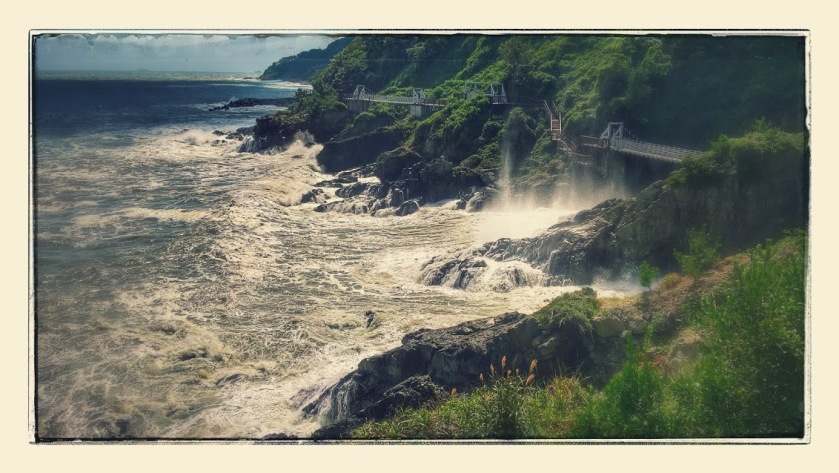
The view from the Igidae Trail to Busan and Haeundae
Life’s complicated just now. I don’t need any more challenges. But here I am, taking on one which is entirely self-imposed. It’ll help me reflect on the good moments in life, or at least on interesting times.
The challenge is one provoked weekly by WordPress, my blogging platform. Once a week, they provide a word. Just one. To respond, I and fellow bloggers choose one of our own photos to interpret the theme. Just one.
Imagine Busan, the city where Emily’s living just now. Imagine busy streets, crowded markets, streaming traffic, a high-rise metropolis of three and a half million people.
But it’s a coastal city too, and one day we took the path at Igidae. Here were views across the bay to those high-rise towers at Haeundae, to Gwangan Suspension Bridge, and to a jagged, rocky coastline.
As we walked away from Haeundae, we replaced city bustle with solitude, with crashing foaming waves, salty spray crusting our hair and faces, rugged paths leading us first up craggy cliffs then down again. The busy city was never more than minutes away, but we were at the edge of a primitive, savage untamed world, unchanging since time began. That was a kind of magic.
The sea crashes to the cliffs of the Igidae Trail
My challenge posts will appear on Sundays. Hence ‘Snapshot Sunday.’
Why go for a good long walk? Well, for the pleasures of the countryside of course. The views, the mulchy paths through woodland and across meadows: all the sights and sounds of The Great Outdoors. But for most of us, there’s another reason too. We want a decent bit of exercise. Get those legs into gear!
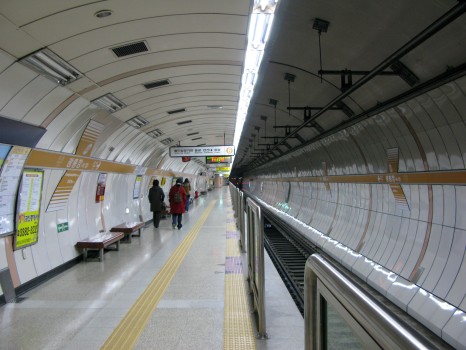
It’s no weather for walking at the moment, so in front of the fire, we fell to reminiscing about walking in South Korea. Not the mountain walks to hidden temples, secret waterfalls. No, we remembered walking in the metro systems of those mega-cities of Seoul and Busan.
It was courtesy of the subway that we got from A to B when we were tourists in those cities. Our command of hangul was so limited that the bus had disappeared round the corner before we’d decoded its destination.
Announcements on the stations were helpfully in Korean and English, and you knew which direction the train was heading in, because as it pulled into the station, a tune would play. Outward – one tune: inward, another. One of Busan’s tunes was a few bars from Vivaldi’s ‘Four Seasons’.
Seoul subway. Once in the carriage, we older travellers had a dedicated area where the younger commuter wouldn’t dare to sit, unless disabled or pregnant.
But all that’s for when you’d reached the platform – sorry – ‘tracks’. First find your platform. At one station in Busan, I found that once below ground, I still had a whole 750 metres to walk to get to the automatic ticket barrier marking the station entrance.
Here we are. Exit number 13
Some stations were vast, with up to 16 exits spread over a large geographical area. Leave by the wrong one and you could find yourself clueless, or stranded on the wrong side of an impenetrably busy highway. Within the station, distances can be so great that they’ve often installed travellators – not to mention three or even four long steep sets of escalators plunging far into the earth. Or a lift – sorry, elevator – four storeys deep. But it won’t get you out of walking, walking, walking, along sparklingly clean tunnels, unending platforms. No wonder every station has scrubbed and user-friendly public toilets for the weary traveller.
And who knew that stations can have more than one stop? If, for instance you need to transfer to another line at Eulji-ro in Seoul, you may need to catch a train to get to the line you’re changing to. And then there’ll still be a route march to get to the right platform.
Seoul metro system. There’s a pre-paid transport card that you can use country-wide, making day-to-day travel super-easy.
If your main interest in walking is to burn off the calories, I can recommend a trip to the metro system in South Korea. Plan a journey from one station to another, build in a couple of line changes, and you’ve more than got your 10,000 steps a day under your belt.
Here’s a challenge we spotted whilst walking down those the long station corridors. Guess the work of art inspiring this advert. Answers in ‘Comments’ please!
If you’d found yourself in the Studley Royal estate in the early 1700s, just along from the ruined Fountains Abbey, you’d have had a rather wild and rugged country walk along the valley of the River Skell, surrounded by woodlands. You might have been able to glimpse the abbey in the distance.
This was John Aislabie‘s estate. He’d inherited it in 1693, but was at that point in his life busy realising his political ambitions – in 1718 he became Chancellor of the Exchequer. Only two years later he was mired in the financial scandal of the South Sea Bubble, which ruined so many and shook the national economy. He was disgraced and expelled from parliament.
He returned to Yorkshire, and devoted his considerable energy and wealth to creating the first water garden of its kind seen in England. It owed a lot to formal French gardens of the time, and balances formal design with wonderful vistas set in an apparently natural landscape.
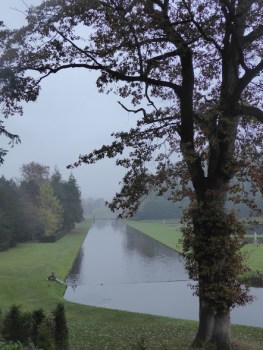
The canal at the centre of the water garden.
If you visit these days you’ll see a proper 18th century garden: the formal lakes, the temples and other follies, the carefully orchestrated views. Work continues year by year to rein the garden back to the detail of what those eighteenth century visitors would have seen. After all, trees grow taller and spawn saplings which grow in their turn. The river silts up. Land slips. Shrubs spread in an ungainly fashion. Unwanted invading plants make the place their home
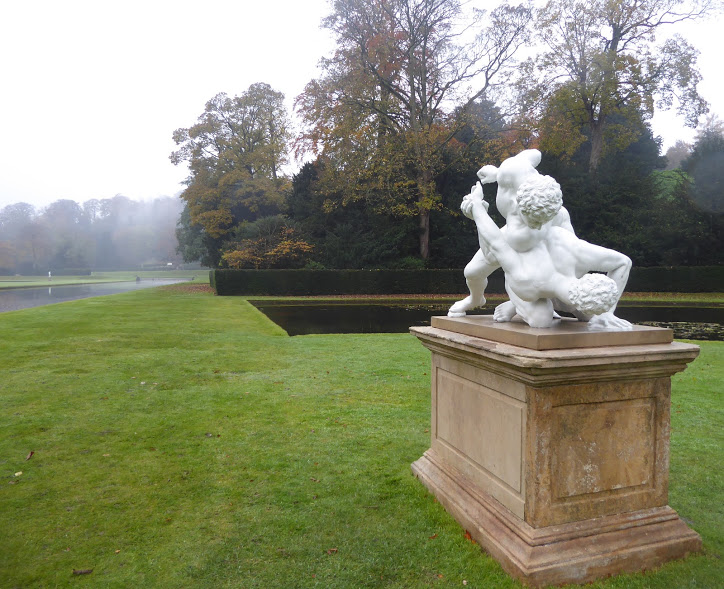
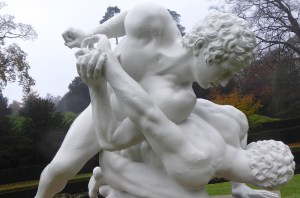
On Saturday, we went on a little tour to look at some recent work. The classical statues – wrestling gladiators and the like which have ornamented the gardens since the 18th century – are lead. Marble would have been nice, but lead’s cheaper, so when they were new, those statues would have been painted in marble-look-alike white.
Wrestling gladiators in front of the Moon Ponds
Now they’re white again. It wasn’t a question of slapping on the Dulux though. No, conservators hunted for evidence of the actual paints used by grubbing about in hidden groins and armpits for contemporary paint fragments, and experimented on discarded lead till they got the right shade, the right paint.
Wrestling gladiators newly painted white.
The formal ponds were once surrounded by planters and benches as well as statuary – contemporary paintings tell us that. These will be replaced, as well as a couple of statues sold in the 19th century when the estate fell on hard times.
Ungainly shrubberies will be knocked into shape and brought down to size. An informal garden will be planted with sweetly scented plants – roses, lavender and so on. Just the place to sit and view the Temple of Piety and the Moon ponds.
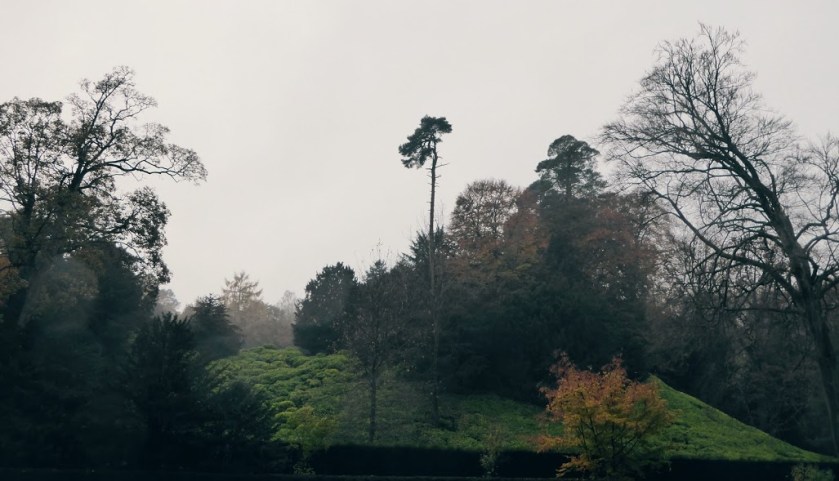
Tent Hill will live up to its name once more. The dense copse which covers it will be thinned out to make room for a tent something like an 18th century military campaign tent. Not for military campaigns of course, but to house entertainments of various kinds, just as it would have done back in the eighteenth century.
So much to do. But every piece of work brings Studley Royal even nearer to the intentions of John Aislabie, who first created this special place more than two ands a half centuries ago.
The Temple of Piety, Moon Ponds, and freshly painted statuary.




















You must be logged in to post a comment.