It was the summer solstice this week. It was also, for three days only in the north of England, summer.
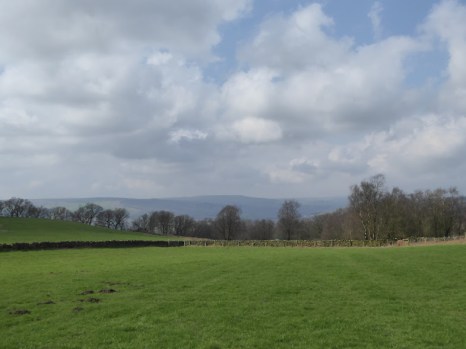
So let me whisk you back eighteen months, to a crisp and clear January day when I took myself off to walk for a couple of hours or so, looking upwards rather than at my surroundings. Skyscape succeeded skyscape. These changing skies perfectly illustrate this week’s WordPress Photo Challenge: transient.
Even better than the fact that Himalayan gardens exist here, and just eight miles from our house, is the fact that they’re next to the village of Grewelthorpe. And if that isn’t the best village name in England, I don’t know what is.
All the same, what are Himalayan Gardens, complete with a sculpture park doing in North Yorkshire?
Twenty years ago, Peter and Caroline Roberts bought a twenty acre woodland garden. It wasn’t up to much really. Coppiced hazel, an infestation of Japanese knotweed, dense dark Sitka spruce woods. Its redeeming feature was a drive of rhododendrons, and this gave Peter Roberts his idea. He looked at other rhododendron collections at Castle Howard, at Bodnant, at Muncaster Castle, and was inspired.
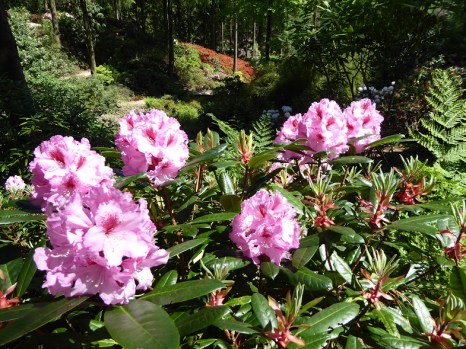
Rhododendrons such as these must have inspired Peter Roberts. Can you spot the drift of red specimens in the background?
Alan Clark, rhododendron guru and Himalayan plant hunter, told him that both site and soil were ideal: ‘I was intrigued by the idea of creating a Himalayan garden from scratch and decided to give it a go!’
Clark helped him with early specimens, Roberts supported plant-hunting trips to the sino-himalayan area … and the gardens began.
You won’t just find rhododendrons and azaleas though. There are massed plants that you’ll find in many well-stocked British gardens. There are drifts of narcissus in the spring. There are carpets of bluebells. There are several lakes on site. Word has got round the bird and insect community that this is a fine place to live, and any birdwatcher or entomologist could have a busy time here. As could visitors who enjoy coming across an eclectic mix of sculptures during their walk.
My photos have disappointed me. They give little impression of the rich feast of colour provided by hillsides covered in an ever-changing pageant of different varieties of rhododendron and azalea.
Nor can you see that this is a work in progress. Peter and Caroline Roberts are constantly developing the site, planting and extending the collection. On Saturday, just after our visit, a new arboretum opened.
Go while you can. This special place is open for two months only every spring, and for a further couple of weeks in the autumn. It’s worth a detour (Susan Rushton, I’m looking at you).
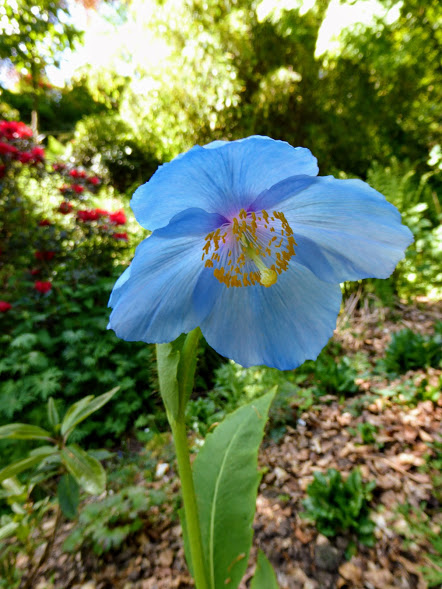
The Himalayan blue poppy makes its striking appearance throughout the gardens
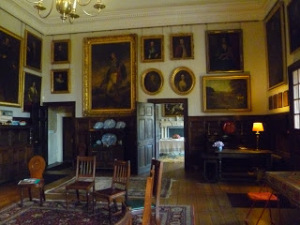
Just round the corner from us, on a back road into Ripon, is a fine old manor house, Norton Conyers. It was in such ruinous condition that it was closed for several years while its owners, Sir James and Lady Graham, oversaw its restoration.
Last year, one one of its few open days, we paid a visit, and I failed to blog about our wonderful afternoon out. But now I don’t have to.
Ann Stephenson, in her wonderfully varied blog ‘Travels and Tomes’ not only recounts something of the house and its history, but lets us all into a secret. Norton Conyers, with its secret attic and resident madwoman may have provided the inspiration for Charlotte Bronte’s ‘Jane Eyre’. How exciting is that?
You can read all about it here. Thanks Ann, for letting me share this story.
While we are on the topic of the Bronte sisters (or, at least, we were two weeks ago), there’s one more thing I should mention– an especially juicy tidbit. Are you listening? Jane Eyre may be inspired by a true story.
Norton Conyers
This isn’t news in North Yorkshire and the cozy city of Ripon that I once called home. Just around the corner from Ripon, roughly two or three miles from the roundabout at the edge of town, lies a beautiful old manor house by the name Norton Conyers. It is a handsome medieval squire’s home, dating back to the 1600’s, which has remained in the possession of one family (the Grahams) for nearly 400 years. That’s an achievement!
However, the house had fallen into disrepair of colossal proportions: rain poured in, wood-boring beetles swarmed, and very little of the grand house was heated. Thankfully, Sir James and…
The Earth. It’s tempting, for this week’s WordPress Photo Challenge, to choose lush woodland, productive farmland, dramatic peaks, crashing ocean breakers, or a charming cottage garden crammed with colourful flowers, and on Earth Day, show it at its striking best.
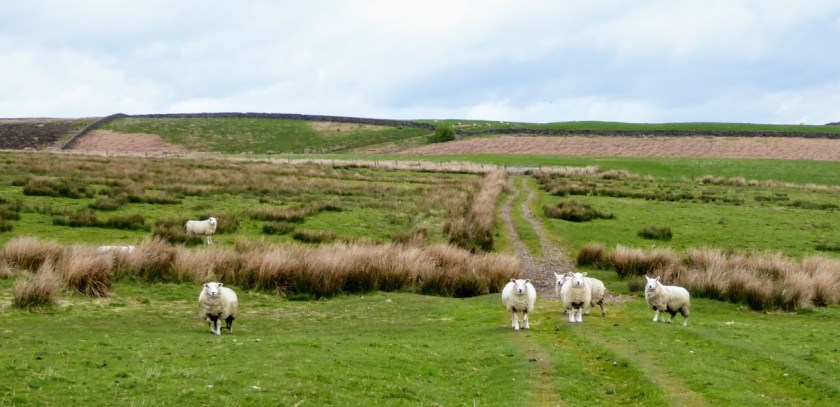
The welcome committee greets us on the path to Ellingstring.
Instead, I want to take you to Colsterdale in Yorkshire. The soil is thin, acid, peaty. Bitter winds scythe across the hilltops, bending to their will those hardy trees that make it to maturity. Brackish ditches lurk below the juncus grass to catch out the unwary hiker. The hills, though beautiful, can look barren, apart from the heather which blushes an extravagant purple every August.
But Earth is clever. This unpromising countryside nurtures thousands of sheep and lambs. Curlews, plover and geese wheel through the sky. Songbirds spring from the heather. There is so much hidden wildlife that much of the area is a Site of Special Scientific Interest.
It wasn’t our best walk. Chris and I set off to ‘do’ part of the Nidderdale Way on Thursday. Thursday was fine. Wednesday hadn’t been. Nor had Tuesday. There’s been an awful lot of rain lately.
Even as we started out, we realised that mud was to be our constant companion. And water, trickling along slippery, sticky oozy paths. We forded streams which according to the map simply didn’t exist. If we wanted to go onwards, we had to wade through running water, or totter across from unsteady stepping stone to unsteadier fallen branch.
It was tiring. Finding not-too-soggy resting places was challenging too. We had our sandwiches in a wood alongside what should have been a babbling brook, but was in fact a raging torrent.
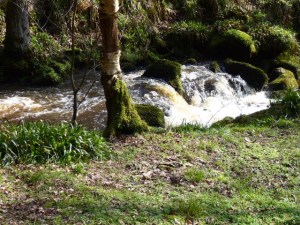
A normally quiet woodland stream.
And that’s when I noticed these stones – and trees. I’d expect boulders and branches like these to have a few tendrils of dry ash-grey lichen clinging to their surface. Instead they were thickly carpeted in vivid green. These specimens (and I don’t know what they are, despite a spot of Googling) were healthy, fecund and spreading very nicely thank you. It’s easy being green in such a damp, shaded and sheltered environment.
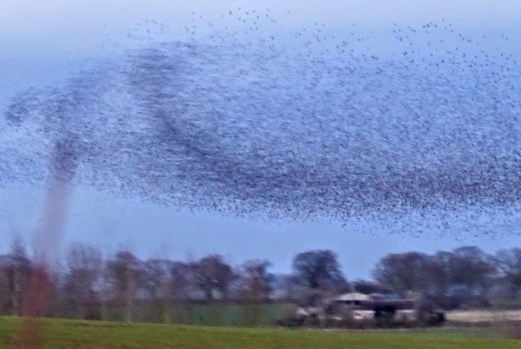
The bush telegraph was busy. It’s that time of year, and starlings are murmurating. Spotted south of Ripon, they’d also been seen at Nosterfield, only a couple of miles from us.
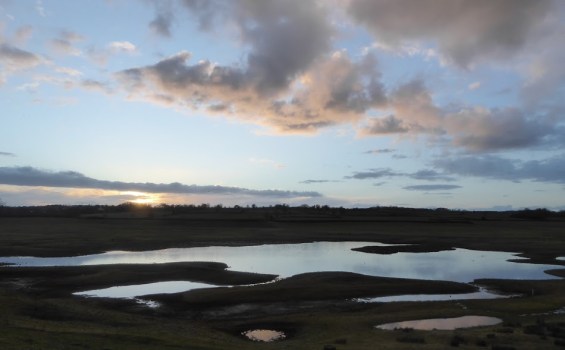
Sunset over Nosterfield Nature Reserve.
Down at the nature reserve, just at sunset, cars gathered. Their occupants waited, enjoying the spectacle of the nightly sunset. Then most of the cars just – went. What did they know that we didn’t? Then Malcolm spotted what we’d come to see, over there in the north.
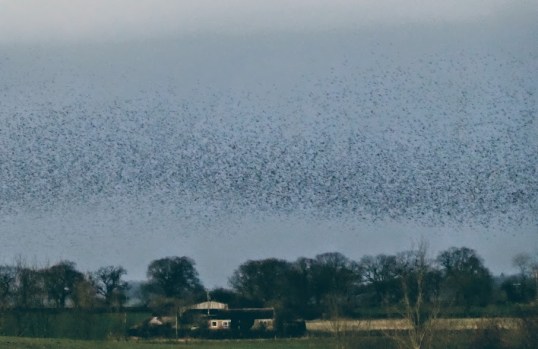
The starlings gather.
Thousands upon thousands of starlings in a dense cloud that spread, re-gathered, swooped, dived and soared like one of those unending computer-graphic screen savers that used to be all the rage.
We left too, We needed to be nearer. And sure enough, there in a lay-by near Nosterfield village we re-grouped, our binoculars to the ready. The starlings formed an immense cloud, sometimes dispersing to blend in with the grey cloud behind, sometimes wheeling together in sinuous black streaks of snake-like movement. For half an hour we watched.
Then this impressive partnership of birds pulsed lower, then lower, then dropped out of sight. They’d finished their performance for the night.
If you come for your holidays to Nidderdale in the Yorkshire Dales – and my goodness, I do recommend it – you’ll want to have an afternoon pottering around Pateley Bridge. It’s just won Britain’s Best Village High Street 2016 award.
Pateley Bridge High Street (geograph.co.uk via Wikimedia Commons)
And if you come to Pateley Bridge, you jolly well ought to visit Nidderdale Museum. Tucked behind the High Street near the Primary School and the Parish Church on the site of the former Workhouse, it’s a little treasure trove.
A photo in the museum collection of Pateley Bridge High Street in the very early twentieth century.
This little museum is entirely staffed by volunteers who cherish each donation and display as many as they possibly can in an engaging and informative way. You’ll punctuate your visit with delighted cries of ‘I remember that! My granny had one!’ Or ‘Oooh, I never knew the railway went there. I wonder where the station was?’. You’ll have an animated discussion with a fellow-visitor about being an ink-monitor at school, or about the mangle that was hauled out on washdays when you were a small child.
You’ll also see things that were not part of your own heritage, but which were an important part of Nidderdale’s past. You’ll discover that this pleasant rural area was once an industrial power-house, with textile workers by the score and lead mines dotted over the landscape. You’ll be reminded how very tough day-to-day life was on a Daleside small holding or farm.
Here’s a very quick tour:
We had a Ewbank carpet sweeper at home … and this splendid bed-warmer, simply heated by a light bulb … and a cream-maker.
A Ewbank carpet sweeper.
A 1960s Belling bed warmer. Known in our family as ‘the bomb’.
A 1960s cream maker (milk and butter required) with contemporary beakers.
We had inkwells like this at school, and I spent many painful hours in the company of copy books like these.
But look at this parlour:
I don’t quite remember a room like this.
And this wholly intact cobbler’s shop, transferred to the Museum in its entirety.
I definitely remember a cobbler’s shop like this.
And here’s a glimpse of life on the farm, before labour-saving machinery came along.
Tools both heavy and huge in use on the farm.
We’ll be going again and again. So much to see, to reminisce over, to learn from. This engaging museum is a treasure in its own right.
My visit was one of the perks of being a National Trust volunteer. Brimham Rocks is Fountains Abbey’s nearest neighbour, and staff there organised this trip – thank you! The museum is open at weekends until mid-March, then daily during summer months.
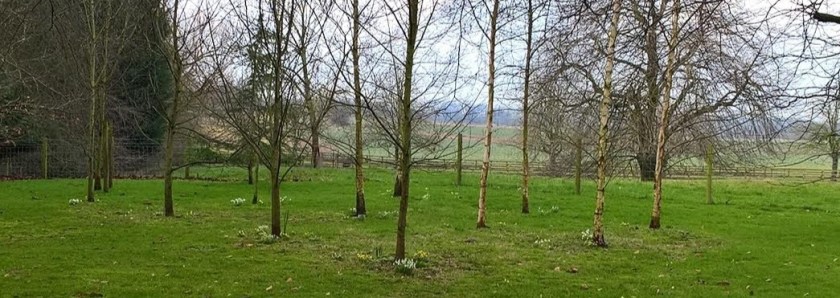
I was out for a convalescent constitutional this afternoon: William had passed A Bug onto me last week, and I’ve been a little delicate. I hadn’t taken my camera with me, only my phone, so these images aren’t the finest. But I don’t care. They’re evidence that spring is on the way. I wish you could hear, as I could, the birds singing as they do only when they too know that short winter days have passed. Yes, spring is springing.
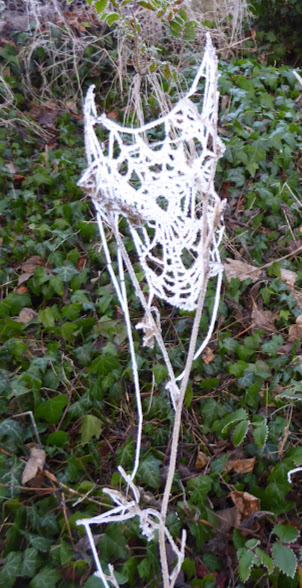
Google spiders’ webs and you’ll find any number of scientific articles celebrating the resilience of the silken strands that spiders produce Not only is the silk stronger than steel, it’s springy and elastic. The design of the web ensures that even when a strand is broken, the overall formation remains sound.
I found a spider’s web on a recent cold and frosty morning. By rights such a delicate structure should have collapsed under the weight of its coating of thick icy rime. It hadn’t. It’s the perfect candidate for this week’s WordPress photo challenge: resilient.
And here are a few more shots from a cold and frosty morning in North Yorkshire:





 The secret attic room at Norton Conyers.












 From Pyrenees to Pennines
You must be logged in to post a comment.