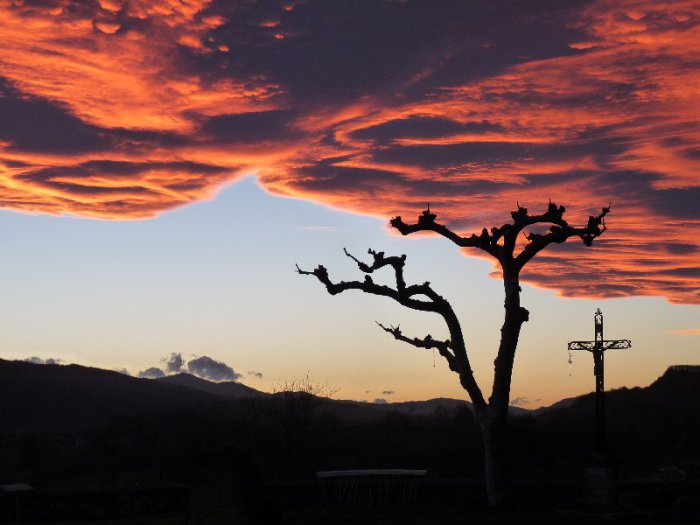
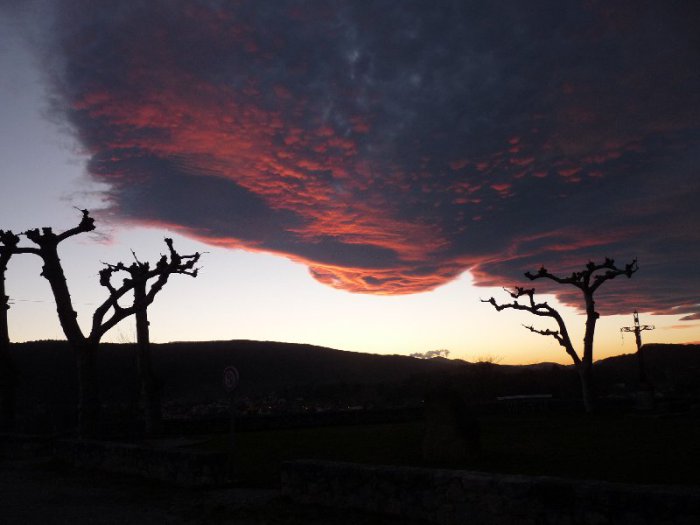
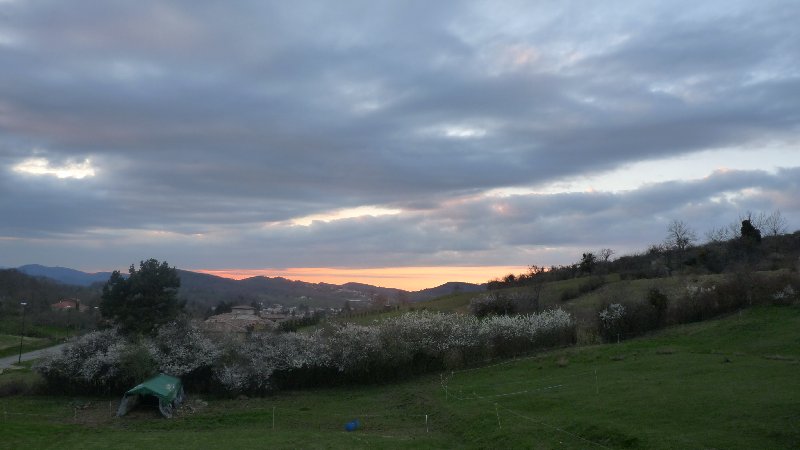
I’ve shown these photos before. I’ve even shown them in a previous WordPress Photo Challenge. But I’ll never forget this February sunset from a few years ago in Laroque d’Olmes. ‘Dramatic’ doesn’t seem an overstatement here.
This is my contribution to this week’s WordPress Photo Challenge inviting shots of a sunrise or sunset. Click on any image to view full size.
We had quite an arresting sunset the other night. As with all sunsets, it was evanescent: here at one moment and gone the next. I’ll show it to you at the end of the post, together with the rainbow that briefly accompanied it in a rainless sky.
That sunset though reminded me of another sunset, even more dramatic, which we experienced in France in February 2014. Evanescent it might have been. But it’s etched in my memory forever.
Sunset seen from the church at Laroque d’Olmes.
The moment is almost over.
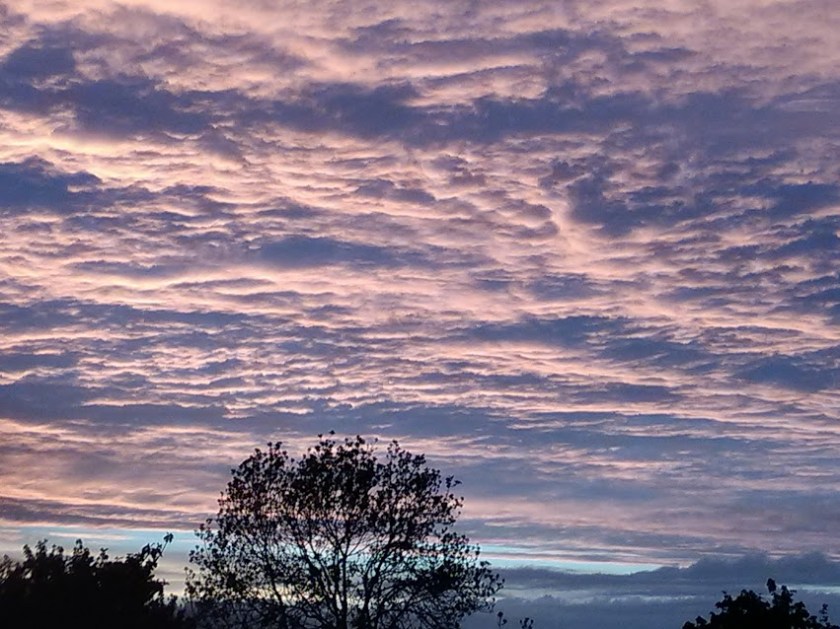
Now then. Here’s our English sunset, from just a couple of weeks ago. Which do you prefer?
We’re just back from France. Specifically, we’re just back from Laroque d’Olmes, the town which we left exactly a year ago, and which for six and a half years, we called home.
We felt anxious about this trip. What would we feel? Would we find we’d made a horrible mistake in leaving Laroque? Would our now rusted and un-exercised French measure up to a week or more of more-or-less constant use? Would people want to see us as much as we wanted to see them?
On a stroll near Laroque with Francis and Tine, we meet one man and his (five) dogs
What actually happened was that for the first few days, we barely had time to think at all. As soon as we got there, we were launched into A Social Diary. We’d have lunch here with one set of friends, our evening meal there with another. We’d slot other friends in for morning coffee, or afternoon tea. One morning we even commandeered the local bar and held court there, in order to catch up with people whom we couldn’t see in any other way. We started to flag. We simply couldn’t keep up the pace.
And luckily, we didn’t have to. Saturday was the day the walking group had suggested we set aside for them. The planned ‘rando’ had to be kicked into touch because of the promise of rain and wind. Instead, a dozen or so of us walked for a couple of hours whilst Jean-Charles, as clerk-of-works, organised a team to transform a roofed shelter outside the church in nearby Fajou into a banqueting hall. As ever, this turned into a magical occasion in which home-made tarts and pies, home-cured sausage, cheeses, bread, wine, more wine, cakes and puddings of every kind were crowded onto picnic tables for us all to feast upon as we gossiped and sang and reminisced, trying not to notice the cold and wind only inches away from us. It felt as if we’d never been away. Part of our time was spent making plans for the group to visit us here in Yorkshire. Watch this space!
Malcolm’s been lent an Ariegeois beret, and here we both are with our friend and hostess, Tine at the end of the feast.
It’s the south of France, it’s Easter Saturday, it’s freezing… but really, we ARE having fun.
The walk home afterwards. It’s suddenly got sunny.
After that, life became so much more leisurely. Lunch in Foix on Easter Sunday with friends, then a lazy Easter Monday with our hosts, getting sunburnt in the garden, cooking and eating the traditional Omelette de Pâques.
..and this was our view, as we cooked and ate our omelette de Pâques on the hillside above Francis and Tine’s house.
It’s memories of all those moments with friends that we bring home with us. Memories too of the much-loved scenery of the foothills of the Pyrenees. Would we return there to live? Not a chance. Laroque itself is going through very tough times, and it shows. The shop, the once-thriving music centre, children’s services – all are struggling. Some of our French friends commented that perhaps we could have made our lives easier by not getting ourselves involved in day-to-day life there, and they could have a point. We plugged into the local networks that talked and acted against corruption here, services closing there, money talking somewhere else, when instead we could have been sitting in our little bubble on a sun-dappled terrace drinking wine and sun-bathing. But by getting involved, we hope we made friends for life, and understood a little more about the society we briefly became part of. But never fully part of. Our very different background, our lack of real understanding of certain basics of French culture left us always feeling to some extent outsiders, however much we were accepted and made to feel at home. It feels as if this is the right time to be involved in life in England once more.
A moody sunset seen from the supper table chez Francis and Tine, with the sloe trees in full blossom.
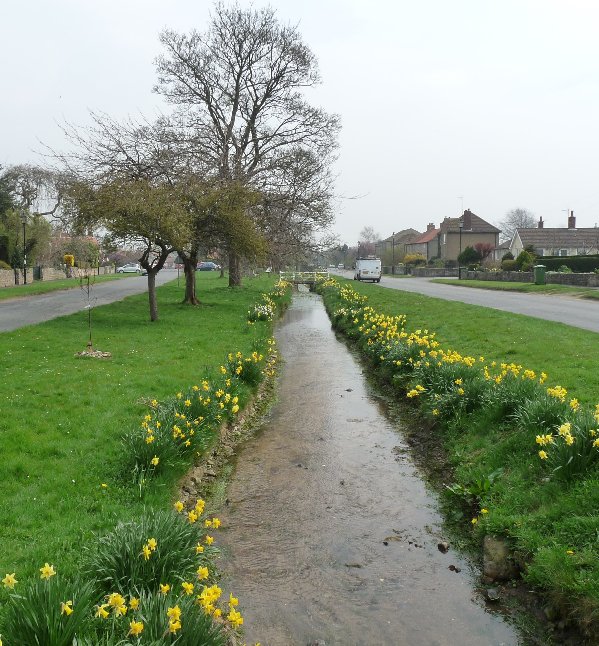
And anyway, who could bear to be anywhere else but here when the daffodils are in bloom?
We’ve just had good friends from Laroque staying for the week. We’ve been obliged to polish up our French, which turned out not to be as hard as we’d feared. And we’ve been doing our best to show-case Yorkshire. We didn’t expect that to be hard, and it wasn’t. But we had fun exploring links between our two home areas, something I’ve talked about before here. Easy enough when you’re walking in the hilly limestone scenery of the Dales, or discussing breeds of sheep, or our former textile and mining industries, or bumbling along single-track roads in the country, with no villages in sight.
But it would be stretching a point to find a meeting point between the land-locked Ariège, and the East Yorkshire coast, surely? Well, as it happens, no. We had a day exploring the coast near Whitby: and I remembered that during the 1800s, Whitby and parts of the Ariège, Laroque d’Olmes included, had a thriving industry in common. Jet.
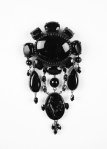
19th century mourning jewellery. Wikimedia Commons.
Back in the mid 19th century, the fashionable French and English alike couldn’t get enough of the gleaming, richly black fossilised wood that came out of local cliffs (Whitby) and river beds (Ariège) to be transformed by local workers into brooches, earrings and lockets. In its hey-day, the industry employed thousands of people engaged in finding and extracting the mineral, carving and polishing it. Queen Victoria ensured its continued popularity in England by wearing jet as mourning jewellery when her beloved Prince Albert died.
We found no jet. So Wikimedia Commons had to help me out.
Its decline as a fashion item matched the decline of readily available sources of the material. Somehow, by 1900, jet had lost its allure, and both areas lost an important source of employment. Jet in the Ariège is consigned to history books and museums. In Whitby, however, there’s something of a revival, and there are once more a few shops selling costume jewellery and other items made of jet.
We never found a single piece, but not for want of trying. Instead, we had a more traditional day at the sea. We ate large plates of fish and chips. We seagull-watched. We paddled on the beach and investigated rock pools. And we ended the day at the higgledy-piggledy and charming settlement of Runswick Bay, clambering up and down the cobbled streets and admiring the quaint cottages with their views across the bay.
Whitby Old Town seen from a ginnel.
The harbour at Whitby.
Fish and chips at the Quayside Fish and Chip Restaurant.
Dog at play on the beach at Whitby.
A young herring gull.
Beach huts at Whitby.
Cottages at Runswick Bay. It’s not raining. The flowers have just been watered.
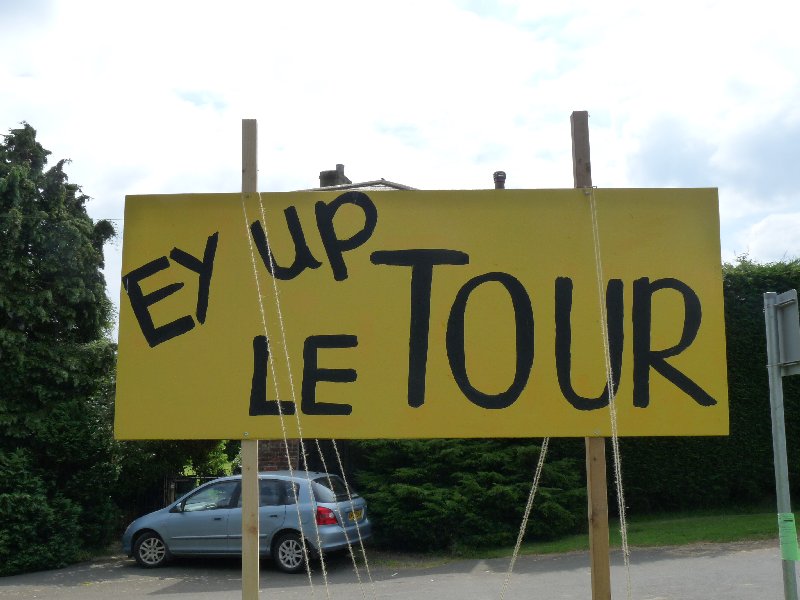
North Lees, the hamlet after North Stainley, welcomes the Tour.
The final post about le Tour de France. I promise. Because it’s actually over, as far as Yorkshire’s concerned. And as far as poor old Mark Cavendish is concerned too.
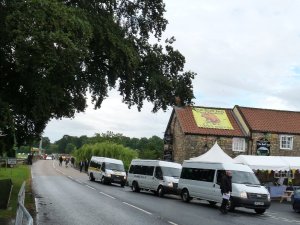
But Saturday was all about Stage One of the Tour. Up early, I dashed over to the next village, West Tanfield, to buy a paper before the road closed for the day. Six mini buses were disgorging security guards who immediately took up positions round the streets. What could be going on? Later, I found out. ‘Wills and Kate’ ( the Duke and Duchess of Cambridge to you, please), due to open the Tour at Harewood House between Leeds and Harrogate, were to be helicoptered into West Tanfield at 1.00 o’clock. Later still, we discovered that my friend Penny was among those who had been presented to the Royal couple – and to Prince Harry too – since her husband’s Chair of the Parish Council there.
West Tanfield would have been a good place to be for other reasons. The riders swoop down a hill into the village and make a sharp turn over a narrow stone bridge before the long straight run into North Stainley. So there were vans from radio stations, cranes ready to hoist TV cameras aloft, and would-be spectators galore, already taking their places at prime spots and keeping the local pub and shop busy.
The busy streets of West Tanfield, 8.00 a.m. , Tour Stage One.
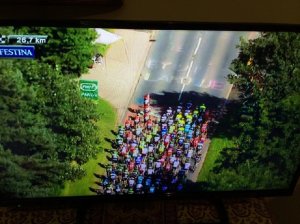
But we’d decided to stay put. Daughter and family had come over from Bolton and we decided that we should profit from the fact that the Tour actually passed the end of the drive. We sauntered down to the village to the stalls on the cricket pitch, and watched a little of the early action on the big screen in the village hall. Back home, we spent a happy quarter of an hour chalking ‘Ey up, Laroque’ on the road to greet all our friends in France when the TV cameras passed over. It worked, as my camera shot of the TV screen proves. But it only lasted a second and nobody but us saw it. Ah well.
If you’d watched the TV attentively, you’d have seen our greeting.
What we saw though were billboard adverts that appeared for the duration all along the roadside for companies that don’t exist in England – PMU, Carrefour – and which had already disappeared an hour after the racers had passed through.
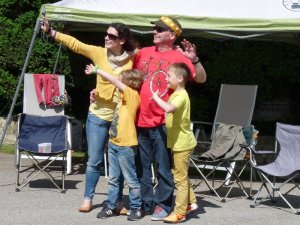
Ellie, Phil, Ben and Alex welcome the publicity caravan.
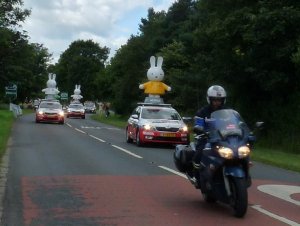
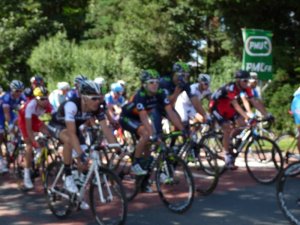
Then, finally …. tour officials in their Skodas…. British police on motorbikes….. French gendarmes on motorbikes….. support vehicles… and the publicity caravan. It wasn’t as extensive as it had been in France, but there WERE vehicles advertising French companies we don’t have in the UK, as well as British ones too. The total haul of freebies my grandchildren had thrown towards them consisted of two Skoda sunhats and a key ring. And then …….. the riders. Amazingly, after five hours up hill and down dale they were still riding in a solid phalanx, whirring towards us as a purposeful army. And then…. they were gone. Team vehicles loaded up with spare bikes aloft, more police and ambulance support followed…. and it was over. For us. Time to switch on the television and follow the action into Harrogate.
Rabbits on Tour.My shockingly bad – and only – photo of the riders passing our gate.
Disappointingly, my crop of Tour photos is exceptionally poor. So I’ll focus on a final look at North Stainley, which took the Tour to its heart, and delivered a very special homage to France and the Tour de France.
An early rider on the Tour
Here’s a close-up.
Another contender.
And another
A decorated wheel.
A garden decorated for the occasion
The Brownies decorate the cricket pavilion.
Bunting and yellow bikes.
A French lawn.
Another yellow bike.
Frank Bailey’s extremely clever revolving sculpture.
The village symbol, constructed from bicycle parts.
All the school children re-interpreted French Impressionist paintings.
The village had to have a few knitted Tour jerseys too.
A re-interpretation of Monet’s ‘Waterlilies’ on the village pond.
The church gets in on the act. ‘Le Moulin Jaune’.
Younger children at the school decorated pennants.
One of the banners at the school
Another wheely good decorated wheel.
North Stainley’s own ‘Man of the Mountains’ house.
Bill? Ben? Or a TdF cyclist?
Ooops. Someone just crashed.
The garage, now closed, has a special display of 2CVs
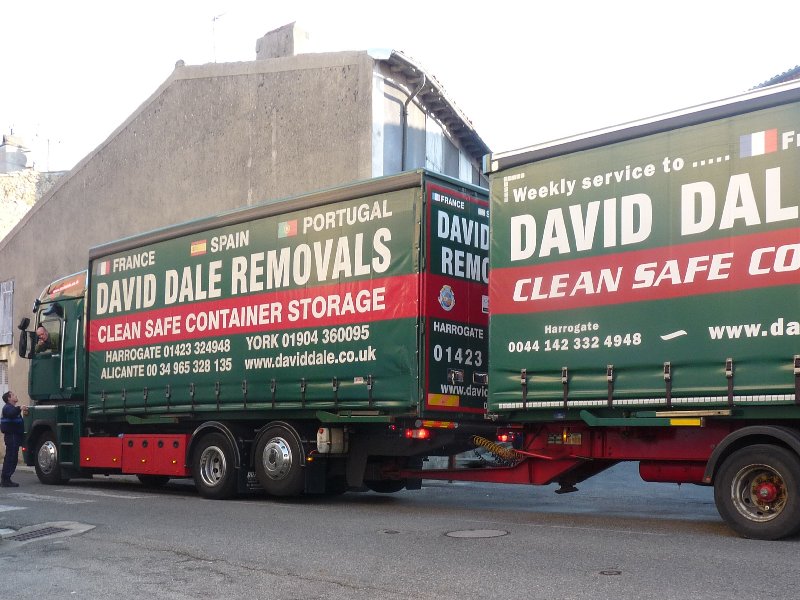
Our removal men travel weekly between northern England and southern Spain with all stops – including Laroque – in between.
You’re making your last visit to Laroque today, for the time being. We left 3 days ago, and now we’re in Ripon. Those last days were a furore of packing, cleaning, ‘goodbyes’ (though never, never final farewells), and two visits from the removal firm, who couldn’t fit everything in, first time round. At this moment, perhaps, the person who bought our house is planning his own removal to Laroque.
I never told you, probably out of sheer superstition, the story of the house sale. The housing market’s incredibly tough in the Ariège just now. House prices have tumbled 25% since 2008. Properties remain unsold for one, two, three years, as unhappy owners reduce the price of their homes in hopes of at last attracting a buyer.
Whereas we had nothing but luck. A man from near Paris, house-hunting here, in the area where he’d grown up, saw our house, arranged to view, and said he liked it. A week later he came again, showing his ‘coup de cœur’ off to his mum and dad. He made a low-price offer, as you do. We refused it, as you do. But we offered him our non-attached garden, being sold separately, at a generous discount, and said we’d include some of the furniture in the house sale. Reader, he offered full price, and the rest is history. Vue-vendue.
We’d just locked the door for the last time. And helping us wave ‘Goodbye’ are Martine, Francis and Anaïs, almost the very first friends we made when we arrived.
So here we are in Ripon, ready to house hunt and begin our new lives here. Oh, and there’s the Tour de France starting in Yorkshire too, in a couple of months. We’ll keep you posted.
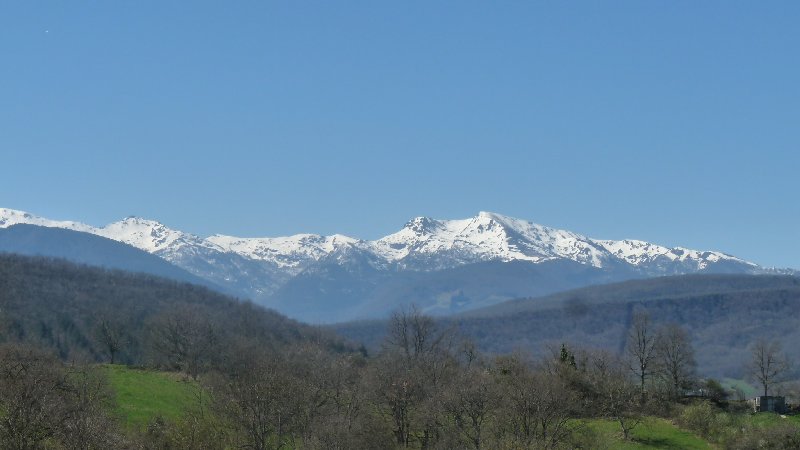
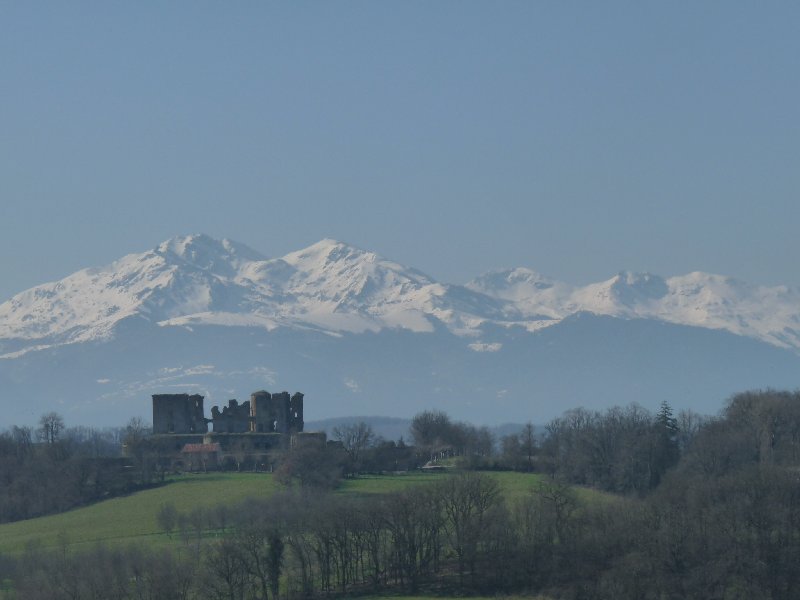
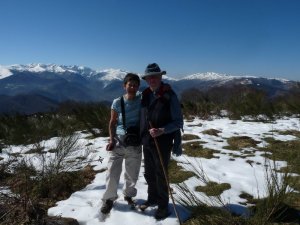
One of the views from our walk last Thursday. In the distance, the ruined castle of Lagarde. In the far distance, the Pyrenees.
It’s come at last. The week we move back to Yorkshire. On Saturday we did ‘The Long Goodbye VI’. This time next week, we’ll have been back in England almost three days.
So that’s it for ‘Life in Laroque’. Maybe one more post. Maybe not.
So what do I do about it? Shut up shop and start again? Or simply change the title and keep writing? I don’t know how things will change for me once I get back to Yorkshire. I’m fairly sure I’ll want to keep on writing a blog. I’ve enjoyed the discipline of getting memories recorded. I’ve loved having feedback from friends. At first, these friends were people I’ve shared part of my life with, people I’ve worked with or spent time with socially. Increasingly, they’re cyber-friends: people who take the trouble to comment, criticise, offer suggestions and memories of their own, and whose blogs interest me.
Yesterday, though, Malcolm made a suggestion, remembering the exhibition I’d had a hand in organising here, comparing the Ariège with Yorkshire. Why not change the title of my blog to ‘From the Pyrenees to the Pennines’? That’s what we’re going to be doing after all : exchanging one set of hills for another. For quite a while, having been away so long, I expect to be something of a foreigner in my own country, and this might be reflected in what I choose to write about. Or not. I just don’t know.
I’m sure I’ll lose some of you, dear readers. Perhaps your interest is in France, specifically this part of France. But I’d love it if some of you choose to continue the journey with me, as we settle back to life in the UK and travel further afield from time to time. We’re bound to come back to the Ariège too. There are favourite people to see, favourite places to visit, and new places still to discover.
So ……. new blog? Continue with this blog under a new name? What do you think? I’d love to hear from you, especially if you’re one of those bloggers with whom I have cyber-conversations. Thanks for coming with me this far. I’ve enjoyed your company.
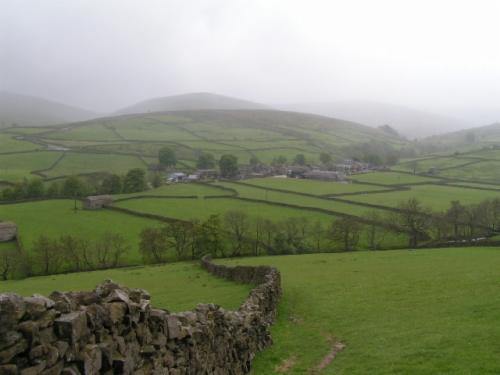
The Yorkshire Dales. They’re not bad either, are they?
…. which is, being very roughly translated, our pot-luck picnic on the Resistance trail.
Posh picnic? I think not. But it’s the taste and the company – that counts.
Jean-Charles has long wanted to get us up to Croquié, a village high above the road between Foix and Tarascon, for a walk with a 360 degree panorama of the Pyrenees, and a very moving monument to some of the Maquisards who died fighting in the French resistance in World War II. This really was the last Sunday we could go, and the day was glorious: hot, with clear blue skies and views for miles and miles in every direction.
Neither Malcolm nor I is particularly on form at the moment, so while our Laroquais friends yomped up a semi-vertical path, deeply slicked in mud, we went part-way up the mountainside from the village of Croquié by car, and then walked on up by road (a road, however, closed to cars) to meet the rest of the group.
Our first destination was the Monument to the Resistance. This site, with views across to the mountains dividing us from Spain, far-reaching from west to east, was chosen as a memorial site not because it was a war-time battle ground. Instead it was a training school for resistance fighters from France, Spain and beyond. There are no barracks, no lecture-halls, no buildings of any kind. Instead the men led hidden existences among the forest trees and rocks. And now there is a fine memorial to them. Singled out were two men who died in nearby Vira (the area where we walked last week) a Maquis stronghold, one who died in our neighbouring town of Bélesta, and one who died following deportation. There is a statue to these men, who are nevertheless depicted without facial features. In this way they stand representative for all the men – and women – who died whether through fighting, by acting as liaison workers, or by offering essential support by giving shelter, clothing and food. Individuals did not pass over to Spain from here: the border is too far away. Instead they were driven to one of the freedom trails such as those near Oust and Seix. Petrol? It could be organised, albeit with difficulty. A key man ran a garage.
First glimpse of the monument.
A better look at it
This is the view those figures have
The sculptor of this monument is Ted Carrasco. A native of Bolivia, pre-Columbian art is a clear influence on his work. He seeks always for his pieces to be in harmony with the environment in which they are placed. His monumental granite figures look over to the Pyrenees which were the scene of their fight against fascism and the Nazi occupation of France.
Time to move on, however. Our path took us slowly upwards through forest, along a track which became increasingly snow-covered and tough going. However, it was only 3 km. or so until we reached the top, where there’s a refuge dedicated to the memory of its original owner, Henri Tartie, known as ‘l ‘Aynat’ – the elder, in Occitan. The original structure is tiny, but served as shelter to many a Maquisard . Now it’s a wood store, because a newer concrete annexe has been added with cooking facilities so that hardy mountain walkers can rest, make a meal, and warm themselves up.
The way up to the refuge.
Jean-Charles gives us a short history lesson outside the refuge.
The modern extension and its ‘facilities’.
A cheerful picnic.
This was our view.
And this.
And this.
This too.
And this , on the way down.
We commandeered a circular concrete table outside, with apparently unending views of those Pyrenees, and somehow squeezed all ten of us round. We unpacked our food: as ever there was wine to share, rhum baba à l’orange, galette charentaise, biscuits – all home-made, of course. Malcolm and I knew it was our last walk with our friends. The fine views, the fine company, the cheerful conversation had a predictable effect. We became tearful. But so grateful that this walk was a bit of a first. Extra-special views, extra-special weather for March, the chance to get close to an important slice of Ariègeois history, and our extra-special friends. We shan’t be with them next Sunday: there’ll be too much to do. It doesn’t bear thinking about.
No, you haven’t missed anything. There was a ‘Long Goodbye II’ – another meal, another great set of walking friends – but that time I didn’t write about it.
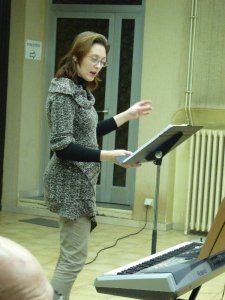
Vanessa, making us sing – and sing it right.
‘Long Goodbye III’ was on Wednesday, at the choir. I thought I was doing the offering this time. To drink, there was my home-made elderflower cordial which, added to a crisp chardonnay, made a rather different take on the kir with which they’re familiar. I made sausage rolls too, using the fine English-style sausage meat produced by the talented Mister Saucisse, and hunted down some cheddar to produce cheese straws.
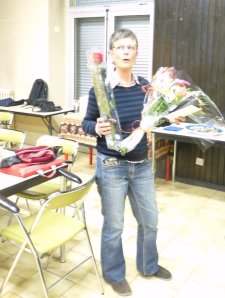
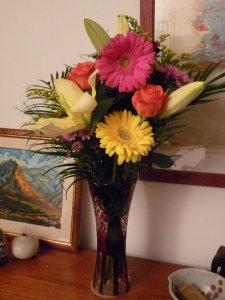
Vanessa curtailed our rehearsal, the party got under way, various people produced cameras and took lots of group shots. As we got organised for one of these, Robert, irritatingly, disappeared. Then reappeared, bearing a rather large bouquet, which was, apparently, for me. Here it is:
A bouquet, a rose. No wonder I look so surprised.
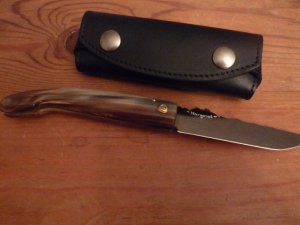
Then another gift. This really is special. The next village along, la Bastide-sur l’Hers, is home to a specialist knife manufacturer, of world importance in his field, Jean-Paul Tisseyre. He’s been on our ‘to-visit’ list for ages, but so far it hasn’t happened. Instead, one of his knives came to me. It’s a Montségur. It’s hand- cast in one piece with a mottled horn tip. Along its back, you can see the profile of the Pyrenees, starting from Montségur and travelling westwards. On one side of the blade, my name’s been inscribed. It’s a gorgeous thing, which was given to me in an equally gorgeous hand-made leather case. I’ll treasure it always, though whether I’ll ever risk taking it out hiking, as intended, is another matter. The French, like the English, consider that to give knives or scissors as gifts risks ‘cutting’ the friendship, so next week I’ll be sure to make a token payment: I have a purse full of English pennies for the purpose.
Isn’t this a wonderful knife?
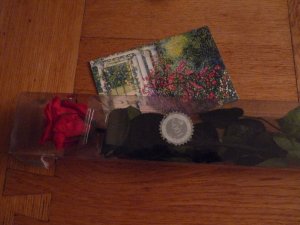
Jocelyne, our choir’s senior member, gave me an everlasting rose….
The rose before being nicely arranged.
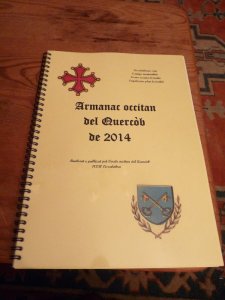
…. and Marianne and Danielle have offered me a book in Occitan. They thought I wouldn’t understand much, but some knowledge of French, Italian and Latin makes the whole thing pretty accessible.
My Occitan library.
Spontaneously, the group burst into song. ‘Se Canto’, the anthem of the Ariege, obviously, which everyone loves to sing at the least provocation, followed by ‘Les Montagnards’: then finally the Cathar hymn ‘Can lou bouyè ben de laoura’, of which I was proud to know some of the words.
Those flowers, back home. Can you see Montségur, Henri’s version, in the background?
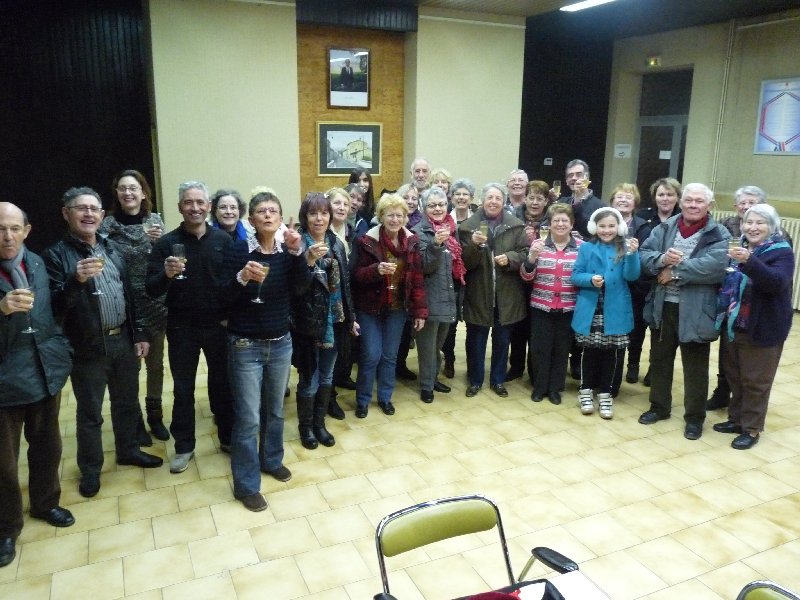
Malcolm – who’s not a choir member – and I were near to tears much of the time. We want to go home, but how can we bring ourselves to leave this community where we’ve been so welcomed and happy?















 From Pyrenees to Pennines
You must be logged in to post a comment.