The pirates return

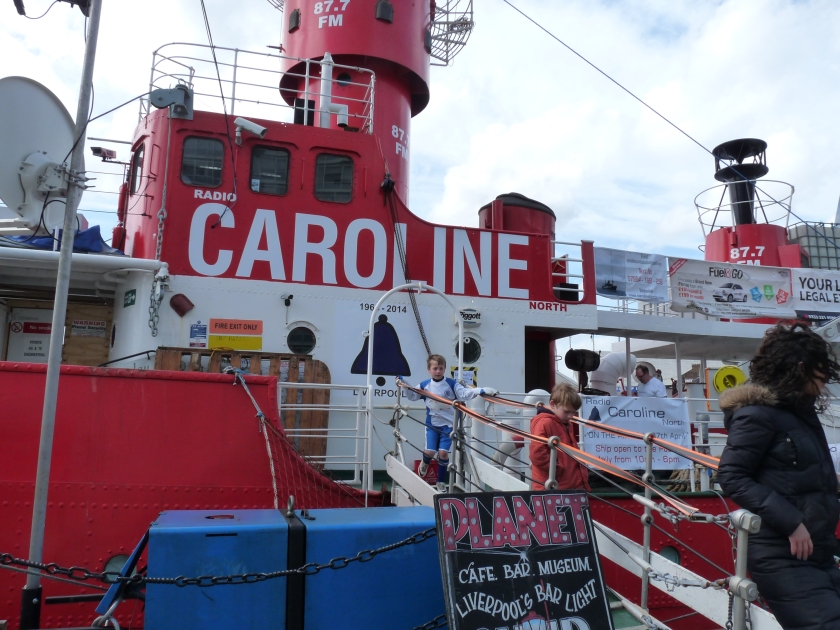
Alex and Ben rush down the gangplank of the pirate ship.

This post probably won’t make much sense if you’re not from the UK.  It won’t make sense even if you’re British if you’re not at least in your mid- 50’s.  You won’t know of a world where your radio listening choices were limited to the Home Service (much like Radio 4), the Light Programme (much like  Radio 2) and the Third Programme ( much like…. yes, Radio 3).  What’s missing from this list?  Yes, indeed, Radio One.

If you were a teenager before the mid 1960s, you weren’t going to get much joy listening out for a diet of pop music by choosing the BBC.  The only option was to tune in to the commercial Radio Luxembourg.  The amount of music it offered grew rapidly throughout the ’60s, but anyone from my generation will remember the commercials too.  Hands up anyone who can remember Horace Batchelor’s ‘Infra-Draw’ method for winning the football pools, turning the previously obscure Bristol suburb of Keynsham, ‘spelt K-E-Y-N-S-H-A-M’ into a household name?

I’d listen whilst allegedly doing my homework, but in 1964, along came another listening choice, broadcast, for goodness’ sake, from a ship anchored four miles off the coast of southern England.  This was Radio Caroline.  By broadcasting from the waters, it avoided the need to be licensed, and that’s why it quickly became known as a ‘pirate’ radio station. The single southern ship was augmented by others broadcasting from around the British coast .  The tag-line was ‘Your all-day music station’, and like Radio Luxembourg and certain American stations, the top 40 was the usual diet, presented by names who later became the mainstay of mainstream radio:  Tony Blackburn, Simon Dee, Johnny Walker……..

By insisting that the broadcasts potentially interfered with radio messages to shipping, legislation succeeded in making the pirates illegal in 1967.  They continued nevertheless, but their hey day was over, because the BBC gave in.  Radio One was born (and Two, Three, Four, and later Five), and most young people exchanged patchy reception from the pirates for the more certain transmissions of the BBC.

Why the history lesson?  Because this last month celebrated the 50th birthday of Radio Caroline.  It still broadcasts via the internet, but up in Liverpool, for one month only Radio Caroline North set itself up on Lightship LV23, in Albert Dock, for a 1960s and 1970s nostalgia-fest.  DJs from the era were wheeled out to have fun and give listeners fun too, playing old favourites and patently enjoying themselves as they chatted over the airwaves.

And one of those presenters was my son-in-law, Phil Sayer.  If you lived near Manchester in the 1980s, you might remember him as one of the presenters  of BBC North West, and later he was on radio stations such as Piccadilly Radio and Smooth FM.  These days he and my daughter run a successful voice-over business, but both still enjoy a chance to do a spot of work on the radio when the chance arises.

We all made a trip to Liverpool on Radio Caroline North’s last Saturday: daughter Elinor, the twins, Malcolm and me.  On the way over in the car we demanded, and got, a mention on air. Once on board ship we clambered up narrow stairways  to get to the cramped studio with its blast-from-the-past transmitting equipment, and found ourselves in the company of radio-geeks and nostalgia seekers from all over the north-west .  Fun all round.  And here are some pictures as a souvenir.

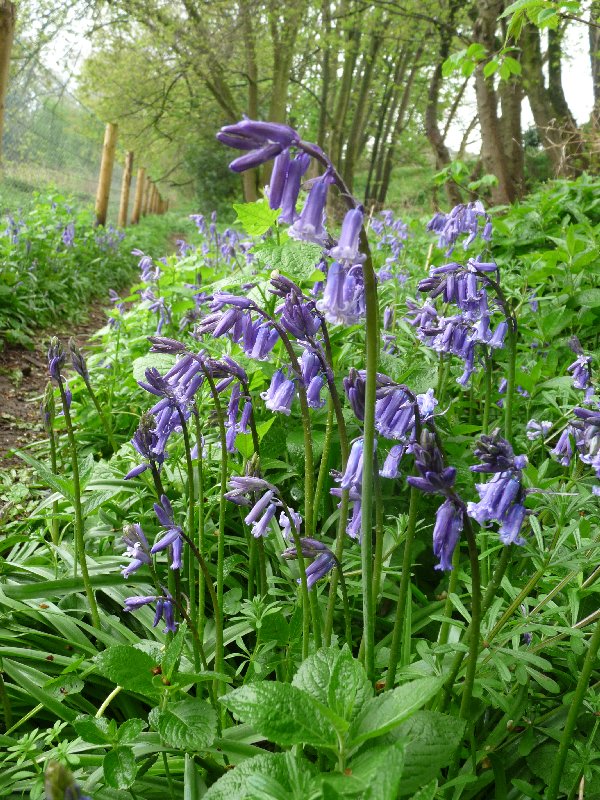
Ransoms and bluebells

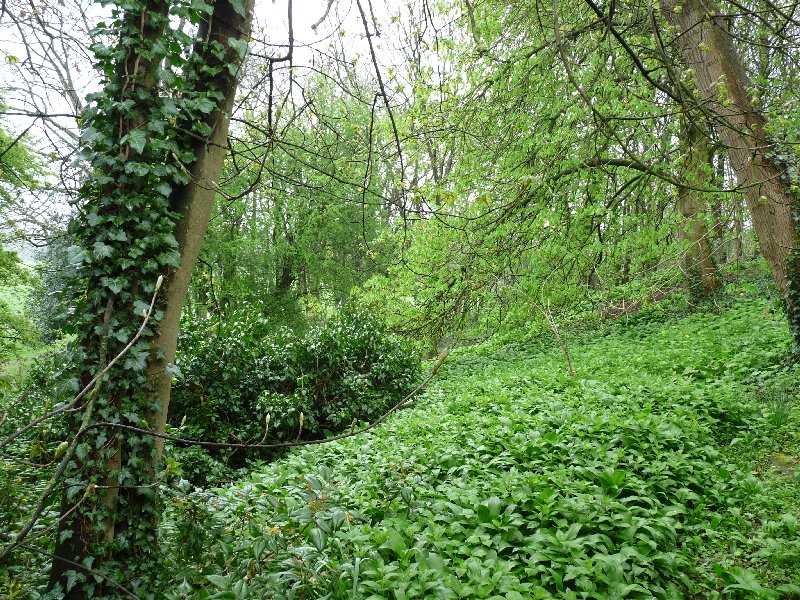
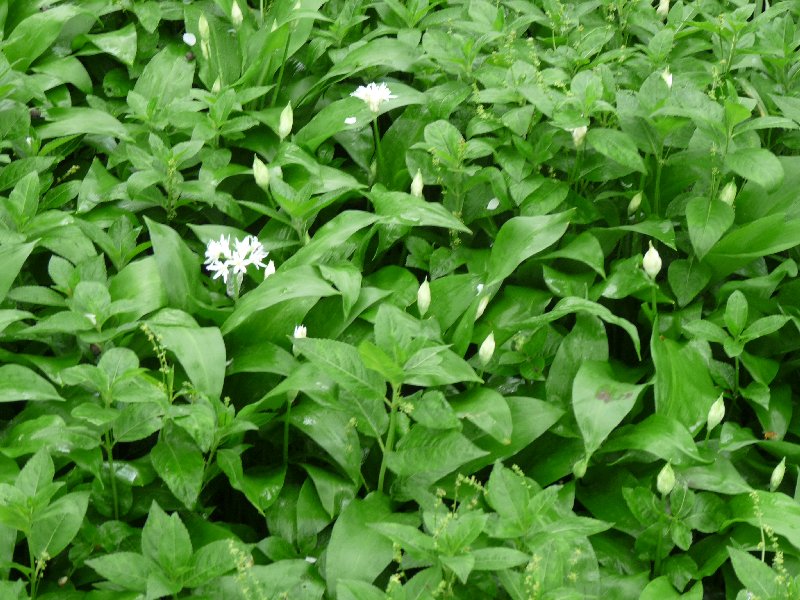
Wild garlic in the woods

Little tells me more forcefully than a walk through the woods at this time of year that we are back in England.  Instead of crisp brown leaves underfoot, from the Autumn before and the Autumn before that, there are narrow damp paths through the rich carpet of undergrowth.

Wild garlic, ransoms, bear's garlic, ramps
Wild garlic, ransoms, bear’s garlic, ramps

And that smell!  As you walk, inevitably bruising the leaves that crowd onto your path, you’ll smell the pungent notes of garlic: because those leaves, topped off by a mass of star-shaped flowers, are wild garlic (or ransoms, ramps or bear’s garlic), and they’re unknown in the part of France where we lived.  In among, competing for the sun which dapples in through the tree canopy, are bluebells.  At the moment, they’re largely still in bud but give them a few days and they too will carpet the woodland floor in a shimmering violet-blue.  And these are our English bluebells.  They’re more graceful than the upright, paler Spanish bluebells that we sometimes saw in France.

Bluebells
Bluebells

The blogosphere is crammed with suggestions for making use of the garlic, among the earliest greenstuffs available after the winter months.  Here‘s what David Lebovitz suggests.

Well, I rely on David to supply ideas for delicious grub, so off into the woods I went for garlic leaves.  I was careful to pick only leaves, rather than yank up entire plants with their tiny bulbs, so that they would grow again next year, though a few bulbs crept into my harvest despite my efforts.  I’d taken my haul  in any case from the woodland edge, as the garlic plants made an escape bid into nearby fields.

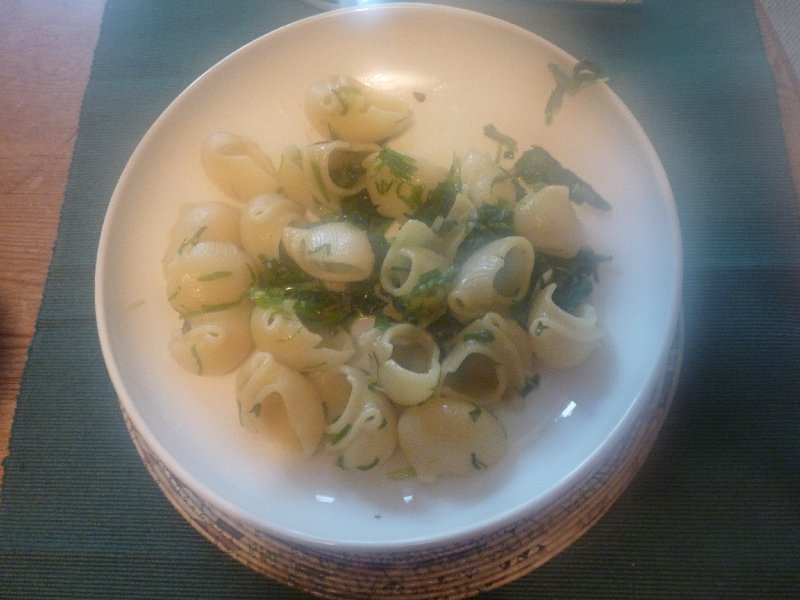
And here’s the resulting pasta dish.  Frankly, we were a little disappointed.  It wasn’t the most interesting dish we’d ever eaten.  But I could see the charm of these leaves to those who’d struggled through the winter months on a diet of beans, swede, and the odd bit of salted pork.  Wild garlic has a bright, ‘green’ flavour, mildly garlicky of course, and I will try it again, maybe substituting it for spinach in a tart with walnuts and a sharp cheese for instance.  I always enjoy an excuse to forage for food.

Wild garlic pasta, David Lebovitz style.

‘…. a host of golden daffodils’*

When I realised that we were likely to move from France to England in the Spring, I immediately became anxious – no – panic-stricken, at the thought that this year we might be too late to enjoy one of the glories of English life: daffodils.  Of course, there are daffodils in France, and spectacularly so in hidden woodlands such as the one we visited last April.

But whilst the French have daffodils, they don’t do daffodils as we do here.  All over England, they’re in pots in urban courtyards, crowded into suburban gardens, rambling over country gardens.  They form part of the roadside verges on tiny D roads, march along urban by-passes and ring roads, line dual carriageways, and romp across traffic roundabouts.  Householders buy them two and three bunches at a time and place jugs and vases full of them all over their homes.

I shouldn’t have worried.  Since the moment we arrived, they’ve been at their spectacular best.  It’s impossible to feel anything but joyful when passing by whole armies of those bright yellow flowers nodding cheerfully in the breeze.

And goodness knows, we’ve needed distracting from the tasks in hand.  Since we arrived ten days ago, we’ve found a home to rent,  started the daunting process of re-registering our car in the UK (you can’t buy a tax-disc without having an English MOT, you can’t get an English MOT without an English number plate, you can’t get an English number plate until….. you get the picture), organised moving our goods, registered ourselves hither and yon, started the process of catching up with British friends, tried to maintain contact with French friends…..

…and finally, of course, I’ve changed the title of the blog.  The header, showing our transition from the Pyrenees to the Pennines, was master-minded by our friend, the talented amateur photographer Richard Bown.  He already has a family history blog, but I really hope he’ll begin a photography blog soon and share some of his fantastic images with you.  If he does, I’ll let you know.  Because you will want to subscribe.

*William Wordsworth: ‘The Daffodils’

What to do next?

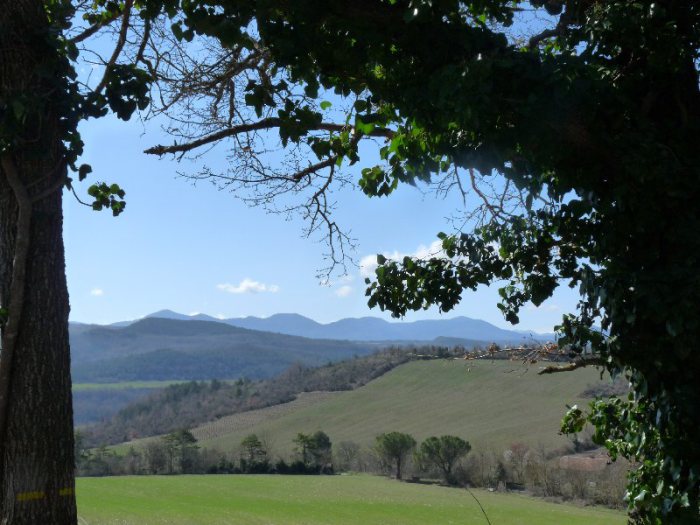
One of the views from our walk last Thursday.  In the distance, the ruined castle of Lagarde.  In the far distance, the Pyrenees.
One of the views from our walk last Thursday. In the distance, the ruined castle of Lagarde. In the far distance, the Pyrenees.

It’s come at last.  The week we move back to Yorkshire.  On Saturday we did ‘The Long Goodbye VI’.  This time next week, we’ll have been back in England almost three days.

So that’s it for ‘Life in Laroque’.  Maybe one more post.  Maybe not.

So what do I do about it?  Shut up shop and start again?  Or simply change the title and keep writing?  I don’t know how things will change for me once I get back to Yorkshire.  I’m fairly sure I’ll want to keep on writing a blog.  I’ve enjoyed the discipline of getting memories recorded.  I’ve loved having feedback from friends.  At first, these friends were people I’ve shared part of my life with, people I’ve worked with or spent time with socially.  Increasingly, they’re cyber-friends: people who take the trouble to comment, criticise, offer suggestions and memories of their own, and whose blogs interest me.

Yesterday, though, Malcolm made a suggestion, remembering the exhibition I’d had a hand in organising here, comparing the Ariège with Yorkshire.  Why not change the title of my blog to ‘From the Pyrenees to the Pennines’?  That’s what we’re going to be doing after all : exchanging one set of hills for another.  For quite a while, having been away so long, I expect to be something of a foreigner in my own country, and this might be reflected in what I choose to write about.  Or not.  I just don’t know.

I’m sure I’ll lose some of you, dear readers.  Perhaps your interest is in France, specifically this part of France.  But I’d love it if some of you choose to continue the journey with me, as we settle back to life in the UK and travel further afield from time to time.  We’re bound to come back to the Ariège too.  There are favourite people to see, favourite places to visit, and  new places still to discover.

So ……. new blog?  Continue with this blog under a new name?  What do you think?   I’d love to hear from you, especially if you’re one of those bloggers with whom I have cyber-conversations.  Thanks for coming with me this far.  I’ve enjoyed your company.

The Yorkshire Dales.  They're not bad either, are they?
The Yorkshire Dales. They’re not bad either, are they?


A hoarder vindicated

The downsizing continues.  We’ve become accustomed to discarding ancient birthday cards, messages sent to us to our last day at work, and even our school reports from the 1950s and ’60s.  We’ve come to expect gales of laughter from friends who don’t share our hoarding instincts and who observe our inner struggles with astonishment (yes, that’s you, Kalba).

So what happened this week?  I thought it was time to get rid of my sewing box.  I thread a needle maybe twice a year when a button falls off or a hem comes adrift.  So why do I need about three dozen reels of cotton in every colour you can think of, miscellaneous hooks and eyes, multi-coloured embroidery thread, a clutch of thimbles, a box of rusting pins and two darning mushrooms, all inherited from my mother?

All the same….  those reels of genuine cotton from the 1950s – no polyester mixes here ,  those cards of thread in various shades of tan , all the better to darn your stockings with, and even those hooks and eyes are all pieces of history.  I thought the friends I keep up with on Facebook might like to see them.  I posted these photos:

And within minutes I had an urgent request from that militant non-hoarder, Kalba, that I should give them to her, swiftly followed by a similar request from another friend.  Daughter Number 1 weighed in, as I knew she would, swiftly followed by Daughter Number 2.  Son has been strangely silent, but daughters have agreed to share custody of the cotton reels.  Three more people joined the conversation,  and started waxing nostalgic about darning mushrooms.  Then someone else pointed out that the factory producing the hooks and eyes had been part of her childhood neighbourhood, but had been closed for decades, and more people joined in to celebrate the almost-forgotten skill of darning.  A further request for the contents of my sewing box came from America, and a school friend whom I’ve not been in touch with for years made contact.

One way or another, my battered old sewing box has awakened memories, provoked recollections and conversations, and generally livened things up.  Just as well I didn’t dispose of it years ago.  There’s no chance of its being discarded now.  Apart from anything else, you just look some of these items up on eBay.  I’m sitting on a small fortune here.


An announcement

The church on the hill that is Laroque's main landmark
The church on the hill that is Laroque’s main landmark

I wonder what you’ll think when you read this?  Will you be as surprised as you would be if you heard that the couple down the road, the ones who always seemed to be such a great team, always doing things together, are getting divorced?    Or maybe you won’t be.  Let’s see.

We’re leaving.  Selling up.  Returning to England.  We’ve loved it here – we love it still.  We believe we’ve made friends for life: we’ve had unforgettable times.

But in the end, the call of family and England itself was just too insistent.  Throughout our time here (seven years full-time)  I’ve had recurring bouts of home-sickness which Malcolm never understood until very recently, when he too got suddenly and painfully afflicted.  We realised we don’t want to grow old here.  I don’t want to find visiting family more of a circus than it already is: I don’t want to miss out any longer on my grandchildren growing up.  So it’s time to go, whilst we’re still young enough to re-establish our English roots.

In many ways it’s an odd time to choose.  The house has developed from the unappetising near-hovel that we bought (but which, oddly, was love at first sight:  why?) to a comfortable and spacious dwelling with a pretty nice large back courtyard where we spend all our time in summer.  We’ve only just finished the en suite bathroom,  for goodness’ sake.

Before……

This slideshow requires JavaScript.

And after……

This slideshow requires JavaScript.

This last week we’ve been talking to estate agents, and realising that in tough times we’ll certainly have to use one – the French still usually prefer word-of-mouth and adverts in ‘Le Bon Coin’.

We’ll certainly be here till March: maybe longer.  A lot depends on whether the house sells.  And because the next move in England will be, we hope, the last one, we need to get it right.  So a temporary pied à terre near Ripon seems quite on the cards at first.  We’ve already started looking.

Don’t jump ship yet!  There’s still quite a few months to go on sharing our Life in Laroque.  And as for the next phase – who knows?

The Lakes with additional rain, cloud … and sheep

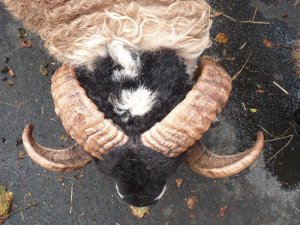
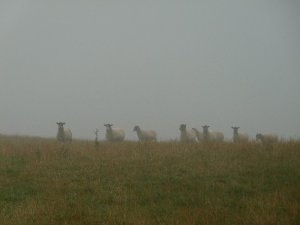
One of the sheep who were our constant companions

The Lake Distict: English holiday destination par excellence, and favourite subject for armies of painters and poets. Wordsworth, who wandered ‘lonely as a cloud’, Coleridge, Southey – they’re known as the Lake Poets – drew inspiration from the area. Peter Rabbit’s stamping grounds, including Mr. McGregor’s vegetable patch, must have been near Windermere, where his creator, Beatrix Potter lived. JMW Turner’s one of thousands of painters who’ve been inspired by views of the Lakes. Batallions of holiday-makers, especially walkers, arrive in the area every week of the year.

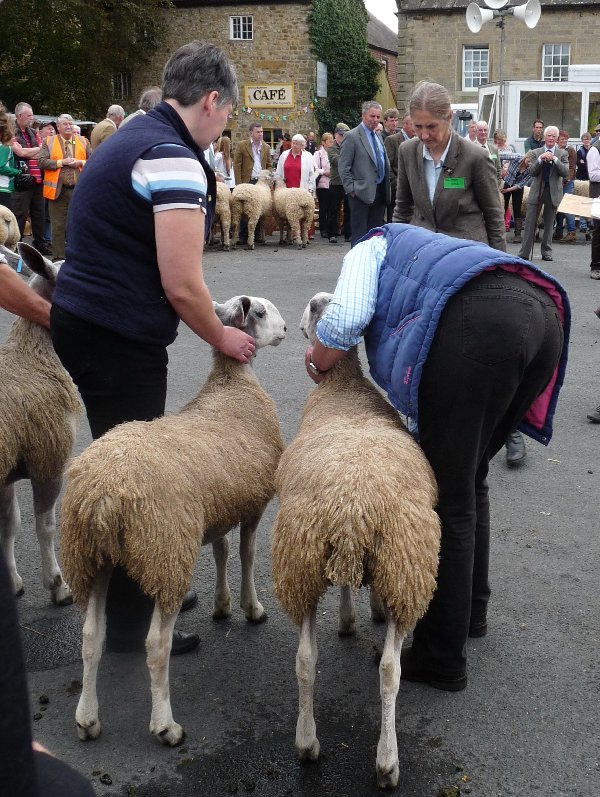
In short, everyone loves the Lake District. Except me. I arrive under banks of mist and bucket-loads of rain (like everyone else). I tramp round pretty towns looking for evidence of ordinary every day life, and find nothing but outdoor shops, craft galleries and tea shops. I’m one of a crowd in an area I’d prefer to enjoy in solitude. So I tend to avoid it in favour of the Yorkshire Dales, Northumberland or the Peak District. Still, there we were last week, first for a magnificent birthday celebration, and then for a family weekend. And for the first time, despite lots of rain and even more mist, I enjoyed being there.  I learnt to distinguish Swaledale sheep from their Herdwick cousins, who have black lambs: I enjoyed briskly walking with friends and family in the bracing cold, and finding daffodils and blossom, despite its being May: and at last I learnt to appreciate the famous scenery.   An excellent holiday.

World Book Day…. UK version

Today’s World Book Day.  I couldn’t understand why there seemed to be no sight of it here in France.  It turns out we Brits are out of step.  Celebrations in the UK are over a month ahead of everyone else’s.  April 23rd may be World Book day for everyone else, but it’s also Saint George’s day, and he’s England’s patron saint.  Apparently he does dragons, not books.

It was the Spanish who first decided to celebrate books and reading on April 23rd, as a way of honouring Miguel de Cervantes, who died on that day.  UNESCO made the connection that Shakespeare, as well as other writers, died or were born on the same day as Cervantes, and a world-wide festival was born.

Children have the most fun on World Book Day, whenever it’s held. Here are my grandchildren off to school this morning.  They had to turn up as a character in a book….. so please meet Harry Potter, and Mr. Willy Wonka.

Ben and Alex in character for the day

Books are often centre-stage in school all day and there are free books to be had for most lucky children

So many of my best memories of the children’s childhood centre round the books they enjoyed.  That first winter of my daughter Elinor’s life was one of those once-in-a decade toughies.  We were marooned in our house up an icy and snow-covered steep slope on one of Sheffield’s seven hills (‘just like Rome’). It was unthinkable to set foot outside with an unwieldy pram and a tottering toddler. But unable to do the daily round, or see friends, my then two year old son Thomas, my new baby and I simply cuddled up on the sofa. I read with him, and breast fed my daughter for hours at a time. I’d never have chosen such a harsh winter with all its limitations, but it remains one of the golden periods of my life.

Then, as now, the books we favoured had the rhythms and cadences, the witty and lively illustrations of authors like Quentin Blake.

Blake’s Mr Magnolia remained a family friend from the day his story was published in 1980 through the pre-school years of all three of my children.  Any of us will recite his story to you at the least provocation.

Meet Mr. Magnolia.  See?  He has only one boot.
Meet Mr. Magnolia. See? He has only one boot.

‘Mr. Magnolia has only one boot.

He has an old trumpet that goes rooty-toot

And two lovely sisters who play on the flute,

But Mr. Magnolia has only one boot.

In his pond live a frog and a toad and a newt……’

Young children now are privileged to have world-class illustrators and fine writers available to them for the price of a paperback, or the use of a library ticket.  I’ve just had a high old time remembering old favourites loved by the whole family– Shirley Hughes’ Alfie, Rosemary Wells’ Noisy Norah, Nita Sowter’s Maisie Middleton, Roald Dahl’s heroes (Charlie of Chocolate factory fame) and anti-heroes (The Enormous Crocodile and of course the Twits).  Make friends with any of these characters by the time you’re three years old, and with any luck, you’re hooked on reading for life.  That’s what World Book Day’s for.

Alfie, his friend Bernard and a good book

Our day out with John Rylands

Before we came back to France at the weekend, I wanted a day in Manchester, where I was at University more than 40 years ago.  It was a city people at that time seemed to love or hate.  I loved it then, and I still do.  It’s buzzy and busy, with galleries, music, shops, and a bravura display of civic Victorian architecture down every city centre street.

Outside John Rylands library

I had a particular memory I wanted to share with Malcolm.  The John Rylands Library.  I used to go there to write an essay or prepare for a seminar on those days when I wanted to pretend to some kind of scholarship that in truth was never part of my make-up.  The building was a celebration of Victorian Gothic architecture at its finest, with wonderful plaster tracery on the walls, splendid fan-vaulted ceilings, and shelf after shelf of ancient leather-bound books.  Seated in some darkened alcove, surrounded by the particular smell of the place – beeswax polish mixed with dusty books, I would work away for an hour or two, convincing myself, if nobody else, that I was getting down to the serious matter of studying in an industrious and creative manner.  Few other people would be there: there were no distractions other than the quiet beauty of the building itself.  The place was built for scholarship.

The reading room where I pretended to write essays.

It was built in the 1890’s by Enriqueta Rylands in memory of her husband John.  Although his origins were humble, he became Manchester’s first multi-millionaire, making his fortune in the textile industry as a cotton manufacturer.  At first, the library collection was modest, but over the years, has come to hold works of world-class importance: everything from the earliest known New Testament text, on papyrus, to medieval illustrated manuscripts, a Gutenberg bible, and the personal papers of the likes of Elizabeth Gaskell.

One of dozens of different fantastical creatures forming the roof bosses

I’m not qualified to comment on the early air conditioning systems, or the electricity originally generated on site.  I simply enjoy the richly patterned stained glass, the sumptuous woodwork, the dragons encircling ceiling bosses, and the sandstones in which the building is constructed, which range from soft pink to a rich dull red.

An upward glance whilst on a staircase

Back in the ‘60’s, I’d work till I got hungry, thirsty, or both.  Last week, we discovered that these days I’d have no excuse to leave, because there’s a modern extension sensitively joined to the side of the building.  This houses Café Rylands, where we had our lunch, made from locally sourced produce; a bookshop which, though small, presented us with fascinating choices, from architecture and design books to children’s stories; and an almost irresistible gift-shop.  It has an energetic and exciting programme of educational events, and I wished we could have signed up for some of them.

Café Rylands and the book shop

When I was a student in Manchester, the library was little known outside academic circles.  Now it’s a different story.  John Rylands Library has been made  Manchester’s ‘Large Visitor Attraction of the Year’ at the city’s annual tourism awards.  You could spend happy hours here, exploring the building itself, the exhibits, and making frequent sorties to the coffee shop for a relaxing break and browse through the papers.  And apart from your spending money, it’s all free.
Drop a coin or two into the donation box, and the automaton will go through its paces

The page three ‘Beastie Boys’

The blog I was going to post has been pretty much written for me.  Here’s what we found on page 3 of the Bolton News this morning.

Page three boys

‘THE Beast is back — in a show that promises to be a real family affair.

Twins Alex and Ben Clift, aged seven, and mum Elinor, of Hardcastle Gardens, Bradshaw, are all appearing in a stage version of Disney favourite Beauty And The Beast, which begins its run tonight at the Albert Halls

The budding actors even went up against each other for the same role — Chip Potts the teacup — with Alex landing the part.

Ben will be part of the ensemble, gracing the stage in various roles including a villager and Sugar Lump.

Bolton Premier Productions first performed Beauty And The Beast in 2010.

Mrs Clift, aged 33, who is playing Babette the feather duster, said: “It was hard because they both wanted to go for it.

They were both really good and Ben was so nearly there. At first he was very sad.”

But now both boys, who are pupils at St Maxentius Primary School, are excited about their roles in the classic fairytale which tells the story of Belle and an enchanted prince.

Alex, who is the older than Ben by one minute, said: “I can’t wait to say all my lines correctly and be pushed around the stage in a trolley. I was so sad we couldn’t both be Chip — I know that Ben would have been just as good.”

Ben said: “I’m enjoying the dancing and the singing and can’t wait to get up on stage in front of my friends and family.

“I was disappointed I narrowly missed out on being Chip, but I’m really glad they still wanted me to be in the show.”

Both the boys, who are keen footballers and play for Turton Tigers, decided to audition after their mum appeared in the same show in 2010.

Mrs Clift, who runs a voiceover company with husband, Phil, said: “I was in it last time. They both loved coming to rehearsals with me, and they were only five then. This time, when the auditions came up again they were both really keen to get involved.” ‘

Thanks, Bolton News and reporter Melanie Wallwork.

Well, tonight we’re off to see the show – with all four of them: even Phil, Ellie’s husband, has his part to play.  He voices the ‘Ealth and Safety announcement at the beginning.  No wonder we had to come to England to be part of the audience.