Here I am, still slaving away at Blogging 101, the University of Blogging. I’m beginning to get a bit on edge when I fire up the laptop in the morning, because I know Senior Lecturer and Course Director Michelle W will have sent out yet another assignment requiring us to tweak and tinker with our blogs, and generally bring them up to scratch. I even played hooky the day before yesterday, and the day before that. Doesn’t she know I have a LIFE to lead?
However, here I am again, back in the University Libary (aka our study). Today we have to write a post. And it’s to be inspired by a blog we found yesterday, a blog new to us, which we felt moved to comment on.
I discovered Katherine Price. She can write in a way that takes me to her world, her street, her little stretch of the Thames and help me to savour with her the local trees and the daily rhythms of the birds, whether a clamour of rooks, or a solitary kingfisher streaking past. The first post I read was a bit of a hymn to staying put and not moving on, a hymn to her home in suburbia.
And it got me thinking about where I live now, and where I used to live… and the time before that… and the time before that. It reminded me of a post I wrote almost 5 years ago, and I thought it was maybe time to revisit it and re-work it.
I spent my childhood in London: population 8.5 million.
Then I went to University in Manchester: population 2.5 million.
A few years later I was living in Leeds: population 751,000.
And then we moved to Harrogate: population 76,000.
Then we went to France and I started a blog. We lived in Laroque d’Olmes with about 2,500 other people.
And now we’ve come back to England, and we live in North Stainley. This is a village whose population is about 730.
Can you see a pattern here?
Everwhere I’ve lived has seemed special at the time. I used to relish all that a big city could offer, whether the museums, cinemas, or the huge choice of shops. As I moved onwards and downwards, I remembered instead and with some horror the crowds, the dirt, the general busy-ness of the place before. Good heavens, even Laroque, not big enough to support a range of shops, much less a cinema or a swimming pool seems rather exotic compared with the facilities in North Stainley (a village hall, a church, and a pub, to be re-opened in early spring). We’ve traded cinemas for a film on Saturdays once every 6 weeks in the village hall, and shops for the chance to buy eggs from the farm not far from here. And this blog is where I often report on what we discover as we explore our local countryside .
I’ll leave you with a quiz: can you identify each of the places I’ve lived in from these images?
December in the north of England has been the month of the flood. Until Boxing Day, it was Cumbria that saw all the action, with some communities flooded out not once, not twice, but three times. They were told to stand by for more on Boxing Day. They readied themselves…. and nothing happened, because the torrential rains prophesied swept south and east of them, firstly into Lancashire, and then Yorkshire
We were staying with my daughter’s family in that part of Greater Manchester that used to be in Lancashire. They live near a Nature Reserve through which Bradshaw Brook passes. I’d say ‘flows’, but such a phrase is normally far too active a description for this narrow little watercourse.
This was Bradshaw Brook yesterday.
Bradshaw Brook, Boxing Day 2015
We were due to travel home from their house to ours, in Yorkshire. Highways England, the BBC, and motoring organisations all had conflicting information on their websites. But they all agreed that our usual route, a scenic drive over the Pennines, was largely impassable.
It would have to be the motorway. Longer, duller, but surer. We’d not long been travelling when we noticed that traffic on the other carriageway was at a complete standstill, for miles…and miles. It was only when we got home that we found out that a 20′ sinkhole had opened up near Rochdale. So much for safer-by-motorway…..
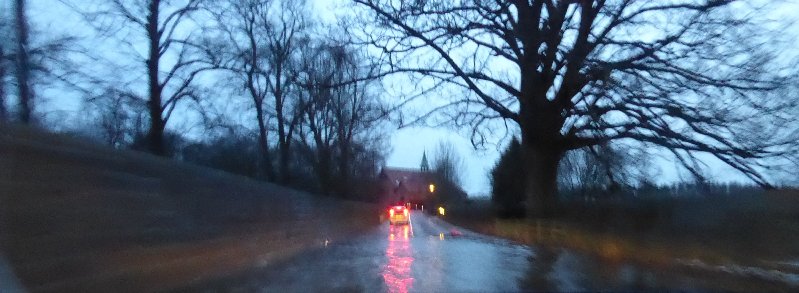
Where to leave the motorway though, for the final few miles home? There were floods in Leeds, floods near Harrogate – there were sure to be floods in Boroughbridge too. What about Knaresborough? It turned out there were floods near there too, as we discovered when warning notices turned us back on the road we’d come on, and sent us back by several miles to look for another route. Familiar fields had turned into lakes, deep and almost unfordable road-side puddles were unavoidable.
This doesn’t look too bad. Trust me. It’s deep.
We’re lucky. We were flood-tourists on our journey home, gawping at rivers-become-seas, and roads-become-rivers. Our home wasn’t flooded, nor will it be. Others aren’t so fortunate. They’re either contemplating the devastation of their own home or business – or both, or anxiously shoring up the front door with as many sandbags as they can lay their hands on, in anticipation of the days ahead, when the forecast continues to be grim. We could all do with a bit of an old-fashioned winter cold snap, with a touch of frost, but positively no rain.
You see that bridge, centre left? That’s a bridge over the River Ure, in Ripon. This lake in the foreground is not a lake, but open ground at the edge of the city, favoured by dog-walkers and children.
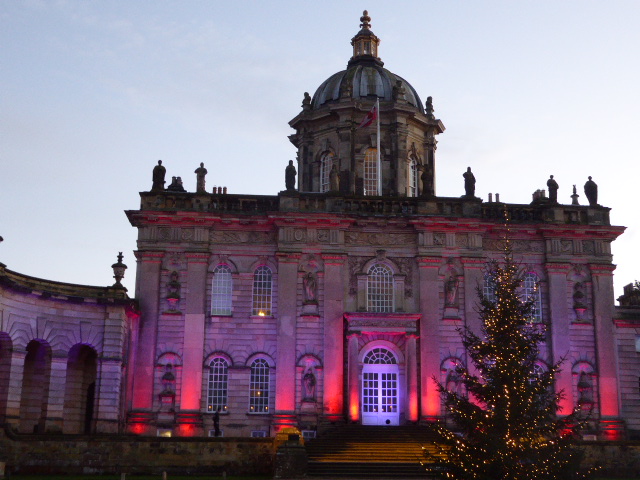
You all know Castle Howard, that magnificent 18th century stately home, and one of Yorkshire’s treasures. I’ve even blogged about it. It provides the backdrops in endless films and TV dramas.
This time, though, as it’s Christmas, I just want to show you how its been decorated for the season. A few weeks ago they shut the doors for a whole fortnight, and everyone from groundsmen and gardeners to guides and caretaking staff turned to and spent their time dragging trees into place, painting, placing baubles, candles and foliage, gilding, and generally making the place festive. Then they re-opened. We came away from our afternoon there, admiring everyone’s hard work and enthusiasm, feeling Christmassy for the first time this year. Happy Christmas everyone!
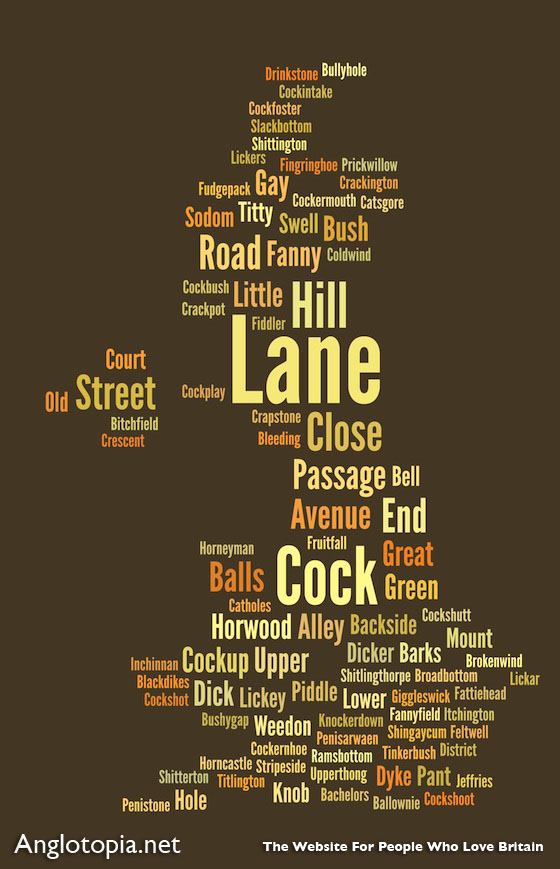
What could be more fun than pottering round the back roads of England on a sight-seeing outing? Even more memorable than charming village greens, ancient market towns, and ever-changing scenery are certain English place names.
Image courtesy of anglotopia.net
What about Affpuddle (Dorset), Barton-in-the-Beans or Burton-le Coggles (both in Lincolnshire), Dirty Gutter (Staffordshire), Dirdle Door and Gussage St. Michael (both in Dorset), Great Cockup (Cumbria), Lower Slaughter and Tomtit’s Bottom (both in Gloucestershire), Oh Me Edge (Northumberland), Ryme Intrinseca (Somerset), Sheepy Parva (Warwickshire) or Wyre Piddle (Worcestershire)? Or dozens and dozens of others.
Somehow, the names themselves give a clue about where in the country they’re situated, to those of us born and bred here. Yorkshire, for instance, often has a gritty edge to the names of its towns and villages, which are characterful, rather than pretty. Blubberhouses is where the houses by the bubbling streams were found: Grimwith was the wood haunted, once upon a time, by ghosts and goblins. And Arncliffe never used to be simply a well known landmark beloved of rock climbers and ramblers, but was instead the eagle’s cliff.
These place names should intrigue us. As elsewhere, those in Yorkshire reveal a history in which migrants from Celtic, Viking and Saxon lands, from Rome and from France populated the teritory, making homesteads and small holdings in a landscape which was not always welcoming.
Long before the Romans, the whole area was dominated by a powerful Celtic tribe, the Brigantes. They could be found in Ireland too, and even the Greek geographer Ptolemy had heard of them. They gave us place names still important round here: Pen-y-ghent – one of the Three Peaks – reminds us that to the Celts, ‘penno‘ meant ‘hill‘. They named three rivers too: the Nidd (‘brilliant‘), the Wharfe (‘winding‘) and the Ure (‘strong’, or ‘sacred‘).
The Romans had a large presence in Yorkshire – especially in York itself – and we live quite near another large and important settlement, Aldbrough. They left artefacts, buried settlements, fragments of their long straight roads, but here in Yorkshire, no place names.
When the Romans left, Eastern England was the destination of waves of invaders from Germanic peoples we now know collectively as Anglo-Saxons. They came, they conquered, they settled. They made homes – ‘hams‘ -for themselves (Clapham), and farms: ‘tun’ means farmstead (Horton). They made clearings in the woodland (‘leys’), and small towns grew up – Leyburn. They were the first to identify Yorkshire as a large geographical entity, and divided the area into Thyrdings, which we later called Ridings. Read all about it in the Anglo-Saxon Chronicle of 1065!
During the same period, Vikings also came from Scandinavia. We think of them swashbuckling their way across the land, raping and pillaging and laying waste to all in their path. But the fact that 2/3 of settlement names in Yorkshire can be traced back to Old Norse tells a different story. The Vikings too wanted land on which to settle and make a living. Their names include terms like ‘slack‘ (‘hollow‘), keld (‘spring‘), ‘gill‘ (‘ravine‘) and ‘foss‘ (‘waterfall‘). In particular, those very many settlements whose name includes ‘– thorpe‘(‘outlying farmstead‘), ‘– thwaite‘ (‘clearing‘) and ‘– dale‘ (‘valley‘) betray their Viking origins.
And then it was 1066 and All That. The Normans came and they conquered. In particular, Wiilliam conducted a campaign of ‘harrying of the north’, systematically devastating the countryside in order to isolate and destroy his enemies. Unsurprisingly, there is little French influence on Yorkshire place names – apart from that left by the monks. Several Cistercian Abbeys in Yorkshire have left their names behind: Jervaulx (that means ‘by the River Ure‘) and Rievaulx (‘the valley of the river Rye’), as well as Fountains Abbey – ‘font‘ meant ‘spring‘ in Norman French, and the area on which the abbey is built is rich in water sources.
So by this time, most settlements in Yorkshire had acquired the names by which we recognise them now. Here are a few of my favourites. Enjoy their names, enjoy their meanings, and maybe add a few more of your own favourites?
Appletreewick (pronounced ‘Aptrick‘): dairy farm by the apple tree. (OE)
Arkengarthdale: the valley where Arkil (ON personal name) had his enclosure.
Buttertubs: perhaps named after the potholes used by the farmers to cool their butter on the way to market.
Conistone Cold: the King’s farm exposed to the cold (ON &OE)
Crackpot: the crevice where crows nest (ON & ME)
Giggleswick: Gikel’s (OE personal name) dairy farm.
Gordale: the dirty valley or the valley covered in manure: (ON &ON/OE)
Hardraw: the shepherds’ row of cottages (OE)
Ingleton: the farm on the hill (OE)
Langstrothdale: the valley with a long stretch of marsh overgrown with brushwood (OE &ON)
Muker: small cultivated field (ON)
Settle: a dwelling place (ON)
Swinithwaite: a clearing made by burning (ON)
Trollers Gill: troll’s arse ravine (ON &OE)
Whernside: the hillside where querns (millstones) were found (ON)
ON – Old Norse
OE – Old English
ME – Middle English
The landscape of Buttertubs, only a little tamed since Viking times.
* Faggergill: the ravine in a sheep enclosure (ON)
^ Scaleber: The hill with the shieling (hut or high pasture) (ON& OE)
We’ve just come back from Herefordshire, where we’ve been helping our friend Hatti celebrate a Big Birthday. She and her family have a cottage there – it’s been in their family for decades now – in the back-end of nowhere, alongside the River Lugg. If you don’t like fishing, or walking the hills and vales, or mooching along woodland paths, best not go there. If you’re in a hurry, don’t go. You’ll only meet a tractor on a narrow single-track road and be forced to reverse all the way back to the last junction. There’s no nightlife, no shopping malls, no nearby towns, not much of any evidence of 21st century life – the family cottage doesn’t even have electricity, for goodness sake: gaslight in the evening is a reposing and rather nostalgic experience.
The cottage.
The River Lugg at the bottom of the garden.
The welcoming committee in the next field.
History, though. The area has history. It’s part of the Welsh Marches, that border territory between Wales and England that was fought and skirmished over pretty constantly from the time of the Romans, by Angles, Saxons, Normans and countless ancient tribes, right up to the time of the Tudors. Offa’s Dyke, that 8th century earthwork which largely defined the Welsh border for centuries can still be seen not too far from here. This was frontier territory, crammed with motte-and-bailey castles, and garrison towns such as Hereford and Shrewsbury. An area of gently undulating hills, deep and wooded secret valleys, it’s a territory that must have lent itself to scraps, battles and long-drawn-out tit-for-tat fighting between the area’s war lords.
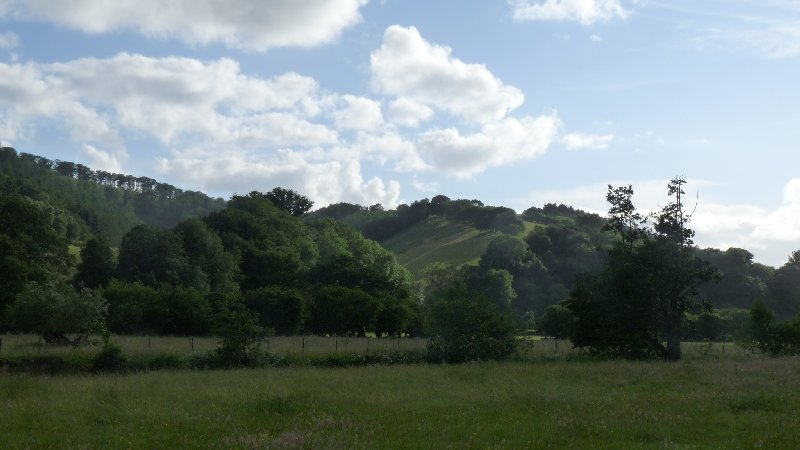
It’s hard to imagine now. Those hills and valleys are patchworked with fields where cattle and sheep browse the meadow grass, and where crops are maturing, ready for the summer harvest. The woods are still there though, and there are trees so old that they may have seen some of those ancient conflicts. There’s an interesting story surrounding the gnarled and twisted sweet chestnuts and oaks in the parkland of Croft Castle, just down the road from where we were staying. It’s said the sweet chestnuts trees were planted in 1588, in the formation of the Spanish Armada.
A Spanish sweet chestnut shows its age.
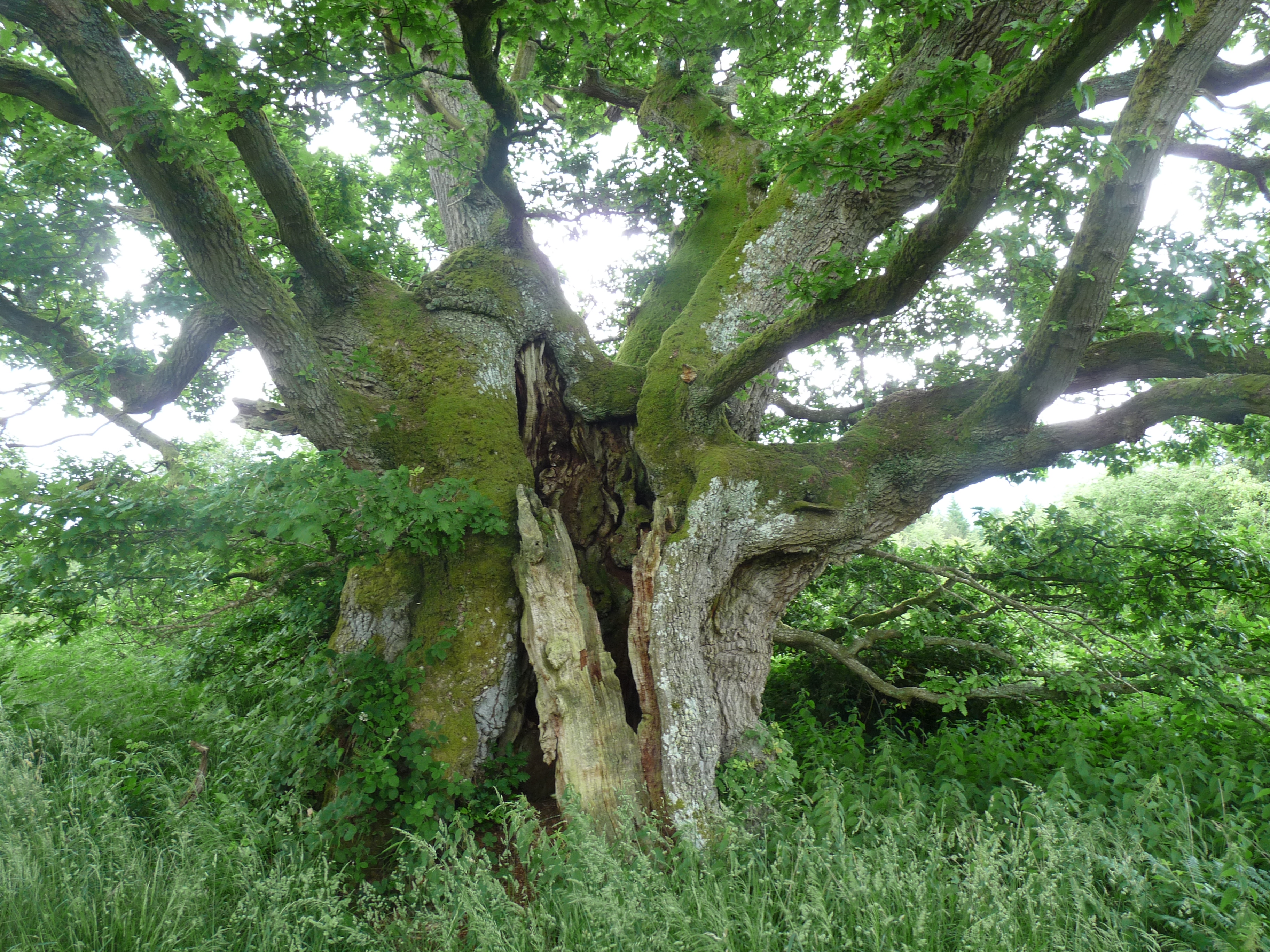
Oaks represented the English navy. Though some trees are even older. This oak tree is thought to be 1000 years old.
The 1000 year old Quarry Oak at Croft Castle.
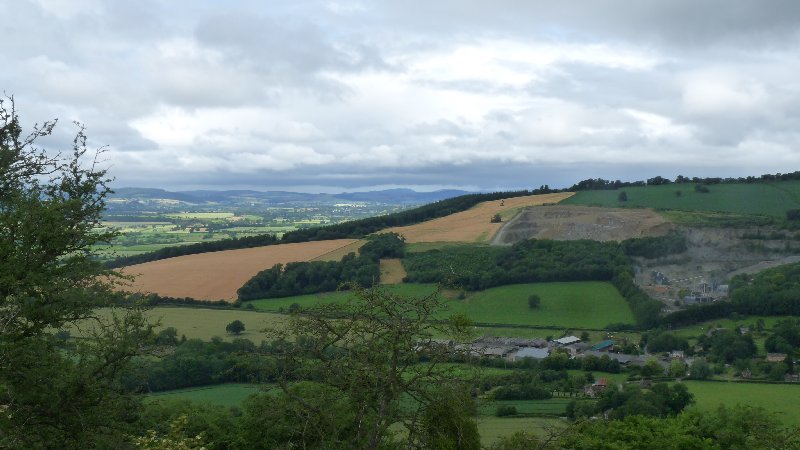
Carry on walking though, and you’ll climb upwards and find yourself on the site of an Iron Age hill fort. Recent excavations there have found evidence too of Romano-British fire ceremonies, animal sacrifice and feasting. Nowadays, it’s enough to marvel at the views across to England one way, Wales the other. It’s said you can see 14 counties on a clear day. We couldn’t, but that may say as much about our command of the local geography as anything else.
Commanding views of several counties, in England….. and Wales.
We had a wonderfully satisfying break: peaceful, lovely countryside to explore, with the added bonus of parkland, gardens, ancient churches. And while Herefordshire remains rather difficult to get at from just about anywhere else in England, it’ll probably go on being one of the country’s best kept secrets.
No it’s not. But before we went there last week, we were inclined to agree with Noel Coward’s judgment. We’d decided to go to north Norfolk for a week off from the twenty-first century: no wi-fi, no TV, no motorways, but instead wide open countryside and sea, small uncluttered villages with a parish church worth exploring, market towns, and a night sky unspoilt by light pollution.
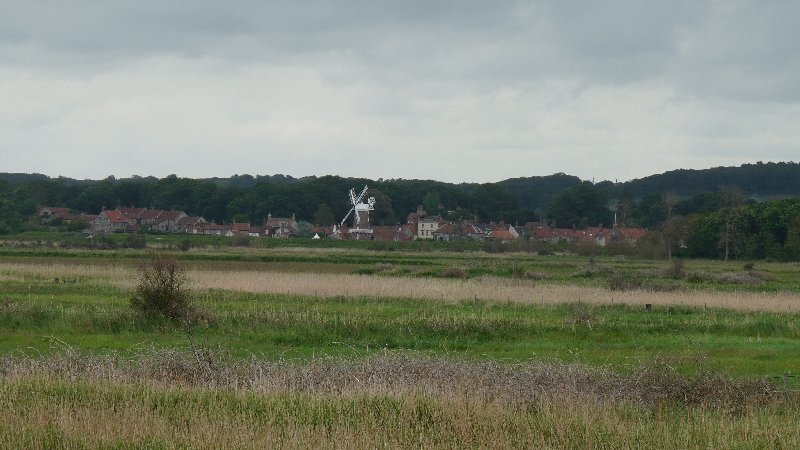
The village of Cley-next-the-sea, seen from the nature reserves on the marshland between the village and the sea.
We stayed near South Creake in North Norfolk, in the delightful bed and breakfast accommodation of Sara and Bob Freakley. Here is the view from their front gate.
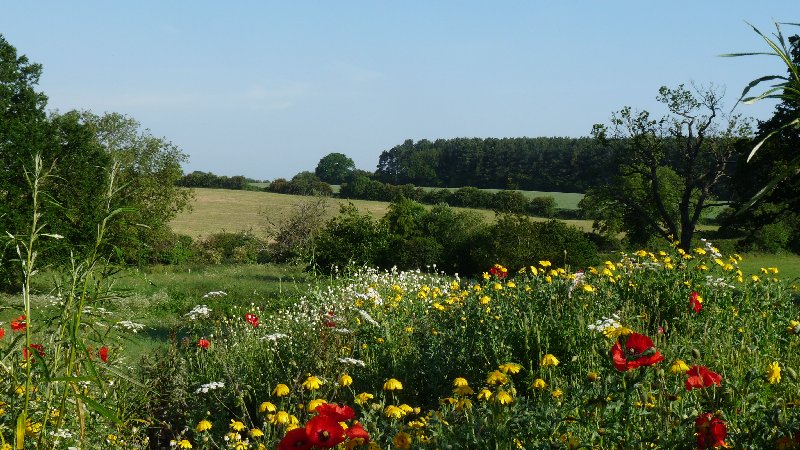
Leicester Meadows: the view from the garden.
You can see that it’s not flat. It’s quietly, comfortably, gently hilly, with woodland and meadowland nearby. South Creake is the kind of village where any number of ducks raise their families on the village green.
Flint cottages at South Creake.
Heavy traffic at South Creake.
A narrow pathway in Cley-next-the-sea.
And like so many Norfolk villages, it has a grand church far in excess of its apparent needs. We loved St. Mary’s church, as so many in the area. Landowners spent money outdoing their neighbours when it came to church commissioning and building. Get it right, and royalty might come to stay – they never did. But wooden angels soar among the rafters of splendid wooden-vaulted roofs. Some churches are tall and stately, others rustic, with flinty walls. A few have chunky cylindrical towers, because flint doesn’t lend itself to crisply finished corners.
St. Mary’s, Burnham Deepdale, with its Saxon round tower.
A typical tombstone in a typical churchyard.
King Charles the Martyr at South Creake church. The Anglo-catholic tradition is strong here.
An angel above our heads at South Creake church.
And angels at North Creake church.
The splendid parish church at Cley-next-the-sea (population: 376)
And then there are the stately homes. Oxburgh Hall – once seen, never forgotten. It’s a romantic, moated 15th century manor house which almost came to the end of its life in the 1950s. This was a period when many landowners, crippled by debt, felt they had no option but to throw in the towel, and dozens of ancient manor houses in Norfolk alone were quite simply pulled down. The auctioneer charged with disposing of Oxburgh declined to allow the winning bid from someone who wanted only the sturdy roof timbers, proposing to leave the rest of the house to tumble down. Members of the family came to the rescue, as did the National Trust. Now it’s one of Norfolk’s best-loved tourist attractions. Here’s why….
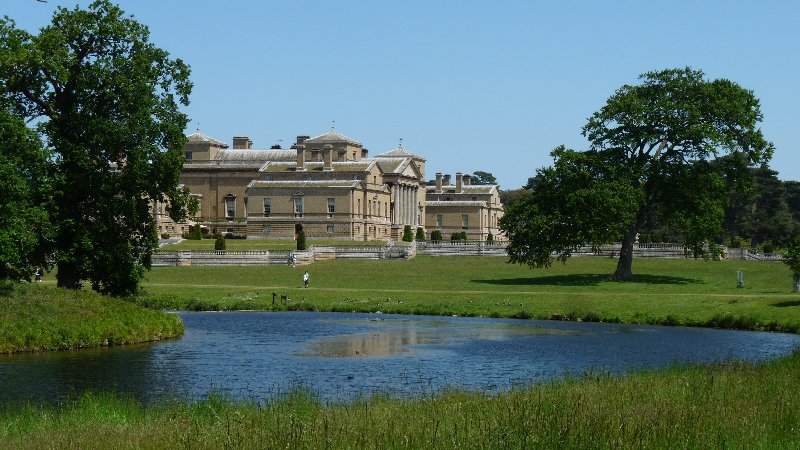
Holkham Hall is overwhelmingly big. We decided we couldn’t do it justice and confined this visit to its four-acre walled kitchen gardens, with its vines, peach trees, vegetable gardens sufficient, back in the day, to support everyone who lived and worked in this sizeable community. Many English readers probably remember all about school history lessons featuring Coke of Holkham, early 19th century politician and agricultural reformer, credited with promoting crop rotation and pioneer experiments in sheep and cattle breeding. Holkham Hall was his home and family seat.
Holkham Hall.
I’d tell you about Peckover House, suggested by friend and fellow-blogger Sharon and her husband Andrew. But it’s just over the border in Cambridgeshire, so not this time.
The orangery.
And then there’s the sea…and the wildlife. But I’ve told you about them already.
We’ve just had a brilliant few days away. First of all in Norfolk, then the Baie de Somme. I’ve realised I love the sea. Not sun-kissed beaches, though. Not ‘miles and miles of golden sand….’ *. Definitely no lying around sun-bathing for me, and building sandcastles is only fun for the first ten minutes.
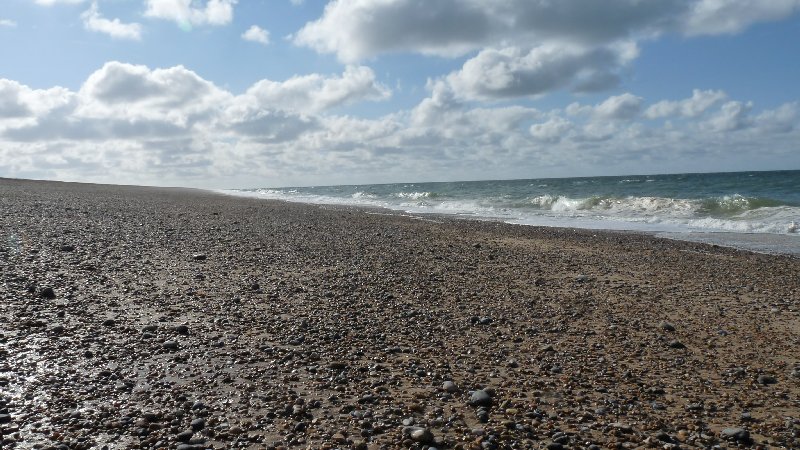
No, I love the kind of seaside we’ve enjoyed this week. In north Norfolk, we seemed to be on the coast whenever it was low tide, squinting at the distant sea in retreat, as it left behind belts of shingle, mud, scrubby dunes and sand. We’d get a convincing work-out crunching along a stony,pebbly beach, taking in the views across a flat but ever-changing landscape in subtle shades of mossy greens, grey and beige, and across a sea foaming white as it crashed to the shore, but with its own varied palette of bands of blue and grey from the shore to the distant horizon. The sky went in for moody tones, too, rather than clear summery blues, with feathery scudding clouds chased along by the rather challenging winds.
We weren’t there just for the landscape though. Birds come here to live and breed, and as birds of passage too. There are supposed to be as many as 420 species here. We knew that while the birds are nesting they are less visible than at some other times of the year. Though we’ve just got ourselves pairs of binoculars, we haven’t yet got the skills to identify everything we see. But we still wanted to be down on the seashore, every chance we got.
Egret in the evening.
Snipe feeding.
Shelduck.
Our favourite. The graceful avocet.
These geese weren’t precisely on the shore. But they were pretty close.
These ducklings were keen to steal our lunch one day, as we had a blustery picnic overlooking the sea near Hunstanton.
Then it was the Baie de Somme, a mere 90 minutes from Calais. We all know about the Somme and the bloody, ceaseless, pointless battle that took place some distance inland during WWI, in 1916. But the Somme estuary is a peaceful place. Like north Norfolk, it’s an area of marshland, water and sky. It offers fresh, brackish and salted water as a rich habitat for a huge variety of birds – and seals. We weren’t very successful bird watchers here either, but it didn’t stop us trying.
*’…in Whitley Bay, Northumberland’. Travel slogan, Whitley Bay, February 1964
Up betimes, in order to be at Harrogate Hospital by 7.30 a.m. Yesterday was a day of white-coat-syndrome-induced high blood pressure, insensibility whilst under the knife, and not a little discomfort for Malcolm. He’s been waiting for months for some minor surgery, and now he’s had it, his life should get a lot more comfortable.
I, meanwhile, had to spend the day in Harrogate waiting for the call to go and collect him. I had quite a few errands to run in any case, and after that it wouldn’t have been worth traipsing back and forth from North Stainley.
So I did my jobs, and then had plenty of chance to loaf about. I’m not the world’s keenest shopper, but I do have a favourite charity shop in Cold Bath Road. Our friend Jonet volunteers there, sifting through and sorting donated books. I love the serendipity of looking along the shelves crowded with fiction old, new, English and foreign, next to an eclectic collection of non-fiction. As usual I left the shop with a satisfyingly large pile of reading, and this time, a new-to-me summer dress.
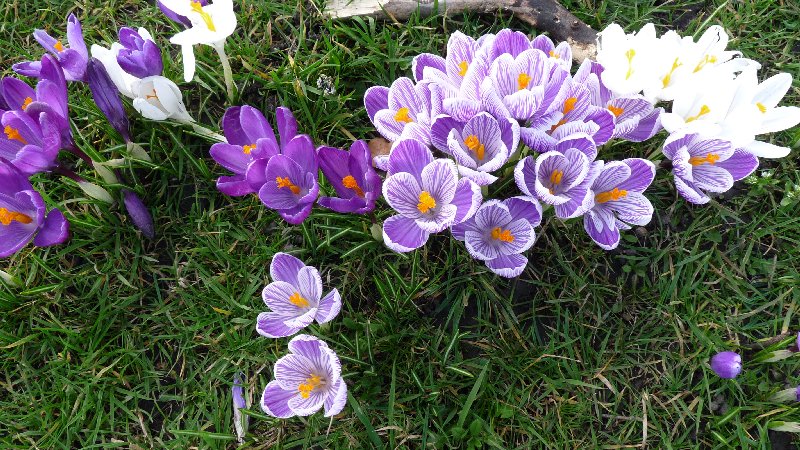
Then I headed for green space. What makes Harrogate a special town is its area of open parkland in the centre of the town – the Stray. It was created from common pastureland in 1778 to link most of Harrogate’s springs (it’s a spa town after all) and an Act of Parliament preserved its size at 200 acres. Even now, if part of its area is lost due to, for example, road widening, it must be replaced elsewhere. It’s pretty unique to be able to step directly from busy shopping streets straight onto a vast green area unbounded by railings or fences. Paths and roads will lead you through this green space to other parts of town. Like me, you could walk across the Stray to get to the hospital, or to reach the community round Cold Bath Road with its neighbourhood shops and Victorian housing. And yesterday, you could enjoy, as I did, the crocuses which have burst forth in their hundreds and thousands in glorious lakes of colour – purple, mauve, sunshine yellow and white. They’ll be followed in a week or so by an equal multitude of daffodils, and then avenues of cherries will blossom in all their pink finery. Here’s a few shots of Harrogate Stray on the warmest day of the year so far.
Easter eggs on display at Betty’s, Harrogate’s Top Caff.
View from the Stray to Harrogate.
Walking on the Stray
I know grey squirrels are no better than rats with tails, but they still cheer me up as they scurry up and down trees.
A sunny morning on the River Ure, just before we reached the Canal.
We went for a walk along the Ripon Canal the other day, starting from the point where it meets the River Ure. Back in its heyday during the Industrial Revolution, busy as it was then, the rural towpath we walked along might not have looked so very different. Back in its heyday, keels would have hauled coal northwards from the Yorkshire coalfields, and lead and agricultural products southwards. The canals were the freight-haulage routes of their age, and even though they were busy thoroughfares, the whole business of passing vessels through the three locks in one direction at a time limited the flow traffic to levels well below what those of us who’ve ever been stuck in a bad-tempered rush hour traffic jam on the M1 have experienced.
Ripon Canal is not one of the country’s great canals. There are water super-highways such as the Grand Union Canal linking London with Birmingham. That’s 137 miles long. There’s the Leeds-Liverpool Canal. That’s 127 miles long. The Ripon Canal runs for just two miles, from Ripon to Oxclose Lock, where it links with the River Ure. Like many of the country’s canals, it was built in the latter part of the 18th century, between 1767 and 1783, opening up water traffic between Ripon and York, and it eventually put the products of the Durham coalfields within Ripon’s reach.
The railways proved to be the death of canals all over England. Ripon’s withstood the opening of the Darlington to York railway in 1841, but the Leeds and Thirsk Railway finished it off. The railway company actually bought the waterway, to ensure local support , but they then neglected it, failing to dredge it, so that it became less and less useable. The canal was abandoned as a waterway in 1906.
But its fortunes have changed again. No longer a tool of the industrial revolution, the canal has become a playground for people who like ‘messing about in boats‘*. The Ripon Canal Trust spearheaded its restoration from the 1960s, and now the whole thing is managed by the Canal and River Trust. So whether you like boats, barges, or a stroll along a quiet backwater near town, Ripon Canal’s worth a visit.
The towpath again.
One of the canal bridges.
Walking the towpath
Barges on the canal.
*That’s what Ratty used to like to do in Kenneth Grahame’s ‘The Wind in the Willows’


















You must be logged in to post a comment.