This is my second response to a photo challenge this week: that’s what happens when you get a bee in your bonnet. I’ll settle down soon, don’t worry.
This time, Patti invites us to change our perspective when taking a photo. Don’t just stand, point, shoot, she suggests. Crouch, squat, get above the action, take a tour round it.
The weather being what it is, I can’t get out much with my camera, so these are all from the archives.
This first one is perhaps my favourite, taken in Gloucestershire. I had to lie at the edge of a flower bed to get this shot of a house barely glimpsed through the ox-eye daisies. Photography as exercise class.
Our friends Sue and Brian’s garden at Horton.
Here are some more shots, taken in much the same way, in gardens and fields.
I wish those alien leaves poking above the dead sunflower in Leran, France weren’t in the shot. This is a photo that’s not quite successful, technically, but It’s a shot I’d like to try again, because for me it’s very evocative of the place where it was taken.
Drystone wall, North Yorkshire.
Nosterfield Nature Reserve, North Yorkshire.
A meadow in Grewelthorpe, North Yorkshire.
Gasholder development at King’s Cross, London.
And here are two more. The back end of a festive lunch, and flags at the EU Parliament in Strasbourg.
This really wasn’t a drunken orgy…
The EU Parliament, Strasbourg.
Click on any image to view the caption, and to see it full size.
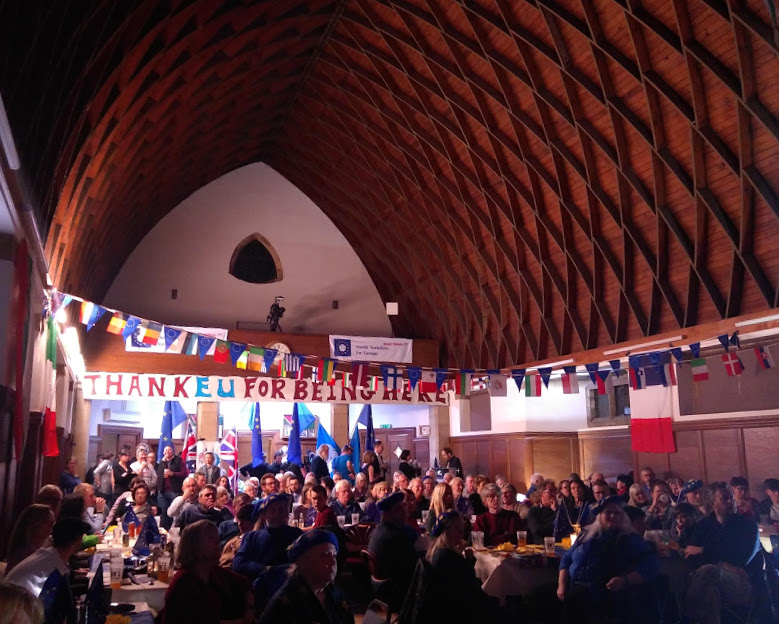
North Yorkshire for Europe made the best of a very bad job yesterday: a party for locally-resident EU citizens, to say ‘thank you’ for making their home here.
It was a great night, with fun, friendship … and tears. More tomorrow ….
As promised earlier, I’ve kept a photo diary of a month in the life of the walled garden. Too bad that my recently-repaired camera turned out not to have been repaired satisfactorily, and I’ve had to rely on my not-very-smart-smartphone.
So here we are, Sue: the walled garden, as it puts itself to bed for winter. The Changing Seasons.
1st November. Here we are. Come in and explore.
2nd November
3rd November.
4th November.
5th November. You want me to go out in THIS?
6th November.
7th November.
8th November.
9th November.
10th November.
11th November.
12th November.
13th November.
14th November.
15th November.
16th November.
17th November.
18th November.
19th November.
20th November.
21st November.
22nd November.
23rd November. Oops. I forgot. Until dead of night.
24th November.
25th November.
26th November.
27th November.
28th November.
29th November.
30th November. And just in time for the end of the month, a good hard frost. Winter’s on its way.
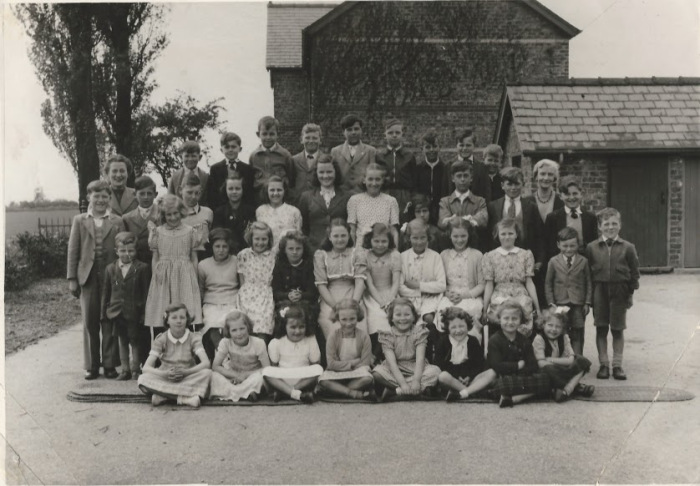
My life has come full circle. Many of my earliest memories come from Sandhutton, current population 260, where my mother was head teacher of a two-teacher school which educated all the village children between five and fifteen years old. These days I visit the village weekly – it’s less than ten miles away. The school no longer exists, but my Spanish teacher lives there.
There we are. Sandhutton School, c.1951, just before I started there.
When I was five, my life changed a bit. We went to live in London (current population 8.13 million).
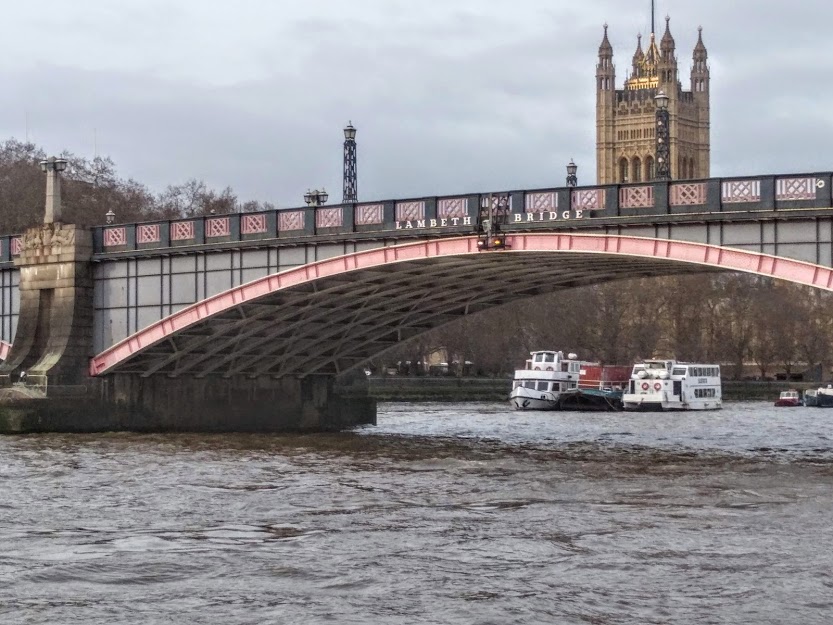
A trip down the Thames: nearly at Westminster now.
I was a student in Manchester (538,000). Then I went on to live in Portsmouth, in Wakefield, in Sheffield, in Leeds: all cities numbering their citizens in the tens,or even hundreds of thousands. I loved city life. I relished the opportunities only a city could usually offer, and the diverse populations living in them.
One of my favourite places in Manchester: The John Rylands Library. Who wouldn’t feel a real scholar in these surroundings?
Thornton’s Arcade in Leeds.
No, just …don’t. A shoe shop in Leeds.
When we moved to Harrogate, some twenty years ago, I announced we were moving to a small town. A mere 75,000 people lived there.
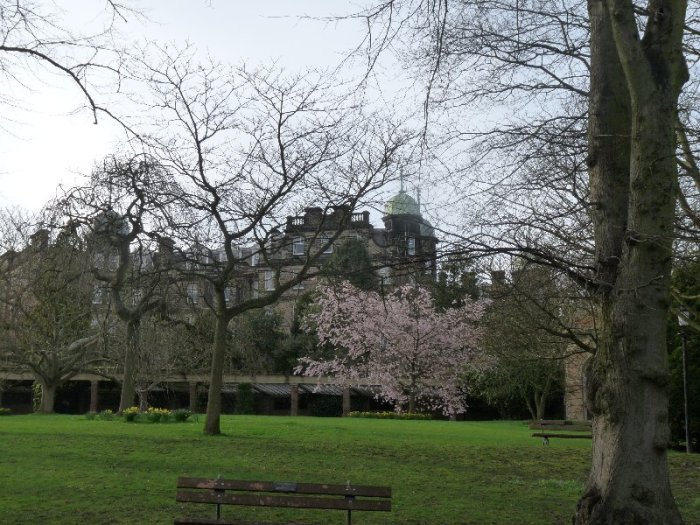
Harrogate: one of its many open spaces: the Valley Gardens.
But that was before we went to France. Laroque d’Olmes has a population of some 2,000 people, and its county town, Foix, has only 10,000. We came to appreciate small town life: its neighbourliness and our sense of belonging – the space to appreciate the countryside and mountains beyond.
The street near the church in Laroque, with the Pyrenees in the distance.
When we came back to England, that small town of Harrogate suddenly seemed horribly large, traffic-infested and in every way untenable, despite its green spaces and lively community life. So here we are in North Stainley, population 730.
In fact we’re not even in the village, but in a little enclave just outside, with that walled garden I showed you last week. Population 8. It’s perfect.
Summer used to be a time for postcards. Sending them. Receiving them. Receiving was better. What to say to your friends and relations with only such a small space to play with? ‘Wish you were here’ maybe?
The views were standard, wherever they came from. The castle. The cathedral. The fisherman’s cove. The crowded beach.
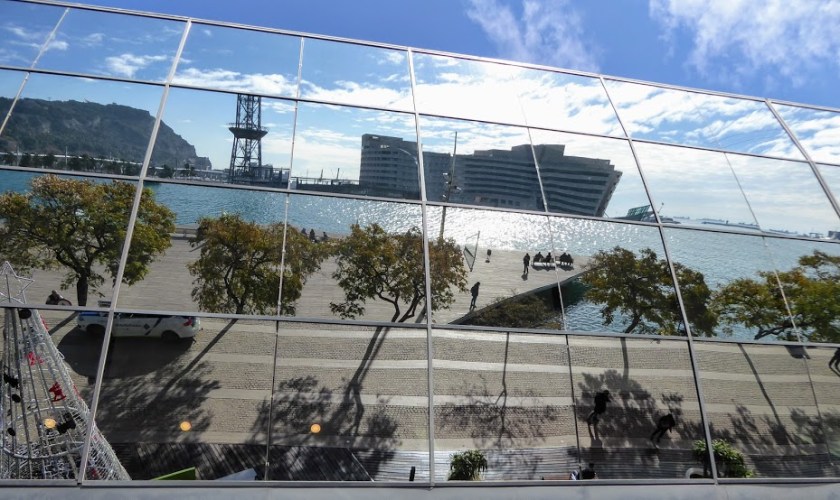
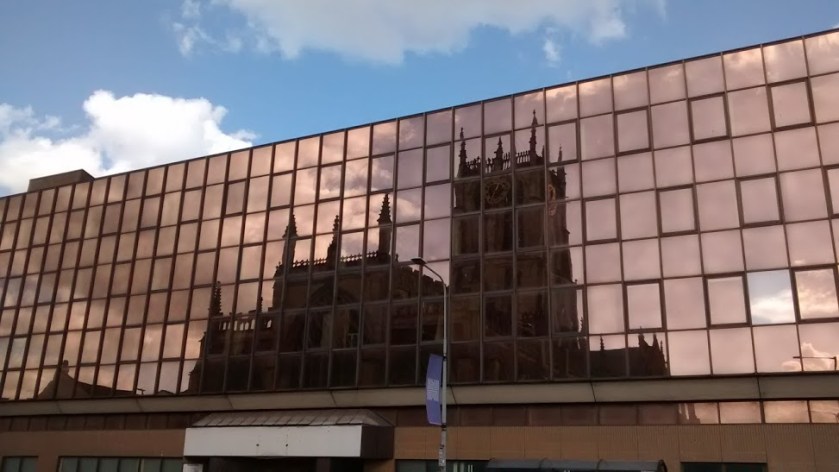
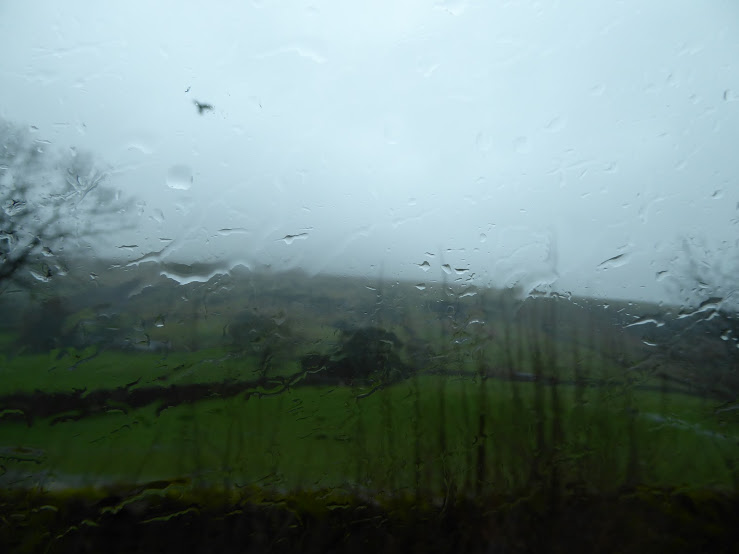
Today I’m reviving the tradition, but with a different angle on the standard shots.
St. Paul’s Cathedral, seen reflected in Angel’s Wing (2000) by Thomas Heatherwick, Paternoster Square, London.The Leeds-Liverpool Canal passing under a bridge near Gargrave.The Port Olímpic area of Barcelona seafront, reflected in nearby buildings.Hull Minster, as seen in a nearby office building.An honest view of a British holiday? The countryside near Penrith on a soggy Sunday.
We’ve just come back from a long weekend in Gloucestershire. The highlight was to spend time with William, Zoë and their parents at the home of Sarah (daughter-in-law)’s parents, who had invited us all: the highlight of this particular highlight was watching Zoë discover strawberries…
Another highlight was to visit Slimbridge, the Wildlife and Wetlands Trust site founded and developed by Sir Peter Scott.
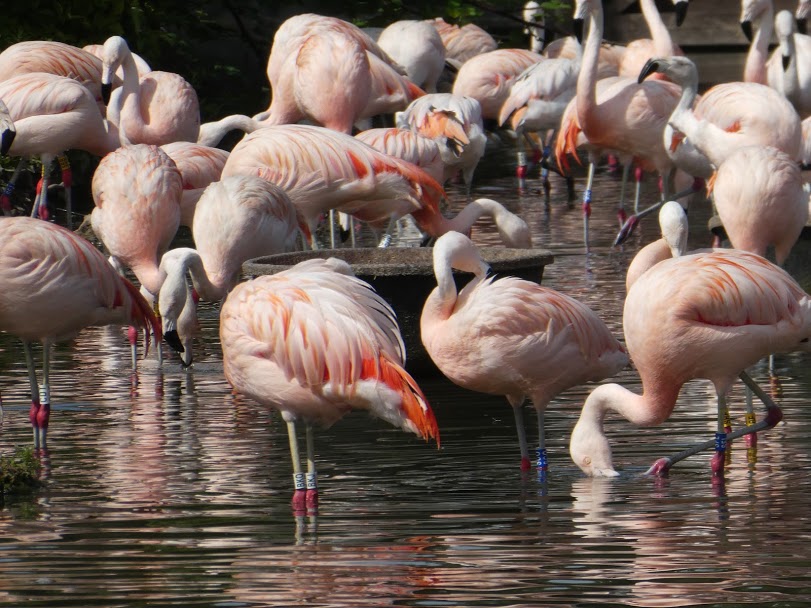
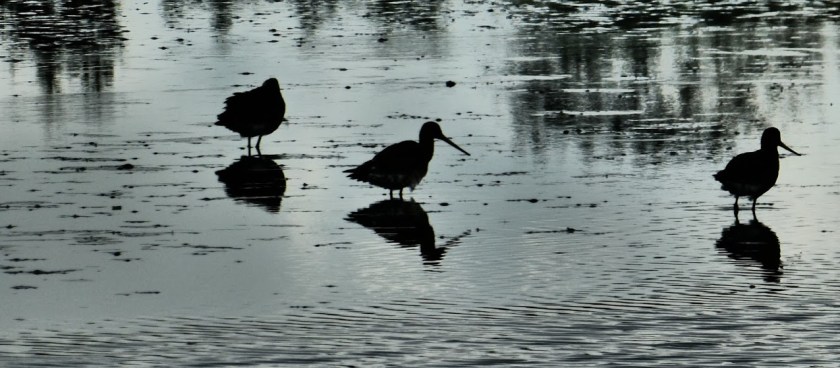
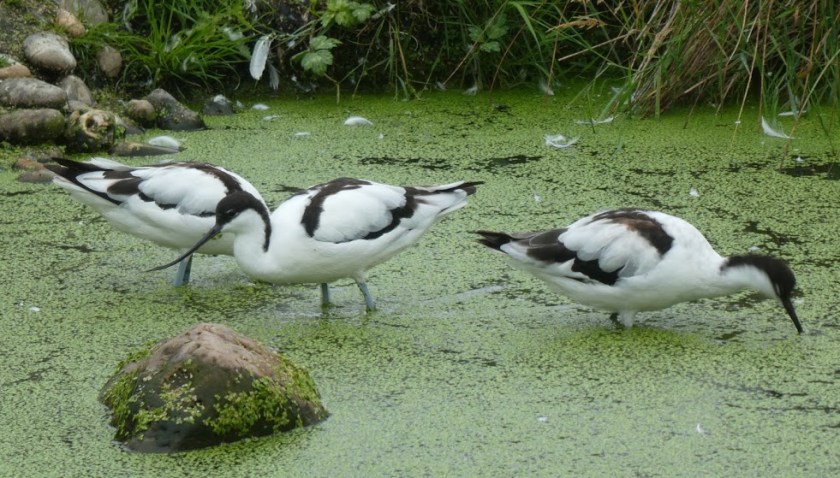
So much to see: water birds of every kind. But I’ve come away with memories of three in particular: three species of wading bird who spend much of their lives fossicking in the shallows for the small creatures on which they depend for their diet.
All three of the birds that so engaged me shared similar characteristics. Impossibly long, fragile-looking legs, giving them a delicate and graceful appearance: impossibly long, unmissable beaks.
Ladies and gentlemen, I present to you various varieties of flamingo….. Who can fail to be entranced by their pink plumage, sometimes almost embarrassingly vivid, at other times delicately pale?
I’m an indifferent housewife and Malcolm is worse. What’s the point of dusting until you can actually see a result from doing so? Malcolm would probably say ‘What’s the point of dusting? All it does is re-arrange the dust.’ Hoovering happens when it has to.
So last week it was a terrible shock when I decided to have a really good spring-clean, hoiked the edge of a rug out from under the radiator where it’s normally firmly wedged, and found this…..
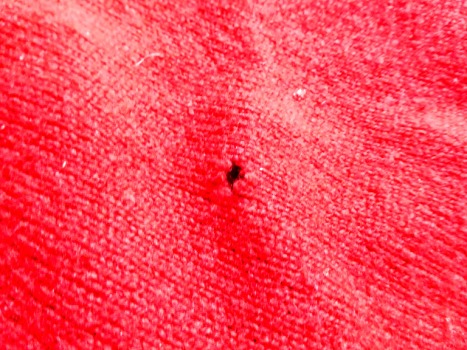
…….. the corner of our Persian rug chewed to a fragment. By clothes moths. Of whom I could see not a single sign.
Well, we cleared up the mess and left it at that. Until today. Malcolm had a little sort out of the jumpers in a drawer, and found this….
….. and this ……
Well. Spring cleaning it is then. With a vengeance. We’ve ransacked the shops for nasty chemicals, packaged for the most part in plastic (so much for our eco-credentials), and set to with the vacuum cleaner, dusters, scrubbing brushes, mops. It’s either that or face the world with every item of clothing interestingly decorated with a filigree of little holes.
Will it make us less indifferent housekeepers? Probably not. It’ll take more than that to change the habits of a lifetime. But then, it turns out that both Harrogate and Ripon are suffering from a serious Invasion of the Clothes Moth. Even Houseproud Housewives are not exempt.
Several of you commented on my coastal pictures from Northumberland, remarking on how relaxing the whole thing must have been. Well …. it recharged the batteries alright … but not by lying down on the beach with a good book. Certainly not.
Only birds sunbathe here……
We were at Nether Grange, an HF hotel, with our walking group. And we were there with other walkers – some in groups, others not. At Nether Grange, walking is what you come for. That and good food eaten in good company. We’d opted for guided walks. Three levels of difficulty are offered each day so there’s no excuse not to get involved. I chose one of each, so finished the week with 15.3 km, 12 km and 17 km. walks under my belt.
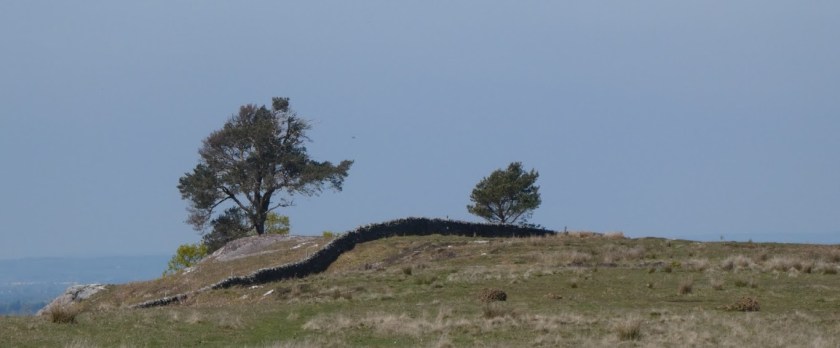
Moorland near Etal.
This is hill country. The Pennines, the backbone range that bisects northern England becomes the Cheviots as it marches towards Scotland. In the car you’ll swoop thrillingly up and audaciously down those hillsides. They provide a backdrop to the area which is at once dramatic and bucolic.
On foot, you’ll get to know about those slopes….. actually, we weren’t often faced with gradients that had us gasping, panting and begging for mercy. But we rarely had a long level stretch either. And our leaders were there to encourage, chivvy along, provide good humour and background notes on all kinds of topics … as well as read the maps, so we didn’t have to.
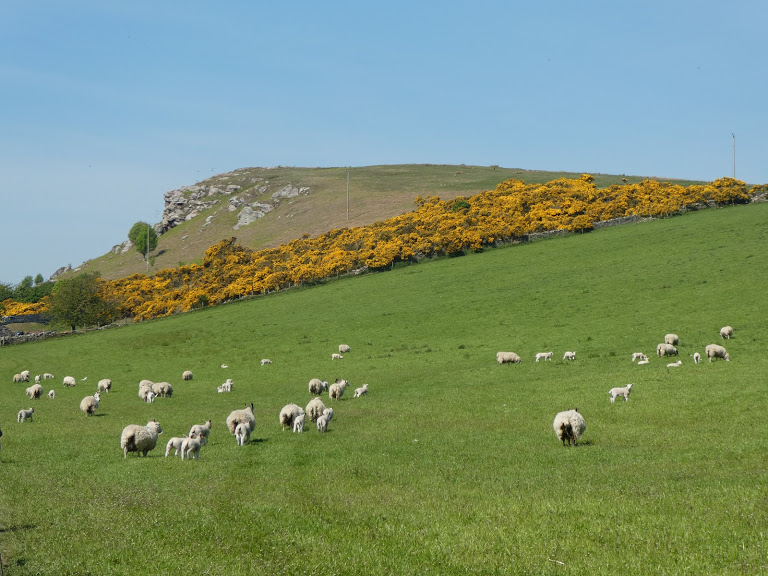
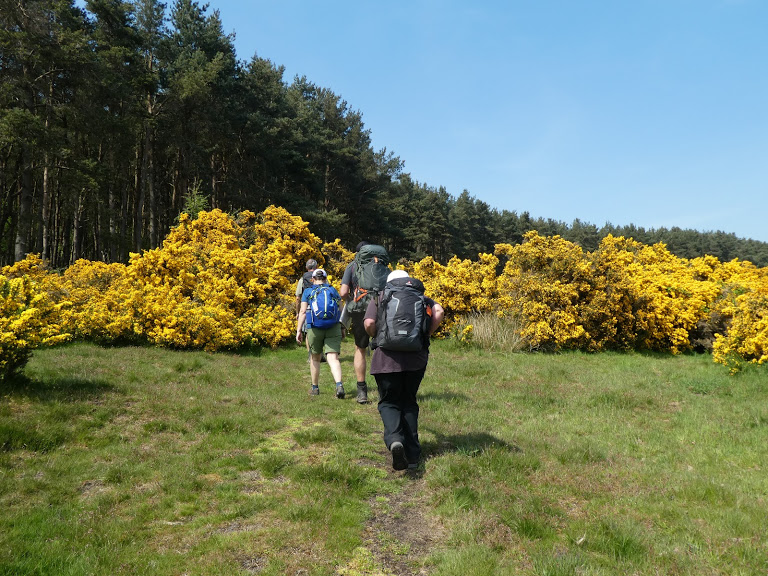
We walked moorland tracks, bouncy with springy turf nibbled short by sheep. We crossed hillsides bright with golden gorse. We tracked through woodland carpeted with bluebells.
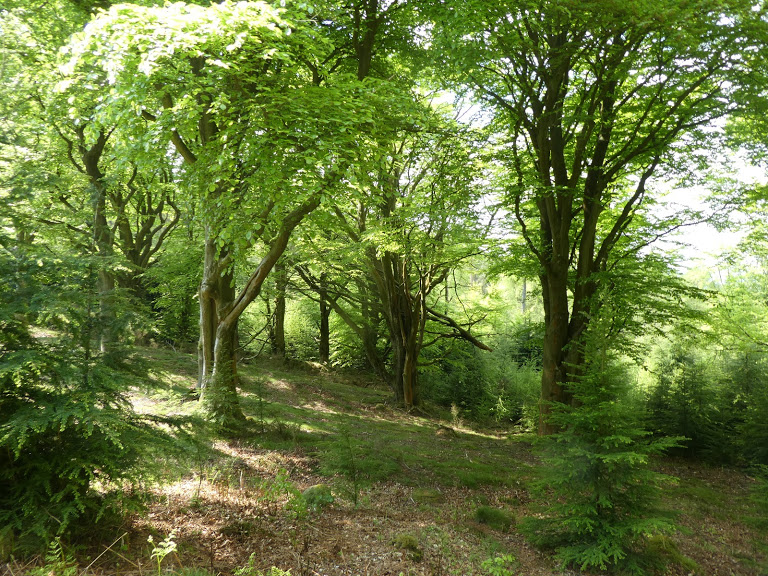
A woodland glade … no bluebells this time.
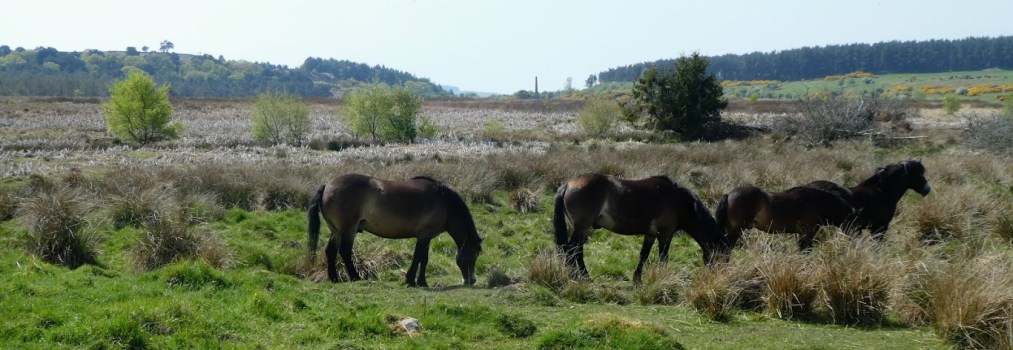
We passed Ford Moss, an extremely ancient raised peat bog where we excited the residents: Exmoor ponies charged with grazing the vegetation and keeping it in trim.
Exmoor ponies going for a gallop.
We passed farms with shire horses and hissy geese.
Shirehorse and foal.
Hissing goose.
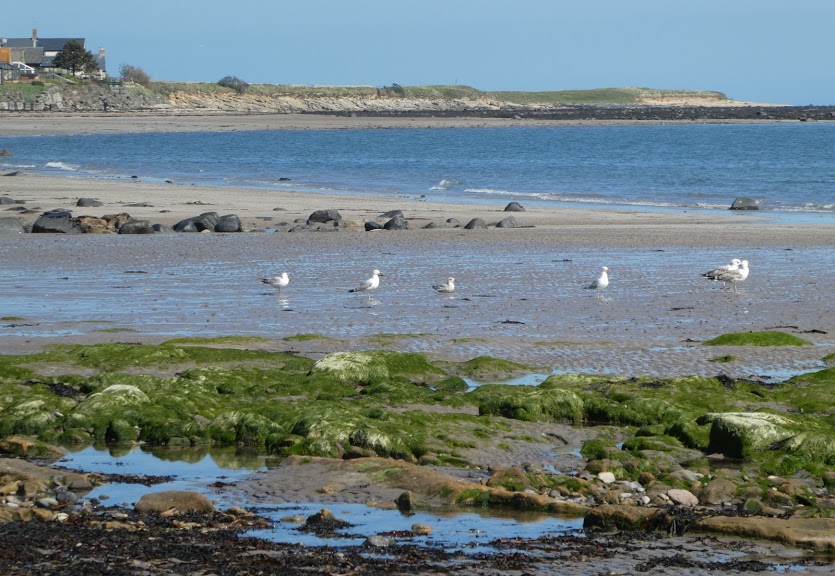
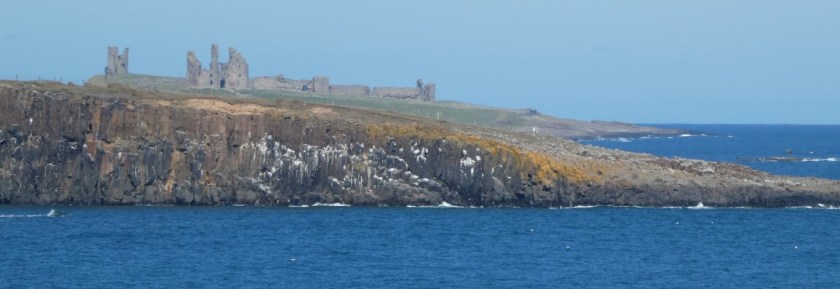
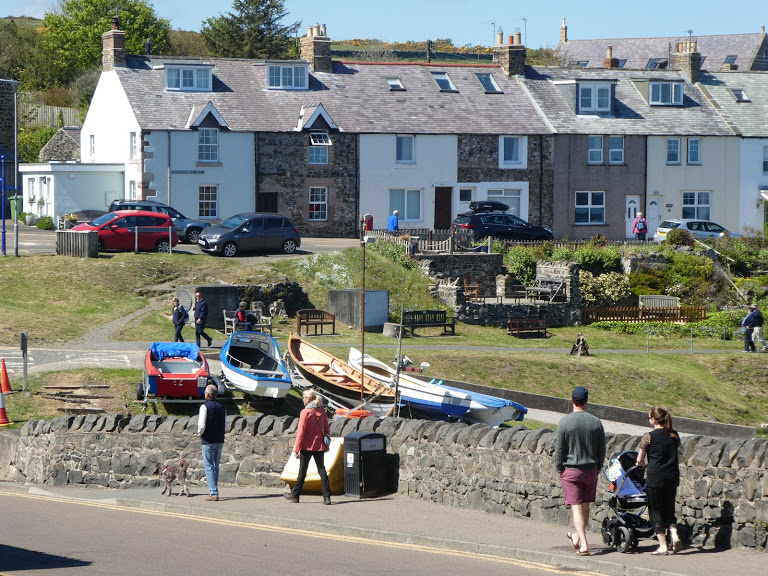
And on the last day, we walked the local coastal path: St. Oswald’s Way. The section between Alnmouth and Craster-where-the-kippers-come-from is characterised by craggy cliffs, and are home, like the nearby Farne Islands, to many thousands of seabirds such as kittiwakes and fulmars. Here’s what the zoom lens on my new camera can do.
Cliffs and Dunstanburgh Castle seen from afar. The next three shots zoom in ….
Craster: cottages, a safe harbour, and a few tourists.
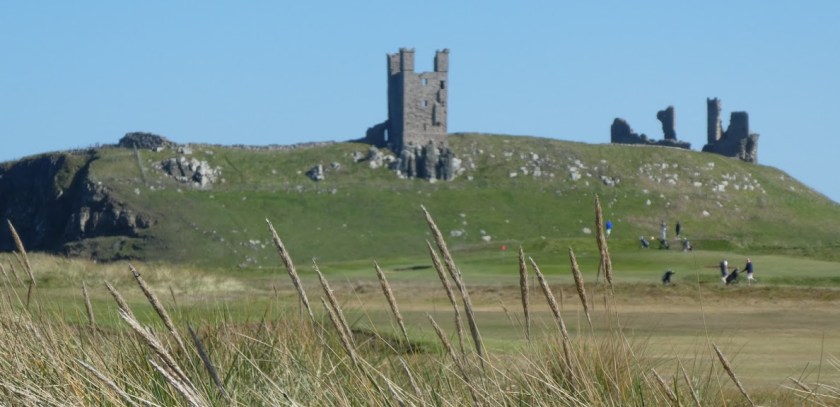
Our group, the 17 km one (10 1/2 miles to the non-metric) finished just beyond Dunstanburgh Castle. It was built in the 14th Century by the Earl of Lancaster, who was openly hostile to King Edward II – never a good idea, because the king had him executed in 1322. This fortification was built to make a bellicose statement, in an area crowded with castles. Now it’s a ruin, and an impressive one. We slogged to the top of the keep for the views, marvelling at the extra-thick walls as we climbed.
Leaving the castle behind us.
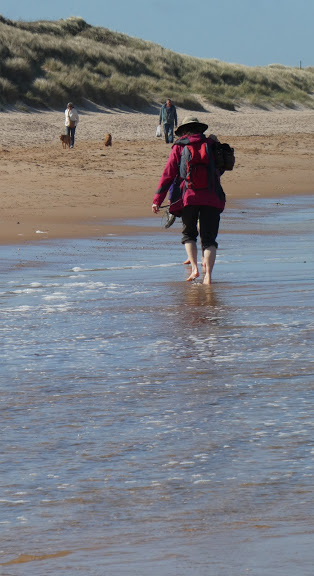
We finished the day, and our three days of walks, with a paddle. Gotta have a paddle. Or ‘plodge’ as the locals call it.
Plodging towards home….
With thanks to our walk leaders Chris, Helen, Paul, Richard: to Reuben and Team Nether Grange, and to our own Mike and Angela for organising the holiday.



























You must be logged in to post a comment.