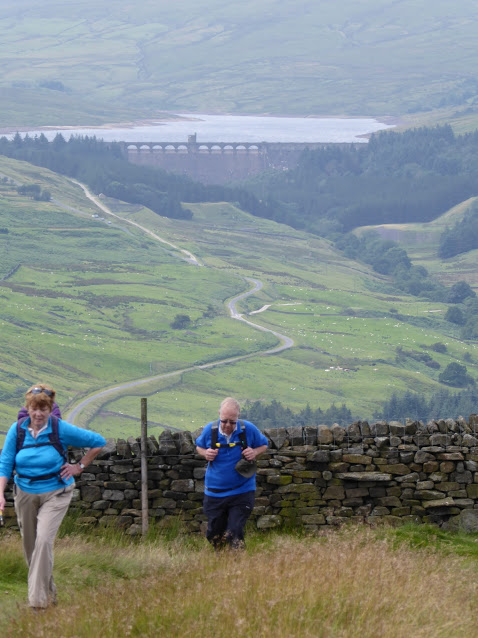
The road we could have taken to Scar House Reservoir
I love Colsterdale. It may be my favourite Yorkshire dale. It’s an isolated area, tucked away, north-west of Masham. Not a single main road goes through it. There are no traffic jams here, just local cars (4x4s are useful), vans and tractors.
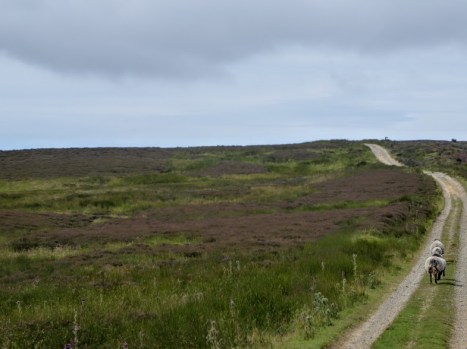
Walking these tracks, be prepared to share your route with a few sheep.
There are routes though. Ancient routes forged as long ago as the 14th century, when there was a long-gone coal mine here, or more recently by stockmen driving their flocks over the harsh moorland landscape. These days, it’s hikers and ramblers who are more likely to use these tracks. Perhaps they’re completing the Six Dales Trail, or finding out the history of the Leeds Pals. Perhaps, like us, they’re enjoying a walk from Leighton Reservoir, and enjoying long distance views of Scar House Reservoir.
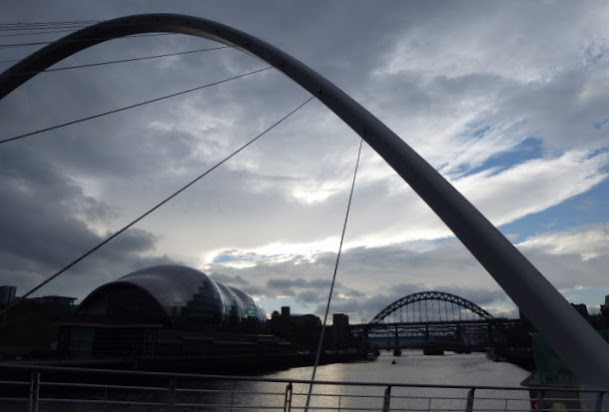
The Millennium Bridge, looking along the Tyne towards the Sage concert hall and the Tyne Bridge.
We were in Newcastle last weekend, and we spent much of our time admiring the fine buildings of the city centre, and mooching about the Quayside. That Millennium Bridge! What a perfect match for its surroundings. It links the proud Victorian architecture of Newcastle with contemporary work housed in the Baltic Centre just on the Gateshead bank of the River Tyne. Its clean soaring parabola provides a perfect complement to the more long established city bridges.
‘The bridges over the Tyne between Newcastle and Gateshead are justifiably famous. They are not merely bridges, but icons for the North East. Over the years the single (Georgian) bridge existing in the early Victorian period has been joined by six others. First the High Level Bridge, giving the river its first railway crossing, then the Swing Bridge (replacing the Georgian bridge), and the first Redheugh Bridge, replaced twice, to be followed by the King Edward Bridge and the most famous of them all, the new Tyne Bridge. After many decades came the Queen Elizabeth Metro Bridge and finally, in 2001, the Gateshead Millennium Bridge opened to provide a stunning pedestrian and cycle link between the redeveloped quaysides on either side of the river. In the space of less than a mile seven bridges link Newcastle with Gateshead.’
1592 was a terrible year for Korea. The Japanese invaded. They raged through the land destroying all they saw. They burnt ancient temples and state-of-the-art palaces as well as ordinary homes. Little was left.
Imagine an England in which every cultural icon was destroyed in WWII – Buckingham Palace, St. Paul’s Cathedral, York Minster, Salisbury Cathedral, Chatsworth….. that’s the kind of morale-destroying disaster Korea faced in 1592.
Rather than accept these losses, Koreans rolled up their sleeves and built everything again, on the same site, and to the same design. Not just once, but in some cases several times, as a consequence of later invasions and revolts. Unlike our own historic buildings, these structures are made not from stone or brick, but from the wood from monumental long-lived trees with statuesque trunks and mighty branches. These palaces and places of worship are carved to traditional patterns and painted in an accepted range of colours with time-honoured designs and images. To our eyes, these palaces and temples look fairly similar. But once we overheard a group talking – ‘Look, anyone can see that’s twelfth century: not a bit like the 15th century style we were looking at earlier’.
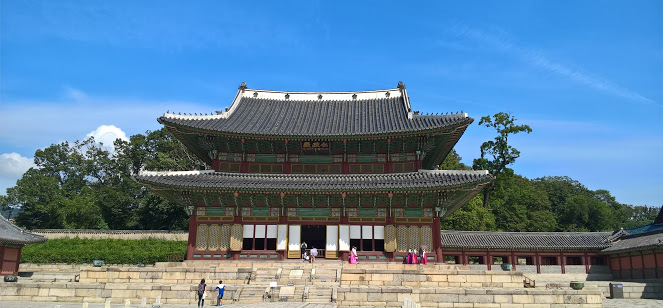
Here’s Seoul’s Changdeokgung Palace. It was first built in 1408 for the Joseon royal dynasty and designed with an extensive natural garden in harmony with the topography of its surroundings. The Japanese burnt it down in 1592. It was rebuilt in 1608, burnt down during a political revolt in 1628, and again by the Chinese Manchu-Qing. Each time it was faithfully restored to its original design. The long Japanese occupation of Korea from 1911 to 1945 saw it heavily damaged yet again: once again it’s been restored, though only about 30% of the original buildings remain.
Against the odds, this palace and its grounds together form a UNESCO World Heritage Site, recognised as a fine example of Far Eastern palace architecture and garden design in harmony with their natural setting. This is a fine and tranquil place.
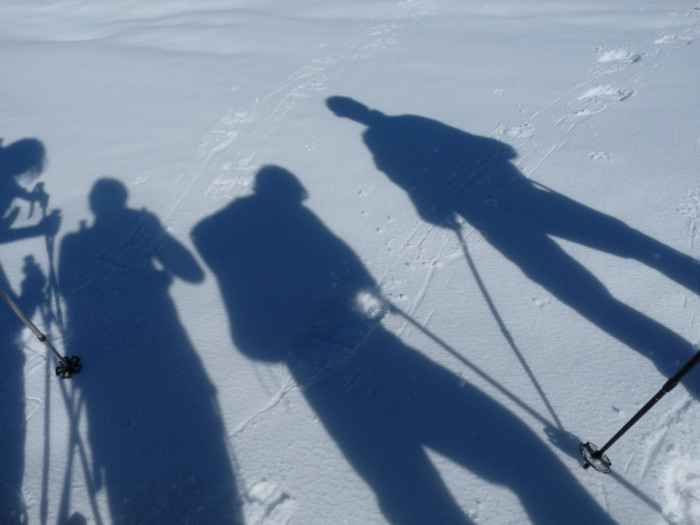
It’s easy to feel like the only person out in the landscape. But you’ll have come with a friend or two, if only to haul you upright when, inevitably you fall deep into a drift of snow.
Back in France, in the Ariège, the very best way of getting out into virgin snow and becoming at one with a pure, glittering white winter landscape was take yourself off to the nearest mountain, strap on your snowshoes and walk through the fresh crisp air as if you were the only person in that particular bit of world. It was hard work though, and after the first hour, I’d had enough.
Three years on, and the memory of the pain, sweat and general exhaustion of the entire procedure has faded. I remember instead the vivid sunlit skies and startlingly white and unspoilt snow. And sometimes there were shadows: clear silhouettes mirroring, yet enhancing the world above the glistering mantle.
This week’s WordPress Photo challenge is ‘shadow’. The challenge is now issued on a Wednesday rather than a Friday. I think I’ll now usually respond on Saturday, not Sunday.
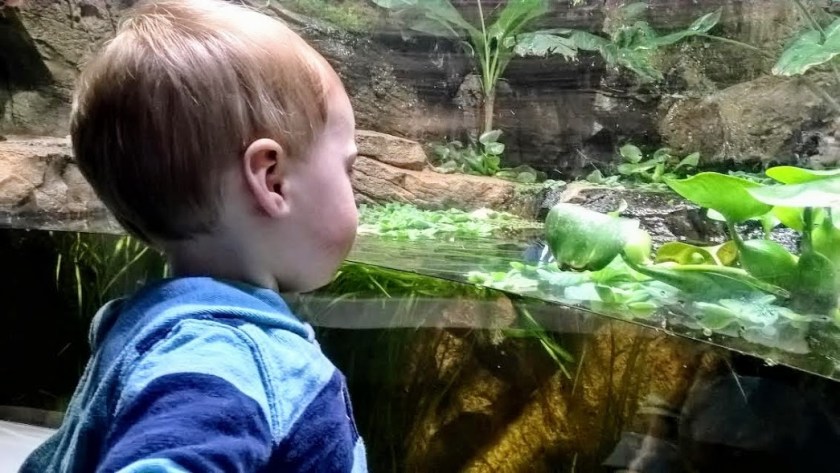
Ten thirty on a damp Wednesday morning. The Horniman Museum was just opening its doors as William and I arrived, and we stomped downstairs to the aquarium.
We were the first arrivals. Here’s William, wholly absorbed in fish, frog and butterfly hunting. This peaceful moment didn’t last long. Within minutes one, two, then three parties of Reception age school children stormed noisily in. The fish continued their solitary swishing round their watery home.
This week’s WordPress photo challenge is ‘Repurpose’. We’re to submit an image of something of our own that we’ve put to a new use. I couldn’t come up with anything worth a snapshot, even though I’m rather keen on ‘repurposing’.
Instead, I want you to come with me to Thanjavur in Tamil Nadu. I was there almost ten years ago as part of my Indian Adventure. I loved this town. It’s not quite on the tourist trail, as its glorious and extravagantly carved temples remain unpainted. They are not vibrantly painted like those in nearby Madurai, so Madurai gets the foreign visitors.
I stayed* with a young American academic, Gwen, who for seven years had made Thanjavur her home. She whisked me about on her motor bike, introduced me to her Indian friends and neighbours, asked me to run errands for her in the market where nobody spoke English or saw tourists much, and took me to tiny back street shops to buy freshly prepared and sizzling-hot evening meals.
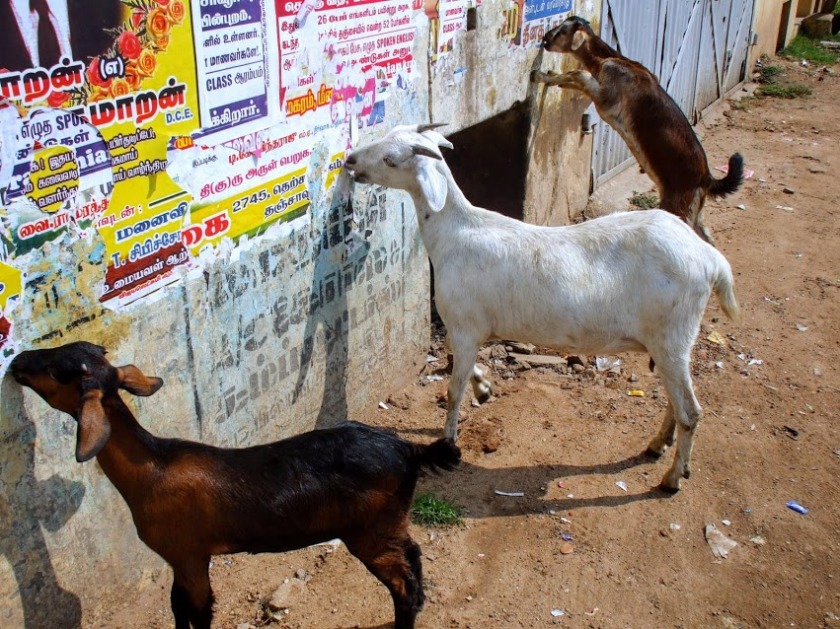
I was by myself though, when early one morning I came upon these goats. They’d found a new use for the adverts pasted on the walls of a house. Look.
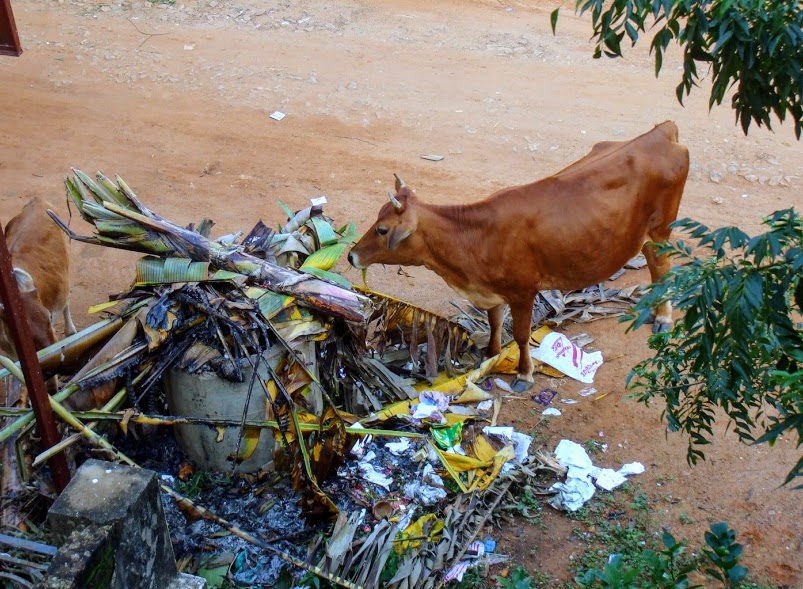
And here’s the cow that was tethered outside Gwen’s window. It’s found an unfortunate use for the pile of rubbish tumbled into a pile on the corner.
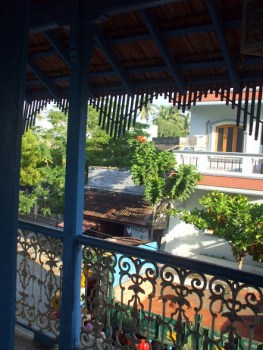
View from Gwen’s window
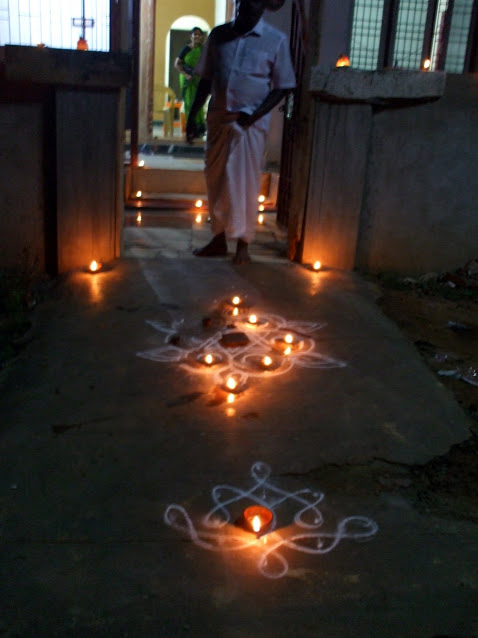
Finally, here’s a different use for a pavement. It’s become a canvas for traditional drawings in fine sand. These designs frame the lights which lit our path homewards every evening during Diwali, the Hindu Festival of Light.
And here are three picture postcards – temple views.
Thanjavur: Breehadeeswara Temple.
Temple elephant, Thanjavur
Thanjavur: Periya Kovil Temple
* via ‘Couchsurfing’, a scheme which matches travellers with locals, who offer beds, local knowledge and friendship.
I felt stuck. In my head, I rummaged through my photo collection. I discarded foggy moody atmospheric mornings like this one. I rejected bright summer meadows and crisp snowy winter walks as not quite projecting the ambience I want to think about on this dismal January day.
Here’s what I’ve chosen. It’s an image that’s more than six years old now, but it sums up much of what we loved best about our years in France.
Our walking group had played its part in organising a walk for ramblers from all over the region. We’d arranged signage, helped sponsors set up their stall, marshalled the event, walked ourselves, and handed out certificates at the end before the visiting walkers departed. Now we could relax.
Here we are in the mediaeval town square in Mirepoix, unwinding over a good and copious meal with plenty of wine. The sun is shining. The afternoon stretches lazily ahead of us. We’re among friends. This is an ambiance chaleureuse at its finest.
When I was at school, my French text books were peopled by characters such as Jean-Claude, Jean-Charles, Jean-Paul, Jacques and Georges. There were Marie, Marie-France, Marianne, Jeanne and Jeanette.
My own classmates answered to names such as Valerie, Jean, Judith, Janet and Mary while the boys’ school along the road had types like Alan, Norman, Brian, Keith, and inevitably, John.
These names identify us firmly as children of the 1940’s and ’50’s.
So over the last week, on our journey through France, I’ve had fun looking for evidence of the latest trends in French first names, via Coca-cola’s latest marketing scheme of personalising drinks bottles with the current most popular given-names.
Almost ten years ago now, I had my Indian Adventure, when I travelled first of all with a small group of like-minded English travellers, and then solo round southern India. That’s when I started blogging, using TravelBlog, though I later transcribed it onto WordPress which may be more user-friendly.
The culture shock of arriving in Bangalore with its constant traffic noise, its motor horns, its street-cattle, its monkeys, its people, its eagles and vultures wheeling overhead is unforgettable.
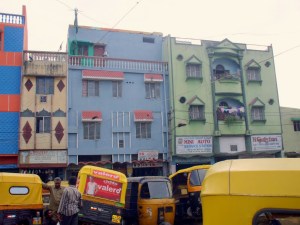
A back street in Bangalore, and a few rickshaws.
Arriving in Pondicherry some three weeks later was just as much of a jolt. Suddenly I was transported (after a motorway journey which included goats grazing on the central reservation) to colonial era France. Here were policemen in kepis, elegant public buildings, corner shops selling baguettes and croissants.
Dept of Public Works, Pondicherry
My guesthouse was a charming 19th century throwback which would have been totally at home on the French Riviera.
My verandah at le Rêve Bleu.
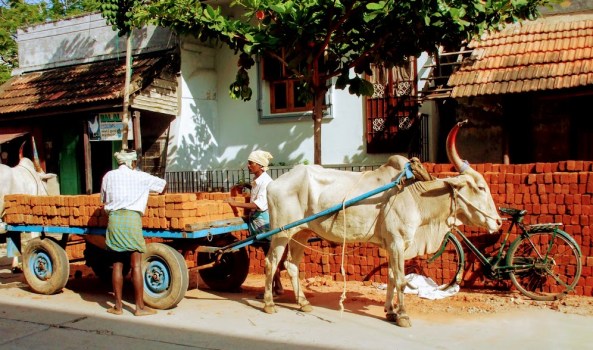
Yet I was undoubtedly in India. There was a spot of building work going on outside my bedroom window. Here’s the delivery wagon:
A delivery from the builder’s Yard
Here’s a more up-to-date delivery lorry:
They don’t usually need reminding to ‘Sound Horn’
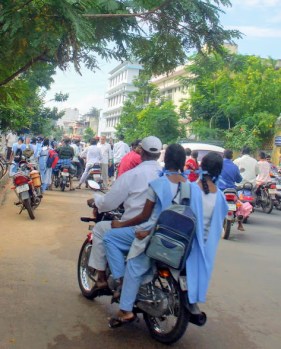
Here’s the school run:
School run, Indian style
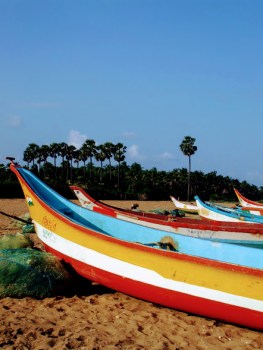
And here’s the beach:
The beach at Pondicherry.
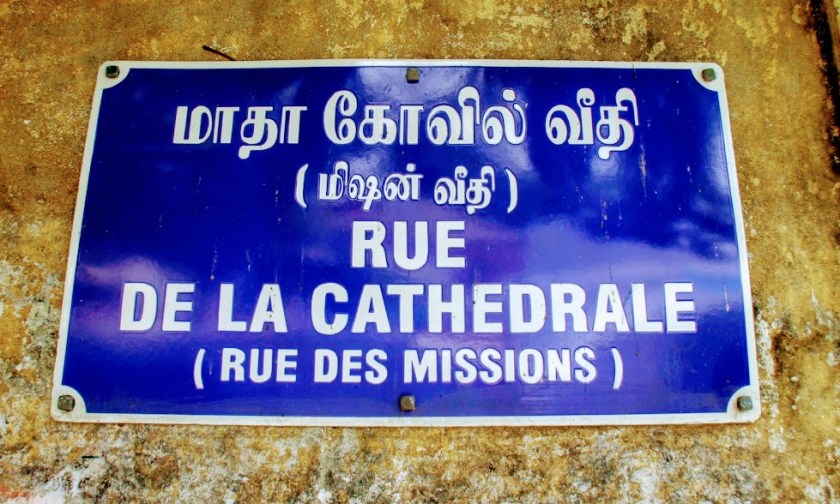
Here though is the photo which answers this week’s WordPress photo challenge: ‘Names’. A street sign which represents the many-faceted cultural references of what I thought of as my favourite Indian city.
Cathedral Road, Pondicherry
In a couple of days I plan to re-blog an old post of mine which has something further to contribute to the ‘Names’ theme.














 From Pyrenees to Pennines
You must be logged in to post a comment.