Back in England, it’s time to dust down our walking boots again. As we stepped out today, on a beautifully fresh and clear early Autumn morning, we contrasted our walk from nearby Masham with hikes we’d gone on in Korea.
It was the weather we noticed first. Probably it’s colder there now too, but then, we wore t shirts and battled against the humidity. We wore fleeces today. We tramped through fungus-laden woodland in both countries. Here though, as we glanced at the tussocky meadowland near the River Ure, we saw sheep, sometimes cattle . There, valley floors were terraced with paddy fields, citric green with young rice.
Here, there were distant views of solid stone barns and farmhouses – even a country house, Clifton Castle. There, we were more likely to come upon a hidden Buddhist temple, its solid, yet graceful wooden form painted cinnabar, blue-green, white, yellow and black.
In Korea, woodland in the countryside is dominant once you get away from ‘civilisation’. Here, we drifted between woods, meadows, ploughed fields and ground by the open river .
We enjoyed the lot. But today, we appreciated saying ‘hello’ again to our familiar local landscape.
During the 19th century, travelling botanists brought seeds of all kinds back from their exotic travels and often gave them to curious gardeners, who would try out these novelties as fashion-statements. In 1839, Himalayan Balsam was introduced and became Quite The Thing. It was so invasive (yes, we know) that it was great for making a huge and spectacular pink display at the back of the garden.
Then there was a certain Miss Welch, who in 1948 was so enamoured of the plant that she took seeds from her home in Sheffield and scattered them all over the place on the Isle of Wight. Or Mrs Norris of Camberley in Surrey who broadcast seeds far and wide, not only in Surrey, but in Ireland, France and Spain, and offered seeds to anyone who would accept them.
Himalayan Balsam (Wikimedia Commons)
Now, apart from a few bee-keepers who recognise that their bees adore its nectar, nobody has a good word for this wretched plant. It marches along river banks and masses into surrounding woodland. It smothers any other species it meets on its relentless progress. It projects its seeds (800 per plant) by entertainingly popping open its seed pods and projecting them several metres away. It’s a bully.
And bullies have to be stopped in their tracks. All over England and beyond at this time of year you’ll find bands of Army Cadets, boy scouts, environmental groups, country lovers and villagers gathering in their local Himalayan Balsam Problem Spot to do battle with this tyrannical species.
We were part of one such band this morning. Our local nature reserve, High Batts, is practically our backyard. It’s a fantastically diverse small habitat for a whole range of birds, plants and other wildlife, and the River Ure courses through it. To the delight of Himalayan Balsam, which chokes the river banks before trying to spread itself all over the reserve. Today, a gang of us got on our dirtiest clothes, found protective gloves, and marched off to show the stuff we meant business. One of our number strimmed the worst affected areas, and the rest of us pulled out plant after plant after plant by its roots, until our hands were sore and our backs ached. I used to think breaking the flower heads off was enough. But no. These plants are many-headed hydras. Wound them and they’ll simply sprout forth ever stronger.
Colin gives a few tips on Himalayan Balsam Management.
Strimming the stuff.
Hard at work uprooting balsam.
Army cadets and other volunteers had worked hard before us. Others will need to continue another day. But we did a pretty good job. And we were rewarded with elevenses of pork pie and three kinds of home-made cake, and the sight of those exclusively pink-flowered zones restored to satisfying diversity . Definitely worthwhile then.
The best Himalayan Balsam is dead Himalayan Balsam.
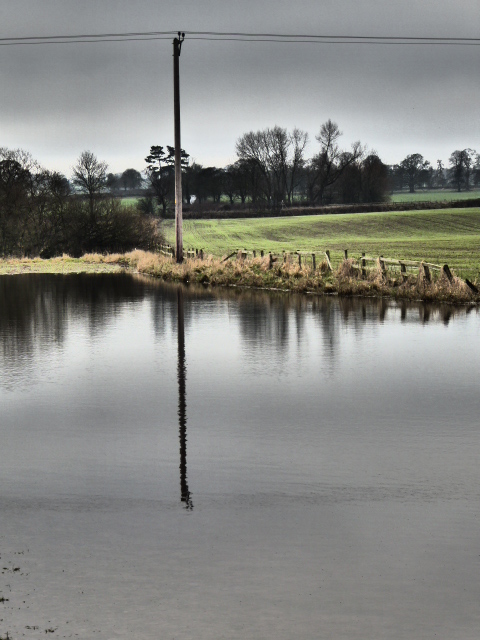
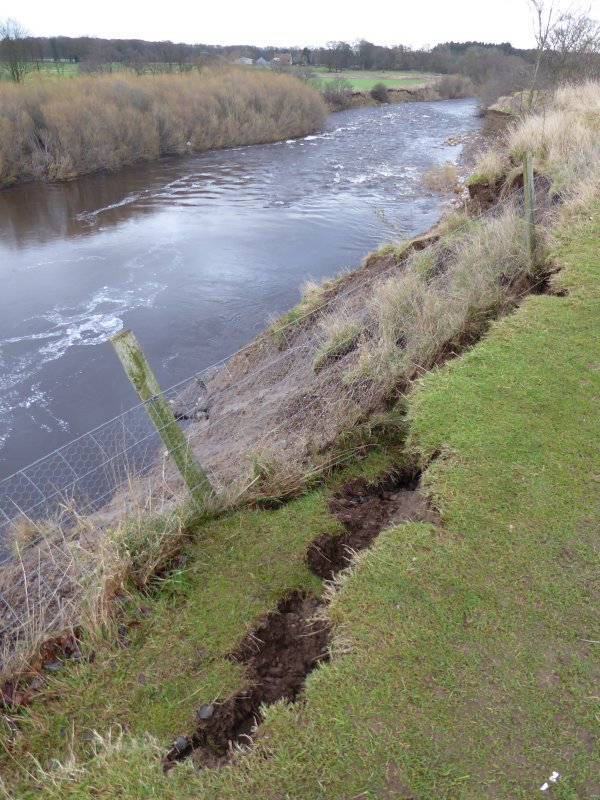
Look. Here was the scene in the field near our house, in January this year. Fields and roads flooded, impassable pathways, rocks and earth tumbling into the River Ure.
Near Old Sleningford, January 2016.
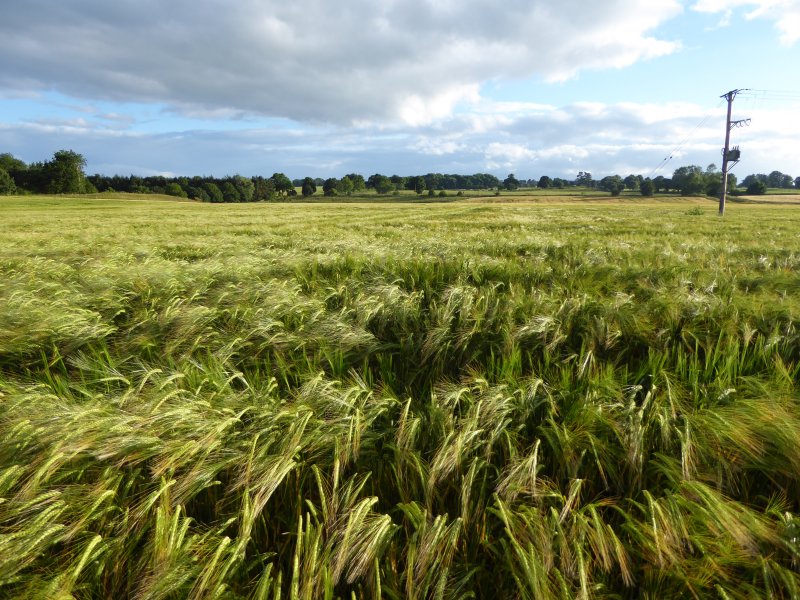
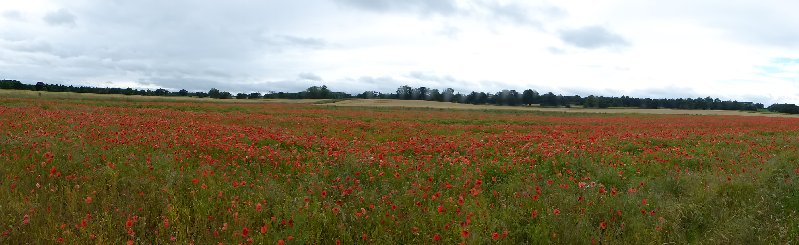
This was the same field yesterday. Barley, barley everywhere, all fattening up nicely for the harvest. Nearby, fields of poppies. Really hopeful, cheery sights on a sunny and blustery day.
The same field, July 2016
Will all our present political crises end so well? I wish I could feel more optimistic.
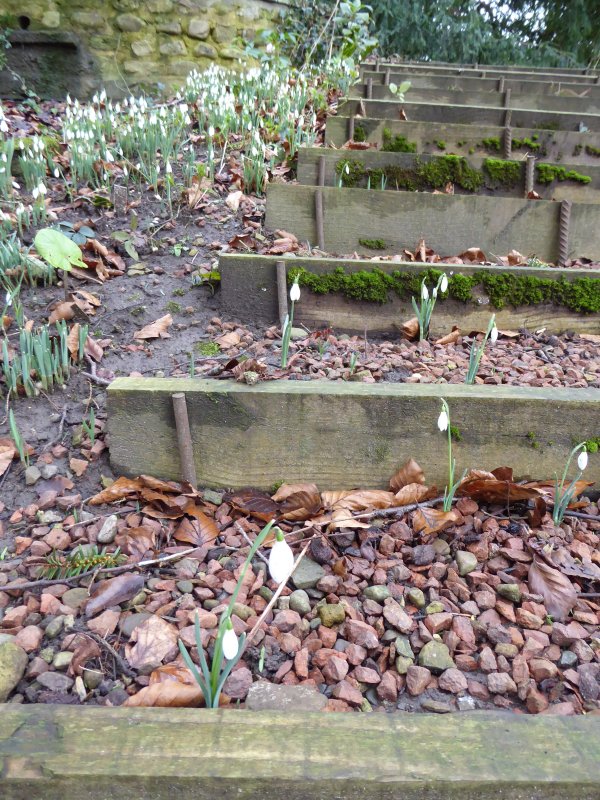
Step out into the garden, and the countryside beyond at the moment, and you’ll find snowdrops doing what they do best in January – piercing the barren earth, colonising grassy patches, nestling under trees and marching across gladed hillsides. Untroubled by unseasonal weather, their inner clocks direct them to grow, multiply, and cheer us all up in an otherwise gloomy, un-festive sort of month. That’s Nature for you: ordered, seasonal and predictable.
A farmer’s field? Or Sleningford-by-the-sea?
But Nature has another face. Come with me beyond the garden, past the fields slickly shimmering with surface water, to the banks of the River Ure. Just two minutes walk from here, it makes a wide sweeping curve away from its route from West Tanfield, and (normally) meanders gently into Ripon. That was before this winter, this rain, this unending water.
Once the rains came, and once it reached town, the River Ure rather wanted to swamp people’s gardens and make a bid to enter their houses. Recently-built flood defences put paid to that idea. The River Ure took its revenge on us, or more specifically, on the farmer whose fields adjoin us. Up in the hills, waters from streams and rivulets in the Dales cascaded into the Ure, which gushed and surged along its course, rising higher and higher, tearing at the banks, ingesting great clods of earth and forcing them downstream. The water levels are falling now. The damage remains.
The River Ure seizes the land.
Look. Here’s a chain link fence which marks a pathway running along the edge of the farmer’s field. It should be on terra firma, with a nice grassy margin between the fence itself and the river bank. Now it has nothing to hold onto. The bank has been snatched away, and the fence is hanging crazily and directly over the swelling waters below. The earth has slipped, and continues to slip. The farmer is losing his field, and the river is changing course. There’s not much anybody can do about it.
We’ll watch the water awhile, and frighten ourselves witless at the prospect of falling in and being swept mercilessly away. Then we’ll wander back though the woods, and enjoy the snowdrops and aconites once more. Nature takes its course.
Not much more than a mile up the road is West Tanfield. It’s an ancient village that already existed when the Domesday Book was written in 1086. Its inhabitants might say though that the most recent chapter in its history was written only last year, when the Tour de France passed through the village. The Duke and Duchess of Cambridge dropped by in a helicopter to watch the riders hurtle down the hill from Masham, over the old bridge and on to Ripon. They took the time to walk through the village talking to as many people as they could. It’s a memory many locals treasure (I’m thinking of you, Penny!)
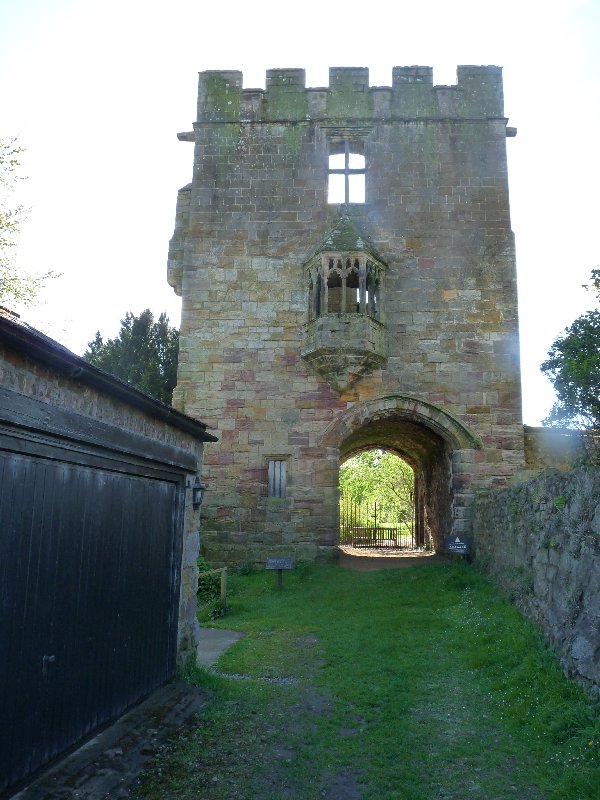
As you walk through the village yourself, you’ll notice a tower next to the 13th century parish church. That’s the Marmion Tower. It’s a 15th century gatehouse, and is all that is left of a vanished manor house that belonged to the Marmion family. As the direct line of this family ended, the succession passed first to the FitzHugh family, then the Parr family. You’ll have heard of them. William Parr was brother to Catherine, the sixth and last wife of King Henry VIII.
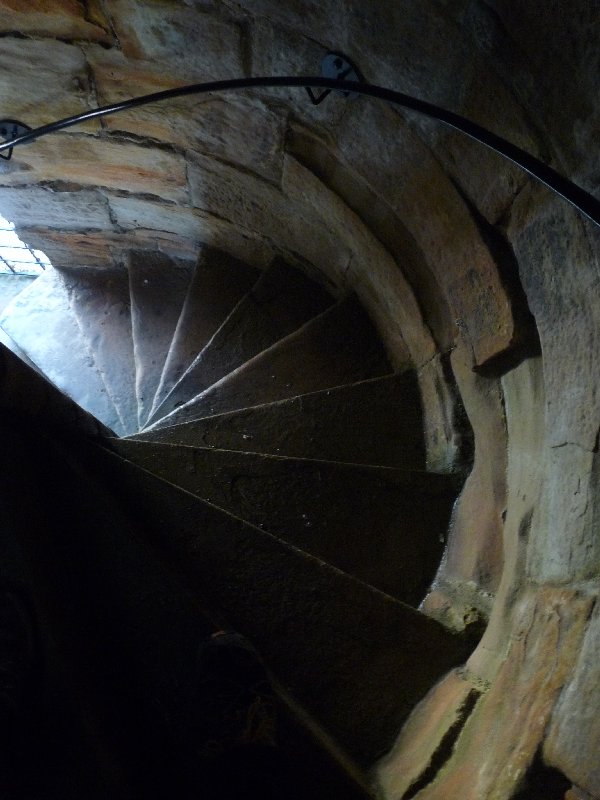
The Marmion Tower with its oriel window.That staircase.
It took me till yesterday to go and explore the remains of this tower. It might look like a castle, but there’s no evidence that it was ever designed to offer real protection. There’s no portcullis to the gatehouse, no narrow windows through which to loose offensive arrows. It’s a three-storey tower, which provided accommodation of reasonable comfort for the time, though the extremely narrow twisting staircase is a bit of a challenge. Although large, the rooms are domestic in scale. They offer splendid views over the River Ure and the fields and woods beyond, and on one side, over the village itself. One of the windows is a beauty in its own right. It’s an oriel window – a kind of bay window – projecting from the first floor of the tower.
The church seen from the tower
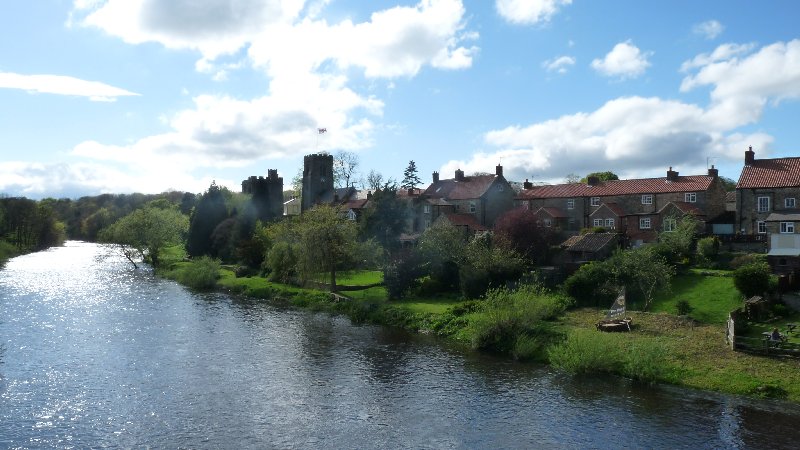
West Tanfield seen from the tower,
It’s ‘worth a detour’. And afterwards, you can go and sit in the gardens of the pub next door, the Bull, and relax over a drink in the picturesque surroundings of the river with the church and tower beyond.
A sunny morning on the River Ure, just before we reached the Canal.
We went for a walk along the Ripon Canal the other day, starting from the point where it meets the River Ure. Back in its heyday during the Industrial Revolution, busy as it was then, the rural towpath we walked along might not have looked so very different. Back in its heyday, keels would have hauled coal northwards from the Yorkshire coalfields, and lead and agricultural products southwards. The canals were the freight-haulage routes of their age, and even though they were busy thoroughfares, the whole business of passing vessels through the three locks in one direction at a time limited the flow traffic to levels well below what those of us who’ve ever been stuck in a bad-tempered rush hour traffic jam on the M1 have experienced.
Ripon Canal is not one of the country’s great canals. There are water super-highways such as the Grand Union Canal linking London with Birmingham. That’s 137 miles long. There’s the Leeds-Liverpool Canal. That’s 127 miles long. The Ripon Canal runs for just two miles, from Ripon to Oxclose Lock, where it links with the River Ure. Like many of the country’s canals, it was built in the latter part of the 18th century, between 1767 and 1783, opening up water traffic between Ripon and York, and it eventually put the products of the Durham coalfields within Ripon’s reach.
The railways proved to be the death of canals all over England. Ripon’s withstood the opening of the Darlington to York railway in 1841, but the Leeds and Thirsk Railway finished it off. The railway company actually bought the waterway, to ensure local support , but they then neglected it, failing to dredge it, so that it became less and less useable. The canal was abandoned as a waterway in 1906.
But its fortunes have changed again. No longer a tool of the industrial revolution, the canal has become a playground for people who like ‘messing about in boats‘*. The Ripon Canal Trust spearheaded its restoration from the 1960s, and now the whole thing is managed by the Canal and River Trust. So whether you like boats, barges, or a stroll along a quiet backwater near town, Ripon Canal’s worth a visit.
Barges on the canal.
The towpath again.
Walking the towpath
One of the canal bridges.
*That’s what Ratty used to like to do in Kenneth Grahame’s ‘The Wind in the Willows’
Today, I rejoined the human race. For the first time since before Christmas, I got up, got dressed, looked out of the window – and wanted to be out there, in the bright and frosty sunlight. Malcolm’s recovery is a good day or two behind mine, but I hope that he too is on the way up.
An early morning frozen pond
The first snowdrops
Frosty thistles
The promise of daffodils
Eleven o’clock shadow
Blue sky January
The sky reflected in the River Ure
Frosted leaves
Those Jacob sheep supervise me home every single walk.
I wasn’t up to a hike. I wasn’t even up to a stroll to the village shop, only a mile and a half away in West Tanfield. But I was up to a riverside amble, particularly when it meant coming upon little clumps of snowdrops on the woodland floor, already unsheathing their white faces to greet the winter sun.
Snowdrops push above the leaf mould
If the snowdrops are out and about, truly, all’s right with the world.
Ever since our friend Micheline had a nasty fall on a walk, three and a half years ago, and had to be air-lifted to hospital, I’ve been slightly wary of walking alone in the countryside.
But sometimes, only solitary will do. Never more than 4 miles from a village, always with a farm somewhere not too far away, I set off for a solo walk this morning, even before all the Grammar School pupils had got on their bus to whisk them off to school in Ripon.
From your point of view, as you look at these photos, you may feel it was all just a repeat of my Sunday morning stroll. But it wasn’t at all, not for me. My path drew me in a big eight mile circle to the west of our village. It took me past a working quarry: always good to watch men at work. It took me past ancient trees: our home patch is particularly good at oak trees which are very old indeed. As I was passing through a wood, an anxious Wensleydale sheep cantered up to greet me. I saw why she was worried. There wasn’t another sheep like her in sight anywhere – she was lost. But I never found anyone I could report her to. I hope she’s alright. There were fungi. There were delicate and skeletal winter seed heads. I saw a pint of milk delivered to someone’s gate, and took a picture of it. Home milk delivery’s getting scarcer here now than it was in my childhood, but I’ve never seen milkmen in other countries I’ve visited. I saw Autumn leaves still clinging to the trees, and plenty more in vibrantly coloured heaps at the base of trees.
Best of all – and I have no photo to prove it – shortly before the end of my walk, as I was climbing steeply through woods with the River Ure below me, three white-rumped deer leapt out of a clearing, and with three rapid yet elegant and beautifully choreographed bounds, disappeared from view, only to re-appear and disappear for good, moments later.
All in all, a pretty good use of a Friday morning, I thought.
Winter birds
Leaving home under the watchful eye of the Jacob sheep
An early morning sky
Big machinery at the quarry.
An ancient oak
This woodland will be deep in bluebells next April
Today was indeed a misty morning. Ripon has no fewer than three rivers in town, and a canal too, and one of those three rivers, the Ure, passes our back door. So it’s no surprise that we do ‘misty-moisty’ mornings, evenings and nights on a regular basis.
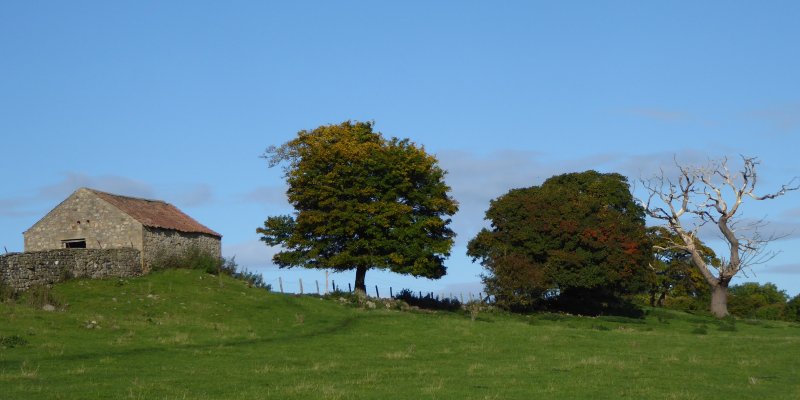
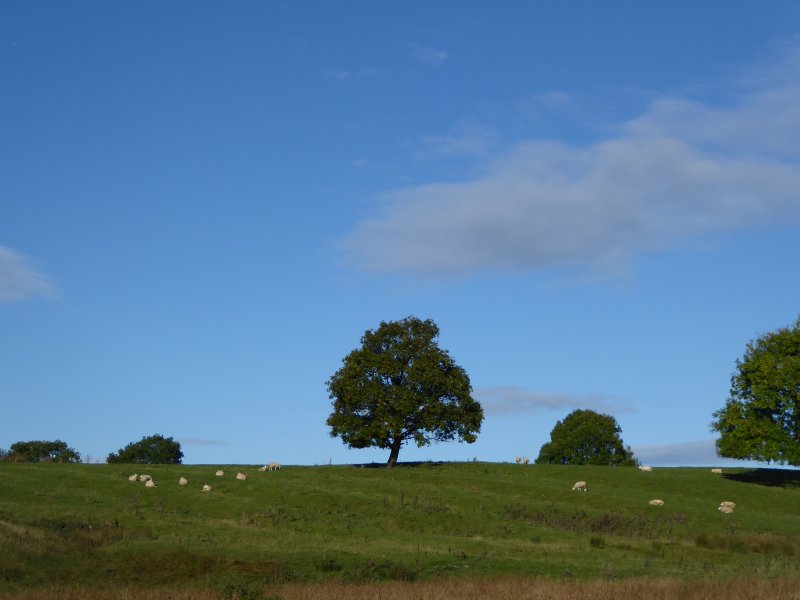
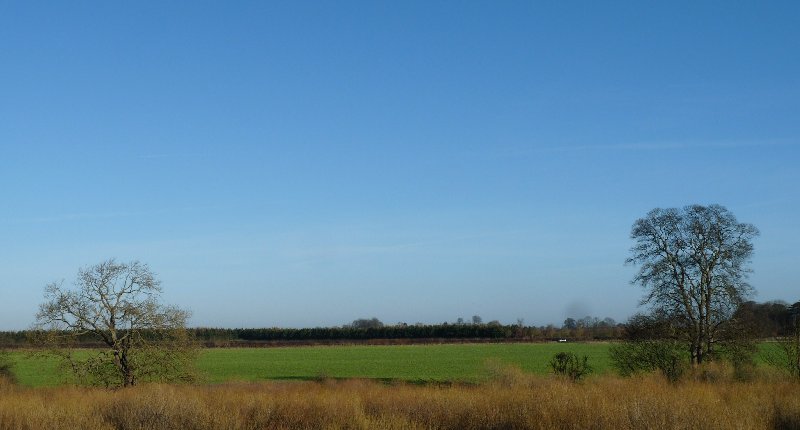
But mistiness is no excuse not to walk the mile and a half along the Ure to visit the village shop at West Tanfield to buy a Sunday paper. Here’s my journey:












 From Pyrenees to Pennines
You must be logged in to post a comment.