…. getting up and out at 6.00!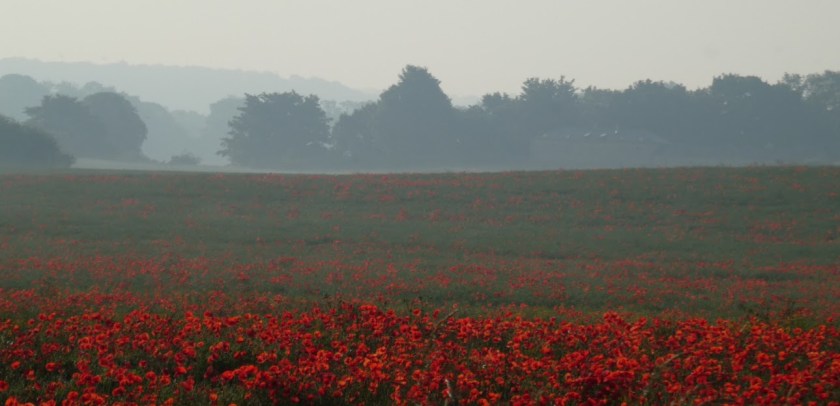


Just look at that. Twelve words. I have to weave those twelve random words into a single poem.
Our U3A writing group is one of the few things that’s continued throughout lockdown. It’s a positive activity at a somewhat negative time. But what CAN you do with a list like that? This, it turns out. I’m not too displeased. And here too are a few photos to illustrate the day.
Wanting to de-clutter
my brain, I drive to
Colsterdale.
Walking boots? – Check.
Map? – Check.
Sandwich? – Check.
Banana? – Check.
Umbrella? Don’t be silly.
No starlings here, but
curlews, skylarks
crest the sky –
that cobalt sky, patched
with buttermilk clouds.
A chattering brook
drains into the reservoir
where fish silently dawdle
and spongy bibulous mosses
make soft mats beneath my feet.
Contented now,
I drive back to town.
I pass that new carbuncle and see
a socially distanced queue
snake round the recently-opened
supermarket.


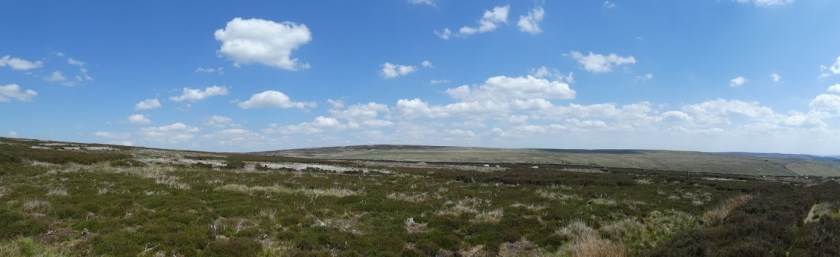 We went to Colsterdale on Sunday. It’s nearby, but feels remote and isolated, because the only road through leads nowhere very much and so it remains one of North Yorkshire’s best kept secrets. Perfect for a Day Out whilst maintaining that all-important Social Distance.
Edged by the pastoral views of farming country, it climbs to become stark, treeless, commanding views to the distant North York Moors, and to the higher parts of the Pennines. Its ascetic bleakness is what appeals to me.


We’d almost reached the area where we planned to park and begin our walk, when I saw them. There! There on the roadside! Look! Two curlews, almost within touching distance. These are shy, beautifully camouflaged birds normally only seen and heard as they quarter the sky, calling the evocative plaintive sound – ‘cur-lee, cur-lee’ – which gives them their name. These two were probably drawing a would-be predator away from the nest.


Whatever the reason, it was such a privilege to watch these birds at close quarters, with their mottled, camouflaging plumage, and their distinctive long downward-curving beaks.
YouTube RSPB video
They flew away after a couple of minutes, and we began our walk, relishing the space, the wild emptiness and the only sounds those of distant curlews.
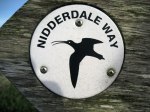
Addendum: several commenters have expressed surprise about the curlew frequenting moorland. Just to show how very much at home the bird is in these surroundings, here is proof. It is the symbol for the nearby long distance walk, the Nidderdale Way. FAO Jude, Agnes
Greensitt Batts
Heslett Wood
Coal Bank Wood
Piccadilly
Five Ponds Wood
Mickley Barrass
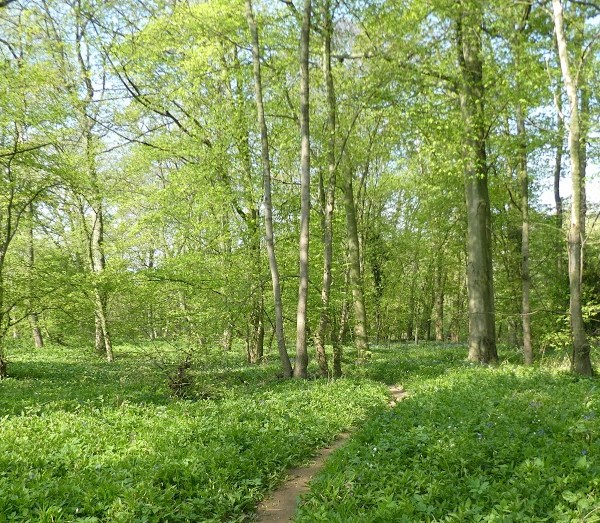
I walk in the woods daily.
Join me just one more time.
Light shafting downwards through the trees.
Loamy paths, wild garlic, bluebells, campion.
Silence: except for birdsong, purling streams.
The tang of sap, earth, flowers.


I’ve made discoveries on my doorstep:
Woodland
Farmland

River bank
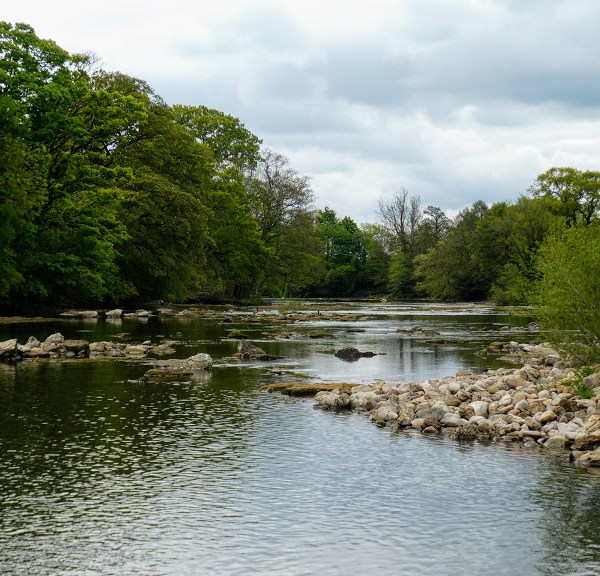
Lakeside
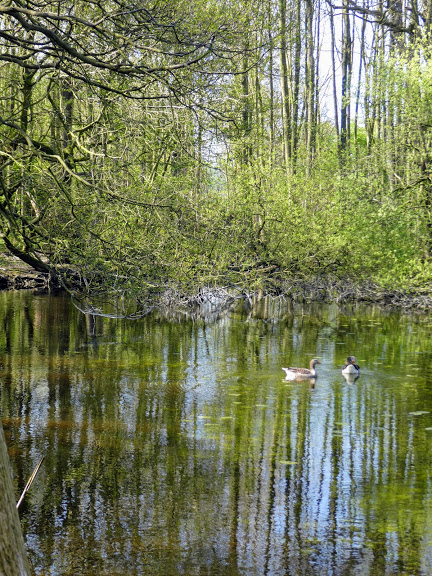
Pasture

Wildlife


A new walk, every single day.
A composite walk for Jo’s Monday Walk
Sunday’s walk, on a cold blustery afternoon, along a too-familiar path, could have been a non-event, a means to burn off a few calories and not much more. Jude’s challenge this week brought me ideas though. ‘Look for texture’, she said, ‘close in on your subject and capture the texture and not the context’. Challenge accepted.
Here we are by the village pond. Here’s Mrs. Mallard. And here are her feathers.


And – a sure sign that spring has sprung – here’s a dandelion.


Off to the track through the fields now. I trudge past the sheep, stolidly munching grass and hay, and spot a rusty old shed at the end of the pasture. Lichen on rust. Perfect.


Well, you can’t wander through the woods without finding a fallen log. And fallen logs mean knots, nooks and crannies, velvety moss. I take a couple of shots.


Oh look. Here’s a muddy bit: and I haven’t got my decent boots on. But oh, look again! Here’s texture a-plenty. A goose-print; a – er – what – squirrel perhaps? print; a different bird print (offers, anyone?); and a dog-print. And finally a cracked-mud print. That was good value.


Any walk in our countryside produces any number of long-established oak trees. So here is some bark – both shots from the same tree.


The last shot of all doesn’t follow the rules. But here’s a farmer doing his Sunday afternoon ploughing. Unturned earth, turned earth, and all being thoroughly investigated by a host of sleek white black-headed gulls. If that isn’t a symphony in textural contrast, I don’t know what is.

And since this is a post for Jo’s Monday Walk too, I’ll just mention that there was tea and Drenched Lemon Cake waiting for me when I got home.
#2020 Photo Challenge 13: Texture. ‘Get close to your subject and capture just the texture itself, without the context’.
Jo’s Monday Walk.
You didn’t need a crystal ball to know that my walk yesterday, reached by car rather than directly from home, might be my last for a while. The thought of impending Lock Down made my hours alone near Masham, walking by the River Ure and through the nature reserve of Marfield Wetlands, special, memorable and something to be savoured, even if it’s not actually a Great Yorkshire Walk.
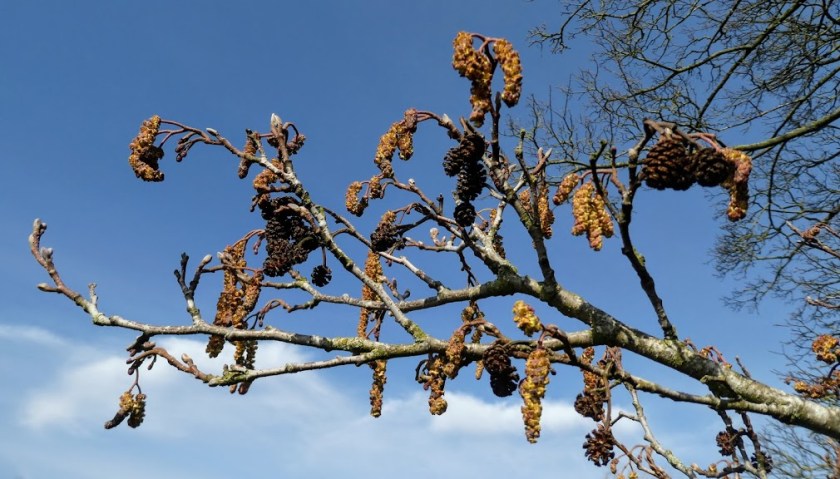
After a couple of miles there’s some pasture land. Some trees there are dead or dying. Ancient trunks have actually fallen. They were demanding to be centre stage for Jude’s Photo Challenge this week, mixing textures with other colours and patterns.
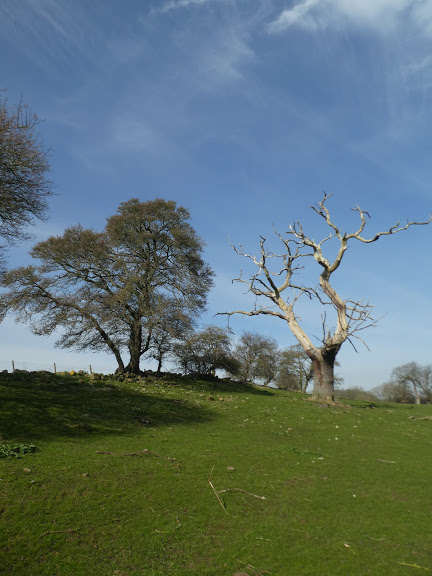
See? Lichens have cunningly introduced themselves into the regular fissures of a fallen log. Lush young nettles complement the bleached dry bark of a different trunk. Peep though knotted holes to spot the greenery beyond. Wisps of white wool wander across the surface of moss encrusted ancient branches.


Then I met stones, originally smoothed and polished by the River Ure as it hurried and bustled noisily along. Now they’re covered again: not by water, but by springy mosses and young creeping plants, and pert little celandine squeezing between them.


Then though it was time for sheep. Not just sheep, but their lambs, endearingly new-born, in their two-sizes too big overcoats. Who could resist?


Keen not to abandon Jude’s assignment, I found two last shots. A row of fat cattle, chewing away in their barn, contrasted with the diagonal and vertical lines of their shelter. And then a rusted old bit of farming machinery provided a perfect picture frame for a view. A fine use for a bit of tackle that’ll probably be on the scrap heap any day now.


The Wetlands were surprisingly quiet (lunchtime…). But I had a bit of fun with a teasel, getting up close to get a shot of its spiny plump body.


A good walk. Lots of memories to store up for a long, odd summer ahead.
2020 Photo Challenge #12: Texture: ‘mix your texture with other colours and patterns.’
Mud. I can’t be doing with it. Viscous, squelchy, squishy, sticky, over-the-top-of-your-boots kind of mud. We’ve had ground slick with treacly mud here for weeks and weeks. But then there’s also Cabin Fever, and the need to plan a walk for our walking group in a fortnight’s time, when spring might have sprung. Walking won out over yet another day indoors.
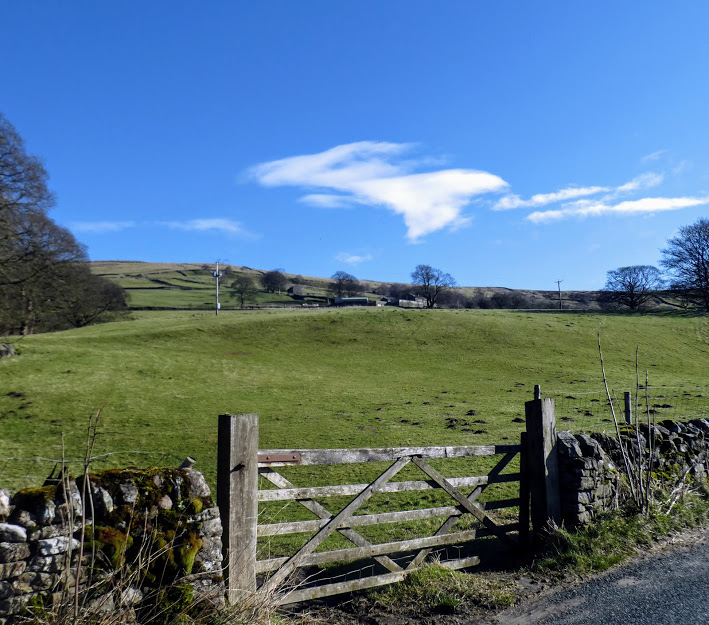
My friend Chris and I set forth for the Yorkshire Dales, parked up in Lofthouse, and set off. Really, it could have been worse. It was a full twenty minutes before we came upon our first serious mudbath: prior to that we’d only had water-on-the-path to deal with.
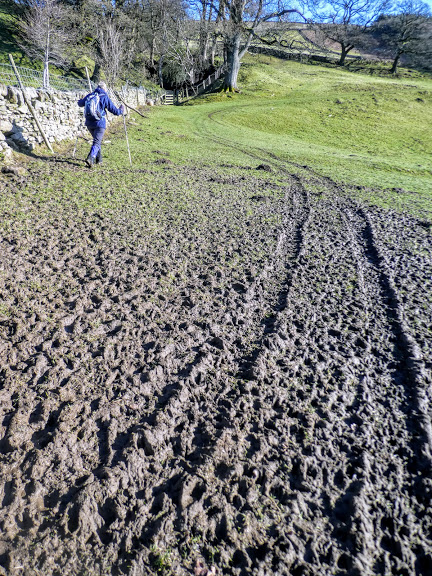
But climbing now, we saw what the fields were like: yes, those are fields you’re looking at. Gouthwaite Reservoir’s not here: it’s over there in the distance.
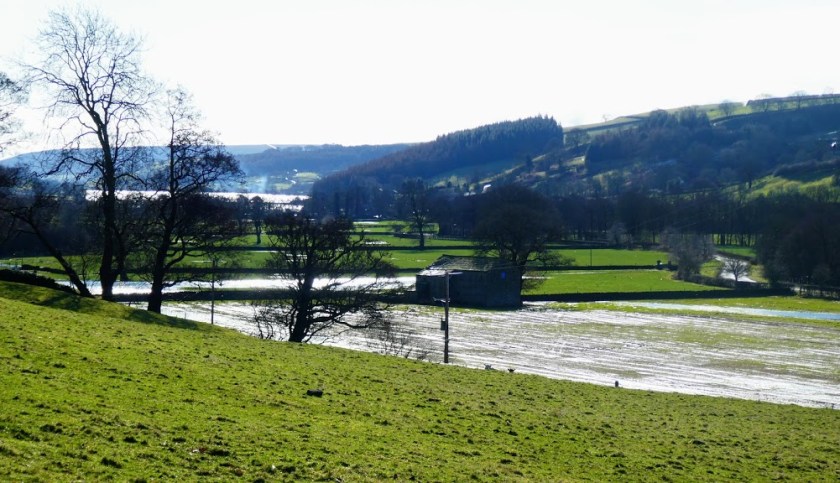
We had our rewards though. The views: the remnants of a snowscape: sheep – and oh look! Our very first lambs of the season – a little huddle of black ones, and just one snowy specimen with its mum.


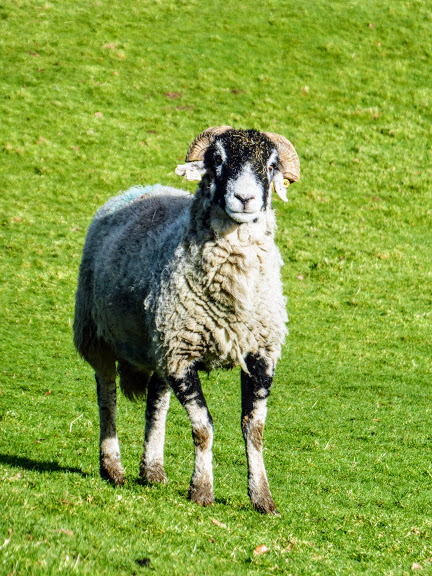
This sheep inspected us as we sat on a log for a snack.
And then, a pleasant surprise. The café at How Stean Gorge was open – on a weekday in February! Coffee and home-made cake while enjoying the view of the stream jostling and hurrying through its narrow ravine. I forgot to take a photo for Jo, but the website shows the Yorkshire Slice Chris and I shared.
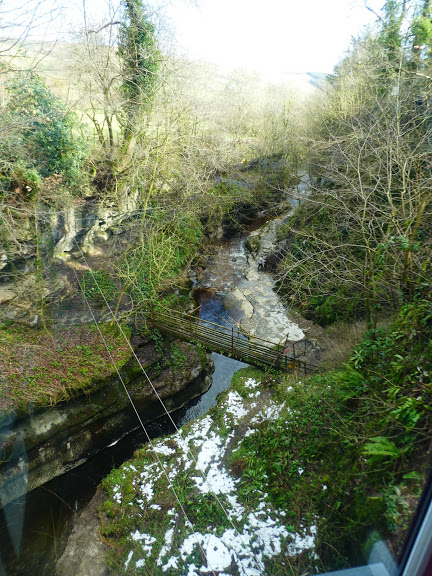

We were on the home straights now. All we had to do was struggle up a steepish hill to the now barely-populated village of Middlesmoor. Just outside its church, on the path that plunges down to our starting point are thoughtfully-provided seats. This is one of the best views in England, and despite the wind, we wanted to appreciate it.
And then, half way down the hill- a traffic jam. This herd of cattle blocked our path. The farmer asked us if we’d mind waiting five minutes. He turned out to have a countryman’s clock, but no matter: we weren’t going to argue with all those cows.
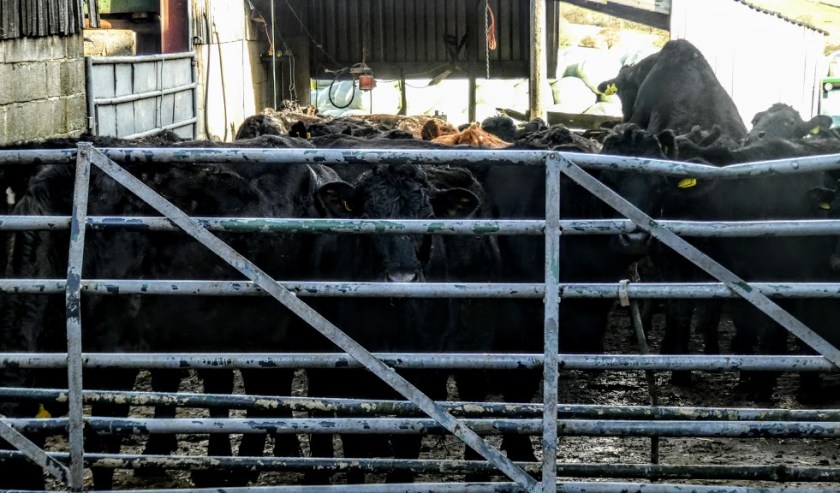


Finally, the cows moved on, and so did we. We got back to the car just as the rain, and then the sleet, started once more.
It was good to be out walking again.
An entry for Jo’s Monday Walk.
I’m in London on Half Term Duty. Zoë’s at Nursery, but William’s four, and at school these days, where an early encounter with the planets quickly turned into an all-consuming passion.
So I thought I should take him to the Planetarium in nearby Greenwich. There’s not much he doesn’t know about the solar system (Makemake anyone?),so ‘Moons beyond counting‘ seemed a likely hit. Twelve thirty, I said, that’s when we’ve got to be there.
At 8.30, William was all present and correct, dressed; rucksack packed with essentials such as a pencil case and an I-spy book of birds; shoes on; coat organised, demanding to leave. I fobbed him off for a while, but by just after 9.30, we were on the top of a double-decker bus bound for Blackheath and Greenwich.
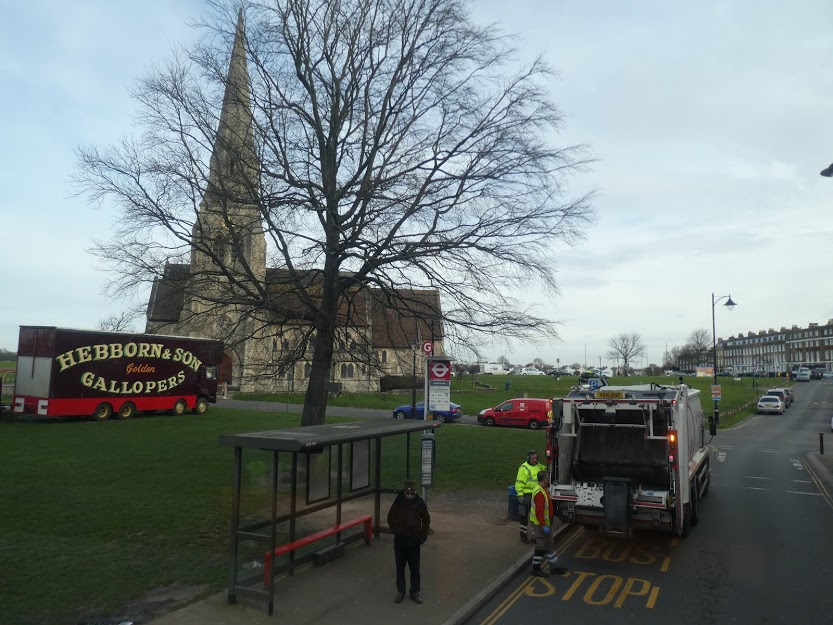
Greenwich has one of London’s lovieliest parks. There are wide avenues, trees, green space – hills even – and if you walk to the far end, a wonderful playground. William was persuaded that this was a good place to spend the two and a half hours before the show. We trotted down avenues and gravelly paths. We chatted to dog walkers – William, having given his full address to one, informed him that I was a visitor who didn’t normally live here.


We examined tree bark.


And we reached the playground, where William climbed, chased, crawled, bounced, made new friends and finally announced, round about 11.30, that he was hungry.


We climbed one hill and then another, looking across at the views of Greenwich below, and the City of London, just across the Thames.
 And we picnicked pretty much on the Greenwich Meridian line.
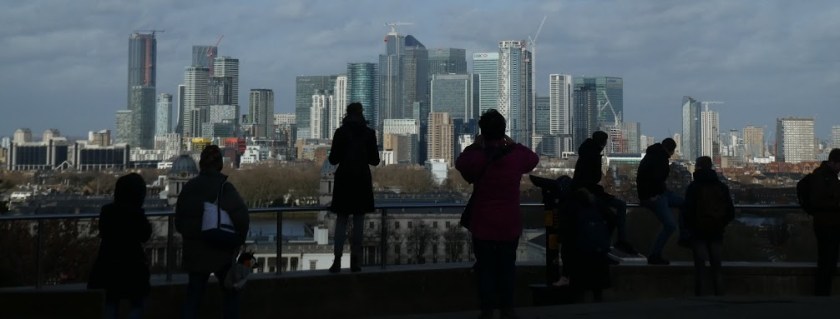
Finally, it was time for the show. We sat next to a boy called Jack who turned out to be just as much of a planet geek as William. The performance over (it was very good thanks, and back home, William gave a far better account of it than I did), Jack and William hurled obscure facts and quiz questions at one another, and were half pleased and astonished, half vexed that each knew as much as the other.
We decided enough was enough, and took a different route back through the park to the bus stop and home. Where we spent the rest of the day doing – what else? – a jigsaw of the solar system.

A walk for Jo’s Monday Walk.

We had to go to Middlesbrough for an appointment the other day, so we thought we’d stay and explore.
Middlesbrough is what’s known as a ‘post-industrial town’. Once, its steel and other heavy industry and its port brought wealth (to some), employment, and attendant grime and looming industrial architecture. Now, it’s reliant on newer technologies, engineering and the presence of the university developed in the 1990s from the older Polytechnic.
But its landscape is still an industrial one, as is that of the surrounding towns: Billingham, Stockton, Redcar. Could it be true that the RSPB had developed a Nature Reserve here, on its outskirts?
It could. RSPB Saltholme. Though it was hard to believe, as we navigated along roads edged by towering chimneys, great metal hangars, clattering unseen machinery.
But in the end, there it was, among the industrial flatlands – wetlands actually, punctuated by shallow lakes and pools. We’d arrived.
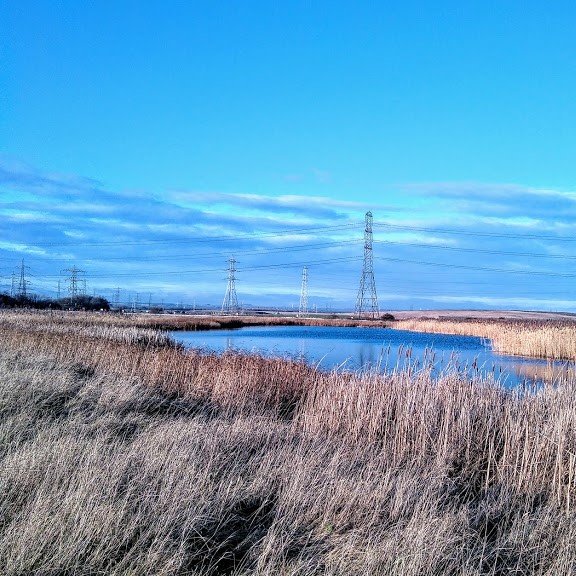
But the birds had left. How silly of us not to remember. At our local nature reserve, Nosterfield, the birds regularly knock off at lunchtime, only reappearing towards dusk. Who knows where they go?
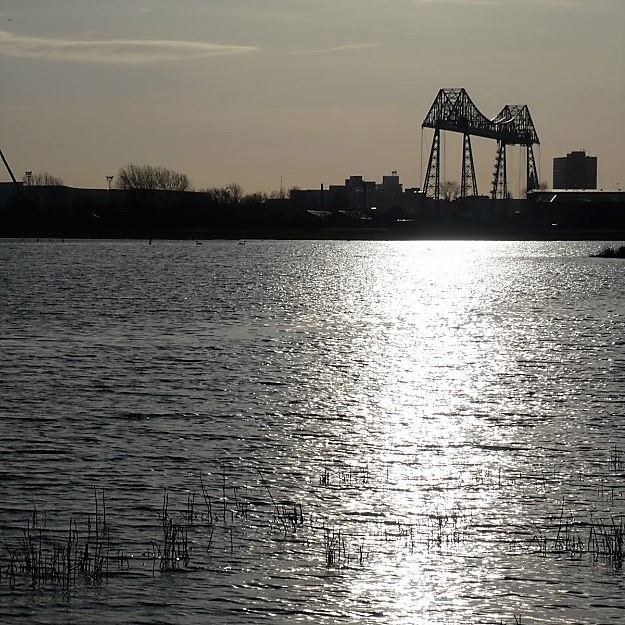
Never mind. We enjoyed a peaceful walk. We got a moment of drama when flocks of birds DID appear, swirling and swooping above the lake. It was quite likely that they were taking evasive action from a resident peregrine falcon hunting for a meal. Drama over, they disappeared once more.


We enjoyed our time in this peaceful oasis. We explored trails that ended in well-equipped hides.
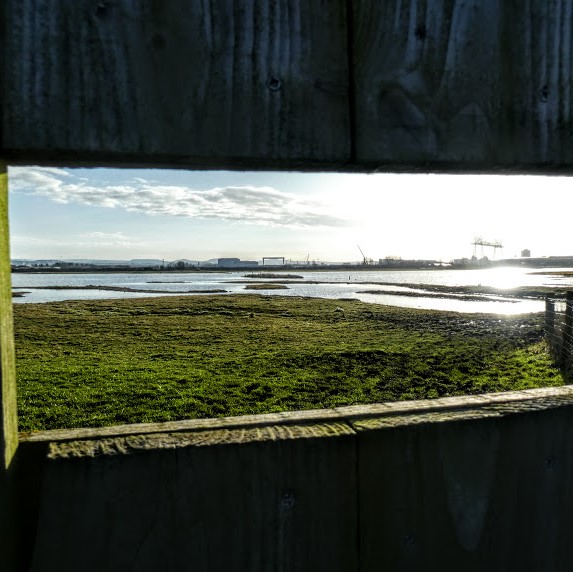
We studied noticeboards with information about what better-informed visitors had spotted that very day. We passed fields with the inevitable large numbers of greylag geese. And towards the end, we were rewarded with just a few sightings: some shelducks feeding; a shoveler or two; a few swans and a very distant heron.


But we enjoyed our afternoon. A near-empty wetland, with its unusual backdrop of an industrial past and present, and the never-out-of-sight Tees Transporter Bridge made for a fine afternoon’s walking … and there was even a café.

This multi-tasking post is for Six Word Saturday, January Light (January Squares), and Jo’s Monday Walk.
 From Pyrenees to Pennines
You must be logged in to post a comment.