A hearty walk, English style

Back in France, we go out with our walking group most Sundays.  ‘Most’, not ‘all’.  Some are just too damn’ tough, but more often, it’s because the walk’s been cancelled.  Rain stopped play.  Unlike their English counterparts, no French hiker wants to hole up behind some convenient rock at midday to fuel up on a damp spam sandwich.  No, lunchtime on a French walk is the opportunity for an extended picnic in some scenic spot, when someone will produce a pastis, someone else a home-made cake or chunks of chocolate, and the whole thing will be rounded off with sugar lumps soaked in some potent home made hooch.  And you can’t do that when the weather’s poor.

We English are made of sterner stuff.  As we discovered just after Christmas.  Our Friends Hatti and Paul arrange a post-festivity walk for about 20 of their friends each year.  It blows away the cobwebs and gets rid of some of those unwanted calories we all seem to absorb throughout December.

On the day, it was intermittently raining.  The wind was gusting and the sky was solidly grey.  Did anyone cancel?  Certainly not!  Instead we were all welcomed at our rendez-vous point with hot coffee or a warming nip of home made sloe gin, and route -maps to send us on our way.
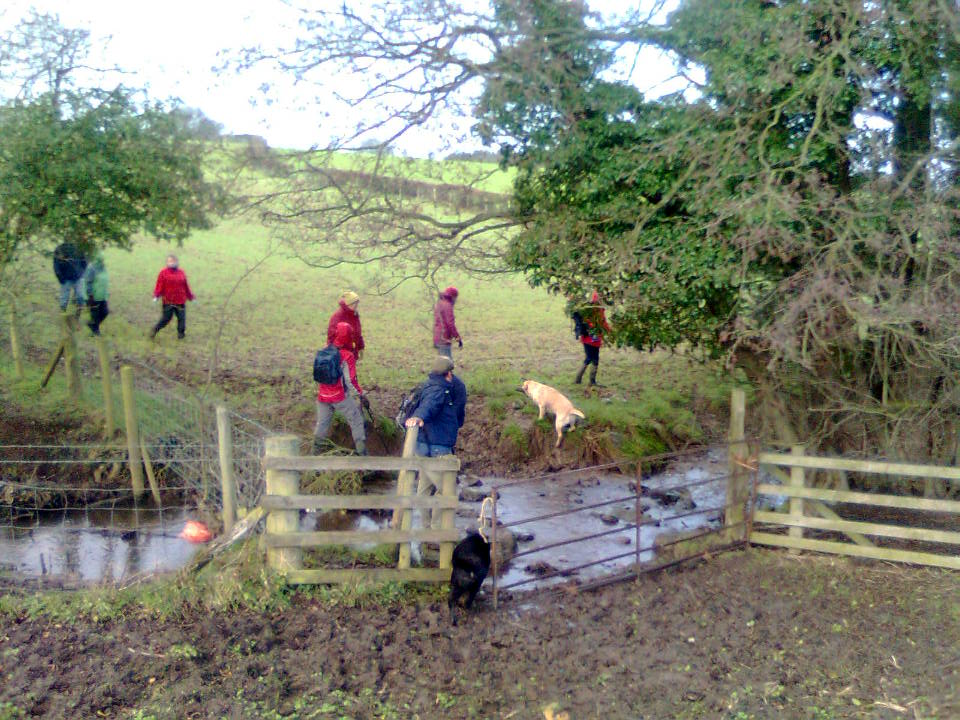
Fording our first stream

The walk itself was under 5 miles long.  But we got our work-out alright.  Leg muscles strained to heave limbs out of gloopy mud, or to leap from stepping stone to stepping stone across overrflowing streams.  Vocal chords often gave up the unequal struggle as wind whipped away shouted attempts at conversation.  Our feet became heavier and heavier with the weight of solid clay sticking to our boots .

But it was fine, dear French reader.  We had fun.  Along the route, we spotted a rainbow which accompanied our path for much of the journey. Welcome pauses in the wind and rain gave us the chance to appreciate the scenery: the skeletal trees set against the grey-green hillsides: the stone farm cottages and the folly at Azerley and the rushing tumbling streams which punctuated our journey.

Arriving at Kirkby Malzeard

No soggy spam sandwiches for us. At journey’s end, we were snug and warm in the Queen’s Head at Kirby Malzeard.  Paul and Hatti had organised sandwiches and chips to be be ready and waiting as we arrived.  And that, surely, is the perfect walk.  A good work-out in good company in lovely countryside, followed by the chance to relax and laugh with friends and food, knowing that nothing more taxing than a hot bath and cosy evening indoors remains to conclude a well-spent day.
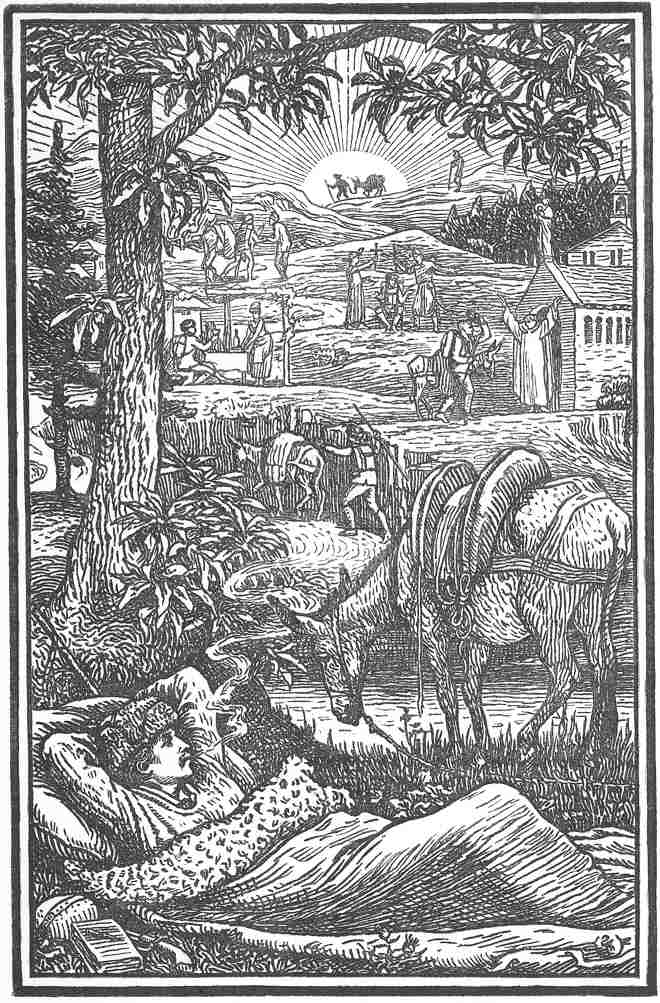
To travel – slowly – is a better thing than to arrive – quickly…..

RL Stevenson: Travels with a donkey

Robert Louis Stevenson knew a thing or two about travelling slowly – and hopefully – what with hiking round the Cevennes with only a donkey for company.

But yesterday, arriving back in Laroque rather quickly having left Bolton only a few hours before, I felt he’d got it right. Our usual way of travelling between England and France is by car.  We can’t claim it’s particularly slow, not with maximum speeds of 130 k.p.h on motorways.  But it does take the best part of 3 days to do the pretty-much-exactly 1000 miles between Laroque and Ripon, and that’s fine.

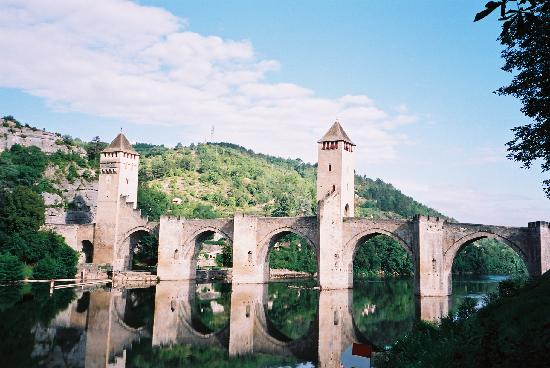
Cahors

We detour to take in delightful towns like Cahors or Vendôme, and make sure we have time to explore a little.  Early morning starts may find us startling deer in the still misty fields, while at lunchtime we’ll be on the look out for a ‘menu ouvrier’, or a rural picnic spot to have a lengthy break.  We’ll enjoy a night at a chambre d’hôtes, and usually have an interesting time chatting to the owners or a fellow guest.  Breakfast with home made jams and maybe breads and cakes comes as standard. A trip on a channel ferry. A night in London with son-and daughter-in-law.  And finally, back up north.

And all this time, we’ll be adjusting between a life in France and a life in England: watching the scenery gradually flatten as we drive north, then begin to undulate again as it passes through Normandy and the Pas de Calais, linking with the similarly gently rolling hills of Kent.

This trip to England though was by plane each way.  It’s quicker and it’s cheaper too.

But the whole business of packing luggage into the required dimensions, checking the weight, hunting for a clear plastic bag for those creams and liquids: then at the airport emptying pockets, removing shoes, belts, is just a bit stressful.

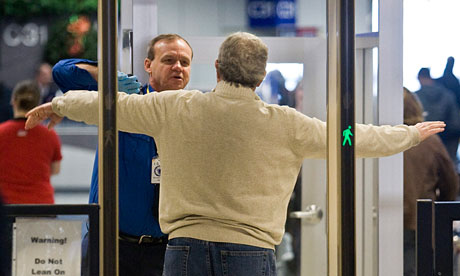
Airport security: an image from the Guardian

And somehow it addles my brain. Three hours ago I was in a traffic jam on the outskirts of industrial Liverpool, and now we’re driving through vineyards in the Aude? The clothes which worked in the morning don’t do in the afternoon, and I’m having trouble adjusting the language coming out of my mouth.  I’m all discombobulated.

We’re lucky we have the time to be more leisurely.  I’m not against taking it even more slowly and walking some of the way down, maybe along one of the pilgrimage routes towards St. Jaques de Compostelle.  Anyone want to come too?  Barbara?  Sue K?

‘So British’. A French view of life in England.

Well, our French friends have been and gone.   It was a busy week full of discovery for us all.  Despite the almost unrelievedly awful weather,  Yorkshire’s sights, both rural and urban, gave a good account of themselves.  But here are one or two of the more unexpected discoveries our friends made.

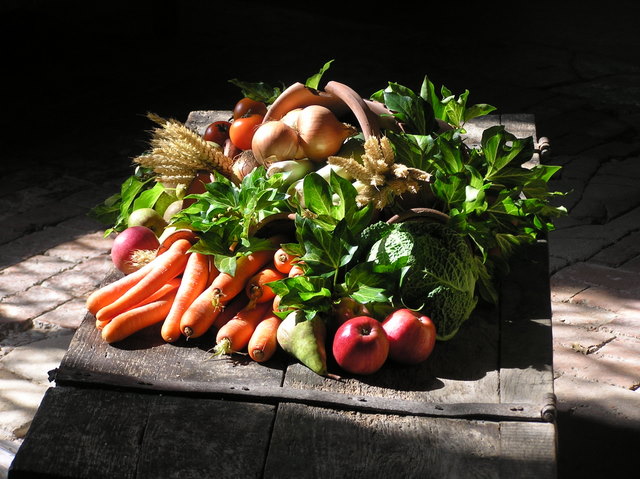
Harvest Festival.  Saturday evening found us in church for a very special concert by the St. Paulinus Singers, a Ripon Chamber choir.  As we entered, our friends were struck by the celebratory pile of pumpkins, cabbages, carrots and Autumn fruits assembled for harvest-time celebrations in church.  They’d never heard of  such a thing.  Oh, and the concert began dead on time too.  Another first for them.

Harvest Festival

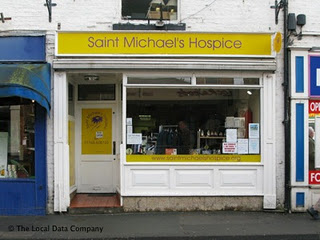
Charity shops.  The French have little other than away-from-town-centre large warehouses given over to the sale of donated goods and run by Emmaus.  The often carefully dressed shops we’re so accustomed to on the British high street are unknown to them.

St. Michael’s Hospice shop, Ripon

Closed for business: open for business.  As we know, shops here tend to be open through the day.  But what a surprise for our French friends to see them closing for the day at 5.30 p.m. rather than around 7.00 p.m! To find supermarkets open in some cases 24/7 was even more astonishing.

Closed at the moment

Houses without shutters.  Evenings walking round town fascinated them.  Instead of shutters there were curtains, which might or might not be drawn.  How exciting to have glimpses of another set of lives!  This is denied to them in France as shutters are usually firmly closed there as night falls.

A night-time window

Buttered bread.  As born-and-bred Ariègeoises, our guests were unused to the idea of having butter AND cheese or ham or whatever on their bread.  They rather felt it was gilding the lily.  But they weren’t keen on the fact that bread is not produced routinely at the average British dinner table.  It’s odd,  we too have come to expect bread as part of a meal in France, but never in the UK

Milky coffee and tea.  The default position for both in France is black (strong coffee, weak tea)

At the butcher’s. Of course our guests wanted to cook a slap-up meal for us.  We all struggled a bit with this one, as French and English butchers cut their beasts up in different ways.  As a recently-lapsed vegetarian, I’m re-learning slowly all I ever thought I knew, and starting at page 1 in French butcher’s shops.

A Friesian: until recently, these were the cows I most frequently saw in England

From the Pyrénées to the Pennines: Chapter 1

Today, three friends from Lavelanet are coming to stay in Ripon (with friends of ours: we can’t cram them into our tiny flat).  They’re members of Découverte Terres Lointaines coming to Discover Yorkshire in Six Days.  Over the next few months, you’ll find out why.

But Yorkshire in 6 days?  That’s quite a challenge isn’t it?  Especially as it would be good to show something of what the Ariège and Yorkshire have in common: dairy and sheep farming, a textile industry long past its glory days, mining and quarrying ditto, a religious past coloured by conflict…. If you were Tour Guide, what would YOU choose?

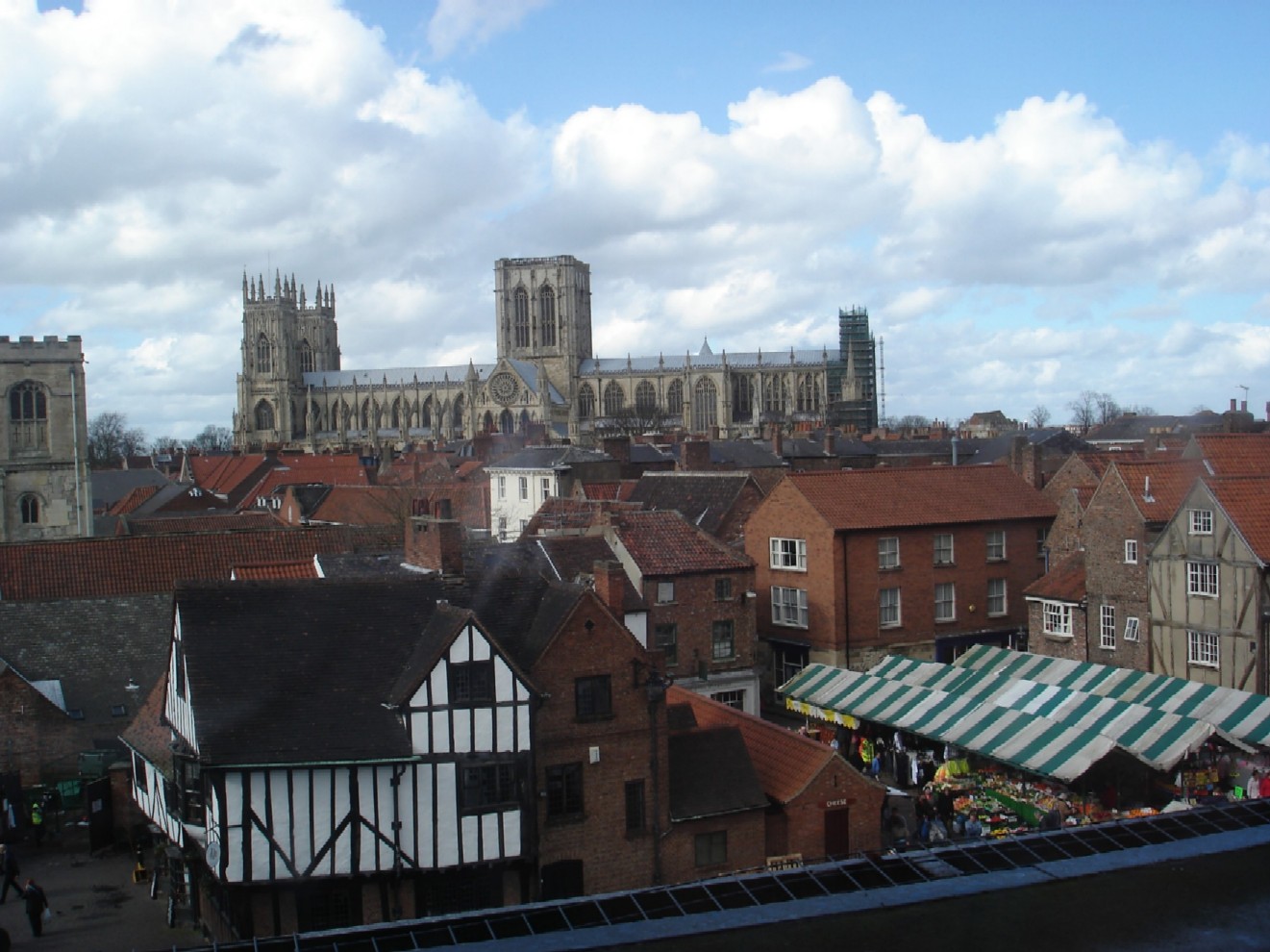
York: The Romans, the Vikings have all been here: a day won’t be long enough

The Dales?  Swaledale, Wharfedale, Nidderdale….etc.  Which is your favourite?

Swaledale

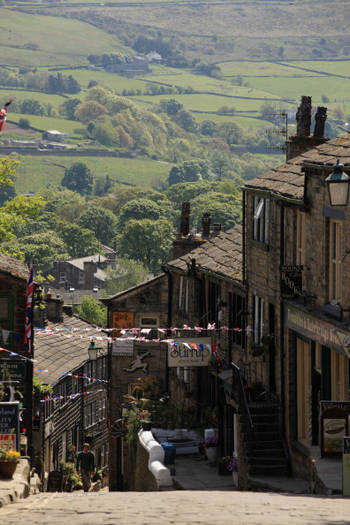
Hawarth: A chance to see a bit of the wonderfully bleak landscape, and visit the home of the Brontë family.

Hawarth

Bradford: its textile industry brought the workers from Pakistan and India who are now such a significant part of the town’s population

Textile Machinery at Bradford Industrial Museum

Saltaire: a model village built by philanthropist Titus Salt in the 19thcentury as a decent place for workers to live.  Philanthropists like Salt built others in the UK – such as Port Sunlight on the Wirral and New Earswick  inYork.

Salt’s Mill, Saltaire

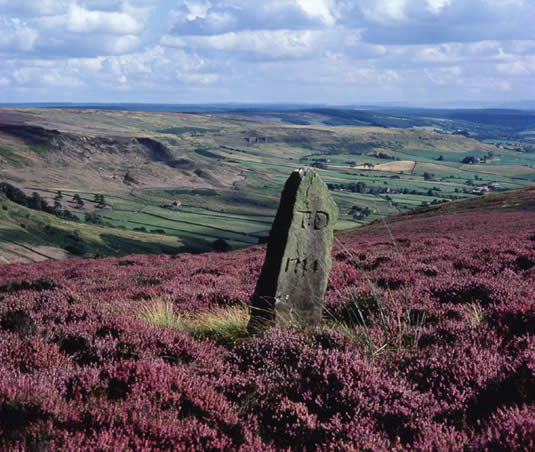
North York Moors:

Rosedale, North York Moors

we’ll see the views on our way to……………

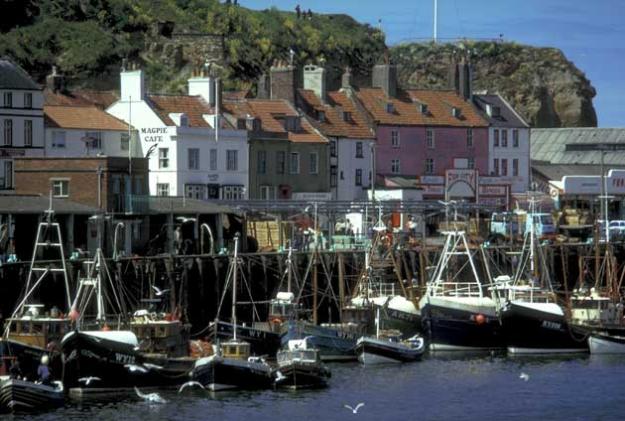
Whitby: fishing port and holiday resort

Whitby

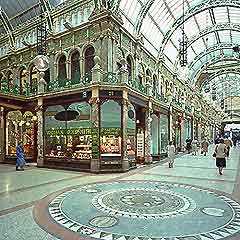
Leeds: the city centre – a mix of Victorian civic pride and modern business district.

Many of the Victorian Arcades are now an up-market shopping destination

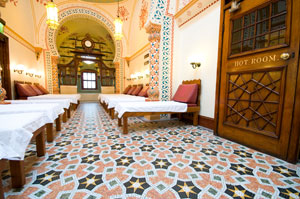
Harrogate Turkish Baths: time for us to relax and re-charge our batteries.

The Turkish Baths at Harrogate

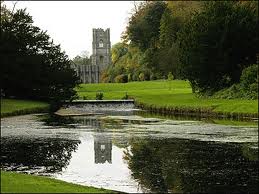
Fountains Abbey: this Cistercian monastery is, like Saltaire, a World Heritage site.  And a beautiful and peaceful place.

Fountains Abbey

We’ll need to include a pub, fish and chips, preferably eaten on the seafront out of soggy paper.  Curry too.  But why is the totally inauthentic chicken tikka masala apparently now our national dish?

I’m so looking forward to being a tourist in my own birth county.  I hope our friends enjoy it too.

Six weeks: a souvenir

Dear reader, perhaps you are feeling quite short-changed.  You subscribe to a blog called ‘Life in Laroque’, and for the last 6 weeks or so, have had nothing but news from England: Yorkshire, to be exact.

Well, we’re back in Laroque, where in our absence they’ve had bitter cold, driving rain lasting for days, and astonishing heatwaves in which the thermometer has topped 40 degrees.

But just before we abandon postings about England, here is a souvenir slideshow of our time there.  It’s a reminder for me really, so if dear reader, you decide to skip it on this occasion, I quite understand.

Normal service will be resumed in my next post.

This slideshow requires JavaScript.

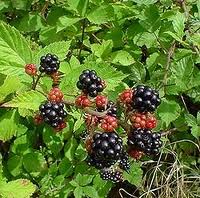
Here we go round the blackberry bush…

I’m so chuffed to be in England for the blackberry season.  Ariègeois blackberries baked in the hot sun are sweet, characterless and make a rather dull jam.  But then who goes to southern France to go blackberrying?

So yesterday I went out, meandered down a few nearby lanes, and came back with a bowl filled with large glossy, juicy, sweet and yet tart berries, a stained T shirt and fingers stuffed with tiny spines and tingling from nettle stings.  I was very happy.

I set my berries to simmer down with the early apples from Jonet and Richard’s tree, and then…. only then, remembered I had neither a  jelly bag nor a cache of jam jars ready waiting for the next stage.  Oddly, I do have a preserving pan.

So it’s been the moment for a little ingenuity.  An old clean T shirt ripped up made a jelly bag, and this morning we’ve been piling our toast with a week’s ration of marmalade, decanting apricot jam into a bowl, and scraping clean an almost-finished jar of honey.  So far so good.  But what happens when I need to make the next lot?

Flour power

Returning from England to France, there’s generally a bag or two of various kinds of flour in the luggage.  ‘What?’ I hear you grumble.  ‘That woman who’s always banging on about buying local? The one who’s got no time for the English abroad who can’t exist without their mug of builder’s tea and a custard cream?’  Yes.  That’s me.  Guilty as charged.

Melting Moments

But the thing is, when in France, I sometimes have a happy hour or two baking English goodies – Melting Moments, Gingernuts, Marmalade Loaf Cake, that sort of thing – with or for French friends.  And as I discovered the other week, French flour is simply not right for the job.  Not better, not worse, just different.

I’d run out of my own supplies, so I nipped out and got a bag of good quality baking flour (because even more than in England, it’s important to buy the right type of flour for the job).  And my tried and trusted favourites turned out all wrong. Ginger biscuits, instead of being satisfyingly chewy, with a solid crunch between the teeth, were sandy and brittle.  Marmalade loaf cake, though light, was close-textured and almost crumbly.  It was so disappointing.  The answer, it seems, lies in the gluten content.  The average French flour is ‘softer’, and has a lower gluten content than the average English flour.

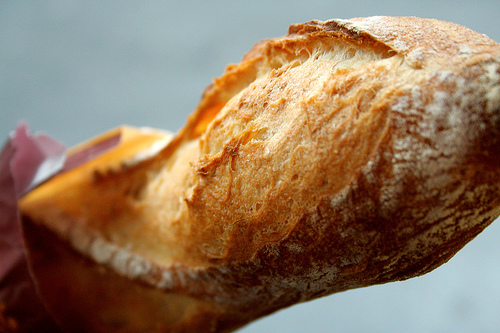
French baguette

So is it surprising that superior French bakers in England, such as Dumouchel, where my daughter used to work on Saturdays, send over to Normandy for supplies of authentic French flour?  Or that the average French stick, bought from the average English baker, in no way resembles its chewy French antecedent, the baguette.

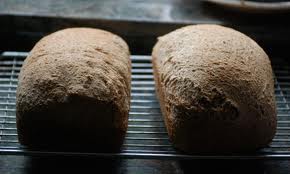
English wholemeal loaves, fresh out of the oven

On this visit to England, I’m appreciating the softer crust and slightly moister qualities of a well-made wholemeal loaf, just as over in France, I enjoy the the crustiness of crisply baked French bread.  Best to accept, I think, that both countries produce fine bakers and cake makers.  But neither could do a fine job using the flour preferred by the other.

If you want an introduction to some of the many flours on offer to the keen baker, Dan Lepard’s site is a good place to start

‘Except ye Lord keep ye cittie ye wakeman waketh in vain’

Ripon Town Hall

That’s the  verse from the Psalms, inscribed above the town hall in Ripon, where we’re spending the next few weeks to avoid the cold and rain of the south of France (no, really, they’ve got the heating on over there).  It reminds us that every evening – EVERY evening – for well over a thousand years, the Ripon Wakeman has sounded his horn to the 4 corners of the city to announce that all is well.

I had to go and check it out yesterday evening.

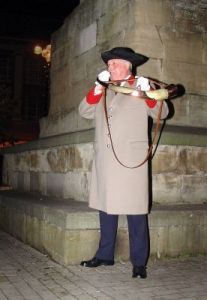
George Pickles, Wakeman, on duty

Promptly at 9, a smartly dressed individual in buff coloured hunting coat, tricorn hat and white gloves took his place before the obelisk on the Market Square and sounded his horn 4 times, once at each corner of the obelisk – one long mournful note each time.

Then he grinned at us, a small crowd of 20.  ”Want to hear a bit of history?’  Well, of course we did.  He made us introduce ourselves, and we found we too came from, well, about 3 corners of the world: Catalonia, Italy, Australia, even South Shields and Merton.  And here’s some of what he told us:

In 886, Alfred the Great, 37 year-old warrior king, was travelling his kingdom to defeat the Vikings, and to drum up support .  Arriving at the small settlement of Ripon, he liked what he saw and granted a Royal Charter.  He lacked the wherewithal to produce an appropriate document, and so gave a horn which is still safely locked in the town hall.

‘You need to be more vigilant, there are Vikings about’. Alfred warned.  So the people appointed a wakeman to guard the settlement through hours of darkness, and he put that horn to use by sounding it at the 4 corners of the Market Cross to announce that all was well as he began his watch.  The town’s now on its 4th horn.

If you want to know more, our current Wakeman, George Pickles,  has written the whole tale for the BBC website.  It’s a good yarn.  Read it when you have a moment

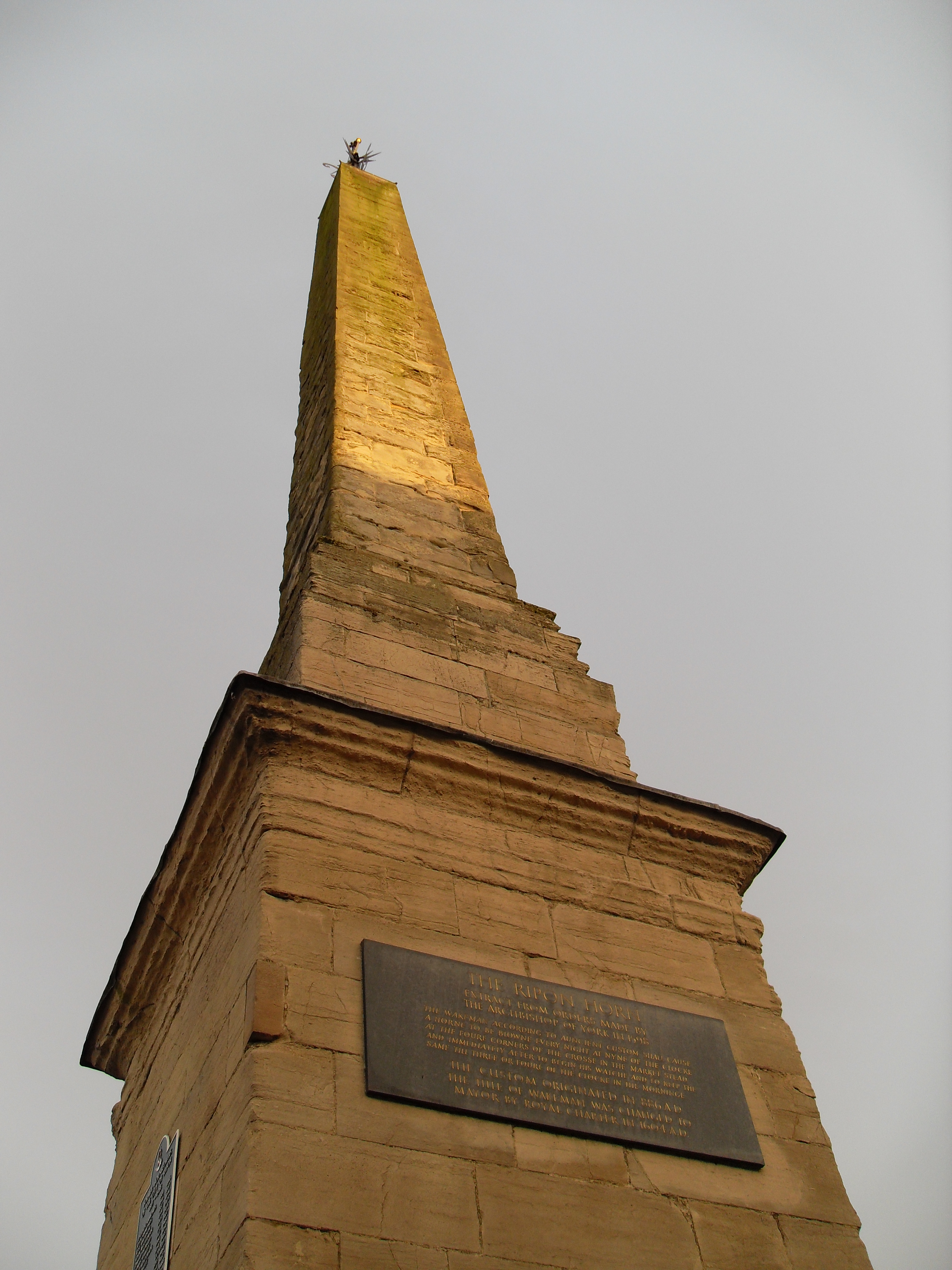
This is the obelisk the Wakeman visits each evening. It was erected by the then MP, William Aislabie in the 19th century, to commemorate his ….60 years as an MP

Lost in Translation

Umbrellas sheltering the unjust?

The rain it raineth every day

Upon the just and unjust fellah:

But more upon the just because

The unjust hath the just’s umbrella.

This daft ditty came into my head as a sudden shower threatened to stop our concreting efforts in the yard – we’re nearly ready to show you the final result – watch this space.  And I thought – ‘If you, dear English reader of my blog, had been here with us, whether you know that verse or not, you’d probably have come up with some doggerel of your own – a nursery rhyme perhaps’:

Doctor Foster went to Gloucester

In a shower of rain.

He stepped in a puddle

Right up to his middle,

And never went there again.

And then I realised that if instead you’d been with me, dear French reader, I wouldn’t have been talking about ‘just and unjust fellahs’ at all: lost in translation doesn’t even begin to cover it. I’m finding that more and more, I’m missing that shared cultural experience. By culture, I don’t mean the literature, the art and so on. To an extent you can mug up your Molière, get up to date with Gavalda.

One potato, two potato, three potato, four….

I mean the shared heritage we all grow up with from childhood. In France I don’t know the equivalent of that whole children’s choosing routine that involves ‘one potato, two potato, three potato, four…..’, or ‘ip dip dip, my little ship, sailing on the water, like a cup and saucer…..’

I don’t know how to criticise someone’s persistently down-beat attitude other than by telling them not to be such a Tony Hancock. Or a Grumpy Old Man.

Anyone in the UK, I guess, would immediately understand ‘I speak English. I learn it from a book’. That’s Manuel in Fawlty Towers. Astonishingly, a French woman actually said that to me last week. How could I have explained, if I’d given in to the almost uncontainable urge to burst out laughing?

Then there are all those people we feel we almost know, but who are probably unknown abroad. Anne Widdecombe and other politicians like her have gone from Scourge of The Left to National Treasure in the blink of an eye.  In France, who cares?  People like me rely on the likes of Nigel Slater and Nigella Lawson to come up with new ideas for Thursday’s meal.  Who does the job in France?

I’ve not heard programmes like ‘The News Quiz’ on French radio.  It would be lost on me if I had.  But then I can read ‘Private Eye’ with some enjoyment and comprehension.  ‘Le Canard Enchainé’?  Not a chance

Mine is the popular culture of an already bygone age. I know cream’s ‘naughty but nice’, and that ‘life’s too short to stuff a mushroom’ (it isn’t), but in the right company, I understand and am understood.  Of course I’m not really complaining that I can’t go round France talking in clichés.  What I do mind is that here, I don’t recognise the allusions that I do hear, and I certainly can’t make them myself. It’ll simply have to remain a closed book (or switched off TV).