Our village shop has a daily battle on its hands to keep itself in our hearts and minds as we plan our weekly shopping. With three supermarkets (two of them offering ‘le hard discount’) within two miles, it’s all uphill.
Dominique and Joel, the owners, have three types of customer: the old faithfuls who buy all their groceries there. There are so few of these that if one of them goes on holiday, or worse, dies (I did say old faithfuls), it makes quite a difference. There are those of us who shop a fair bit there, and make a conscious decision to do so, to keep the shop in business as an asset for the whole community. And there’s the passing trade, and those who only go if they’ve forgotten the matches, or fancy a tub of ice-cream just before closing time.
So they encourage local producers, offer delivery, open earlier and later than the supermarkets (though they have a long break at midday) and are constantly on the look-out to stay noticed.
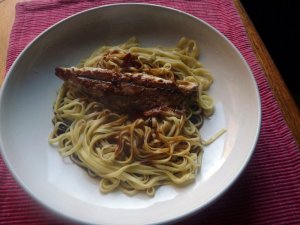
One of their winning ideas, though, is to supply fresh fish on one day a week. You’re as well to get yourself there in good time on Wednesday, or it’ll all be gone. Every week, there’ll be a choice of two varieties. And last week, the choice was a fairly unusual one for this part of the world: mackerel, my favourite. Inspired by various ideas from BBC Good Food, though owing allegiance to none in particular, this is the speedy no-nonsense meal I came up with.
Grilled sweet soy mackerel
Ingredients
4 mackerel fillets
zest and juice of 1 lime, or 1 lemon
1 tbspn. rapeseed oil
Noodles, as required
For the sauce
2 tbspn. soy sauce
1 red chilli, deseeded and cut into matchsticks
Juice 1 lime or lemon
Thumb sized piece of ginger, finely grated
2 tbspn. muscovado sugar
2 tbspn. water
Score the mackerel fillets a couple of times on the skin, then lay them in a shallow dish. Sprinkle with the lime or lemon zest and juice, and leave to marinate for 5-10 mins.
Place all of the sauce ingredients in a small pan and gradually bring to a simmer. Cook for 5 mins to thicken slightly, then remove from the heat and set aside.
Turn the grill to its highest setting and place the mackerel on a greased baking tray, skin side up. Sprinkle the fillets with the oil and some sea salt, then grill for 5 mins until the flesh is opaque and cooked through.
Meanwhile, cook the noodles.
To serve: divide noodles between shallow bowls, top with mackerel fillets, and drizzle the soy sauce mixture over the top
Just 4 km along the road from us is a village. If you’re passing through (and you won’t: it’s not on the main road to anywhere much) you’ll probably think it’s just another sleepy French backwater. A backwater called Léran.
But you’d be wrong. Over the last five or six years, Léran has reinvented itself.
Once upon a time, when this area was, for the time, quite industrialised, when Laroque and Lavelanet were churning out textiles to meet an apparently unending demand, Léran was the leather-working village. It must have been quite a smelly unappetising place with all those hides hung out to dry and cure. The river Touyre, flowing through the village, was dirty and polluted from the leather making processes. It would already have been pretty bad from flowing through Lavelanet and then Laroque when dyes from the textile trade were flushed into the waters. Friends of ours remember their parents being employed in the still-busy leather works in those days. Immigrant workers from Spain and Italy were much in demand to augment the local working population.
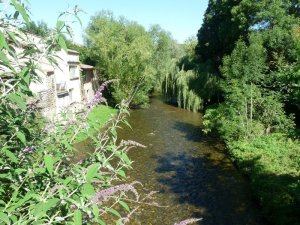
The Touyre today. Not dirty at all.
But times change, and as the textile mills declined, so did the leather works. Léran’s population fell as the young left to seek work elsewhere.
About perhaps twelve years ago, a few anglophones, scouting around for somewhere attractive to open chambres d’hôtes, found the village, noted its quiet agricultural setting, its château built by the local landowners, the Lévis- Mirepoix, and the stunning views towards the Pyrenees. They opened a couple of businesses. Guests, above all English, but other English-speakers too came to stay, liked what they saw, and some looked for properties to buy in the village. At that stage houses were cheap enough in this failing little community.
Slowly, the village came back to life. Marek and Shirley Woznica (yes, they are English) bought the run-down and almost decrepit little village bar and set about turning it into le Rendez-vous, the village hub for French and English alike. Quality meals, quiz nights in both French and English, open mic events soon became part of their regular programme.
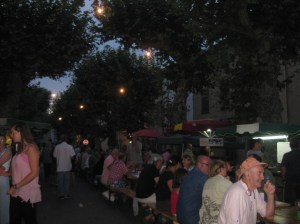
Le Rendez-vous on a warm summer’s evening, while the market’s in full swing
At a village vide grenier (that’s ‘empty your attics’, the French answer to our car boot sale) some years ago, we remember French inhabitants telling us that the English were responsible for some revival in the village fortunes. ‘But it’s a shame they keep themselves to themselves and don’t mix with us’, they said regretfully.
Well, that might have been true then, but it’s no longer the case.
About five years ago, another English resident, Alan Simmonds, a fine musician, decided to begin a choir. Inevitably, people round here call it ‘the English choir’, but it’s truly cosmopolitan, with singers from several different countries of origin in Europe and beyond. It’s already got a name for itself, and is quite in demand.
In summer, there are the Friday evening markets, when visitors and residents alike crowd into the village streets to buy their evening meals from an eclectic mix of food stalls, and sit down to share their meals at long ranks of tables laid out along the main street. This is Léran at its liveliest.
Evening market: crowds from the village and beyond sit down to eat together in the main street
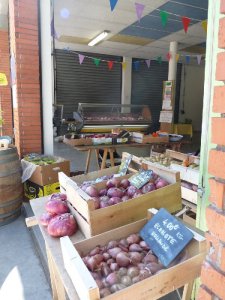
But it hasn’t been onwards and upwards without some struggles. The village shop closed, then the bakery. Léran no longer had any shop but a hairdressers. A now rejuvenated village council decided to act. They opened up a municipal storage building, named it ‘Les Halles’, and set about encouraging a mix of local traders to come on different mornings of the week to sell bread, meat, charcuterie, cheeses and vegetables to the villagers – it’s the only community round these parts that now has a daily market. So far it’s going well.
A stall at Les Halles
And this year, the village has developed yet another project: ‘Léran: le village qui chante’. In mid-June, St Cecilia’s Day, French communities everywhere throw themselves into a weekend of music-making of every kind. There are concerts in churches, bars, along the street. Anywhere. It’s a great weekend to be in France. But Léran wanted to do even better. With a tuneful choir, and some fine musicians living in the community, from opera singers to folk music, the villagers pulled together to put on a three day series of events. This is how they described it in their publicity:
Everything from popular operatic arias to foot-tappin’ jazz. Soulful solos to choral songs that rock the rafters.
World-class singers, a host of musicians, and the hugely popular Choeur de Léran.
All in a lively village with the Pyrenees as backdrop.
They weren’t wrong. Concerts in everywhere from the local hall, the village church and even local houses drew enthusiastic audiences from miles around. We loved the Baroque group, ‘L’ensemble de Montbel’, which we attended. No wonder le village qui chante now wants to make it an annual event.
Peering through the main gate of the Château de Léran
More recently, there has been one very sad event. In July this year, that château I mentioned caught fire one afternoon. It had been fairly recently developed as rather elegant flats: now one of the turrets has been consumed by angry flames. It’s a sad loss for the community.
So there we are. A lively and vigorous village community which we’re delighted to have as neighbours. Do we ever wish we’d chosen to live there instead? Well, no. We like the English whom we’ve met there, but we’re glad that we don’t have the easy option of making our social circle an English one, which must be almost inevitable in a community of so many Anglophones. We’ll go on coming for a meal chez Marek and Shirley, we’ll look out for concerts and other events in the village, and then we’ll stroll over the hill back to Laroque.
Les Halles in full swing
Sreet view
Our favourite house on Rue de la Place: always cheery with flowers
Gosh. Was it really only five weeks ago that we were there? Was it only 5 weeks ago that we togged ourselves in skimpy sun gear, floppy hats and clodhopping sensible shoes to make our annual pilgrimage to Le Jardin Extraordinaire? If you’ve been following our story of our life in France you may remember the photos of this joyful, playful, meditative, exuberant, and quite lovely space which so many of us come to explore and relax in for the one weekend only, in very early September (follow the link above).
The meadow at the Jardin Extraordinaire today
Today we wanted a walk: it’s not high summer any more, but the sky was very blue, the sun was pretty hot, the morning mists had burnt off and who knows if tomorrow it may rain? We wanted to take bags and a bucket and see if there were a few late blackberries (there were), a few sloes (there weren’t) and a few early walnuts (there were) to make our sortie near Lieurac worthwhile.
That was the entrance, a few weeks ago.
Our path took us past the site of Le Jardin Extraordinaire. It’s not normally a public space, so we couldn’t wander down to the river, or scramble up the hillside. But we could walk by the meadow which had greeted us at our last visit, and we could see the tunnels and bowers of gourds. Autumn has struck. The bright fleshy stems and leaves of the gourds and sunflowers have changed into gnarled and bony twigs. The pumpkins which once peeped from beneath their leafy green sunhats are now exposed on bare earth, those leaves crisp and brown like curls of tobacco. The sunflowers still rear their tall heads over the scene, but they too are blackened and dry.
Dying sunflowers
Ripe pumpkin
Supervising sunflower
It’s still lovely though. This is no cemetery. The seed pods, the gourds, the berries are all ripe now, They’re ready for the next stage: marauding animals may eat them, humans too, or else they’ll seed themselves, so that early next year, the garden can begin to grow again, and be transformed by the creative artists and gardeners of Artchoum.
Rosehips along our walk
And we too marauded today. We came back after our walk with full bags, muddy shoes, and that feeling of well-being that comes from a peaceful and productive afternoon out in the countryside in the bright Autumn sunshine
No sooner back from England, than we were making tracks for Barcelona.
Why? To help daughter Emily and her flat-mate move.
A trailer load Barcelona-bound
Saturday saw us leave Laroque with a large and unwieldy trailer load of cast-offs for Emily and her flat-mate’s new home. Two beds and mattresses, a table, a blanket box, a linen basket, a bike, ephemera from the kitchen, all kinds of detritus. We’d spent an afternoon on Friday packing the load, carefully, and with lots of thought and planning. Ten minutes after we set off on Saturday, it became unstable. We stopped and rejigged, went on a few miles… and more of the same. It started to rain, with quite high winds. We stopped a third time, bought more rope (OK, washing line. It’s all we could find), really had a good go at things, and finally, we had a steady load that got us all the way to Barcelona, in said wind and rain, as far as the frontier. Hooray! In Spain, the sun shone.
In Barcelona, we unloaded, unpacked, fetched and carried, and did our best to get the new flat …er … ship-shape. Sunday morning, while the girls played house, Malcolm and I were off duty. What to discover today? Well, look one way from the street outside her flat, and you’ll see far below you, the sea.
Yes, that’s the sea down there.
Look the other way, and you’ll see far above you…. bunkers.
Bunkers above
Those bunkers are among Barcelona’s lesser known secrets, and they looked intriguing. It’s a toughish climb up there, but stop for breath, and your reward is increasingly dramatic views of the city spread far below you.
View part way up.
At the top, there are battered concrete remains: the bunkers that were built by Spanish Republican forces in 1937 in their efforts to defend the city. Little could be done against the air power of the Nationalists. The Republicans were under-resourced, and their best hope was to use this high vantage point as both a look-out,and a place from which to launch protective curtains of artillery fire.
Once peace was restored, the bunkers came into use once more: a chronic housing shortage in the city meant that right up until the 1990’s, the site developed into a shanty town, housing up to 600 residents, though the council resisted providing services such as water and refuse disposal until well into the 1980’s. Remnants of this improvised town can still be seen in vestiges of tiled floors.
View of the city glimpsed through the morning glory
Another, glimpsed through the remains of a bunker.
Floor tiles from the former shanty-town.
Looking down the other way, away from the coast.
Now, you’re most likely to make the trek up here to get the very best views of the city: better than from Tibidabo. It’s not the view those Republican forces saw. From up here at La Rovira, you look down on a modern city: recent tower blocks dwarf the older buildings, though your attention will always be caught by the spires of la Sagrada Familia, still under construction. A highly-recommended excursion. Get yourselves there before everyone discovers it.
Climb down again: this is what you see.
I hardly know Bristol. I did stay there for the night, maybe 40 years ago, with friends who lived near the zoo. It was thrilling to be woken in the morning by the lions roaring as they rose from sleep to greet the day. But our South Gloucestershire stay included a day-trip to the city. With no chance at all of doing such a big place justice, we decided we’d spend the whole day exploring the harbourside area. If I’d gone there during my first visit to Bristol I’d have found an industrial zone, its glory days over, unkempt and unwelcoming to the casual visitor. Now the harbour is a vibrant, shipshape and attractive area, busy with locals and tourists alike.
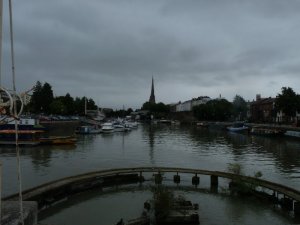
An early view of the harbour
We planned to go to Isambard Kingdom Brunel’s SS Great Britain, an early passenger steamship, the first to cross the Atlantic, back in 1845. But it’s so worth an extended visit we decided instead we’d spend a whole day there, next time. Because there will be a next time.
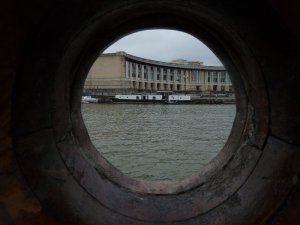
Old and new. A view of the Lloyd’s building from the Matthew
Instead we climbed aboard a replica of the Matthew, a caravel in which John Cabot sailed to America with a crew of some 20 men, in 1497. It’s unbelievably small. With little space for the men, no privacy, uncertain kitchen and sanitary arrangements and positively no computer-assisted stabilisers, it’s hard to believe that there were sailors willing and able to undertake the voyage. But they sailed forth, and reached land – perhaps Newfoundland – some five weeks later. They got home too, though somewhat confusingly via Brittany. Their travellers’ tales are unrecorded.
The Matthew
Besides boats and ships of all kinds, there were the working trains of Bristol Harbour Railway shunting back and forth, trailing unlikely trucks of what looked like scrap and jumble There were museums, to most of which we gave a reluctant miss . We did visit, though far too briefly, M shed, which gives a lively account of the history of Bristol and its role in the slave trade. I don’t quite know how we managed to avoid visiting the Arnolfini gallery: probably because we know we must go back.
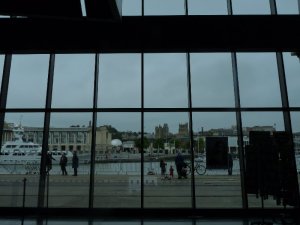
View of the harbour from the M shed
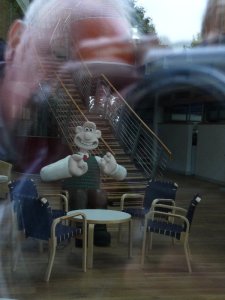
There’s something very exciting about being near a working waterway: because we did see boatbuilding and other water trades going on, despite its being a Saturday. And we saw Nick Park’s place too, Aardman Animations, and peered through the windows in hopes of catching a glimpse of Wallace – or Gromit.
Peering in to see Wallace
And we had coffee stops, and lunch stops, and afternoon tea stops. Because it was that sort of lazy day. But having failed to visit SS Great Britain, we felt it only right to finish the day by allowing ourselves to be astonished by Clifton Suspension Bridge, which Isambard Kingdom Brunel designed when he was only 24, though it still wasn’t completed when he died almost 30 years later.
I couldn’t take the whole bridge in at one glance
Now however, it’s used daily by more than 11.000 vehicles daily: rather different from the light horse-drawn traffic he had in mind when he made his design. Our day was complete when we spotted another form of transport drifting lazily over the bridge: a hot air balloon. Bristol, you did us proud.
We’re in England. We’ve been here nearly three weeks, and so busy catching up with Those Twins in Bolton and friends in Yorkshire that blogging has quite simply not been on my agenda. But here we are in South Gloucestershire with daughter-in-law’s parents: there should be a name for this particularly satisfying relationship as it’s one we enjoy and appreciate.
On Friday they took us to Westonbirt Arboretum. If you’re spending a few days round Bristol and Bath there’s no better place to recharge your batteries. You could pass the morning in the Old Arboretum, a carefully designed landscape dating from the 1850’s. There are something like two and a half thousand varieties of tree – 16,000 specimens in all, from all over the world, planted according to ‘picturesque’ principles of the 18th and 19th centuries, offering beautiful vistas, enchanted glades and stately avenues. After a light lunch in the on-site restaurant you could go on to explore the Silk Woods an ancient, semi-natural woodland, or the grassy meadows of the Downs
It was Robert Holford who designed and encouraged the planting of the Arboretum, back in the mid 19th century. This was a period when plant-hunters were bringing new and exotic species back from their world-wide travels. Holford was able to finance some of these expeditions, and the Arboretum contains many of the specimens his scientific adventurers brought back.
Truly, it’s a magical place. We arrived, let out a collective sigh, and simply allowed stress and worry to fall away. Strolling about, we gazed upwards at trees whose end-of-summer leaves seemed to be fingering the clouds, into copses where we could glimpse others already turning to the ochres and russets of Autumn, and then closely at the trees themselves. It was the bark that caught our attention close up. Smooth and silvery, brown and knobbly, grey and wrinkled, the variety astonished us. Take a look at these. And if you get a chance to visit this Arboretum, at any time of year, then take it.
I’ve got a large collection of recipe books. Despite regular and judicious weeding, the shelves get heavier with every passing year. You know me well enough to realise that Nigel Slater gets a shelf all to himself, which he shares with my latest new cooking best-friend, Diana Henry.
In among are certain stand-alone favourites: Denis Cotter’s ‘Paradiso seasons’ – stylish vegetarian recipes from an Irish restaurateur: Pushpesh Pant’s encyclopaedic ‘India cookbook‘: a reliable guide to quick and easy suppers from Sandeep Chatterjee’s ‘Indian Vegetarian Cookery’: and ‘Persia in Peckham’ by Sally Butcher, a great book to browse through and read, as well as to cook from.
Yet for all that, I find myself increasingly visiting the internet when hunting for new ideas. Any page that is immediately greyed-out by a superimposed advert is banished without further ado. So is any recipe that comes expressed in the cups so beloved of Americans and Australians (A tablespoon of butter? Oh, please no.)
I’m likely to find what I want among the pages of my favourite food bloggers. And here they are, in no particular order. What they can all do is write, and communicate their pleasure in the dishes they make with me, their reader. Perhaps you’ll come to enjoy them too.
Once upon a time, just after I’d left school, I worked in Italy, in Florence. As an au pair living en famille, I had no need to cook, but I remember those intriguing food shops; corn-yellow chickens, feathered heads intact, hanging in long lines from hooks above the counter; vast wheels of parmesan, fragrant hard flakes dusting the counter from the last-cut slice; the salumeria, with dusky cured meats and salamis suspended from the ceiling, and piled into baskets. I remember thick soups of fagioli ad’oglio and the excitement of first eating such simple dishes as soft cushions of mozzarella dressed with tomatoes, olive oil and pepper. Mainstream now, but so exciting back in the 60’s. Rachel’s blog puts me back in touch with those days.
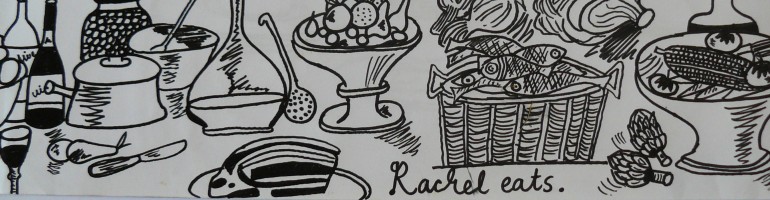
Rachel is a young English woman living with her small son Luca in the Testaccio district of Rome. I think perhaps she chooses to lives there, in Testaccio, as much as anything because of its busy daily market, with its stalls of just-picked vegetables and fruits, its fresh local cheeses and cured meats all sold by the people who’ve grown and produced these goods. Back home, she transforms what she’s just bought into simple tasty and achievable recipes which I always want to cook the second I’ve read about them. If ‘slow food’ is the motto you live by, Rachel’s your woman, because she’ll always point out that so many of the dishes she enjoys require time to develop a range of complex flavours, though otherwise not too much effort. Here’s the last dish of hers we enjoyed.
I think that Kath is the less-than-ordinary cook I aspire to be. Like me, she learnt from her mother – my earliest cooking memories are of helping to chop up candied lemon and orange peel for the Christmas cake, aged about 4. Like me, her cooking school was family life. Like me, she enjoys it when her children cook with her. Unlike me, she seems to be able to get away with cooking a lot of cakes and puddings: I like to make them, but taking 2 slices out of a whole cake before it goes stale isn’t a great idea. Kath is always keen to try things she’s never embarked on before, such as making her own butter. Any woman who provides a recipe for damson ice cream gets my vote. She’ll tweak a standard favourite and make it into something new: gooseberry and elderflower cheesecake comes to mind. There’s a lot of baking, but also plenty of ideas for inexpensive tasty main meals such as chorizo, lentil and bean stew. Good stuff.
Vegetarianism is by no means mainstream here in France. It’s seen as cranky, even. Outside the big cities, you’ll struggle to find a restaurant offering meat and fish-free main dishes (so take a bow, le Rendez-vous at Léran, for your daily vegetarian choice). On a domestic level, the vegetarian diet here tends to be … well …. brown. ’70’s retro, really. Lentils and chick peas, tasty items in themselves, tend to be offered without the revitalising additions of brightly coloured vegetables or zingy spices. How I long to thrust Natalie Ward’s blog in front of French vegetarian cooks. Here is what she says on her ‘About…’ page:
‘This blog is to share our enthusiasm for fantastic food with a world flavour. Using seasonal produce, grown locally where possible, we aim to excite with global vegetarian cuisine . Our inspiration comes from what fruit & vegetables we see growing while walking the dog in the “campo” in the morning and we hope to share some of the beauty of Andalucia in the process.’
She succeeds alright. She favours fresh, bright yet often quite complex flavours that excite the palate. Almost every recipe of hers that I have cooked has become part of my repertoire. It’s the sort of food I can make for non-vegetarians, who will have cleared the plate and asked for more even before they’ve realised that there’s not a mouthful of meat on offer.
I offer this recipe to those of you who despair over what to do with yet another mound of courgettes from the kitchen garden.
I love London. Why wouldn’t I ? Visiting gives me the chance to stay with my son and daughter-in-law. It gives me chances to expose myself to ‘culture’ with big and small ‘c’s’ of all kinds. And I love shopping there. No not THAT kind of shopping. Food shopping.
Rachel Kelly? Or Marmaduke Scarlet?
I love to nosey round Lewisham, maybe beginning with a rich dark espresso at the noisy and friendly Italian delicatessen, crowded with members of the local Italian community; going on to the Turkish shop; the Polish and Latvian stores; the Caribbean stalls on the market. Then there are Indian stores, various kinds of African ……
Rachel Kelly, aka Marmaduke Scarlet enjoys London too. She lives there. Having a metropolitan address doesn’t stop Rachel from eating seasonally, from locally sourced ingredients, including the wild leeks from her own garden. She celebrates the cultural diversity of London, using ingredients which we poor provincials sometimes struggle to find. She asks herself why some things work best one way rather than another, and wonders how to be creative with those leftovers. She tells a good story. She loves Nigel Slater. She makes me feel hungry as I read her latest post. Really, what’s not to like? You could try this one, maybe.
I hardly seem to need to recommend this. I note that half the blogs I read already have him on their blog roll. A professional American cook and baker living in Paris, he writes wittily about his life in the city and as he travels Europe and the world. I wouldn’t think of visiting Paris now without checking first on the various food shops, bars and restaurants he recommends, and his recipes are worth a go too. Those Whole Lemon Bars: once tasted, never forgotten.
When I was at school, my French text books were peopled by characters such as Jean-Claude, Jean-Charles, Jean-Paul, Jacques and Georges. There were Marie, Marie-France, Marianne, Jeanne and Jeanette.
My own classmates answered to names such as Valerie, Jean, Judith, Janet and Mary while the boys’ school along the road had types like Alan, Norman, Brian, Keith, and inevitably, John.
These names identify us firmly as children of the 1940’s and ’50’s.
So over the last week, on our journey through France, I’ve had fun looking for evidence of the latest trends in French first names, via Coca-cola’s latest marketing scheme of personalising drinks bottles with the current most popular given-names.
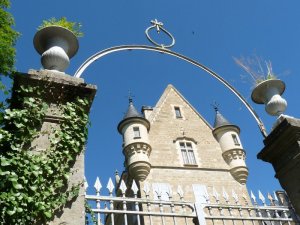
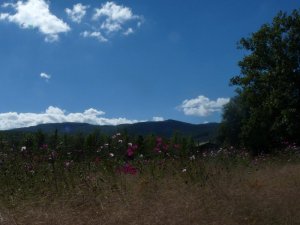
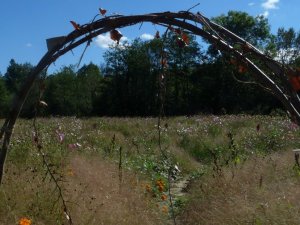
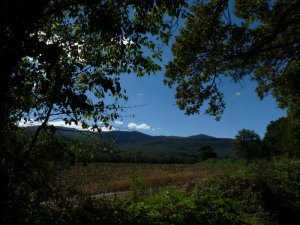
Le Jardin Extraordinaire is always comfortingly familiar, yet always surprising. If you’ve been once, you’ll go again, on this one weekend of the year, to enjoy strolling round this very special wild, yet bewitchingly tamed garden. The members and volunteers of Artchoum have been working for months to create this space, just for your pleasure. You’ll want to explore the riverside walk and exclaim at the enchanted place they’ve created with stones, trees and flower petals. You’ll go on to wander through the leafy tunnels and arches tumbling with gourds. Then you’ll amble off into the woods, where more fantastical experiences await you. People come from miles around to explore, smile and wonder at this very special place. But although you won’t be alone, there’s a relaxing feeling of space and of peace too. You’ll go away refreshed, invigorated and joyful.
To see the pictures as a slideshow, click on the first photo to enlarge it and start the show


















 From Pyrenees to Pennines
You must be logged in to post a comment.