Happy Christmas!
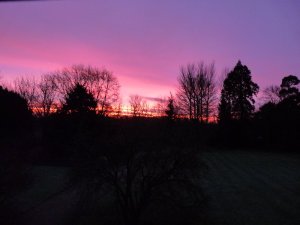
Winter has arrived. It’s taken its time. We’ve been accustomed to mildness, and lots of mud. Suddenly though, sunrise has been that rich blazing orangey-red, with vibrant yellow, that seems to arrive only on very cold days. And Jack Frost has been amusing himself by designing complicated patterns on car windscreens, making sure they’re good and hard to scrape off by a would-be early driver.

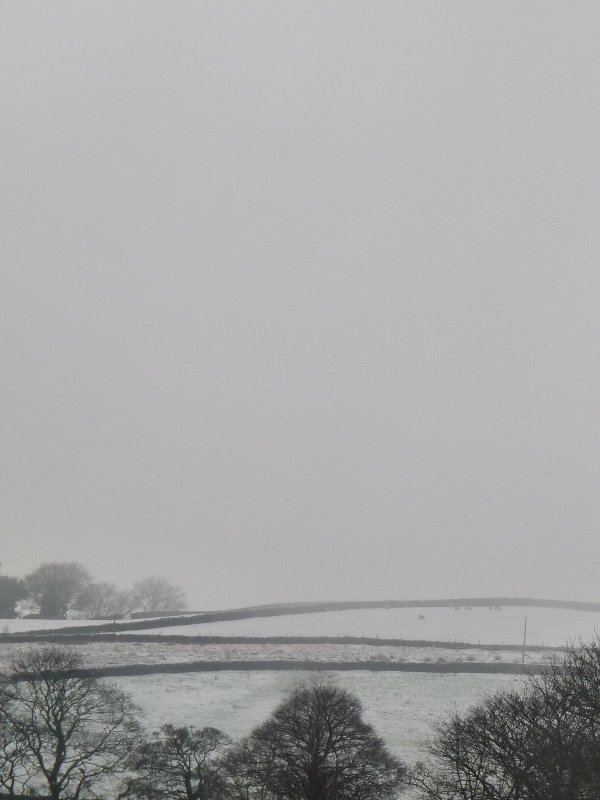
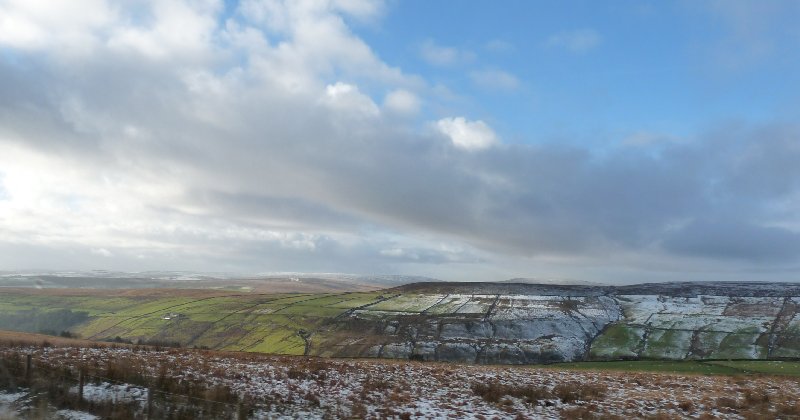
Last Friday, we travelled over the Pennines to Bolton. The hills were, for the first time this year, covered with snow. We even had the mini-adventure of battling through a mini-blizzard. And the next day, we travelled back. Cars slithering and careering wildly, or worse, along icy roads, closed our usual road home: instead we diverted across bleak moorland via Todmorden, Mytholmroyd, Hebden Bridge, Howarth and Keighley – a real Wuthering Heights landscape, meeting only very hardy sheep for much of the way. These were the views.


I’ve never been one for an evening down at the pub. When I was younger, I hated going out to meet friends there, for all it was a rite of passage and part of growing up. The smell of cigarette smoke, mixed with that of alcohol and under-ventilated space was the first downer, and then there was the problem that I didn’t – and still don’t – like beer. If weaker, to me it tastes of soap, and if stronger, of iron filings. What, really, was the point?
Over the last few years, pubs have had to re-invent themselves. Now that beer is cheap(ish) and cheerful at the supermarket, and now that people can relax at home in front of ever larger TV screens, fewer and fewer people want to dig themselves out of their cosy homes simply to go to their ‘local’ and have a drink with friends. So some offer Quiz Nights, or the chance to watch the Big Match on the Big Screen. Many many more have given up the unequal struggle and simply closed for ever.
Some though are doing well because they’ve chosen to offer good food, and those are the ones we like these days. The area we’ve chosen to live has more great pubs than seems entirely necessary. There are at least four within very easy reach. Get talking about matters of food when you’re out with your friends, and everyone will have yet another favourite haunt which they’ll insist you should try. What all these pubs have in common is cosiness. They’re warm and welcoming: muted colours and old oak furnishings, and often a slightly idiosyncratic lay-out which guarantees you a degree of privacy whilst also enabling you to people-watch . At this time of year, there’s sure to be a log fire flickering in the corner. Cheerful young staff will whisk you to a table as you arrive and summarise the ‘daily specials’. These pubs tend to have a limited range of dishes on offer, but that’s because the menu is designed round what’s available on the day, for that day.
There’s beer to drink – of course there is, it’s a pub after all – but these days there’s a decent wine list too, although the mark-up’s way beyond what we got used to in France.
So we’ve traded treating ourselves to a ‘formule’ at some local French restaurant, sitting outside and relaxing under the welcome shade of a large umbrella in favour of a cosy hour or two over a meal in front of the fire in an English pub. And do you know – they both have their special charms.
Here we are today at the Freemasons Arms in Nosterfield. Not a bad way to spend a Sunday.


Since we Yorkshire folk are from the Pennines rather than the Pyrenees, we’re inclined to make more of a fuss about steeply climbing roads. The main road from Thirsk to Helmsley is the notorious A70 via Sutton Bank, and no sooner have you left Thirsk than the warnings start:
Certainly, it is a dizzying climb, with the patchwork fields of the Vale of York laid out far below. Then suddenly, you’re at the top. You’d have to be in a real hurry not to park and get out for a while to enjoy the view, as we did twice today, once on the way out, and once on the way back. It’s winter now – not long to the shortest day – so these sunset scenes were taken at just after 3.00 p.m., a mere three hours after we’d climbed upwards, only shortly before midday.
Eeh bah gum, it were grand.


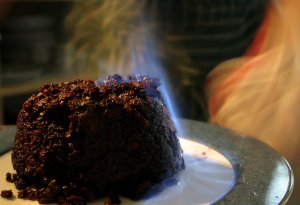
I hope you made your Christmas pudding today, the last Sunday before Advent. It’s more or less obligatory.
Once upon a time, if you were a good housewife of the parish, you’d have been kneeling at your pew in church as the vicar intoned the words of the Collect for the day:
‘Stir up, we beseech thee, O Lord, the wills of thy faithful people…..’
‘Stir up? Stir up? Oh, goodness me, I haven’t made my Christmas pudding’. And church service over, our good housewife would scuttle home and make it. She’d assemble dried fruits, suet, flour, rich dark muscovado sugar, cinnamon, cloves, eggs, a bottle of barley wine or some other hooch, grate an apple and some lemon zest . Then she’d tip all the ingredients into a bowl, and gather all her family around to stir the pudding too, and make a wish as they did so. Then she’d spoon the lot into a pudding basin, firmly tie a greaseproof paper lid over it, and steam it for 5 hours or so.
On Christmas day, she’d steam it again. She’d heat brandy, pour it over her pudding, then set the alcohol alight and bring it, flaming bright, to table with a jugful of sherry sauce for all the family to enjoy. We’ll be doing that too.
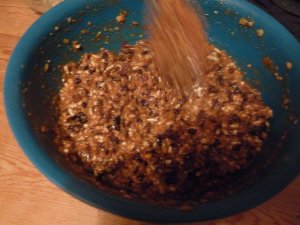
Today I went walking as usual with Ripon Ramblers, and told them I’d be making my pud later on. They thought I was frankly bonkers. Everyone, it seems, plans to buy their puddings. I don’t care. We’ve had fun measuring, mixing, stirring and wishing. The pudding is steaming as I type. This is the recipe I chose this year. The kitchen’s smelling pretty good at the moment.

Ever since our friend Micheline had a nasty fall on a walk, three and a half years ago, and had to be air-lifted to hospital, I’ve been slightly wary of walking alone in the countryside.
But sometimes, only solitary will do. Never more than 4 miles from a village, always with a farm somewhere not too far away, I set off for a solo walk this morning, even before all the Grammar School pupils had got on their bus to whisk them off to school in Ripon.
From your point of view, as you look at these photos, you may feel it was all just a repeat of my Sunday morning stroll. But it wasn’t at all, not for me. My path drew me in a big eight mile circle to the west of our village. It took me past a working quarry: always good to watch men at work. It took me past ancient trees: our home patch is particularly good at oak trees which are very old indeed. As I was passing through a wood, an anxious Wensleydale sheep cantered up to greet me. I saw why she was worried. There wasn’t another sheep like her in sight anywhere – she was lost. But I never found anyone I could report her to. I hope she’s alright. There were fungi. There were delicate and skeletal winter seed heads. I saw a pint of milk delivered to someone’s gate, and took a picture of it. Home milk delivery’s getting scarcer here now than it was in my childhood, but I’ve never seen milkmen in other countries I’ve visited. I saw Autumn leaves still clinging to the trees, and plenty more in vibrantly coloured heaps at the base of trees.
Best of all – and I have no photo to prove it – shortly before the end of my walk, as I was climbing steeply through woods with the River Ure below me, three white-rumped deer leapt out of a clearing, and with three rapid yet elegant and beautifully choreographed bounds, disappeared from view, only to re-appear and disappear for good, moments later.
All in all, a pretty good use of a Friday morning, I thought.


Today was indeed a misty morning. Ripon has no fewer than three rivers in town, and a canal too, and one of those three rivers, the Ure, passes our back door. So it’s no surprise that we do ‘misty-moisty’ mornings, evenings and nights on a regular basis.
But mistiness is no excuse not to walk the mile and a half along the Ure to visit the village shop at West Tanfield to buy a Sunday paper. Here’s my journey:
This is how the old nursery rhyme goes:
When cloudy was the weather,
I chanced to meet an old man clothed all in leather.
He began to compliment, and I began to grin,
How do you do, and how do you do?
And how do you do again?
Though I didn’t meet any old men clothed all in leather, I did meet quite a few dog-walkers. And quite pleasant chats were had with nearly all of them
Today is the eleventh day of the eleventh month. Remembrance Day. This year has been the one in which we’ve all been encouraged to focus on the horrible loss of life in the First World War: a war in which there were 16 million military deaths worldwide and 20 million casualties.
‘Casualties’ sounds such a, well, casual word. In fact many of these ‘casualties’ were unable any longer to work, to form sustained relationships, or in any way able to re-join normal life. And the communities from which the dead and injured came were also maimed, losing many or in some cases all of their young men. The way of life in such communities changed forever.
The most telling way of appreciating the scale of this loss, for me, has been the sea of poppies at the Tower of London. I’ve been unable to witness it in person, but this blog, which I came by thanks to fellow blogger KerryCan, brings the whole project to life in a most moving way. Thank you, Silver Voice from Ireland. Here is your post:
I have just returned from a short trip to London, England,where we lived for almost two decades before returning to Ireland. London is a city that I love and I look forward to each return visit. This year marks the centenary of the start of the First World War which has been commemorated in the most astonishing way at the historic Tower of London.
 The ‘Weeping Window’ the source of the wave of poppies that will fill the moat
Some decades ago, when I worked in the banking area in the City of London, summer lunchtime would be spent sitting on the grass looking down at the Tower and enjoying the sunshine. We happily munched on our ham and mustard or cheese and pickle sandwiches while enjoying the historic view and discussing the gruesome executions that took place just yards from where we dined! The Tower itself dates back to…
View original post 448 more words
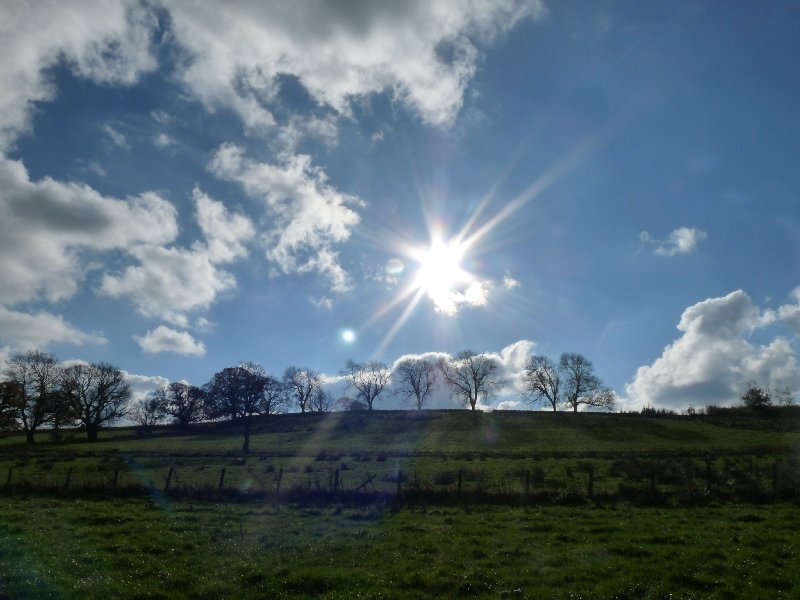
What a difference a week makes. This time last week, Amelia and I were ‘recce-ing’ the walk I was due to lead this Tuesday, stumbling around near Swinton trying to make sense of a map and a warren of pathways. Both reasonably competent map-readers, we found ourselves confronted by too many cross-paths, and too many waymarks that didn’t QUITE make things clear enough. We got there in the end, of course, having met in the course of our journey several equally puzzled hikers turning their maps every which-way as they tried to choose the correct route.
This week, I competently led seven Ripon Ramblers on the walk and wondered why we’d found it all quite so difficult. But it got me thinking about all those paths. Paths are created by those who use them. Roads were too, once upon a time, as all those single track and often ill-repaired ‘C’ roads meandering from village to village testify.
But these days, roads are planned. It’s town planners, the Highways Agency, and whole bevies of committees who decide where roads will go, and how they will get there. If they deem it necessary, they will flatten hillsides or even communities that stand in the way.
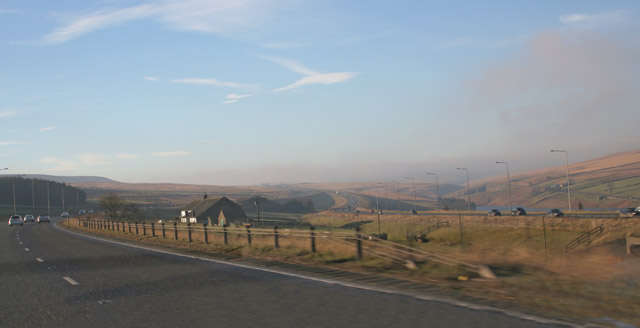
Usually. There’s that famous farm in Calderdale which parts the two carriageways of the M62, the motorway which links Yorkshire with Lancashire. Legend has it that at the planning stage, the farmer refused the blandishments of every official from the Department of Transport, every civil servant who tried to persuade him that The Road Must Go Through, till finally Officialdom gave in and built the road around his farm. Sadly, it’s not true, and you can read about it here Still, whatever the truth of the story, it nicely illustrates the fact that these days, road are normally built where planners decide.
With paths, it’s a different story. Those routes that we use every time we go out walking in the country were chosen by those who did the walking, often many centuries ago. Well-trodden paths that have linked communities over the years are public rights of way that have to be kept useable and maintained by local councils in just the same way as roads must be. Local authorities have a duty to ensure that they are useable by installing gates and stiles to enable users to, for example, cross from field to field. Landowners who wish to vary the route of a path must have good reason, and must provide for and maintain a viable alternative.
On Tuesday, we went along a whole variety of paths, as we always do when out walking. Some were fine tracks covered in chippings and linking farms. One path was straight and wide with fine stone foundations: once it was a railway line built to haul goods to a reservoir under construction in the early 20th century. But much of the time, we could pick out our routes across farmland only by observing a sinuous line of flattened grass where others had walked before us. I enjoy knowing that most of these paths, whatever kind they are, have often been used for decades and even centuries before.
Needs can change though. That day when we first tried the walk Amelia and I had a dreadful time looking for a certain path. We even ended up at a farm asking for directions. ‘You’ll never find it’ we were told. ‘Nobody’s used it for ages, and it’s hopelessly overgrown. You’d much best use the road’. Well, it didn’t really suit us, but we could see why it had happened. The road was more direct than the old path so people ‘voted with their feet’ and stopped using it.
We’re pretty lucky to have a great network of paths. And besides that, in large areas of the country, we have ‘the right to roam’, meaning we’re free to explore the open countryside away from paths, following the Countryside and Rights of Way Act, introduced in 2000 after a 60 year campaign. I’m enjoying those paths, whether mooching, walking purposefully, exploring, or simply ‘following my nose.’


The Ramblers association does much to promote the interests of walkers and protect the walking environment.
I’ve just found the blog post I wrote at our very first Hallowe’en season in France, back in 2007. This particular celebration seems to have become more and more Americanised here in the UK, and now in France too. In fact, I understand that the Fête de la Citrouille in Belesta is no more. Exhibiting pumpkins has been exchanged for ‘trick or treating’: 0r as the French so snappily put it ‘Donnez-nous des bonbons ou nous vous jetons un mauvais sort’.
I thought I’d like to reminisce. Here’s that blog post from a day in our very first autumn in France.
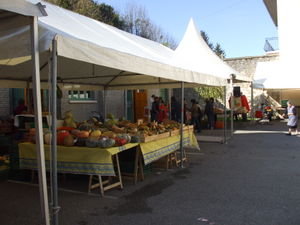
‘In Harrogate, Hallowe’en seems to mean spending the evening of 31st October greeting a steady stream of cheerful young witches, wizards, ghosts and ghouls to the door threatening tricks if they don’t get their treats. Here in nearby Belesta, it’s something rather different, since the period round Hallowe’en is for them La Fête de la Citrouille – the Feast of the Pumpkin.
Well, just look at those pictures. If you could grow pumpkins like that, wouldn’t you want to celebrate? Yesterday, we had real fun looking round on the first day, which was also their Vide-Grenier day (Empty Your Attics). Pretty much like an English car boot sale really, except the stalls spread through the streets of the town. French attics and barns can turn out some splendidly puzzling tools and equipment, and as for the light fittings…… We enjoyed rooting around, and got ourselves quite a hoard of books at knock-down prices.


Of course the highlight of the day was yet another walk, a long ramble from Lesparrou, where we had dumped the car, along the wooded banks of l’Hers and through fairly isolated hamlets with picturesquely dilapidated (but still functional) barns, and productive potagers. Every day, the snow on the Pyrenees creeps just a little lower down the slopes, and we enjoy watching its progress. We ourselves celebrate the fact that the steeply wooded slopes which form part of nearly every walk become less strenuous as our fitness increases.’
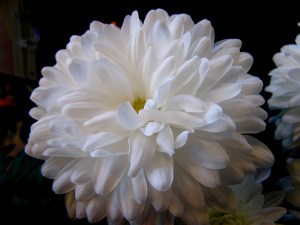
It seems all such a distant memory now. Back in England, we don’t enjoy the huge variety of pumpkins, squash and gourds which are part of every autumn and winter market in France. Back in England, All Saints’ Day on November 1st goes unremarked. Our cemetries are not suddenly overwhelmed with pots – hundreds and hundreds of pots – of chrysanthemums, as the entire population make this annual pilgrimage to the graves of their relatives during the period of ‘la Toussaint’. Even though it’s half-term here too, our roads are not suddenly nose-to-tail with holiday makers as French families take this last opportunity to get away together before Christmas. In England, as shopkeepers clear away the pumpkins and Hallowee’en paraphernalia, they’ll fill their shelves with Christmas goods. That won’t happen in France, not until early December. Hallowe’en and Toussaint have a particular feel in France which is quite absent from the same period in England. I miss the pumpkins. But not the chrysanthemums.


You must be logged in to post a comment.