I’m not so blinkered as to believe that Yorkshire has all the best bits of scenery. I’ve had days to recharge the soul in every English county from south to north, from west to east, enjoying stirring uplands, gentle verdant hillsides, sky-filled flatlands, slowly-flowing rivers and tranquilly tinkling streams, and the constantly-changing views from the beach at the seaside.
All the same, what we saw whilst out walking today gave every picture postcard of anywhere outside the Yorkshire Dales a run for its money.
John’s view of Yorkshire, as described on his T-shirt, is the correct one.
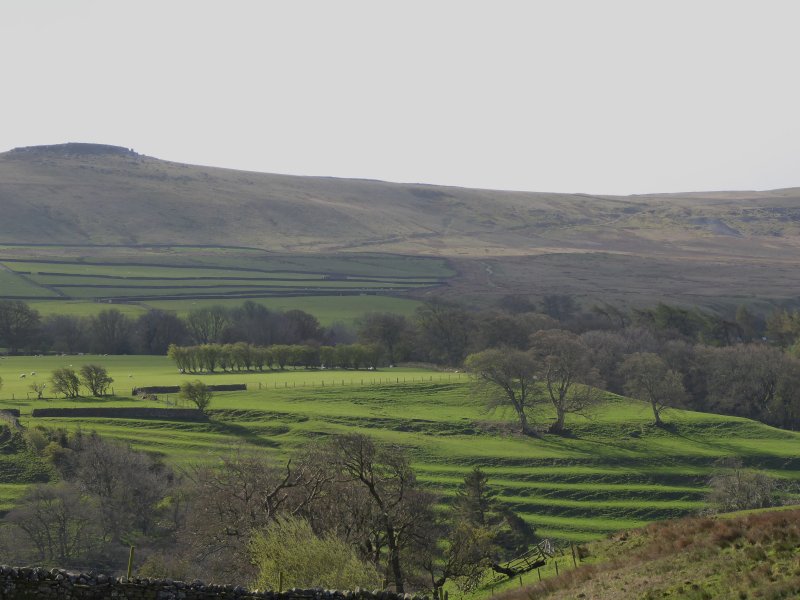
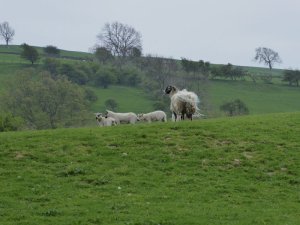
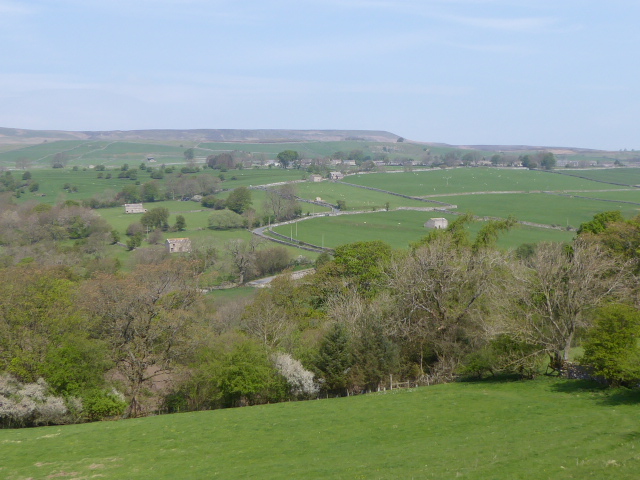
From Pateley Bridge, set in the heart of Nidderdale (Area of Outstanding Natural Beauty), we energetically panted and clambered through Guisecliff Wood, whilst looking down at the village of Glasshouses below. We emerged, puffing for breath at the top, One way, we could look across the Daleside landscape of ancient field systems and stone-built settlements, to the vale of York beyond.
Looking across towards the Dales.
The other way were the moors, no longer bleak, because this is heather time. We breathed in the intoxicating smell that I like to buy potted up as rich, almost peaty flavoured heather honey. We stared, almost mesmerised at those carpets of blooms stretching away from us, mile after mile: not lilac, not lavender, not violet nor damson – simply that special low-key subtle purple that only heather can deliver.
Marching through the heather.
Past Yorke’s Folly: it’s said it was built in 1810, commissioned by the local landowner, John Yorke of Bewerley Hall, who was casting about for some means to keep his labourers in employment in a time of economic depression. These men received a shilling and a loaf of bread a day for their efforts.
Yorke’s Folly: a resting place for weary walkers to enjoy the view.
Then it was back to woodland again – very English woodland, with a full green canopy, not yet ready to turn to autumnal colours. Skrikes Wood, Nought Bank, Fishpond Wood.
Skrikes Wood.
Then back along a few final paths before returning to Pateley, and a very welcome pub lunch.
Regular readers will know I’m a huge fan of Rachel Roddy, and her tales of life and cooking in Rome, as told in her blog ‘rachel eats’. Well, here she is in Sicily. And if you’re reading this under a sullen English August sky, you might like to take a virtual trip with me, and join her there.
Hello. We are in Southeast Sicily in a town called Gela. I have written a piece about this for the FT Weekend magazine, which is beautifully illustrated by Luke Best. If you would like to read it, here is the link. More here soon – R
I’m feeling ‘Off-Black’, as Farrow & Ball might style it.
‘Off-Black’. From the Farrow & Ball shade card.
Or possibly rather ‘Down Pipe’: that’s grey-black to you.
‘Down Pipe’ from the Farrow & Ball shade card.
My camera’s gone bust. Just as I was coming to the most photogenic bits of a walk yesterday, and just as I was about to take a shot of some unusual fungi to show to a mushroom-geek friend, my camera declined to switch on. Or off. The toggle simply wobbled about a bit. It’s going to have to be sent away for repair, and I shall be camera-less for…. oh I dunno, a couple of weeks I suppose. I can’t even download the photos I’d already taken, and it’s all going to be somewhat expensive. And how can I write a blog post without photos, hmm?
To add to my woes, we’re just getting to the final brush-strokes of decorating our bathroom, to which our landlords have recently offered a make-over. I can’t show you our efforts here, which may be just as well, because our previous well-known lack of enthusiasm for painting and decorating has turned into sullen resignation. Let’s just get it over and done with, ASAP. I’ve even been heard to say I’d rather take in ironing to earn money so someone else could do it. And if you know anything at all about my lack of enthusiasm for ironing, you’ll know that things are really serious.
So this is all I can show you of the bathroom. The shade we are covering the walls in. It’s called ‘Cat’s paw’. Nothing to do with cats, apparently: ‘Cat’s Paw is not named after the animal but after a complicated knot. The perfect name for this colour as it is the darkest accent for the often knotted String and Cord’. The theory is that this naturally cold room will feel warm and nurturing on those cold winter days which seem to be marching towards us already, even though it’s mid-August. We like it, anyway, and perhaps by the end of today we’ll be able to pack up our paint brushes, fold up the dust sheets, and give the lot away to anyone who’s made enough to be planning a painting project any time soon.
I was looking on the internet for something just now, when I found myself staring at this blog post that I wrote more than three years ago. And it suddenly made me homesick for a little bit of France. Not the friends, or the food, or the scenery or any of the finer things that France can offer. No, what I suddenly missed was the mangled version of English which is the stock-in-trade of every magazine and newspaper article there. I wonder what the must-have words of 2015 are?
Stuck in a waiting room with a pile of magazines between me and my appointment time, my idea of hell is a choice between fashion mags and ones about cars.
Less so in France, at least as far as the fashion ones are concerned. It’s not that I’m more interested in being stylish and chic here. I simply have fun reading the articles and noting the ‘English’ words and phrases on almost every line.
Are you a sophisticated lady? Cool? Relax et sexy? Show-off? Perhaps you aim for le twist sporty-glam, or like le mix et le match, le style ‘street’, or le fun et le trash.
Down at the shops are you looking for un look color block, le style boyish ou girly, arty-trendy, crazy doll, grungy girl? If you’ve any sense, you’ll have made a…
My goodness. I haven’t been on a walk like that since we left the Ariège. Over there, in the foothills of the Pyrenees, you knew you’d very likely have to struggle up and down through at least 600m in the course of a day’s march. Over here in Yorkshire, the hills and dales are generally much more forgiving, and I’ve got unused to climbing…. and descending.
All that changed yesterday. We went to Sutton Bank. You know what you’re going to be up against even before you arrive. The main road leading to the top has a gradient of 1 in 4, caravans are banned, and HGVs regularly get caught out on the way up. Yet the summit is a mere 298m. above sea level.
But it really is all about the gradient, this walk . And the wind. Not for nothing does the Yorkshire Gliding Club site itself at the top of the escarpment, all the better to enjoy the wind, the thermals and the views over North York Moors National Park. It made for an entertaining beginning to the walk, watching gliders being towed to a height of 600m. before being detatched to begin their slow and graceful descent to earth.
A glider is towed upwards on a windy day.
But this walk was all arse about face to someone accustomed to those Ariègeois walks. There, you started at the bottom, panted doggedly till you got to the top, where you had lunch, and then you skittered down again. Yesterday, we started at the top, and having waved the gliders goodbye, set off down the escarpment, through English woodland, with tantalising views across to the plain beneath. It wasn’t as mad as it seemed though. The path was steep enough to be slippery and uncertain, and it felt good to do this while we were still fresh. Climbing, later in the day, though tough, was the lesser challenge.
A level walk across the fields.
Soon after our lunch break, we were striding across fields set about with recently harvested bales of straw and hay, enjoying the views . This was to break us in gently for a thoroughly vertical-seeming climb, with steps among the tree roots to help us upwards. About half way up, we had a reprieve, because extraordinarily, there is a lake. Lake Gormire was formed in the last ice age, when a gigantic ice sheet scoured out a deep hollow in the crags. The southern end got trapped by landslips, and water from springs at the base of the escarpment allowed water to collect. It’s a lovely, secret place, and a haven for wildlife.
Lake Gormire.
A final effort, and we were there, at the top of the escarpment once more. A short walk along the top brought us to journey’s end, but not before we had stopped to admire the view which locals modestly call the finest view in England. Well, it’s certainly very fine.
Almost at the top of Sutton Bank and journey’s end.
We were glad to have had this challenging walk. Our muscles and air-waves reported they’d had a fine work out. We should do this more often.
We’ve got a genie living in the corner of our kitchen. He’s not very prepossessing. He’s a kind of fawny-beige colour, and he just sits there, fidgeting and occasionally burping quietly in his pot. He’s just a little smelly. If we just left him, he’d quietly expire, and probably get a bit more pungent. But I do feed him, every two days or so. I spoon a couple of measures of flour and a glug of tepid water into him, and give him a soothing stir, because I’m very fond of him. We eat a little bit of him every day.
The sourdough genie.
Here’s how. Whenever we need a new load of bread, I split our genie in two, and return half of him to his pot, with a little meal of flour and water. The rest I turn into a bowl, add a loaf’s worth of flour, salt, and some tepid water. And I knead this exceedingly sticky mess until it becomes an obedient ball of soft, rather floppy dough. Then it’s into a warm place with it for a few hours, till it’s grown a whole lot bigger.
Then it’s time to knock the dough back, form into a nicely loaf-like sphere, and pop it into a well-floured basket: the sort you might have acquired on holiday in France a few years ago to pop your morning croissants into. Leave it to rise again.
When it’s nearly ready, turn the oven on, good and high. Put a dish of hot water on the oven floor. Get a baking tray ready.
Here’s the scary bit: inverting the basket so the dough falls, but doesn’t tumble heavily, out of its basket and onto the tray. Slash the top of the loaf with a few deep cuts, pop it in the oven, and you’re done. Forty minutes later, there’s your very own loaf of sourdough bread.
Sourdough loaf, fresh for breakfast.
The hardest bit is getting your sourdough genie into the kitchen in the first place: it’s a bit of a faff rather than difficult. Here’s how it’s done: though Googling ‘sourdough starter’ will deliver a dozen or more ways of getting going. What you’ve done in making your very own sourdough starter is introduce wild, local yeasts into your flour and water mixture. So your starter will be different from mine. The one you’re making now will be different from the one you make in the middle of winter. I have a friend who’s been known to take his sourdough starter on holiday with him, to get his yeasts making friends with exotic foreign strains.
I’m having a bit of a sourdough moment. It’s only a phase. One day soon, I’ll forget to feed our little genie, or worse, I’ll get fed up and let him die. Meanwhile, I enjoy the particular magic of creating the conditions for yeasts I can neither see, touch nor smell to come into my kitchen and help me create our daily bread.
Pateley Bridge, population just over 2,000, is slap in the middle of Nidderdale, an AONB (Area of Outstanding Natural Beauty) appreciated for its landscapes, its rich flora and fauna, and its now hard-to-spot industrial past. But if you were there this last weekend, it might not have been to use the town as a base to explore the Yorkshire Dales. You might instead have been coming to Niddfest, a new family-friendly festival offering a weekend of talks and outside events for nature lovers, and especially book-loving nature lovers, of all ages. That’s why we went, on Saturday, and again on Sunday. We had a pretty busy weekend there, but it turns out we weren’t busy enough.
Pateley Bridge High Street (Wikimedia Commons)
We weren’t there when Poet Laureate Carol Ann Duffy and National Poet of Wales Gillian Clarke introduced the festival, reading from their work. We were absent from the sessions when the likes of Piers Torday, Katharine Norbury and Michelle Harrison were reading from and discussing their books. We didn’t go on the Moor Safari, or on the river walk along the Nidd, or foraging for wild edible plants. We didn’t commandeer our grandsons so they could explore for bugs at Studfold Adventure Trail, or go den-building in the woods.
Scar House Reservoir, scene of our bird-watching walk.
What we did do was go on what was billed as a bird-watching walk with Mark Cocker and the Nidderdale Bird watchers’ group. And what a way to start. A young cuckoo landed on a fence post, and was immediately followed by his unwitting foster-mother, a meadow pipit, who spent frantic moments stuffing food down his always-open throat. Bear in mind that a meadow pipit is some 15 cm. long, and weighs in at 15 g . The cuckoo wasn’t far from its adult size of 33cm, and 110 g.
With a start like that, the rest of the morning might have been a let-down. But it wasn’t. We saw an old shed where a colony of swallows had begun their days, and learnt that they, like most swallows, would end up wintering in a reed bed somewhere near Durban, South Africa…. some twelve and a half thousand kilometres away. We saw house martins, goldfinch, and quantities of ‘red’ birds – red kites, redpolls, redstarts. We learnt to distinguish thistle varieties, and learnt which ones bees favour. We began to understand just how many varieties of bees, beetles, flies and other insects populated this limited corner of Nidderdale. All this thanks to the bird watchers and especially to Mark.
Then we hurried up to Middlesmoor – to hear Mark again, in conversation about his books. Do look at his website – here – to learn more. His nature writing is something special. He celebrates wildlife in its day-to-day environment, but believes the natural world is far more than an interesting and quite engaging backdrop to our lives. It’s fundamentally important, and environmental issues need to assume an equal, if not a greater importance in political decision-making than, for instance economic affairs. Instead, they are sidelined if not totally disregarded.
Middlesmoor churchyard.
This politics-with-a-small-p approach continued the next day, when we heard Oxford graduate and Cumbrian shepherd James Rebanks speak about his bestseller ‘The Shepherd’s Life’. He has many strings to his bow (adviser to UNESCO for instance) – farming in the Lake District simply doesn’t pay. He points out that our desire for cheap food, our disconnection from where our day-to-day nourishment comes from is putting traditional farming, where animals are treated well and with respect at risk.
And then it was Rob Cowen. How could we not be fascinated by his book ‘Common Ground’? He has become forensically interested – almost obsessed – by a small patch of green space just at the edge of Harrogate. This small area was our own ‘green lung’, only yards away from our front door when we too lived in Harrogate. He weaves the story of his growing infatuation together with more personal notes about the baby he and his wife were expecting. It’s clear his well-being depends upon his developing close relationship with this edge-land, this little piece of woodland, river and grass still clinging on to the top corner of a busily expanding town. Nature writing with a difference.
What a rich feast we had. In some ways we’re sorry we didn’t cram in more of what was on offer. But as you see, we had more than enough to digest. A brilliant festival. It had better come back next year.
Starting round Swinsty reservoir. It’s not raining yet……
Reservoirs. If you live in the city, you’ll be dependent on one, almost certainly. Every time you turn on the tap, the water that come gushing out will have started out in some far-flung and distinctly rural part of the area.
These days, reservoirs aren’t just – er – reservoirs. They’re playgrounds for all of us – walkers, dog-walkers, fisherfolk, bird-watchers and naturalists of all kinds. They’re protected and protective habitats for all kinds of wild creatures. And in their watery depths, they conceal their history. Those reservoirs built between the 1860s and 1960s conceal drowned ancient villages, mills, factories, farms and country estates, leaving almost no trace behind. It’s hard to believe that the 4 reservoirs of rural Nidderdale hide a once-industrial area, where iron smelting, woollen fulling (a process something like felting) and flax-making took place, and where, in the early 19th century, the demand for labour was so acute that pauper children as young as nine were recruited from London to keep the factories working.
We Ripon Ramblers went off yesterday to walk a figure of 8. Park at Swinsty Reservoir, walk all the way round adjacent Fewston Reservoir, back to Swinsty again and walk round there. You can see from the pictures that the early promise of the day was not maintained. It rained and showered a lot. But rain and showers make for picturesque views.
An umbrella or two: the ideal accessory for an English walk.
Looking across Nidderdale.
A very rainy view.
Walking through the woods. A fine canopy against the rain.
Geese of all kinds populate the reservoirs in huge numbers.
A leaden sky.
Flowers of high summer at the lakeside.
Fishermen don’t seem to mind the weather.
Fewston reservoir.
Fewston just as the rain sets in.
Oh, and at the end, we took a small diversion to visit the old and picturesque village of Timble. It may seem like many a charming Yorkshire village, but it has a bit of extra history on the side, in the form of the Robinson Library. This building was the gift of Robinson Gill of New York, in 1892. He’d left Yorkshire in 1851 for America to seek his fortune. He found it: he had two successful stone yards on the Hudson River and was president of two New York banks.
His ancestors were prosperous yeoman who had lived in nearby Swinsty Hall, and he himself had been born and raised in Timble. From his adopted home in the States he arranged an endowment of £2000 to pay for a teacher for the school and for the upkeep of the building, and laid out £100 for books. The library provided the villagers with not only a library, but a free school, a Sunday school, a social centre and a reading room. The endowment failed with Robinson’s death: his descendents weren’t as astute about money as he had been, so the library fell on hard times for a while. The children now travel elsewhere for their schooling – after all, the village only has 100 inhabitants – but a recent programme to restore and re-invigorate the building means it is once more an active social centre for the community and beyond.
The Robinson Library, Timble. (Wikimedia Commons)
So, dear American readers, come and discover the area for yourselves, with its unexpected link to your part of the world. You could stay at the Timble Inn, an 18th century coaching inn, and then discover not only those reservoirs and their hidden history, but the towns, villages, dales and moorland of Nidderdale. You’ll be glad you did.
Swithin, Benedictional of St. Æthelwold, Winchester, 10th century, British Library (Wikimedia Commons)
It was Saint Swithin’s Day last Wednesday (15th July). I thought everyone knew that. But when I mentioned it to a group of younger people I was chatting with that morning, they looked at me with blank incomprehension.
St Swithin’s day if thou dost rain
For forty days it will remain
St Swithin’s day if thou be fair
For forty days ’twill rain nae mare
Yes, apparently the weather we get on Saint Swithin’s day is the weather we can expect for the next forty days. Nobody really knows why this blameless 9th century Bishop of Winchester is responsible for his apparent hold over the climate in high summer. He seems to have been a nice chap. He held banquets to which he invited the poor, not the rich. He miraculously restored a basket of eggs that workmen has maliciously broken. He asked that on his death, he should be buried outside the cathedral, rather than inside, so that passers-by would tread on his grave, and so that it should be regularly watered from the skies. But in 971, he was moved to a new indoor shrine. And lo! The heavens opened. Perhaps this is where the legend originated.
But it has a measure of truth. Round about mid July, the jet stream settles into a pattern that holds good until round about the end of August.
Not this year. Saint Swithin’s day was pretty good: warm, fresh and sunny. Since then though, we’ve had cold days, hot days, or like this morning, woken up to driving rain. As this picture sort of shows.
Looking out of the window at breakfast time today.
Here are some pictures of a walk I took yesterday, a day on which Saint Swithin kept his promise made on Wednesday. It was a day of high summer, with the crops ripening fatly in the fields, the verges crammed with tall plants that often obscured the view, and a warm refreshing breeze in the air. That’s what Saint Swithin is supposed to deliver. He’s got some 36 days left to remember to keep his promise – every day.
We’ve just come back from Herefordshire, where we’ve been helping our friend Hatti celebrate a Big Birthday. She and her family have a cottage there – it’s been in their family for decades now – in the back-end of nowhere, alongside the River Lugg. If you don’t like fishing, or walking the hills and vales, or mooching along woodland paths, best not go there. If you’re in a hurry, don’t go. You’ll only meet a tractor on a narrow single-track road and be forced to reverse all the way back to the last junction. There’s no nightlife, no shopping malls, no nearby towns, not much of any evidence of 21st century life – the family cottage doesn’t even have electricity, for goodness sake: gaslight in the evening is a reposing and rather nostalgic experience.
The cottage.
The River Lugg at the bottom of the garden.
The welcoming committee in the next field.
History, though. The area has history. It’s part of the Welsh Marches, that border territory between Wales and England that was fought and skirmished over pretty constantly from the time of the Romans, by Angles, Saxons, Normans and countless ancient tribes, right up to the time of the Tudors. Offa’s Dyke, that 8th century earthwork which largely defined the Welsh border for centuries can still be seen not too far from here. This was frontier territory, crammed with motte-and-bailey castles, and garrison towns such as Hereford and Shrewsbury. An area of gently undulating hills, deep and wooded secret valleys, it’s a territory that must have lent itself to scraps, battles and long-drawn-out tit-for-tat fighting between the area’s war lords.
It’s hard to imagine now. Those hills and valleys are patchworked with fields where cattle and sheep browse the meadow grass, and where crops are maturing, ready for the summer harvest. The woods are still there though, and there are trees so old that they may have seen some of those ancient conflicts. There’s an interesting story surrounding the gnarled and twisted sweet chestnuts and oaks in the parkland of Croft Castle, just down the road from where we were staying. It’s said the sweet chestnuts trees were planted in 1588, in the formation of the Spanish Armada.
A Spanish sweet chestnut shows its age.
Oaks represented the English navy. Though some trees are even older. This oak tree is thought to be 1000 years old.
The 1000 year old Quarry Oak at Croft Castle.
Carry on walking though, and you’ll climb upwards and find yourself on the site of an Iron Age hill fort. Recent excavations there have found evidence too of Romano-British fire ceremonies, animal sacrifice and feasting. Nowadays, it’s enough to marvel at the views across to England one way, Wales the other. It’s said you can see 14 counties on a clear day. We couldn’t, but that may say as much about our command of the local geography as anything else.
Commanding views of several counties, in England….. and Wales.
We had a wonderfully satisfying break: peaceful, lovely countryside to explore, with the added bonus of parkland, gardens, ancient churches. And while Herefordshire remains rather difficult to get at from just about anywhere else in England, it’ll probably go on being one of the country’s best kept secrets.
You must be logged in to post a comment.