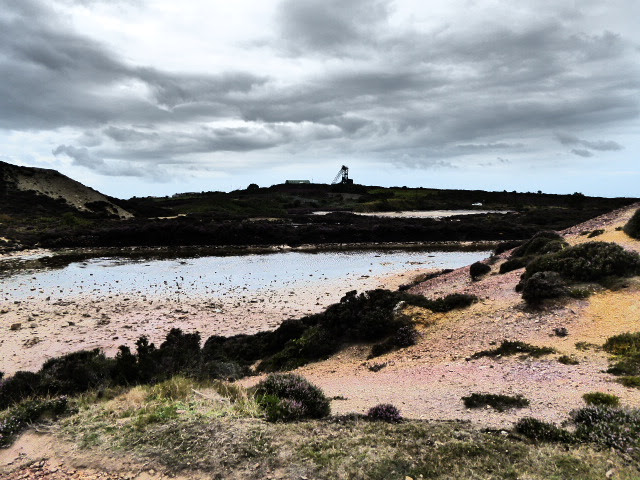
What an extraordinary place it is. Its landscape is brutal, ravaged, yet strangely compelling, stained and despoiled by centuries and centuries of mining . The copper ore found there was exploited as long ago as the Bronze Age. The Romans knew it. By the 1780s it was the largest copper mine in Europe, and the ore mined here was used to sheath the wooden hulks of the British Admiralty’s war ships, protecting them from seaweed, barnacles and shipworm. Eventually, as the copper seams became exhausted the site was largely abandoned. An industry that once employed up to 3,000 people was by 1840 giving work to a few men, underpaid, undernourished and ravaged by typhus. The site is stained by leaching ores and acids and pools of chemical waters. A few grittily determined plants make their home here.
There’s still copper . They’ve recently discovered zinc, lead, silver and gold. Work at this extraordinary place continues.
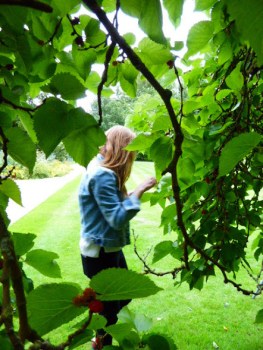
My morning sortie to gather a bowlful of mulberries for breakfast (actually, forget the bowl. Mulberries go directly to mouth) has suddenly got much harder. Autumn’s in the air as I traipse across the dewy grass. The mulberries are fewer.
The mulberry tree still bears fruit.
This isn’t just the fault of the weather. We have some new residents in the garden. A family of moorhens: mum, dad, and five chicks. They like mulberries too. The windfalls that used to be mine, all mine, are now theirs, all theirs. But who could begrudge such charming tenants?
Mrs. Moorhen and Number One Chick.
Chicks in a hurry
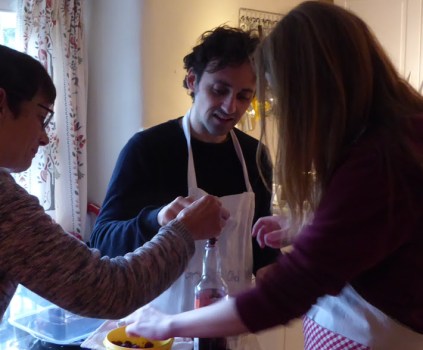
Anyway, I suddenly realised that if we were going to have our much talked-of mulberry gin in time for Christmas, we needed to act. We had a houseful of helpers. Not just Malcolm, but Emily and her boyfriend Miquel, over from Barcelona.
Out came the bowls. Out came the small steps. Out came the team. We stripped the tree of any berries that were ripe enough to fall into our hands, as the moorhen chicks cheeped and protested from their lair in the flowerbed.
Emily concentrates on the task in hand.
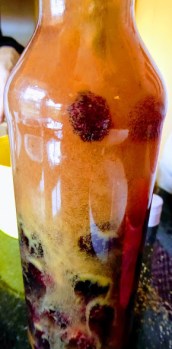
The rest was easy. Wash the berries. Half fill an empty bottle with gin. Poke berries into bottle. Add sugar. Argue about whether to follow the recipe that suggests adding a handful of roasted almonds or not. Decide to leave almonds out today, but add them to the next batch. Screw cap on bottle. Shake. Place in cupboard with note to self to shake bottle daily for a couple of weeks, then wait for months. That’s it. Tidy up. Before Christmas we’ll strain off the gin, re-bottle it … and look forward to sampling it on Christmas Day.
How many people does it take to fill a mulberry gin bottle?
Or … if you’re on our Christmas present list, you might get a bottle too.
Last week, we were at the Bowes Museum. This place, with its unusual history and exhilarating present deserves a post all of its own soon.
It happened to be the first day of ‘Turkish Tulips’. This exhibition though, isn’t displayed in a dedicated space in the museum. Instead, the artworks chosen have been sited next to existing displays, situated on a grand staircase, or even smuggled into other exhibitions on display. It’s brilliant. These juxtapositions illuminate both the permanent collection and the works chosen for the exhibition.
Look at this. We found it in a room of paintings largely from the 17th and eighteenth centuries. Well, maybe this photo doesn’t convince, but in real life, in glowing, luminous detail, it did. It’s a Dutch 17th century still life, right?
Five tulips in a Wan-Li vase, Rob and Nick Carter, 2016.
Well, no. It was created not by a Dutchman in the 17th century, but by a British couple, Rob and Nick Carter in 2016. This is no oil painting on board or canvas, but an image on an iPad.
Five tulips in a Wan-Li vase, Rob & Nick Carter 2016.
Five tulips in a Wan-Li vase, Rob & Nick Carter 2016.
Stop. Look. Take your time. Watch as those tulips, with their waxy-textured petals and burnished stems gradually lose their lustre. Their colour fades. The stems become limp. Later still, those once glossy petals take on the texture and appearance of crisp autumn leaves as the exhausted stems slump slowly to the ground. In some 25 minutes you have watched the life and death of a vase of tulips, filmed over a ten day period.
That film might have been speeded up. But we, as viewers were slowed down. And having taken the time to watch this captivating film, we were ready to give other works in the same gallery our fuller attention too.
This is my response to this week’s WordPress photo challenge: textures. As photos, mine don’t really pass muster this week. Taking a photo of an iPad image in a public gallery is not really all that easy though.
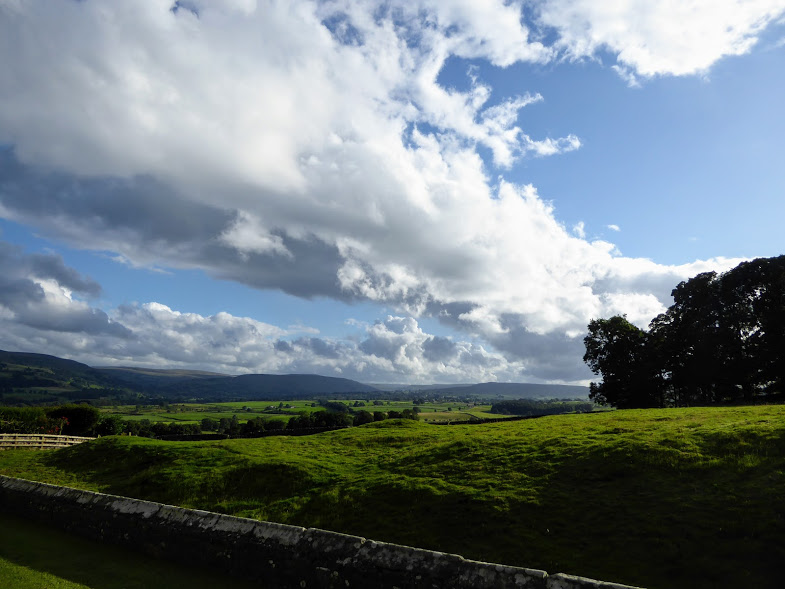
This is the scenery near Leyburn in Wensleydale. This is Bolton Castle.
Bolton Castle, Wensleydale.
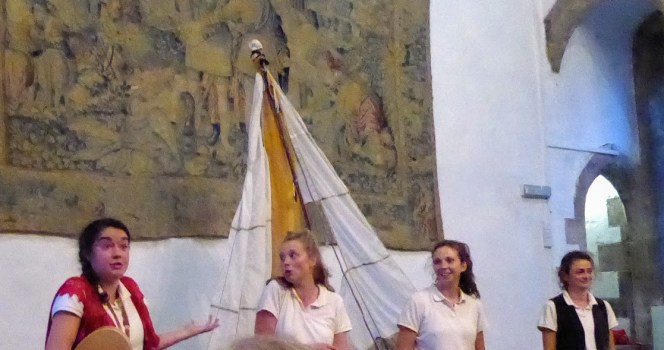
Imagine sitting in the grounds of this 14th century castle as evening draws in, a picnic beside you, to watch The Handlebards’ version of Shakespeare’s ‘As You Like It’. You know this will be no ordinary performance. The Handlebards are four female actors who cycle the length and breadth of the kingdom, with all they need for the tour crammed into two bicycle carriers. At each performance, they take every part in Shakespeare’s comedy of bizarre mistaken identity, family breakdown, love and lust.
So far so good. But this is England in July. We’d had two days of almost incessant rain. In a downpour, the Handlebards cycled the 26 (mainly uphill) miles from Ripon, where they’d performed at the Workhouse Museum.
The Castle has a Great Hall. Performing here rather than on a soggy greensward seemed a better idea in the circumstances. And it was. During the evening it rained. And then rained again. The audience never noticed a thing. We were too busy admiring the way four women became twenty or more people.
A simple, but infinitely adaptable stage set.
To become a man, all they had to do was don a codpiece adorned with a tennis or cricket ball. A selection of hats served to distinguish one character from another. Bicycle handlebars identified the wearers as sheep. Your character needs to disappear stage right to enter stage left as someone else? Easy. Leave the person whom you were addressing in charge of your hat, and s/he will continue to talk to it. With the flourish of a stick, a youth became faithful, ancient Adam. Orlando and his family were all twoubled by an inability to pwonounce the letter ‘r’. And so it went on, as one inventive twist or piece of slapstick followed another. Shakespeare would have loved it.
This is the only photo I have of the Handlebards, and it’s out of focus at that. They take a bow as we give them a more than enthusiastic standing ovation.
I’m now a Handlebards groupie. And the fun doesn’t end here. In other venues, having travelled there on other bicycles, a troupe of male actors is giving similarly irreverent treatment to ‘A Midsummer Night’s Dream’. We’re on the mailing list.
The rain let up a bit in the interval. Here’s the view.
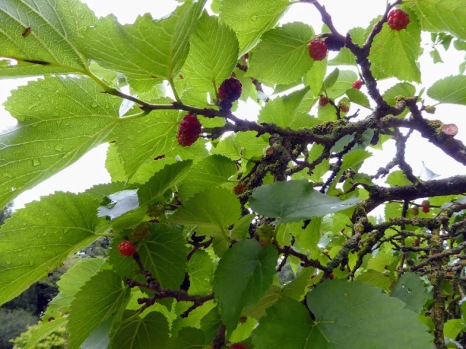
See this tree? I look at it every day, from the study window. As trees go, it’s not so special to look at. But for two months in summer it gives satisfaction to three households, by providing them with mulberries, day after day after day.
Mulberries ripe and under ripe.
Although they grow on trees, mulberries are a bit like loganberries, or a cross between raspberries and blackberries. They’re tart, yet sweet, and very moreish indeed. I can’t pass the tree without scavenging on the lawn for a handful to eat.
Yet another bowlful of mulberries
I collect a dishful every morning to put on my cereal. We add them to summer pudding, to yoghurt, to ice cream. We bake with them. We make syrups, cordials and mulberry gin with them. And the tree goes on and on, producing more and more fruits, every day from July to September.
The birds ignore them. We don’t. Such a satisfying job, collecting our daily ration of free fruit.
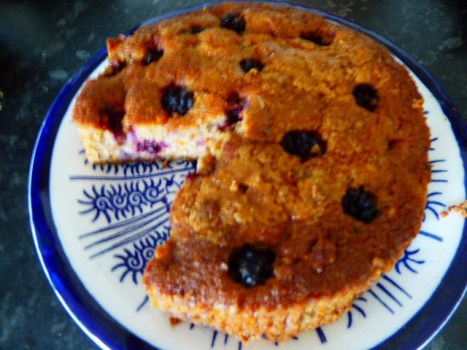
Here’s a recipe I tried out this week. It’s adapted from one of Nigel Slater’s reliably tasty offerings. No mulberries? Poor you. Use raspberries, tayberries, loganberries or blackberries instead. They’ll be good too.
Mulberry and apricot cake
175 g. butter
175 g. golden caster sugar
c. 200 g. apricots
170 g. mulberries
2 eggs
175 g. self-raising flour
100 g. ground nuts – I used a mixture of walnuts and almonds. Hazelnuts are good too.
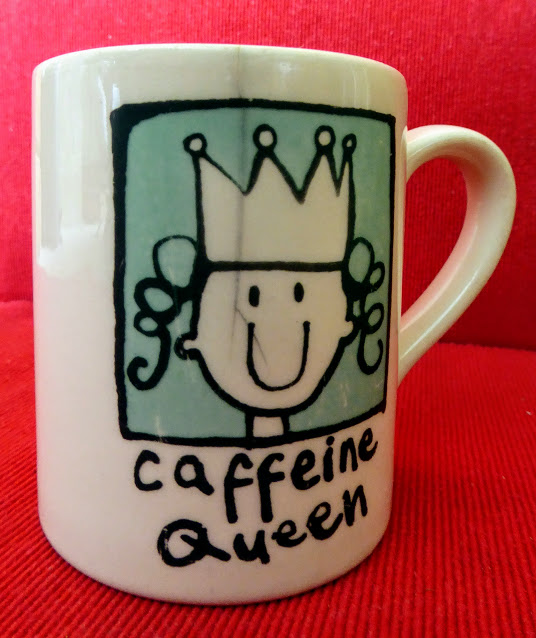
Ellie gave me this mug – oh – more than twenty years ago. Straight away, it appealed to me, though it’s not an item of any refinement. It’s not fine china. It’s not hand made, nor hand painted. Nevertheless, this piece of unremarkable pottery soon became not just another mug, but my Caffeine Queen.
I’m a caffeine queen too. Make me begin the day without a strong shot of coffee inside me and I’ll be simultaneously cranky and listless for hours on end. Caffeine Queen and I are united daily at the breakfast table.
She lived with us in Leeds. She travelled with us when we moved to Harrogate. Then she went to France, and returned to England when we too came back.
Overnight visitors didn’t realise that she was mine, and mine alone. If they chose to drink from her when helping themselves to coffee, or even worse, tea, I’d sulk and fume in silence. Silent, because even I knew I was being ridiculous and unreasonable.
Today though, at breakfast time, I noticed something. A long black crack running straight down Caffeine Queen’s head.
I’ve drunk from her for the very last time. If I fill her with hot coffee she may shatter and break beyond repair. If I’m careful, she may see out her days – and mine – in a new role as my favourite pencil pot.
As far as blogging goes, I’m still in Barcelona: though in reality I’m snuggled in a cosy jumper looking upwards as a grey sky turns greyer.
In Barcelona, we visited the Monasterio de Pedralbes. It’s not actually a monastery, because no monk has ever lived there. It’s a priory, built in 1326 by King James of Aragon for his wife Elisenda de Montcada, who wished to found a community of Poor Clares there. Poor Clares? These are nuns who devote themselves to a life of simplicity and prayer, and in Elisenda’s time were almost always drawn from the ranks of the aristocracy. She herself never became a nun, but she was very real presence in the life of this community.
And what a fine place it is. A graceful three-storied cloister surrounds a peaceful garden. Here is a fountain, topped off with a rather cheeky looking angel. This is where the nuns would wash their hands before dining in silence in the refectory, while devotional works were read to them from a pulpit.
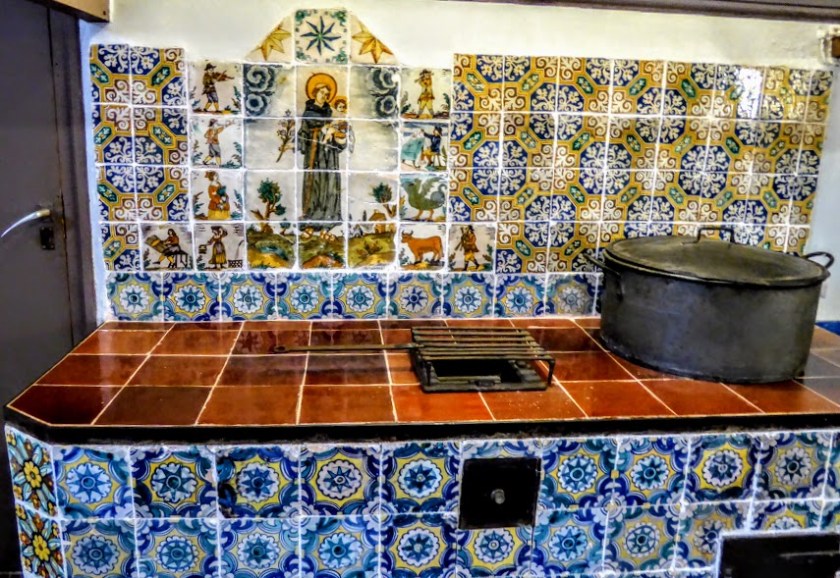
But it’s the kitchen I’d like to show you. In its day, this was a state-of-the-art workroom. Who wouldn’t like to cook at this unusual kitchen range, supervised by Saint Anthony? Look at these fine sinks, dating from about 1520. There are bread ovens, tiled worktops, and it was here that the simple diet of the nuns was prepared: fresh and salted fish, pulses, rice, vegetables and fruit. Meat was reserved for festivities.
Saint Anthony’s range cooker.
A double drainer kitchen sink, without constant running hot water.
This is another of Barcelona’s hardly-discovered treasures. Just a couple of school parties there, and once they’d gone, we had the place almost to ourselves. Put this on your must-visit list too.
Today marks 1172 days since cancer came into our family. 1168 days since my husband and I walked through the doors of this hospital, hand in hand, for the very first time.
Those doors were the last thing my husband saw of the outside world, before being wheeled into an ambulance and brought home to die. He said, at that point, that a bag for life would probably be an unwise investment.
Today, 463 days since my husband died, and 343 days since my own diagnosis, I walk out of the same doors once again, on my own, to the outside world, for what we all hope will be the very last time. To freedom. To our children. To countless more days.
Here, they’ve given me the most precious gift – my life, wrapped up in a metaphorical box with a bow, when my husband couldn’t even begin to pick…
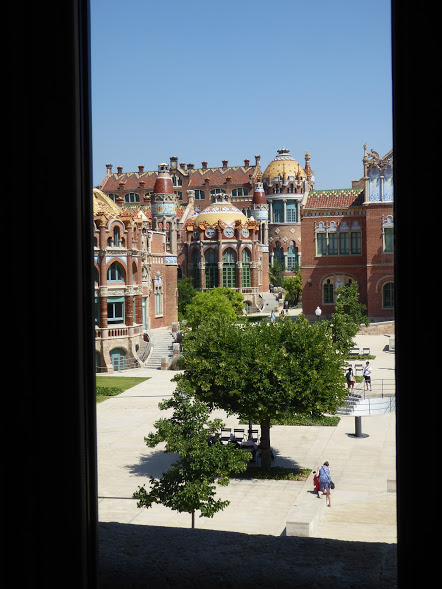
A view of some of the site, glimpsed through one of the windows.
It’s a story that goes back to the 15th century, when Barcelona already had six hospitals. In 1401 these merged onto a new site in Raval, to offer improved care to the sick.
By the 19th century, these facilities were too small, too outdated, no longer really fit for purpose. A Catalan Banker, Pau Gil, put up the money to fund a truly enormous and visionary project: a whole community of buildings offering state-of-the-art care to the poor of the city. The plan was for facilities of the highest quality, designed in cutting-edge modernist style by cutting-edge Modernista architect Lluís Domènech i Montaner.
Modernism? Think of it as Art Nouveau, Catalan style. You’ll recognise it in the works of Antoni Gaudi. Montaner found inspiration from Moorish architecture. Playful looking mosaics and the light-flooded areas are the special feature of his buildings. What we noticed straight away was bold colour, bold decoration: rich-hued tiled roofs: and within, tiles and mosaics in sunny yellow, grass green, sky blue.
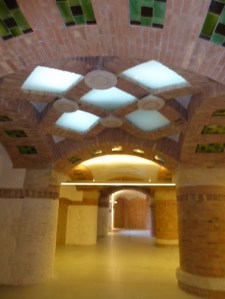
Sun, grass, sky. Why not remind the sick inmates of a cheerful world outside the hospital? Why not have light, airy, high-ceilinged rooms, tiled throughout for ease of cleaning, and because they would never become dingy and faded? Why not build underground tunnels, tiled in cream, so that patients could be moved round the site without being exposed to the elements? Why not build a decent well-lit operating theatre, well-stocked libraries for doctors to consult, and set all these buildings among gardens which patients and staff alike could enjoy?
Underground walkways between the hospital buildings.
This was a Christian foundation. Nuns provided nursing care until the 1990s, as they had done since the hospital’s earliest years Mosaics in the building told stories from the Christian tradition, such as that of Saint George slaying the dragon. Other carvings and statues relied on ancient legends. This frog nursing a baby frog, for example, is an old symbol of caring love.
Originally, men and women were separated, but later, the hospital was organised by specialism. Now, although research continues here, modern buildings behind continue the work of the hospital.
A women’s ward in the hospital, 1920s.
The foundation stone was laid in 1902, and facilities were developed until about 1930. Large parts of the site were never built at all, from lack of funds. This isn’t surprising. There is nothing of the workhouse about this place. It’s a beautiful, special site, fully deserving of its UNESCO World Heritage status, acquired in 1997. It only opened its doors to visitors a few years ago, and it’s not yet truly on the tourist trail, despite being just up the road from then Sagrada Familia which is always surrounded by hordes of tourists. Visit it now, while it’s still an oasis of calm. It’ll be somewhere you’ll remember forever.
I’d intended to go into the story of this place in more detail. But a fellow blogger, Restless Jo, whom I ‘met’ only recently, introduced me to a series of posts by a blogging friend of hers, Jude. Here’s a link to the first one, from which you can reach all the rest. She tells and illustrates the history of this place so well that, quite simply, I don’t have to.
Yesterday, we left Barcelona. As we walked from our hotel to the metro station down a quiet calle, we noticed these accidental collages: walls whose damaged plaster work revealed the original brick beneath; damaged multi-surfaced walls where graffiti had been added; brick walls juxtaposed with stonework, with decorated tile work, or with handsome brick decoration; a nursery school whose facade had been decorated with a festive collage of coloured streamers and children’s drawings.
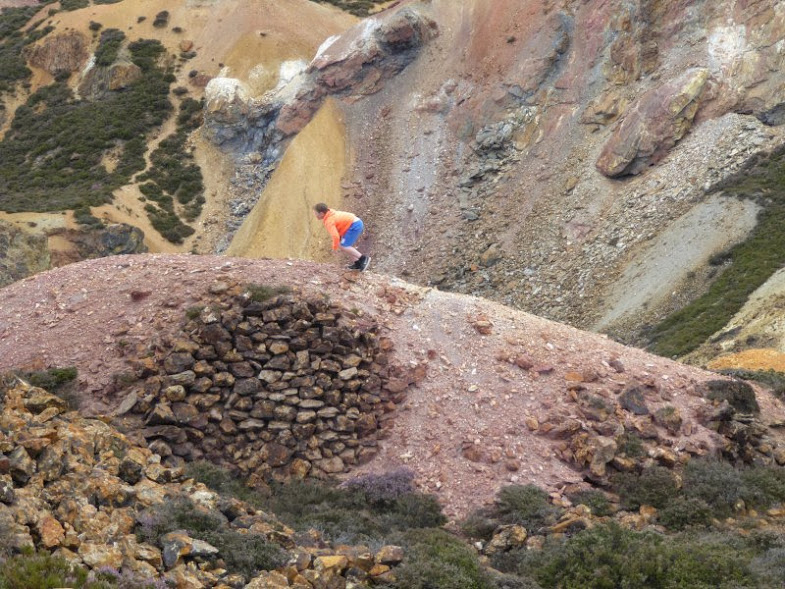 As soon as I saw that this week’s WordPress Photo Challenge was ‘elemental’, my mind flew back exactly a year. This was when we were in Anglesey for a week with the boys. This was when we visted Parys Mountain.












You must be logged in to post a comment.