An apology

This blogging from Korea malarkey is turning into a nightmare. Posts get published, or not, according to the whim of who-knows-who? Photos are worse. Sometimes they appear, sometimes they vanish, then reappear, from an already-published post. Facebook users have the added joy of seeing the same pictures of the Ariège every time one of my posts appears.

It was never supposed to be this stressful.

So pictures I’d like you to see will appear, but back in England, when I shan’t have to contend with a not-so-very smartphone.

Bulguk-sa. A suitable twinning with Fountains Abbey and Studley Royal?

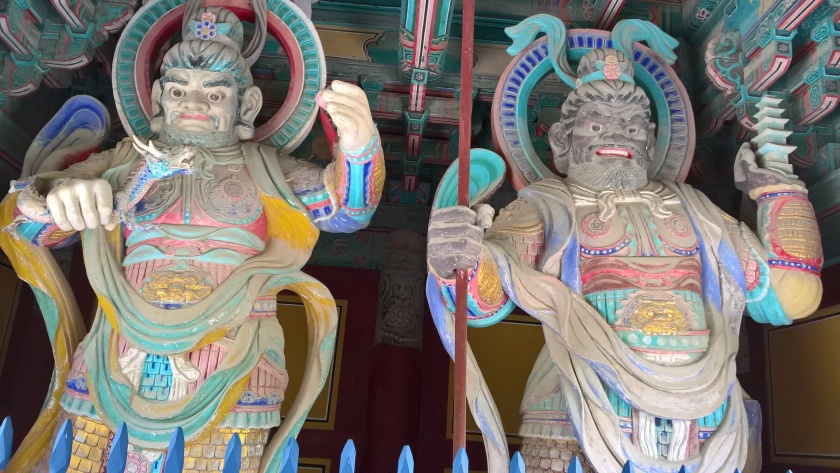
WP_20160928_10_13_45_Pro_LI.jpgWe went to one of the oldest surviving Buddhist monasteries in Korea today, Bulguk-sa. Like Fountains Abbey, it’s a UNESCO World Heritage site. It’s been around about 250 years longer than Fountains, as it was started in the year 751.

Both are religious foundations. But whilst the monks were forced to leave Fountains Abbey on the Dissolution of the Monasteries in 1539, Bulguk-sa is still an active religious community. We were moved this morning by witnessing a solitary monk chanting his devotions in one of the buildings.

Both suffered the destruction of their buildings. Bulguk-sa, like so much of Korea’s heritage, was burned by Japanese invaders in the 1590s. Fountains Abbey crumbled following the Dissolution at much the same time.

Fountains Abbey remains a ruin. Bulguk-sa has been rebuilt. The Japanese destroyed Korea’s heritage so often and so comprehensively over the years that if significant buildings were not restored there would be, quite simply, nothing left.

So I think a twinning arrangement is in order. Exchange visits once a year as a minimum. Though with genuine Buddhist monks to welcome us at Bulguk-sa, I wouldn’t turn up in my polyester dressing-up robes from Fountains Abbey.

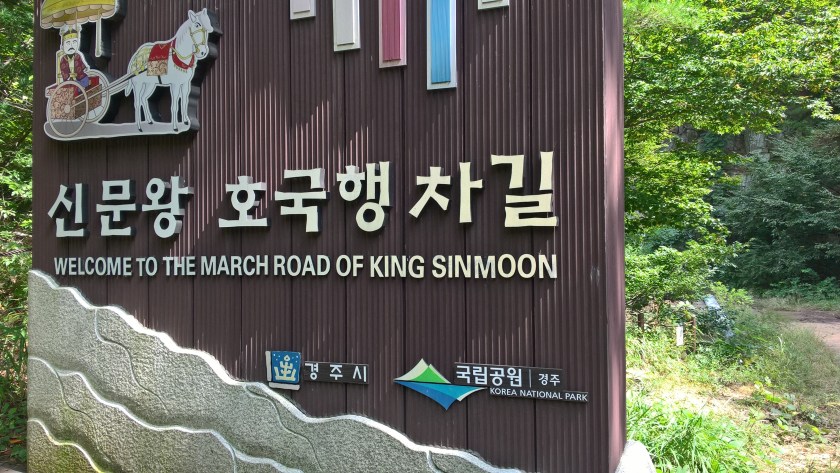
The March Road of King Sinmoon

WP_20160927_12_35_12_Pro_LI.jpg

That’s what we walked today. The signboard in Gyeongju National Park told us so. But that was the only bit in English, and Google is not being helpful.

On the signboard, the king is in a chariot. We couldn’t see that working. We were up and down hill on a woodland walk that closely resembled one we might have had in the Ariège, or England, or …. lots of places. Rocky, stony, full of little streams and trees, trees, trees.

Except… there were dozens of little acid-green frogs darting ahead of us as we crossed the streams. Chipmunks zoomed up and down trees. I saw a sinuous and speedy watersnake

And we sweated. How we sweated. We only walked eight km.there and back from the Yongyeonpokpo Falls, which are not in anyone’s Top Ten ‘must see’ waterfalls, though they’re nicely restful. And we were soaked. And utterly exhausted.

Next time we’ll emulate King Sinmoon and take a chariot.

Our rural retreat.

I’ve messed up. After Busan, we chose Gyeonju, a city so rich in history it’s known as ‘the museum without walls’. I booked us in at a guest house, as I thought, just beyond the edge of the town.

Our hosts kindly came to collect us from the bus station. We left town. We left out-of-town trading estates. We left any form of housing. We left the main road. We started to climb. We saw a sign ‘Gyeonju National Park’. Still we travelled.

And after thirty five minutes we pulled in here. We’re surrounded by forested mountains, by bubbling streams, by tiny smallholdings set into the valleys. There are cicadas, songbirds, slightly officious magpies. There are frogs and fish in the pond, and red and blue dragonflies. There are even some adorable kittens.

Do you really think I’ve messed up?

How to be a Korean woman

You’re young, female and Korean. Perhaps you’re a student, a worker, even a mother. You’re slim, stylish, beautiful, have enviably flawless skin, and shiny long dark hair. Just like all your friends.

One night however, you go to bed, and you wake up in the morning as an ‘ajumma’, an auntie, an older woman. You’ve shrunk four inches, your hair is shorter, perhaps even curly. You’ll put on nice comfy trousers and no longer remain silent on bus rides. Most importantly, you’ll wear your badge of office. This is a quite enormous visor, worn to protect your skin from damaging rays from the sun. You won’t go out without one.

There is no half way house that I can see. You’re young. Or you’re an ajumma. That’s it.

Gamcheondong – culture village

You’ve seen post after post showing urban Korea to be home to the high-rise. Often it is. But not always. Gamcheondong in Busan for instance. At the time of the Korean war the little houses clinging to steep hillsides provided safety and refuge. The community was closely-knit over the years, but not prosperous.

In the early years of this century, the area started to become something of an arty community. Murals appeared, galleries, quirky touches of all kinds. Now the narrow streets and winding alleyways are a tourist destination. Today, we joined those tourists.

In which we are VIPs.

Emily came to Korea to teach. She’s at an Elementary school – children up to thirteen. And today, the Principal invited us to look round.

What a day. We were welcomed like royalty with elegantly presented ginseng tea and dainty fruit slices. We looked round the spacious, clean and orderly building where 360 children study.

We saw the classrooms, the well-stocked library, the science labs, the music and art area, the counselling room, the resources area, the sanatorium, the English room, the school broadcasting area, the after-school club rooms, the spacious kindergarten, the staff work rooms … and then the dining room, where we had school dinner, and jolly good it was.

After, we saw the playground, the garden and the sports pitches. We were beyond impressed.

The children were excited to see us, and there were welcome notices greeting us everywhere. My pictures of course are child-free, which is a shame. We had a truly special experience. Koreans clearly value education, and are proud to show off their achievements.

Hundreds of fish, thousands of fish, millions and billions and trillions of fish ……

……. are sold almost every day at Korea’s largest fish market at Jagalchi, Busan. Fish so fresh it’s still kept alive in tanks; cured fish; dried fish; seaweeds both fresh and dried; sea foods of every kind.

Two market halls, one with fish restaurants above – they’ll cook the fish you chose in the market below, or serve it raw. Several streets full of vendors. Can there be any fish left in the sea?

A high-ride, a hard yomp, and a moment of peace.

We found ourselves  in a cable car, rising slowly and stately, above the city to the forested mountain above Busan.

Once there, we explored the maze of forest trails. For the first time, my hard-won hangul came in handy. Only a few signposts were translated.

I wanted to visit the Buddhist hermitage of Seokbul-sa

If only I’d known how hard it would be, scrambling down stony forest hillside, then up again. Then down again. Then an endless hairpin-bended track.

It was worth it. Commanding views of the distant mountains; intimate, beautifully painted prayer rooms, and best of all, figures from Buddhist legend carved directly into the rock looming above the hermitage.

I was glad to have made the effort. But it was a very tough walk indeed.

The Igidae trail

Wow! Wow! What a trail to find within the boundaries of Busan, a city of some four million people. The crashing waves brought on by the aftershock of the distant typhoon, the bright sunshine, the blue skies and those striking views made this a very special walk.