We went to Foix today: county town of the Ariège, twinned with Ripon, not that anyone takes any notice of that.
It has a castle- a fairy tale castle if you’re that way out, or the scene of medieval jousting and chivalrous knights if you prefer. It’s a Proper Castle, anyway.
We always enjoy pottering down the city’s narrow little streets, and today these are what we found there…..
Mary Poppins?
Who knows?
…. and beneath our feet ….
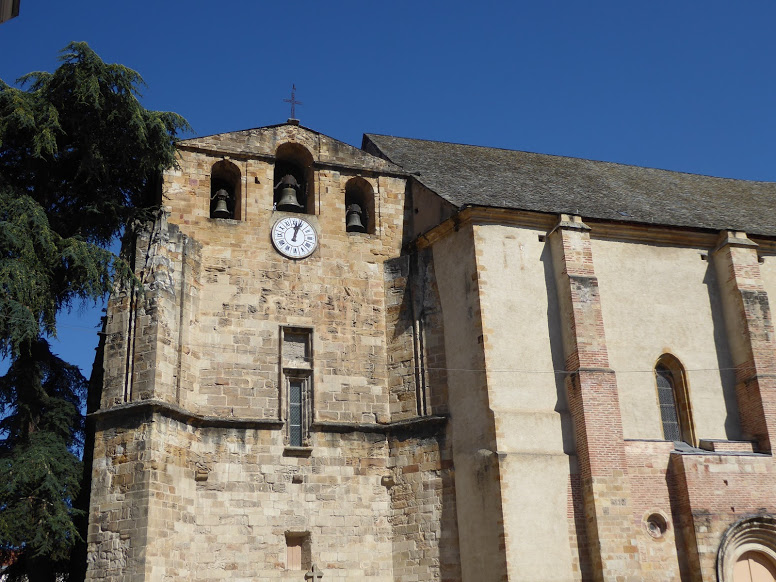
…and later, in the mediaeval abbey church of Saint Volusien…….
The church of Saint Volusien.
And near the altar, marching above our heads….
……these jolly creatures were marching above us, near the high altar.
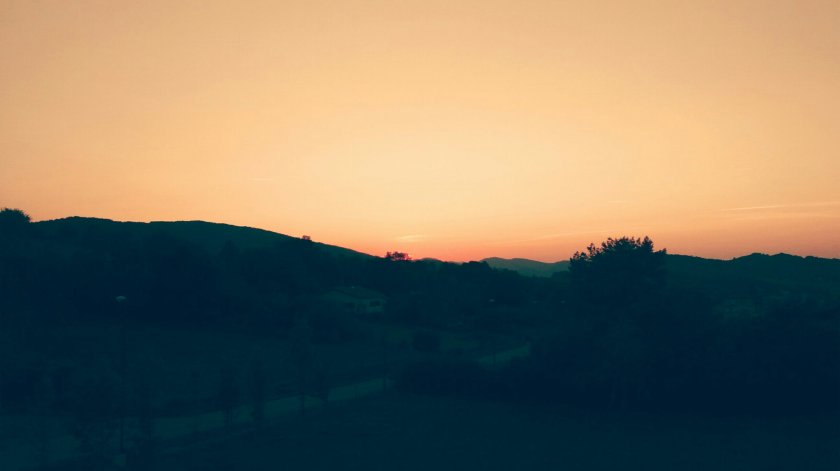
My last post showed a sunrise over Corrèze. This is the sunset from our friends’ house in Laroque d’Olmes. You can’t see the Pyrenees from here, but the foothills, the Plantaurel.
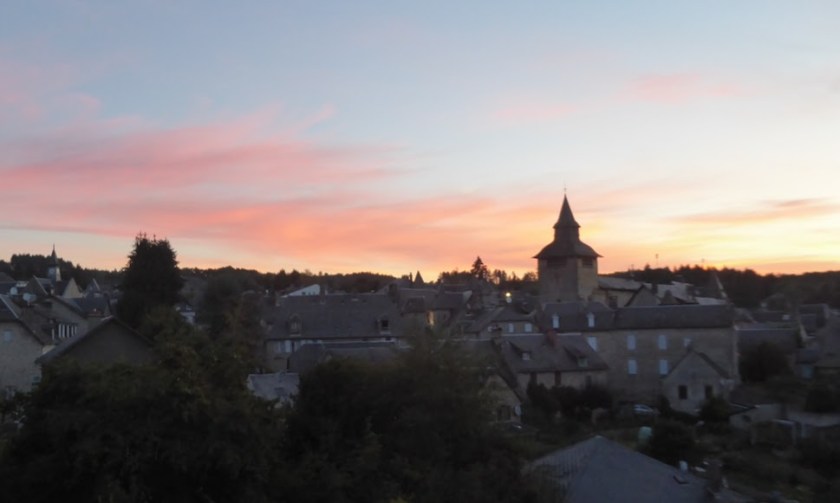
Here’s the view from town.
Lovely as it is to see our friends (five hour lunch, eating, drinking, talking and laughing on a shaded terrace anyone?), Laroque has been a horrible disappointment.
Since we left, quelquespetitscommerces have closed. InterMarché has come to town. And McDonald’s. They’re building a Lidl, so I took a picture of the town through the webbing and netting of the building site. It’s not a small town any more. It’s one of those out-of-town roads lined with out-of-town stores. I’m just glad we no longer live here.
As we say goodbye to Corrèze for now, it seems fitting that the Ragtag word for today is ‘crepuscule‘. It means twilight, and I always thought of it as an evening word. But it can mean dawn as well. So was this photo, taken from Sharon and Andrew’s house, and home to us for a week, taken in the morning or the evening? What’s your guess?
I was going to write a final post from the town, the region where we have been so happy this week, just taking life s-l-o-w-l-y. I’ve decided though to let a few pictures do the talking. Landcapes, townscapes, doors…. whatever took my eye, in no particular order. Best come and visit for yourselves, I think.
Corrèze old town.
Set into a house wall in Corrèze.
The gates into Sharon and Andrew’s property. You can stay here from next year, when all the work is done.
Corrèze old town. Another view.
A cagadour, or latrine at the top of an old house in Corrèze.
We were just getting back from our evening walk with Mortimer. We’d already had a run in with Jacques the donkey. Well, Mortimer had – he doesn’t seem to like him. And now Jacques doesn’t like Mortimer. As you can see.
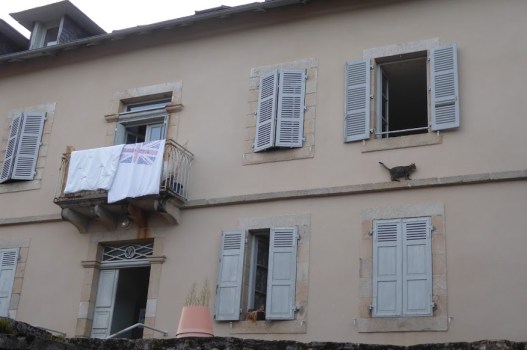
On the home stretch, I glanced up. Look at this cat. Yes, the horizontal band running between the ground and first floors of this building is as narrow as you think it is.
The cat picked its way delicately forward until it came to the corner. Now what? It peered cautiously forward – the next building along was too far away. It peered even more cautiously backwards, and nearly tumbled. It thought hard.
Finally, and with infinite care, it walked, step by anxious step, backwards to the balcony where it had started its unwise adventure. Another cat was hovering there. Cheering? Admonishing? Getting a stiff whisky ready? Who knows.
I don’t think this feline road show will be repeated tomorrow.
And Mortimer? He hadn’t a clue why his evening walk had ground to an abrupt halt for ten minutes or so. Just further evidence that his dog sitters, though amiable enough he supposes, are barking mad.
A spot of history, a spot of lunch, a new village to explore …. had to be done.
Orliac-de-Bar is only a few miles from here. Like so many others in the area, it has a little building, the village oven, built once upon a time to bake the loaves of those villagers who had no oven of their own. These days, when everybody uses the boulangerie or a bread-making machine, they’re generally dusted down and used only on high days and holidays
We arrived as the oven was getting going. As visitors from afar, the organisers seized on us, anxious to show off their little bit of village history. A couple of men thrust bundle after bundle of brushwood into the glowing maw of the oven. When the oven was judged to be hot enough, the woody embers were swept out, and the oven allowed to cool – just a little.
Our new friends popped an ear of wheat into a wooden clasp and introduce it into the heat. It singed. Nope. The oven was still too hot. The wheat should be burnished gold, not burnt. Try again soon…..
The oven…
… the brushwood ….
….the ear of wheat ….
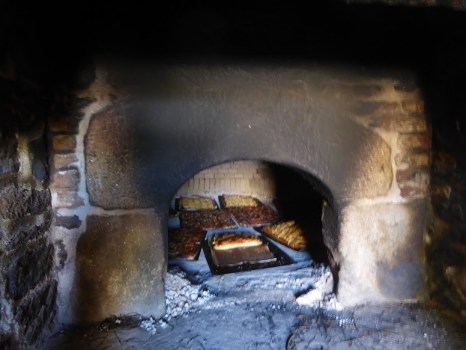
Eventually the oven was pronounced to be not too hot, not too cold, but just right. A small team of villagers jammed pizzas (that well known French country delicacy?) and apple tarts into the oven to be baked.
An oven filled with good things.
Twenty minutes later we were sitting down at long refectory tables arranged in the village square, doing what the French do best: sharing food, wine and conversation. No photos. I was too busy enjoying myself, and never gave it a thought.
Pizz and apple tart.
The village also had an exhibition of aspects of its history. Here are some photos of a not-so-long-departed way of life. I think they need no explanation.
Ploughing with oxen. This photo is in colour, so can’t be so very old.
More ploughing. Love the head gear!
Harvest time.
Doing the wekly wash at the communal lavoir. Many lavoirs are much smarter than this, with stone walls and a pitched roof.
One woman’s spinning wool, another flax; another one is knitting, and the fourth is basket making. Even whilst having a natter, the work must go on.
The family pig, before being slaughtered.
And here are our new-found friends, waving us off after a day well spent.
Goodbye, Orliac-de-Bar!
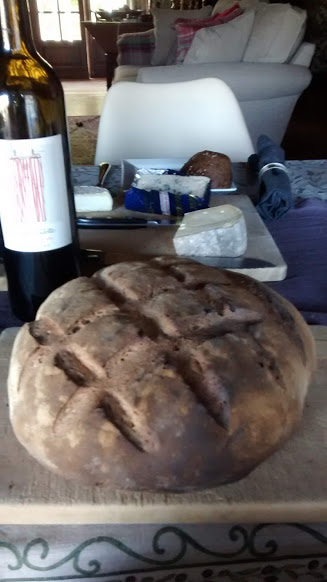
Back at home, we had a fine solid Orliac-baked loaf to accompany our cheese and salad.
Click on any photo to view full size, and see the captions.
Corrèze. It’s a town in the Département de la Corrèze. With a name like that, you’d think it would be Chief Town. But no, that’s Tulle, a city just down the road. Corrèze has fewer than 1200 inhabitants and is reached up a winding forest-flanked road with no dual carriageway in sight. It’s the River Corrèze, flowing through the edge of the town that gives it, and the département, its name .
It’s one of dozens of beautiful and ancient towns and villages in the region, but it hasn’t made the A Team. It’s not been designated one of the most lovely villages in France, and I hope it’s grateful for that. The ones that have, like Collonges-la-Rouge are tourist meccas. Doing a spot of DIY or trying to relax in your garden if you live there must be a real pain, with rubber-neckers down every street and alleyway throughout the summer.
Though it is popular with tourists, it’s not a must-see destination. And yet just look at its historic town centre.
The gate into the historic town centre.
Just inside the gate: the church of Saint Martial.
The town square, glimpsed through the doors of the church.
The Notaire (lawyer)’s place. Built during the Renaissance.
Near the town walls, a couple of houses still have evidence, high up, of the sanitary arrangements….
The old town centre, as seen from Sharon and Andrew’s house.
Who’s this little devil, spotted high up on a house wall?
The town was largely neglected by the big events in history, though the English burned it down in the 100 years war. The French Revolution passed it by, but sadly not the First World War. The town never really recovered from losing 100 of its young men. Its war memorial makes for affecting reading, recording the deaths of two, three, even four young men from the same families.
Part of the memorial to the fallen of WW1.
Just enjoy a few pictures from the old historic centre of this town, which has supplied all our needs all week without our needing to travel further than the country paths surrounding it. There’s far more I could show you. It’s a thoroughly civilised place to be.
Blogging has been an enriching experience for me. It’s made me write, observe, record the moment with my camera. It’s brought me a whole community of blogging ‘friends’ (you know who you are: I love the contact I have with you). And some of those virtual friends have become real friends. There’s Kathryn, who with her husband, has a holiday home in the village near where we lived in France: we’ve seen them both at home and away. There’s Ros, who once contacted me to tell me she enjoyed my posts: she’s been a good friend for several years now.
And there’s Sharon. She started to follow me when we moved to France, because it was her dream too. We’ve returned to England. She and Andrew moved to France just under a year ago, to Corrèze in the Limousin, but we’d already met a couple of times before this. We followed their progress in their new life through their blog, and recently, she announced they needed help. They had to go away for a week or so without their dog Mortimer. Dog sitter required. We applied. We got the job. And here we are.
Corrèze has seduced us completely. Here’s the view of the town from their garden.
Corrèze, as seen from Sharon and Andrew’s garden
I’ll want to share our discovery of this place, settled since the 9th century alongside the River Corrèze. But for now, come with us on our walk with Mortimer on this misty moisty morning (it was 30 degrees yesterday – but that was yesterday) through the quiet countryside. The conditions prevent my showing the gently rising and falling hillsides, thickly forested, with meadows between for the Limousin cattle, so important in the area’s economy. But it’s lovely: relaxing and restorative. Corrèze and its history tomorrow!
I let myself off posting yesterday, Tuesday, because we were concluding a drive all the way from Yorkshire England, to the Limousin, France – all but 800 miles in two days. You’ll hear why in my next post. Just now, I’ll tell you about our Monday stop-over.
Les Hayons is a transport caff in Normandy, pure and simple. We love it. Truckers from all over this part of northern France aim to end their working day here. They’ll have a quick wash, a drink, then head for the restaurant – refectory style tables where they can sit down among old friends and new and talk over the events of their solitary day pounding along the motorway.
I’m justifying an out-of-focus shot by hiding behind data protection. No trucker can be identified I think.
They’ll help themselves from a buffet-style first course, then there’s a choice of about a dozen home-cooked main courses – copious, traditional tasty food washed down with as much wine or cider as you want. After that, a cheese board – local unpasteurised cheeses from the farms down the road, and finally ice cream or some such for pud. The cheery noisy atmosphere, the decently cooked if simple feast puts us in holiday mood every time we eat there.
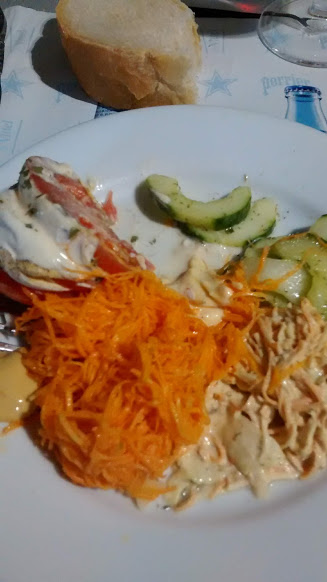
With so much food on offer, it seemed wisest to begin the meal with a simple bright orange carrot salad.
We stayed the night there too. Maybe that wasn’t quite such a good plan. The truckers stay in their well-appointed cabins built into their lorries. The days of their needing a trad. bed in a trad. simple hotel room are over. So, lacking a bed in a truck, we chose their former hotel instead. Which was fine. But though the truckers were all tucked up for 9.00 p.m. or 10.00 p.m. that was because they were ready for the off at 4.30 a.m. or 5.00 a.m.
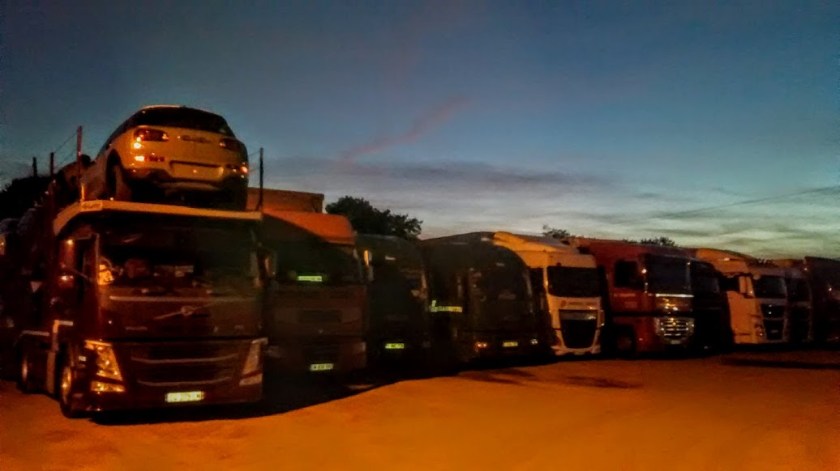
Our alarm call was the sound of revving engines and heavy tyres crunching across gravel. We too were ready to roll at 6.30 a.m. And barely a truck was still there. Look at the scene the evening before. Scores of trucks, neatly lined up in auditorium sized parking lots, protected by the orange glow of sodium lighting.
And we shared breafast in the bar with men in orange: workmen ready to go on shift and face the rigours of the day in their hi-viz clothing. Life at our next destination is very different.
The RDP challenges for Tuesday and Wednesday this week were ‘orange’ and ‘feast’ respectivly. Two birds with one stone.
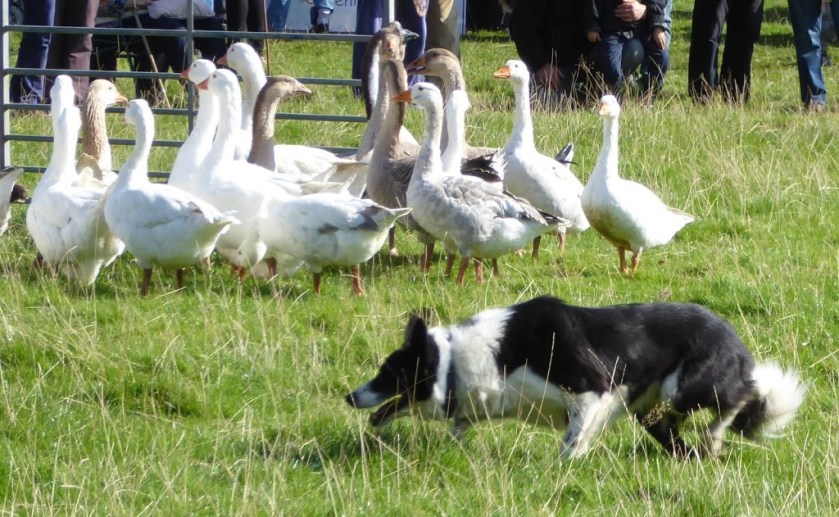
A fortnight ago, I showed you something of the sheepdog trials at Wensleydale Show. It reminded me of Masham Sheep Fair, three years ago. Sheepdogs were demonstrating their skills there too – of course they were. But not with sheep. The creatures they were herding were – geese….
Geese being kept in order by a skillful sheep dog. What a come down.
And here is the post I wrote four years ago about Masham’s annual sheep show:
A sheep is a sheep is a sheep…..
… or not.
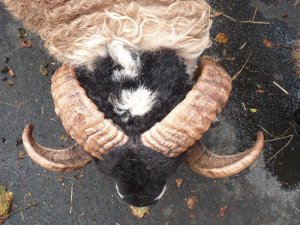
The splendid horns of a Swaledale sheep.
On Saturday we called in, far too briefly, at the annual Masham Sheep Fair. This is the place to go if you believe a sheep looks just like this.
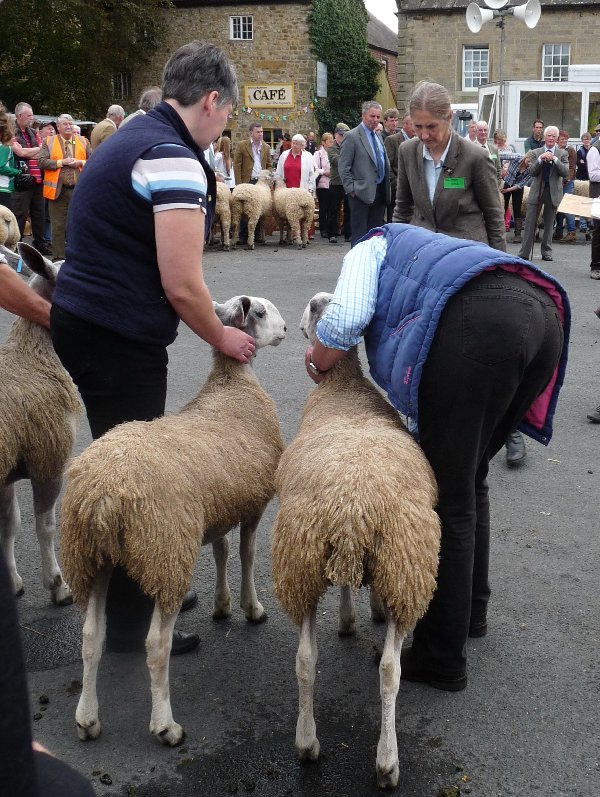
Saturday was the day a whole lot of sheep judging was going on in the market square. Here are a few of the not-at-all identical candidates. And yet they are only a few of the many breeds in England, and in the world. There are 32 distinct breeds commonly seen in different parts of the UK, and many more half-breeds. I was going to identify the ones I’m showing you, but have decided that with one or two exceptions (I know a Swaledale, a Blue-faced Leicester or a Jacobs when I see one), I’d get them wrong. So this is simply a Beauty Pageant for Masham and District sheep.
And if you thought wool was just wool, these pictures may be even more surprising. Who knew that sheep are not simply…. just sheep?



















You must be logged in to post a comment.