Ragtag Tuesday: London calling – an energy give & take

This Country Mouse, this bumpkin, loves a trip to London.  I love visiting my family above all, especially William and little Zoë (who’s doing alright.  She’s been moved from Intensive Care to High Dependency and back to Intensive Care: out of, and now back into an incubator. These set backs are not unexpected in such tiny babies, but the staff are confident that she’s basically doing well. Slowly she’s learning to breastfeed).

Zoë during her brief time out of an incubator.

I love the neighbourhood shopping streets. They’re often, and depressingly, a bit grubby and litter-strewn.  But they’re full of life.  Turkish, Lebanese, Italian, Chinese and East Asian, English, Syrian, French, Ethiopian, Eastern European, Caribbean shops, take-aways and restaurants rub along together.  There are barbers and hairdressers, some specialising in working with the tight curls of the local black population.  They may not open early, but they’re busy until late.  Markets sell fruit and veg. by the bowlful, and the fish stalls are an education in unfamiliar marine life.  No pictures – sorry.  When I take William to the park, I may find myself making common cause with grannies from Poland, France or Thailand.

I love the happenstance of walking the backstreets almost anywhere in central London.  When I have to get to King’s Cross Station, I often get off the tube at some station beforehand and complete my journey on foot.  That’s how I found myself in Smithfield Market, England’s largest wholesale meat market, trading in meat sales as it has been for over 800 years.  Then nearby is the church of Saint Bartholomew the Great.  It ought to be twinned with Fountains Abbey. One was founded in 1123, the other in 1132.

I like exploring the destinations the average tourist doesn’t have time to see.  The Wallace Collection, the Museum of London Docklands, the Wren churches of the City of London.
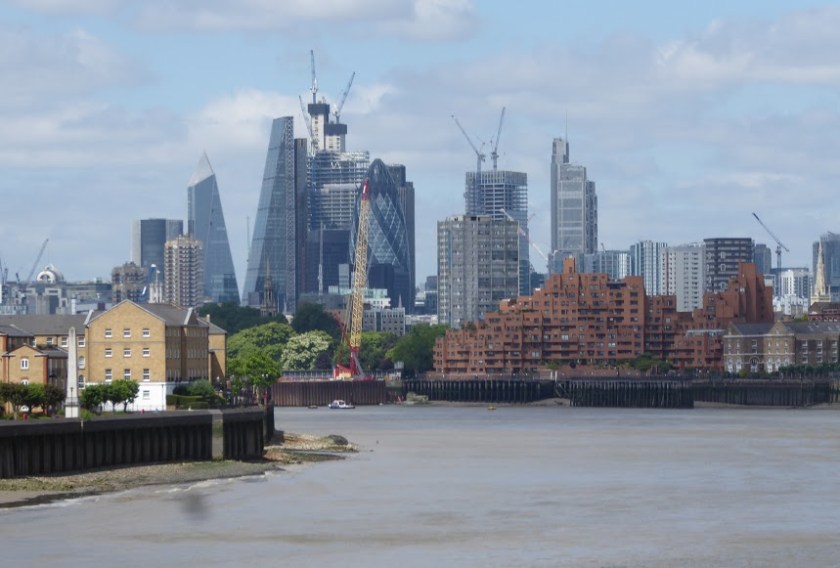
Go to the Museum of London Docklands, to explore London as a sea-trading city from Roman times onwards, and you’re rubbing shoulders with the high-rise financial quarter, seen here from the Thames.

I’m energised by my visits to London.  I love exploring, and discovering London’s secret corners.  It’s an interesting combination.  London gives me renewed energy as willingly as it tires me out.

This week’s Ragtag Challenge is Energy.

The Sainsbury sinkhole

Bang in the centre of Ripon we have a supermarket, Sainsbury’s. Nearly a fortnight ago, when it was full of busy shoppers, it was evacuated. It hasn’t been opened since.

The Sainsbury sinkhole (photo courtesy of StrayFM)

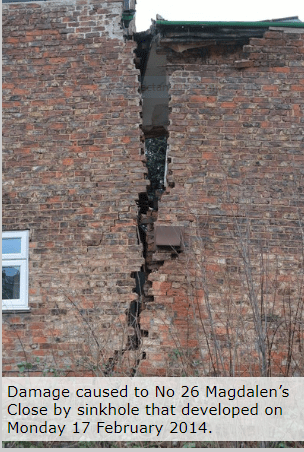
The cause? A sink hole. In Ripon, we know about sink holes, those vast gaping deep holes that suddenly appear, cracking open the surface crust. They cause alarm and distress and considerable damage when they occur. Back in 2014, a couple returning to their house near the town centre found they couldn’t open their back door, heard noises…. and realised the back of their house was collapsing into a hole. It continued to widen, and they and their neighbours were evacuated.

Damage caused by the Magdalen’s Close sinkhole (photo courtesy of British Geological Survey)

The Sainsbury sink hole doesn’t look much. But it’s thought to be 100 feet deep, and is right next to the fire escape. Is this hole the beginning of something bigger? The geologists are on the case.

Gypsum is the problem. Much of Ripon is built over this highly porous rock, and as water from the several rivers near the city run down from the higher ground to the west, it dissolves the rock into a maze of caves whose tracery of walls become ever more precarious. As the surface level of the ground water fluctuates, so does the level of danger caused by the problem. Here’s the story.

It’s all hot news every time it happens. Then most if us forget about it …. till the next time.

Ragtag Tuesday: Wensleydale Show

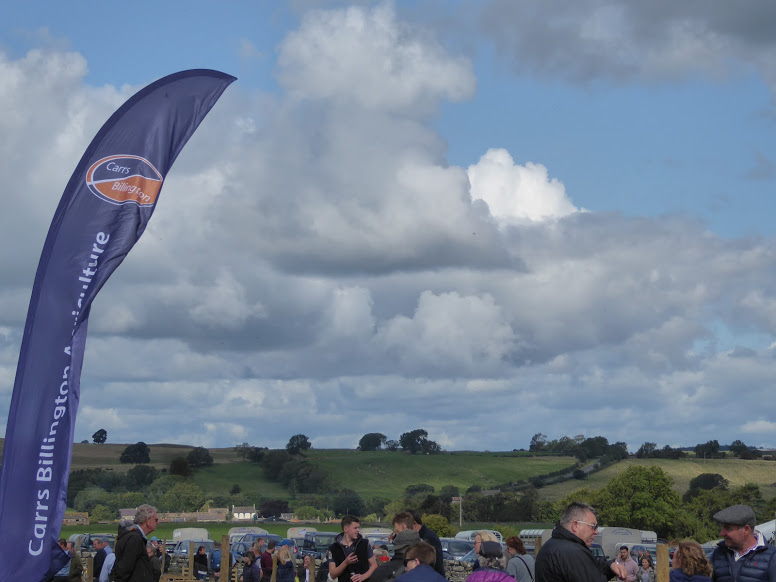
The show at Wensleydale in full swing.

Summer in the countryside is show time. Here in Yorkshire, Harrogate kicks it off in July with The Great Yorkshire Show.  Then week after week until the end of September, villages, towns and whole Dales follow on with theirs.

This is when farmers, breeders, stock men, makers of agricultural machinery and equipment and The Great British Public all get together to celebrate all things rural, and in the case of farmers, normally so isolated in their day-to-day working lives, simply to meet and have a chin-wag.

Emily wanted to take City Boy Miquel to a proper country fair.  So the Wensleydale Show in Leyburn it was.  He saw more sheep and cattle in a single day than he’s probably seen in a lifetime.

We began with the sheep dog trials.  One expert dog, guided by the whistles and calls of its master, has to encourage a small group of sheep down the hill, through a gate, up the hill again and through another gate, round and back again to finish up closeted in a small wooden pen. Those dogs and their shepherds were pretty good.  But from the sheep’s point of view, why go through a gate which has no fence on either side of it?  Why not just go round?  And certainly, why go into a small pen when there’s all that hillside to enjoy?  Fun was had by all but the frustrated shepherds, none of whom completed the course with a full scorecard.  But that didn’t stop them being pretty damn’ good.

Off to inspect the sheep themselves.  Some had dense clouds of thick warm wool, others rangy dreadlocks.  Some had squat round faces, others magisterial aquiline profiles.  Miquel was astonished to find that sheep weren’t simply, well, sheep.

Swaledale sheep.

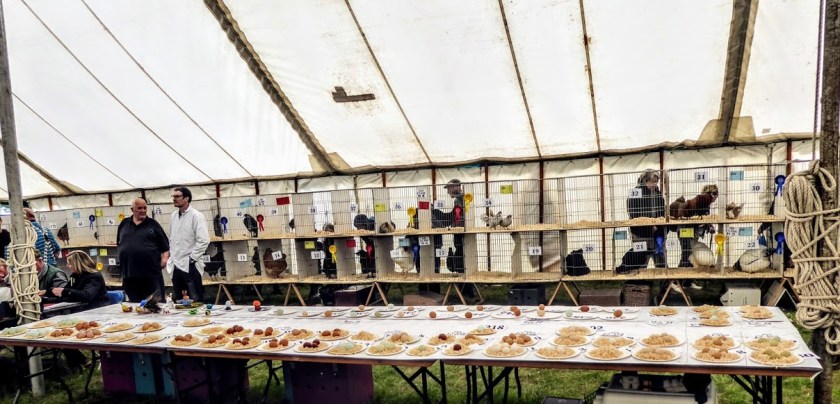
Poultry.  Large hens and ducks, small hens and ducks, sleek hens and ducks, messily-feathered hens and ducks, long scaly legs, short feather-trousered legs. White eggs, brown eggs, blue eggs, speckled eggs …..

Hens, ducks and eggs in the poultry tent.

Cattle with beautiful hides, and bulls looking unusually complacent in this showground setting.

Best of all, a heavy working horse, a Suffolk Punch, just the one, a reminder of what crop farming and ploughing used to involve.  This splendid beast was traditionally tricked up in her party clothes, reminding me of Whit Mondays when I was a child, when the shire horses employed for delivering beer and ale to pubs were dressed in all their finery for this one special day of the year.

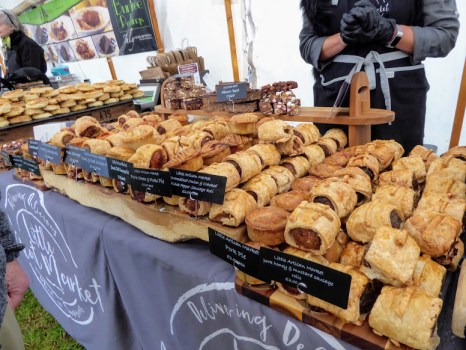
And in among, we watched displays in the show ring, sampled local cheeses and pies, bought decadent and wholly nontraditional treats like gooey chocolate brownies, and generally enjoyed All the Fun of the Fair.

Hungry yet?
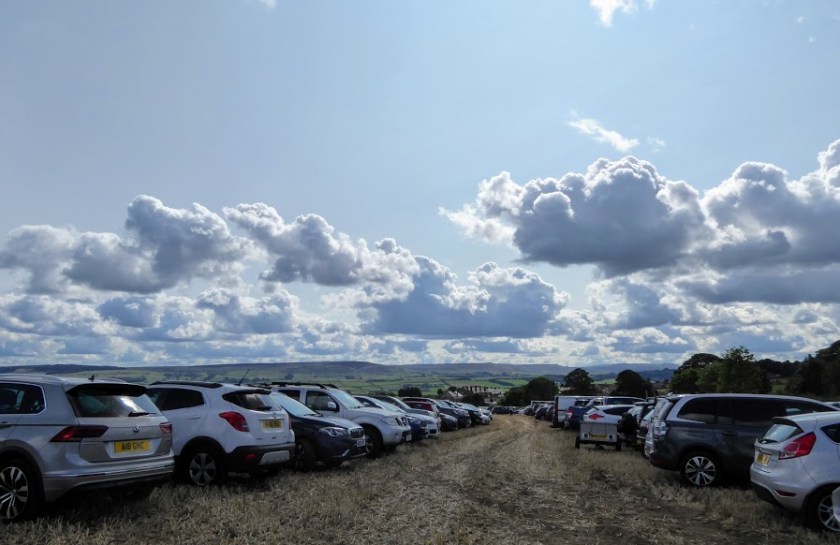
Not a bad view from the car park.

Today’s Ragtag Prompt is ‘Fair’.  Yesterday’s was ‘Coddiwomple’ – to travel purposefully towards a vague destination.  Well, we – Miquel especially – were a bit vague about how we’d spend the day…… until we got there.

Click on any image to see it full size.

A crowd in the countryside

Regular readers know I’m a member of a walking group.  Regular readers don’t know that one of the features of our summer programme is a series of evening pub walks: walks of only three or four miles, finishing up at a pub for a convivial meal or drink together.  Usually about eight to twelve people come along.  This time, it was my turn to lead the walk, which had been publicised round the area in a low-key kind of way.

I’d already been messaged by a Chinese woman who asked if, though they weren’t members of ‘rumbles’, a group of nine of them could come along.  Three other new-to-us people got in touch, and on the night, two other ‘newbies’ were there.  Then there were Emily and Miquel, over from Spain.

The group of nine proved after all to be eleven, and included two small children.  They were an extended family, living in various places all over the north of England, who’d snatched a few precious days staying together at a local campsite.

The usual regulars turned up.  I did a quick head count.  Twenty nine people….

The walk begins……

Have you ever tried getting twenty nine people over several stiles, down narrow paths, along the lakeside, through the woods, across the fields, down the road and back through the Nature Reserve without losing anyone en route?  Actually, because of the small children, the Chinese team left us at half time, but we had fun making new friends and promising to try out the restaurant that one branch of the family runs, many miles north from here.

Sunset over the lake at the Nature Reserve.

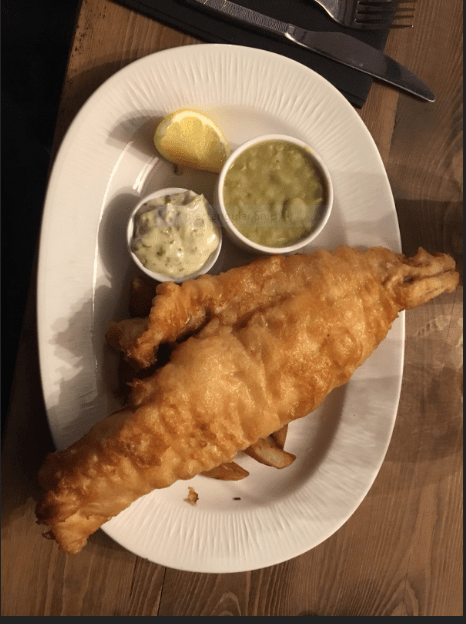
The pub coped admirably.  In fact only twelve of us chose to eat there, though most of the others stayed for a drink.  Here’s free publicity for The Freemason’s Arms, Nosterfield.  Great home-cooked food (try the fish and chips if you dare.  Massive), provided by a friendly, unflappable team.

Photo courtesy of Miquel, who was almost, but not quite, defeated by this plateful.

Ragtag Tuesday: Thirsk goes yarn bombing

‘Yarn bombing is a type of graffiti or street art that employs colourful displays of knitted or crocheted yarn or fibre rather than paint or chalk. It is also called yarn storming, guerrilla knitting, kniffiti, urban knitting, or graffiti knitting.’ Wikipedia

Thirsk has adopted yarn bombing in a big way.  It’s the town where I first came across it, at Remembrance tide two years ago.  St. Mary’s church was festooned – drowned almost – in a sea of poppies knitted by keen volunteers from miles around.  It was a arresting, beautiful, and had the effect they were seeking.  As we paused to look and admire, we did indeed remember the fallen of the two World Wars.

A display of knitted poppies by Thirsk Yarn Bombers at St Mary’s Church, Thirsk (Photo: Northern Echo)

This year, Thirsk asks us to remember the NHS (National Health Service), now 70 years old.  Various knitted offerings are clustered in the Market Square.  It’s witty, charming, and reminds us all how much almost every one of us is grateful for the NHS and all who work in it.


Today’s Ragtag Challenge is ‘Yarn’

A meadow: a celebration of summer days

The early 1950s were in many ways the fag-end of the war.  I lived in Sandhutton, a little village outside Thirsk, where my mother was head of a two-teacher school.  I was with the under eights, while she taught the nine to fifteen year olds. Few pupils aimed to pass for Grammar when life as a farm labourer awaited.  The school photo confirms my memory. Everything was beige and grey.

Sandhutton School, c.1952, just before I started there as a pupil. My mother is the teacher on the left, and my teacher, Miss Burnett, is on the right.

Sweets were almost unknown, and we were happy to supplement our adequate-but-dull diets by marauding the hedgerows for blackberries and rosehips, or by getting up at four in the morning to go mushrooming on the now-abandoned airfield.

Perhaps that dinginess is why my memory of that meadow is so vivid.  Not far from our house, it was where we’d go sometimes when, during the long school summer break, my mother put together a picnic .  I enjoyed running wild in the fields, while she managed a rare daytime doze in the sunshine. What I remember is flinging myself down in the grasses which then rasped and tickled my bare legs.  I was searching, among the vetch, the buttercups and the poppies for daisies or other small flowers that I could make into a daisy chain. I wasn’t very good at it. The stems would split and mash, and my chain would tumble apart before it had even reached bracelet proportions.

I remember the fuzzing and the droning of the bees and flying things that murmured and hummed about my head; the brief sting of one of the single-minded ants out to seize any of our stray crumbs.  I think back to the vivid colours of the meadow flowers – yellow buttercups and vetch, blue cornflowers, white meadowsweet blushing faintly pink or yellow, and the delicate papery petals of scarlet poppies.  It smelt – well,  green – and wafting from the next field was the sappy smell of recently cut hay. In the early afternoon there were no birds singing. Instead, the whirring of insect wings, the rumble of a distant tractor.

Directly above, as I lay in the grass, were no threatening clouds at all – of course there weren’t – just puffs of white cumulus, or ethereal streaks of cirrus in the perfectly blue sky.  

Distance lends enchantment to the view.  But it really was like that.

This miscellany of photos doesn’t come from Sandhutton at all, but from bits of North Yorkshire, from Shopshire, from Franconia …. anywhere that has a meadow.  Click on any image to see it full size.

Ragtag Tuesday: Blue light

If you saw my post at the weekend, you’ll know my head and my heart are just in one place: thinking of little Zoë, one week old today and doing well: her mum has been allowed home, so that’s one milestone.  Luckily the hospital is a walkable distance from the family home, so that’s all good.

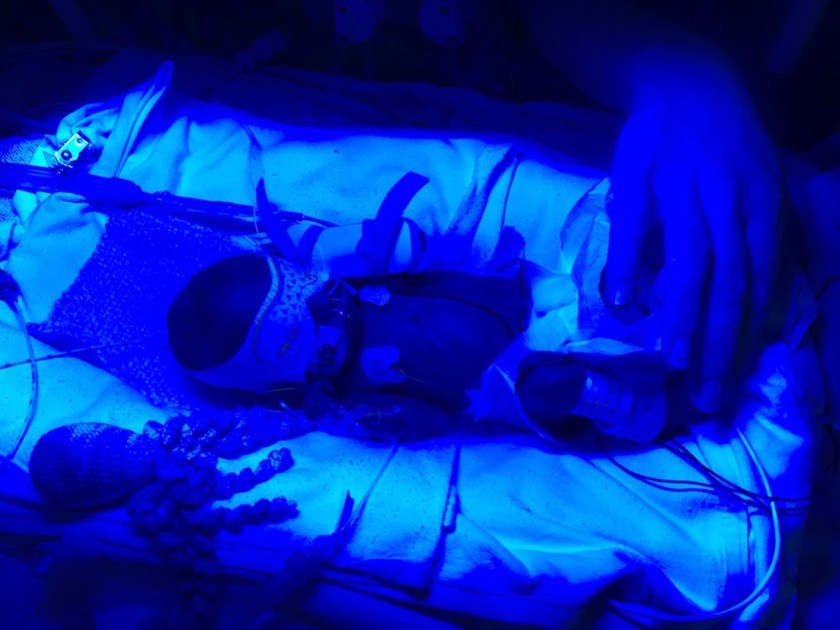
The Ragtag Challenge word today is ‘blue’.  So this gives me a chance to show you William visiting his new little sister as she experiences life under an UV lamp: all good for clearing up the jaundice that many little babies seem to experience shortly after birth.

William watches Zoë.

And here’s the blue knitted octopus that the nurses gave her to clutch at, as she waves those little arms about. 

She’s doing well, so far.  29 weeks in the making, and she even has some hair.

New life

William’s parents were expecting a baby. We were all looking forward to meeting her sometime in late October. But things suddenly got dramatic, Sarah got whipped into hospital, and the focus changed to keeping Sarah and the baby stable for – please – just a few more weeks. Or failing that, a few more days.

But the baby was born on 7th August, at only 28 weeks old. She weighed 1.19 kg. (that’s 2 lb. 10 oz. in old money). And so far, all is well, with both mother and baby. I went to meet Zoë (for such is the baby’s name) today.

I was a little wary to tell you the truth. What would I feel about this little scrap, wired up and screened from us in her little plastic incubator, surrounded by a phalanx of monitors, recording graphs and banks of numbers?

It was easy. I fell for her, instantly. Those delicate attenuated toes with their tiny nails! Those gently waving arms! Those slowly blinking, unfocussed blue eyes! She’s a proper little person. We can’t wait to get to know her.

And hooray for the NHS. Between Ellie and this little baby, our family has had its money’s worth.

The play’s the thing

Best not go and see the Handlebards.  Not if you’re hungry, anyway.  Here is a theatre troupe who will drink your beer and steal your strawberries all in the name of art.

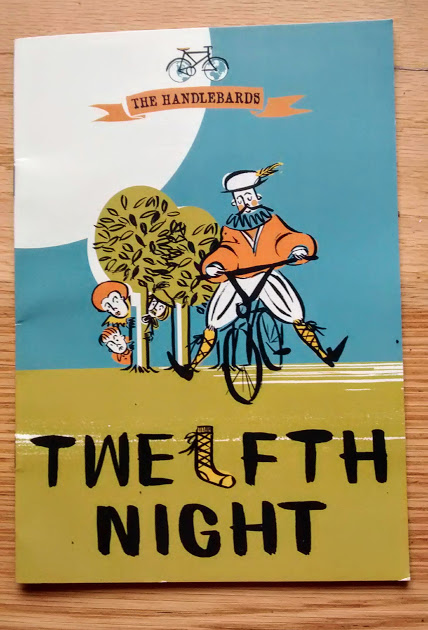
But our date with the Handlebards has been in the diary since February.  Ever since I saw this witty and inventive  lot at Bolton Castle last year I’ve been on their mailing list.  Last year I saw the female troupe.  This year we went to see the men at work. William Shakespeare’s Twelfth Night.  Sixteen characters.  Four actors.  No problem.  Men can multi-task too.

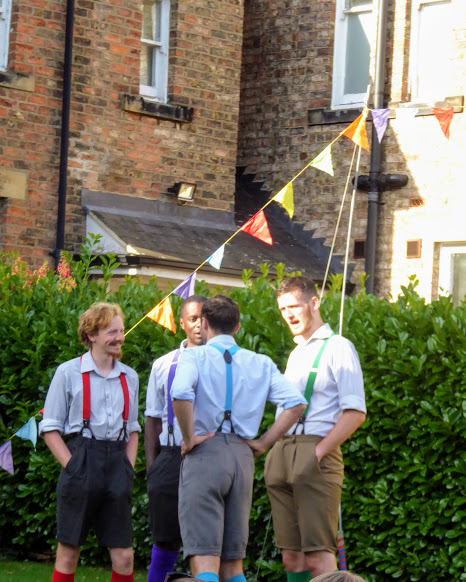
The four Handlebards just before it all began.

And multi-task they did.  The Queen’s English, broad Scots, Northern accents all had their places. Hats, jackets and gilets all stood in for the characters who wore them, but who were temporarily detained in another role.  Balloons barely concealed behind an voluminous white pinny lent girth and a (sort of) female form to Maria, while sporting a little number in prettily sprigged voile enabled us to understand that the (bearded) Olivia was now on stage.

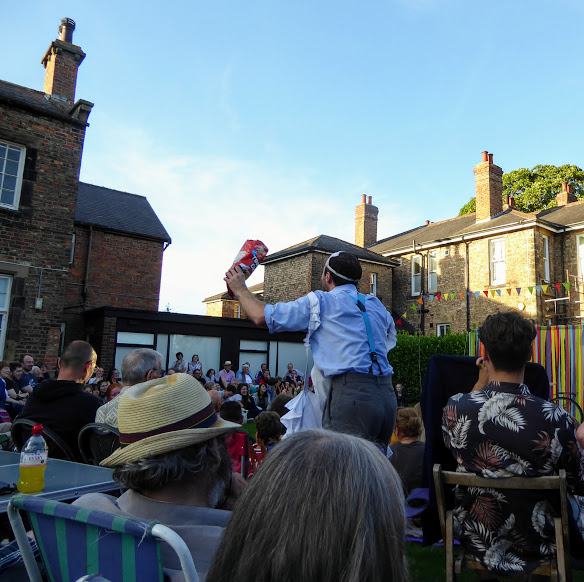
Occasionally audience members were pressed into service.  The cast took any opportunity to help themselves to crisps, wine and cake, legitimising the thefts by working them into the action on stage.  Nobody thus deprived of their picnic minded at all.  Picnic?  Yes, it was a lovely summer’s evening.  We’d all spread ourselves over the lawn of the Ripon Workhouse Museum, armed with blankets, garden chairs and baskets of treats.  Gruel was not on the menu.

See what I mean? Who stole the crisps?

It was all a bit exhausting, even for the delighted audience.  How the troupe summon up the energy  to cycle off to a new venue day after day is beyond me.  But that’s what they do, up and down the length of the kingdom throughout the summer season.  ‘Have bike, will perform’ must be their motto.  Here’s what they say:

Since 2013, the HandleBards have clocked-up over 7000 miles by cycling around the world to perform Shakespeare. Described by none other than Sir Ian McKellen as ‘uproariously funny’, we set the world on wheels with our unique brand of extremely energetic, charmingly chaotic, environmentally friendly cycle-powered theatre.

We love an adventure.

You really should go and see them after all.  And take a picnic.  A picnic big enough to share.

Tuesday’s Ragtag Challenge is ‘Play’.  I went to the play.  Here’s what I saw.

Nosterfield-on-the-water

Nosterfield

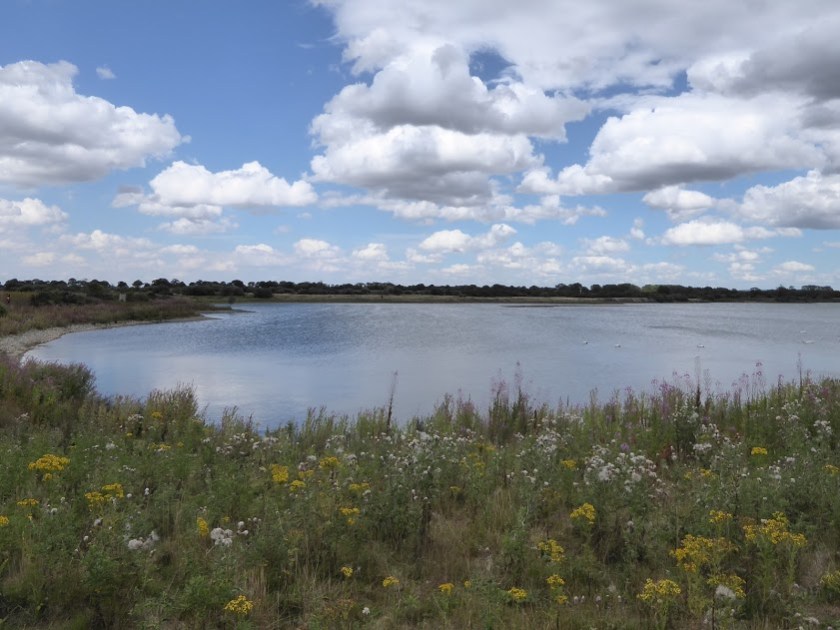
We don’t live near the sea: 61 miles, to be exact.  But sometimes, on a hot day, only a wide expanse of water will fit the bill.  And that’s what Nosterfield, fewer than four miles away can provide. It was – and still is – a gravel quarry.  On any day of the week, you’ll see great yellow trucks lumbering down the road, laden with gravel.  Back before the 1980s, this area was a lunar landscape: sand and gravel pits, gargantuan earthmovers,spoilheaps.  Some of it still is.

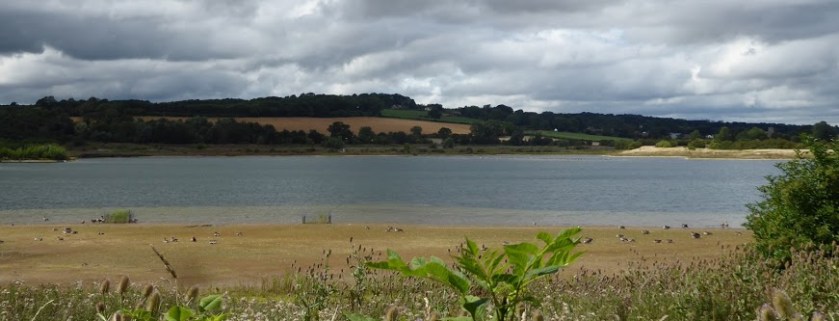
Mid afternoon’s not a busy time for birds: the water level’s low too.

But in the 1990s, a professional landscape architect, Simon Warwick, spotted its potential.  He’d noticed how even as an industrial site, the area attracted thousands of migrating ducks and geese each autumn.  Parts of the site were no longer economically viable and no longer being worked.  Not without considerable difficulty, he established the Lower Ure Conservation Trust, and focused on creating an area of wet grassland, with water attached – sometimes extensive lakes, and at other times drying out into muddy scrapes.  Native flora were allowed to regenerate naturally.

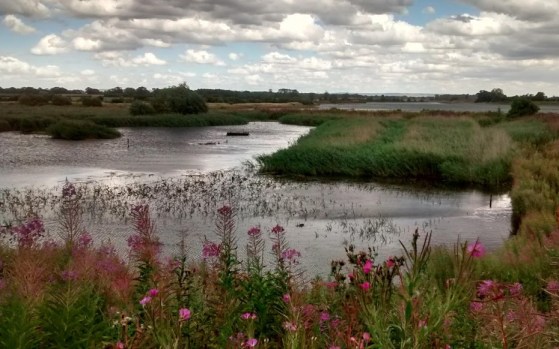
The lakes can be full …..
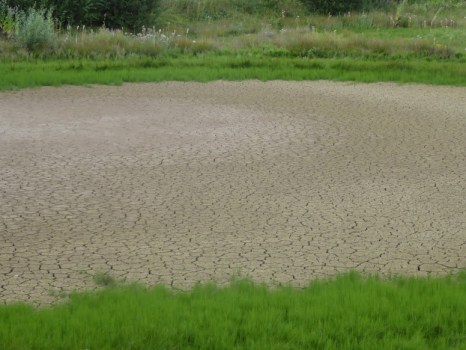
….. or empty.

Wildfowl are delighted.  Wading birds are enchanted.  200 species of bird make use of this service station for birds, halfway between the important migratory staging posts of the Dee Estuary and Teesmouth.  Birdspotters and nature lovers generally love this place, and the well-appointed hides that are a feature of the site are rarely out of use.

If, like us, you’re strictly amateur in your knowledge of birds, you might love it too.  It’s a tranquil place, except when the birds are having spirited and raucous exchanges, and a perfect place to spend an hour or two at any time of year.  But especially on a hot day in summer, with a cooling breeze drifting from the waterside. With wild cherries, apples, plums and blackberries on offer, you’ll even have a snack provided.

Early blackberries near the path.