B****r Chennai!

I was off to Chennai because I’d found a CouchSurfing host – an Indian woman and her husband, not much younger than me. That would be interesting. What an opportunity!  To stay in a real Indian household!

I had no idea what a confusing city Chennai is. It makes Bangalore look like a market town. Busybusybusy with chaotic housing and business districts jumbled together with shanty towns and piles of uncollected rubbish. I thought I’d got used to all that, but this was in a different league, especially after Pondicherry. 

When I arrived chez my prospective host, she told me she didn’t plan to put me up, but had booked me into a local hotel, the only one in the area. I hated it.  The traffic screamed and hooted all night. The shower didn’t work. I had to get up at 2 a.m to ask the manager to turn down his Bollywood DVD he was whiling away the night with, and the traffic and hotel clamour began well before 5.00 a.m., mainly men loudly clearing their throats, spitting and coughing. I stomped round the area looking for another hotel, but there wasn’t one, good, bad or indifferent (indifferent would do).

Some of Chennai’s endless traffic.

Later,  I quite enjoyed being whisked round the city by my CouchSurfing host – highlights were the ancient banyan tree in the Theosophical Society Gardens …

… and sundry Catholic churches pretending to be wedding cakes. Lads on the beach playing cricket.  Though I wasn’t allowed to pick my own photo opportunities. ‘ Here! Take photo here!’

But at the back of my mind all the time, when I wasn’t fighting sleep, was the dread of spending another night at that awful, awful hotel. I was dropped off after our day out at 4.30 and fully intended to take a nap, but clamour prevented it. I gave up and went and rang dozens of hotels – no vacancies. My CouchSurfing host’s plans for the next day included a taxi to Mamallipuram, with, or apparently without her. 

Night came and endless hours of listening to traffic and my fellow guests throat-clearing and spitting. So at 6.30 I got up, wrote and delivered a note to my host, and got a rickshaw to the Bus Stand. Let me tell you it’s not easy when three different people give you three different bus numbers, and three different stops, and the bus destinations are only in Tamil script, but I was determined to get to Mamallapuram good and early, so I coped. Chaotic Chennai traffic eventually gave way to palm trees, lagoons, and views of the sea, Finally I was happy.
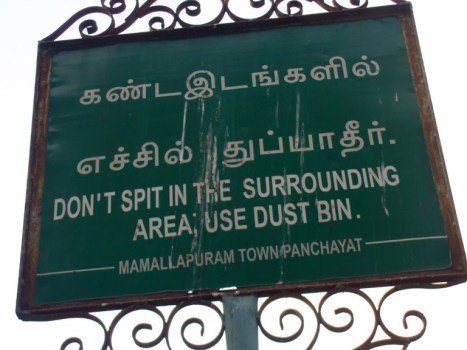
Advice for my fellow hotel guests,but seen in Mammallapuram.

Mamallapuram struck me as a more congenial place to be. It’s a small seaside town, albeit touristy, With Added Culture. It’s a World Heritage Site with fantastic temple architecture and sculpture which I’ll share images of in my next post.

Walking down the street, I suddenly thought ‘I don’t HAVE to go back to Chennai tonight’. The first hotel I called at had a room, monastically simple, but clean. Outside my room was a shady courtyard, and as I started to talk about Chennai to the American tourist relaxing there, I just burst into tears. I didn’t know just how badly the noise and exhaustion had been affecting me, but I DID know that a night at the seaside was just what I needed.
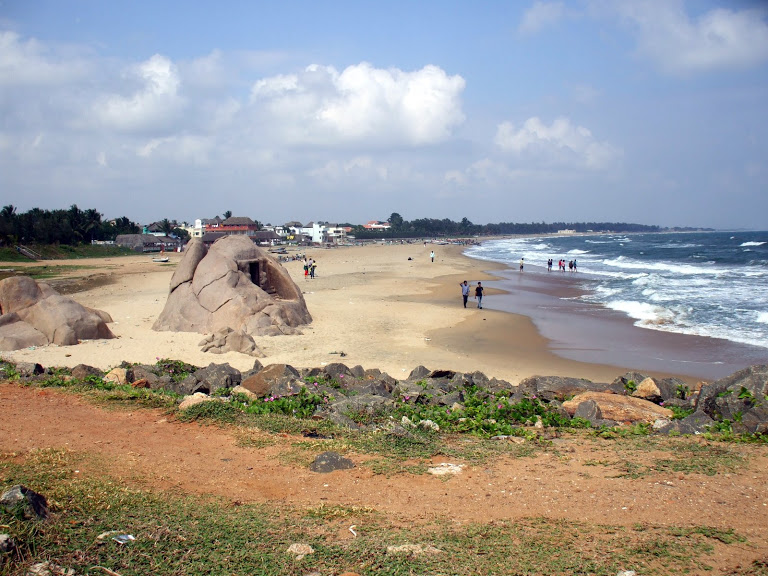
View of Mamallipuram from the Shore Temple

The Post I Prepared to Post……

… before giving you a Bonus Post.

Now it’s Six Word Saturday Two.

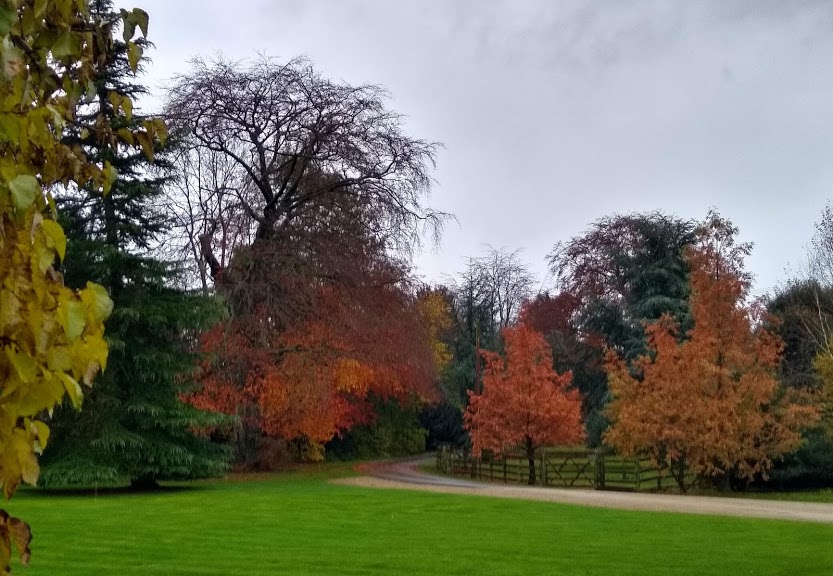
Rainy Ripon’s Festival of Fallen Leaves

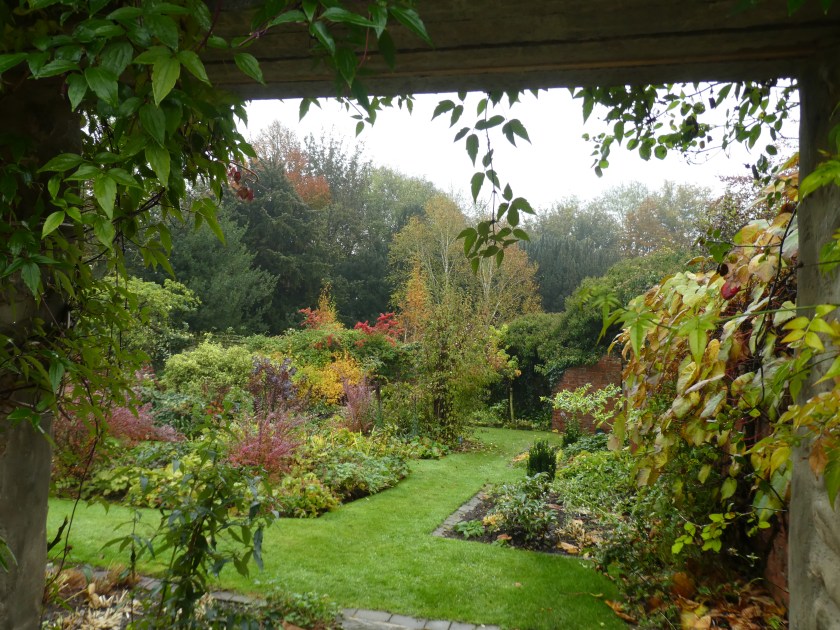
Start in the dripping, glistening garden …

… then go to Ripon – still raining …

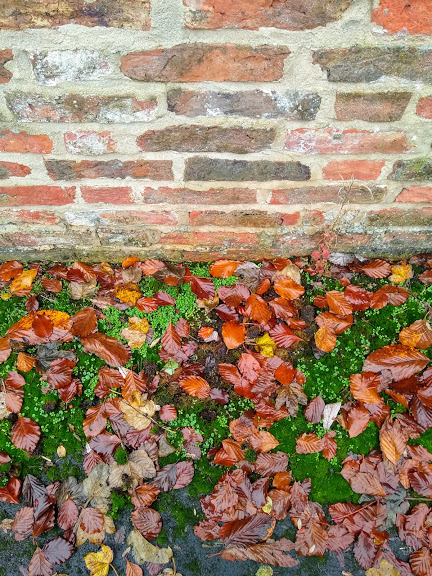
Lustrous leaves shine on the pavement.


These are for two challenges: Six Word Saturday and A Festival of Leaves


Tree House at the Berlin Wall

Today commemorates the Fall of the Berlin Wall in 1989.  You’ll find plenty of posts celebrating this in different ways:  here’s one.

I thought instead I would share a tale I heard when we were in Berlin two years ago.  It’s an optimistic, positive story for unoptimistic times.

September 17th, 2017

The tale of a tree house

I love this story.  I hope you do too.

Quite suddenly and unexpectedly, one night in 1961, Berlin became a divided city. At first there was merely barbed wire fencing, then a wall. It was all done in such a hurry that mistakes were made. One tiny part of Kreuzberg that belonged to the Eastern sector got isolated in the West. The Americans – for it was in their zone – could do nothing about this unremarkable patch. It became an unloved and unlovely rubbish dump.

Then along came Osman Kalin, an immigrant Turk. He wanted a vegetable patch. He cleared the land and started to plant seeds.  As his patch became productive, he gave vegetables to schools, to the local church, to anyone in need. He cobbled together a rather ramshackle tree house.  He became something of a local hero.

Initially, the East didn’t mind. But when East Berliners successfully started to tunnel under his patch and escape he came under suspicion. The authorities came to interrogate him, and he welcomed them in his usual hospitable way. They gave up and left him alone.

In 1989, the Wall fell. A newly united Berlin City Council began to see Osman’s ramshackle domain as an embarrassment. They gave him notice to quit. The local and wider community was horrified. 25,000 people signed a petition demanding he be allowed to go on growing his vegetables.

He stayed. He’s 95 now, and doesn’t work so much on his vegetable patch, though his son does. He lives in a flat nearby rather than in the tree house. He’s still a much-loved local hero.

I heard this story on a walking tour offered by Alternative Berlin Tours, led by the remarkable and endlessly interesting Dave. Very highly recommended.

 An entry for Six Word Saturday. In her post, Debbie too has chosen to celebrate the fall of the Berlin Wall

A little bit of France in India: Pondicherry

Pondicherry.  Until 1954, a French Colonial settlement.  I wanted to stay in this most French bit of India, and I wasn’t disappointed.  Only its historic old town built, French style, in a grid pattern retains a Gallic flavour these days, but what fun I had there.

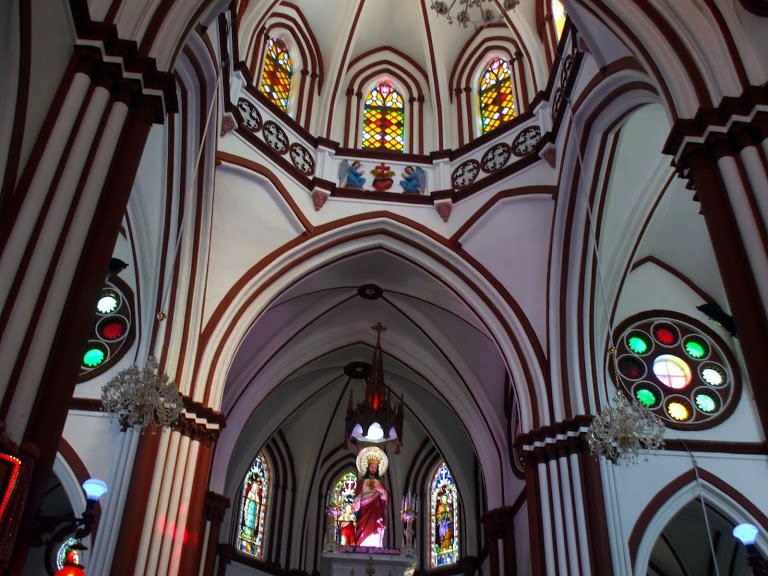
Sacred Heart Church, near where I was staying. A Catholic church in glorious technicolour.

I think Pondicherry remains in my memory as  a haven of peace because -well, it was.  My solo Indian journey was stimulating, exciting, eye -opening: but exhausting.  A solo female traveller had few options for daytime relaxation.  I wasn’t spending my days in tourist Meccas, so there were no coffee shops for me to enjoy simple down-time. Men had their tea shops.  Women – not so much.  Pondicherry provided these, and the shores of the Bay of Bengal. And French patisseries where I discovered the joy of an Indian croissant and a strong shot of coffee as an antidote to spicy fare.  I truly loved my spit-and-sawdust all-you-can-eat-piled-on-a-banana-leaf cafes, but they weren’t places to linger after you’d downed your food.  In Pondicherry I went up-market, without the up-market bills.

I stayed in a hotel called Le Rêve Bleu, and was immediately transported back to the town’s colonial days.  Older staff spoke French, because they would have been taught in French at school.  Sadly, this no longer applies to anyone younger than 55 or so: it’s English now.

Rooms were large and elegantly proportioned, and there was a leafy courtyard.  Christelle, the young and cheerful French owner whizzed me about on her motor bike on shopping sprees to make sure I wasn’t ripped off when choosing the textiles I wanted to take home.  She found me a young local woman who gave me a couple of wonderfully relaxing and rejuvenating massages.  And her male staff cooked up beautifully spicy breakfasts that I ate in that courtyard.  Yet this was a budget hotel.

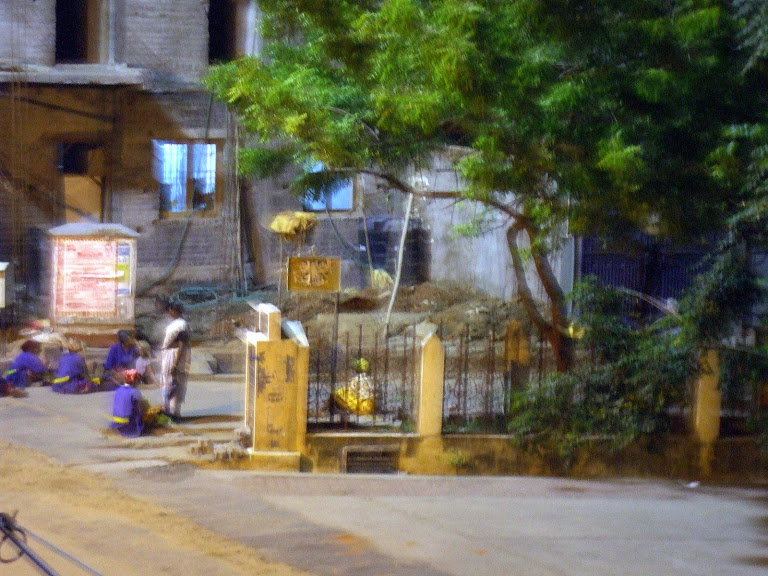
All the same, I didn’t sleep much there.  My room overlooked a quiet road where from midnight, the female street cleaners would get busy.  They spread themselves over several streets, and shouted conversations to each other.  They’d sit down cross legged on the pavement near my window and chatter during their breaks.  I was charmed by them.  Night birds called.  Dogs fought. At 5.30 there was the Call to Prayer.  At 6.30, the (often female) builders showed up at the building site opposite.  Hopeless really.

A fuzzy night photo of the street cleaners sit in the road and have a nice loud chat in the middle of the road outside le Rêve Bleu at midnight.

So I’d get up early and go for a walk along the seafront.  I’d look as the schoolchildren piled into rickshaws or onto the backs of bikes arriving  at school.  I’d smile at the policemen in their fine French kepis, and enjoy passing public buildings still signed in French.

To be continued….

New readers:  This is Chapter Something-or-Other of an occasional series of memories of my month long trip to India in 2007.

November: Depressing? Or with Hidden Gems?

I really don’t like November.  It’s dank, dismal, dreary and depressing, despite being my elder daughter’s birthday month (my Bonfire Night baby).  I need a project to cheer me up.

I’ve found one.  I’ll take at least one photo in the walled garden, every single day throughout the month, come rain, come shine.

Then on Thursday I read Amy’s blog post in which she celebrates the changing season in Yosemite with a glorious gallery of photos.  She’s joined Sue’s blogging challenge called, of course, Changing Seasons.  That seems to be a perfect peg to hang my photos on.

My shots today show the garden on a thoroughly Novemberish sort of Friday: raining, of course.  Later on this month, I’ll post again.  Whatever the weather, I hope it’ll show that even in November, beginning with the final vestiges of summer, and winter setting in towards the end of the month, that the walled garden is a fine place to be.


This is also an entry for Six Word Saturday.

Another India Season: Thanjavur

After I’d left my new English friends to do solo travelling, my first stop was Thanjavur.  I wanted temples in Tamil Nadu, and it seemed to be a toss-up between Thanjavur and Madurai.  Thanjavur won, because I suspected it was less on the tourist trail.

Thanjavur and its Chola Temple at sunset.

In case you don’t know, CouchSurfing is an online community in which travellers offer and make use of hospitality offered. It’s based on the premise that this makes travelling more affordable, but more importantly, gives travellers the opportunity to experience the community they’re visiting at first hand, rather than in the somewhat detached way hotels can offer.

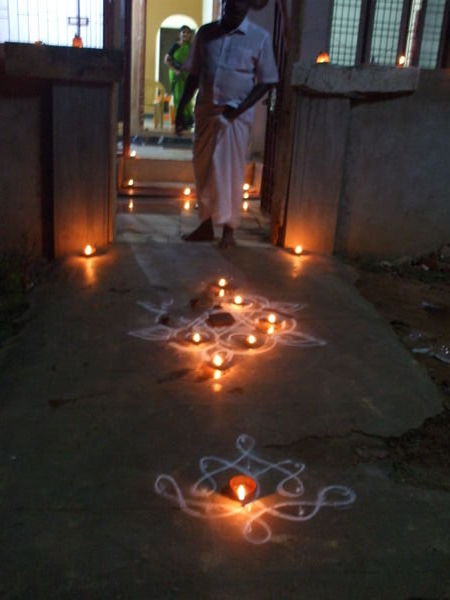
So I stayed with Gwen, an American doing post-graduate research at the University there. We’d exchanged emails over a month or two, and she didn’t feel like a stranger when I met her. She gave me a wonderful welcome and few days with her.  Gwen had made it her business to be part of the community she lived in. She’d learnt fluent Tamil, so had good relationships with her neighbours. So while there, I had the chance to mooch round and enjoy with her the rangoli decorations and lights put out at night for a Hindu Festival of Light (not Diwali, yet another one).

Rangoli decorations lit up in the street at night.

I met the neighbours and was invited into their homes. I narrowly avoided a big faux pas with one household: a young couple, both teaching at the university. Invited to sit down, I nearly plonked myself in the nearest vacant place on a sofa. I recovered myself in time and did not sit, after all,  next to the husband, but squeezed onto the other sofa, with the women. Gwen said it would have seemed very odd to them if I hadn’t remembered in time. We chatted to another neighbour, a Christian, who explained that she liked to keep the Hindu festivals too, and showed us her Hindu decorations taking their place alongside her pictures of the Pope.

I ran errands for Gwen, and in that way had several language-less conversations in the food market, where everyone was keen to shake my hand, because tourists in Thanjavur don’t generally go and buy half a kilo of carrots.

My friends in the market.

We zipped round on her scooter and bought takeaways.  These are known as ‘parcel meals’, and neatly packed up for you in a cotton cloth.  We caught local buses together and visited temples. We had meals, served on a square of banana leaf, in local cafés. I wandered round her neighbourhood when she wasn’t there, and saw a small community going about its day-to-day business.

I was woken in the morning to local sounds: the Muslim Call to Prayer transmitted by loud microphone at, erm, 5.30 a.m. : the church bells ringing a few minutes after that (20 % Muslim and Christian communities here): the street hawkers who kicked in at about 6.45: the day-today noise which seems to begin so early in Indian communities.

View from Gwen’s window. She looks healthy, despite her diet.

And of course it was interesting to talk to Gwen, who knew exactly what I would be finding difficult, and could guess what assumptions I might be making. She gave me the odd Tamil lesson, and more importantly a gesture one (‘Yes’ and ‘No’ are the opposite way round from ours, I learned rather late in the day). She  was much the same age as Tom and Ellie, but that didn’t seem to matter – it didn’t to me, anyway.

I’m ashamed not to be giving you an art history lesson involving all those temples.  Quite simply, I didn’t label my photos well enough.  Instead, I’ll give you a picture-show:  From Thanjavur itself; from the small town of Kumbeshwara which has eighteen temples; from the exquisite temple at Kambakonam; and from Dharasuram.  Sadly, one of my main memories of Dharasuram was the astonishing pain of trying to walk round the site.  One always leaves ones shoes at the entrance to a temple, and the paving stones were fiery hot and  burning.  As usual, no surface remained unadorned, but studying them in detail proved impossible.

Besides the detail of the sculptures, enjoy the temple elephant giving us a blessing, and the bronze worker busy working at the bazaar within the Nageshwara Shiva temple in Kumbeshwara.  Don’t think of these places as simply being lavishly decorated places of worship.  They’re living communities, with bazaars, sometimes cattle and elephants.  Some, such as the Chola Temple at Thanjavur, have inviting grassy spaces.  Bring the family for a picnic!


(Almost) all is safely gathered in…

Regular readers will know I’ve got into the habit, once a month or so, of revisiting an old post. And I’m reminded of what October used to mean in France. Blackberrying’s over now in England (the devil spits on the fruit as soon as October kicks in, didn’t you know?), but my inner-Frenchwoman has been squirreling away scavenged apples, pears, mushrooms – even a few unimpressive walnuts. It all reminds me of France, where foraging is a way of life…

October 25th, 2012

‘All is safely gathered in, ere the winter storms begin’ *

Autumn colours mean it’s harvest time for foragers.

I’ve written before about the ‘au cas où’ bag: the carrier you always have with you on a walk, ‘just in case’ something tasty turns up and demands to be taken home and eaten.

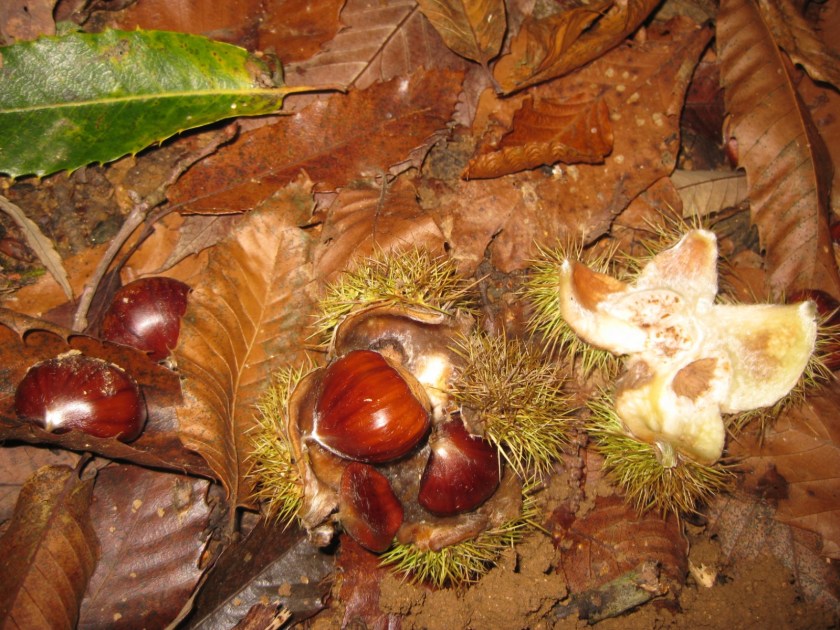
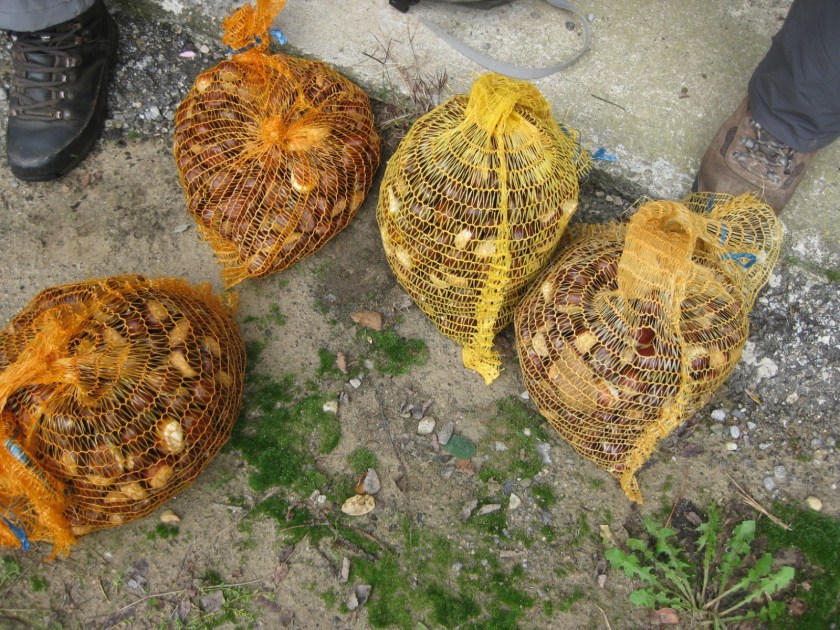
Well, at this time of year, it isn’t really a case of ‘au cas où’ .  You’re bound to find something.  A fortnight ago, for instance, Mal and I went on a country stroll from Lieurac to Neylis.  We had with us a rucksack and two large bags, and we came home with just under 5 kilos of walnuts, scavenged from beneath the walnut trees along the path.  A walk through the hamlet of Bourlat just above Laroque produced a tidy haul of chestnuts too.

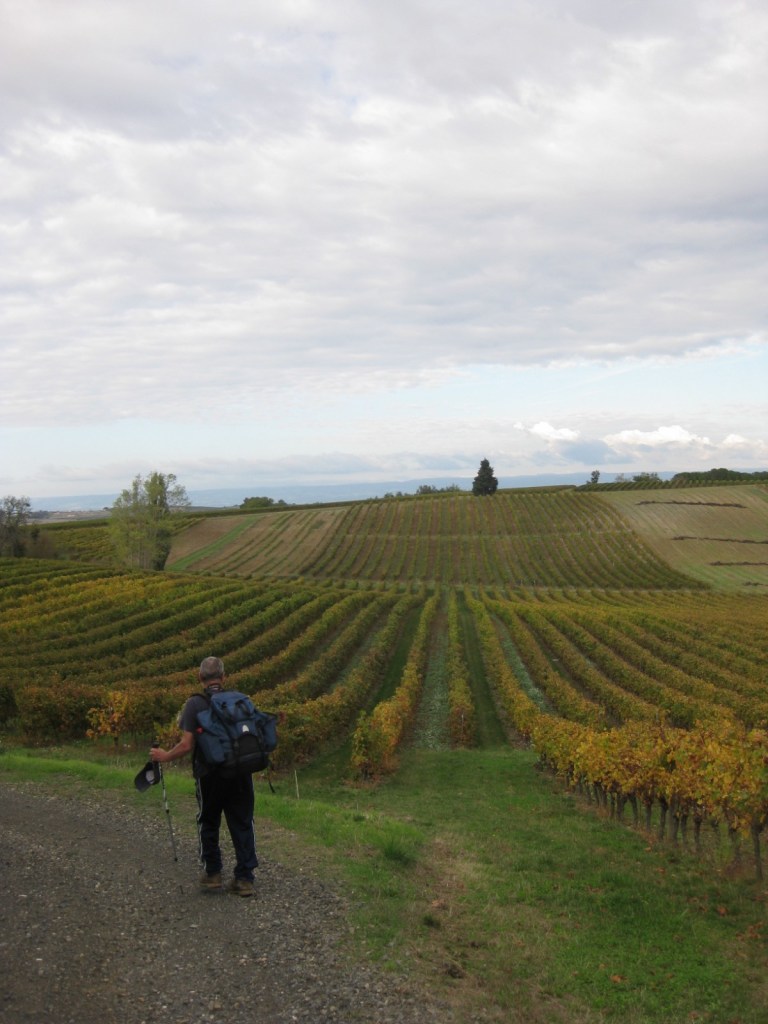
Yesterday, we Laroque walkers were among the vineyards of Belvèze-du-Razès.  The grapes had all been harvested in the weeks before, but luckily for us, some bunches remained on the endless rows of vines which lined the paths we walked along.  We felt no guilt as we gorged on this fruit all through the morning.  The grapes had either been missed at harvest-time, or hadn’t been sufficiently ripe.  They were unwanted – but not by us.

The walnuts we’re used to in the Ariège are replaced by almonds over in the Aude.  You have to be careful: non-grafted trees produce bitter almonds, not the sweet ones we wanted to find.  But most of us returned with a fine haul to inspect later.  Some of us found field mushrooms too.

Today, the destination of the Thursday walking group was the gently rising forested and pastoral country outside Foix known as la Barguillère.  It’s also known locally as an area richly provided with chestnut trees.  Any wild boar with any sense really ought to arrange to spend the autumn there, snuffling and truffling for the rich pickings.  We walked for 9 km or so, trying to resist the temptation to stop and gather under every tree we saw.  The ground beneath our feet felt nubbly and uneven as we trod our way over thousands of chestnuts, and the trees above threw further fruits down at us, popping and exploding as their prickly casings burst on the downward journey.

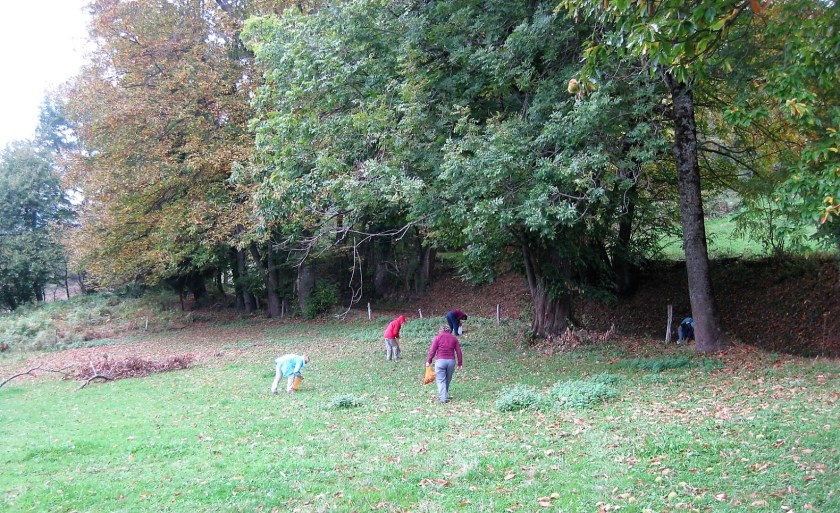
As our hike drew to an end, so did our supply of will-power.  We took our bags from our rucksacks and got stuck in.  So plentiful are the chestnuts here that you can be as picky as you like.  Only the very largest and choicest specimens needed to make it through our rigorous quality control.  I was restrained.  I gathered a mere 4 kilos.  Jacqueline and Martine probably each collected 3 times as much.  Some we’ll use, some we’ll give to lucky friends.

Serious business, this scavenging.

Now I’d better settle myself down with a dish of roasted chestnuts at my side, and browse through my collections of recipes to find uses for all this ‘Food for Free’.

Jacqueline, Martine and Maguy’s chestnut haul.

* Two lines from an English hymn sung at Harvest Festival season: Come, ye thankful people, come’

A contribution to Six Word Saturday, and Jo’s Monday Walk: it’s more than one walk Jo.  Extra value?  Or disqualified?

Power lines, South Korean style

You can’t beat East Asia for power lines.  When we arrived in Seoul for our South Korean adventure three years ago, we were stupefied by the skyscrapers, charmed by the traditional hanoks.  But what we couldn’t take our eyes from were these.

Are there enough lines here for you Becky? Hey Jude?  How about you?  It was your post that put me in mind of these beauties.


October Squares: Lines.

‘Let us Sing in Celebration of a Union Proud and Free’

On Saturday, about a million of us descended on London, all committed Remainers, demanding a Final Say on the Brexit Deal, which even as we marched was being debated in Parliament with as much dissent as usual.

Our own little patch of Yorkshire sent three coaches.  Nineteen coaches from Yorkshire altogether. Everyone had their own important reasons for being there.

But the Yorkshire Remain Voice Choir had come to sing. We had permission to commandeer Wellington Place, right next to Trafalgar Square, and sing below the Duke of York Monument. And that’s what we did. 

We’d come into being about two years ago in two ways. Over in York for Europe, Martin and Gill were crafting clever lyrics with a view to starting a Remainers’ choir.  And in North Yorkshire we began to sing at our street stalls.  Arnold conducted a few singers, a tuba, and a guitar. Small beginnings …. but now it’s county-wide, with members from Settle to Sheffield – almost 80 miles apart. Dozens play their parts.  Composing lyrics; practising; arranging; securing singing spots; keeping song books up to date; booking coaches. 

We have SODEM’s support in London, and an official photographer in Bedford-based Chiara Mc Call. We’ve sung all over Yorkshire, in London, even (thanks to Louise in South Yorkshire) in Brussels. Whenever the going’s got tough, we’ve had North Yorkshire’s Richard S’s boundless enthusiasm and hard work to keep us going.  These days, apart from the original small team, we have a Yorkshire band’s worth of brass, and drums and various stringed instruments.

In London on Saturday, we had a large and pretty much captive audience.  Slow-motion marchers inevitably listened – enthusiastically – as they passed. Many stopped off specially to listen, applaud and join in too. Demonic Cummings and Boris Johnson, those two splendid images fresh over from Germany, unsurprisingly pushed off towards Trafalgar Square as we began.


Our audience, viewed from the choir (CM)

There are thirty eight songs in our repertoire – all, with one exception, pastiches of well-known numbers.  Our signature number is of course:

‘We’ve come from Yorkshire just to say (just to say)

Your Brexit deal is naff…‘(to the tune of ‘On Ilkley Moor’, naturally).

But we can do other folk songs:

‘What shall we do with….‘, not a ‘Drunken Sailor’, but ‘this Rotten Brexit?’

…..drinking songs: ‘I’ve been a Remainer for many’s the year’ rather than the more traditional ‘Wild Rover’.

We can do Old Time Musical: ‘I’m forever European’ (‘I’m forever Blowing Bubbles’).

Radio Two standards such as ‘Delilah’ ask:

‘Why why why deceive us?

More lies won’t appease us’.

We can reference American traditions:

‘We’ve had quite enough of Brexit it’s a con’.  (‘She’ll be coming round the Mountain’)

While ‘The Battle Hymn to the Republic’ becomes ‘Our eyes have seen the threat to all the freedoms we hold dear’.

Hymns too …. ‘Bread of Heaven’, and the Last Night of the Proms (‘Land of Hopeless Tories  ‘).

There’s one song in our repertoire that’s not original: ‘Ode to Joy’. It moves many of us to tears every time we sing it. 


Brexit or no Brexit (no Brexit please!) we’d like to continue.  A pro-Europe Choir and Band for Europe?


Photos and videos labelled ‘CM’ are by our wonderful friend and supporter Chiara McCall. Follow her on Instagram @chichi76.myreflection


Autumn lines

I’m looking for lines.  Most obviously, they call to mind buildings, railways, pavements, washing lines, power lines: man-made kinds of things.  But Mother Nature does lines too, as we observed yesterday at Harlow Carr Gardens in Harrogate.  Lines of still-summery oak leaves edged against the sky.  Veins, dark against the now-glowing colours of the leaves.  A  tree trunk  reflected into the water as one long sinuous line.

So Becky, here are some more lines for your October Challenge: Lines and Squares.