We’re back in England now, back to temperatures of under six degrees when we’d got used to nearer twenty in Spain. Back to rain and wind instead of sunny breeze. Still, I can sit and sort my photos out.
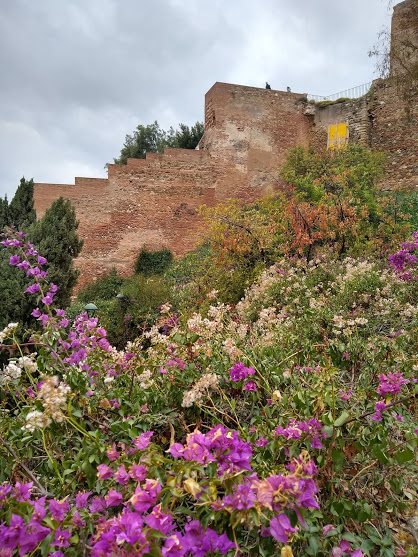
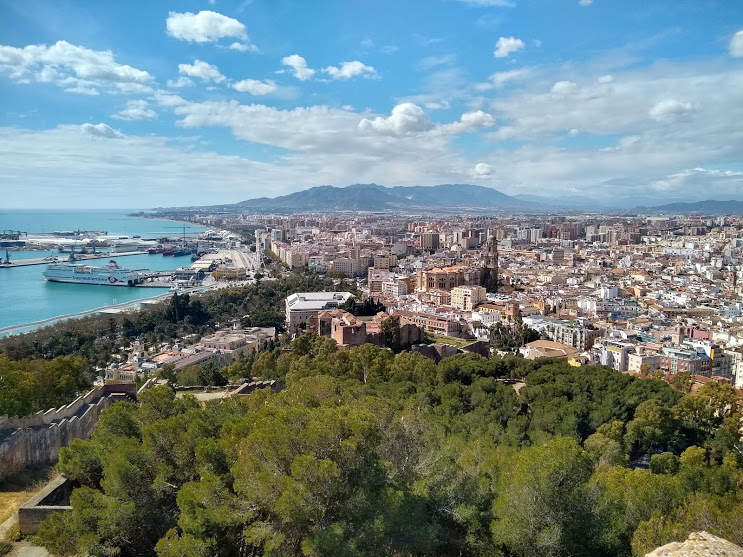
The view up – looking towards the Alcazaba: the adjoining castle to Gibralfro.
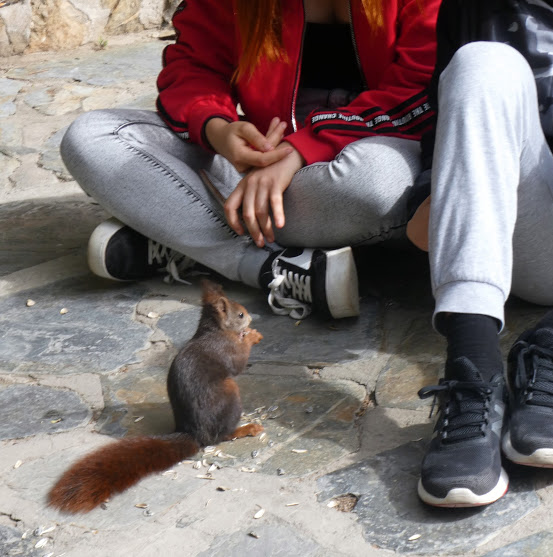
Here are some from the day we slogged up the 240′ to Castillo Gibralfro in Málaga. Part way up, we came upon this enchanting scene.
I know the arguments about the potential dangers to both humans and wildlife from too-close contact. But these two Spanish children are not likely to forget, or be unaffected by this chance encounter with this little squirrel: or to resent the fact that he charmed the greater part of their mid-morning snack from them.
Father Christmas came early. Three months without a camera was enough, he reckoned. He lacked a beard and red clothing, and looked remarkably like Malcolm, but he helped me choose, provided the credit card and carried the new camera home for me.
Even at ten o’clock, there was still mist rising from the Moon Ponds. And even though the view from Surprise View is no longer surprising, it’s none the worse for that.
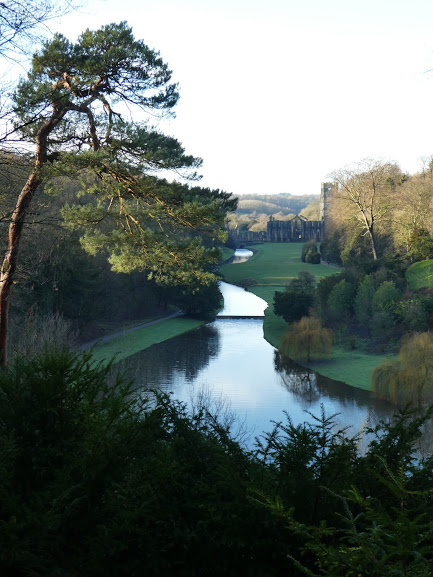
A distant view of Fountains Abbey from the High Ride, Studley Royal
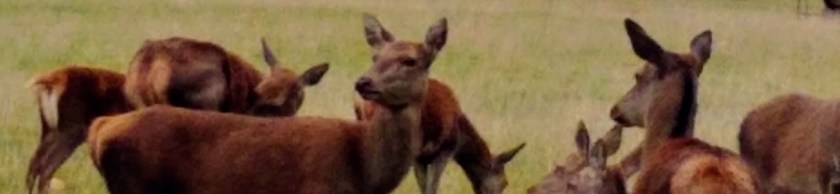
But look! This is what we spotted in a distant meadow. Time to put the zoom lens through its paces. Aren’t these deer magnificent?
Later, we passed the fine Elizabethan Fountains Hall. It was fun to contrast the view of the house itself with the version spotted in a puddle we passed.
Fountains Hall…….
….. in a puddle.
A good walk, and it’s good to have a camera once more.
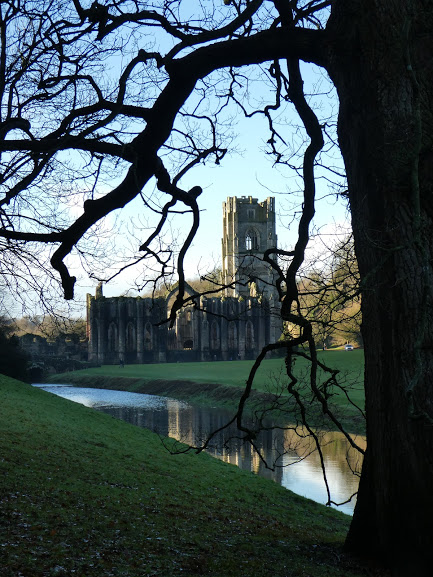
Back in the valley, a less distant view of the Abbey.
As usual, click on any image to view it full size.
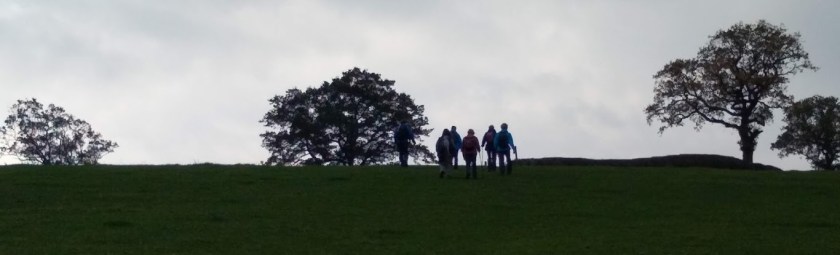
I enjoy Jo’s Monday Walks, and browsing through the posts of some of those who contribute too. So I thought I’d join in the fun. Yes, I know it’s Tuesday…..
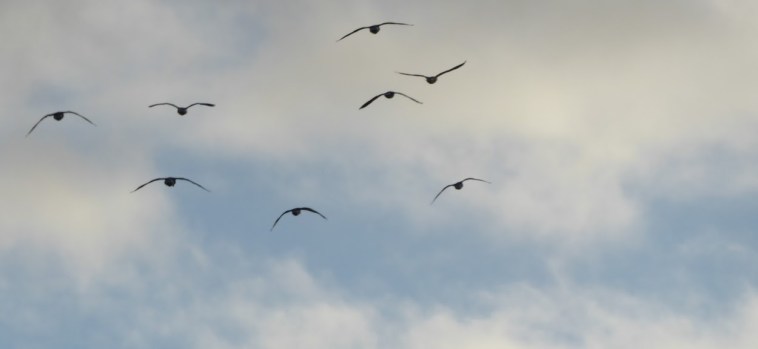
On my way to yoga last Friday I was stopped in my tracks. There, high above me was that unmistakeable raucous calling that only flying geese can deliver. I watched, as ever transfixed by the cooperative and graceful weaving flight of these birds. They maintained their traditional V shape as they journeyed on, but I realised they weren’t constantly following the same Top Goose. First one, then another would fly forwards, only to be succeeded by another, only moments later. Always, however, they remained connected, a purposeful team.
I saw these geese at Marfield Wetlands exactly this time last year. Disobligingly, they did not formed perfect Vs for me.
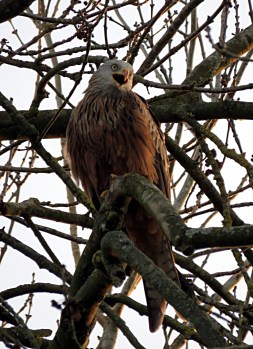
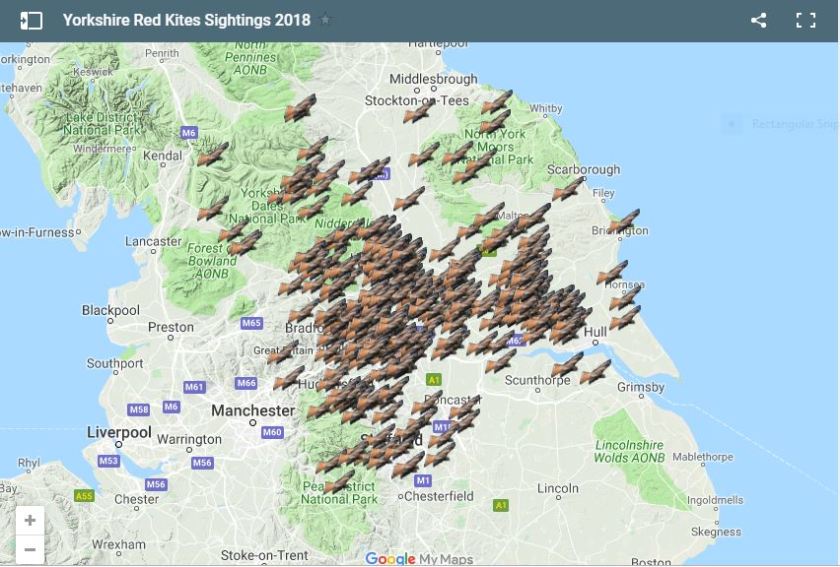
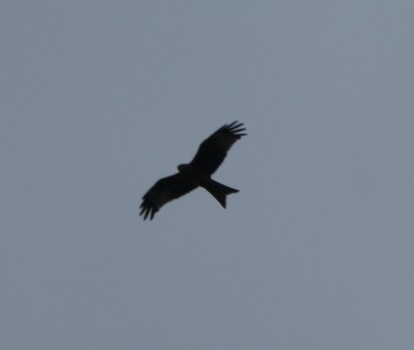
Later, lying on my back in the yoga group, I glimpsed a red kite, wheeling and diving directly above the skylight.
Red kite (Wikimedia Commons)
A Good Morning.
These photos were taken this time last year. I still have no camera….
Ragtag Tuesday. It’s still there. As is Ragtag-every-other-day-of-the-week. Have a look. But I’ve moved to Saturday’s Ragtag Daily Prompt.
If you live near Studley Royal and its deer park, as we do, you’ll be used to deer. They’re very shy though, and unless you’re there very early, or when poor weather is keeping visitors away, you’ll only get distant views of them.
Yesterday though, we were having a walk, a long walk, just outside the park grounds. Our path had led us upwards, through woodland, and alongside the long stone wall which bounds the estate. And that’s when we noticed them. A stag with his harem of does – some twenty or thirty of them. We stuck our noses over the wall, and watched. The deer watched us, and concluded that since these faces apparently had no bodies attached, they posed no threat.
The stag – and there was only one – was striding around in an assertive manner, aiming to garner respect. The deer weren’t bothered either way, and there were no other males to impress. He realised he was wasting his time, and fell to grazing instead.
I’m still stuck without a camera, so these slightly fuzzy efforts will have to do as a record of a few magic moments shared with a parcel of deer we came across .
Did you know that ‘parcel‘ is a collective noun for deer? Me neither. Try these too.
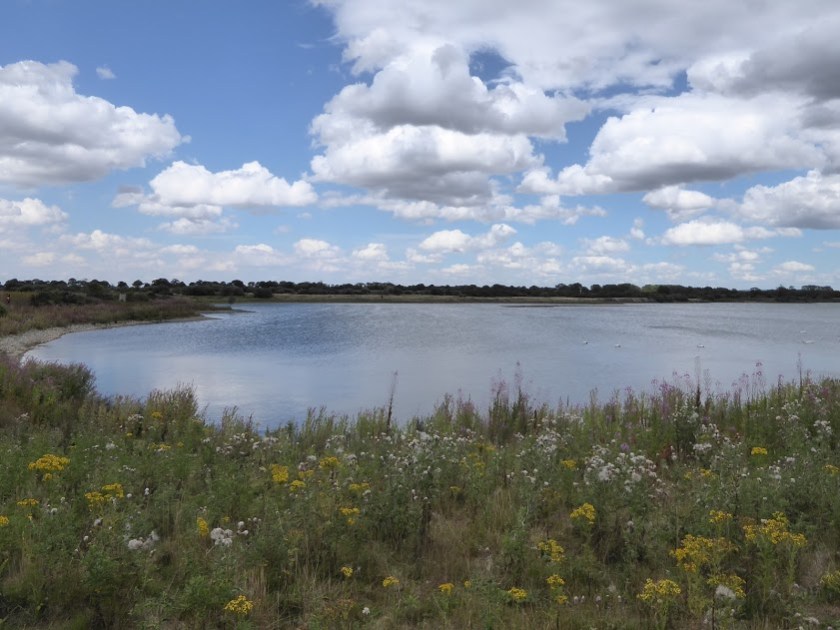
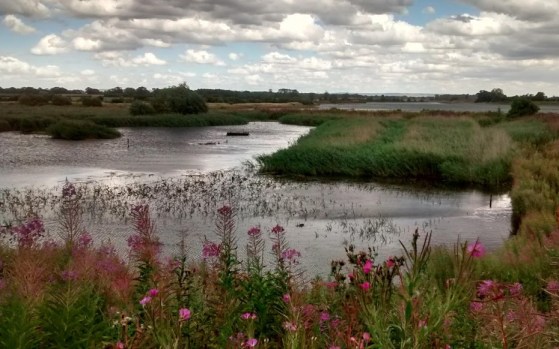
We don’t live near the sea: 61 miles, to be exact. But sometimes, on a hot day, only a wide expanse of water will fit the bill. And that’s what Nosterfield, fewer than four miles away can provide. It was – and still is – a gravel quarry. On any day of the week, you’ll see great yellow trucks lumbering down the road, laden with gravel. Back before the 1980s, this area was a lunar landscape: sand and gravel pits, gargantuan earthmovers,spoilheaps. Some of it still is.
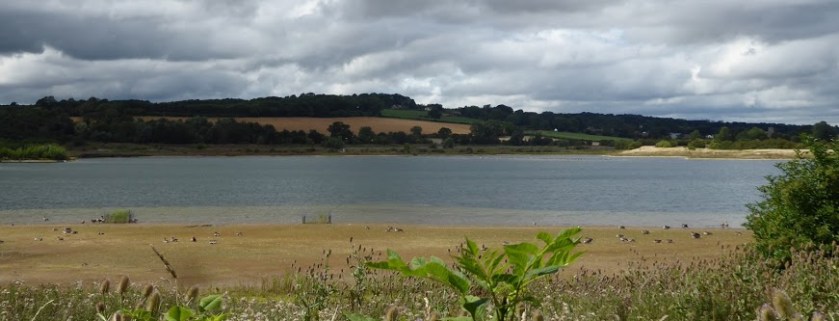
Mid afternoon’s not a busy time for birds: the water level’s low too.
But in the 1990s, a professional landscape architect, Simon Warwick, spotted its potential. He’d noticed how even as an industrial site, the area attracted thousands of migrating ducks and geese each autumn. Parts of the site were no longer economically viable and no longer being worked. Not without considerable difficulty, he established the Lower Ure Conservation Trust, and focused on creating an area of wet grassland, with water attached – sometimes extensive lakes, and at other times drying out into muddy scrapes. Native flora were allowed to regenerate naturally.
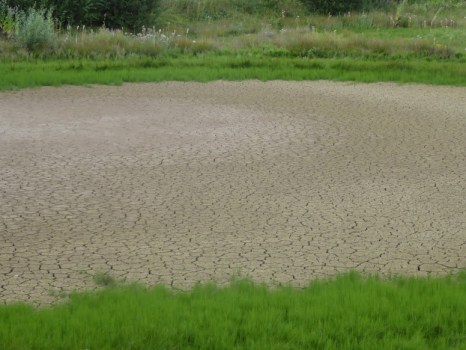
The lakes can be full …..….. or empty.
Wildfowl are delighted. Wading birds are enchanted. 200 species of bird make use of this service station for birds, halfway between the important migratory staging posts of the Dee Estuary and Teesmouth. Birdspotters and nature lovers generally love this place, and the well-appointed hides that are a feature of the site are rarely out of use.
I wonder who’s on that scrape over there?
Greylag geese.
If, like us, you’re strictly amateur in your knowledge of birds, you might love it too. It’s a tranquil place, except when the birds are having spirited and raucous exchanges, and a perfect place to spend an hour or two at any time of year. But especially on a hot day in summer, with a cooling breeze drifting from the waterside. With wild cherries, apples, plums and blackberries on offer, you’ll even have a snack provided.
Diaphanous sugar-pink wraiths trailing long floating tendrils pulsated gently round their royal blue tank: hypnotic: mesmerising. They neither paused nor hurried. They simply oscillated, surged, ebbed, flowed. These ethereal creatures didn’t merit their prosaic name of Black Star Northern Sea Nettle. Who dreamed that one up?
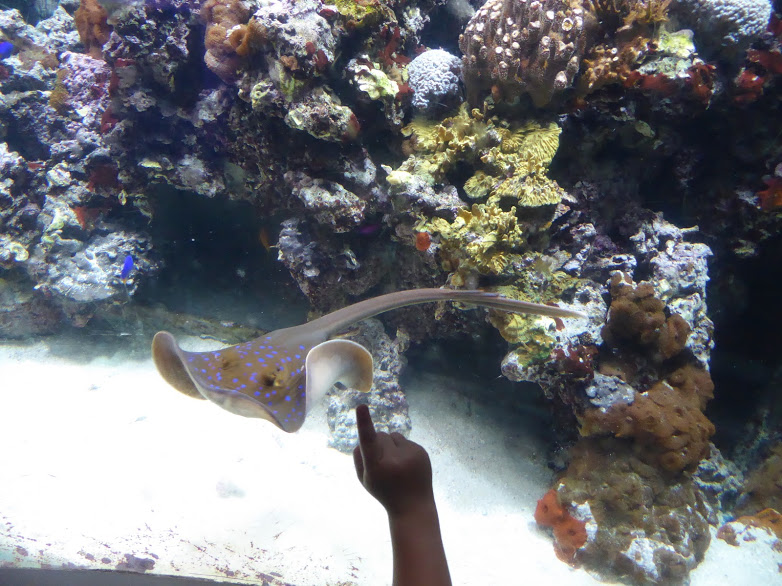
When we finally left them to it, we discovered we hadn’t finished with pulsing creatures. Here was a Blue Spotted Ribbon-Tail Ray. He gently wove round the tank, his flat body slowly rippling to the rhythm of his inner pulse.
William helpfully points out the Blue-spotted Ribbon Tail Ray.
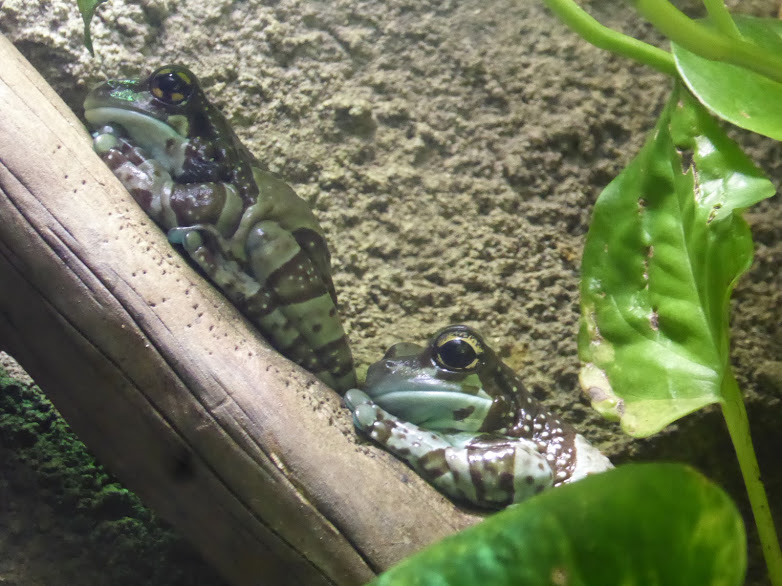
Then there were the frogs. Look at these two Amazon Milk Frogs. They had nothing to do but regard us without interest, as their chests swelled and deflated – pulse, pulse.
Two Amazon Milk Frogs, so called from the sticky white substance they secrete through their skin when threatened.
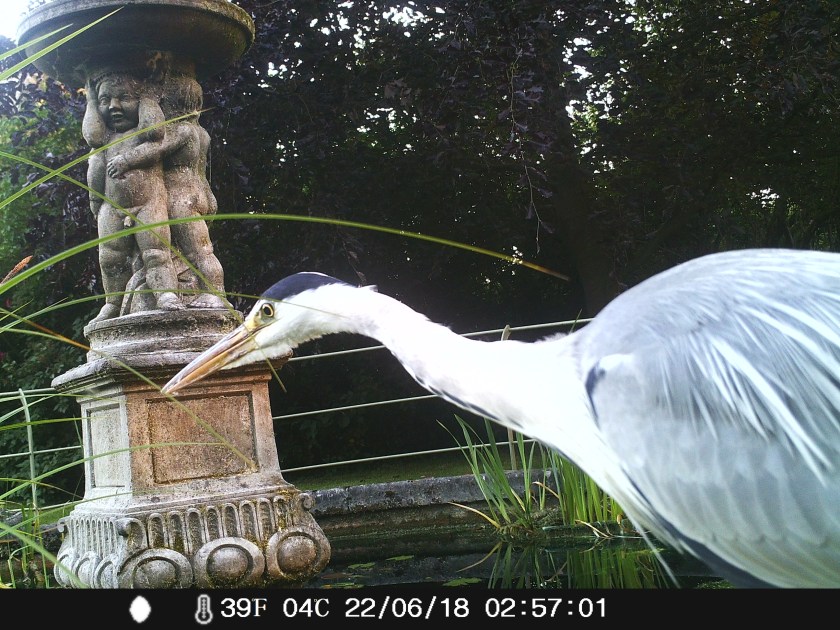
In the garden is a pond. And in the pond there are some fish. We live near the River Ure. So near our home, some hungry herons live….
Back at Christmas time, William and family gave us a trail camera, wildlife-filming-for-the-use-of, mainly at night. This week, we decided to site it near the pond, to see if a Hungry Heron would visit. One did …..
The camera is still set to GMT. He really visited at 03.57.
This post is in response to the Ragtag Daily Prompt. Let’s let them introduce themselves: ‘RDP was started by a ragtag collection of bloggers who weren’t ready to give up on the Daily Prompt when Word Press was. So, seven of us agreed to provide a prompt once a week, and we began on June 1, 2018.’ Good luck, Ragtag! This is the kind of party I’d like to join.
We found ourselves tussling with the fag-end of Storm Hector on Thursday, as it exhausted itself gusting round the neighbourhood. It closed the market early as stallholders gave up the battle to keep their goods and stands in one place, and dumped leafy branches in the path of unwary motorists.
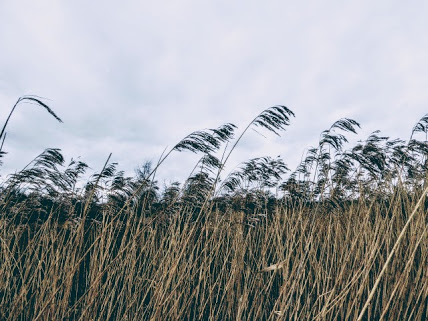
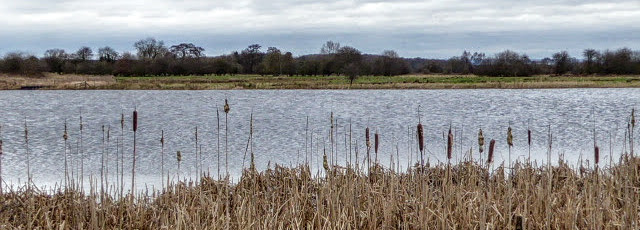
It reminded me of a more than breezy walk last February. Look! Here are the grasses edging the wetlands at Staveley Nature Reserve.
Here’s a telegraph pole, a battered shed door on a local farm and – it is a nature reserve after all – grasses and bullrushes standing (nearly) to attention.
In the absence of the popular WordPress Challenges, Cee Neuner has generously offered to compile and maintain lists of challenges and the bloggers who host them. You can find them here.
Wildlife has had a tough time getting going this year. Bluebells late, lilac late, bird migrants late – where are our swifts, diving and swooping in the evening skies, gorging on feasts of flies before night sets in?
At last though, mallard ducklings have appeared on the village pond. There seem to be three families: tiny ducklings; some a few days bigger; and one lot who could be described as teenagers. Apart from having little in the way of wings yet, they look pretty grown up. We idled away part of the afternoon the other day, just watching them scuttle and swim.
It’s as well they breed so prolifically, those ducks. The babies have little chance of making it to adulthood. The resident goose doesn’t like them. Jealous drakes don’t like babies who aren’t their own. Foxes like them alright, but as a snack. And then there’s the road, though drivers try hard to avoid these creatures, who simply haven’t learnt their Green Cross Code. My favourite sight from last year was seeing a mighty dustbin lorry shudder to a halt, and wait while Mrs. Mallard led her brood of seven efficiently across the busy road.
Last Monday, towards evening, the place to be was our home. We dashed from window to window, watching as dozens, then hundreds, then thousands of starlings descended on the trees round our house. They weighed down the branches, then in coordinated waves – responding to some urge we could not understand – they swept skywards, tearing across the garden, swooping, diving, before briefly settling again to repeat the performance again and again for a whole three-quarters of an hour, before finally disappearing to settle near the river for the night.
So near to our house, those mesmerising formations of groups of birds twisting and turning in harmony, as if in some graceful aerial dance weren’t so apparent as they are at a distance. We were rewarded instead by seeing them at close quarters, rising, landing and rising again from the trees near our house.
You must be logged in to post a comment.