It wasn’t our best walk. Chris and I set off to ‘do’ part of the Nidderdale Way on Thursday. Thursday was fine. Wednesday hadn’t been. Nor had Tuesday. There’s been an awful lot of rain lately.
Even as we started out, we realised that mud was to be our constant companion. And water, trickling along slippery, sticky oozy paths. We forded streams which according to the map simply didn’t exist. If we wanted to go onwards, we had to wade through running water, or totter across from unsteady stepping stone to unsteadier fallen branch.
It was tiring. Finding not-too-soggy resting places was challenging too. We had our sandwiches in a wood alongside what should have been a babbling brook, but was in fact a raging torrent.
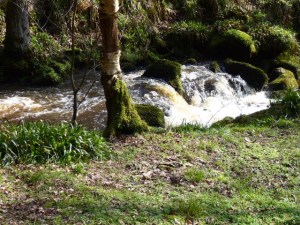
A normally quiet woodland stream.
And that’s when I noticed these stones – and trees. I’d expect boulders and branches like these to have a few tendrils of dry ash-grey lichen clinging to their surface. Instead they were thickly carpeted in vivid green. These specimens (and I don’t know what they are, despite a spot of Googling) were healthy, fecund and spreading very nicely thank you. It’s easy being green in such a damp, shaded and sheltered environment.
Surely it’s only in England that you would find an annual festival dedicated to marmalade in all its forms? And it’s no surprise to find it hosted in a delightful country house, Dalemain, the family home of the Hasell-McCosh family.
Delmain, Cumbria
Eleven years ago, Jane Hasell-McCosh devised this very British festival, and now in March every year, some 2,000 marmalade makers submit their entries to be judged .
The day kicked off in a rare rain-free moment with local schoolchildren belting out a jolly song about the delights of marmalade. In this ballad, they rejected any treat they were offered, preferring instead a slice of toast, well slathered with this bitter orange preserve. As if.
Marmalade celebrated in song.
Dan Lepard and Jane Hassel-McCosh start the day off.
The judges of 2000 pots of marmalade get their reward.
MC was one of my baking heroes, Dan Lepard. He introduced everyone, and announced the winners. And then we went into the house, to visit room after room stuffed with pots of marmalade. Each jar is awarded a series of marks, and is given an individual critical commentary. I was quite cross that I hadn’t in the end made the effort to enter any of my own efforts.
The entrants though are not only true Brits, eccentric or otherwise. In our B&B we had met Chris Brown, a baker from Vancouver, who had come for this one weekend only to enter his marmalade. He’d already won gold medals in previous years. So many Japanese have done well that the Japanese Ambassador himself came to the opening ceremony and made a gracious and witty speech. There were Australians there, and Kiwis, South Africans, Americans, someone from the Czech Republic ….
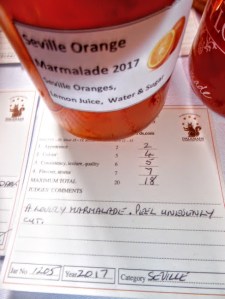
18 is a decent score: worth a silver medal, I believe.
The competition has categories for Seville orange marmalade of course, for marmalade with a twist, for any citrus marmalade, for dark and chunky marmalade ….. all this could be predicted. But a category for marmalade makers who are also campanologists? Octogenarians? ‘The Establishment’: those redoubtable and upstanding members of society, such as bishops, MPs and judges who used to be the only people who could verify your likeness for a passport application?
This is entirely in keeping with the professional-but-with-a strong-hint-of-the-amateur feel of the festival.
Dan Lepard and Jane Hassel-McCosh open the proceedings.
I paid extra to go to Question Time. Baker Dan Lepard, food historian Ivan Day, marmalade guru Pam ‘the jam’ Corbin, and Martin Grant, MD of Mackay’s Marmalade made the hour whizz past. One conversation stood in my mind. ‘If we sent each of you home with a basket of raspberries, or blackcurrants and asked you to make jam, you’d all come back with much the same product. If we sent you home with a bag of oranges, you’d each come back with something quite different.’ And it’s true. They’d range from dense, dark and treacly with big chunky chewy peel to bright jewelled orange jellies with a delicate filigree of fine strands of zest suspended within. And all stops in between. This immense variety to be had from a product made simply with oranges, a bag of sugar, a lemon, and perhaps a little secret something is what gives marmalade its continuing appeal.
Who knew that squirrels like marmalade?
After lunch, we popped into Penrith. The town had gone orange for the weekend. The face of the town clock was orange: the shop windows were dressed in orange, and there was an orange-themed market in the town square. Marmalade anyone? It was all good fun, despite the unremitting rain.
The town clock turns orange for the weekend
Stall on the market square
Next morning, we headed home. The rain was so intense that newly established rivers and waterfalls cascaded from the hills. Older-established rivers burst their banks and flooded across roads. Fields developed impromptu lakes. It reminded us of a remark that Malcolm had overheard at the festival: ‘I come every year. But it always rains’
It’s easy to feel like the only person out in the landscape. But you’ll have come with a friend or two, if only to haul you upright when, inevitably you fall deep into a drift of snow.
Back in France, in the Ariège, the very best way of getting out into virgin snow and becoming at one with a pure, glittering white winter landscape was take yourself off to the nearest mountain, strap on your snowshoes and walk through the fresh crisp air as if you were the only person in that particular bit of world. It was hard work though, and after the first hour, I’d had enough.
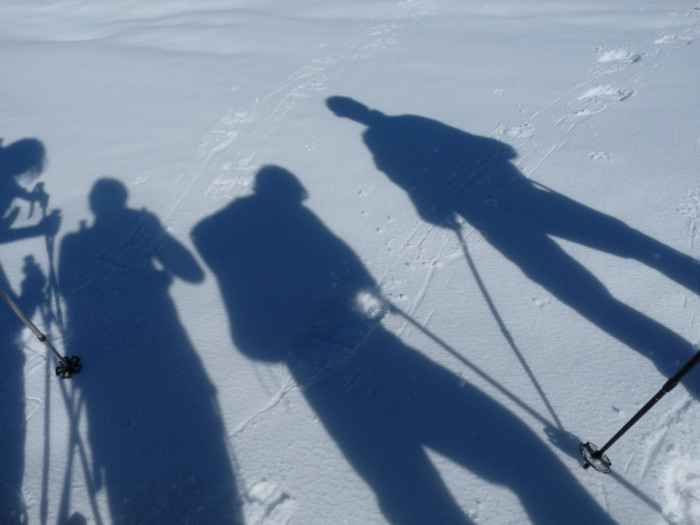
Three years on, and the memory of the pain, sweat and general exhaustion of the entire procedure has faded. I remember instead the vivid sunlit skies and startlingly white and unspoilt snow. And sometimes there were shadows: clear silhouettes mirroring, yet enhancing the world above the glistering mantle.
This week’s WordPress Photo challenge is ‘shadow’. The challenge is now issued on a Wednesday rather than a Friday. I think I’ll now usually respond on Saturday, not Sunday.
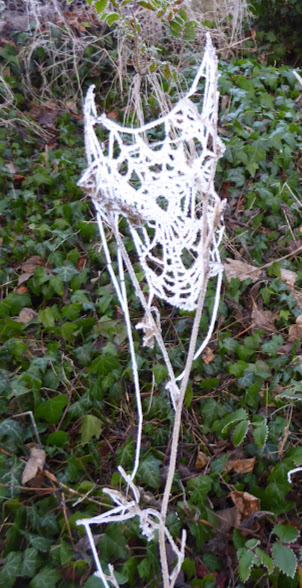
Google spiders’ webs and you’ll find any number of scientific articles celebrating the resilience of the silken strands that spiders produce Not only is the silk stronger than steel, it’s springy and elastic. The design of the web ensures that even when a strand is broken, the overall formation remains sound.
I found a spider’s web on a recent cold and frosty morning. By rights such a delicate structure should have collapsed under the weight of its coating of thick icy rime. It hadn’t. It’s the perfect candidate for this week’s WordPress photo challenge: resilient.
And here are a few more shots from a cold and frosty morning in North Yorkshire:
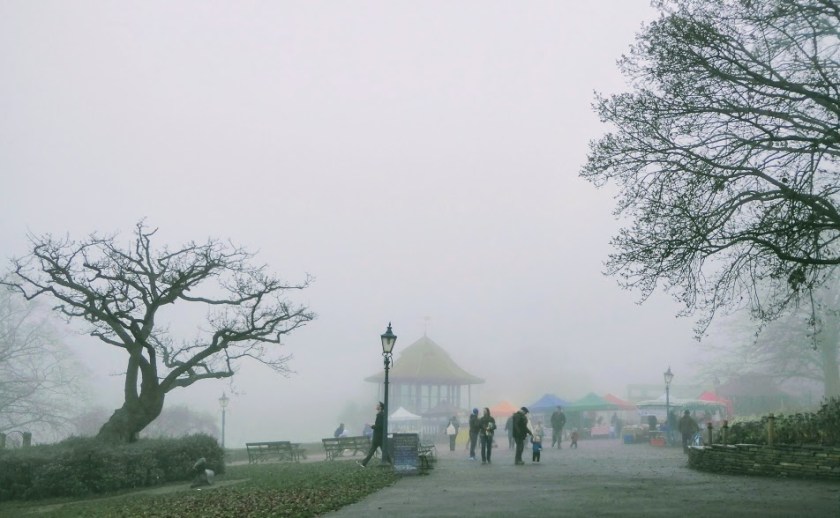
The Horniman Farmers’ Market, glimpsed through the gloom.
It’s just over a year since I first blogged about the Horniman Museum. Last Saturday we were there again. It couldn’t have been more different, even though so much was still the same. William is no longer a cheerful little bundle to be toted about in the arms of a willing aunt or granny. He’s a running, jumping talking live-wire of curiosity, demanding to be taken to see the ‘dugong’ (yes, really), or the owls, insisting on commentating, as far as he can, on everything he spots.
That’s a dugong, that is.
An owl takes centre stage at the European Wildlife Photographer of the Year Exhibition. William approves.
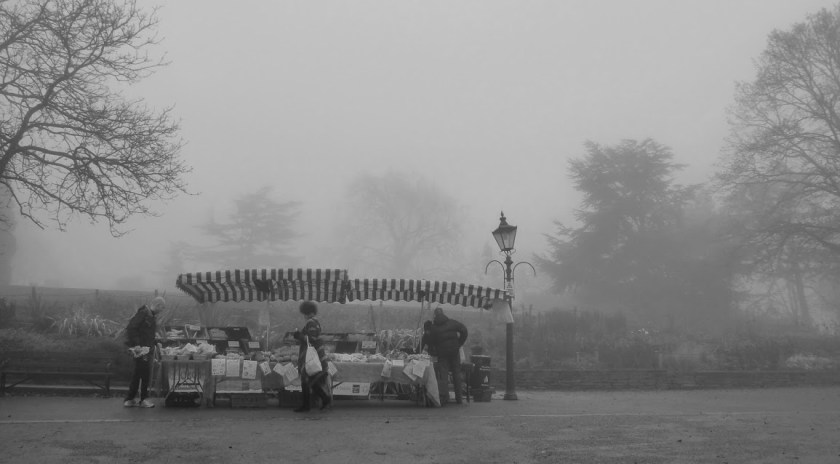
Last year, after our museum visit, we enjoyed strolling outside in crisp winter sunshine. This year there was heavy mist, obscuring the views of London. Instead of strolling round the gardens, or visiting the farmyard creatures, we settled for the small farmers’ market that’s there on Saturdays. There were stalls selling vegetables, and cheeses, or locally cured meats. There was street food. Tom and Sarah bought a goose for Christmas. We sampled spicy Iranian tit bits. And best of all, we had an early lunch. Look at this from the Smeltery. Tasty, chewy sourdough toast, topped off with melted raclette, bacon, chimichurri and some onion chutney, together with a handful of toasted walnuts. It’s perfect winter picnic fare.
A Smeltery sandwich in preparation…
… and on its way….
… here it is.
Buying winter vegetables.
But all the same, enough was enough. Next time, we’ll go when the sun is shining.
Photo challenge: ‘It’s not this time of year without…..’. It’s holidays and celebrations that WordPress seems to have in mind in setting this challenge, but this is November, and we don’t do Thanksgiving in England. We do dark nights that begin at four o’clock. We do gusting rain that snatches the remaining leaves from the trees. We do fog that rises from the river. Nothing much to celebrate at all. Except …. except that it can turn out differently.
Read on.
Sunshine after rain at Studley Royal
I was in a bad mood when I got up. My shoulder hurt – a lot. The sky was steel-grey, the temperature steel-cold, and I was supposed to be leading a walk. This was going to be No Fun At All, because although no rain was forecast, we’d had two days of full-on deluge. I just knew that virtually the entire circuit would be a mud-bath.
I trudged off to our rendez-vous with ill grace. Once there though, I started to cheer up. The prospect of good company for the day is always a positive start. We set off. The ground was unexpectedly firm, the clouds started to lift and the sun to shine. Soon we were making a coffee-stop outside 14th century Markenfield Hall.
Coffee stop in front of Markenfield Hall.
Then it was through woods and across open fields (still no mud) to find a lunch spot overlooking Fountains Abbey, still framed with russet Autumn leaves.
Sandwiches, sunshine and Fountains Abbey.
After lunch, a muddy farm, where we attracted the interest of the locals.
Calves closely inspected us as we squelched past. Yes, this farmyard was very muddy indeed.
And an uplifting final couple of miles, with grazing red deer, light-reflecting ponds and surrounded by a final burst of Autumn colour.
Here is the parkland of Studley Royal. Can you see the red deer in the distance?
That’s where I spent my evening, near the Temple of Piety. Can’t complain at that. (geograph.org.uk)
I was volunteering at Fountains Abbey and Studley Royal yesterday evening. I wasn’t sure I wanted to be there. It was raining – and how – as I drove there, and the evening looked very unpromising.
A small team of us were there to make an evening’s Family Bike Ride round the Abbey and Studley Royal grounds run smoothly. Apparently I was going to be stuck near the Temple of Piety and Moon Ponds preventing riders from disappearing up into a woodland path, with only my two-way radio for company. I hadn’t even got an umbrella. Anyway, who would bother to turn out with their families, and all the family bikes, to trundle round Fountains Abbey in the rain?
Baby coot (Tim Felce: Airwolfhound)
I was wrong. Of course. The rain stopped. Families turned up, and lots of them. At first though, I had many minutes of peace to stand and absorb the views of the very special Georgian water garden. I spent time enjoying the company of a new family of coots: I suspect the three little spherical balls of fluff I saw with their solicitous parents had hatched that very day.
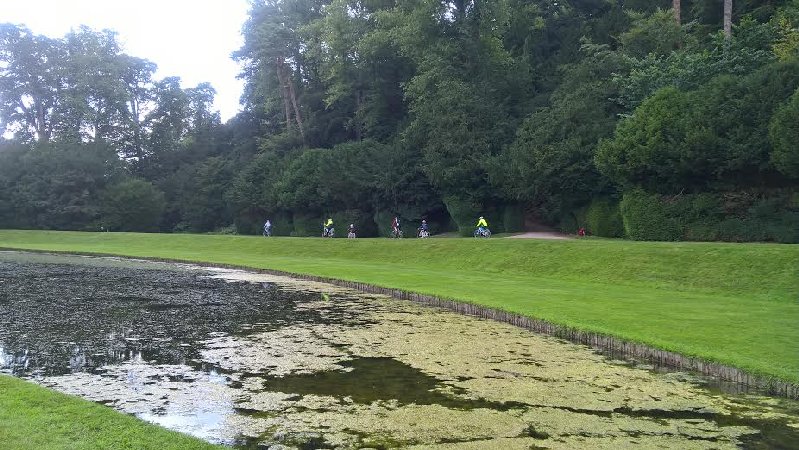
This was my view for much of the evening. Those coots are out there somewhere.
And then the bike riders came. There were confident teenagers relishing the chance to get up speed in this tranquil setting. There were primary-aged children enjoying family time with their parents. There were little ones, able to wobble along on their bikes, their parents confident that they were utterly safe from passing traffic. Open Country, a local charity working to help people with disabilities access the countryside had brought along a team and several tandems.
Some people went round the circuit once, some twice, a few as many as five times. I took lots of photos with lots of cameras for family souvenirs of the evening. Sadly, I hadn’t brought my own camera. These not-at-all impressive photos are taken with my camera phone.
I’ll volunteer again sometime for this event. But not next time. Next time I’ll want to be there with my own family, trundling around this very special site with my own grandchilden (first though, I’ll have to learn not to fall off a bike).
One of the last families of the evening finishes the last lap.
Look. Here was the scene in the field near our house, in January this year. Fields and roads flooded, impassable pathways, rocks and earth tumbling into the River Ure.
Near Old Sleningford, January 2016.
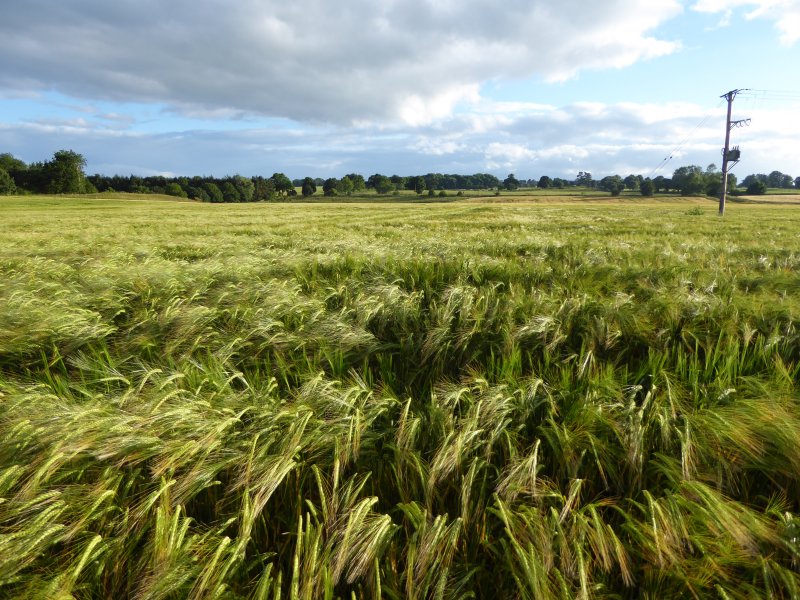
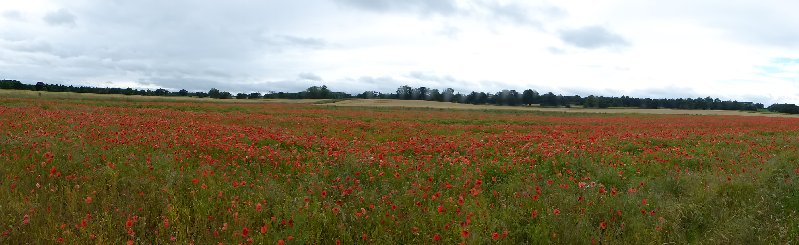
This was the same field yesterday. Barley, barley everywhere, all fattening up nicely for the harvest. Nearby, fields of poppies. Really hopeful, cheery sights on a sunny and blustery day.
The same field, July 2016
Will all our present political crises end so well? I wish I could feel more optimistic.
You’ll know that we waved ‘Goodbye’ to Emily this week. She’s arrived in South Korea, jet-lagged and exhausted, but not so much that she can’t send snippets of up-beat information about her new life as Emily-in-Busan.
While she was with us, Emily-in-Barcelona briefly became Emily-in-London, Emily-in-Bolton, and Emily-in-Yorkshire. And while she was with us, Boyfriend-from-Barcelona came to visit. What should we show someone from a vibrantly busy city, one of whose attractions is several kilometres of golden, sunny, sandy beaches? Well, on a frosty, gusty February day, with more than a threat of snow in the air, what could be better than a day beside the seaside?
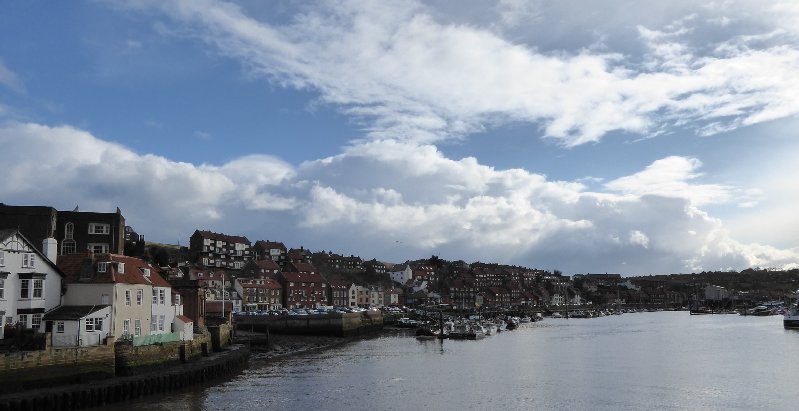
Whitby: the view anyone who’s been there would recognise.
Whitby seemed to fit the bill. Picturesque fishermen’s cottages huddled round the quay. A clutter of narrow cobbled shopping lanes – a tourist mecca to rival Las Ramblas. A sandy beach with donkey-rides, and the chance to find fossil remains etched into the cliffs or a morsel of jet washing about on the sands. A ruined Benedictine Abbey high above the town, the inspiration for Bram Stoker’s ‘Dracula’, and the focus of a twice-yearly Goth music festival. And fish and chips. Always fish and chips at an English seaside destination. Emily and Miquel explored the lot.
Whitby Abbey.
Whitby seen from St. Mary’s Church, next to the Abbey.
The old town.
The abbey and church seen from a ginnel.
The beach.
The beach.
The beach – again.
A close view of those cliffs.
One of the hundreds of gulls, thousands of gulls, reasy to steal your fish and chips with no warning.
And just before we left … a little bit of rainbow.
And Miquel, windblown and chilled to his fingertips, declared that it had been a fine day out, with the added bonus of being firmly inside the car when we journeyed home across the North York Moors as the snow began to fall.
Best to be back in the car when the weather’s like this.
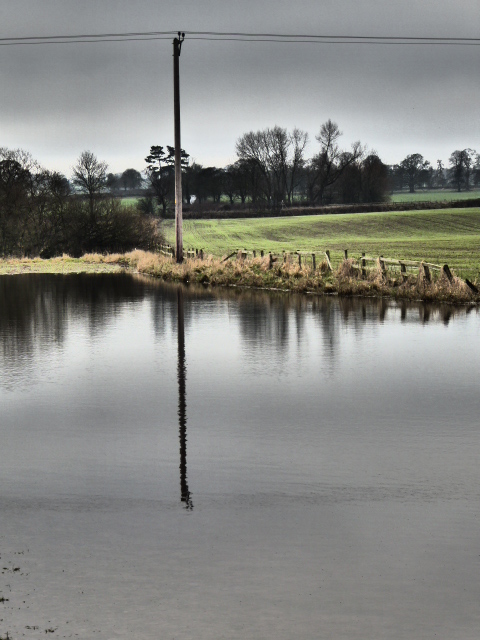
I first walked from Jervaulx to Jervaulx last April, and wrote about it here. However, I failed to lead my fellow ramblers along the same route later that month as I’d said I would, because it rained…. and rained. I’d promised them the walk though, and today was the day: bright, sunny, blustery – a perfect winter hike. Except for one thing. Those floods that have dominated British news this winter are still making their presence felt.
The ruins of Jervaulx.
Our route today didn’t take us through pastureland. Sheep aren’t very good at being knee-deep in mud. It took us through soggy fields, and past lake after lake after lake: waters that simply were not there last time I took this route. It was all very pretty. Less pretty was the scene at stiles. Look at us skidding and sliding, trying to pick the shallower puddles as we waited out turn to get from one field to another.
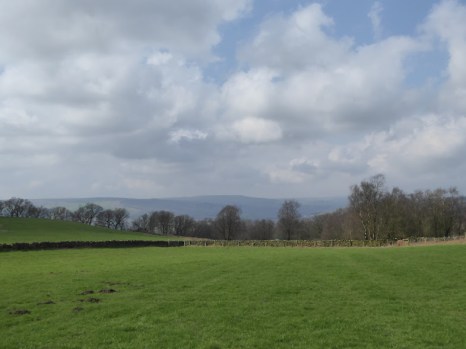
We’re British though, always plucky in adversity. We soldiered on, sometimes a little weary of heaving mud-crusted boots along sticky, sludgy paths. But nobody fell over, nobody lost their sandwiches in the mud. Everybody enjoyed those vistas over the Dales, the starkly beautiful skeletal outlines of winter trees, the blue skies, dappled with characterful cloud. Were we glad to have made the effort? Well, I was, and I think my steadfast and dependable companions were too.

























 From Pyrenees to Pennines
You must be logged in to post a comment.