As far as blogging goes, I’m still in Barcelona: though in reality I’m snuggled in a cosy jumper looking upwards as a grey sky turns greyer.
In Barcelona, we visited the Monasterio de Pedralbes. It’s not actually a monastery, because no monk has ever lived there. It’s a priory, built in 1326 by King James of Aragon for his wife Elisenda de Montcada, who wished to found a community of Poor Clares there. Poor Clares? These are nuns who devote themselves to a life of simplicity and prayer, and in Elisenda’s time were almost always drawn from the ranks of the aristocracy. She herself never became a nun, but she was very real presence in the life of this community.
And what a fine place it is. A graceful three-storied cloister surrounds a peaceful garden. Here is a fountain, topped off with a rather cheeky looking angel. This is where the nuns would wash their hands before dining in silence in the refectory, while devotional works were read to them from a pulpit.
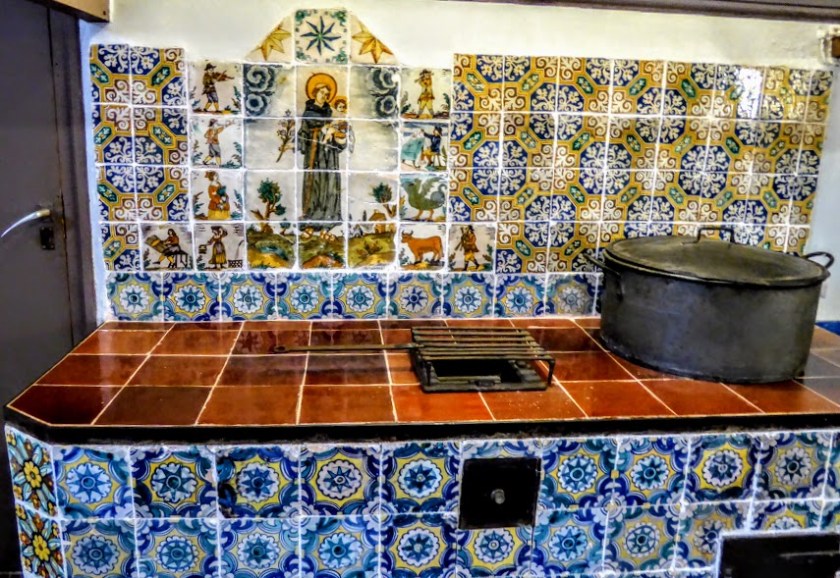
But it’s the kitchen I’d like to show you. In its day, this was a state-of-the-art workroom. Who wouldn’t like to cook at this unusual kitchen range, supervised by Saint Anthony? Look at these fine sinks, dating from about 1520. There are bread ovens, tiled worktops, and it was here that the simple diet of the nuns was prepared: fresh and salted fish, pulses, rice, vegetables and fruit. Meat was reserved for festivities.
Saint Anthony’s range cooker.
A double drainer kitchen sink, without constant running hot water.
This is another of Barcelona’s hardly-discovered treasures. Just a couple of school parties there, and once they’d gone, we had the place almost to ourselves. Put this on your must-visit list too.
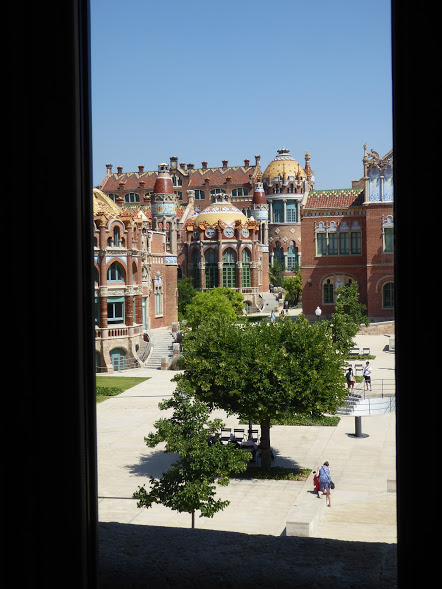
A view of some of the site, glimpsed through one of the windows.
It’s a story that goes back to the 15th century, when Barcelona already had six hospitals. In 1401 these merged onto a new site in Raval, to offer improved care to the sick.
By the 19th century, these facilities were too small, too outdated, no longer really fit for purpose. A Catalan Banker, Pau Gil, put up the money to fund a truly enormous and visionary project: a whole community of buildings offering state-of-the-art care to the poor of the city. The plan was for facilities of the highest quality, designed in cutting-edge modernist style by cutting-edge Modernista architect Lluís Domènech i Montaner.
Modernism? Think of it as Art Nouveau, Catalan style. You’ll recognise it in the works of Antoni Gaudi. Montaner found inspiration from Moorish architecture. Playful looking mosaics and the light-flooded areas are the special feature of his buildings. What we noticed straight away was bold colour, bold decoration: rich-hued tiled roofs: and within, tiles and mosaics in sunny yellow, grass green, sky blue.
Sun, grass, sky. Why not remind the sick inmates of a cheerful world outside the hospital? Why not have light, airy, high-ceilinged rooms, tiled throughout for ease of cleaning, and because they would never become dingy and faded? Why not build underground tunnels, tiled in cream, so that patients could be moved round the site without being exposed to the elements? Why not build a decent well-lit operating theatre, well-stocked libraries for doctors to consult, and set all these buildings among gardens which patients and staff alike could enjoy?
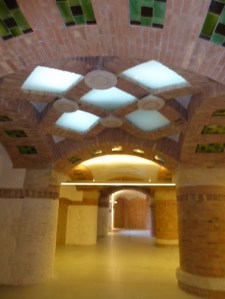
Underground walkways between the hospital buildings.
This was a Christian foundation. Nuns provided nursing care until the 1990s, as they had done since the hospital’s earliest years Mosaics in the building told stories from the Christian tradition, such as that of Saint George slaying the dragon. Other carvings and statues relied on ancient legends. This frog nursing a baby frog, for example, is an old symbol of caring love.
Originally, men and women were separated, but later, the hospital was organised by specialism. Now, although research continues here, modern buildings behind continue the work of the hospital.
A women’s ward in the hospital, 1920s.
The foundation stone was laid in 1902, and facilities were developed until about 1930. Large parts of the site were never built at all, from lack of funds. This isn’t surprising. There is nothing of the workhouse about this place. It’s a beautiful, special site, fully deserving of its UNESCO World Heritage status, acquired in 1997. It only opened its doors to visitors a few years ago, and it’s not yet truly on the tourist trail, despite being just up the road from then Sagrada Familia which is always surrounded by hordes of tourists. Visit it now, while it’s still an oasis of calm. It’ll be somewhere you’ll remember forever.
I’d intended to go into the story of this place in more detail. But a fellow blogger, Restless Jo, whom I ‘met’ only recently, introduced me to a series of posts by a blogging friend of hers, Jude. Here’s a link to the first one, from which you can reach all the rest. She tells and illustrates the history of this place so well that, quite simply, I don’t have to.
Yesterday, we left Barcelona. As we walked from our hotel to the metro station down a quiet calle, we noticed these accidental collages: walls whose damaged plaster work revealed the original brick beneath; damaged multi-surfaced walls where graffiti had been added; brick walls juxtaposed with stonework, with decorated tile work, or with handsome brick decoration; a nursery school whose facade had been decorated with a festive collage of coloured streamers and children’s drawings.
How to have a relaxing day of discovery in this most crowded of tourist venues:
1. Stay away from the city centre. Begin your day mooching around a neighbourhood market.
2. Stroll through the university zone and a peaceful park. Visit the serene and beautiful Monasterio de Pedralbes, and spend time in its ancient cloisters.
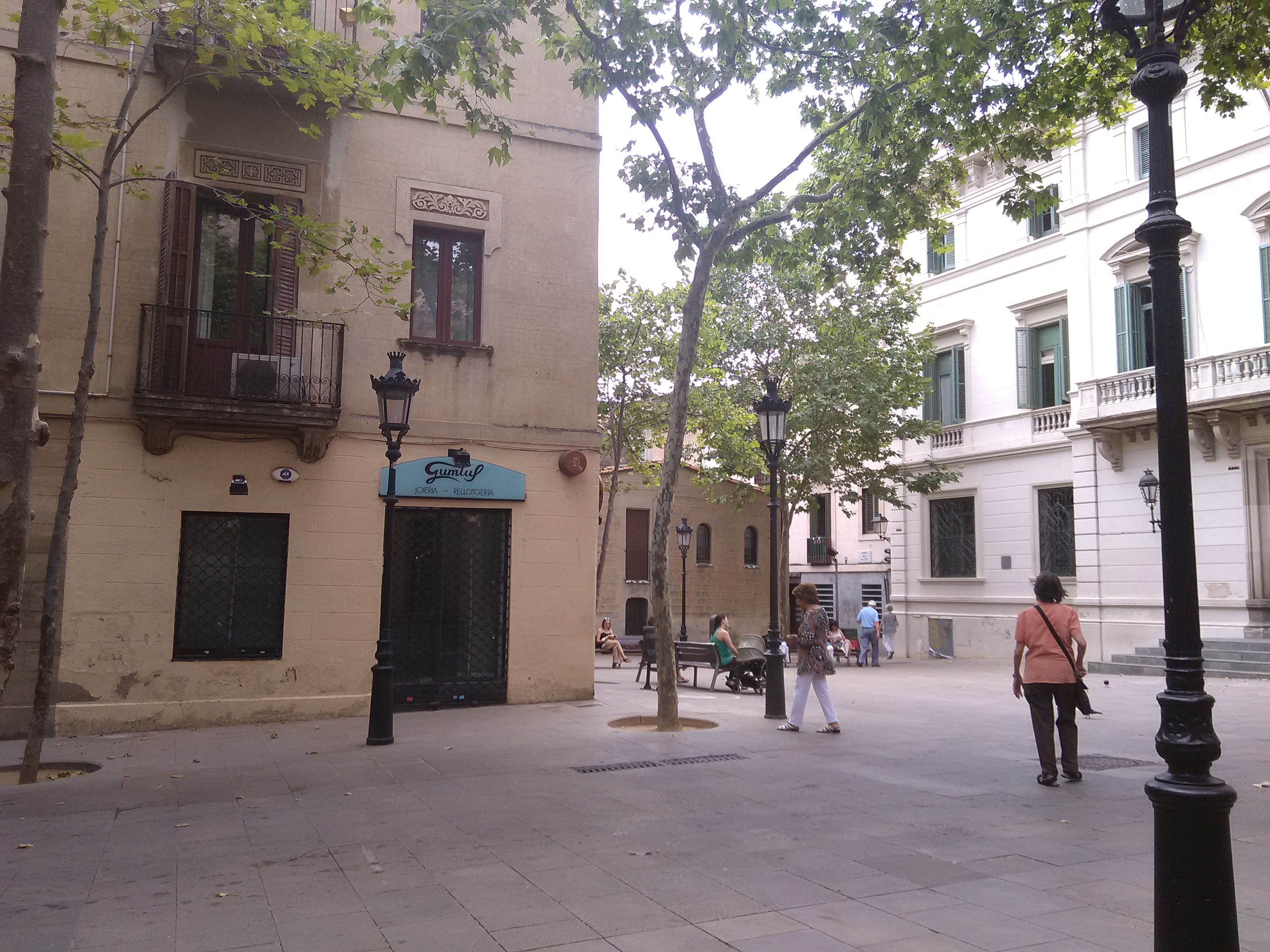
3. Afterwards, in the nearby well-heeled suburb of Sarrià , find a quiet square to linger over a restorative clara.
4. Later still, mooch round looking for a lunch spot where the locals eat: office workers, the granddad who’s collected his small charges from their hockey game, that sort of thing. Enjoy.
5. Later, much later, meet Emily and Miquel. Another meal, I think. Watch this space. It hasn’t happened yet.
We’ve just snuck over to Barcelona. Just for two and a bit days. Just to see Emily, because the last time we were together was in South Korea last autumn.
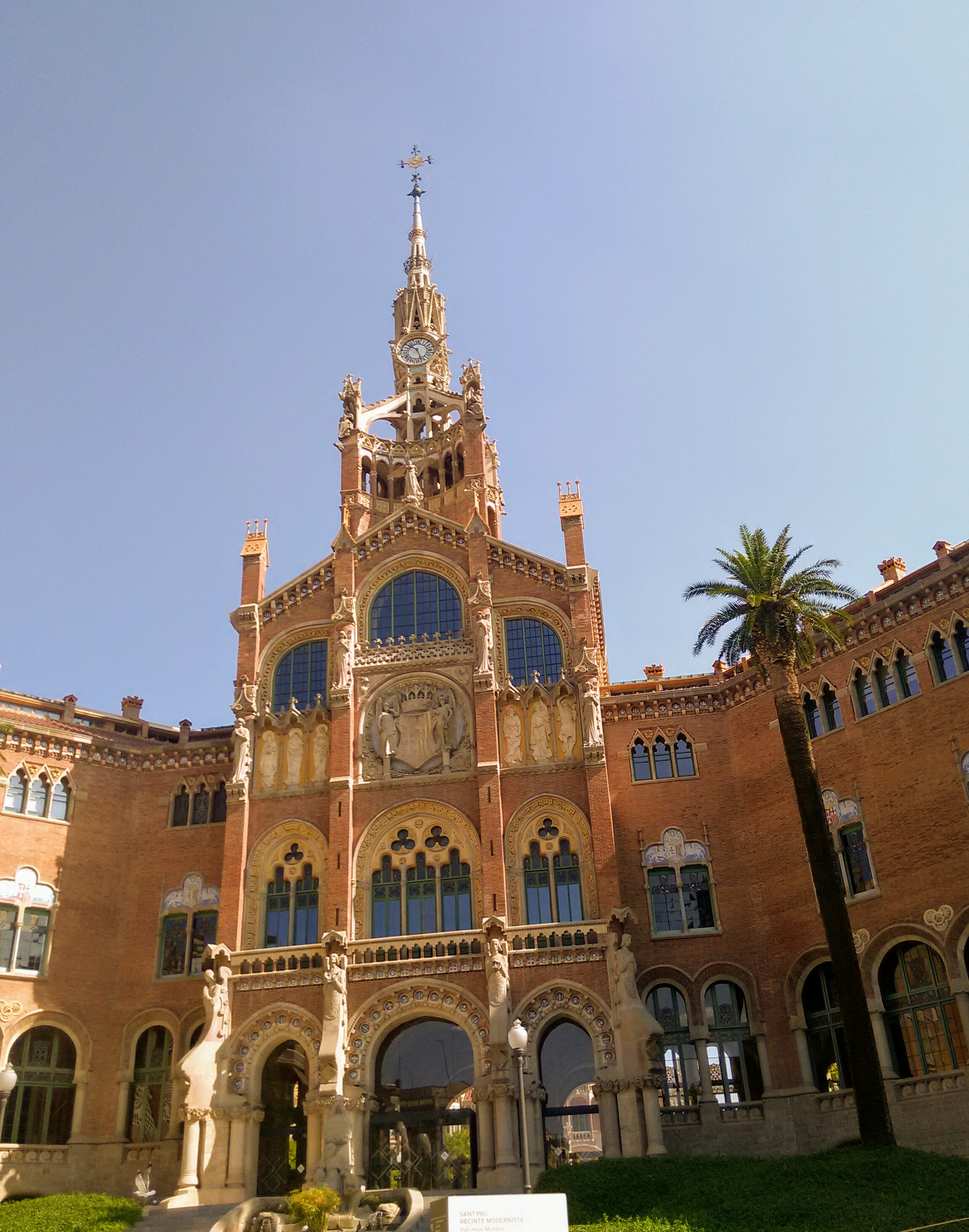
This morning was sightseeing. I’ll just show you a single photo of the Hospital de Sant Pau, a truly wonderful complex of modernist buildings, and a UNESCO World Heritage Site. You’ll get the full tour once we’re back home.
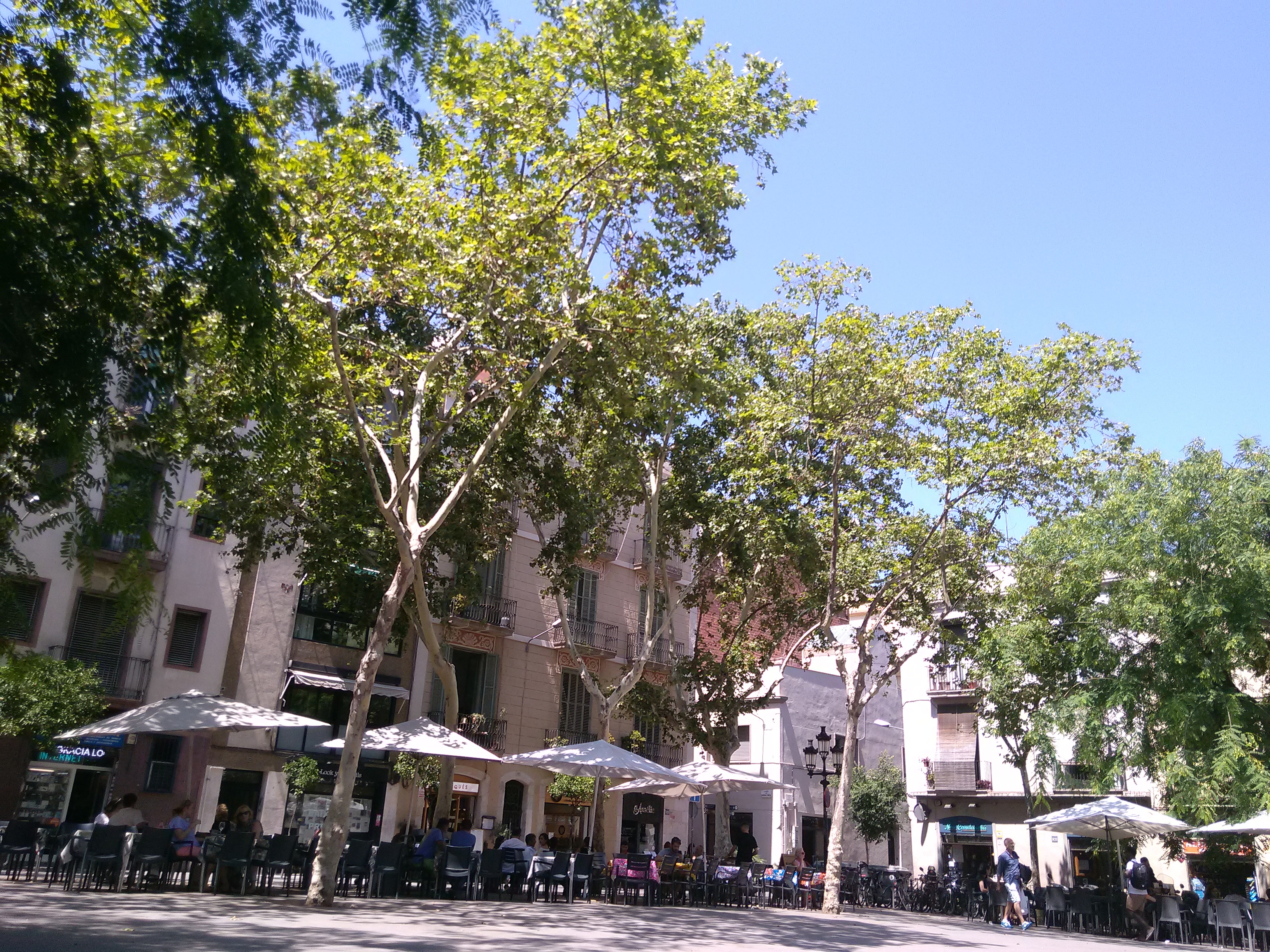
This afternoon was hot. No better way to spend it than catching up with Emily over a leisurely lunch sitting in a tree lined square. It’s what the Spanish do best.
We were in Seville two years ago. Just like every other tourist, we wanted history, the sights, tapas.
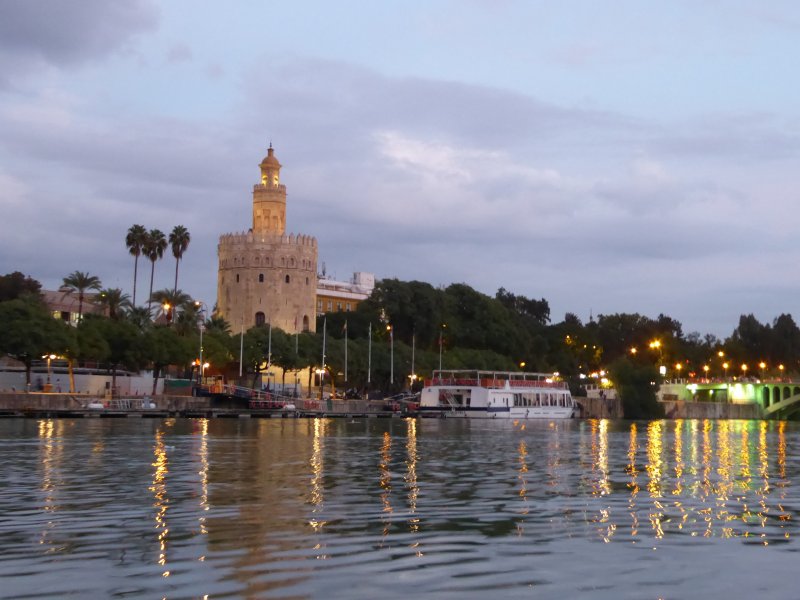
Torre del Oro
The gardens of Alcazar Palace.
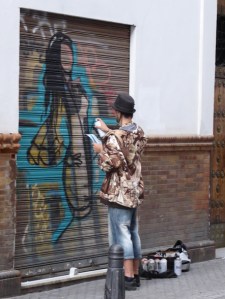
On our walk from the station to our hotel, down narrow back streets, we discovered Seville has other less publicised art works. Almost every garage door that we passed had been decorated: graffiti style, country scenes, market scenes and cars, especially cars…..
Artist at work …
A few however, bridged the gap between the narrow back streets of our first walk just beyond the city centre, and the discoveries we’d make in the next few days, by depicting views of a city we came to love in our short visit.
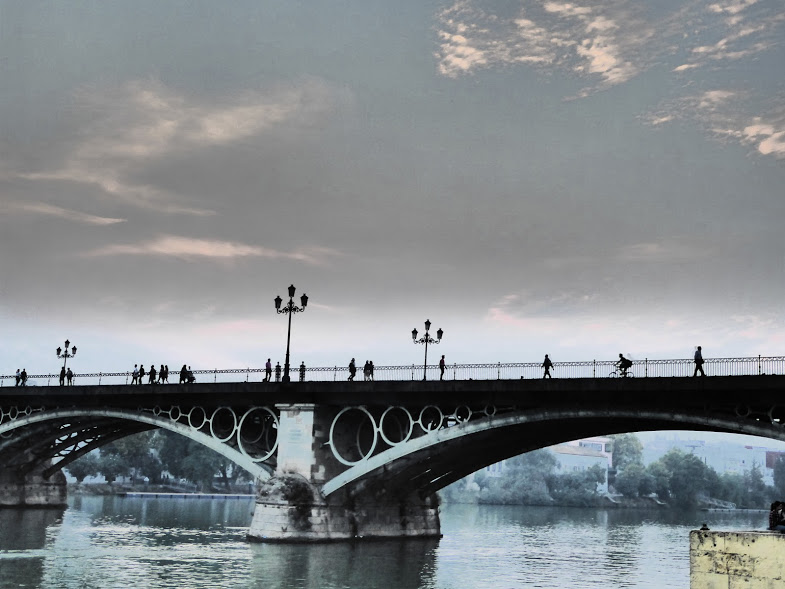
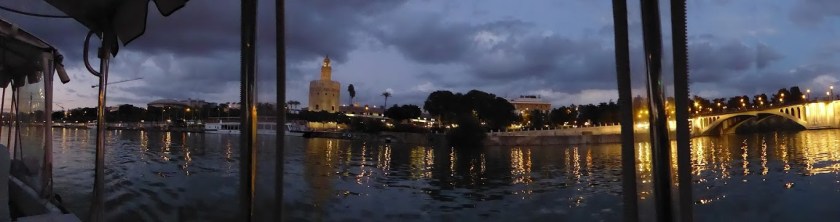
View of the Cathedral, la Giralda, and the bridge.Puente de Isabel IIA more romantic view of Seville by night, looking across the river Guadalquivir towards the Puente de San Telmo and the Torre del Oro.
Torre del Oro by night: or Seville as not seen by Columbus.
‘In fourteen hundred and ninety two
Columbus sailed the ocean blue’……
….as any English school child of my generation will tell you. Well, he actually set sail from Palos, not too far away from the city of Seville: soon it became the gateway to the New World. Ships returned here laden with silver bullion from Bolivia, Peru and Mexico. And before that, in the 12th century, Seville had been the capital of the Almohad Moorish dynasty. So it’s had a splendid past, and has still scores of magnificent buildings from those glittering periods in its history. Seville is famous for its fiestas, its party-going spirit, its bullfights even, and as the home of the tapas, those delicious snacks made the more enjoyable for always being shared with friends. What’s kept us from visiting it until now, I ask myself?
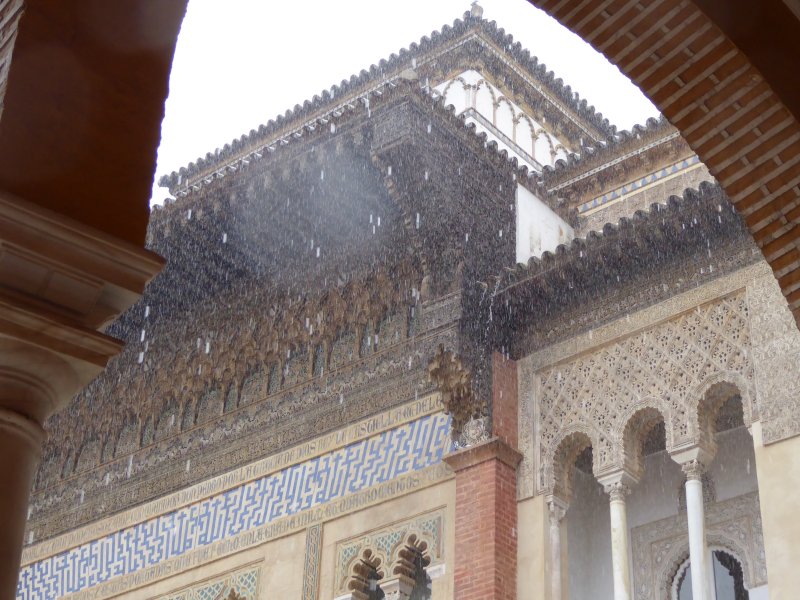
We spent a week there. In mid-October it should have been as warm as an English summer’s day. But in true English style, it rained, deluged, bucketed down for the whole of our first two days. So we’ll draw a veil over the soggy sights we saw then. I won’t tell you about the wonderful cathedral and its Moorish tower, la Giralda , or about the palaces of Real Alcázar: you can read about those elsewhere.
Real Alcazar in the rain.
Let’s talk instead about other highlights: Pilate’s house, for instance. It’s sometimes called the poor man’s Real Alcazar, but for us it was magnificent. A mixture of Gothic, Renaissance and Mudéjar styles, it’s a visual feast of elegant and beautiful tiling of the kind even the meanest back street in Seville will produce a dozen examples. It was the then Mayor of Seville who started to have this house built following his pilgrimage to Jerusalem in 1519. He discovered that the distance from Golgotha to Pontius Pilate’s house was the same as the distance between his planned new home and a Sevillian temple known as Cruz del Campo…. so Pilate’s house it was. Here are some photos.
The historic centre of Seville is a warren of tiny streets, some barely longer than a garden path, no wider than a single car. How does anyone become familiar with them? We didn’t. Once, Malcolm decided to explore what he thought was the parallel street to mine and meet me on the corner. We didn’t see each other again for an hour, not till we’d both abandoned meeting again and each returned to the hotel. On the way of course, we both got waylaid by splendid ceramic tiles in entrance halls, over doorways and climbing up facades. Every stroll through the town was an act of discovery.
Glancing through a perfectly ordinary front door.
Even the undersides of balconies are decoratively tiled.
And street names – often with a strongly Catholic flavour – are always shown in ceramic tiles.
Here’s an old fire insurance sign: ceramic of course.
A favourite: this frieze runs the whole width of the building on both sides.
A narrow street by night.
No cars here, please.
A particularly fine terrace just near where we were staying.
We had a special evening on the Guadalquivir river, seeing the city by night.
I went to a truly wonderful concert, ‘In-vocazione’, that I spotted advertised in a craft-makers cooperative. Sixty singers from Seville, from Italy, and a Franco-Russian-Spanish(??) group sang together, plundering mainly from the folk traditions of southern and Eastern Europe, of Iran, of India,. At the beginning, a single male voice was joined by other men, then by women singing from the balconies. As one group moved down to join the men, more sang from the balconies and others, joyfully, among the audience. They inhabited and involved the architecture of the building as much as they did us, their audience. At the end, as part of their encore, they taught all of us there to join in one of my own choir’s standards, ‘Belle mama’. Singing ‘our’ song with these astonishing choirs was one of the most moving moments of my life.
The women start to sing.
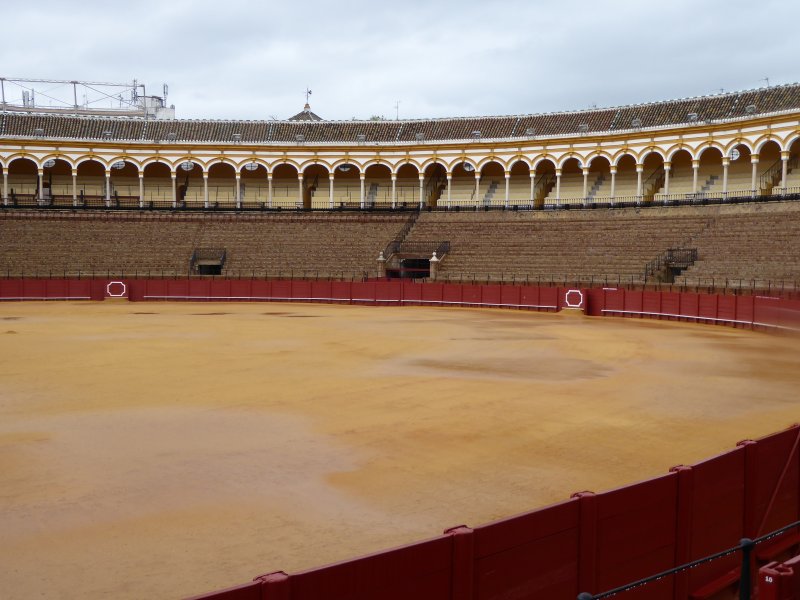
We didn’t expect to enjoy visiting the Bullfighting Museum. But we did. Who knew that bullfighting was devised not as a spectator sport, but as a means of teaching the soldiers of the nobility how to go to war with the enemy? Or that Spain’s youngest bullfighter in recent times was merely nine years old? Or that tickets on the black market to a specially anticipated fight can cost as much as three thousand euros? No wonder we don’t plan to go.
Plaza de Toros de la Maestranza: not a bull in sight today.
And tapas. We ate somewhere new every day. We ate different dishes every day. The variety of foods on offer is quite extraordinary, from refined and elegant to rib-sticking and peasanty, with fish very often being star of the show. Here’s a picture of a DIY dish. Bake your own chorizo over a little bonfire of alcohol. Delicious.
Cook your own tapa.
Let’s end on a popular, un-cultural note. Here’s a sequence of decorated garage doors and graffiti that made us smile as we mooched round the city.
This slideshow requires JavaScript.
Do you fancy going to Seville soon? I certainly do.
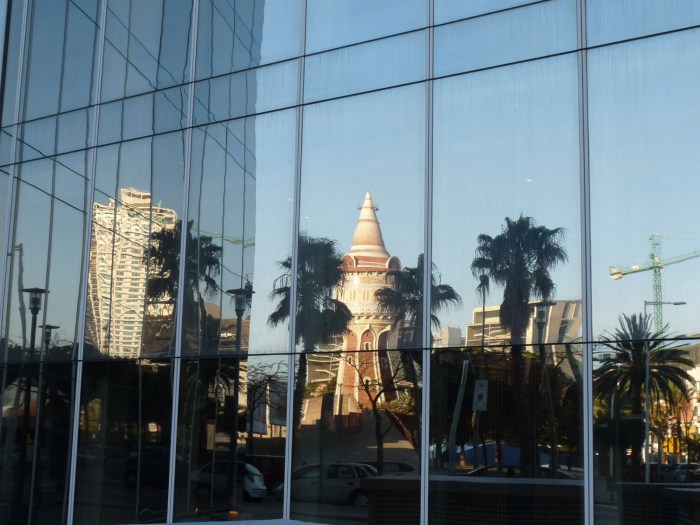
A view of Plaza de España, and the popular horse-drawn carriages of Seville, seen reflected in the windows of the public toilets.
It starts at the airport. No standing for ages in an untidy queue waiting to struggle your way onto your place in the ‘plane. You, your partner and baby are ushered forward, taken onto the aircraft like minor dignitaries and shown to your seats where the emergency procedures are explained.
At your destination, everyone’s prepared to make friends with you, help you in every way they can.
Out at a restaurant, your baby will be the star of the show. He may be passed round for a series of cuddles while you get on with your meal .
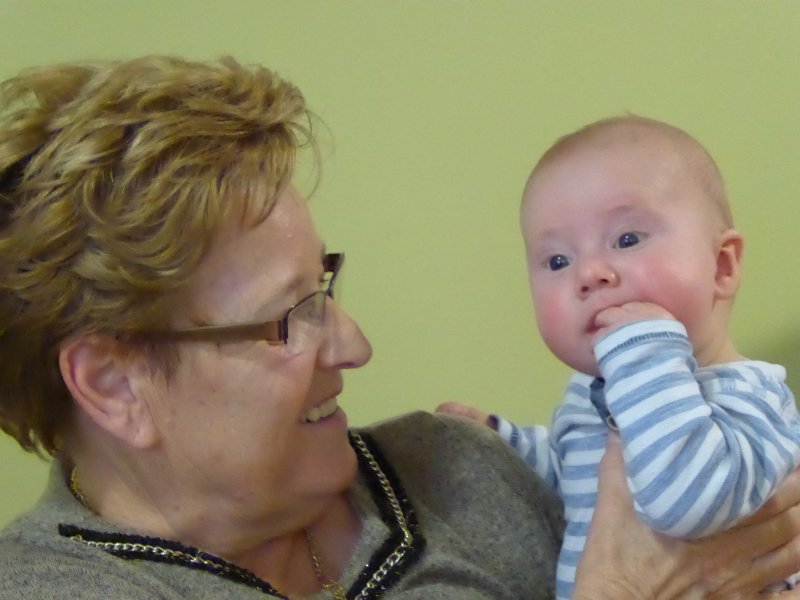
William in a restaurant with his Spanish would-be Granny, who made every attempt to add him to her existing collection of 8 grandchildren.
If you have the sense to travel with two sets of the baby’s grandparents, you may only get a chance to spend quality time with your infant after bedtime and before breakfast. This may mean you see him mainly round about 3.00 a.m. , but you can’t have everything
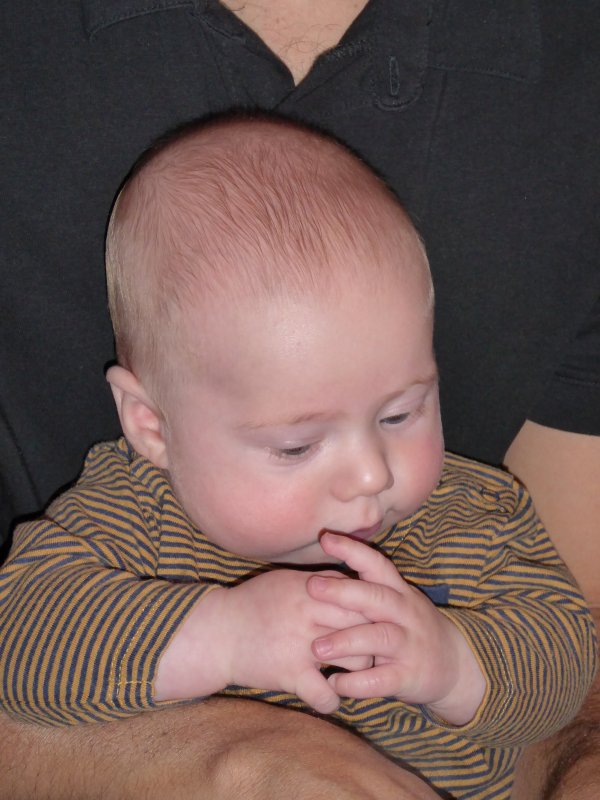
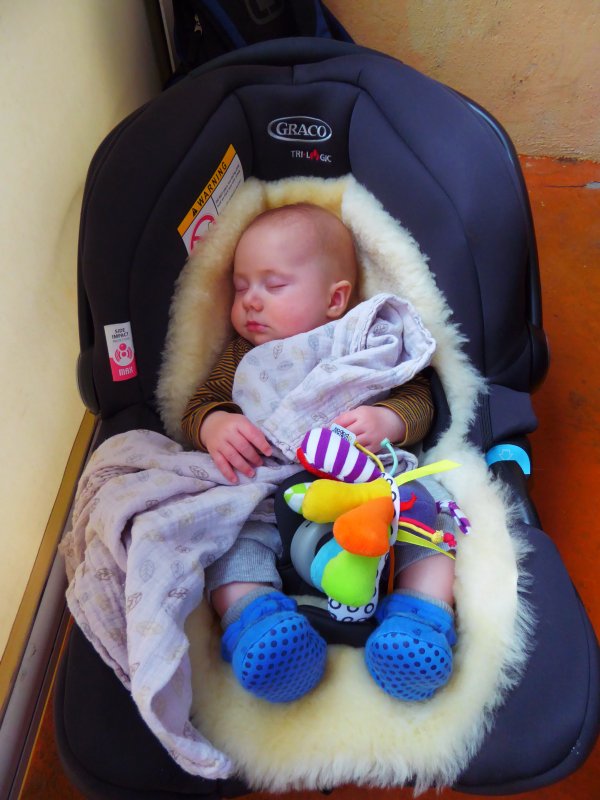
So that was how our holiday in la Rioja, Spain, worked out. We’d gone there with three-month-old William, his mum Sarah and dad Tom (my son), and Sarah’s parents. Daughter Emily and her boyfriend Miquel joined us from Barcelona for the weekend too. We’d chosen an area unknown to us all, which seemed worth exploring. Our base was a tiny hamlet, El Villar, whose only claim to fame is that there are dinosaur prints, lots of them, all over the place. You’ll find them by looking out for life-sized models of Tyrannosaurus Rex and similar ranging round the area. But we spent time wandering round the extraordinarily folded and buckled landscape of hills and mountains and the tiny villages perched on the slopes. There were vultures, soaring high above us on the thermals as they searched for their next meal. There were ancient towns and churches. There were Spanish lunchtimes, lazy affairs that started at 2.00 or so and carried languidly along till 4.00 or later. There were evenings of fiercely competitive card games in which the best (wo)man didn’t always win
This slideshow requires JavaScript.
Most of all though, there was William. He was the centrepiece of a holiday in which an extended family had the chance simply to spend time together, getting to know each other better, and having fun. Babies make good holiday companions.
 In Barcelona, we visited the Monasterio de Pedralbes. It’s not actually a monastery, because no monk has ever lived there. It’s a priory, built in 1326 by King James of Aragon for his wife Elisenda de Montcada, who wished to found a community of Poor Clares there. Poor Clares? These are nuns who devote themselves to a life of simplicity and prayer, and in Elisenda’s time were almost always drawn from the ranks of the aristocracy. She herself never became a nun, but she was very real presence in the life of this community.
















 From Pyrenees to Pennines
You must be logged in to post a comment.