Fast food

You’re busy in town. No time for a nice relaxing lunch. Not enough money anyway. What to do? Here in Korea, it’s easy.

You pop into your nearest mini-mart, perhaps a 7-Eleven. You buy a carton of noodles from the vast choice available – think pot noodles with dozens of flavours to choose between. You buy a mug of coffee that so far is simply a cardboard cup with a sachet included.

You pay. You collect chopsticks, and sit yourself down at a table to get organised. There’s the hot water dispenser. There’s the microwave. Get cooking. Relax! Enjoy your food, your drink. Sit down for a few minutes and count your change.

That lunch – and it wasn’t too bad at all – cost about £1.50.

Something old, something new.

Korea is a fascinating mix of the bang up-to-date and the resolutely traditional. I can only talk about what we’ve seen, but we’ve seen quite a bit.

In the land of Samsung, Hyundai and Kia, almost everyone is semi-permanently attached to their smartphone. Just take a metro journey and watch them all, immersed.

In this same country though, you’ll find dozens of little back street workshops where they’ll try and fix your failed toaster, or put a few stitches in your now just a little saggy bra.

On the one hand there are clever, highly qualified whizz-kids working away in their state-of-the-art studios. On the other there’s a little old lady squatting on the roadside with a handful of vegetables to sell, or an old man with a cart or bike amassing discarded cardboard.

On the one hand, there’s Starbucks, Dominos, MacDonald’s et al. On the other are little family food businesses feeding locals from tiny one room restaurants, street stalls, or places in the market. We all love the tasty traditional food they provide, but will they survive into the next generation? Who would want such a gruelling life for their child? The food sellers of today make sure their children are educated for different choices.

I could go on. High-rise living versus traditional hanok: those traditional homes, till recently the homes of the poorer classes are suddenly desirable again. Here in Gyeongju, new hanoks are going up, built of fine materials – quite state-of-the-art, right next to their shabbier antecedents.

I wonder how Korea will change its habits over the next generation or so?

A day with the Shillas

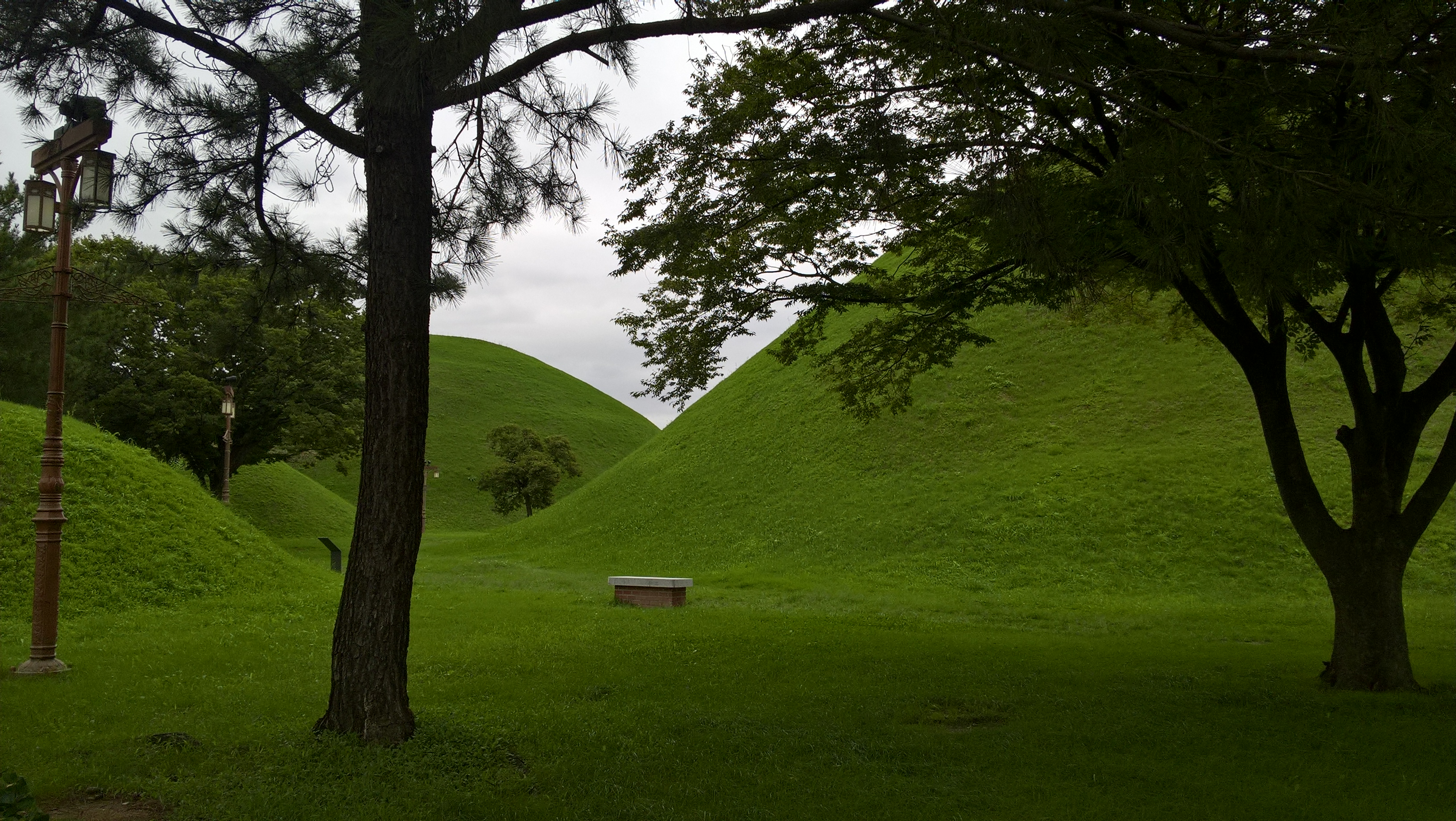
After yesterday’s exploration of what my friend Penny is pleased to call Teletubby land, otherwise known as the burial mounds of the Shilla dynasty, we wanted to know more.

We went to Gyeongju National Museum. We saw the most extraordinary Shilla artefacts, from the Neolithic era right through to the early 10th century, when the dynasty finally ran out of steam.

Such exquisite early tools and pottery. Then, when the Shillas recognised the need to bury their kings by equipping them for the next world, what exquisite jade and fine gold jewellery and ornaments.

How come we learn about the ancient Egyptians, but not about these sophisticated and forward-thinking people? It really is our loss. I want to know more.

The only pictures I’ve got to show at the moment are the gold accessories that a sixth century Shilla monarch would have worn in life, and taken with him to the after-life on his death.

The stimulus of tumuli

If I take just one thing from our visit to Gyeonju, it’ll be this.

The busy town is broken up by expanses of parkland. In these parks are tumuli – large grassy mounds. Some are fairly small, some are enormous. Each one is the burial place of a monarch from the long-enduring Shilla dynasty, which lasted from 57 BC to 935 AD, or one of their family. Like the Egyptian pyramids, these mounds contained fabulous treasures: we’ll go and see some tomorrow.

For us, these mounds are striking enough, even without sight of their treasures. I wonder why they’re so little known outside Korea?

An apology

This blogging from Korea malarkey is turning into a nightmare. Posts get published, or not, according to the whim of who-knows-who? Photos are worse. Sometimes they appear, sometimes they vanish, then reappear, from an already-published post. Facebook users have the added joy of seeing the same pictures of the Ariège every time one of my posts appears.

It was never supposed to be this stressful.

So pictures I’d like you to see will appear, but back in England, when I shan’t have to contend with a not-so-very smartphone.

Bulguk-sa. A suitable twinning with Fountains Abbey and Studley Royal?

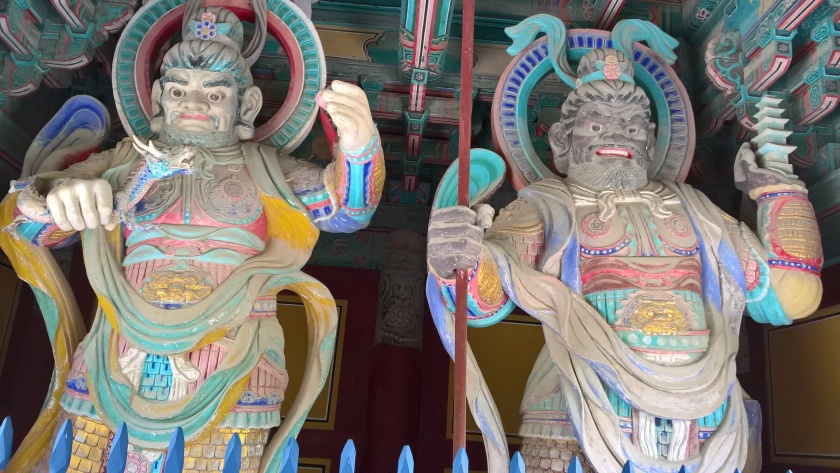
WP_20160928_10_13_45_Pro_LI.jpgWe went to one of the oldest surviving Buddhist monasteries in Korea today, Bulguk-sa. Like Fountains Abbey, it’s a UNESCO World Heritage site. It’s been around about 250 years longer than Fountains, as it was started in the year 751.

Both are religious foundations. But whilst the monks were forced to leave Fountains Abbey on the Dissolution of the Monasteries in 1539, Bulguk-sa is still an active religious community. We were moved this morning by witnessing a solitary monk chanting his devotions in one of the buildings.

Both suffered the destruction of their buildings. Bulguk-sa, like so much of Korea’s heritage, was burned by Japanese invaders in the 1590s. Fountains Abbey crumbled following the Dissolution at much the same time.

Fountains Abbey remains a ruin. Bulguk-sa has been rebuilt. The Japanese destroyed Korea’s heritage so often and so comprehensively over the years that if significant buildings were not restored there would be, quite simply, nothing left.

So I think a twinning arrangement is in order. Exchange visits once a year as a minimum. Though with genuine Buddhist monks to welcome us at Bulguk-sa, I wouldn’t turn up in my polyester dressing-up robes from Fountains Abbey.

The March Road of King Sinmoon

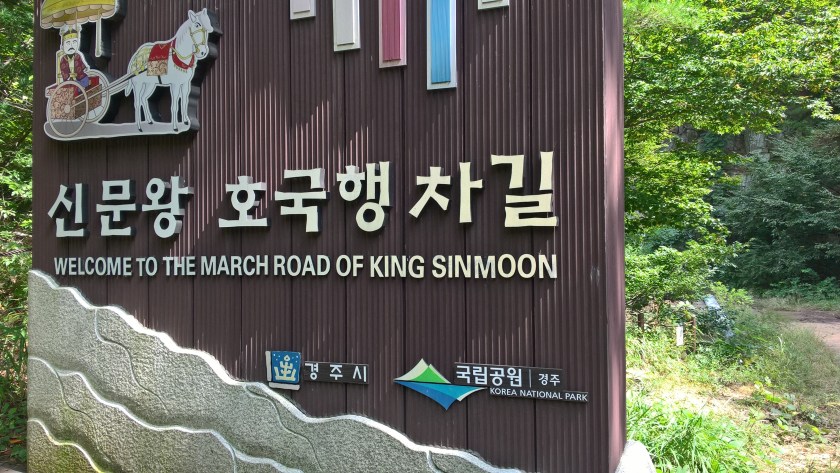
WP_20160927_12_35_12_Pro_LI.jpg

That’s what we walked today. The signboard in Gyeongju National Park told us so. But that was the only bit in English, and Google is not being helpful.

On the signboard, the king is in a chariot. We couldn’t see that working. We were up and down hill on a woodland walk that closely resembled one we might have had in the Ariège, or England, or …. lots of places. Rocky, stony, full of little streams and trees, trees, trees.

Except… there were dozens of little acid-green frogs darting ahead of us as we crossed the streams. Chipmunks zoomed up and down trees. I saw a sinuous and speedy watersnake

And we sweated. How we sweated. We only walked eight km.there and back from the Yongyeonpokpo Falls, which are not in anyone’s Top Ten ‘must see’ waterfalls, though they’re nicely restful. And we were soaked. And utterly exhausted.

Next time we’ll emulate King Sinmoon and take a chariot.

Our rural retreat.

I’ve messed up. After Busan, we chose Gyeonju, a city so rich in history it’s known as ‘the museum without walls’. I booked us in at a guest house, as I thought, just beyond the edge of the town.

Our hosts kindly came to collect us from the bus station. We left town. We left out-of-town trading estates. We left any form of housing. We left the main road. We started to climb. We saw a sign ‘Gyeonju National Park’. Still we travelled.

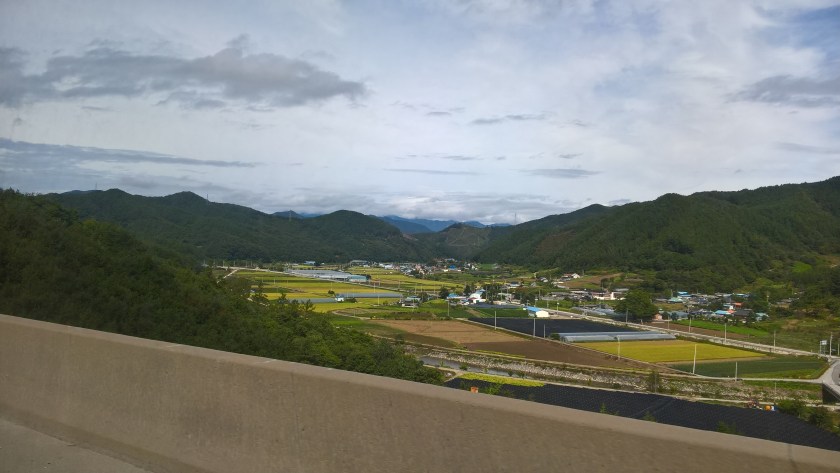
And after thirty five minutes we pulled in here. We’re surrounded by forested mountains, by bubbling streams, by tiny smallholdings set into the valleys. There are cicadas, songbirds, slightly officious magpies. There are frogs and fish in the pond, and red and blue dragonflies. There are even some adorable kittens.

Do you really think I’ve messed up?

How to be a Korean woman

You’re young, female and Korean. Perhaps you’re a student, a worker, even a mother. You’re slim, stylish, beautiful, have enviably flawless skin, and shiny long dark hair. Just like all your friends.

One night however, you go to bed, and you wake up in the morning as an ‘ajumma’, an auntie, an older woman. You’ve shrunk four inches, your hair is shorter, perhaps even curly. You’ll put on nice comfy trousers and no longer remain silent on bus rides. Most importantly, you’ll wear your badge of office. This is a quite enormous visor, worn to protect your skin from damaging rays from the sun. You won’t go out without one.

There is no half way house that I can see. You’re young. Or you’re an ajumma. That’s it.