If you go to London, and if you go to the Victoria and Albert Museum some time before next February, don’t miss a rather special temporary exhibition I saw there this week.
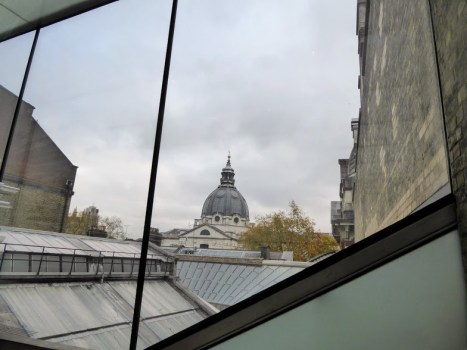
Find the glass lift, and allow it to sweep you upwards to the sixth floor. Here, from this light and airy vantage point, you can enjoy views over the museum and beyond.
Contemporary Korean ceramics. That’s what you’re looking for. There are glossy ceramic tiles, reinterpreting Korea’s exquisite porcelain from the Joseon dynasty (you can see examples of these down on the first floor). There are wonderfully lustrous translucent vases, in luminous reds, yellows and blues. Oh wait …. they’re carved from soap.
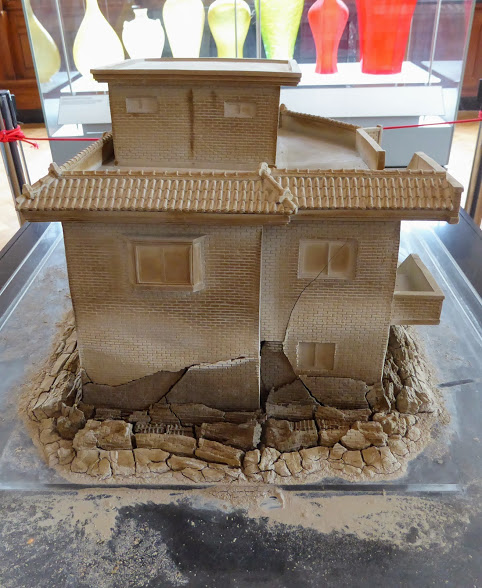
But what drew me back, several times, was this house.
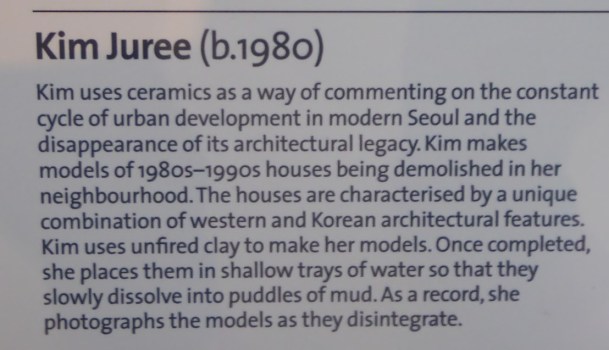
Here’s what its creator Kim Juree has to say about this, and the many houses she has created in the same idiom.
So what you’ll see if you visit won’t be what I saw. Don’t wait too long. This temporary structure isn’t long for this world.
If you peer behind the house, you’ll see a few of those vases carved from soap.
I’m pretty fed up. I was sickening for something down in London, and once I got home, The Virus took a grip. Goodness it’s malevolent: and it’s not letting go. The only consolation is that I’ve got through an astonishing number of books, including Min Jin Lee‘s Korean family saga Pachinko.
This is the story of several generations of one Korean family with roots near Busan, who emigrate to make a new life in Japan following the repressive occupation of their own country by the Japanese from 1911. It’s a compelling family saga taking us from 1911 to 1989; from poverty to economic stability, with sacrifice and hardship as constant themes.
How could I not be interested, since Emily’s just returned home to Spain from a year in Busan? And yet the world in which the book begins is not one she or we would recognise. A time traveller from 1911 or 1930 London, Liverpool or Leeds would find a lot that’s familiar in those same cities today. A time traveller from Busan? Not a chance.
The story starts in Yeongdo, which is now part of Busan, but was in 1930 a fishing village on an island set apart from the mainland.
‘…..the market ajummas squatting beside spice-filled basins, deep rows of glittering cutlass fish, or plump sea bream caught hours earlier – their wares arrayed attractively on turquoise and red waxed cloths spread on the ground. The vast market for seafood – one of the largest of its kind in Korea – stretched across the rocky beach carpeted with pebbles and broken bits of stone, and the ajummas hawked as loudly as they could, each from her square patch of tarp.’
Here’s an ajumma, 2016 style, at Jagalchi market.
Well, I doubt if the market is still there – it certainly won’t be on the beach. Instead, the immense Jagalchi fish market is on the nearby mainland, together with ajummas, certainly, but these days it’s all plate-glass buildings and the ephemera of modern port life.
Jagalchi Market – outside ….
…… and inside
As for Yeongdo. No longer is it an island fishing settlement, with small wooden houses surrounded by productive vegetable patches. I can’t find any pictures, so instead must rely on Min Jin Lee’s word pictures of empty beaches, densely wooded hillsides rich in edible fungi. Those hillsides still exist – but look down over the settlements and the docksides below. And Yeongdo is linked to the mainland by a bridge. Sunji and her family wouldn’t recognise a thing.
Apart from my photo of an ajumma selling fish, all other images are from Wikimedia Commons
1592 was a terrible year for Korea. The Japanese invaded. They raged through the land destroying all they saw. They burnt ancient temples and state-of-the-art palaces as well as ordinary homes. Little was left.
Imagine an England in which every cultural icon was destroyed in WWII – Buckingham Palace, St. Paul’s Cathedral, York Minster, Salisbury Cathedral, Chatsworth….. that’s the kind of morale-destroying disaster Korea faced in 1592.
Rather than accept these losses, Koreans rolled up their sleeves and built everything again, on the same site, and to the same design. Not just once, but in some cases several times, as a consequence of later invasions and revolts. Unlike our own historic buildings, these structures are made not from stone or brick, but from the wood from monumental long-lived trees with statuesque trunks and mighty branches. These palaces and places of worship are carved to traditional patterns and painted in an accepted range of colours with time-honoured designs and images. To our eyes, these palaces and temples look fairly similar. But once we overheard a group talking – ‘Look, anyone can see that’s twelfth century: not a bit like the 15th century style we were looking at earlier’.
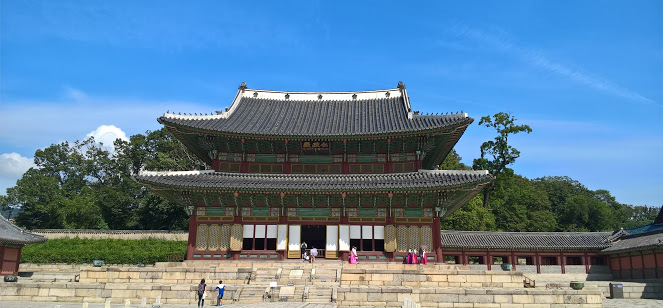
Here’s Seoul’s Changdeokgung Palace. It was first built in 1408 for the Joseon royal dynasty and designed with an extensive natural garden in harmony with the topography of its surroundings. The Japanese burnt it down in 1592. It was rebuilt in 1608, burnt down during a political revolt in 1628, and again by the Chinese Manchu-Qing. Each time it was faithfully restored to its original design. The long Japanese occupation of Korea from 1911 to 1945 saw it heavily damaged yet again: once again it’s been restored, though only about 30% of the original buildings remain.
Against the odds, this palace and its grounds together form a UNESCO World Heritage Site, recognised as a fine example of Far Eastern palace architecture and garden design in harmony with their natural setting. This is a fine and tranquil place.
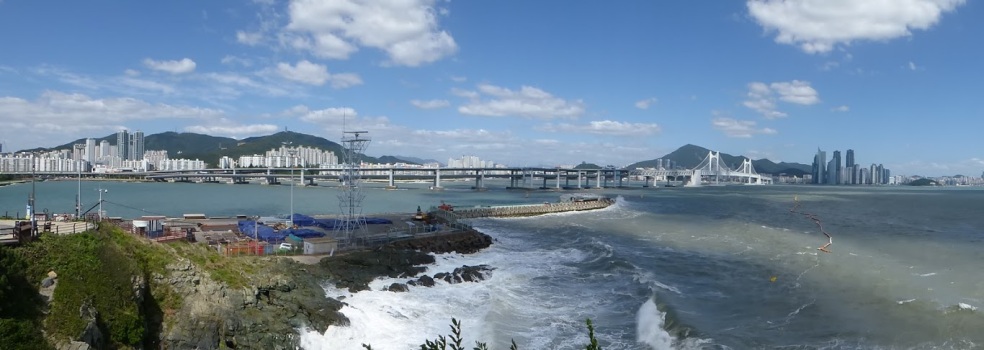
The view from the Igidae Trail to Busan and Haeundae
Life’s complicated just now. I don’t need any more challenges. But here I am, taking on one which is entirely self-imposed. It’ll help me reflect on the good moments in life, or at least on interesting times.
The challenge is one provoked weekly by WordPress, my blogging platform. Once a week, they provide a word. Just one. To respond, I and fellow bloggers choose one of our own photos to interpret the theme. Just one.
Imagine Busan, the city where Emily’s living just now. Imagine busy streets, crowded markets, streaming traffic, a high-rise metropolis of three and a half million people.
But it’s a coastal city too, and one day we took the path at Igidae. Here were views across the bay to those high-rise towers at Haeundae, to Gwangan Suspension Bridge, and to a jagged, rocky coastline.
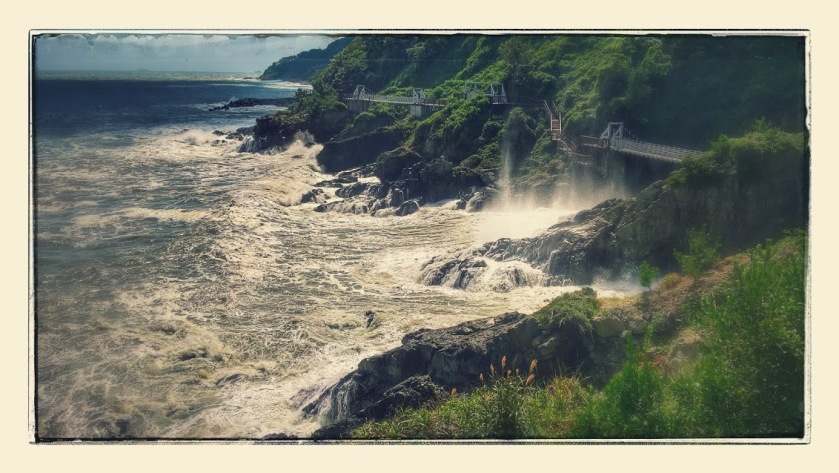
As we walked away from Haeundae, we replaced city bustle with solitude, with crashing foaming waves, salty spray crusting our hair and faces, rugged paths leading us first up craggy cliffs then down again. The busy city was never more than minutes away, but we were at the edge of a primitive, savage untamed world, unchanging since time began. That was a kind of magic.
The sea crashes to the cliffs of the Igidae Trail
My challenge posts will appear on Sundays. Hence ‘Snapshot Sunday.’
Why go for a good long walk? Well, for the pleasures of the countryside of course. The views, the mulchy paths through woodland and across meadows: all the sights and sounds of The Great Outdoors. But for most of us, there’s another reason too. We want a decent bit of exercise. Get those legs into gear!
It’s no weather for walking at the moment, so in front of the fire, we fell to reminiscing about walking in South Korea. Not the mountain walks to hidden temples, secret waterfalls. No, we remembered walking in the metro systems of those mega-cities of Seoul and Busan.
It was courtesy of the subway that we got from A to B when we were tourists in those cities. Our command of hangul was so limited that the bus had disappeared round the corner before we’d decoded its destination.
Announcements on the stations were helpfully in Korean and English, and you knew which direction the train was heading in, because as it pulled into the station, a tune would play. Outward – one tune: inward, another. One of Busan’s tunes was a few bars from Vivaldi’s ‘Four Seasons’.
Seoul subway. Once in the carriage, we older travellers had a dedicated area where the younger commuter wouldn’t dare to sit, unless disabled or pregnant.
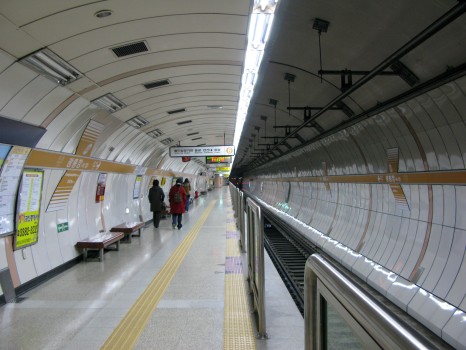
But all that’s for when you’d reached the platform – sorry – ‘tracks’. First find your platform. At one station in Busan, I found that once below ground, I still had a whole 750 metres to walk to get to the automatic ticket barrier marking the station entrance.
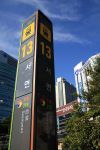
Here we are. Exit number 13
Some stations were vast, with up to 16 exits spread over a large geographical area. Leave by the wrong one and you could find yourself clueless, or stranded on the wrong side of an impenetrably busy highway. Within the station, distances can be so great that they’ve often installed travellators – not to mention three or even four long steep sets of escalators plunging far into the earth. Or a lift – sorry, elevator – four storeys deep. But it won’t get you out of walking, walking, walking, along sparklingly clean tunnels, unending platforms. No wonder every station has scrubbed and user-friendly public toilets for the weary traveller.
And who knew that stations can have more than one stop? If, for instance you need to transfer to another line at Eulji-ro in Seoul, you may need to catch a train to get to the line you’re changing to. And then there’ll still be a route march to get to the right platform.
Seoul metro system. There’s a pre-paid transport card that you can use country-wide, making day-to-day travel super-easy.
If your main interest in walking is to burn off the calories, I can recommend a trip to the metro system in South Korea. Plan a journey from one station to another, build in a couple of line changes, and you’ve more than got your 10,000 steps a day under your belt.
Here’s a challenge we spotted whilst walking down those the long station corridors. Guess the work of art inspiring this advert. Answers in ‘Comments’ please!
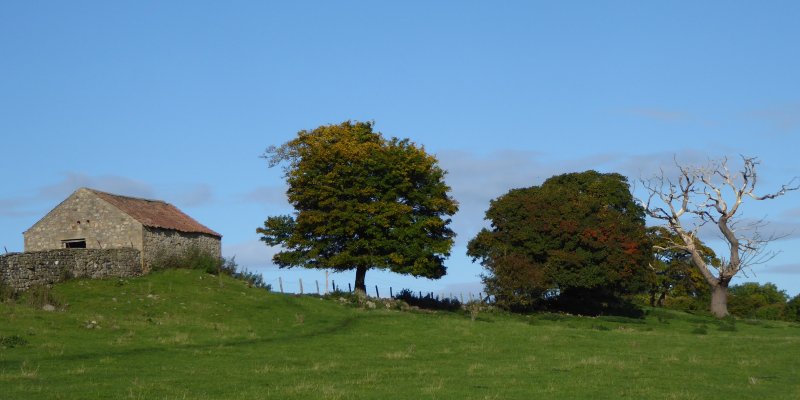
Back in England, it’s time to dust down our walking boots again. As we stepped out today, on a beautifully fresh and clear early Autumn morning, we contrasted our walk from nearby Masham with hikes we’d gone on in Korea.
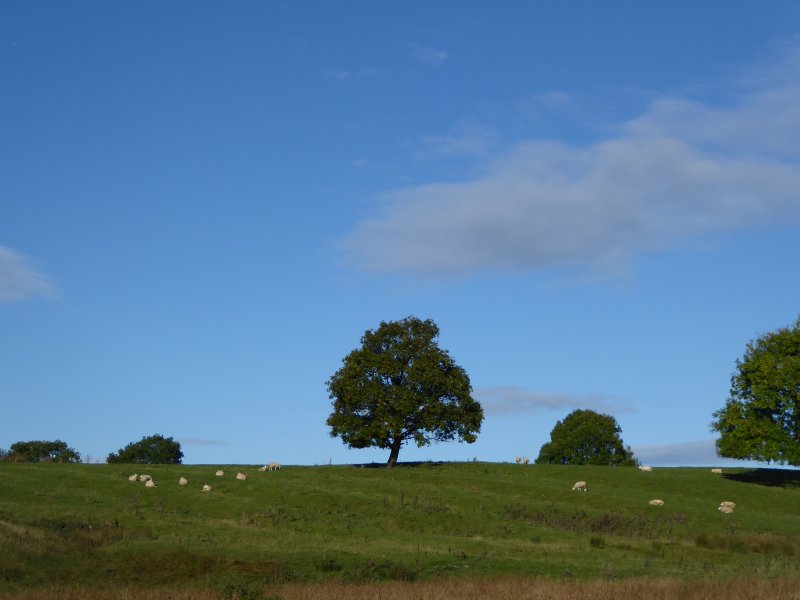
It was the weather we noticed first. Probably it’s colder there now too, but then, we wore t shirts and battled against the humidity. We wore fleeces today. We tramped through fungus-laden woodland in both countries. Here though, as we glanced at the tussocky meadowland near the River Ure, we saw sheep, sometimes cattle . There, valley floors were terraced with paddy fields, citric green with young rice.
Here, there were distant views of solid stone barns and farmhouses – even a country house, Clifton Castle. There, we were more likely to come upon a hidden Buddhist temple, its solid, yet graceful wooden form painted cinnabar, blue-green, white, yellow and black.
In Korea, woodland in the countryside is dominant once you get away from ‘civilisation’. Here, we drifted between woods, meadows, ploughed fields and ground by the open river .
We enjoyed the lot. But today, we appreciated saying ‘hello’ again to our familiar local landscape.
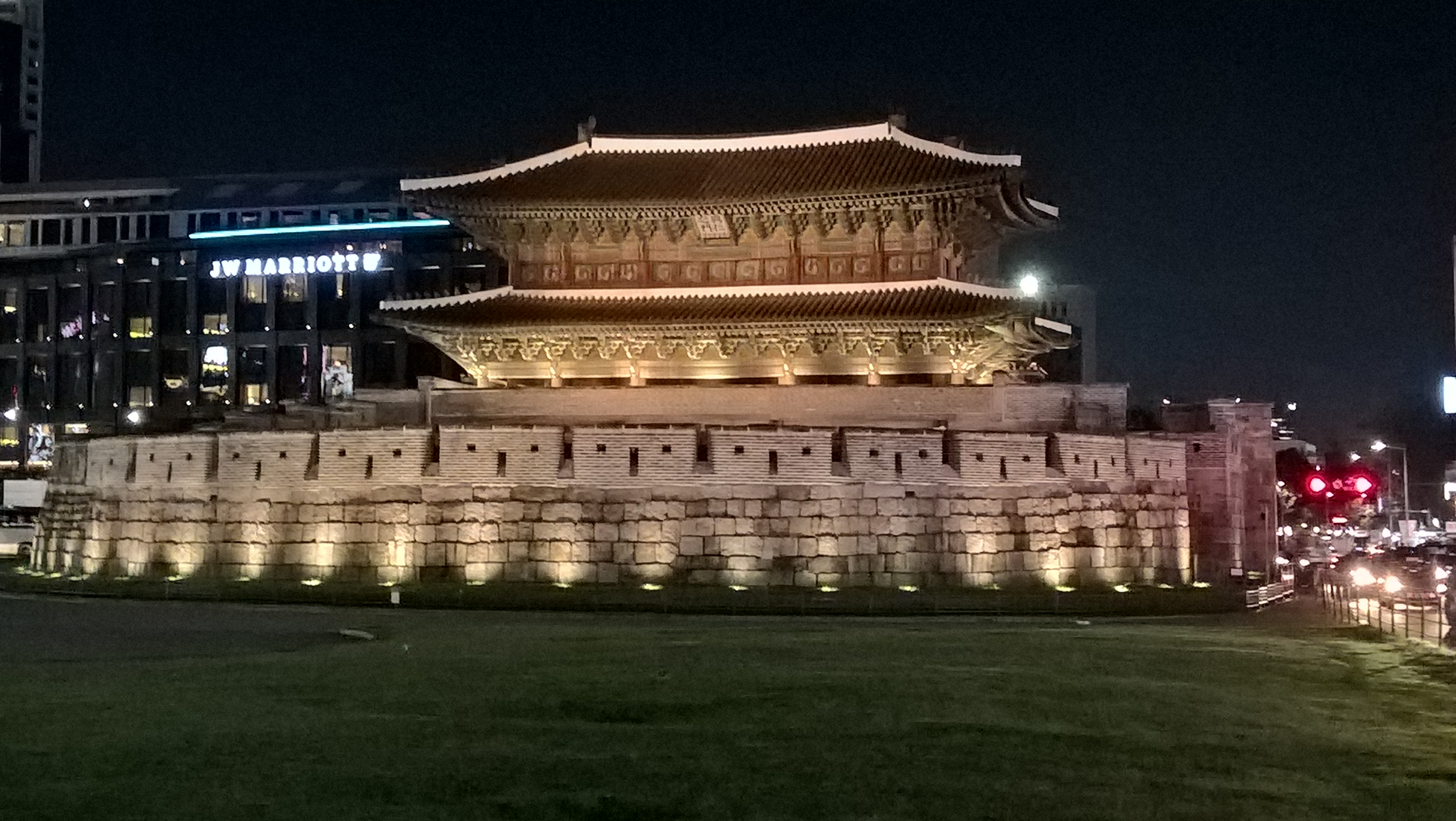
Here’s a photo we took this evening of one of Seoul’s old main city gates, Dongdaemun. Next to it is a street market, several modern hotels and high-rise buildings, endless traffic, shops, cheap restaurants. A real slice of Korean life.
When hiking in Korea, it looks as if you need an objective. There and back to see how far it is won’t do.
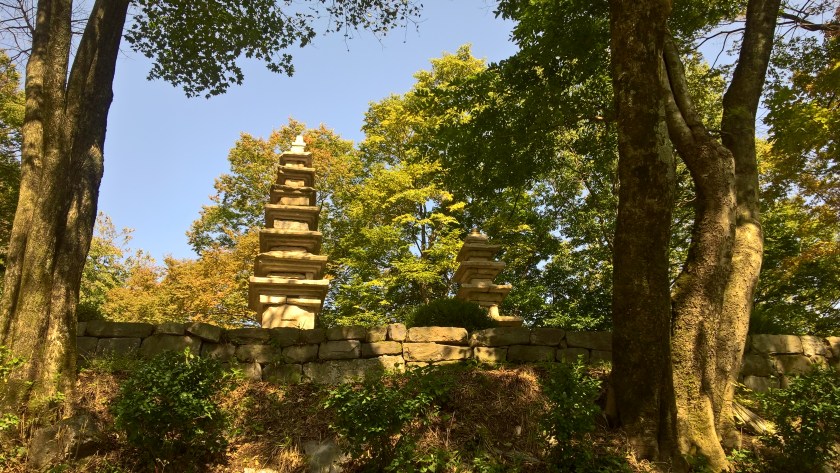
So yesterday we became Korean hikers for the day, and followed upward, ever upwards the path to Nammaetap, the Brother and Sister Pagodas.
This is the story. Back in the days of the Shillas, a monk living in a cave right here in the mountains found a tiger who appeared before him in agony, with a bone in his throat. Of course the monk helped him. Days later, the beast reappeared with a thank you offering. A beautiful girl. The girl said the tiger had snatched her away from her marriage ceremony. The monk sent her home, but too late. The wedding had been cancelled.
The pair agreed to live as brother and sister, and devoted their lives to the service of Buddha. They passed into Nirvana on the same day, and are remembered in these two pagodas, situated high above the temple at Donghak-sa. This is one of the few monasteries in Korea where you will find Buddhist nuns.
Even without the story to entice us upwards, this was a wonderful, tough walk through woodland, along streams, up a steep rocky path to views at the top from those two pagodas.
Here we are, out in the sticks, just outside the boundary of the Gyeryongsan National Park.
Only it turns out we’re not really in the sticks. Down the road are two villages. They mainly exist for tourists, and are edged by hotels.
Not walkers in woolly hats and fleeces though. Instead, visitors lounge around in one of the dozens of coffee bars. The walkers – and there are plenty – just use the public car parks and then yomp straight up a mountain.
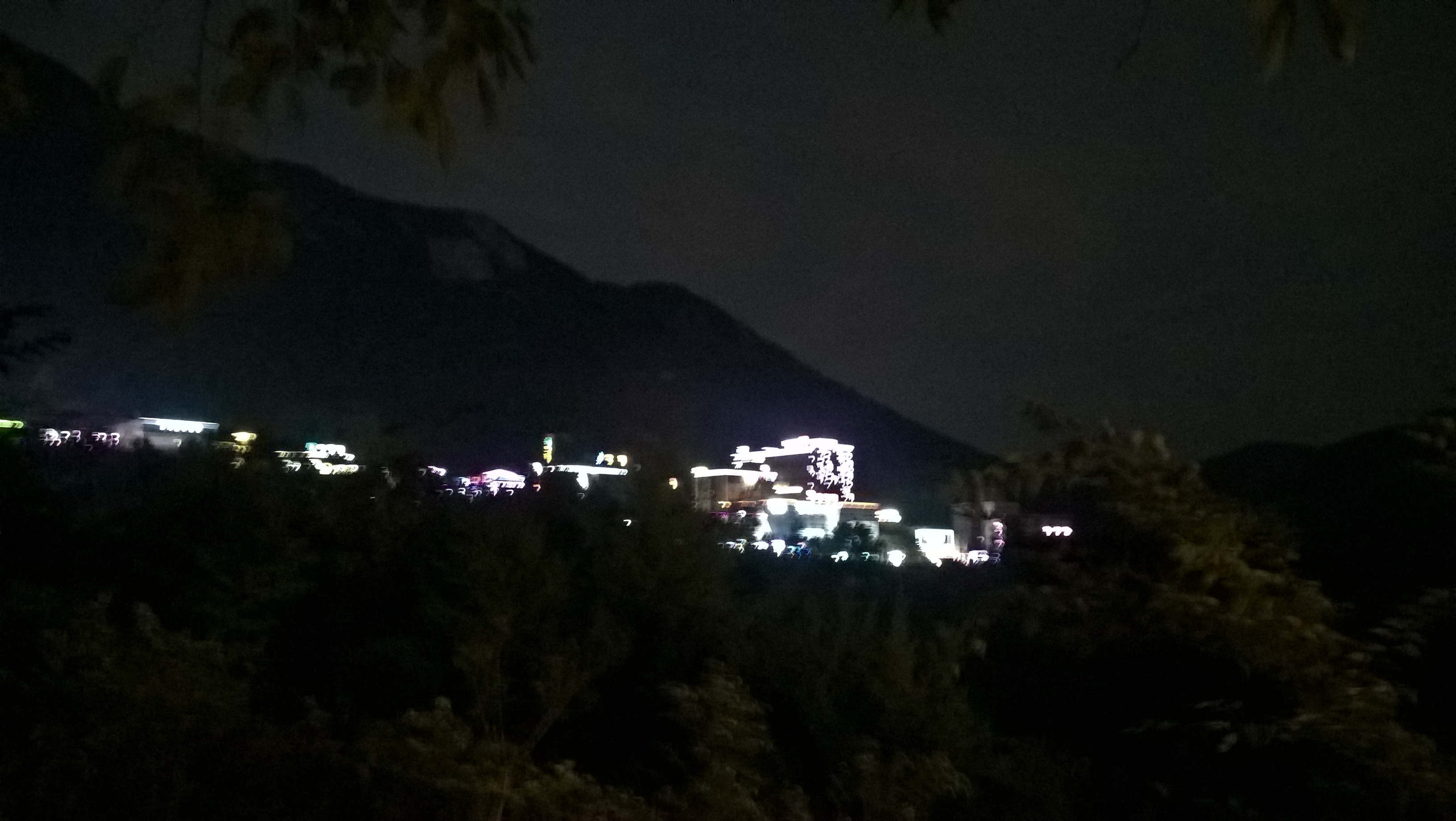
This is the scene as the sun goes down. The hotels light up, and stay lit up till six the next morning. There are displays of coloured raindrops or flashing rainbows.
Blackpool illuminations, right here on the edge of Gyeryongsang National Park. Best stay in and shut the blinds.
We hated Jeonju on sight. High-rise hell. It got no better, so we cut and ran this morning, having booked the only place we could find in Gongju within our price range. Well, just outside Gongju, anyway …
KTX (High-speed train) to Gongju Station. It turned out not to be all that handy. The station’s 20 km.from town. And our hotel’s 30 km. away, in a different direction.
The woman from Tourist Information at the station had clearly had no custom all day. She took our problem to heart. She thought hard. The best she could come up with was a bus (journey time 1.20 minutes), due in a while, then a taxi.
The bus arrived. She ran out to talk to the driver. Success! He would take us beyond the terminus to the bus garage, and from there we could walk.
Our bus bumbled along country roads, climbing and climbing into the mountains of the Gyeryongsan National Park. It was beautiful, yet shabby, rather like the Ariège with added paddy fields. We were the only passengers, and entirely happy, looking out at scenes of Korean country life.
Suddenly, the driver stopped the bus. He indicated we should wait and dashed into a rural Police Station. Did he need a pee?
After five minutes, he reappeared, in the company of a police officer, and motioned us to dismount with our luggage. He was smiling cheerfully.
The PC had just a little English, and explained he’d take us to our hotel. And bundling our luggage into his patrol car, that’s exactly what he did.
So here we are, stuck in the mountains for our last three days. Do we feel stuck? Not at all. Our plans may have changed, but in a good way. We found a little restaurant for our evening meal and became quite the centre of attention. Koreans come here a lot for a bit of mountain air. The English? Not so much.










 When hiking in Korea, it looks as if you need an objective. There and back to see how far it is won’t do.



 From Pyrenees to Pennines
You must be logged in to post a comment.