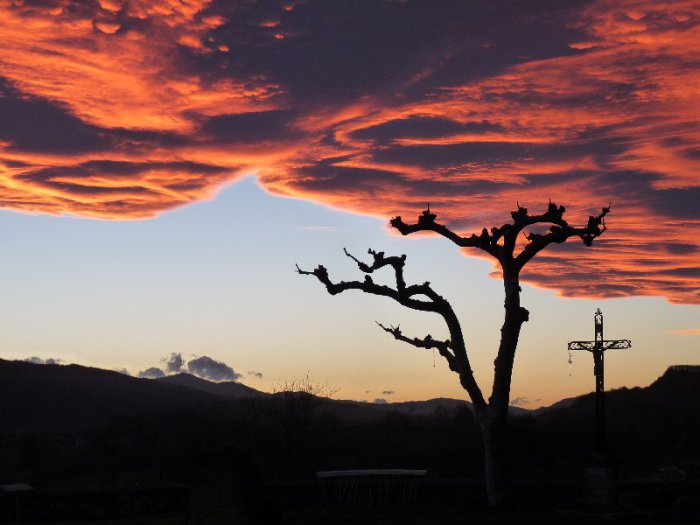
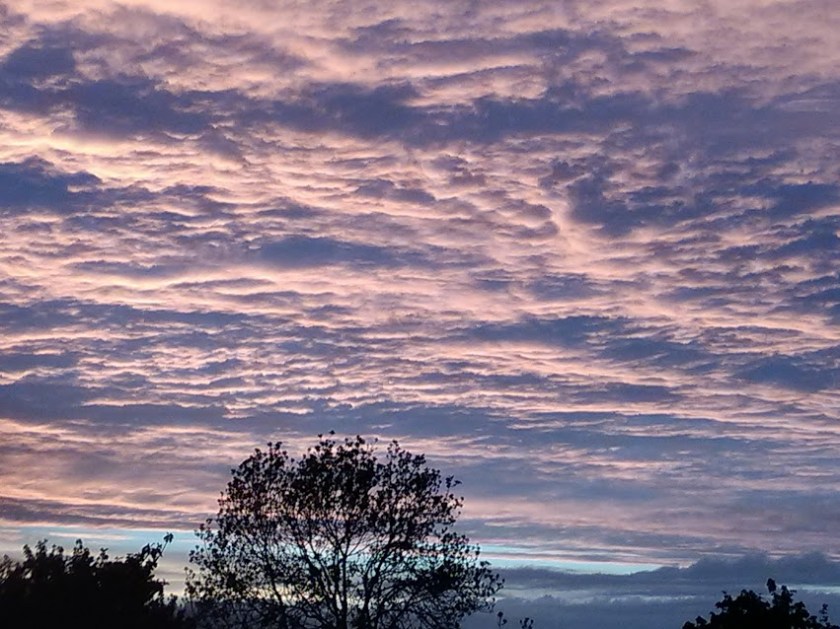
We had quite an arresting sunset the other night. As with all sunsets, it was evanescent: here at one moment and gone the next. I’ll show it to you at the end of the post, together with the rainbow that briefly accompanied it in a rainless sky.
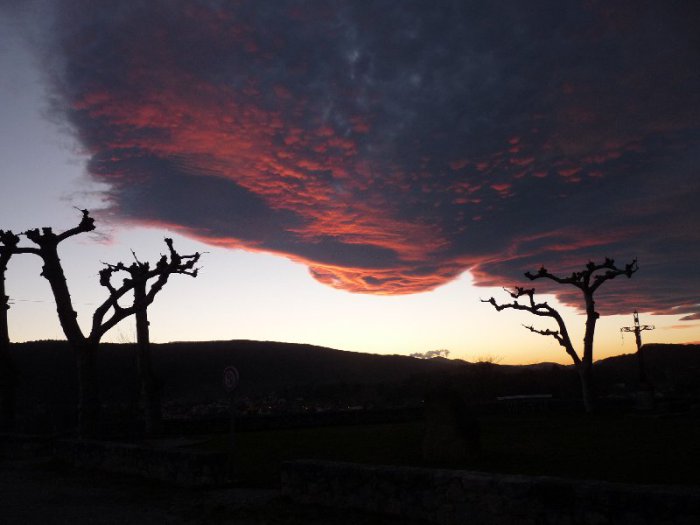
That sunset though reminded me of another sunset, even more dramatic, which we experienced in France in February 2014. Evanescent it might have been. But it’s etched in my memory forever.
Sunset seen from the church at Laroque d’Olmes.
The moment is almost over.
Now then. Here’s our English sunset, from just a couple of weeks ago. Which do you prefer?
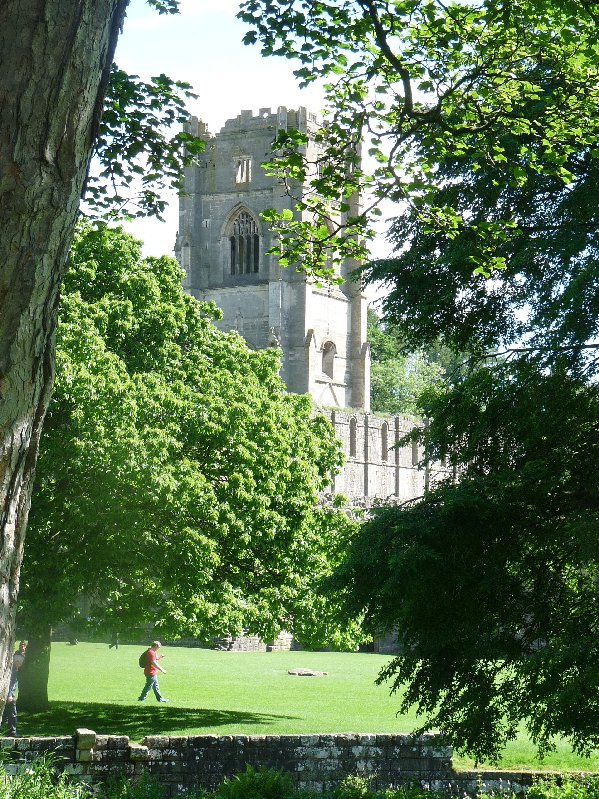
Fountain’s Abbey seen from a hillside walk last Autumn.
In 1132, thirteen Benedictine monks from York fetched up in a wild and isolated place we now know as the manicured and lovely parkland setting of Fountains Abbey and Studley Royal. The Archbishop of York had offered them the land so they could establish a pious community based on silence, prayer and simplicity.
Over the years – over the next four centuries – they built a community with all the trappings of a large village: sleeping, living and working quarters, an infirmary, guest accommodation, a mill, a tannery, quarrying, as well as the daily focus of their lives, the Abbey church itself, where they worshipped eight times a day.
Huby’s Tower at Fountain’s Abbey, built not many years before the Dissolution of the Monasteries
Their principal source of income was from sheep, whose wool came to be valued at home and abroad. Merchants from all over Europe to buy and trade.
The Abbey site could not sustain enough sheep for this thriving business. Lay brothers (the manual workers of the monastic world) were sent further and further afield to establish small working sheep farms – granges. During the 15th century they came here, and built the house in which we now live.
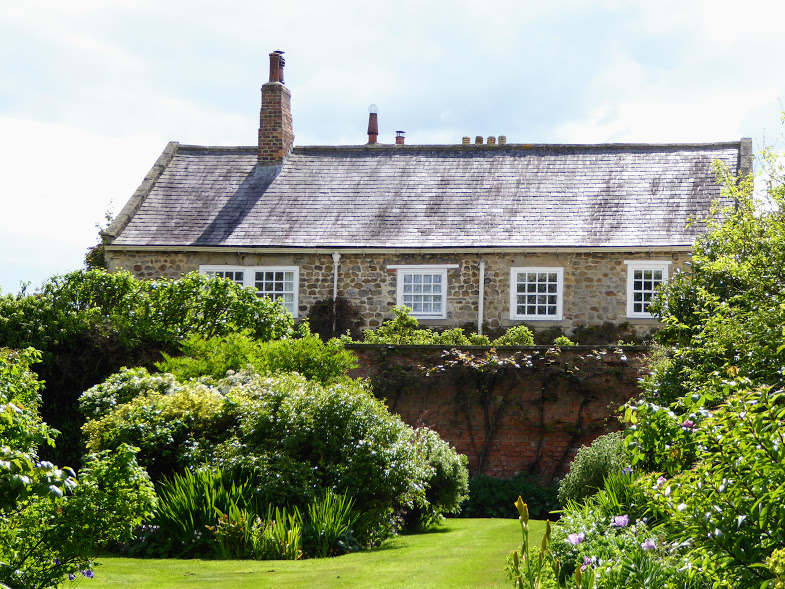
The first floor was once the lay brothers’ dormitory. Now it’s our flat. I bet those monks didn’t look out over this lovely walled garden.
It’s changed a bit of course. Who knows how much of the house is truly original, though the stone-built walls are a traditional, sturdy and strong build? We no longer live in an upstairs dormitory, as the lay brothers did.
The Victorians divided the place into rooms for the servants of the country house which was built and attached to the grange in the 18th century. The animals and working quarters are no longer downstairs, though the old, spacious and business like kitchen hearth still exists.
As I make the eight mile journey from here to Fountains Abbey I like to think of the heritage our home shares with this wonderful UNESCO World Heritage site. Aren’t we lucky?
The Old Grange is attached to the fine 18th century house next door. We seem to have access to their wisteria.
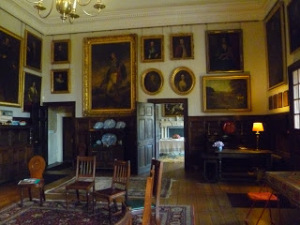
Just round the corner from us, on a back road into Ripon, is a fine old manor house, Norton Conyers. It was in such ruinous condition that it was closed for several years while its owners, Sir James and Lady Graham, oversaw its restoration.
Last year, one one of its few open days, we paid a visit, and I failed to blog about our wonderful afternoon out. But now I don’t have to.
Ann Stephenson, in her wonderfully varied blog ‘Travels and Tomes’ not only recounts something of the house and its history, but lets us all into a secret. Norton Conyers, with its secret attic and resident madwoman may have provided the inspiration for Charlotte Bronte’s ‘Jane Eyre’. How exciting is that?
You can read all about it here. Thanks Ann, for letting me share this story.
While we are on the topic of the Bronte sisters (or, at least, we were two weeks ago), there’s one more thing I should mention– an especially juicy tidbit. Are you listening? Jane Eyre may be inspired by a true story.
Norton Conyers
This isn’t news in North Yorkshire and the cozy city of Ripon that I once called home. Just around the corner from Ripon, roughly two or three miles from the roundabout at the edge of town, lies a beautiful old manor house by the name Norton Conyers. It is a handsome medieval squire’s home, dating back to the 1600’s, which has remained in the possession of one family (the Grahams) for nearly 400 years. That’s an achievement!
However, the house had fallen into disrepair of colossal proportions: rain poured in, wood-boring beetles swarmed, and very little of the grand house was heated. Thankfully, Sir James and…
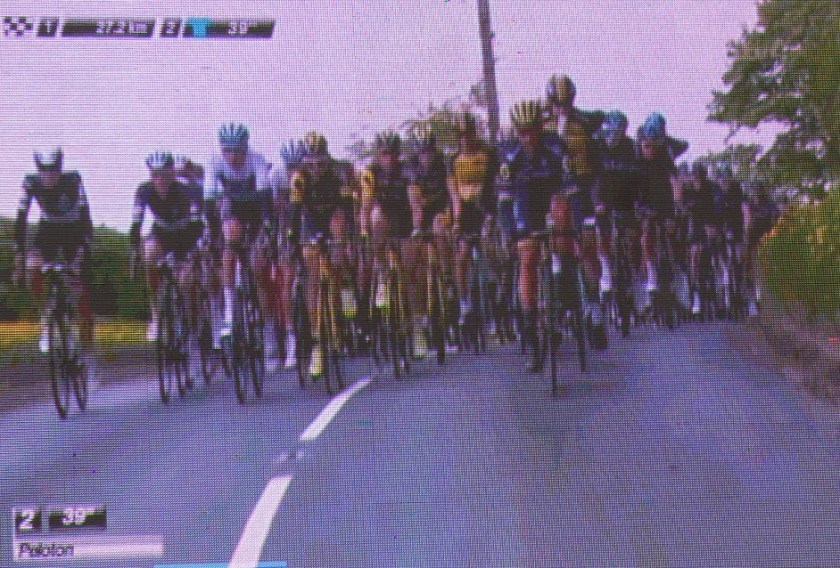
Three years ago, Yorkshire hosted the start of the Tour de France, which I wrote about here, here, and here.
Three years ago, plans were hatched for an annual Tour de Yorkshire.
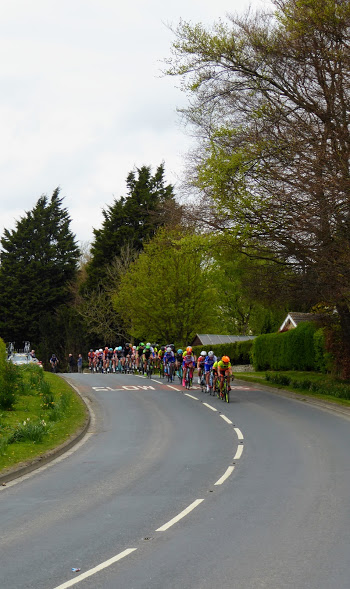
This year, le Tour once again passed the end of our drive.
We watched the Women’s Race from the end of our road, and had a happy low key morning chatting to neighbours we knew, and neighbours we hadn’t previously met. Police motorbikes sped past, support vehicles, a helicopter above, then the riders themselves, followed by more support vehicles, more police, and finally, a couple of women riders who were never going to make it into the winning cohort, but were giving it their best shot anyway .
Our neighbours decorated their garden.
Police prepare the way.
The helicopter’s filming the action.
Women riders zooming through North Stainley.
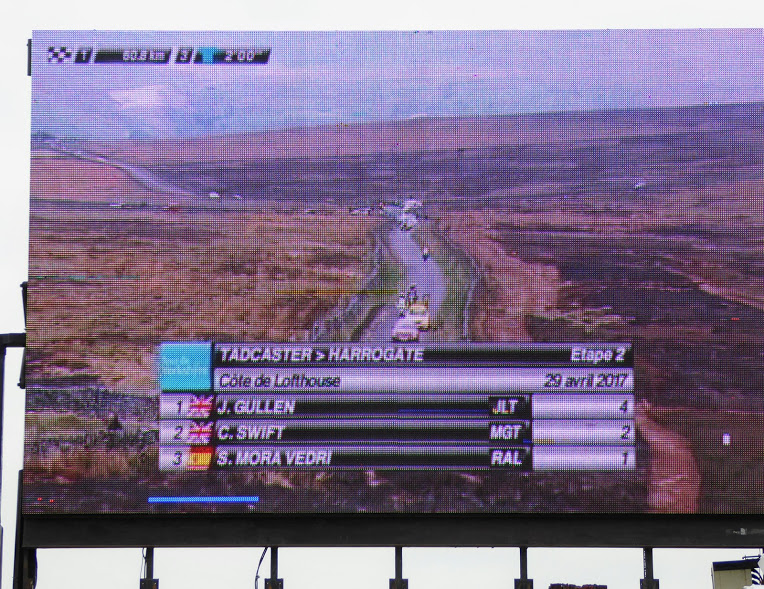
During the afternoon though, I sauntered into West Tanfield to watch the Men’s Race. I arrived to find a party atmosphere. There, amongst all the stalls on the village field, was the Big Screen showing the progress of the Tour in real time. Just look though. Just as in ze Tour de Fraunce, everysing eez in Frainch. ‘Tour de Yorkshire’, ‘Le Côte de Lofthouse’, ’29 avril 2017′. It’s a sweet little homage to the Tour de France, without which …..
The Big Screen explains all, in French.
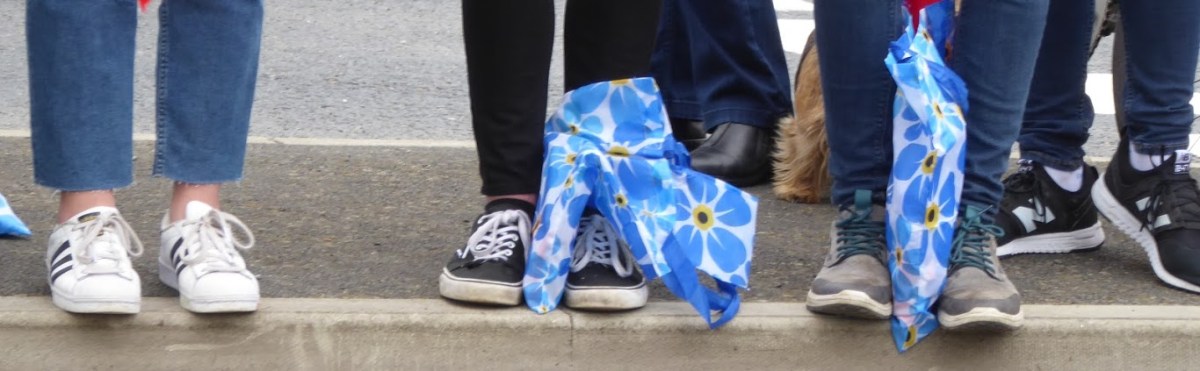
I’d missed the caravan giving out freebies. A friend told me that in Health and Safety conscious England, these aren’t chucked randomly out of publicity vehicles. Instead the vehicles stop, and small teams amble among the crowds, giving out flags, batons, shopping bags. She said it was rather nice and added to the party atmosphere.
Spectators with their freebie shopping bags.
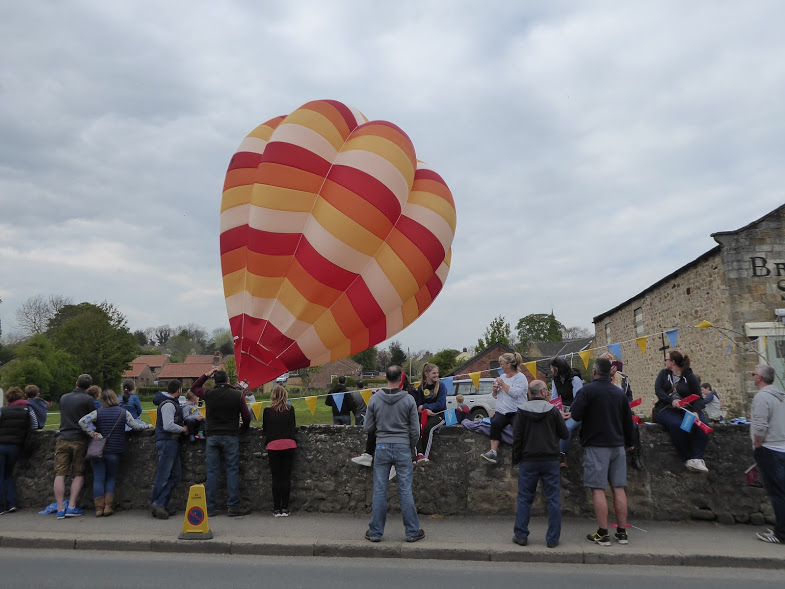
A hot air balloon was moored near the pub. We didn’t find out why, as it never became airborne.
The securely tethered hot air ballon.
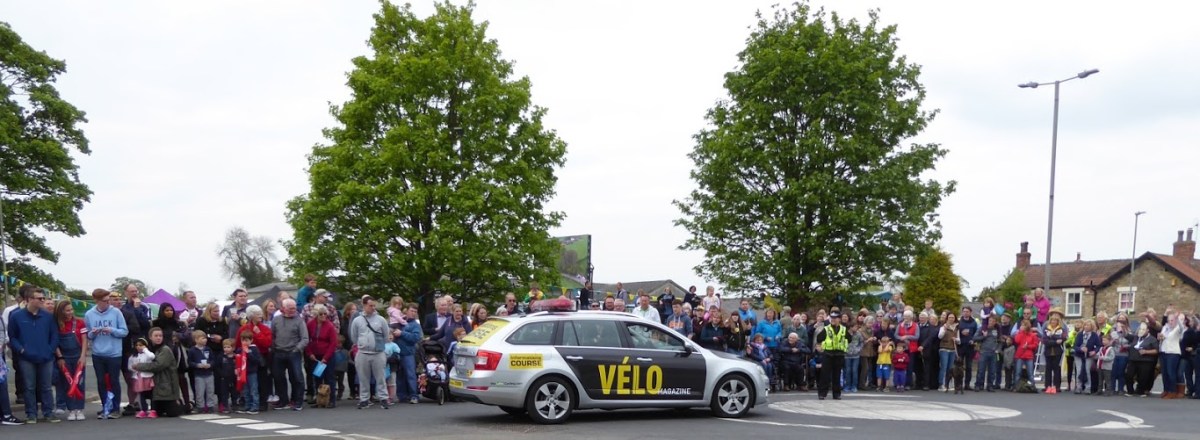
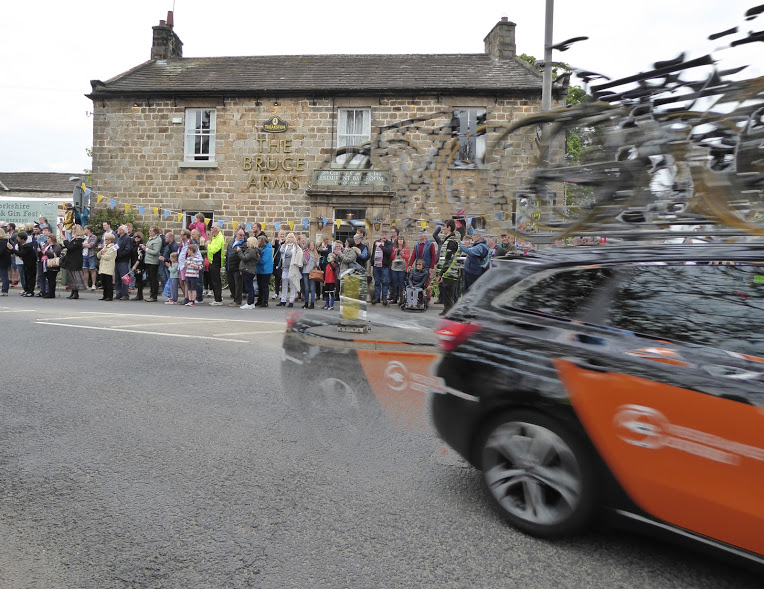
As the Big Screen informed us the riders had reached Masham, we started to line the streets. Volunteer Tour Makers shooed us onto the pavements, and we waited …. First of all, police motor bikes. Then this vehicle, complete with Man with Microphone. ‘Allez, allez allez’, he yelled. ‘Oi! Oi! Oi!’, we yelled back. ‘Allez, allez, allez!’‘Oi! Oi! Oi!’. ‘Allez!’‘Oi!’, ‘Allez!’‘Oi!’ ‘Allez, allez, allez!’‘Oi! Oi! Oi!’
Cheerleader’s vehicle.
Then this, the moment we’d been building up to.
They were gone. More support vehicles, and a final one telling us it was over.
Support vehicles came from all over France, from Belgium, from the Netherlands, from Italy …. and from the UK.
We all wandered off, perhaps to check out the big screen showing the riders going through Ripon. As I left the village, the dustbin men were already clearing the streets. The party was over.
William’s a London child. His commute to nursery passes railway tracks and city streets, as well as a walk through a rather nice park. The animals my grandson sees on his daily round are dogs-on-leads, cats and urban foxes.
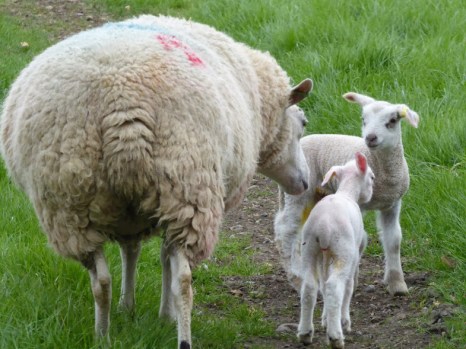
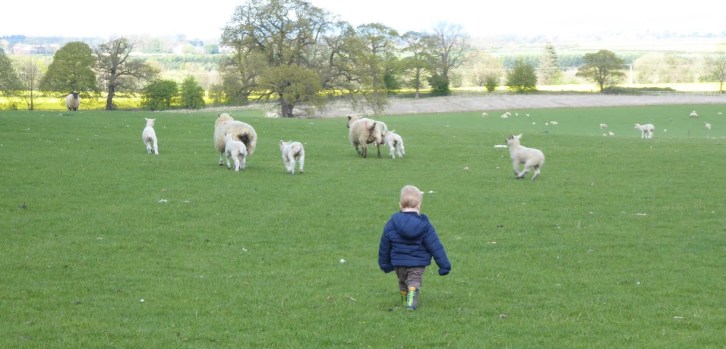
We wanted Yorkshire to offer him something different. On his very first afternoon, we visited two-day-old lambs in the field at the end of the road, wobbly on their legs and clinging to their mothers. Later we’d visit older lambs, confidently running and jumping across a public footpath as William wandered among them.
Newborn twin lambs with mum.
Confident lambs, confident William.
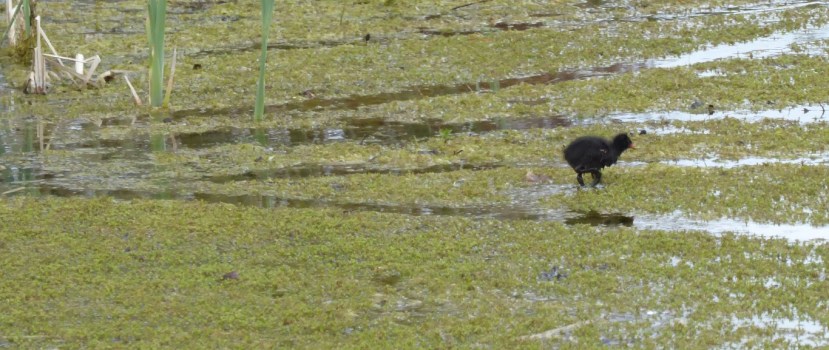
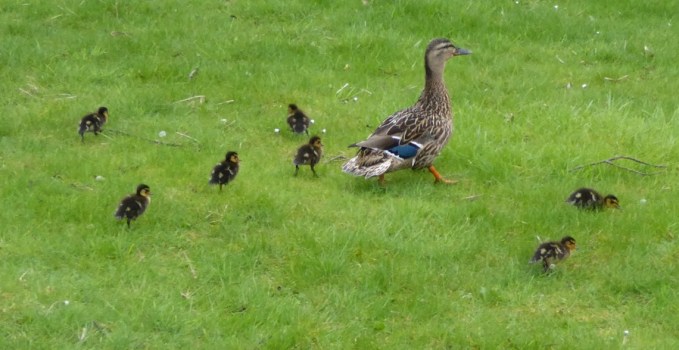
Then it was off to the duck pond. Two Mrs. Moorhens had a chick each, so light that even pond weed could bear their weight: were they walking on water? Mrs. Mallard had eight balls of fluff scuttling from land to pond to rushes – constantly on the move.
A moorhen chick walks on water.A mother mallard and her eight babies. Except the eighth is off-camera.
The next morning, good friends Gill and David invited us over. There were puppies to pet, dogs and a cat to stroke. And then there was Reggie, their grandson’s very own Thelwell pony. Reggie turned out to be far too scary to ride, but perfectly good to take for a walk.
Gill, William and Sarah take Reggie walkabout.
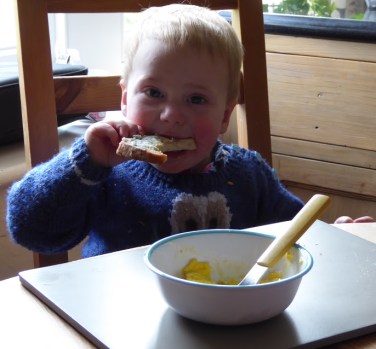
Then William was put to work, collecting eggs. He didn’t break very many as he dropped them none too gently into his collecting basket. Afterwards he fed the hens. And we went home for scrambled eggs on toast. Thank you William. Thank you Gill, David and the hens.
William’s collecting eggs….
…. and feeding the hens.
William’s personally-gathered eggs for a scrambled egg lunch. Mmm….
Late one afternoon, William and I went for a walk in the woods and saw rabbits, a dozen or more, grazing the grass on the other side of the fence.
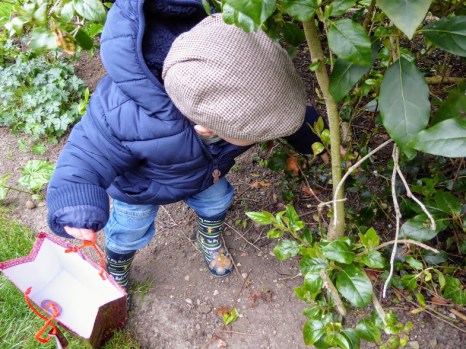
I wonder if it was one of them who left the chocolate eggs that William found in the garden when he went hunting for them on Easter Sunday?
Ripon Cathedral – viewed from High St Agnesgate (geograph.org.uk)
One of the bells of Ripon Cathedral sounded this morning: sonorous, measured and slow. The pancake bell. It’s rung out every Shrove Tuesday for centuries now, just like other bells in other churches, countrywide. It reminds good Christian folk to come to church and confess their sins, before Ash Wednesday. Some also believe it was to remind thrifty housewives to use up their eggs, butter and milk before fasting during Lent.
Gentlemen of the press outside the cathedral to record the action.
Nowadays it’s a signal to gather outside the cathedral and have a bit of fun. Somebody has already cooked a pile of pancakes. No point in making lacy delicate crepes. These pancakes are in for a tough time as props in the annual pancake race. Contestants have to run from the Cathedral, down Kirkgate, pan in hand, tossing as they go …. onto the pavement, as often as not.
I watched teams from the Rotary Club, from local primary schools, from the Italian restaurant down the road.
The lads from Valentino’s Italian Restaurant arrive to run in style.
Sadly though I missed seeing the clergy do their bit: things to do, places to go. It all seemed amiably uncompetitive. Just a chance to chat to the Hornblower (who keeps us safe through the night here in Ripon), to friends, and to take a few snapshots of this happy little Shrove Tuesday tradition.
David from the Rotary Club gets a bit of practice in.
The Ripon Hornblower keeps a friendly eye on the proceedings.
Children from Holy Trinity School tussle it out.
Later, much later, Malcolm and I had pancakes too, delicate lacey ones, served with lots of sugar and lemon juice. We tossed them of course. But we didn’t run down the street with them.
Photo challenge: ‘It’s not this time of year without…..’. It’s holidays and celebrations that WordPress seems to have in mind in setting this challenge, but this is November, and we don’t do Thanksgiving in England. We do dark nights that begin at four o’clock. We do gusting rain that snatches the remaining leaves from the trees. We do fog that rises from the river. Nothing much to celebrate at all. Except …. except that it can turn out differently.
Read on.
Sunshine after rain at Studley Royal
I was in a bad mood when I got up. My shoulder hurt – a lot. The sky was steel-grey, the temperature steel-cold, and I was supposed to be leading a walk. This was going to be No Fun At All, because although no rain was forecast, we’d had two days of full-on deluge. I just knew that virtually the entire circuit would be a mud-bath.
I trudged off to our rendez-vous with ill grace. Once there though, I started to cheer up. The prospect of good company for the day is always a positive start. We set off. The ground was unexpectedly firm, the clouds started to lift and the sun to shine. Soon we were making a coffee-stop outside 14th century Markenfield Hall.
Coffee stop in front of Markenfield Hall.
Then it was through woods and across open fields (still no mud) to find a lunch spot overlooking Fountains Abbey, still framed with russet Autumn leaves.
Sandwiches, sunshine and Fountains Abbey.
After lunch, a muddy farm, where we attracted the interest of the locals.
Calves closely inspected us as we squelched past. Yes, this farmyard was very muddy indeed.
And an uplifting final couple of miles, with grazing red deer, light-reflecting ponds and surrounded by a final burst of Autumn colour.
Here is the parkland of Studley Royal. Can you see the red deer in the distance?
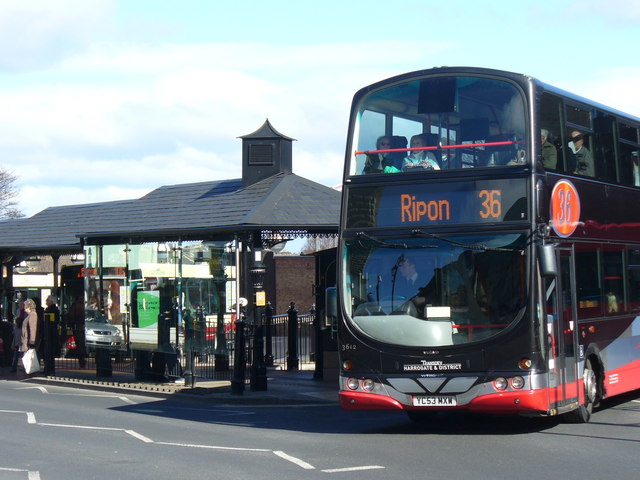
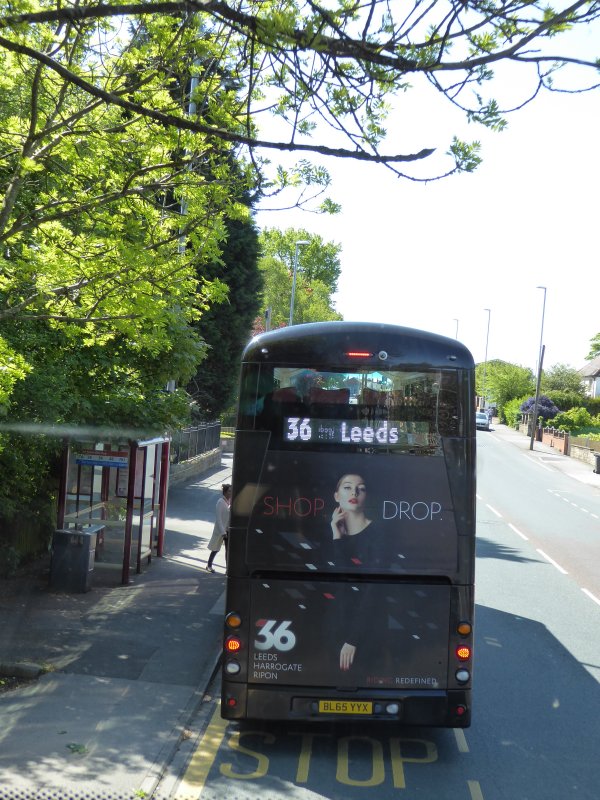
The 36 bus leaving Leeds for Ripon (Wikimedia Commons)
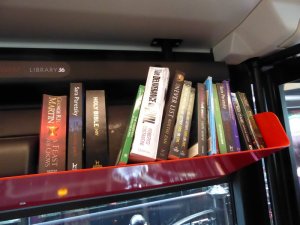
Everyone loves the 36 bus. It’s the one that takes us from out in the sticks of Ripon, via Harrogate to Leeds. It’s the one with plush leather seats, 4G wi-fi, USB points at every seat. It’s the one with a book-swap shelf where I always hope to find a new title to enjoy, while bringing in one of my own to swap. And best of all, we old fogeys travel for free on the 66 mile round trip.
The book-swap shelf wasn’t very exciting today. But I found a Fred Vargas to read.
Best get to the terminus early though. Everyone’s jockeying for the best seats, the ones at the front of the top deck, where you can watch as the bus drives through the gentle countryside separating Ripon from Harrogate, via Ripley, a village which the 19th century Ingleby family remodelled in the style of an Alsatian village, complete with hôtel de ville. After the elegance of Harrogate and its Stray, there’s Harewood House – shall we spot any deer today? Then shortly after, the suburbs of The Big City, which gradually give way to the mixture of Victorian and super-modern which characterises 21st century Leeds.
We had lots to do in Leeds today (more of that later, much later) and had a very good time being busy there. But much of our fun for the day came from sitting high up in that 36 bus, watching the world go by. For free.
Seats on the top deck secured.
Ripon to Harrogate.
You can’t see Ripley for the trees.
The message board keeps us in touch with waht’s going on.
Hurtling towards a roundabout in Harrogate.
‘Fashionable South side’ is what the estate agents call this part of Harrogate.
Harewood village.
Arriving in Leeds city centre.
That’s the town hall in the distance.
On the way home, rows of Leeds suburban semis.
This pub’s still preserving memories of the Tour de France in 2014.
Easter holidays. Time to have those ten-years-old grandsons over. Time to keep them so busy they don’t have a chance to realise that ours is not a home stuffed with devices. Not a smart phone in sight.
Let’s get them back to the past straight away, even before we get them back to our house. Are they too old for an Easter Bunny hunt at Fountains Abbey? Apparently not. Not when there’s a chocolate bunny to eat at the end. Are they too cool for egg and spoon races and egg-rolling down the hill? Apparently not.
Egg-and-spoon race.
Egg rolling.
Would they like to visit ‘Forbidden Corner’? They agreed they would, even though we failed to provide a description of what to expect. We couldn’t. It’s been described as ‘The Strangest Place in the World’. Perhaps it is. It’s a folly. It’s a fantastical collection of follies. It’s woodlands, walled gardens, mazes, tunnels, grottoes, built in the manner of a topsy-turvy collection of fairy tale castles in enchanted grounds. Every stone putto is liable to pee on you as you walk past. Every passage is too narrow, too low, too dark, and may lead nowhere. You just want to try to get along it anyway, because at the end there may be another secret door, with halls of mirrors, or ever-changing fountains, or grotesque stone gremlins, or stepping-stones …. And beyond, in every direction, the glorious countryside of North Yorkshire.
Next day, off to Brimham Rocks. No child can resist the opportunity to climb and jump among these extraordinary tottering towers of balanced rock formations. A visit there is a regular fixture for Alex and Ben.
And finally – yet more rocks. Underground this time. Stump Cross Caverns: limestone caves set about with stalactites and stalagmites, tinted in all kinds of shades from the iron and lead seams that also penetrate the area. Gloomy, dark and mysterious, and guaranteed to fire the imagination. Photographs courtesy of Ben.
Down, down, deep into the earth.
In the evenings we sat round the kitchen table and played board games. The London Game brought out everybody’s inner mean streak as we blocked other players in, or despatched them to the end of the line at Wembley Central. Stone Soup gave us the opportunity to lie and lie again in an effort to get rid of all our cards. All very satisfactory. A good time was had by all.
But Granny and Grandad would quite like a rest now. Please.






 The secret attic room at Norton Conyers.














 From Pyrenees to Pennines
You must be logged in to post a comment.