Fields of mud – seeds of hope

Citizens of Ripon and beyond have been calling into the cathedral as often as they could over the last few weeks.  Not necessarily to view this ancient building, or even to spend quiet moments reflecting.  Perhaps not even to view the poppies which are here, as they are throughout the city centre.

We’ve all been visiting the Fields of Mud  in the Cathedral itself.  Back in early October, that’s all we could see.  A large brown rectangle of damp mud, surrounded by sandbags.  This mud is from Passchendaele, and from a Great War military camp in Ripon. As, over the weeks, the wet earth dried and cracked, five ghostly, battle weary figures slowly emerged on the surface.

This image, exhibited in the Cathedral, is a print projecting the final appearance of the piece.

There are millions of ungerminated poppy seeds lying dormant in that mud.  When the piece is decommissioned later this month, it will be broken up and segments will be made available to the public to create their own memorials.  This work’s legacy can continue indefinitely.

This astonishingly moving and evocative piece is the inspiration of Dan Metcalfe: his farming background has given him an understanding of mud.  It’s disagreeable, destructive and even dangerous, as every WWI tommy well knew. But it also harbours seeds, waiting to flourish and grow when conditions are right .

Now the figures are fully visible, as the mud which surrounds them has dried out.  And so we can see that these are the same figures that have appeared round town, near North Bridge and the Cathedral itself, at Hell Wath and Rotary Way: and in nearby Sharow, where the British Legion home for former service personnel used to be.  These soldiers, and a nurse appear as silhouettes, made from rusted metal, and they are trudging home, their backs to the conflict and facing the future.

Ripon city has recently made us keenly aware of the sacrifices  made in the Great War.  But the poppies, the Fields of Mud are not the whole story.  Tomorrow, on Remembrance Day, I’ll show you Ripon’s Remembrance Light Show.
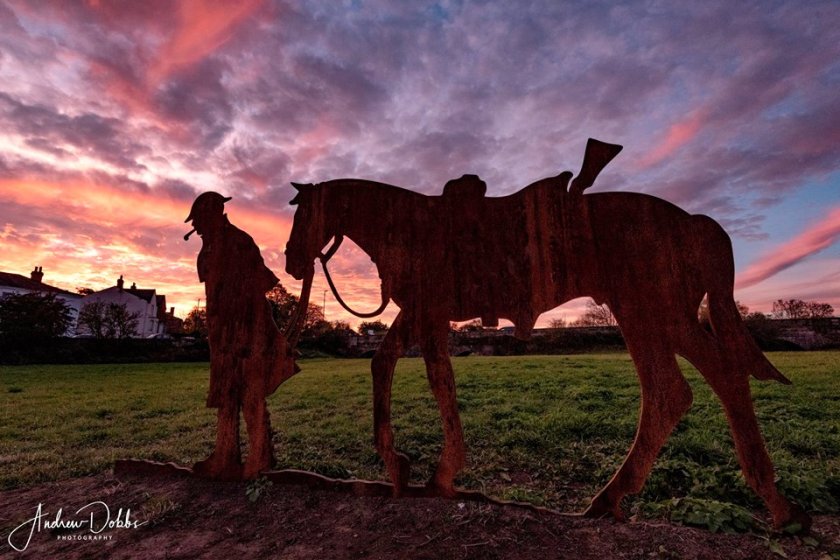
Fred and Old Bones trudging home near North Bridge, Ripon. The soldier’s pipe is turned upside down to keep his baccy dry during the inevitable rain. This brilliant image was captured at sunset by Andrew Dobbs. (https://www.andrewdobbs.photo/)

Click on any image to see it full size.

Getting in touch with my inner French paysanne

Beatswell Wood.

I was walking back from my friend Claire’s through Beatswell Wood the other day when I noticed it.  A fallen branch.  A nicely rotting fallen branch.  Then smaller branches, conveniently broken into wood-burning-stove like lengths.  My inner French peasant knocked urgently at my brain. ‘You can’t leave those!’ she said, in perfect English. ‘Fuel for free!  Whaddya mean you’ve got no bag?  What are arms for?  Get on with it!’

And it’s true.  No self-respecting French country person – man or woman – would think of leaving for a walk without a just-in-case (‘au cas où’) bag.  Here’s an account of what we used to do in France, especially in autumn.

Yesterday we were better prepared.  We both set forth, equipped with large strong bags, just big enough to collect stove-length pieces of wood, or ones dried out enough to break in two.  A stout thick branch each – to be sawn up later – completed our haul.  Kindling sorted.  A day or two’s heat sorted.  Well, you know what they say about wood, and about how it heats you several times?  We aren’t woodcutters.  But we do gather it, then stack it, then burn it.  That’s three times.  That’s good value.

The path to the woods.

Click on any image to see it full size.

‘……the poppies blow, between the crosses, row on row’*

Soon, it will be the eleventh hour of the eleventh day of the eleventh month.  One hundred years since Armistice Day 1918, and the end of World War I.  Since the 1920s, here in Britain and the Commonwealth, the poppies which were so ubiquitous in the Flanders fields of battle have been used as a symbol to commemorate those who died in conflict.

For about a year now, Ripon has been making plans for something rather special – The Ripon Community Poppy Project.

Hand knitted poppies have appeared all over town, specifically a great avenue of them on the route between the Cathedral, past the Market Square and Town Hall and down towards the park – Spa Gardens. Shopkeepers have dressed their windows in commemoration.  All this year, the citizens of Ripon and beyond have been knitting and crocheting dozens of poppies, scores of poppies, hundreds and thousands of poppies. Sadly, not me.  I can’t knit.  Now these poppies are being displayed.  Everywhere.

It’s been an extraordinary project, involving the young, the old, the housebound, all of whom have been united in wanting to have Ripon remember the fallen in a striking yet appropriate way.

And there’s more.  I’ll be posting about ‘Fields of Mud, Seeds of Hope’, and  events at the Cathedral later.  For now, just have a short walk round Ripon with me and enjoy the poppies, as you remember the terrible story of the Great War.

*’In Flanders Fields’ by John McRae.

Click on any image to view full size.

A window of opportunity

I’ve always loved looking at the contributions to Thursday doors, where bloggers from around the world share images of their favourite doors. Somehow, I’ve never got round to joining in.  But looking through my photos for something or other yesterday, I realised that I had the makings of a post about windows. Here it is.

Here’s an image from the last March for Europe in London in June.  I’ll be there again, probably as you read this, marching for a People’s Vote on the Final Deal.  I’m not sure how much I believe in another referendum, but what other hope have we got to turn the tide against the national disaster that is Brexit?

Happier times, happier pictures.  I started off by including images from Europe too.  But I’ll do England today, and maybe travel further afield another time.

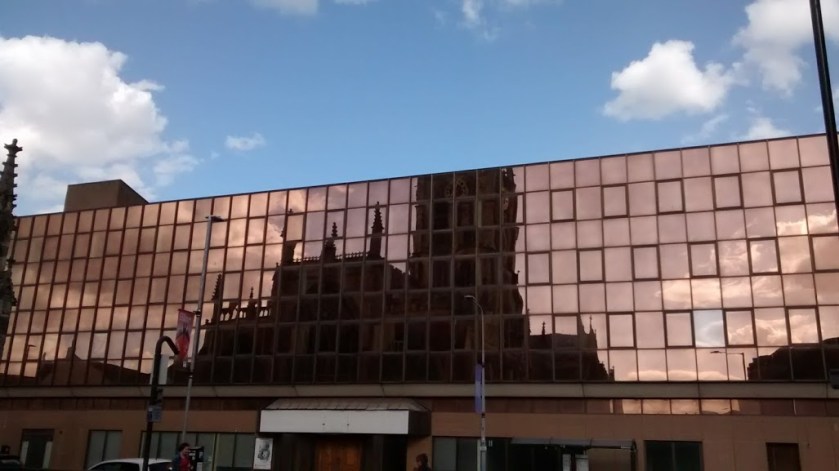
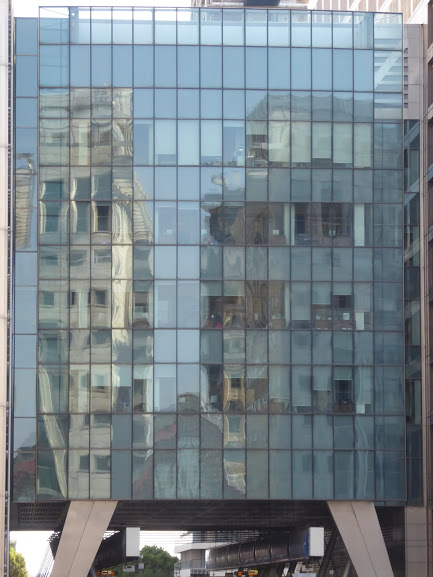
Hull Minster, as seen from the office buildings opposite.

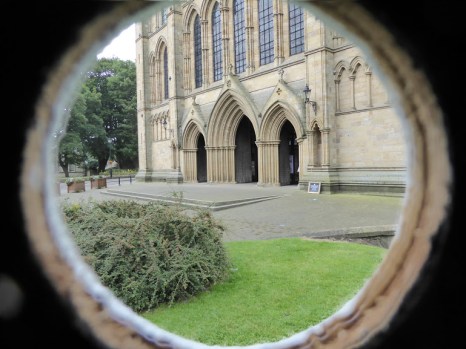
And Ripon Cathedral glimpsed through a camera obscura in early 2017.

There’s an osteopath in Ripon who always has a delightfully quirky window display.  Here’s winter.

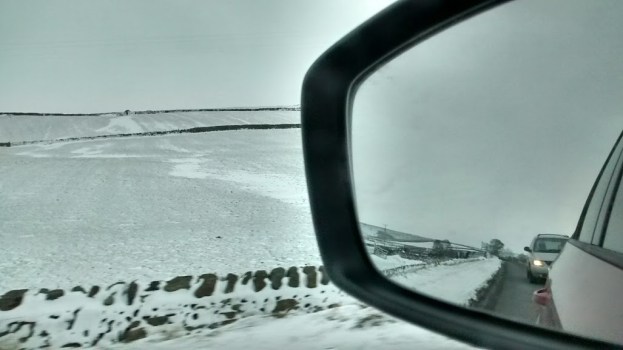
Through the car window, a snowy winter landscape near Kex Gill in Yorkshire.

Train windows:  a view of Canary Wharf through the windows of the DLR line.

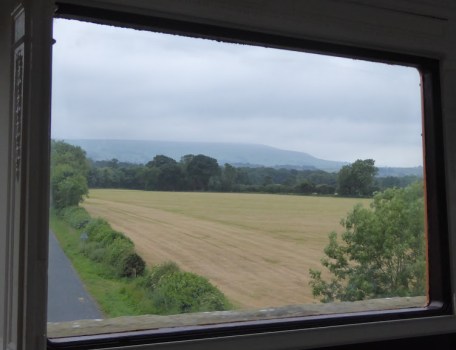
And the more rural landscape from the Wensleydale Railway.

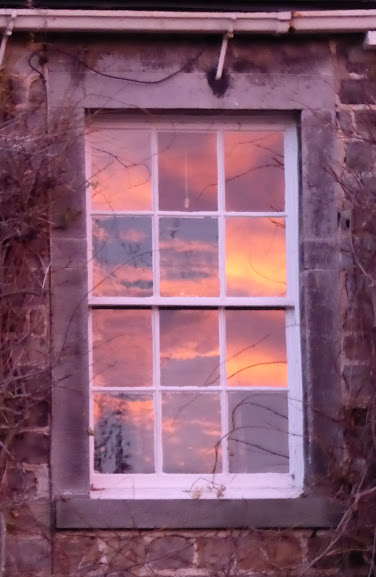
I’ll finish with the photo I found that started me off.  This was the view I took outside our house on Christmas Eve morning last year.

Ragtag Tuesday: a serendipitous sunset

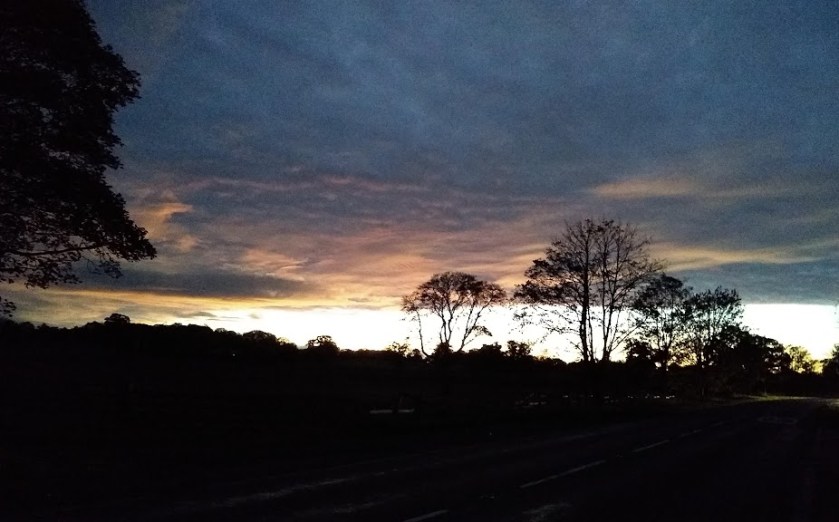
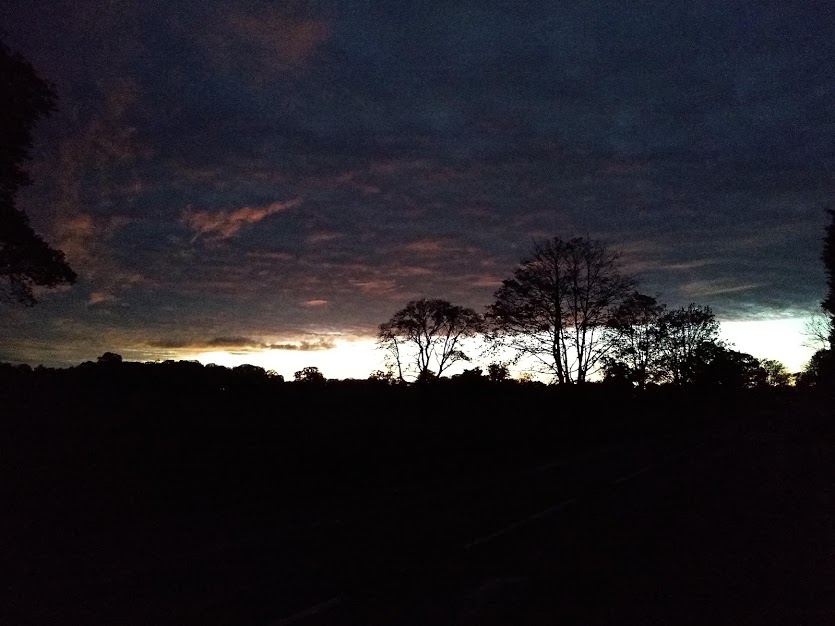
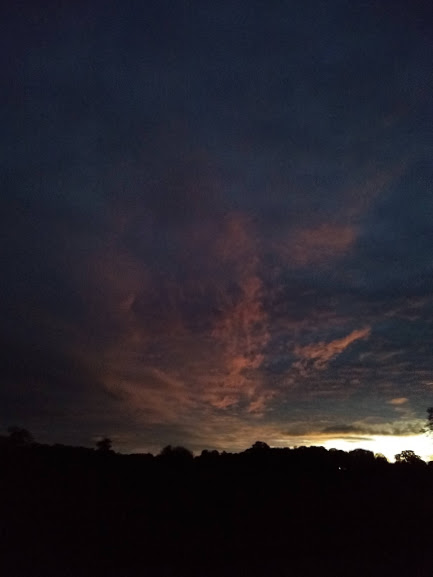
I was dashing out to a meeting yesterday evening when this sight greeted me at the end of the road.

Pure serendipity.  I suddenly realised how early I was.  There were five minutes to spare when I could stand and stare at the black outlines of the newly-skeletal trees.  The sky was transforming from a sappy fresh green and yellow through to a pale teal blue, before bleeding into grey-edged tones of salmon pink cloud.  Why hurry?  I stayed and enjoyed the moment.

Tuesday’s Ragtag Prompt is ‘Serendipity’.

The Sainsbury sinkhole

Bang in the centre of Ripon we have a supermarket, Sainsbury’s. Nearly a fortnight ago, when it was full of busy shoppers, it was evacuated. It hasn’t been opened since.

The Sainsbury sinkhole (photo courtesy of StrayFM)

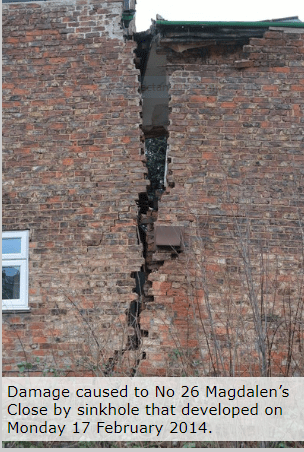
The cause? A sink hole. In Ripon, we know about sink holes, those vast gaping deep holes that suddenly appear, cracking open the surface crust. They cause alarm and distress and considerable damage when they occur. Back in 2014, a couple returning to their house near the town centre found they couldn’t open their back door, heard noises…. and realised the back of their house was collapsing into a hole. It continued to widen, and they and their neighbours were evacuated.

Damage caused by the Magdalen’s Close sinkhole (photo courtesy of British Geological Survey)

The Sainsbury sink hole doesn’t look much. But it’s thought to be 100 feet deep, and is right next to the fire escape. Is this hole the beginning of something bigger? The geologists are on the case.

Gypsum is the problem. Much of Ripon is built over this highly porous rock, and as water from the several rivers near the city run down from the higher ground to the west, it dissolves the rock into a maze of caves whose tracery of walls become ever more precarious. As the surface level of the ground water fluctuates, so does the level of danger caused by the problem. Here’s the story.

It’s all hot news every time it happens. Then most if us forget about it …. till the next time.

The play’s the thing

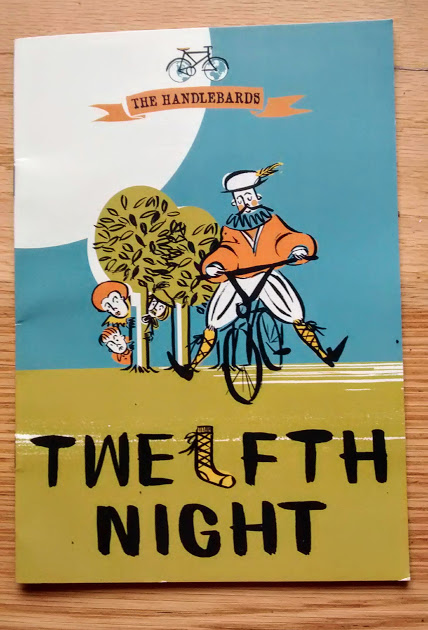
Best not go and see the Handlebards.  Not if you’re hungry, anyway.  Here is a theatre troupe who will drink your beer and steal your strawberries all in the name of art.

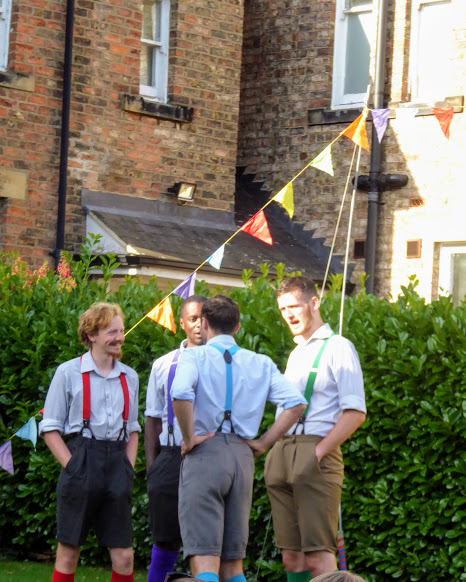
But our date with the Handlebards has been in the diary since February.  Ever since I saw this witty and inventive  lot at Bolton Castle last year I’ve been on their mailing list.  Last year I saw the female troupe.  This year we went to see the men at work. William Shakespeare’s Twelfth Night.  Sixteen characters.  Four actors.  No problem.  Men can multi-task too.

The four Handlebards just before it all began.

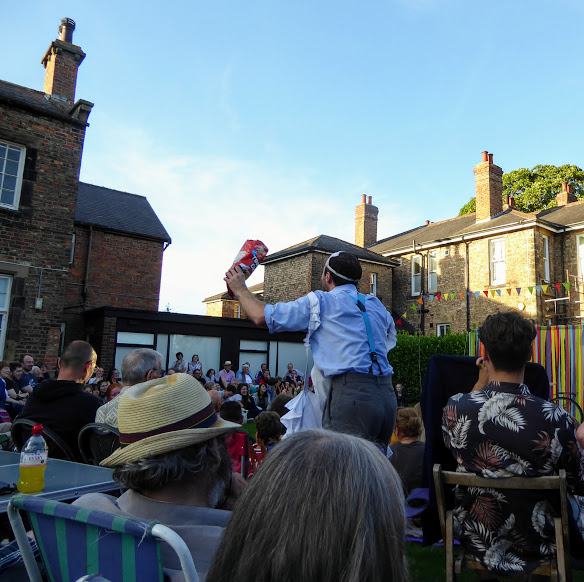
And multi-task they did.  The Queen’s English, broad Scots, Northern accents all had their places. Hats, jackets and gilets all stood in for the characters who wore them, but who were temporarily detained in another role.  Balloons barely concealed behind an voluminous white pinny lent girth and a (sort of) female form to Maria, while sporting a little number in prettily sprigged voile enabled us to understand that the (bearded) Olivia was now on stage.

Occasionally audience members were pressed into service.  The cast took any opportunity to help themselves to crisps, wine and cake, legitimising the thefts by working them into the action on stage.  Nobody thus deprived of their picnic minded at all.  Picnic?  Yes, it was a lovely summer’s evening.  We’d all spread ourselves over the lawn of the Ripon Workhouse Museum, armed with blankets, garden chairs and baskets of treats.  Gruel was not on the menu.

See what I mean? Who stole the crisps?

It was all a bit exhausting, even for the delighted audience.  How the troupe summon up the energy  to cycle off to a new venue day after day is beyond me.  But that’s what they do, up and down the length of the kingdom throughout the summer season.  ‘Have bike, will perform’ must be their motto.  Here’s what they say:

Since 2013, the HandleBards have clocked-up over 7000 miles by cycling around the world to perform Shakespeare. Described by none other than Sir Ian McKellen as ‘uproariously funny’, we set the world on wheels with our unique brand of extremely energetic, charmingly chaotic, environmentally friendly cycle-powered theatre.

We love an adventure.

You really should go and see them after all.  And take a picnic.  A picnic big enough to share.

Tuesday’s Ragtag Challenge is ‘Play’.  I went to the play.  Here’s what I saw.

Happy Yorkshire Day!

I’ve got lots of readers with Yorkshire connections.  With addresses in Australia, southern France, London, Northumbria, Spain and East Sussex, among other places, I bet not one of them has celebrated Yorkshire Day.

Apparently it all began on August 1st 1975, in Beverley, as a protest movement against the local government re-organisation of 1974′

Who knew?  Not me.  Not anyone I know.  We all bumbled through life in the 1970s, 80s, 90s, and though the early years of the twenty first century, blissfully unaware until about five years ago that we were supposed to be partying for Yorkshire.

Two Ripon shops take Yorkshire Day seriously.

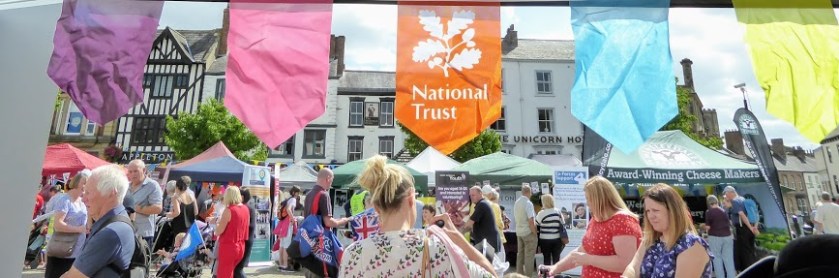
Now Yorkshire cities take it in turn to host Yorkshire Day, and this year it is Ripon’s turn.  This meant a fairground in the Market Square, a procession with a band and civic dignitaries, a service in the cathedral, picnicking in the Park, and all manner of stalls in the town centre, mainly celebrating Yorkshire charities and institutions.

Such as The National Trust’s stall celebrating Fountains Abbey & Studley Royal.  I was there.  I was one of a small team encouraging mainly families to have fun.  A few punters dressed up as monks from the Abbey, or as fine Georgian ladies who might have enjoyed the Studley Royal Water Gardens.  Most children – boys and girls – got enthusiastic about using the kind of wool which was produced in abundance at Fountains Abbey to get stuck into simple weaving.  They chose their colours with care, threaded their shuttles, and wove, wove, wove.  They ended up with nothing more elaborate than a bookmark, but goodness, they treasured them, and handed them carefully to mums, grandads – anyone who would put them safely away till they arrived home.

And we all ate Wilfra Cakes.  That’s a sort of apple pie cooked with Wensleydale cheese, and a long-forgotten Ripon delicacy, produced thanks to the Workhouse Museum.

If we go back this evening, there are bands playing, and a big firework display.  Well, any excuse for a party in God’s Own Country.  Why not?

The Market Square at midday.

Snapshot Saturday: Secret Ripon

Ripon has been a city for well over 1300 years.  Founded by a saint – Wilfred – it’s been under the control of the Vikings, the Normans, and more recently Harrogate Borough Council.  It’s been a religious centre, a market town, a textile town.  These days it’s no longer so important.  But those of us who live here tend to like this quiet unassuming place with a past to be proud of.

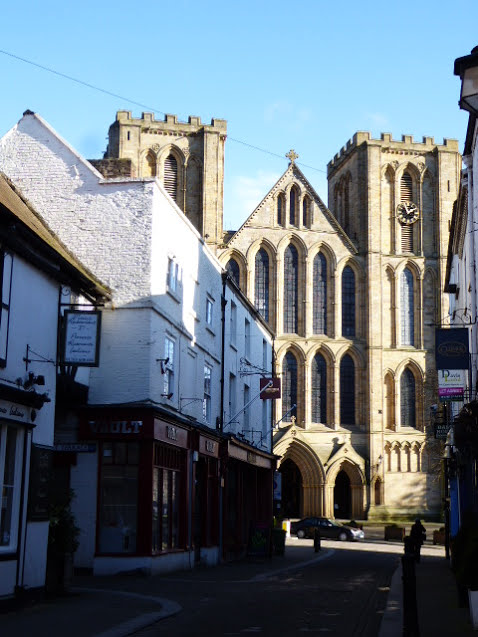
Come for a day trip, and you’ll head straight for the Cathedral, built and destroyed and rebuilt several times from the 7th to the 15th centuries.

Ripon Cathedral, now as in the past peeps from behind ancient narrow streets.

You may make for the Workhouse Museum, the Prison and Police Museum and Courthouse Museums, and learn about the lives of the deserving and undeserving poor of former centuries.

After that though, we could go and look for a Ripon not mentioned in the guidebooks.  It was by chance that I found a charming  oasis of calm, tucked away yards from the city centre and known to few.  It once housed a non conformist early 19th century ‘Temple’, of which all that remains is the Dissenters’ Graveyard.  A secret, quiet place, you’ll have it all to yourself.


Walk further up the road and you’ll find The Crescent, set back from the road behind a spacious gardens.  Now as then, back in the 19th century when the houses were built, it’s a fine address.  Lewis Carroll thought so,  He used to visit friends here, and compose songs and stories for their daughters.  There’s a blue plaque to prove it.

Day trippers tend to go home for supper.  Which is a pity.  Wednesday visitors could go and watch bellringing practice in the belltower of the Cathedral.  Hearing the bells tolling rhythmically and tunefully for practices, weddings, and on Sundays is one of the joys of Ripon life.


Day visitors miss out too on seeing the Ripon Hornblower setting the watch, as the postholder has done every single night since 886 and the time of Alfred the Great.  The Wakeman, employed by the city, blows his horn in all four corners of the market square to announce the watch is set and that citizens can sleep safe in their beds (these days the watch is provided by North Yorkshire Police I suppose). Then he goes off to tell the mayor, who may be watching tv, having a bath or an evening down at the pub, or at the cinema … no matter.  The mayor needs to know.

I could show you the Leper chapel, or the house where Wilfred Owen lived.  I could take you down ancient ginnels, or along the canal which was Ripon’s transport hub once upon a time.  Or you could make your own discoveries.  It’s a city you can enjoy exploring in your own time.

This week’s WordPress photo challenge is called Tour Guide.  Click on any image to see it full size.

This post is for you, Ros.  You’re a friend I would never have met except through blogging.  And you’re coming to visit us soon.  Where shall we explore first?

Snapshot Saturday: You can never have too many snowdrops

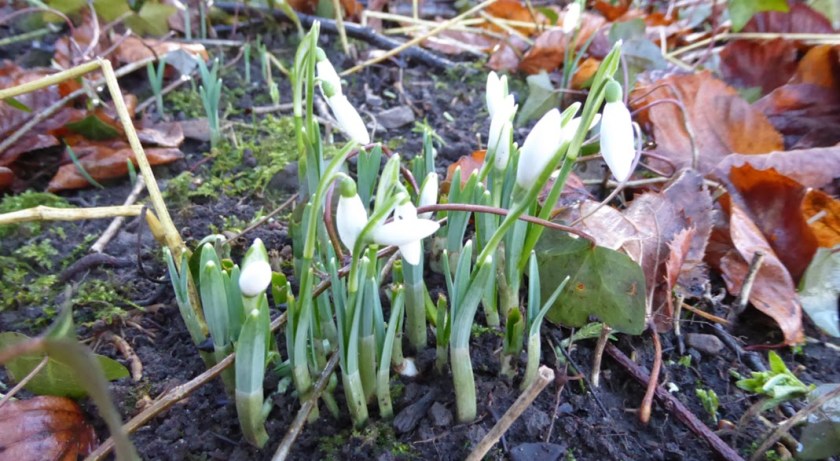
2018. Our earliest snowdrops.

On New Year’s Day, I excitedly posted a photo of the earliest snowdrops of the year, spotted that very morning.  If I’d known that this week’s WordPress Photo Challenge was to be ‘Growth’, I might just have held back.

As it is, I now realise just how special those early hardy little shoots are.  That little patch of snowdrops I showed you was alone, quite alone on a sea of bare earth, creeping ivy and a few shriveled Autumn leaves.

Let’s fast forward maybe four weeks.  This is what the garden and surrounding woodlands will look like after all the hundreds and thousands of local snowdrops have grown, pushing themselves forth through the chilly frozen earth.  Our annual miracle.

February 2017.  All the local snowdrops have arrived.

Click on any image to view full size.