This week’s WordPress Photo Challenge invites us to show images of where we’d rather be at the moment. Well, I’ll tell you where I’d rather not be, and that’s here, in North Yorkshire.
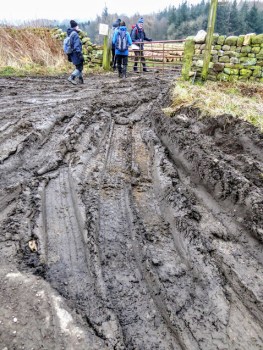
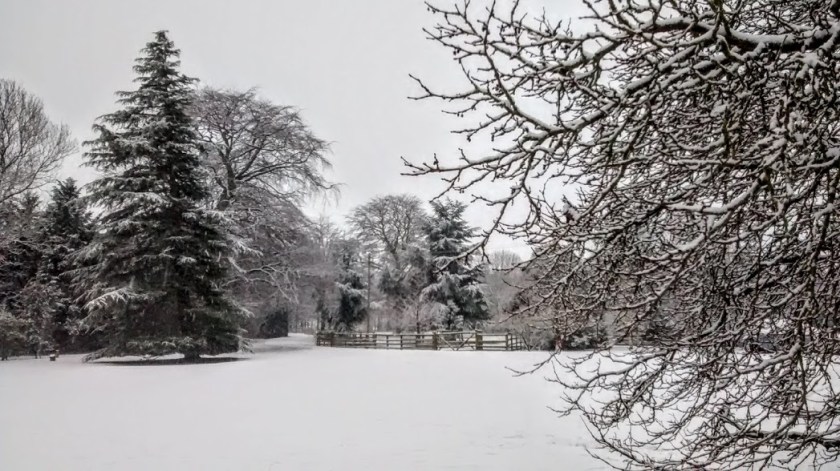
I love Yorkshire, and I’m happy to agree that it’s ‘God’s own country’. But frankly, life here is a little trying just now. Like most of England, we had The Beast from the East a couple of weeks ago bearing snow, blizzard and fierce wind. And much of the rest of the time it’s been raining. This photo was taken a couple of months ago: since then, things have only got worse.
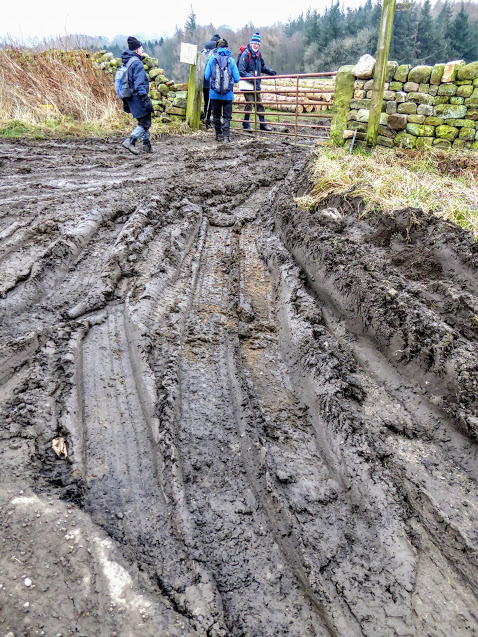
This is what our country walks have become: Nutwith Common in January
So how about a little trip back to the Ariège, where we lived from 2007 to 2014? Here’s a selection of photos, all taken there in March or very early April. Down in the foothills of the Pyrenees where we lived, blossoms were out, and wild daffodils carpeted the more out-of-the-way hills. At the weekend we would head off for Montségur and higher land to enjoy the snow that was still thick there. We were never fans of snow-shoeing, but now I’d be more than happy to exchange their crisp deep snow for our thick deep mud.
It was cold the other night. Very cold. And for three hours, I stood outside in the dark. I was happy.
I was volunteering at Fountains Abbey and Studley Royal as part of an event that spanned two continents: in Poland; in Denmark; in Germany; in Russia; in France and in China. Do follow the links: you’ll immediately have a clutch of places to add to your ‘must visit’ list.
In all these places, for one dark chilly night in February, there was a Garden of Light. Normally, we can only enjoy the Water Gardens of Studley Royal by daylight. But thanks to this international festival, there was a new opportunity.
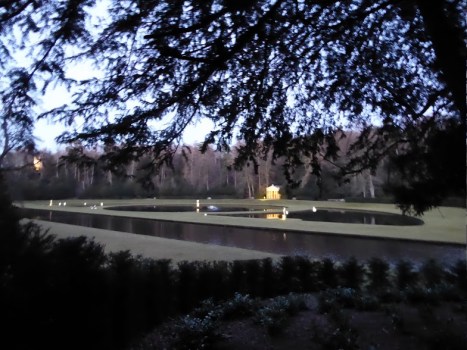
Looking across the Moon Ponds towards the Temple of Piety as night falls.
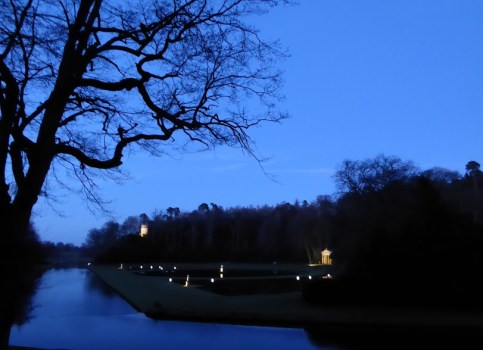
As night fell, lighting designed to spotlight the special features of the gardens pierced the darkness, revealing a garden in harmony with the philosophy of the time in which it was conceived: where Nature and Art work hand in hand. 18th century music played in the background.
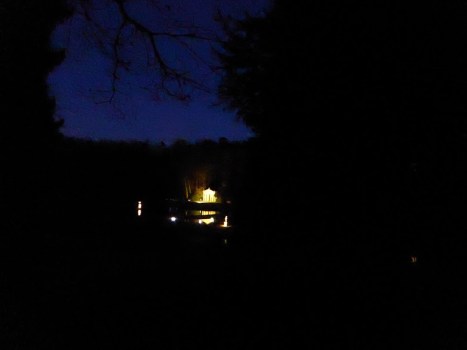
Visitors were able to stroll round, lanterns or torches in hand, focusing on the Temple of Piety and the classical statuary of the Moon Ponds; or glancing upwards at the Octagon Tower and Temple of Fame, all bathed in golden light. The Moon Ponds themselves were lit by glowing orbs – sometimes silver white, sometimes red or blue, fading in intensity as the evening wore on.
The Abbey too was lit up, though I barely saw this as it wasn’t my role to be available there.
A deliberately out-of-focus shot of the Abbey.
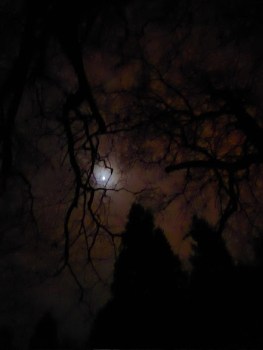
The moon was perfect – exactly half way between waxing and waning, it lit the visitors’ paths and illuminated the night sky. Whenever I looked up there was Orion’s Belt – and so many other stars usually invisible to town-dwellers.
Those of us there relished the chance to enjoy this peaceful yet joyous occasion. And as the event drew to a close, owls reclaimed the night, and their plaintive hooting accompanied us as we walked away, chilly but content.
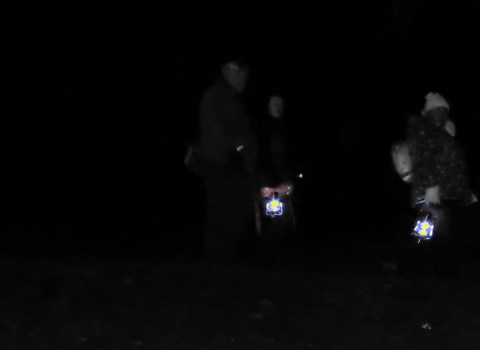
The evening draws to a close and visitors take their lanterns home.
Ripon has been a city for well over 1300 years. Founded by a saint – Wilfred – it’s been under the control of the Vikings, the Normans, and more recently Harrogate Borough Council. It’s been a religious centre, a market town, a textile town. These days it’s no longer so important. But those of us who live here tend to like this quiet unassuming place with a past to be proud of.
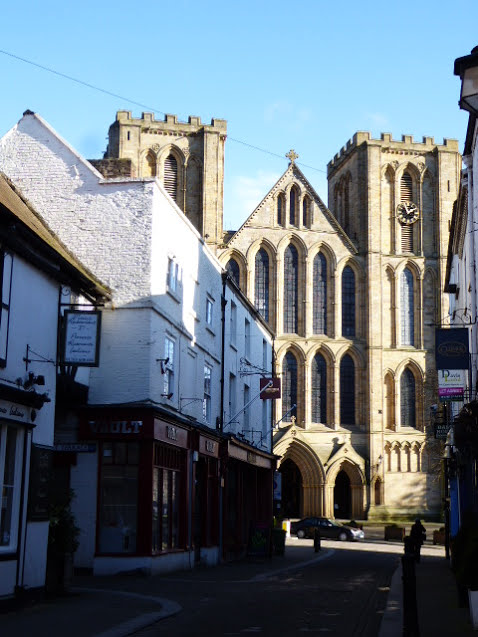
Come for a day trip, and you’ll head straight for the Cathedral, built and destroyed and rebuilt several times from the 7th to the 15th centuries.
Ripon Cathedral, now as in the past peeps from behind ancient narrow streets.
After that though, we could go and look for a Ripon not mentioned in the guidebooks. It was by chance that I found a charming oasis of calm, tucked away yards from the city centre and known to few. It once housed a non conformist early 19th century ‘Temple’, of which all that remains is the Dissenters’ Graveyard. A secret, quiet place, you’ll have it all to yourself.
Walk further up the road and you’ll find The Crescent, set back from the road behind a spacious gardens. Now as then, back in the 19th century when the houses were built, it’s a fine address. Lewis Carroll thought so, He used to visit friends here, and compose songs and stories for their daughters. There’s a blue plaque to prove it.
Day trippers tend to go home for supper. Which is a pity. Wednesday visitors could go and watch bellringing practice in the belltower of the Cathedral. Hearing the bells tolling rhythmically and tunefully for practices, weddings, and on Sundays is one of the joys of Ripon life.
The bells swinging during practice – very noisy: earplugs will be worn!
Hard work, rhythmical work.
There are a lot of them….
Day visitors miss out too on seeing the Ripon Hornblower setting the watch, as the postholder has done every single night since 886 and the time of Alfred the Great. The Wakeman, employed by the city, blows his horn in all four corners of the market square to announce the watch is set and that citizens can sleep safe in their beds (these days the watch is provided by North Yorkshire Police I suppose). Then he goes off to tell the mayor, who may be watching tv, having a bath or an evening down at the pub, or at the cinema … no matter. The mayor needs to know.
The Market Square, where the Wakeman does his job.
Wakeman at work.
I could show you the Leper chapel, or the house where Wilfred Owen lived. I could take you down ancient ginnels, or along the canal which was Ripon’s transport hub once upon a time. Or you could make your own discoveries. It’s a city you can enjoy exploring in your own time.
This week’s WordPress photo challenge is called Tour Guide. Click on any image to see it full size.
This post is for you, Ros. You’re a friend I would never have met except through blogging. And you’re coming to visit us soon. Where shall we explore first?
The WordPress photo challenge this week is ‘Beloved’.
I don’t think the humans in my life whom I love would be happy for me to plaster their images all over the blogosphere. I have no pets, beloved or otherwise. So I’ll have to look a little further.
Here’s a little miscellany of images, beloved images:
The Yorkshire Dales, whose rolling hills, bisected by ancient drystone walls I missed so much during our years in France.
The Pyrenees, from their richly flowered springtime meadows through to winter, when their rocky slopes are covered in deep snow, and which I now miss every single day. I’ll miss the shared picnics on our walks together, when our French friends pooled resources, and we ate everybody’s offerings of home-cured sausage, local cheeses, bread, home-baked cakes together with wine and somebody’s grandfather’s very special eau de vie.
Springtime daffodils. Every year I go into deep mourning when they wither, die and finally become untidy heaps of dying leaves. I’m happier now as they thrust their sheathed stems through the hard soil, promising to flower soon- but not quite yet.
There are books: I need a pile beside my bed to get me through the night.
A single, perfect cup of coffee from Bean and Bud in Harrogate.
Skeins of geese flying overhead mark the seasons here, and I love their haunting, raucous cries.
And so on….
The Pyrenees seen from St. Julien de Gras Capou in summertime.
A shared picnic near Montaillou, in March.
The Nidderdale Way.
Near Pateley Bridge.
We’ve already seen our first daffodils in North Stainley this year.
Just a random pile of books. I don’t think I’ve read most of these.
Our beloved Bean and Bud,
Geese flying uncharacteristically untidily over Marfield Wetlands.
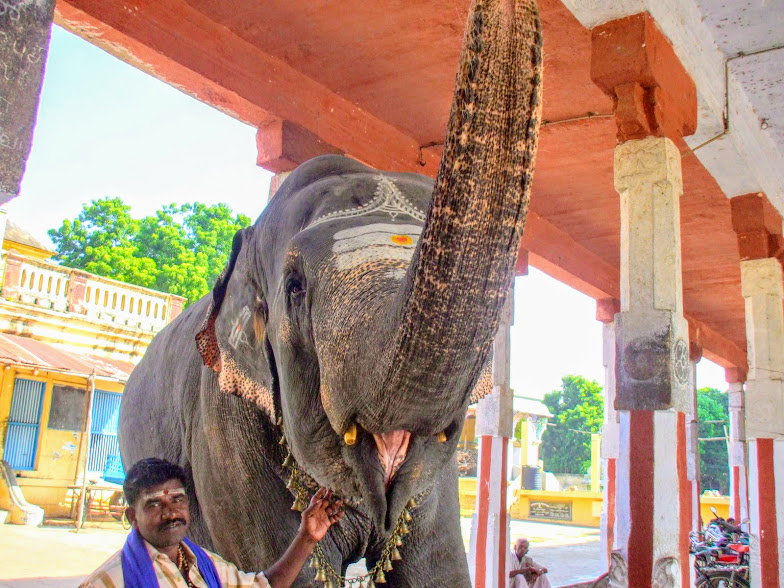
I’ll end though with this. I wasn’t beloved of this elephant in Kumbakonam, Tamil Nadu, who was only doing his job when I visited him ten years ago on my Indian Adventure. But I felt beloved and very special when he raised his trunk and brought it down upon my shoulder – his very distinctive way of blessing me.
Elephant in the temple of Adi Kumbeswarar, Kumbakonam, ready to give me his blessing.
Click on any image to see a slideshow of the photos, full-size.
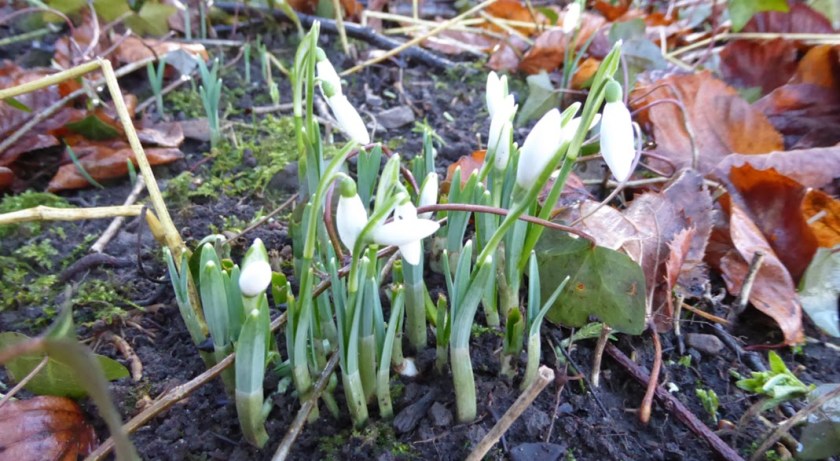
As it is, I now realise just how special those early hardy little shoots are. That little patch of snowdrops I showed you was alone, quite alone on a sea of bare earth, creeping ivy and a few shriveled Autumn leaves.
Let’s fast forward maybe four weeks. This is what the garden and surrounding woodlands will look like after all the hundreds and thousands of local snowdrops have grown, pushing themselves forth through the chilly frozen earth. Our annual miracle.
February 2017. All the local snowdrops have arrived.
For the last WordPress Photo Challenge of the year, we’ve been bidden to come up with our favourite shot of 2017. How to choose?
I was thinking of maybe reviewing the year, one month at a time: family moments, walks in the Dales, trips to Poland, Germany, France and Spain. Nope, it wasn’t working .
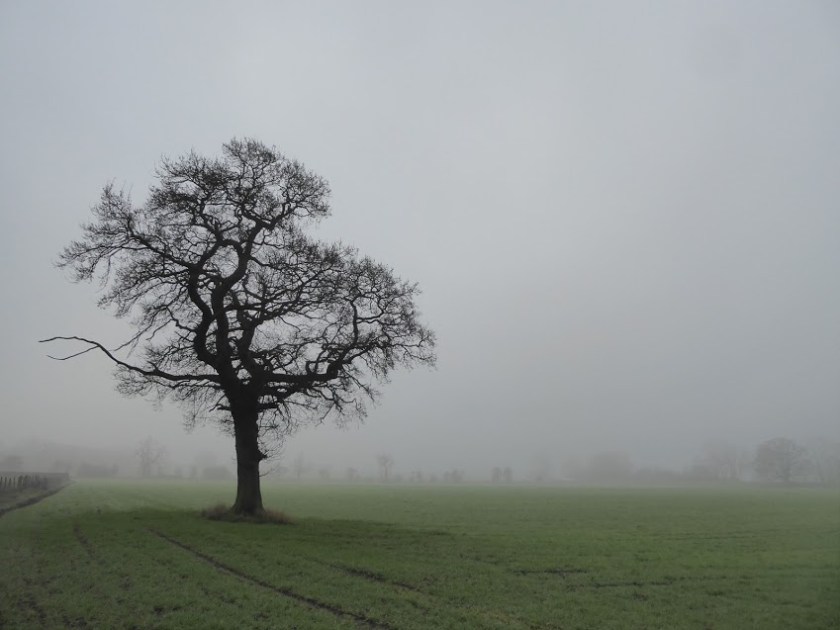
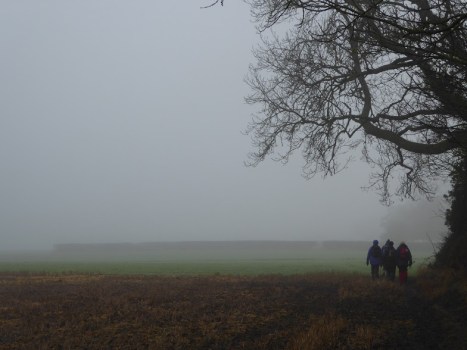
The shot that I found kept presenting itself was this one, taken on a chilly walk not so far from here almost a year ago. It chimes in with my somewhat gloomy feelings about the future: political uncertainty here, in Catalonia, in America, to name just three.
Not all was gloom though. Look! We were walking with friends. And in the end, the sun came out, and we were able to turn our backs on the damp unfriendly fog.
If only politics were so simple. Happy Christmas everyone.
Our friends from Laroque d’Olmes are with us. They’ve visited us in Yorkshire before, and are big fans, both of the friendliness of the locals, but more especially of the landscapes, whether dramatic or domestic, that we’ve been able to show them.
The other day it was the turn of Wharfedale, whose dramatic landscape was sculpted first of all by the glaciers of the Ice Age. Since then, the River Wharfe and its tributaries have created waterfalls and river cliffs, cut gorges and deposited patches of sand and shingle on riversides. We couldn’t show our friends the underground landscape of passages, caves, pools, streams, waterfalls, stalagmites and stalactites: but on a day such as we had on Sunday, with the sun shining and the sky a startling shade of blue, who cared?
We took them to Kettlewell, and on a walk worth doing for the names of the features we passed. You go up Dowber Gill, and pass the Five Sisters waterfall. Then it’s on to Providence Pot and the old lead mine workings, up to Hag Dyke: Great Whernside’s just further on.
We finished our day at Grassington, having a quick look at the dramatic waterscape at Linton Falls.
For a few weeks now, we’ve been watching the geese. At first just a few, but in the last week or so, huge skeins of them in groups of V formations take over the sky, honking as they fly, at about half past eight in the morning.
Saturday was The Big One. Two thousand or more birds invaded the sky above. And somehow, though we were looking out for them, we missed them. These are the birds, far fewer, that flew over yesterday.
I’ve spent time on the net, trying to find out more about where they’re coming from, or going to. All I know is that while they’re here, they enjoy scavenging in the recently harvested fields, and Mecca, for them is the wetlands of the former quarries at Nosterfield. And I also know that their massed flights mean that summer is over.
We’re migrating too, albeit temporarily. We’re off to Poland, my father’s country of birth. If I can I’ll do a daily post while I’m there.













 From Pyrenees to Pennines
You must be logged in to post a comment.