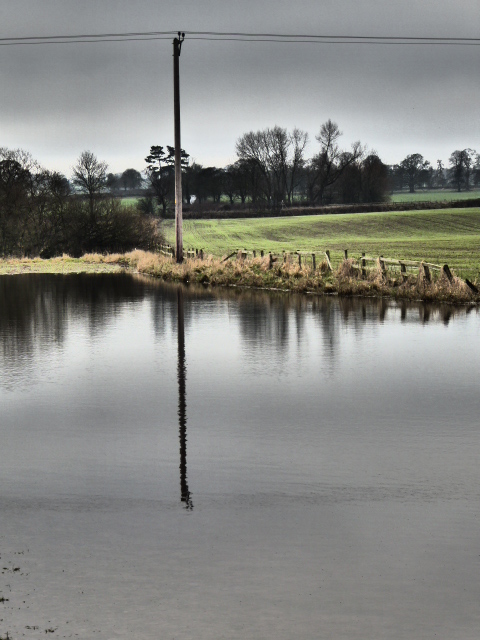
Look. Here was the scene in the field near our house, in January this year. Fields and roads flooded, impassable pathways, rocks and earth tumbling into the River Ure.
Near Old Sleningford, January 2016.
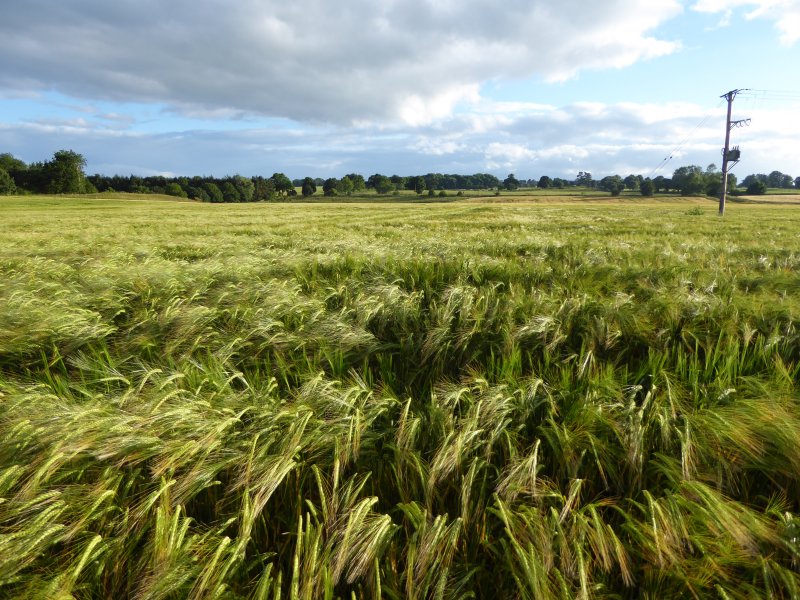
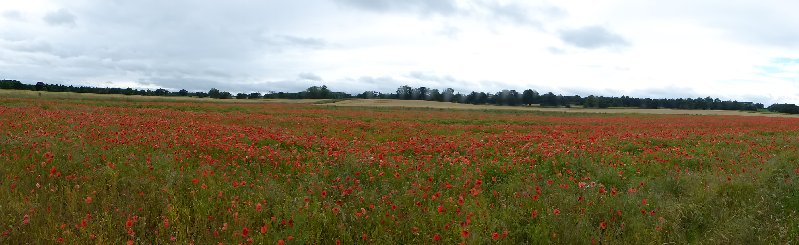
This was the same field yesterday. Barley, barley everywhere, all fattening up nicely for the harvest. Nearby, fields of poppies. Really hopeful, cheery sights on a sunny and blustery day.
The same field, July 2016
Will all our present political crises end so well? I wish I could feel more optimistic.
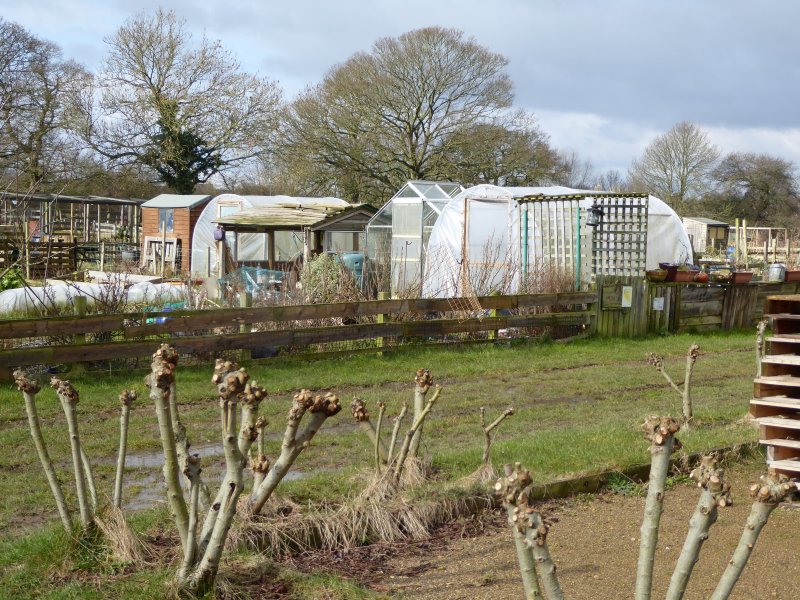
I love allotments. I love those productive shanty towns that you often see at the side of housing estates, edging railway lines, or just beyond the local sewage works. I relish the make-do-and-mend of gardeners’ huts fashioned from lengths-of-wood-and-bits-and-bobs, set alongside neat little cabins bought from B&Q. I enjoy contrasting planting styles. Here – neat meticulous rows of cabbages, beets, carrots and potatoes: there – less organised plots with discarded tyres serving as planters for courgettes and beans set among a hotchpotch of gooseberry and redcurrant bushes. I love the camaraderie of the allotment community – the willingness to share hard-earned knowledge, tips, seeds, cuttings, and even muscle-power. So much more fun that a solitary afternoon battling with weeds.
In Harrogate, I had an allotment. I was the disorganised type, always running from behind, because work and family life got in the way. In France, our vegetable garden was too far away to get the attention it deserved. Here in North Stainley, there are no allotments …..
….. until now.
A few years ago, some villagers decided to initiate an allotment project. They worked hard, but progress was slow. Surrounded by countryside, even identifying a suitable site proved difficult.
I heard about the plans and asked to become involved just as the group reached a turning point. The local landowner has offered to rent out a plot large enough for ten full-sized allotments. An allotment is ten poles (or rods or perches) large. That’s the size of a doubles tennis court. We reckon most people will be happy with a half plot. Twenty allotments then.
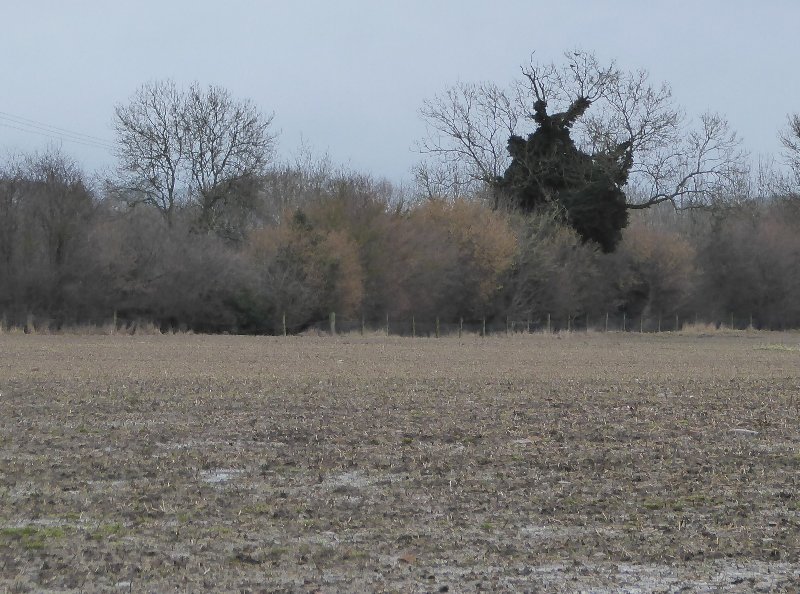
Our allotments-to-be.
So last Saturday we went to look at the land. It’s a large chunk at the end of a productive field, and it’s currently rather wet, like just about every other field in England. Promising though.
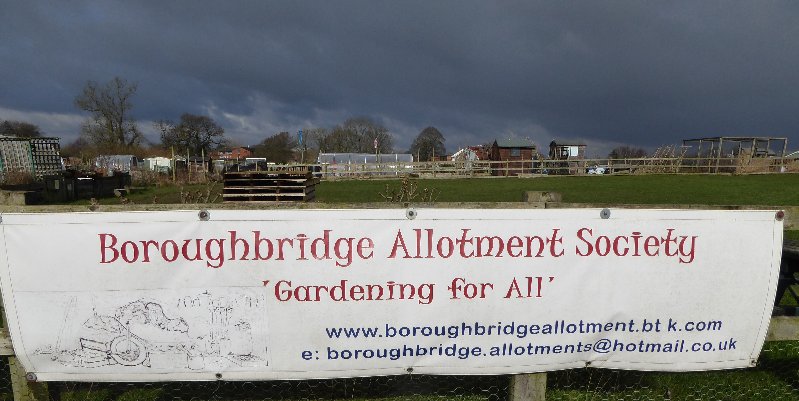
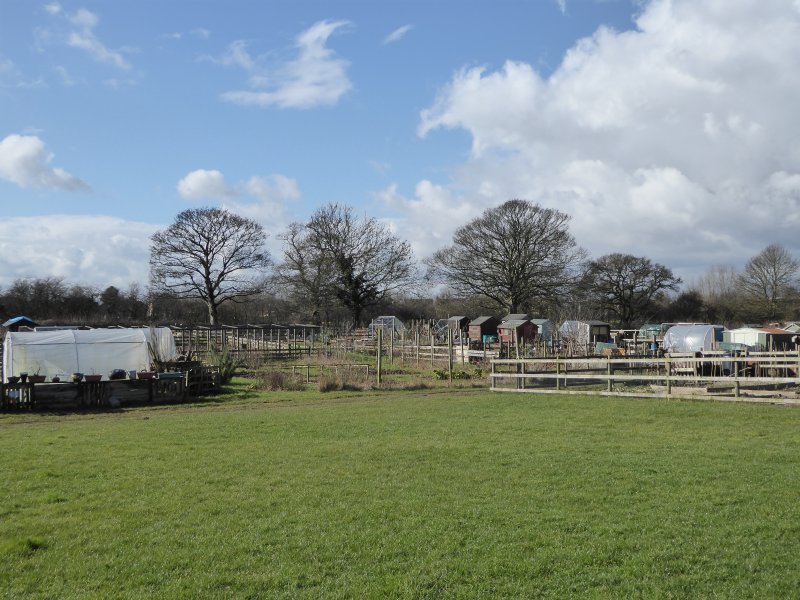
Then we went along to neighbouring Boroughbridge, where they’ve had an Allotments Society for the last 6 years or so. They were friendly and generous with their time. So much to think about though. Paying for water to be piped to the site. Thinking about car-parking and access to individual plots. Keeping pesky rabbits at bay. What to do with allotment tenants who grow only weeds. Establishing a fair rent and knowing what that rent has to pay for. We’ll be lucky to be up and running for next winter. There’ll certainly be no planting before 2017…
Six years ago, this was a field as unpromising as ours. There’s hope, then.
Here I am, still slaving away at Blogging 101, the University of Blogging. I’m beginning to get a bit on edge when I fire up the laptop in the morning, because I know Senior Lecturer and Course Director Michelle W will have sent out yet another assignment requiring us to tweak and tinker with our blogs, and generally bring them up to scratch. I even played hooky the day before yesterday, and the day before that. Doesn’t she know I have a LIFE to lead?
However, here I am again, back in the University Libary (aka our study). Today we have to write a post. And it’s to be inspired by a blog we found yesterday, a blog new to us, which we felt moved to comment on.
I discovered Katherine Price. She can write in a way that takes me to her world, her street, her little stretch of the Thames and help me to savour with her the local trees and the daily rhythms of the birds, whether a clamour of rooks, or a solitary kingfisher streaking past. The first post I read was a bit of a hymn to staying put and not moving on, a hymn to her home in suburbia.
And it got me thinking about where I live now, and where I used to live… and the time before that… and the time before that. It reminded me of a post I wrote almost 5 years ago, and I thought it was maybe time to revisit it and re-work it.
I spent my childhood in London: population 8.5 million.
Then I went to University in Manchester: population 2.5 million.
A few years later I was living in Leeds: population 751,000.
And then we moved to Harrogate: population 76,000.
Then we went to France and I started a blog. We lived in Laroque d’Olmes with about 2,500 other people.
And now we’ve come back to England, and we live in North Stainley. This is a village whose population is about 730.
Can you see a pattern here?
Everwhere I’ve lived has seemed special at the time. I used to relish all that a big city could offer, whether the museums, cinemas, or the huge choice of shops. As I moved onwards and downwards, I remembered instead and with some horror the crowds, the dirt, the general busy-ness of the place before. Good heavens, even Laroque, not big enough to support a range of shops, much less a cinema or a swimming pool seems rather exotic compared with the facilities in North Stainley (a village hall, a church, and a pub, to be re-opened in early spring). We’ve traded cinemas for a film on Saturdays once every 6 weeks in the village hall, and shops for the chance to buy eggs from the farm not far from here. And this blog is where I often report on what we discover as we explore our local countryside .
I’ll leave you with a quiz: can you identify each of the places I’ve lived in from these images?
I haven’t been on a ‘proper’ walk yet this year. First it was the ‘flu, and its aftermath. Then it was rain or snow on the days when I might have been free to get out for a blow in the breezy cold. And finally it’s the mud. Mud’s the one that gets me every time, despite having been given a wonderfully efficient pair of walking gaiters among my Christmas presents. I find it frustrating, pulling my boots from an oozing, slippery, sticky slick of mud only as a preparation for sliding into the next soupy puddle . It makes for slow walking on days when briskly striding out is what’s needed to combat the cold.
So today, keen to get out for at least an hour or so, and equally keen to avoid That Mud, I ended up on a star-shaped walk. I turned back down every path I started, and ended up doing a zig-zag circuit beyond the edges of the village.
Young kestrel feeding
I started off by looking for the young kestrel I’ve come across on a couple of days this week. I had first spotted him in a field near our house, dismembering and eating some small creature just 6 feet away from where I stood staring at him. He flapped off crossly to a nearby wall when he considered I’d got too close, and it was on this wall I saw him the next day too. Today he wasn’t there. I think there were too many dogs out walking their owners.
Beatswell Woods with extra water.
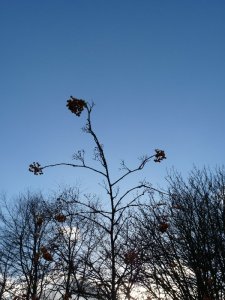
Then I went down into Beatswell Woods. I hoped for buds on the trees, or a few early flowers, but it was wet and wintry still. Then I walked to the fields, thinking I’d choose one of the paths there to take me in a big sweep round the edge of the village. No go. All the paths were muddy, and the horse I stopped to chat to had pretty filthy socks too. Though there was this rowan, with golden honey coloured berries instead of the more usual red.
Rowan berries against a chilly blue sky.
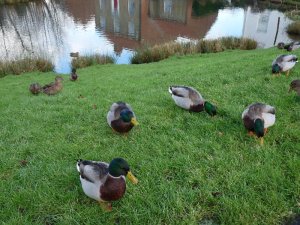
At the village ponds, the drakes and ducks ran fussily up to greet me, hoping for crusts. When they saw I had nothing, the drakes returned, like a bunch of fourth formers, to teasing and irritating the only couple of females in the group.
Drakes and ducks hoping for crusts.
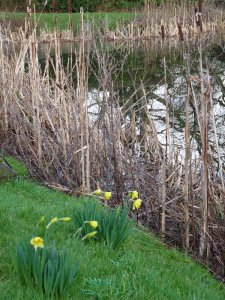
But it was near the ponds that I had my second sighting of daffodils this year, so very early. Surely they should wait until the crocuses have put themselves about? But the crocuses are only just poking the tips of their leaves above the soil, and don’t plan on coming out yet.
Daffodils by the pond.
Returning to the woods, I saw the snowdrops. Isolated patches a couple of weeks ago, now they’re in magnificent great white drifts climbing the hillsides, nestling under trees, even risking everything by straggling across the (muddy) paths.
Drifts of snowdrops in the woods.
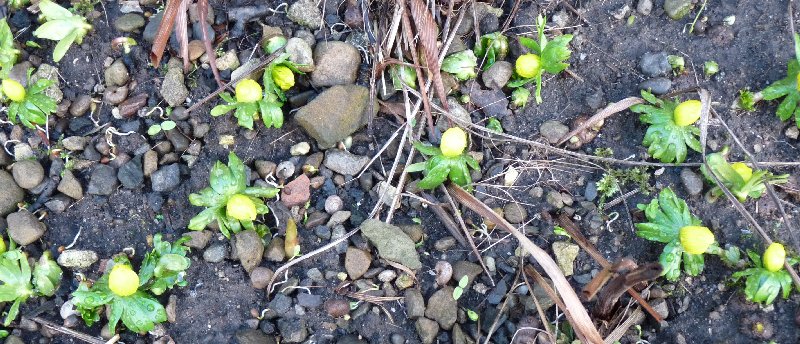
A bit of a curate’s egg of a walk then. A few frustrations, quite a few pleasures, but a healthy glow on my cheeks, and, just before I came into the house, another treat. All these aconites, pushing up their bright yellow faces through the soil, bringing with them hopes of Spring.
Ever since our friend Micheline had a nasty fall on a walk, three and a half years ago, and had to be air-lifted to hospital, I’ve been slightly wary of walking alone in the countryside.
But sometimes, only solitary will do. Never more than 4 miles from a village, always with a farm somewhere not too far away, I set off for a solo walk this morning, even before all the Grammar School pupils had got on their bus to whisk them off to school in Ripon.
From your point of view, as you look at these photos, you may feel it was all just a repeat of my Sunday morning stroll. But it wasn’t at all, not for me. My path drew me in a big eight mile circle to the west of our village. It took me past a working quarry: always good to watch men at work. It took me past ancient trees: our home patch is particularly good at oak trees which are very old indeed. As I was passing through a wood, an anxious Wensleydale sheep cantered up to greet me. I saw why she was worried. There wasn’t another sheep like her in sight anywhere – she was lost. But I never found anyone I could report her to. I hope she’s alright. There were fungi. There were delicate and skeletal winter seed heads. I saw a pint of milk delivered to someone’s gate, and took a picture of it. Home milk delivery’s getting scarcer here now than it was in my childhood, but I’ve never seen milkmen in other countries I’ve visited. I saw Autumn leaves still clinging to the trees, and plenty more in vibrantly coloured heaps at the base of trees.
Best of all – and I have no photo to prove it – shortly before the end of my walk, as I was climbing steeply through woods with the River Ure below me, three white-rumped deer leapt out of a clearing, and with three rapid yet elegant and beautifully choreographed bounds, disappeared from view, only to re-appear and disappear for good, moments later.
All in all, a pretty good use of a Friday morning, I thought.
Winter birds
Leaving home under the watchful eye of the Jacob sheep
An early morning sky
Big machinery at the quarry.
An ancient oak
This woodland will be deep in bluebells next April
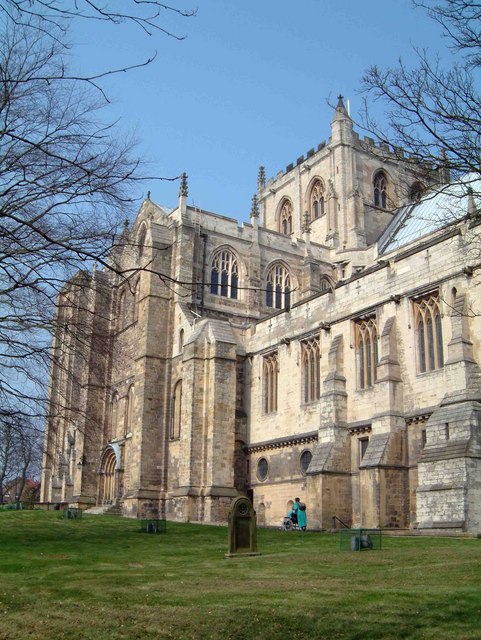
Ripon Cathedral: image courtesy of Wikimedia Commons.
Last week, I got the chance to climb the bell tower at Ripon Cathedral. How could I refuse? Hearing the full peal of bells joyously announcing Sunday worship, and at other times too, is one of the privileges of being near Ripon.
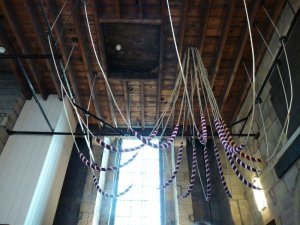
Bell ropes ready for action.
It was Wednesday evening. That’s when the team of ringers always meet to practise and learn new changes. I knew bells were rather heavy things, and imagined that tugging on the bell-ropes to make them chime must be a young person’s hobby – preferably a burly, muscular young person. But no. Bell-ringers are young, old, male, female, slim and rangy, tall and chunky, small and wiry. All that’s needed is an enthusiasm for this particularly British pursuit.
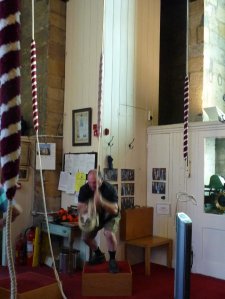
Getting started.
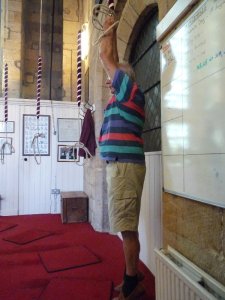
It was a fine thing to watch every member of the team as they got each bell going. That did look hard work. Holding the rope high above their heads, each ringer tugged to bring it low down, again and again, till the bell had acquired its own satisfying momentum: till indeed, it was turning so far that the bell reached the top of its 360 degree swing, paused momentarily, and could be controlled. Each bell sounds a different note in the scale, with each ringer sounding his or her bell in harmony with the rest.
Keeping the rhythm going.
There may have been bells in Ripon cathedral since the 13th century. Over the centuries, bells have been replaced or recast. The bell tower itself has been refurbished several times to replace ancient, beetle-infested timbers. By the early 20th century, the cathedral at Ripon acknowledged that its bells were no longer really doing a great job, so in 1932, ten of them were recast by John Taylor and Co. of Loughborough – one of only two bell foundries left in the country. Three more bells were added in 2007/8. At the same time as the main recasting, the bell tower was strengthened with steel and concrete. Since the heaviest bell (and it’s one of a team of 13) weighs in at one and a quarter tons, a good strong and safe bell tower seems essential.
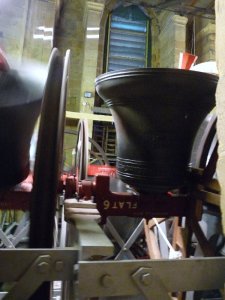
Bell in the belfry, almost fully turned.
It was a wonderful thing to watch the ringers working in rhythmic harmony (pull, pause, pause, pull), but what made the evening even more special was the opportunity to climb the bell tower itself. We had to put on thick ear protectors. Then we climbed the twisting narrow stone stairs, with almost impossibly far-apart treads, to find ourselves on what amounted to a walkway around the majestically swinging, harmoniously clanging quite enormous bells. We felt the tower shudder and sway and assumed it was our own fantasy. No, apparently it really does move with the momentum of all those bells. Despite the ear protectors, our ears felt sore from the auditory assault. Eyes and ears feasted on those bells swinging, sounding and reverberating.
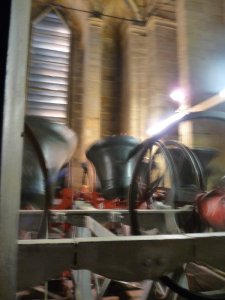
A harmony of bells.
Reluctantly, we ventured down the stairway once more. The ringers were well into their rhythm now, guided by the somewhat arcane instructions of their leader, which meant absolutely nothing to us. But I can see the attraction of being part of such a well structured and purposeful team, using skills that have changed little over the centuries. I can understand why they like occasionally to give themselves challenges such as ringing a full three-hour peal, why they welcome visiting bell-ringers, why they enjoy the chance themselves to ring different bells in different churches. And why, apparently, at the end of a hard-working practice, they like nothing more than to get down to the local pub and sink a well-earned pint.
Thanks, North Stainley Women’s Institute, for organising this visit, and to the bellringers of the cathedral for allowing us a glimpse of their Wednesday evening practice.
North Lees, the hamlet after North Stainley, welcomes the Tour.
The final post about le Tour de France. I promise. Because it’s actually over, as far as Yorkshire’s concerned. And as far as poor old Mark Cavendish is concerned too.
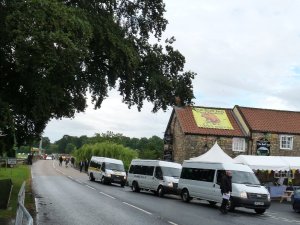
But Saturday was all about Stage One of the Tour. Up early, I dashed over to the next village, West Tanfield, to buy a paper before the road closed for the day. Six mini buses were disgorging security guards who immediately took up positions round the streets. What could be going on? Later, I found out. ‘Wills and Kate’ ( the Duke and Duchess of Cambridge to you, please), due to open the Tour at Harewood House between Leeds and Harrogate, were to be helicoptered into West Tanfield at 1.00 o’clock. Later still, we discovered that my friend Penny was among those who had been presented to the Royal couple – and to Prince Harry too – since her husband’s Chair of the Parish Council there.
West Tanfield would have been a good place to be for other reasons. The riders swoop down a hill into the village and make a sharp turn over a narrow stone bridge before the long straight run into North Stainley. So there were vans from radio stations, cranes ready to hoist TV cameras aloft, and would-be spectators galore, already taking their places at prime spots and keeping the local pub and shop busy.
The busy streets of West Tanfield, 8.00 a.m. , Tour Stage One.
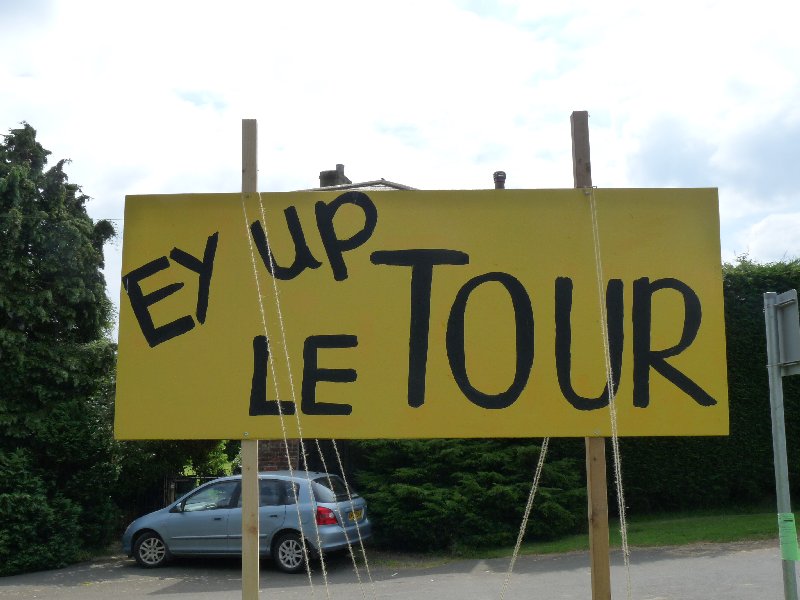
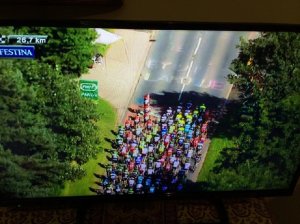
But we’d decided to stay put. Daughter and family had come over from Bolton and we decided that we should profit from the fact that the Tour actually passed the end of the drive. We sauntered down to the village to the stalls on the cricket pitch, and watched a little of the early action on the big screen in the village hall. Back home, we spent a happy quarter of an hour chalking ‘Ey up, Laroque’ on the road to greet all our friends in France when the TV cameras passed over. It worked, as my camera shot of the TV screen proves. But it only lasted a second and nobody but us saw it. Ah well.
If you’d watched the TV attentively, you’d have seen our greeting.
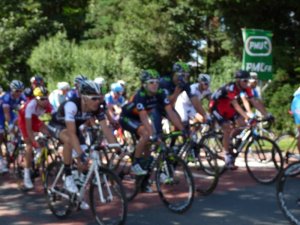
What we saw though were billboard adverts that appeared for the duration all along the roadside for companies that don’t exist in England – PMU, Carrefour – and which had already disappeared an hour after the racers had passed through.
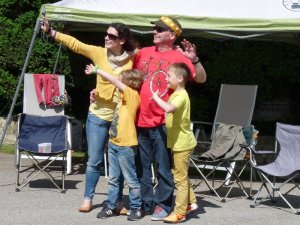
Ellie, Phil, Ben and Alex welcome the publicity caravan.
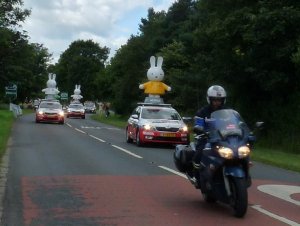
Then, finally …. tour officials in their Skodas…. British police on motorbikes….. French gendarmes on motorbikes….. support vehicles… and the publicity caravan. It wasn’t as extensive as it had been in France, but there WERE vehicles advertising French companies we don’t have in the UK, as well as British ones too. The total haul of freebies my grandchildren had thrown towards them consisted of two Skoda sunhats and a key ring. And then …….. the riders. Amazingly, after five hours up hill and down dale they were still riding in a solid phalanx, whirring towards us as a purposeful army. And then…. they were gone. Team vehicles loaded up with spare bikes aloft, more police and ambulance support followed…. and it was over. For us. Time to switch on the television and follow the action into Harrogate.
Rabbits on Tour.My shockingly bad – and only – photo of the riders passing our gate.
Disappointingly, my crop of Tour photos is exceptionally poor. So I’ll focus on a final look at North Stainley, which took the Tour to its heart, and delivered a very special homage to France and the Tour de France.
An early rider on the Tour
Here’s a close-up.
Another contender.
And another
A decorated wheel.
A garden decorated for the occasion
The Brownies decorate the cricket pavilion.
Bunting and yellow bikes.
A French lawn.
Another yellow bike.
Frank Bailey’s extremely clever revolving sculpture.
The village symbol, constructed from bicycle parts.
All the school children re-interpreted French Impressionist paintings.
The village had to have a few knitted Tour jerseys too.
A re-interpretation of Monet’s ‘Waterlilies’ on the village pond.
The church gets in on the act. ‘Le Moulin Jaune’.
Younger children at the school decorated pennants.
One of the banners at the school
Another wheely good decorated wheel.
North Stainley’s own ‘Man of the Mountains’ house.
Bill? Ben? Or a TdF cyclist?
Ooops. Someone just crashed.
The garage, now closed, has a special display of 2CVs
A stained glass window in Harrogate by Caryl Hallett celebrates the TdF
After seven years of living in France, we reckoned we were old hands at le Tour de France. It had gone past our house twice – once west-east, once east-west, and jolly exciting too, for roughly 30 seconds, which is all it takes for the competitors to go whizzing past… though there’s the no-small-matter of the caravan, and all its extraordinary vehicles full of excitable young women (only gorgeous young females and the occasional hunk need apply) flinging forth key rings, baseball caps, sweets and so on to the crowds scrabbling around for these souvenirs of the day.
And this year, for the third time in our lives, the Tour is going past our house again: because in 2014, for one year only, the Tour de France begins in Yorkshire, aka God’s Own Country. It’s quite a coup for Yorkshire tourism, as it’s an opportunity to showcase this wonderfully scenic area as a tourist destination to a world glued to its TV sets for the duration of the Tour.
Even letting agents are getting Tour de France fever.
Yorkshire has been going Tour mad for weeks – no, months. One of the earliest signs was last November, when the Harrogate Advertiser asked readers to knit little TdF jerseys to be strung as bunting in local streets. 3,000 jerseys should cover it, they reckoned. We now known that there are well over 10, 000 of them – yellow, green, white-with-red-spots, in Harrogate District alone, and who knows how many in the county as a whole, or down south when the riders complete the Cambridge to London stage? You can see them strung in shop windows, along house railings, swagged along churches, between public buildings or threaded through the branches of trees.
Outside a church in Killinghall
House railings in Killinghall.
… and a Ripon shop.
Then there are the yellow bikes. There are town trails to discover the dozens of yellow-painted bikes deposited round towns, in gardens, along country roads, in shop windows…. I’m sure many will be around months after the event, but many more will have been cleaned up and shipped off to various projects in Africa.
Yellow bikes: suspended from a pub…
…along railings….
… or simply along the roadside.
Our own community, North Stainley, has had Rural Arts working with the children at the Primary School to produce their own interpretations of impressionist paintings, and these are now on display round the village. The pond has got its own Monet style bridge with LED waterlilies for the duration. There are two new sculptures inspired by the Tour, and there’s a whole programme of social events. Every village and town along the route is involved in providing fun for residents and visitors alike on the weekend of the Tour. The description of choice seems to be ‘Le Grand Départy’. Please groan if you want to….
A splendid feat of engineering at North Stainley: Frank Bailey’s ‘Rotation Franco’ The wheels revolve in different directions.
North Stainley’s symbol, a stag, this time made of bicycle parts.
North Stainley’s take on Monet’s waterlilies.
Tour de France banner at the Primary School, North Stainley
The Folies-Bergere meets Betty’s. One of North Stainley’s impressionist pictures.
..and another ‘Impressionist’ picture
Roads along the route have been repaired and revamped, presumably to the detriment of the road maintenance programme of all highways not on the TdF course. Traffic islands in towns have been replaced by moveable versions, so they can be shifted from the road for The Big Day. Anyone with open land and the means to provide sanitary and other arrangements, from farmers to schools with big playgrounds, is offering camping or parking facilities for the duration. The French may well look askance at this degree of organisation, because over there it’s fine to turn up and park your camper van on any spare bit of mountainside that you can find. Here however thousands and thousands of would-be spectators all have to cram themselves along some 400 km. of route, as opposed to the 3,500 km available in France. Our village alone has been told to expect up to 7,000 spectators, the next village along, 10,000. The logistics are a nightmare, and forward planning essential.
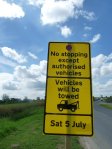
These signs suddenly appeared at the end of last week.
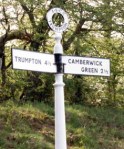
The way to Camberwick Green? Sadly not. This road sign was made by Countryways and stands by the Bluebell Railway in Sussex
Hands up if you remember Trumptonshire! If you were a child in the 1960s or 70s, or if you were the parent of such a child, chances are that you do remember your weekly visits to Trumpton or the smaller communities of Camberwick Green or Chigley. For a blessed quarter of an hour after lunch you’d all sink yourselves in front of the TV to catch up with news from Trumpton fire station (‘Pugh, Pugh, Barney McGrew, Cuthbert, Dibble and Grub’), or Windy Miller’s windmill, or Lord Belborough and his steam engine of Winkstead Hall near Chigley.
Trumptonshire was a quiet and ordered little county. And one of its communities, Camberwick Green, was the picturesque village that embodied all that rural life is supposed to be about: the sense of community, the dramas that enliven everyday life and bring everyone together, the charming mixture of contemporary technology and Edwardian costume, the idiosyncratic mix of characters from every walk of life.
Reader, we’ve just moved to Camberwick Green. Well, in fact our village is called North Stainley, but we’ve heard plenty of people who don’t live here refer to it disparagingly as ‘toy town’. I can see why. The traditionally designed houses clustered round the village green (home of the cricket club) are not old cottages, but have all been developed and built over the last few years. The original village consisted of a very few houses near the main road, a small church and (now ex-) chapel, a tiny village school at risk of closure, and three duck ponds.
The local landowner, however, saw the potential of the community and gradually sold off land to developers, who built houses. These developers however, didn’t throw up standard estates. They grouped the new homes round existing open space and those duck ponds. There’s a large, well-appointed and well-used village hall. There’s an adventure playground for the children: because the village has plenty of children now and that tiny school is bursting at the seams: some classes take place in the village hall. And the families who moved in all bought into the idea of village life at its best.
This community has a regionally important cricket club, training the young players of the future. There are women’s groups, a book group, a WI (obviously), a drama group, a social group which fundraises for the benefit of the young people in the community…. and so on. Perhaps because most people can remember what it’s like to move to a community and know not a soul, they’re unusually welcoming to newcomers. We’ve been made to feel at home amongst them, and encouraged to join in.
This morning, for instance, a large group of us were painting the walls of the long-closed village shop and garage, to smarten it up before the Tour de France passes through the village next month. Tonight it’s the second and final night of the Arts Society’s production of Blood Brothers. The village website demonstrates that this is a busy, sociable and purposeful community. We’re very happy to be here.














 From Pyrenees to Pennines
You must be logged in to post a comment.