Le Tour de Yorkshire

A stained glass window in Harrogate by Caryl Hallett celebrates the TdF

After seven years of living in France, we reckoned we were old hands at le Tour de France.  It had gone past our house twice – once west-east, once east-west, and jolly exciting too, for roughly 30 seconds, which is all it takes for the competitors to go whizzing past… though there’s the no-small-matter of the caravan, and all its extraordinary vehicles full of excitable young women (only gorgeous young females and the occasional hunk need apply) flinging forth key rings, baseball caps, sweets and so on to the crowds scrabbling around for these souvenirs of the day.

And this year, for the third time in our lives, the Tour is going past our house again: because in 2014, for one year only, the Tour de France begins in Yorkshire, aka God’s Own Country.  It’s quite a coup for Yorkshire tourism, as it’s an opportunity to showcase this wonderfully scenic area as a tourist destination to a world glued to its TV sets for the duration of the Tour.

Even letting agents are getting Tour de France fever.

Yorkshire has been going Tour mad for weeks – no, months.  One of the earliest signs was last November, when the Harrogate Advertiser asked readers to knit little TdF  jerseys to be strung as bunting in local streets.  3,000 jerseys should cover it, they reckoned.  We now known that there are well over 10, 000 of them – yellow, green, white-with-red-spots, in Harrogate District alone, and who knows how many in the county as a whole, or down south when the riders complete the Cambridge to London stage?  You can see them strung in shop windows, along house railings, swagged along churches, between public buildings or threaded through the branches of trees.

Then there are the yellow bikes.  There are town trails to discover the dozens of yellow-painted bikes deposited round towns, in gardens, along country roads, in shop windows….  I’m sure many will be around months after the event, but many more will have been cleaned up and shipped off to various projects in Africa.

Our own community, North Stainley, has had Rural Arts working with the children at the Primary School to produce their own interpretations of impressionist paintings, and these are now on display round the village.  The pond has got its own Monet style bridge with LED waterlilies for the duration.  There are two new sculptures inspired by the Tour, and there’s a whole programme of social events.  Every village and town along the route is involved in providing fun for residents and visitors alike on the weekend of the Tour.  The description of choice seems to be ‘Le Grand Départy’.  Please groan if you want to….

Roads along the route have been repaired and revamped, presumably to the detriment of the road maintenance programme of all highways not on the TdF course.  Traffic islands in towns have been replaced by moveable versions, so they can be shifted from the road for The Big Day.  Anyone with open land and the means to provide sanitary and other arrangements, from farmers to schools with big playgrounds, is offering camping or parking facilities for the duration.  The French may well look askance at this degree of organisation, because over there it’s fine to turn up and park your camper van on any spare bit of mountainside that you can find.  Here however thousands and thousands of would-be spectators all have to cram themselves along some 400 km. of route, as opposed to the 3,500 km available in France.  Our village alone has been told to expect up to 7,000 spectators, the next village along, 10,000.  The logistics  are a nightmare, and forward planning essential.
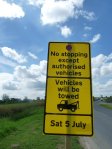
These signs suddenly appeared at the end of last week.

And there are three weeks to go…..

Bradley Wigg-fins visits a Ripon chippie

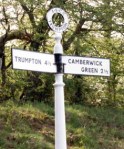
Camberwick Green

The way  to Camberwick Green?  Sadly not. This road sign was made by Countryways and stands by the Bluebell Railway in Sussex
The way to Camberwick Green? Sadly not. This road sign was made by Countryways and stands by the Bluebell Railway in Sussex

Hands up if you remember Trumptonshire!  If you were a child in the 1960s or 70s, or if you were the parent of such a child, chances are that you do remember your weekly visits to Trumpton or the smaller communities of Camberwick Green or Chigley.  For a blessed quarter of an hour after lunch you’d all sink yourselves in front of the TV to catch up with news from Trumpton fire station (‘Pugh, Pugh, Barney McGrew, Cuthbert, Dibble and Grub’), or Windy Miller’s windmill, or Lord Belborough and his steam engine of Winkstead Hall near Chigley.

Trumptonshire was a quiet and ordered little county.  And one of its communities, Camberwick Green, was the  picturesque village that embodied all that rural life is supposed to be about: the sense of community, the dramas that enliven everyday life and bring everyone together, the charming mixture of contemporary technology and Edwardian costume, the idiosyncratic mix of characters from every walk of life.

Reader, we’ve just moved to Camberwick Green.  Well, in fact our village is called North Stainley, but we’ve heard plenty of people who don’t live here refer to it disparagingly as ‘toy town’.  I can see why.  The traditionally designed houses clustered round the village green (home of the cricket club) are not old cottages, but have all been developed and built over the last few years.  The original village consisted of a very few houses near the main road, a small church and (now ex-) chapel, a tiny village school at risk of closure, and three duck ponds.

The local landowner, however, saw the potential of the community and gradually sold off land to developers, who built houses.  These developers however, didn’t throw up standard estates.  They grouped the new homes round existing open space and those duck ponds.  There’s a large, well-appointed and well-used village hall.  There’s an adventure playground for the children: because the village has plenty of children now and that tiny school is bursting at the seams: some classes take place in the village hall. And the families who moved in all bought into the idea of village life at its best.

This community has a regionally important cricket club, training the young players of the future.  There are women’s groups, a book group, a WI (obviously), a drama group, a social group which fundraises for the benefit of the young people in the community…. and so on.  Perhaps because most people can remember what it’s like to move to a community and know not a soul, they’re unusually welcoming to newcomers.  We’ve been made to feel at home amongst them, and encouraged to join in.

This morning, for instance, a large group of us were painting the walls of the long-closed village shop and garage, to smarten it up before the Tour de France passes through the village next month.  Tonight it’s the second and final night of the Arts Society’s production of Blood Brothers.  The village website demonstrates that this is a busy, sociable and purposeful community.  We’re very happy to be here.

‘…. a host of golden daffodils’*

When I realised that we were likely to move from France to England in the Spring, I immediately became anxious – no – panic-stricken, at the thought that this year we might be too late to enjoy one of the glories of English life: daffodils.  Of course, there are daffodils in France, and spectacularly so in hidden woodlands such as the one we visited last April.

But whilst the French have daffodils, they don’t do daffodils as we do here.  All over England, they’re in pots in urban courtyards, crowded into suburban gardens, rambling over country gardens.  They form part of the roadside verges on tiny D roads, march along urban by-passes and ring roads, line dual carriageways, and romp across traffic roundabouts.  Householders buy them two and three bunches at a time and place jugs and vases full of them all over their homes.

I shouldn’t have worried.  Since the moment we arrived, they’ve been at their spectacular best.  It’s impossible to feel anything but joyful when passing by whole armies of those bright yellow flowers nodding cheerfully in the breeze.

And goodness knows, we’ve needed distracting from the tasks in hand.  Since we arrived ten days ago, we’ve found a home to rent,  started the daunting process of re-registering our car in the UK (you can’t buy a tax-disc without having an English MOT, you can’t get an English MOT without an English number plate, you can’t get an English number plate until….. you get the picture), organised moving our goods, registered ourselves hither and yon, started the process of catching up with British friends, tried to maintain contact with French friends…..

…and finally, of course, I’ve changed the title of the blog.  The header, showing our transition from the Pyrenees to the Pennines, was master-minded by our friend, the talented amateur photographer Richard Bown.  He already has a family history blog, but I really hope he’ll begin a photography blog soon and share some of his fantastic images with you.  If he does, I’ll let you know.  Because you will want to subscribe.

*William Wordsworth: ‘The Daffodils’