Building a Skyscraper: Crane required

What a doddle it must be to erect a modern high-rise building, compared with the difficulties faced by those builders in mediaeval times. Their churches and cathedrals soar dizzyingly heavenwards without benefit of modern scaffolding kits, cranes and mechanical diggers.

It’s the view of Cádiz shown in the featured photo that prompted thoughts like these. The modern industrial hub is visible from the older city centre. Here’s another view:

Cádiz

Let’s go to London, a city so changed from the days when I lived there in the 1950s and 60s. Here’s a gallery of soaring towers, and the cranes that made building them possible. There are even cranes surrounding St. Paul’s Cathedral. And The London Eye makes a useful picture frame for yet another high-rise office.

And here’s new and old, juxtaposed: from Gherkin to Tower of London

Slightly off-topic, I have to include a few shots from the Gasholder development in Kings Cross. From dirty industrial back streets to desirable address in an imaginative few years.

There’s one cathedral still under construction that’s taking even longer to build than its mediaeval antecedents: La Sagrada Familia in Barcelona. Look.

Did you notice the builder in his hi-viz gear and safety equipment? He’s not the only one who needs to have a head for heights on these modern buildings. Here’s a team of window cleaners in Warsaw:

Tina has invited us, in this week’s Lens-Artists Challenge #173 to choose interesting architecture. I’ve chosen to focus on how the buildings I’ve selected reached such immense heights.

The London skyline seen from Greenwich

Black Monday? Or Grey Monday? Or Out-and-About Monday?

It is a grey Monday outside. And Jude has invited us to celebrate grey and black in this month’s Life in Colour challenge. Let’s go on one of our mini-breaks and see what we can find. We’ll start in London:

We’re walking down the South Bank here. That’s the Oxo Tower in the distance.

Oh, but maybe London’s too obvious as a starting place. Let’s start from Gateshead instead, and join a group gazing out of the window from the Baltic Centre.

We’re off to Spain now. We’ll stop off in Seville. You may need a comfort break by now, so we’ll stop off at the public toilets in Plaza de España, and enjoy the reflections we can see in its glass walls.

Plaza de España, Seville

Shadows from street lights as evening falls, but we get away in time to see the Alhambra in Granada illuminated at night – it’s the featured photo.

Shadows in Seville

We’ll pop across the next day to see my daughter in Premià de Mar. It’s silhouettes and sunny shadows there.

This is only a mini-break. We’ll go home via Whitby and just have a stroll to the end of the pier. There are always cormorants there. And seagulls on the rooftops.

Time for home now. Goodnight!

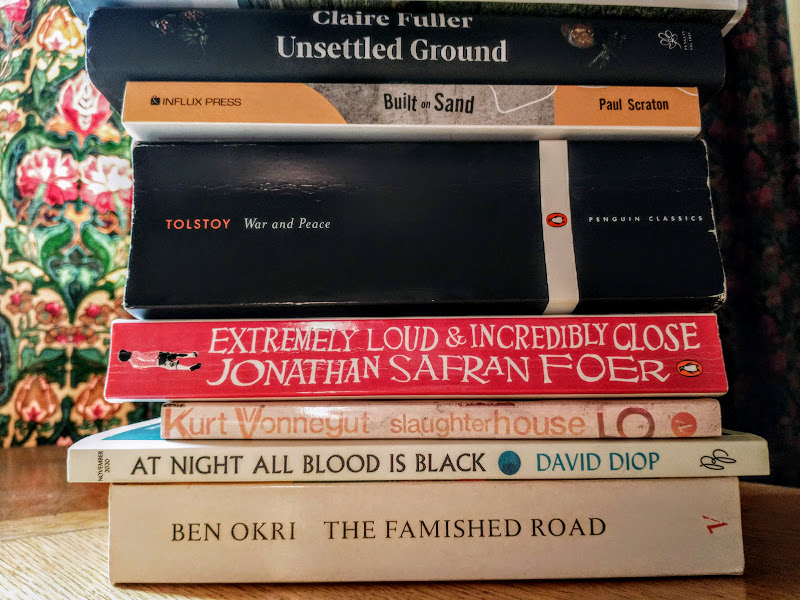
Six Degrees of Separation … in November

‘On the first Saturday of every month, a book is chosen as a starting point and linked to six other books to form a chain. Readers and bloggers are invited to join in by creating their own ‘chain’ leading from the selected book.

Six Degrees of Separation: Kate W

I haven’t read What are You Going Through by Sigrid Nunez, so I’ll rely on Kimbofo’s summary in her blog post on this book: ‘This is a story about stories — the stories we hear, the stories we write, the stories we tell ourselves… It’s about truth and fiction, confronting our fears, searching for hope to sustain us and caring for others. Most importantly, it’s about life and death, and asks pertinent questions about what makes a good life — and what makes a good death.’ 

My link to this is Alice Zeniter‘s The Art of Losing, a story told through the eyes of Naïma, a third generation French-Algerian. I was engaged in this book from start to finish. It’s the 70 year story of a family, and begins in a village in Algeria, where Ali has made good and become a figure of some importance in his family and community. The Algerian War of Independence changes all that, and forced to flee to France, they become harkis (French Algerians), despised alike by the French whom they live among and Algerians who remained in the home country. A life of camps and sub-standard accommodation and work awaits them. It falls to university-educated Naïma, Ali’s granddaughter, finally to visit Algeria again and make some sense of what she finds. This is a story about colonisation, immigration, and how to carry on in the face of the loss of your country and cultural identity, and is both a powerful history lesson and a meditation on the difficult questions posed by the cultural upheaval of being forced to leave your home country.

This leads me to Doria, a French-Moroccan teenager living with her mum in one of the soulless housing projects that encircle Paris, and whose story is told by Faïza Guène in Kiffe Kiffe Demain. We were living in France when I read this – oh, maybe ten or more years ago. But it’s stayed with me as a touching, funny and furious story of a sparky young woman prepared to make a go of things when her education, her family circumstances, her address, and a dose of casual racism stacks everything against her.

Another story of an immigrant, and like The Art of Losing, based on fact. The Fortune Men, by Nadifa Mohamed is a re-imagining of the life of a Somali seaman, Mahmood Mattan, wrongfully convicted of the murder of a Cardiff shopkeeper, Violet Volacki. At first the book swings between telling Mattan’s story and that of the victim, and her family. As the story unfold, Mahmood blossoms as a character. He’s a chancer, a thief, an adventurer, a lover and a doting father of three little boys. But he’s not a murderer. He’s the victim of racism, both from different elements of the multi-ethnic community in Cardiff where he then lived, and institutional racism at the hands of the Police, false testimony, and fabricated evidence. The most involving part of the narrative describes Mattan’s incarceration, when he evolves and shape-shifts as a character: tough, vulnerable, a risk taker, a believer in British justice. A moving, nuanced and compassionate re-imagining.
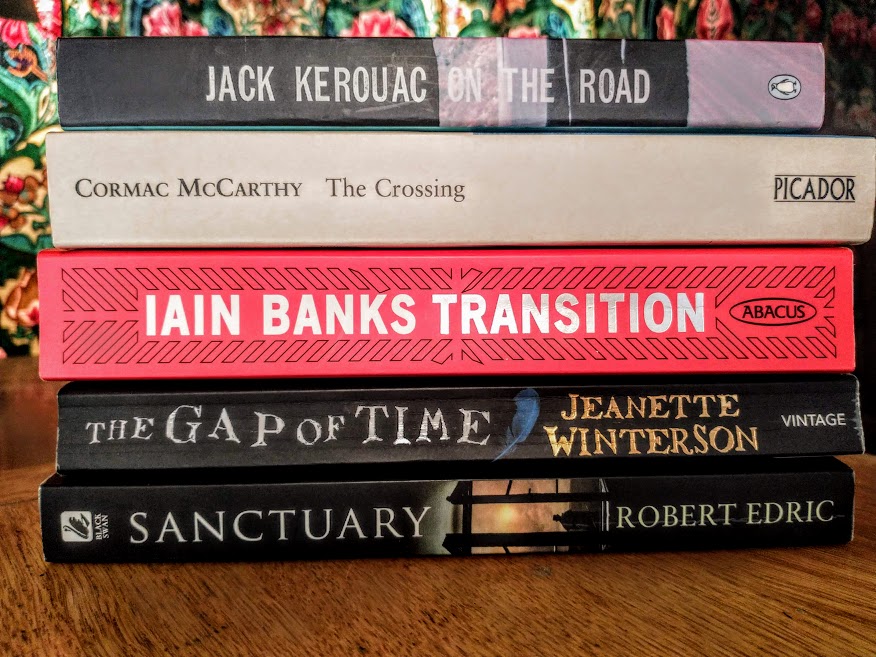
The same period of history, but we’re moving to London for Frances Spufford‘s Light Perpetual. I liked this book. I had high expectations, having thoroughly enjoyed Golden Hill and Red Plenty, and while this didn’t quite measure up, reading this book was time well spent. Several children died in South London during WWII when a Woolworth store took a direct hit. What if they’d lived? This is what Spufford explores, dropping in on 5 lives at 15 year intervals. The writing is good – that goes without saying. My only reservations are that the five characters he choses live lives which are all late 20th century issue-driven: the woman married to a National Front thug; the music lover who makes good in the 1960’s popular music scene; the sufferer from inner demons, addicted to his prescribed drugs; the Sahf London wide boy, and the print-worker whose career is swallowed away by the computer revolution. Accepting all this, the book is well done and realised and carried me along to its conclusion, a re-working of Psalm 150, which was a staple of my London C of E grammar school days at exactly this period.
Children died in my next choice too. The Green Hollow by Owen Sheers. I was 19 when disaster struck Aberfan, just doing an afternoon shift in the lending library where I worked. No internet then, no social media. It was rare for news items to reach us during the working day. But this did. And it touched us, horrified us even before we understood the full extent of the tragedy, though we didn’t talk about it together. It was too shocking. Owen Sheers put me back in touch with those feelings. He paints a scene of ordinary families getting ready for the day, ordinary children chattering their way to school, an ordinary teacher taking the register. A series of letters explain why the Coal Board is taking no action about the slag heaps, despite the concerns of the council. And then …. a rumble, a roar develops. That is all. Then we switch immediately to the rescue. To the young medical student who finds himself unwittingly part of the rescue operation, to the miners, parents, journalists. To the street where every single house has the curtains drawn. Death has touched them. Now the town is different. Life goes on. It has to. Children yearn to appear on ‘Strictly’ while every year commemorating what happened all that time go. Scars exist alongside hope.

Goodness. I can’t leave things here. What can I do to lighten the mood? Well, it’s a bit of a stretch, but I have taken you round Europe and Africa, and maybe we went by ship. Deep Sea and Foreign Going: Inside Shipping, the Invisible Industry That Brings You 90% of Everything, by Rose George. Fascinating. The story of container shipping. How it gets from A to B. Why it gets from A to B and under what constraints. What it transports from A to B and then from B to A. How goods got from A to B prior to container shipping… and so on. There was me thinking that I was trying to be green, avoiding air freight where possible. It turns out that container ships are dirty, polluting, can employ crew in less than savoury conditions and for slave-wages, and which expose them, among other things, to piracy. Frankly, it sounds hell. And yet … the camaraderie and the draw of the sea encourages some to come back, contract after contract to a world they love. Beautifully written, absorbing and informative. A book I would never have chosen to read – but that’s what bookish friends are for. Thanks, Penny!

PS. In a recent post, I indicated that I would post a review of Yrsa Sigurðardóttir: Gallows Rock. It got edged out, but I’m sure its moment will come.

PPS. Frank’s Beach Walk Reflections are his thoughts as he enjoys a seaside walk. Today, he’s thinking about red, and he’s used some of my photos, as well as those of three fellow-bloggers. You might like to take a look.

Just one day along the Thames

London last week was a time for me to enjoy the grandchildren’s company in museums and in parks during fine autumn weather, and in making a Christmas cake. On Friday though, the weather forecast was foul. We planned to go to Greenwich briefly to buy things we couldn’t get locally, then hole up at home. We bought pumpkins which, closely supervised by the children, Tom later translated into faces (‘Happy face’, said Zoe: ‘Scary face’ said William. Tom seems to have wanted a face with a head full of gnashers.)

As we finished our list of jobs, the rain unexpectedly stopped, and we decided on a jaunt to the Thames Barrier, which I’d never seen. A walk though an industrial estate offered us gravel raining down from a conveyor belt …

… and soon we were on The Thames Path. I’m always thrilled by the river in the city. I love the juxtaposition of new and old – the airy skyscrapers filled with office workers, and city types wheeling and dealing: on the water below them, rusting rusting barges plodding up and down like Dirty British Coasters, as they’ve done for centuries.

Ahead was The Thames Barrier, a buffer against the threat of flooding in London and which I think of as being rather new. It’s not. Its fortieth birthday is next year. The header photograph was our first sighting. And here’s a gallery of views as we approached, passed it, and came back the other way.

Then we were on our way back, as clouds turned dirtier, greyer, and the rain started once more to fall. Here were the buildings of Canary Wharf and Central London, viewed across ancient wooden jetties.

The promised rain had returned as a deluge. We scurried home, had lunch, and turned our attention to making Horrid Hallowe’en Biscuits and Perturbing Pumpkins.

Amy asked us to share just one day from our week for Lens-Artists Challenge #172. I chose last Friday.

Love my Library? Of course I do!

Bookish Beck is encouraging us to share why we Love our Libraries, and perhaps share some stories to show why. I’m a volunteer at our local library, though I dropped off for a while during the pandemic. This means that I have a constant supply of books which I end up bringing home to read rather than putting them back on the right shelf. And why not? I probably can’t plough through the number of books that I bring back – there aren’t enough hours in the day – but I can sample things I might not usually have considered. Some I win, some I lose, but it keeps the borrowing figures up, and that’s important when libraries battle with every council service for a share of the limited money-pot.

My post is just squeezed in for the October deadline.

Currently Reading

Melissa Harrison: The Stubborn Light of Things. I really have only just started this, but it’s promising. This is a selection of Harrison’s Nature Diaries for The Times from the last few years . She’s living in London in the section of the book I’m reading now, and discovering that Nature can thrive in the most unpromising of circumstances.

Read

What did I bring home this last month?

Alistair McIntosh: Poacher’s Pilgrimage – An Island Journey.⭐⭐⭐⭐ A powerful exploration of a sense of place. McIntosh returns to the Outer Hebrides of his youth, and undertakes a 12 day walk – a pilgrimage – from Harris to the Butt of Lewis. Not a place I know, but which I’d now like to explore, for its harshness, its Celtic roots, its community deeply rooted in its landscape and traditions. The book is part travelogue, part exploration of the island’s religious past, part exploration of ideas round war and pacifism. It’s a bit of a slow burn, but ultimately rewarding as an exploration both of a place, and one man’s mind.

The Decameron Project: 29 New Stories from the Pandemic.⭐⭐⭐⭐ In a world overwhelmed by a global pandemic, The New York Times approached authors to contribute a short story encompassing their take on this discomfiting period. It brings Lockdown galloping back into my mind, even though few stories tackle this directly. The strangeness of the world at that time is brought into focus by a visit to a Barcelona dog owner with John Wray, or Colm Toibin bicycling in Los Angeles. Not every story is a success. I wasn’t a fan of Margaret Atwood’s Impatient Griselda. But as a memorial to a moment in history, with fine writing as standard, this collection is unbeatable.

Nadifa Mohamed: The Fortune Men. ⭐⭐⭐⭐⭐ Mini review forthcoming in November’s Six Degrees of Separation

 Yrsa Sigurðardóttir: Gallows Rock. ⭐⭐⭐⭐⭐Mini review forthcoming.

Francis Spufford: Light Perpetual.⭐⭐⭐⭐ Mini review forthcoming.

Alice Zeniter: The Art of Losing: ⭐⭐⭐⭐⭐Mini review forthcoming.

Barbara Demick: Nothing to Envy. ⭐⭐⭐⭐⭐A readable and illuminating account of the famine years of the early 20th century in North Korea, as seen through the eyes of six escapees. Not all of these people had long been critical of the repressive, totalitarian regime under which they had been brought up. They accepted unquestioningly that there was nothing to envy beyond the country’s borders, despite the fact that education, career ambitions, love and home life were under constant surveillance and minor ‘offences’ could result in lifelong unpalatable consequences for themselves and their families. An eye opening look at a largely unknown world.

Peace Adzo Medie: His Only Wife. ⭐⭐⭐ Afi is a young seamstress from a not-at-all-well-off family. The chance of marriage to a wealthy man from Accra whose family disapprove of the woman who is the mother of his child changes all that. Her marriage takes place without the groom being present , and though he installs her in a luxury flat in Accra and makes sure she wants for nothing, it’s a while till she even meets him. When she does, she falls in love. But will that be enough to win him back from his other life with that other woman? I was only partly engaged in this tale. As someone who doesn’t know Africa at all, it seems to paint a believable picture of both bustling big city and small town life. But Afi seemed to me to achieve career success unbelievably easily, and I didn’t quite believe in her apparently deep love for Eli. I enjoyed the family relationships described, but on the whole, this was a book I was never fully committed to though I read it willingly enough.

Returned Unfinished

Ian Stephen: A Book of Death and Fish: I haven’t anything like finished this book. But I can tell that it celebrates language, and the telling of a good tale. I’m not in the market for a long immersive read at the moment, but I know I will come back to this book.

Janice Galloway: The Trick Is To Keep Breathing. Goodness knows, I’ve tried to finish this book. I can’t. It’s just too painful. Claustrophobic, disturbing, this is a story about a woman’s inner collapse on the death of her lover. As the ‘other woman’, she can neither be acknowledged nor supported. I’ve only once had depression, of the post-natal variety, and I was well supported, unlike isolated Joy. But the contact with this unwelcome world where everything is just too damn’ difficult and exhausting was more than I could bear. I don’t even know if there is any kind of happy ending to this suffocating tale.

Afia Atakora: Conjure Women. I didn’t finished this book, but abandoned it at about page 50. I found the narrative hard to follow, and wasn’t invested in it sufficiently to try. Reading the reviews, I’ve missed out. Note to self. Try again later.

Borrowed, and waiting their turn

Ann Morgan: Reading the World.

Lana del Rey: Violet Bent Backwards over the Grass.

Eavan Boland: The Historians.

Lucy Newlyn: The Craft of Poetry.

The past meets the present along the South Bank

Enjoying grandchildren and blogging simply don’t mix, so I haven’t been part of Becky’s Past Squares lately. But old and new meet beautifully in London, so let’s finish the month by strolling along London’s South Bank.

I took this picture of my grandchildren because it reminded me of an iconic advert for Start-rite shoes which I can’t show because it’s under copyright. Instead I’ll show you a blast from the past: their dad’s first pair of shoes – yes, I still have them.

And later, as day became evening, here’s the London skyline: St Paul’s Cathedral, built after the Great Fire of London by Sir Christopher Wren, with a forest of cranes showing the continued growth of this city.

Thanks Becky, for yet another month of fun and squaring. Looking forward to hearing about your adventures in Portugal.

Twisted and Squiggly

Half term looms. Which means bloggers too need a little down time, and I shan’t be around next week. So here’s a simple post, with just a few twists and loops for Cee’s Fun Photo Challenge, which is this week – Twisted or Wiggly.

The header photo comes from just above Reeth, North Yorkshire. The one below shows a just-harvested field, complete with twisted and wiggly tyre marks, with just-about-to-migrate swallows assembled on the power lines.

Now three shots from Seoul, South Korea: scenes from a rubber band shop (yes, really) a string shop (yes, really) and street electric cables (yes, really).

Finally, a scene from the garden this past winter .. a Past Square for Becky

Street art: a tour of Berlin, Spain, and ending up in England.

It was in Berlin that I first really discovered a love of Street Art. Maybe it’s because I got some background understanding by going out for the afternoon with Dave, of Alternative Berlin Tours. I learnt the difference between graffiti, street art, stickers and transfers, and something of the political anger and activism that can inform so much of it: particularly near the former Berlin Wall. This has now been re-invented as The East Side Gallery and I don’t show anything of that here because many of its images are so well known. Here are some examples we saw in Dave’s company, or exploring later on our own.

Having done Street Art Module One in Berlin, I was ready a year or so later to do Module Two in Valencia, It was here that I met an irrepressible type who peoples doorways and random bits of street furniture, painted by David de Limón.

Our tutor introduces us to David de Limón

And it was here too, as we once had in Seville, that we encountered street artists doing their day – or occasionally night – job.

Here are a few more:

I like the way that the windows become part of the fantasy here.

And here’s one just for Past Squares

And we’ll have a whistle-stop tour of Spain and view a few more:

Catalan independence is always the story in Berga …
… whereas relaxing over a drink with a friend is more Seville’s style

Maybe this is my favourite image of all, a bit of fun created from damaged plasterwork in Seville:

Another Past Square for Becky, and worth another outing, I think.

Although – hang on – no. My real favourite has got to be in Manor House Gardens, Hither Green, because the artist appears to have designed this image with my granddaughter in mind.

With thanks to Patti for providing us with a chance to wander city streets this week in quest of images that amuse, provoke and stimulate us. It’s the perfect moment to join the Photographing Public Art Challenge too. As well as Monday Mural. All this and Past Squares and Monday Window too … This is taking multi-tasking to a new level.

The header image comes from the top floor of an apartment block in Málaga.

Lens-Artists Photo Challenge #170

Monday Mural

Monday Window

Past Squares

Photographing Public Art