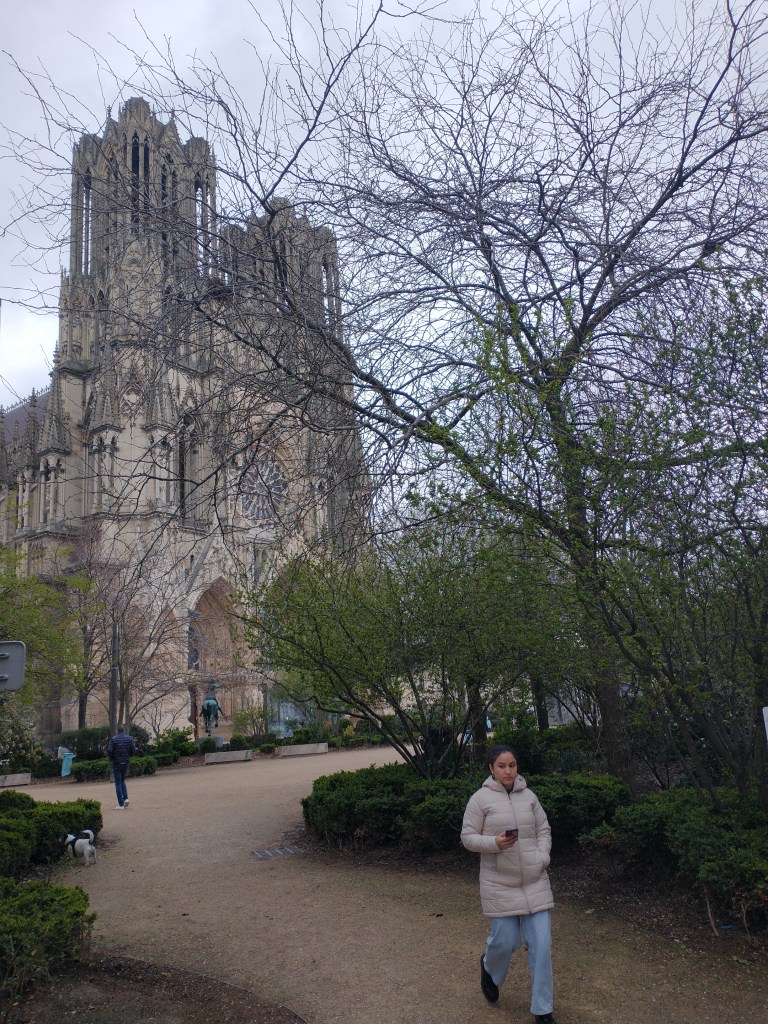
From the wonders of nine hundred year old man-made cathedrals…
Reims Cathedral, built between 1211 and 1345
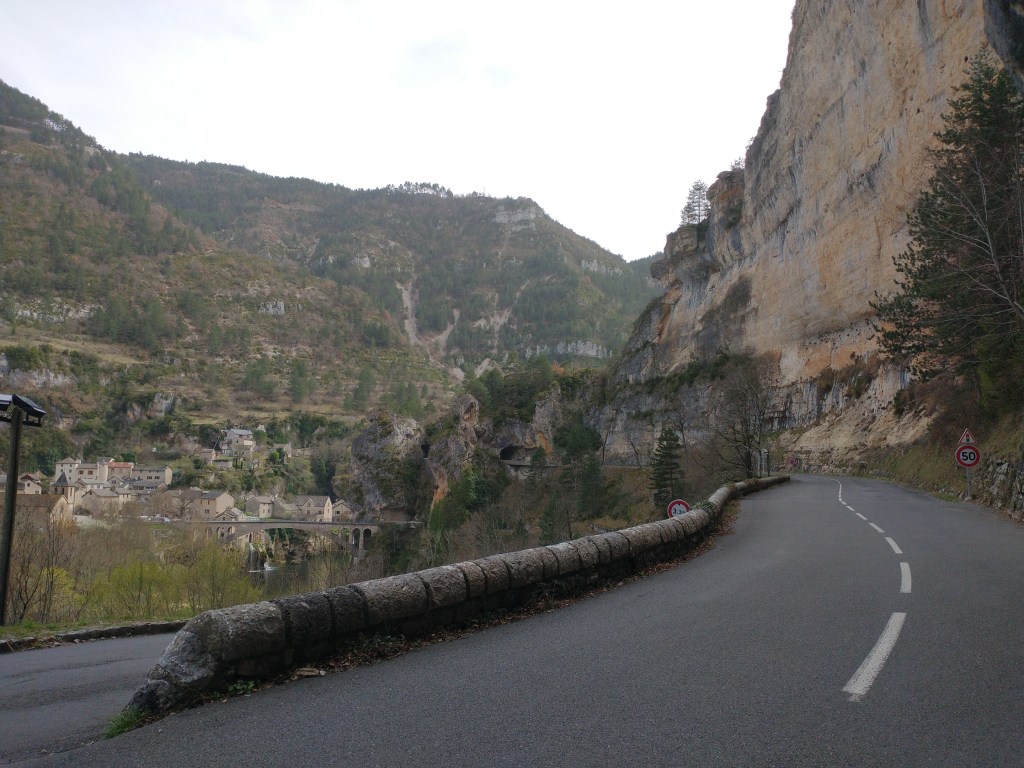
… to the perhaps two hundred and fifty million year old natural wonder which is the Gorges du Tarn (better photos later, I hope. My phone-camera was over-awed) …
The Gorges du Tarn, several million years in the making.
… to the twenty year old wonder which is the Millau Viaduct.
Millau Viaduct, the tallest bridge in the world, with a structural height of 336.4 metres.
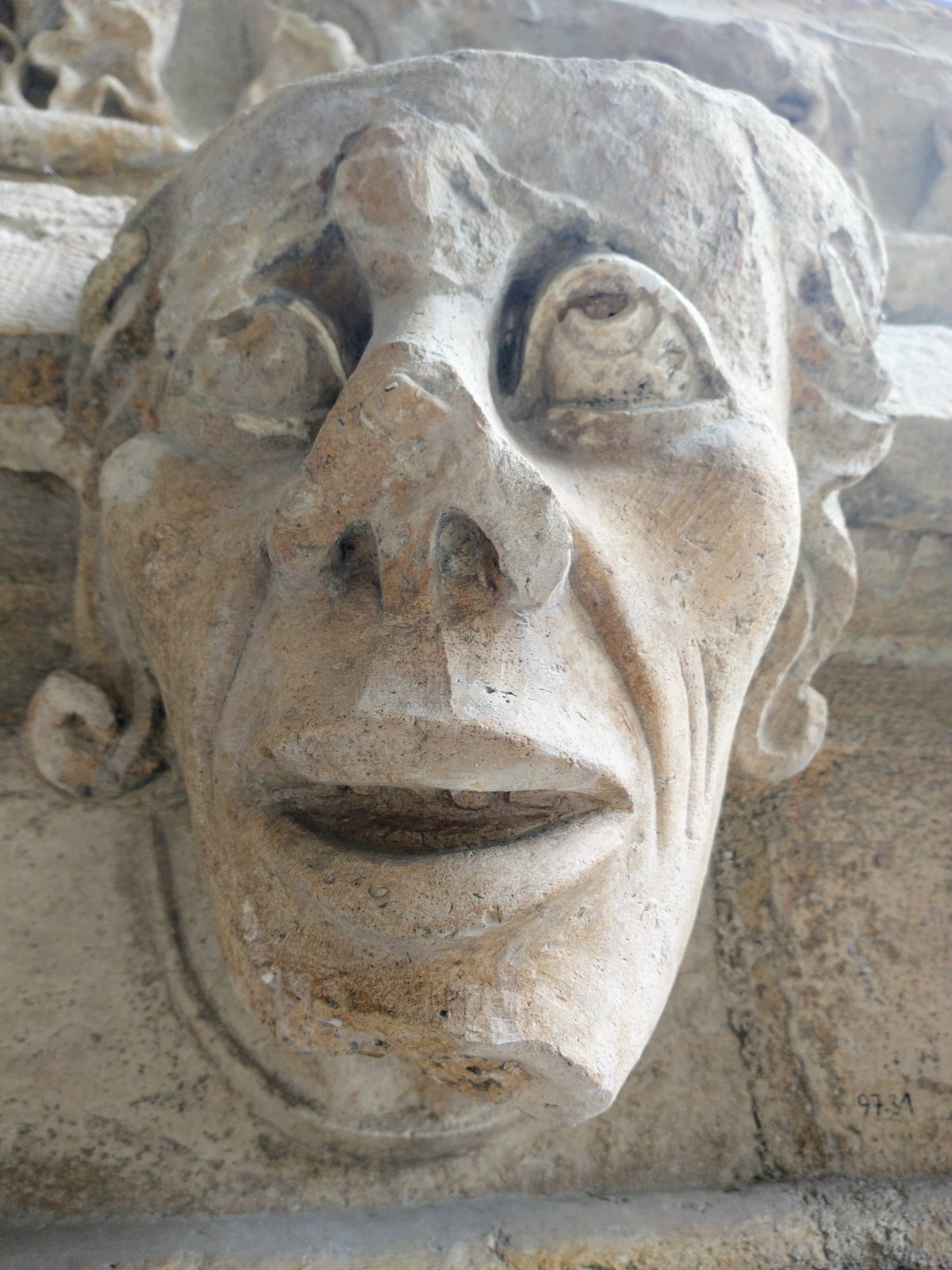
The featured photo shows a spot of shock and awe from a weathered statue stacked outside Reims Cathedral and awaiting restoration.
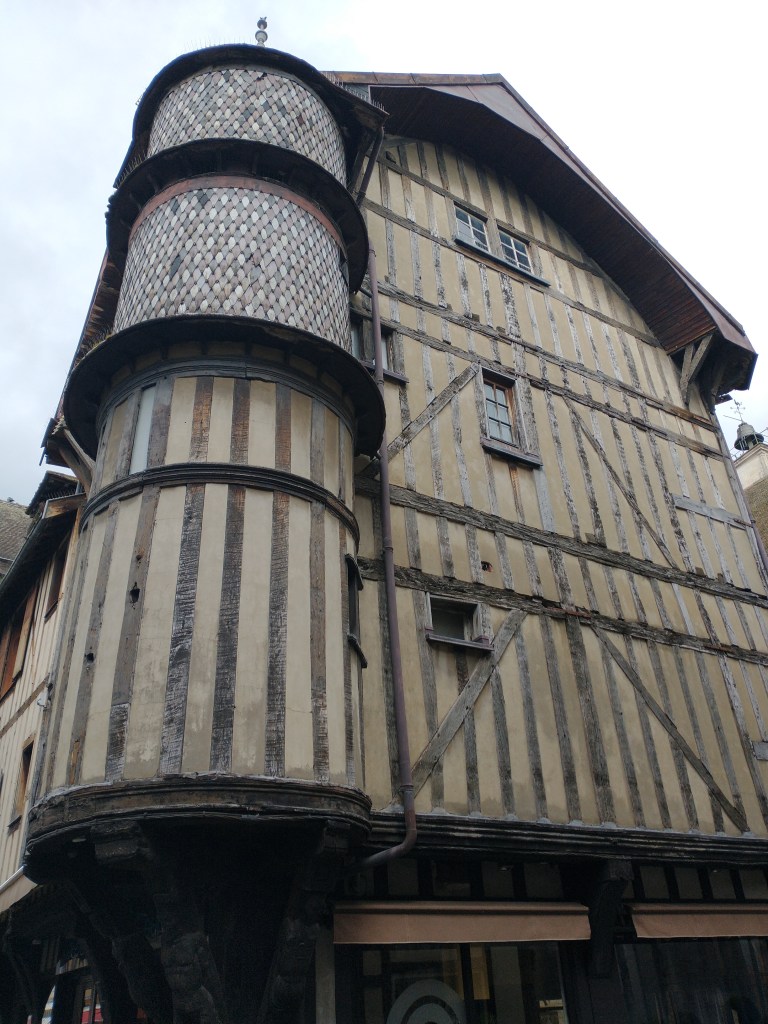
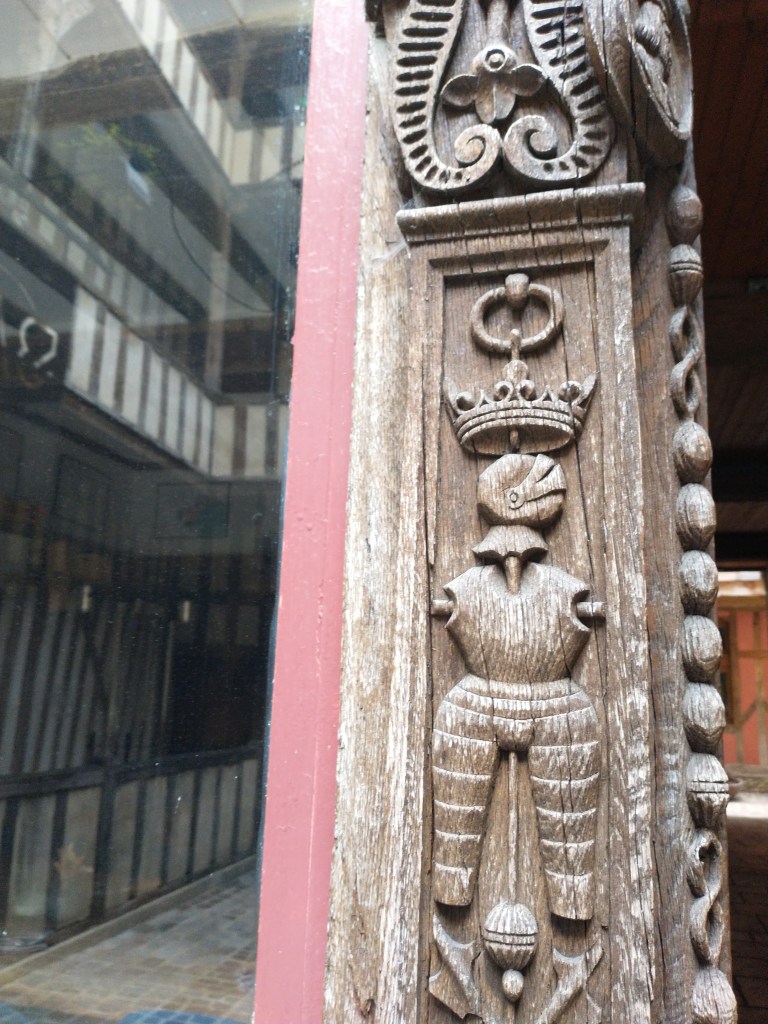
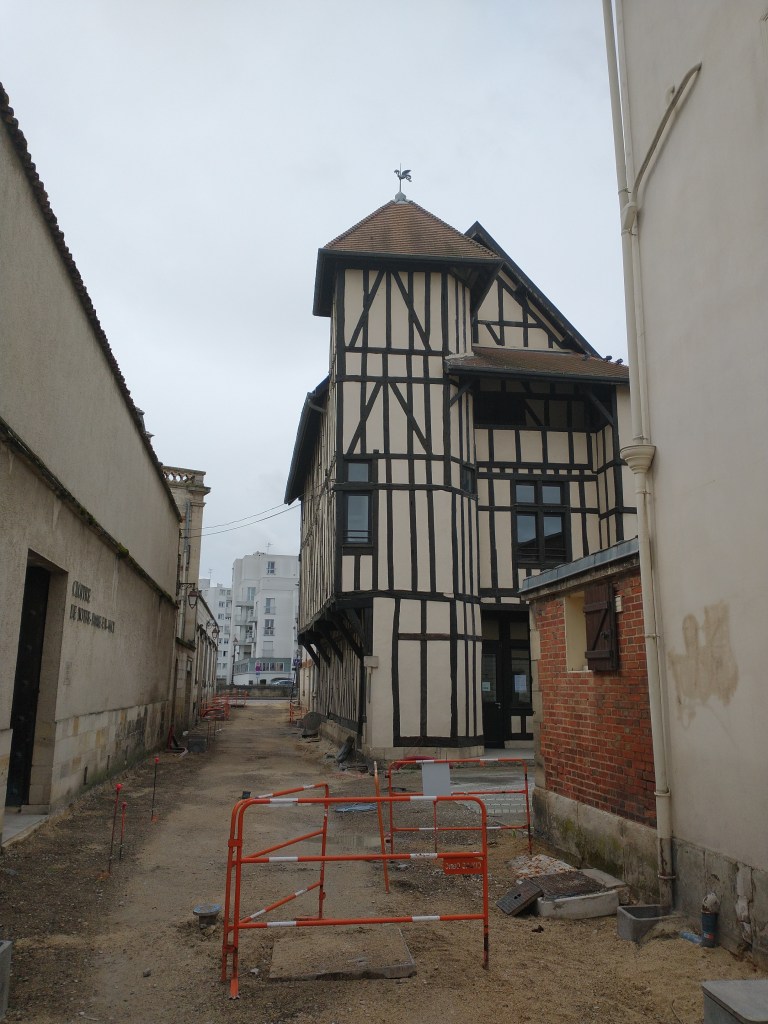
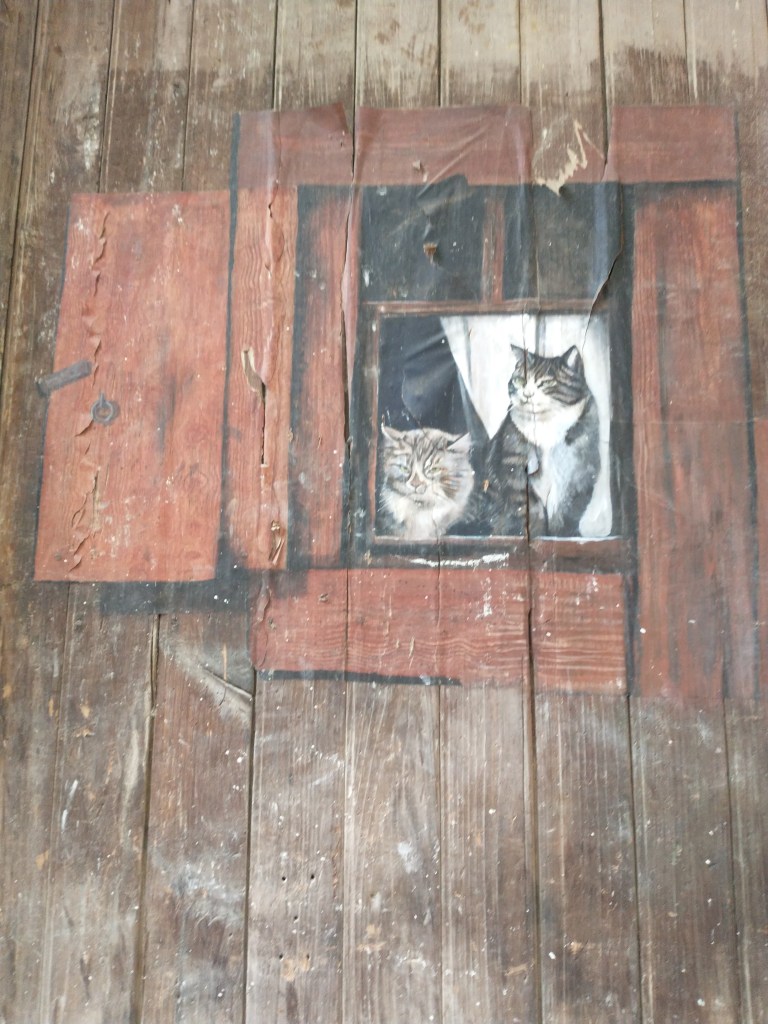
We’re on our way to Spain to see daughter and family, trundling down through eastern France. Now we’re in the Aube, in Troyes. It’s been a successful city since Roman times, but what you see now is a place that still has hundreds of half-timbered houses. Still lived in, still used as shops and business-places. A few are in bad nick. Some are being renovated. Some lean at impossibly drunken angles. Most are well cared for and entirely habitable, just getting on with life, as they have been for centuries. And a few of them provide a convenient surface for discreet pieces of street art.
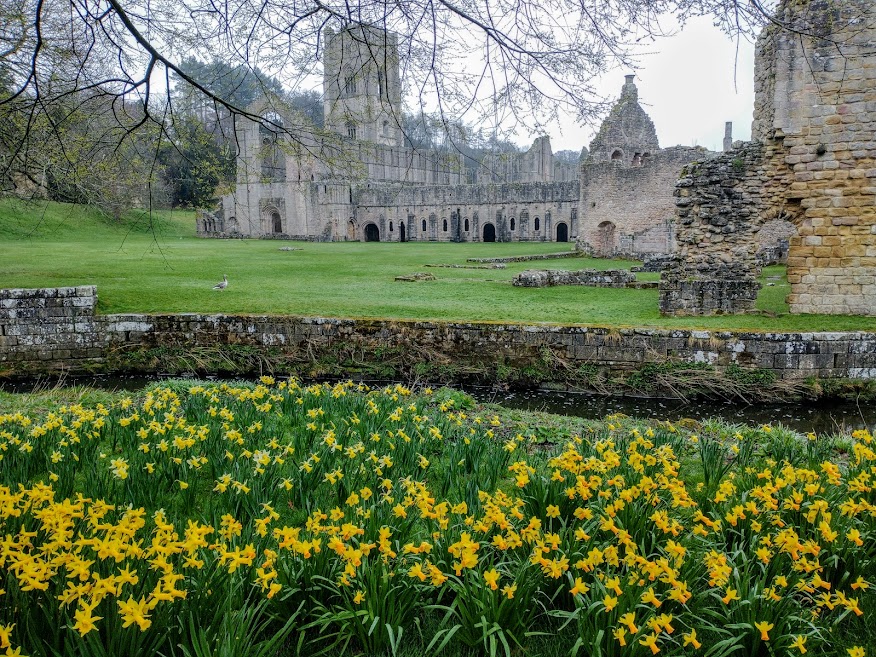
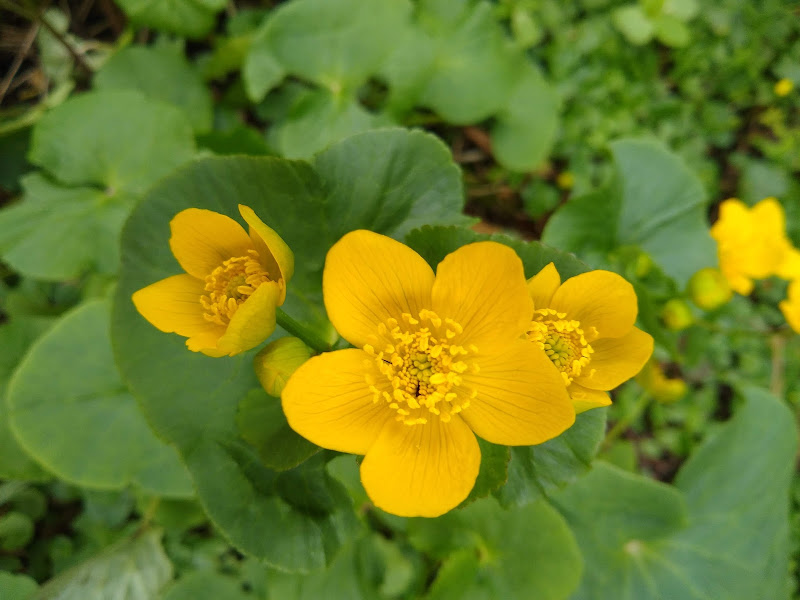
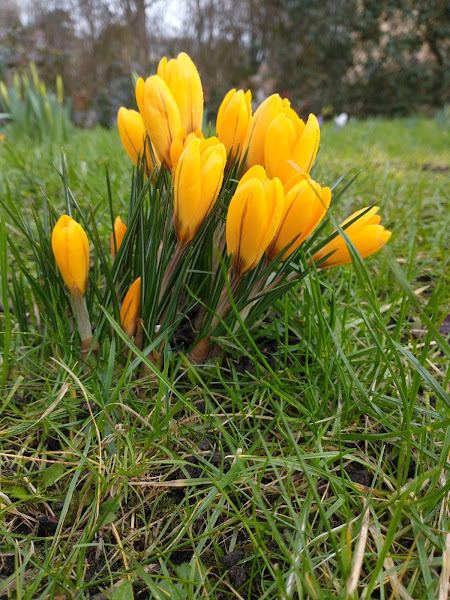
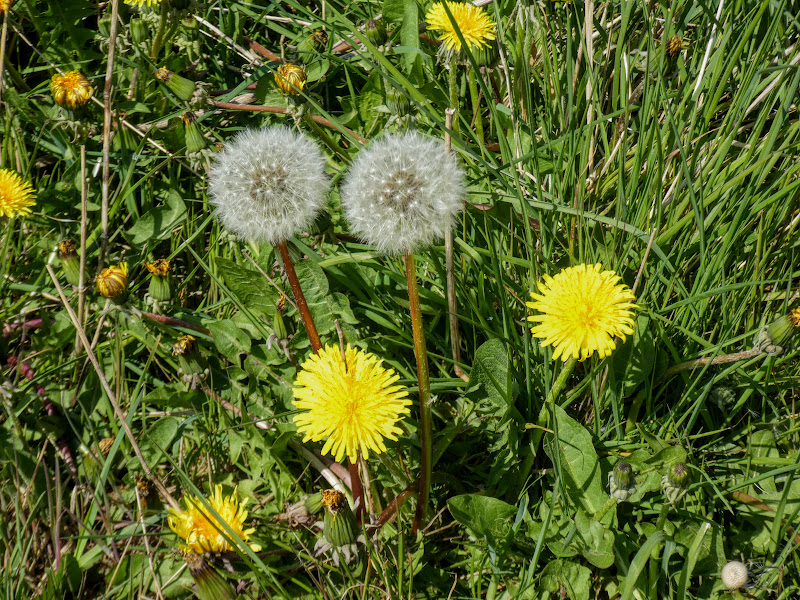
Last week, I offered you a monochrome spring day. Today, because Denzil’s Nature Photo Challenge also asks us to celebrate the spring, I’m going for colour. Just one colour though. What shouts ‘spring’ as cheerfully as the many flowers which emerge over these weeks in every shade of yellow? Look at Fountains Abbey in the header photograph – it’s just carpeted with sunny daffodils. But there’s more …
As you read this post, we’re on the road, heading for France, then Spain to see the Spanish branch of the family, and even to attend a wedding. Please expect little in the way of responses to comments, whether on your own blog or this one for the duration. But nine years ago, on 20th March, we were leaving our home in Laroque for the very last time…
Last news from Laroque
23rd March 2014
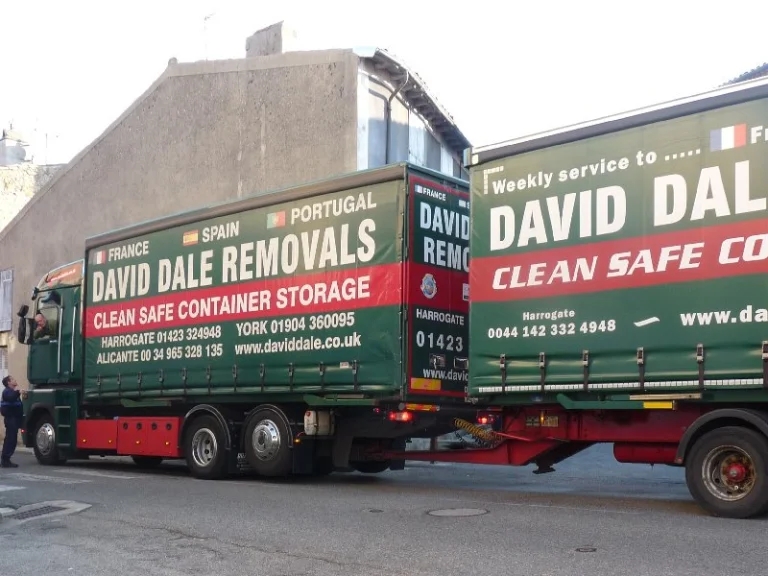
You’re making your last visit to Laroque today, for the time being. We left 3 days ago, and now we’re in Ripon. Those last days were a furore of packing, cleaning, ‘goodbyes’ (though never, never final farewells), and two visits from the removal firm, who couldn’t fit everything in, first time round. At this moment, perhaps, the person who bought our house is planning his own removal to Laroque.
I never told you, probably out of sheer superstition, the story of the house sale. The housing market’s incredibly tough in the Ariège just now. House prices have tumbled 25% since 2008. Properties remain unsold for one, two, three years, as unhappy owners reduce the price of their homes in hopes of at last attracting a buyer.
Whereas we had nothing but luck. A man from near Paris, house-hunting here, in the area where he’d grown up, saw our house, arranged to view, and said he liked it. A week later he came again, showing his ‘coup de cœur’ off to his mum and dad. He made a low-price offer, as you do. We refused it, as you do. But we offered him our non-attached garden, being sold separately, at a generous discount, and said we’d include some of the furniture in the house sale. Reader, he offered full price, and the rest is history. Vue-vendue.
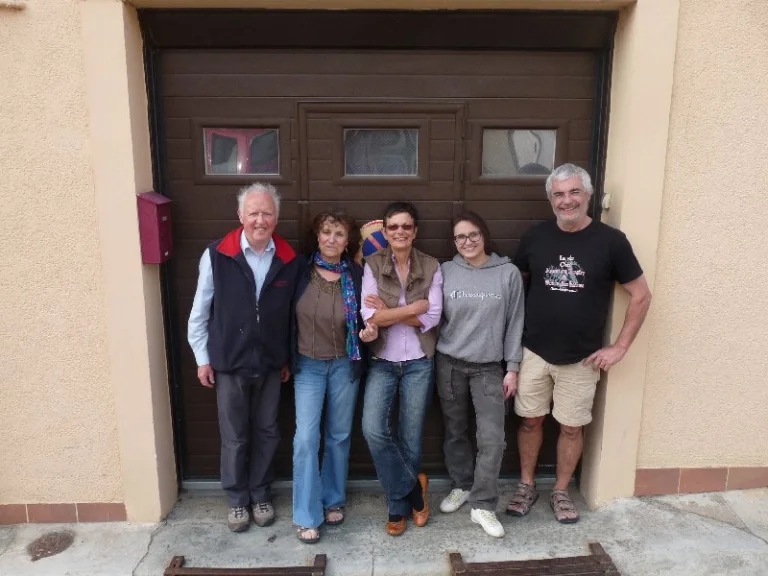
We’d just locked the door for the last time. And helping us wave ‘Goodbye’ are Martine, Francis and Anaïs, almost the very first friends we made when we arrived.Nine years on, we have a granddaughter called Anaïs.
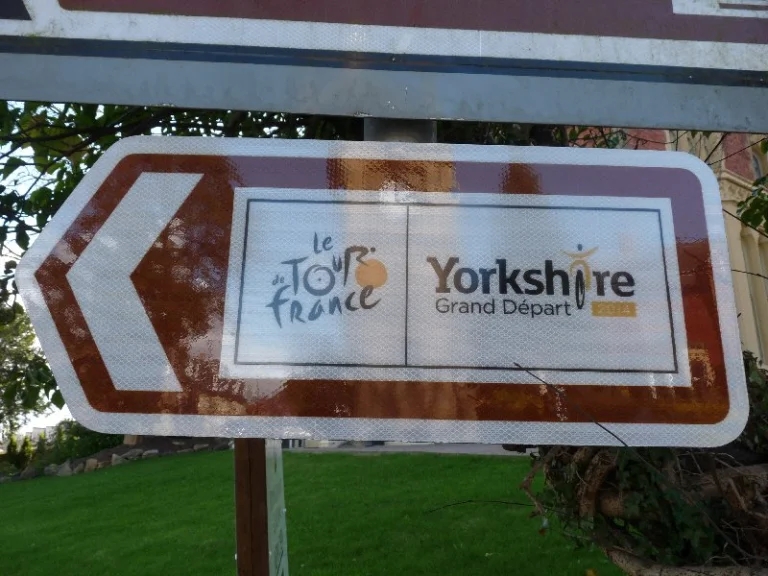
So here we are in Ripon, ready to house hunt and begin our new lives here. Oh, and there’s the Tour de France starting in Yorkshire too, in a couple of months. We’ll keep you posted.
Our luck continued here in England. The very first property we viewed to rent – as a temporary measure while we house-hunted for somewhere suitable – was the house we are still living in nine years on, with no intentions whatever of leaving.
This amateur snapshot-ist has just joined a photographic club, and it’s been a smart move. Although the group has got its share of real talent, members are just as welcoming to those of us who bumble about in the shallow end. There are talks from well-travelled and accomplished photographers: but in between, there are workshops. Last week, a member shared his enthusiasm and lots of tips for monochrome photography, and left me with the resolve to keep my camera strictly on black and white for at least a week or two.
So now I’ve got a bit of a job: This week’s Lens-Artists Challenge is all about Spring. Spring – that season when colour returns after the sombre tones of winter, with bright yellow daffodils, celandines and marsh marigolds; the soft pink of blossoms; vivid grassy greens from leaves that push through the ground or from the swelling buds on twiggy branches, and newly-blue skies. And I’ve gone and made monochrome my rule-of-the-day.
It didn’t help that Sunday was a bit cold, rather grey, somewhat windy and really not very spring like. But rules are rules, even if they’re totally self-imposed. Here we go …
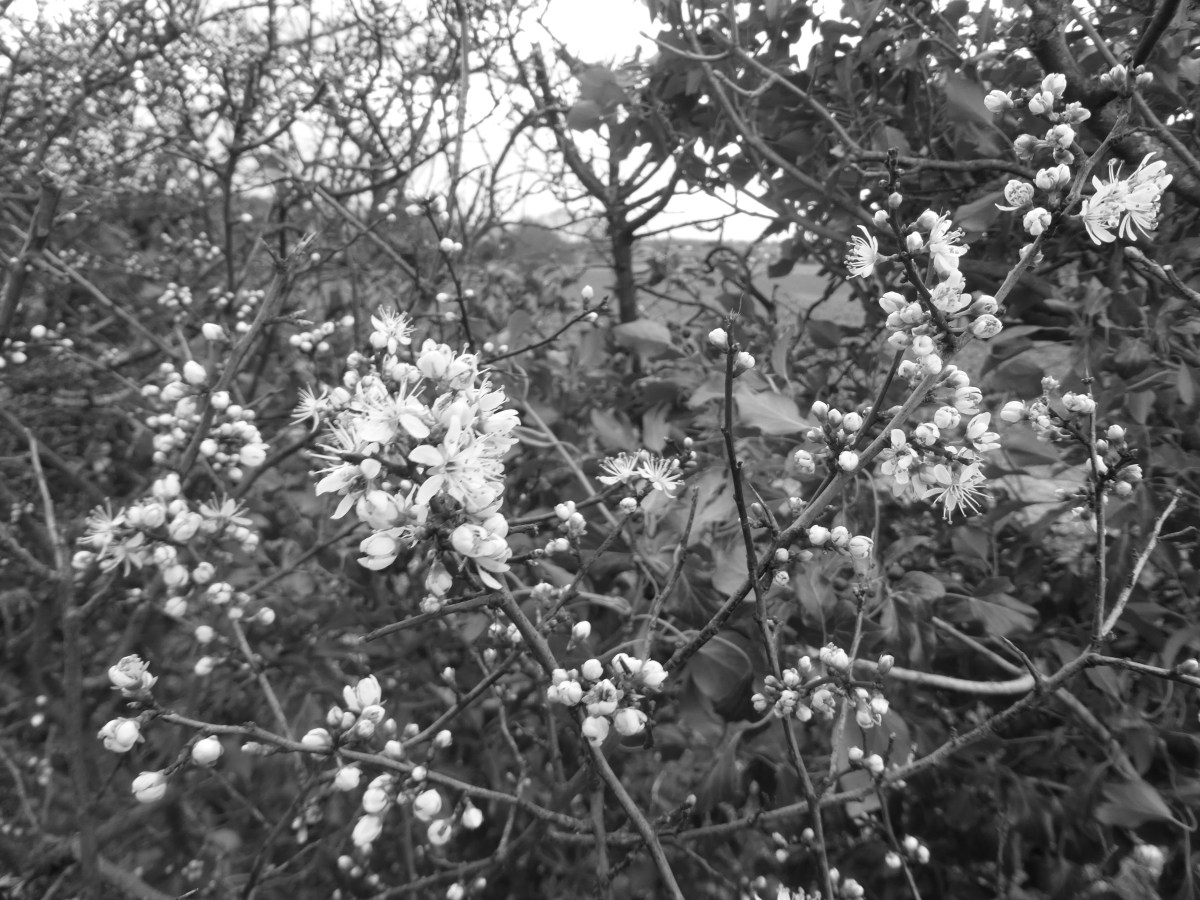
Out of the back door, guarded by spring-time pots, along the lane, edged with tree-blossom, still-wintry trees, and passing a bank of white violets .
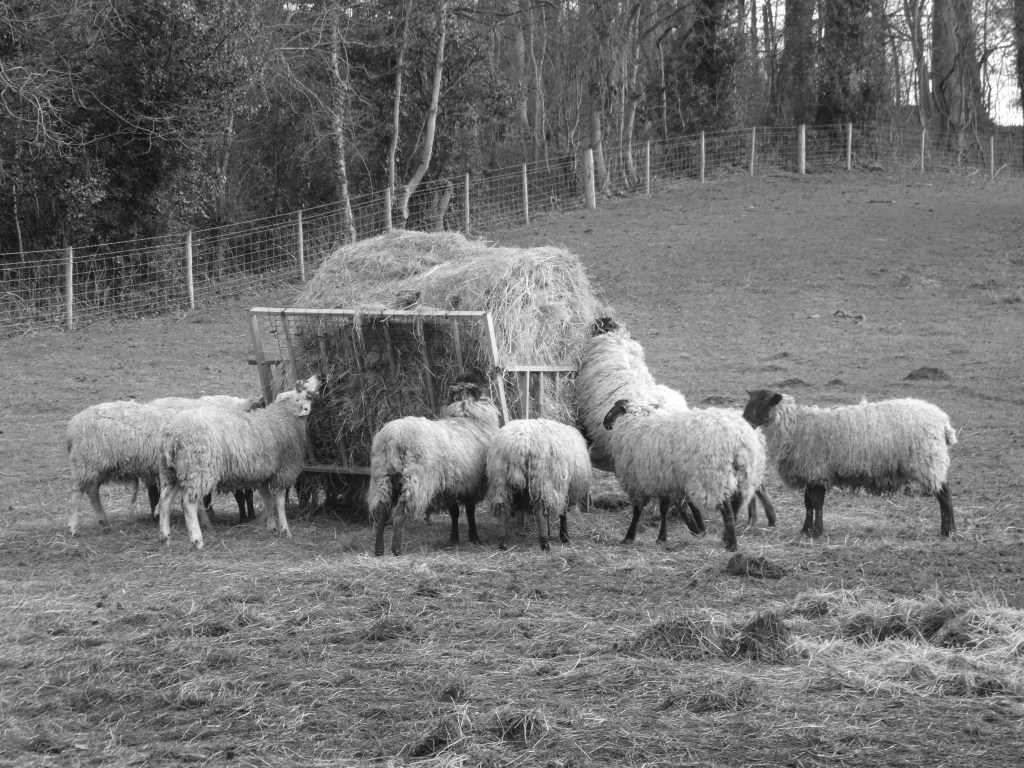
The sheep know it’s too early to lamb here. They’re still relying on winter feed.
I wander through the grounds of Old Sleningford Hall, and then along the river bank. There’s twisted hazel thinking of bursting its buds, young wild garlic.
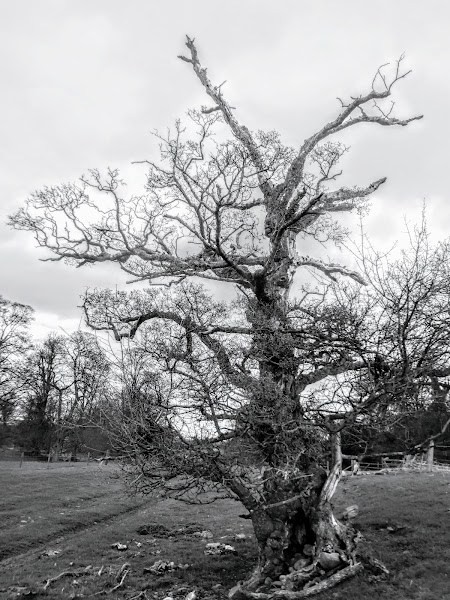
Nearly home. How does this ancient tree, almost completely hollow, continue to live, to sprout new growth?
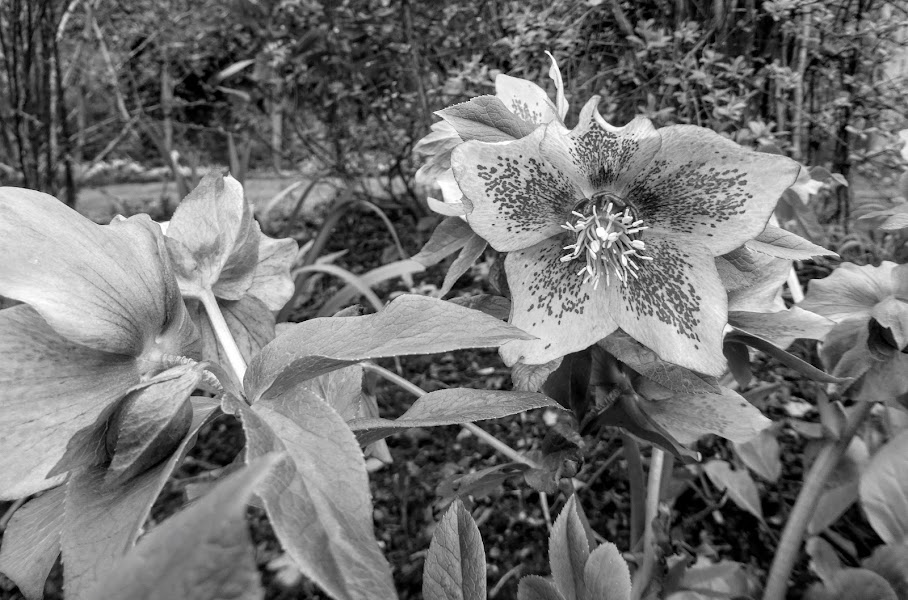
Back in the garden. The hellebores are – apart from the daffodils – making the best showing. We’ll end our walk by enjoying those.
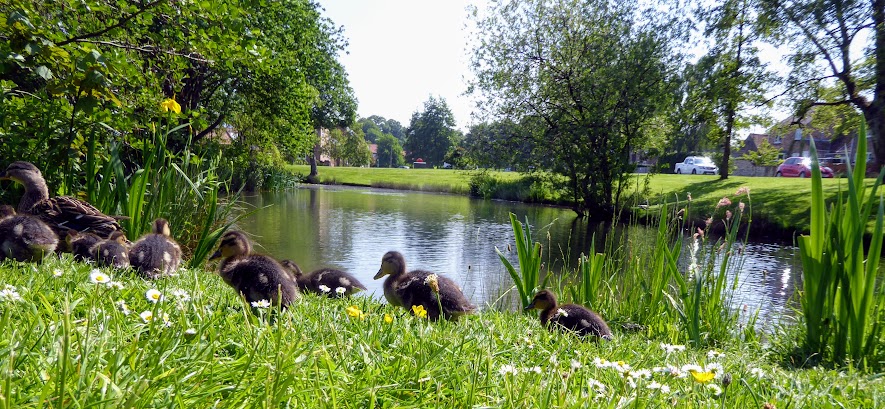
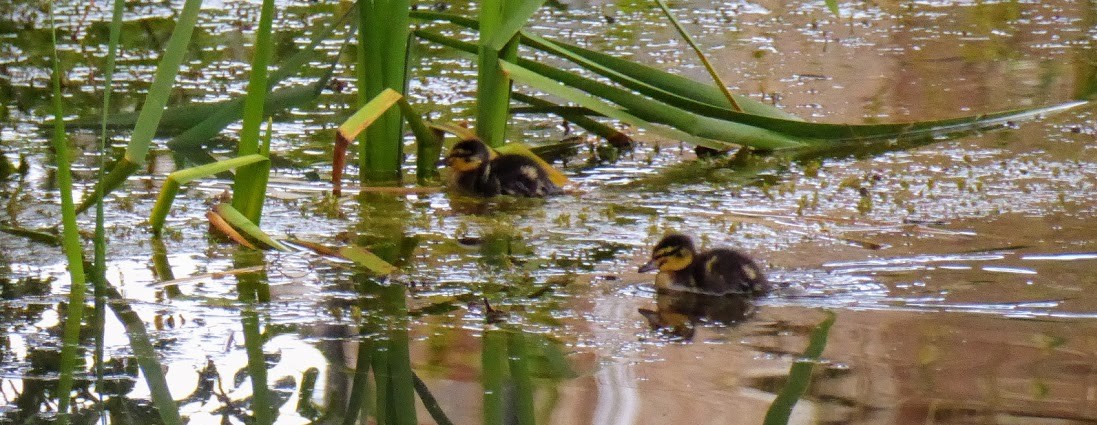
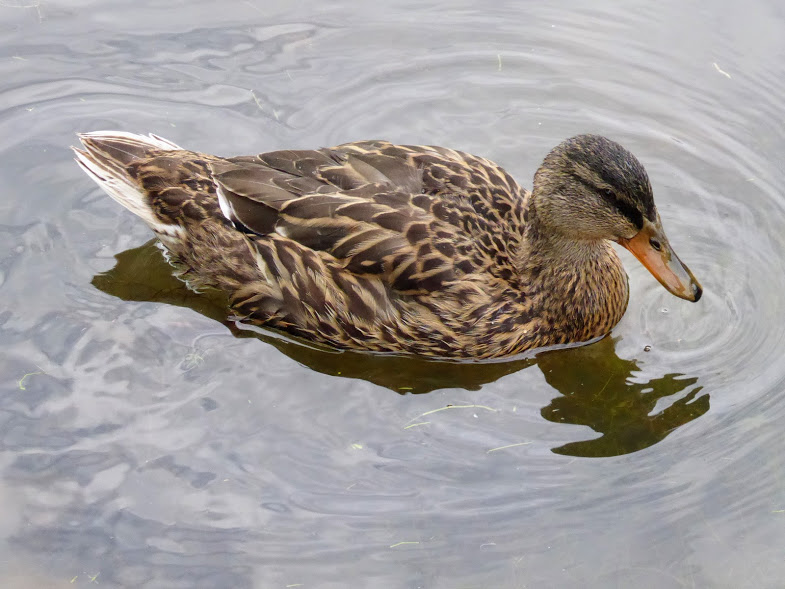
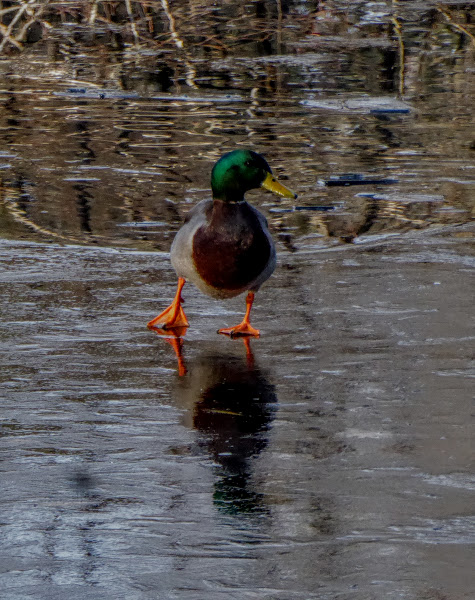
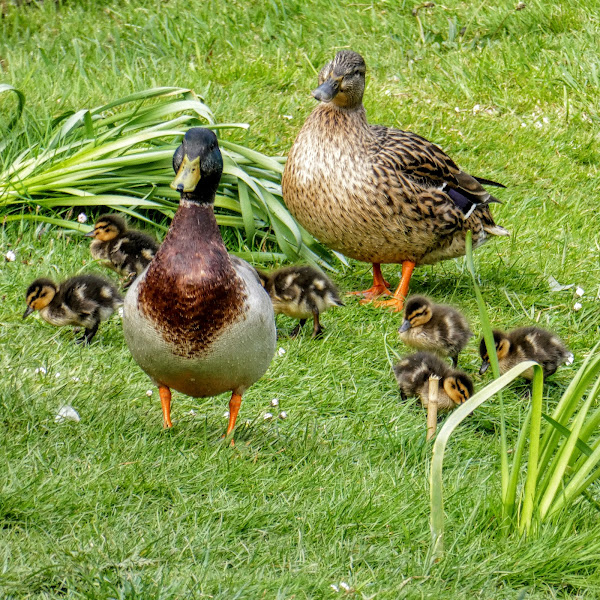
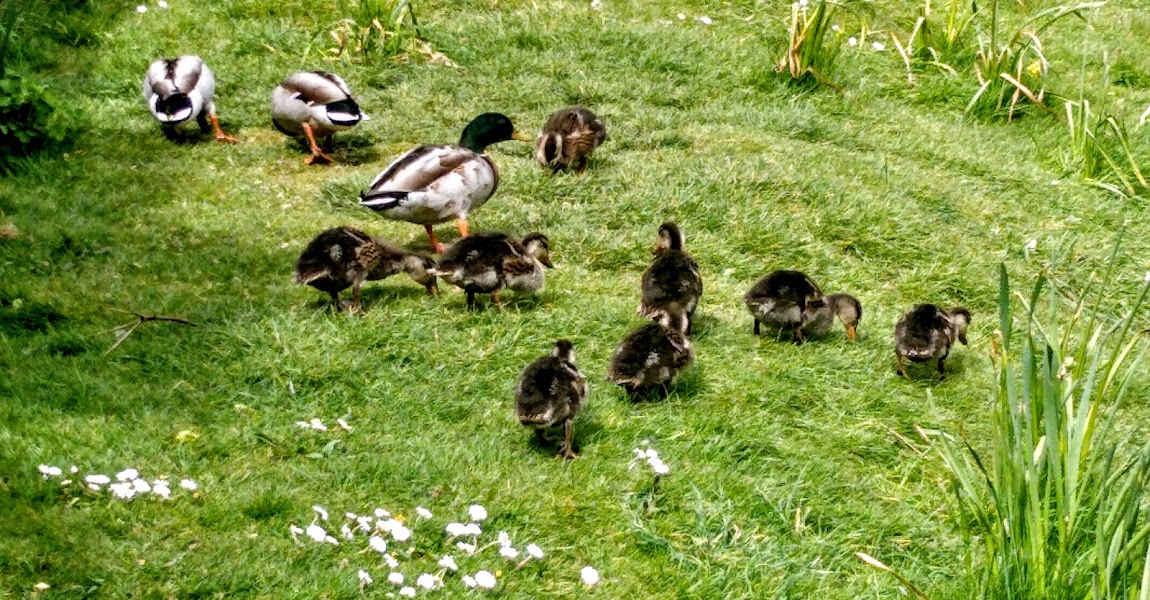
We’re lucky. Our village has not just one, but three village ponds. It’s home to a variety of geese, to coots and moorhens … and to any number of mallards. Males seem to outnumber females. Most days in the spring and summer the laddish drakes – if they’re not lazing around on the grass – like so many teenage boys, mob the younger females in a rather aimless and half-hearted fashion.
We’re nearly at the time of year when ducklings will hatch and charm us all. The ponds are on both sides of the main-ish road that splices the village in two: the mother ducks march their broods back and forth, confident that traffic – yes even huge and heavy municipal dustbin lorries – will instantly grind to a halt to let the young family cross.
Nevertheless, few broods grow intact to adulthood. Jealous mallards despatch ducklings not their own. Geese kill them. Foxes take them to feed their own young. Herons visit. And despite the care most drivers take, there are traffic accidents. We often wonder what happened to the brood that Malcolm spotted one day on a lane near here: a mother duck leading fourteen – yes fourteen – ducklings along the road.
It was twelve years ago this weekend that I realised that even ordinary-seeming mishaps on country walks can have very unfortunate consequences …
SOS Air Ambulance
March 20th, 2011
Poor Micheline. Her pain, her distress was our Sunday Soap Opera.
We’d gone walking with our Rando del’Aubo friends, near Nébias again. We’d yomped up a mountainside, two hours of it, and were looking forward to lunch in – oooh, maybe ten minutes. That’s when Micheline fell over a tree root.
It was bad. Very bad. Broken ankle? Knee? We still don’t know. Anny, who has GPS, ran off to find some kind of reception for her mobile, so she could ring emergency services, and give them our exact reference.
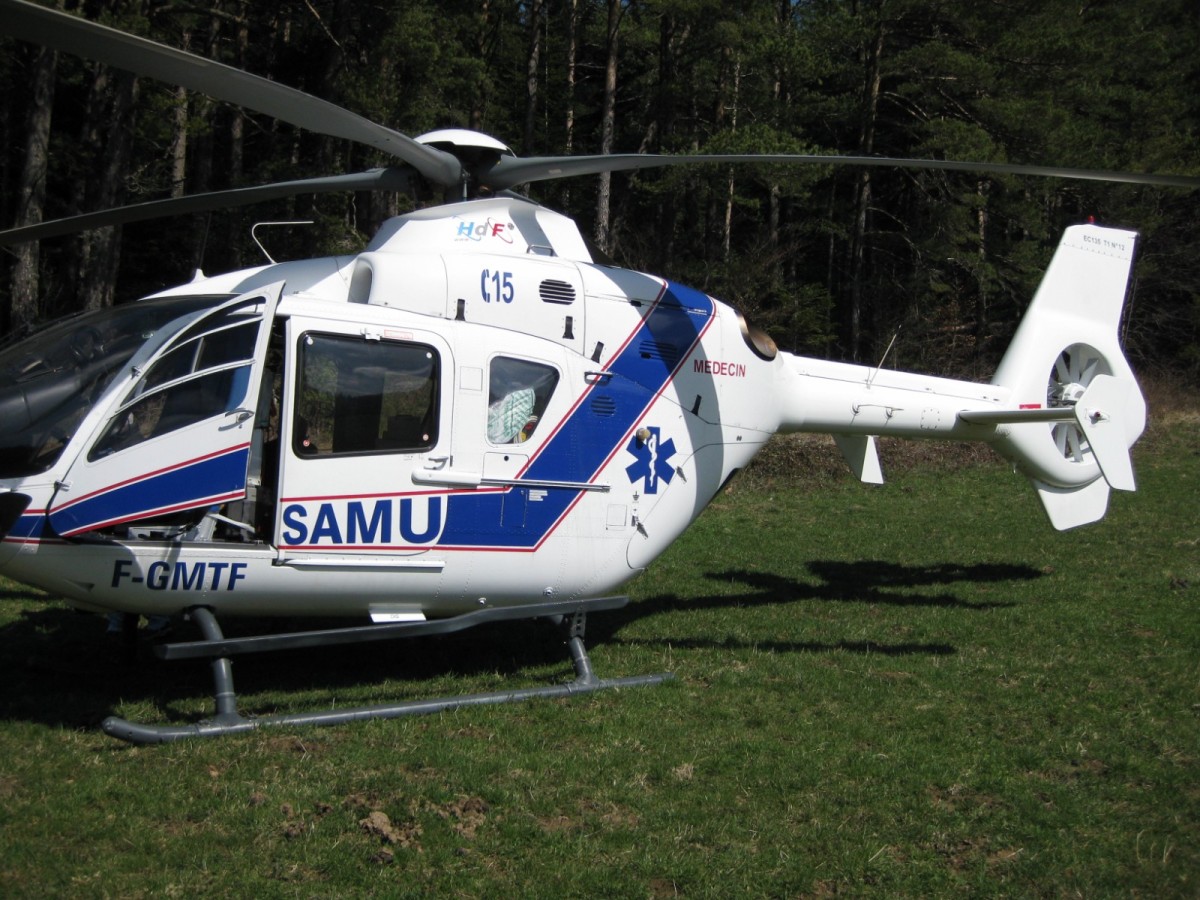
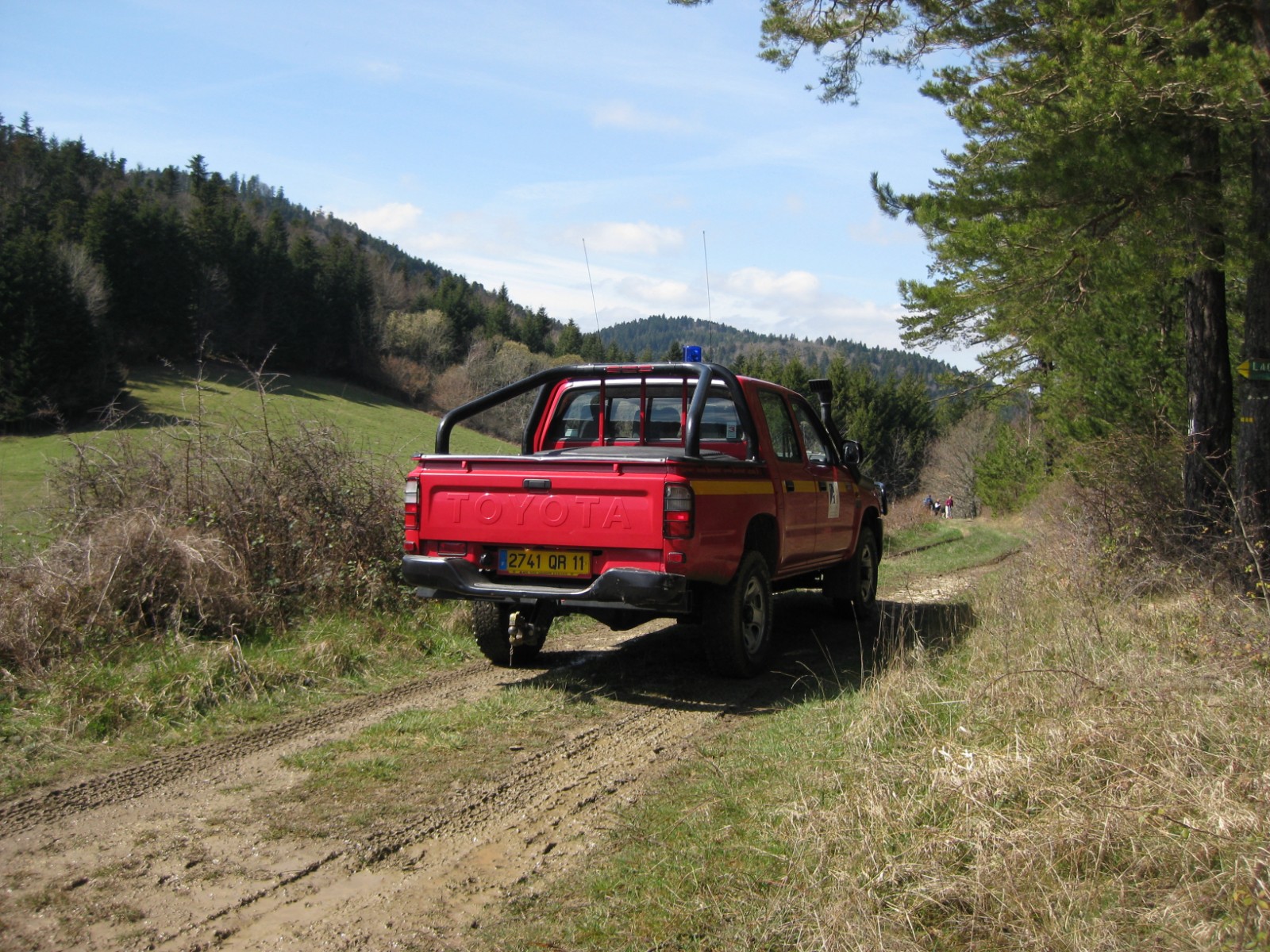
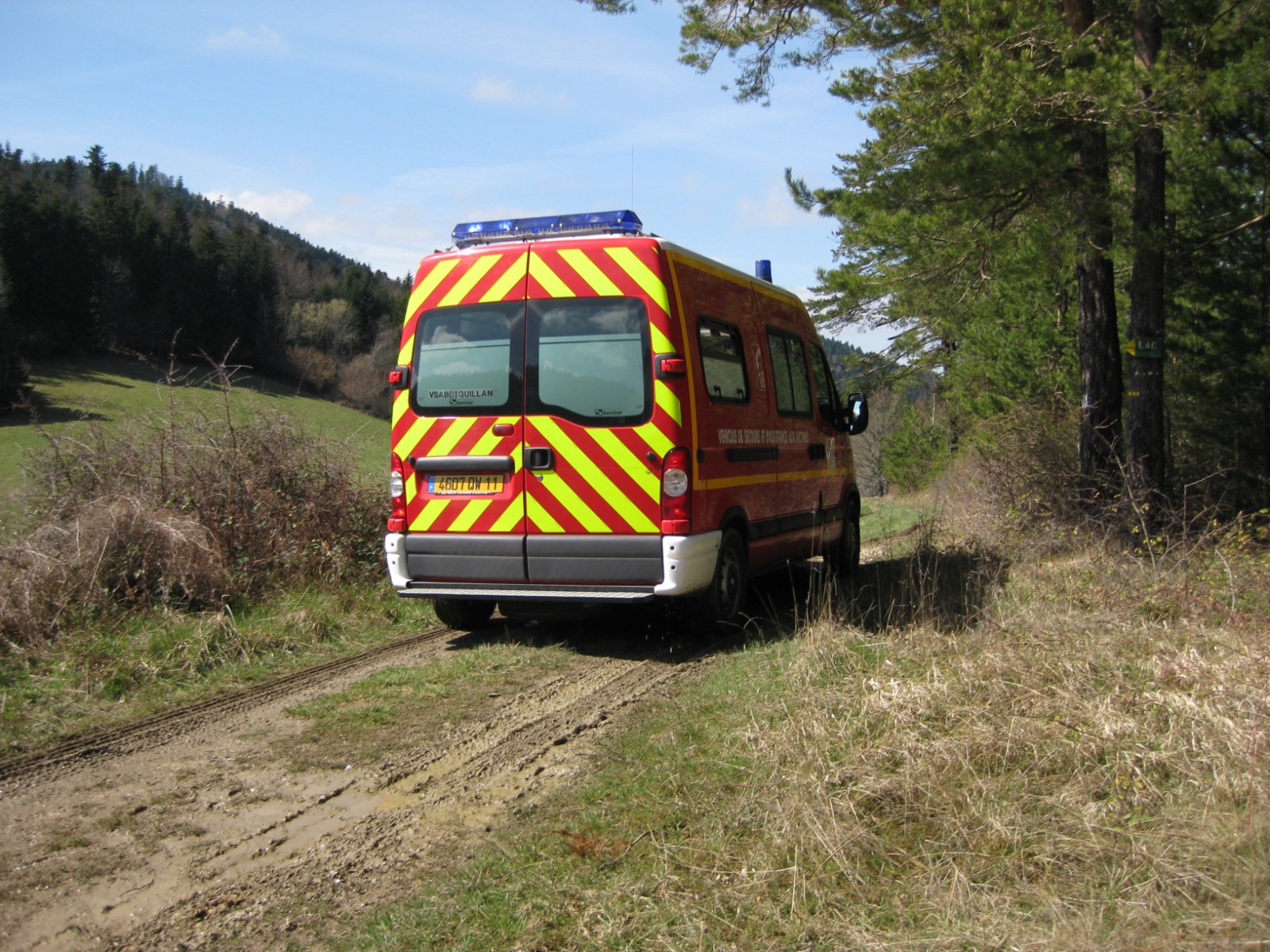
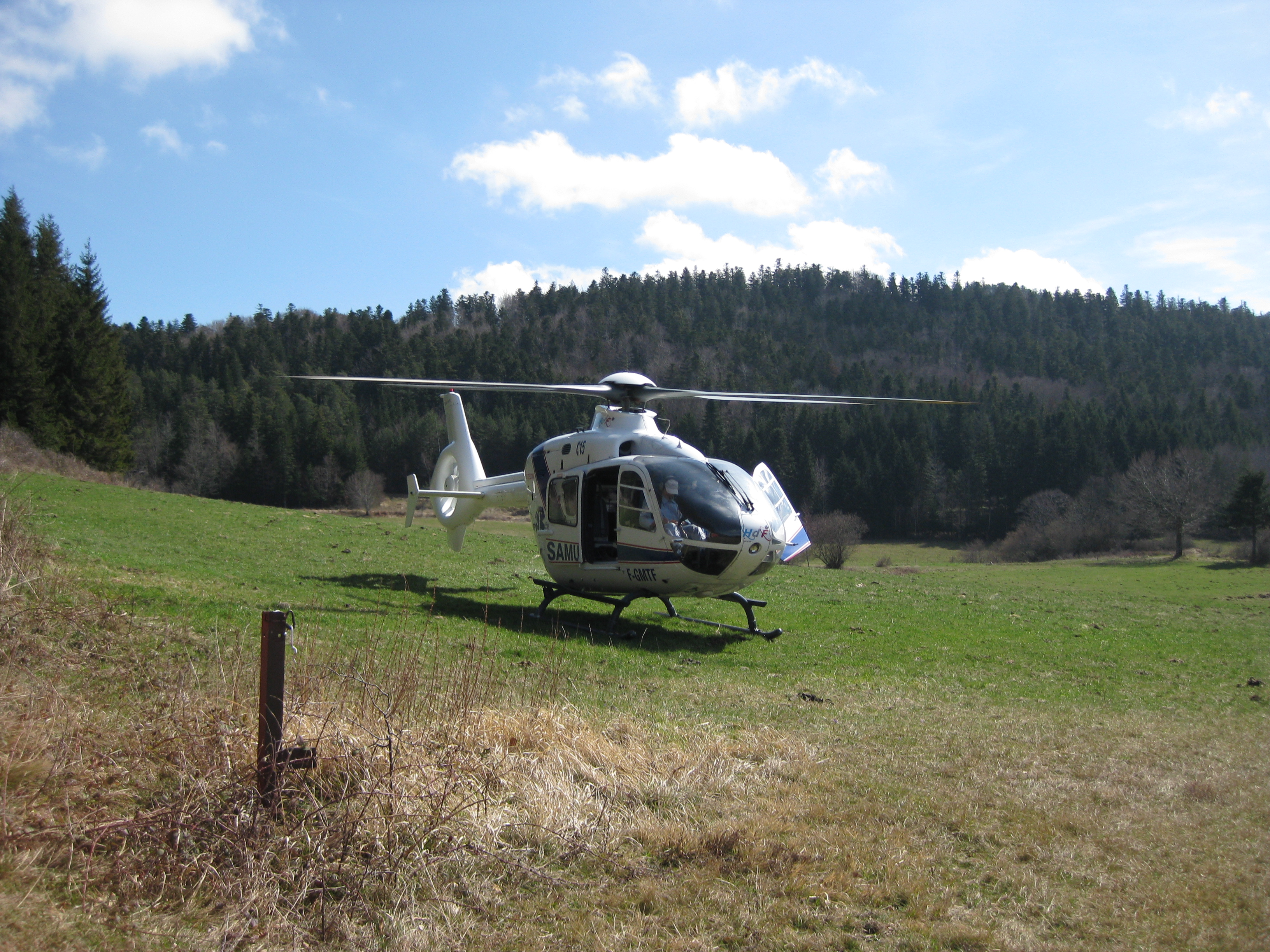
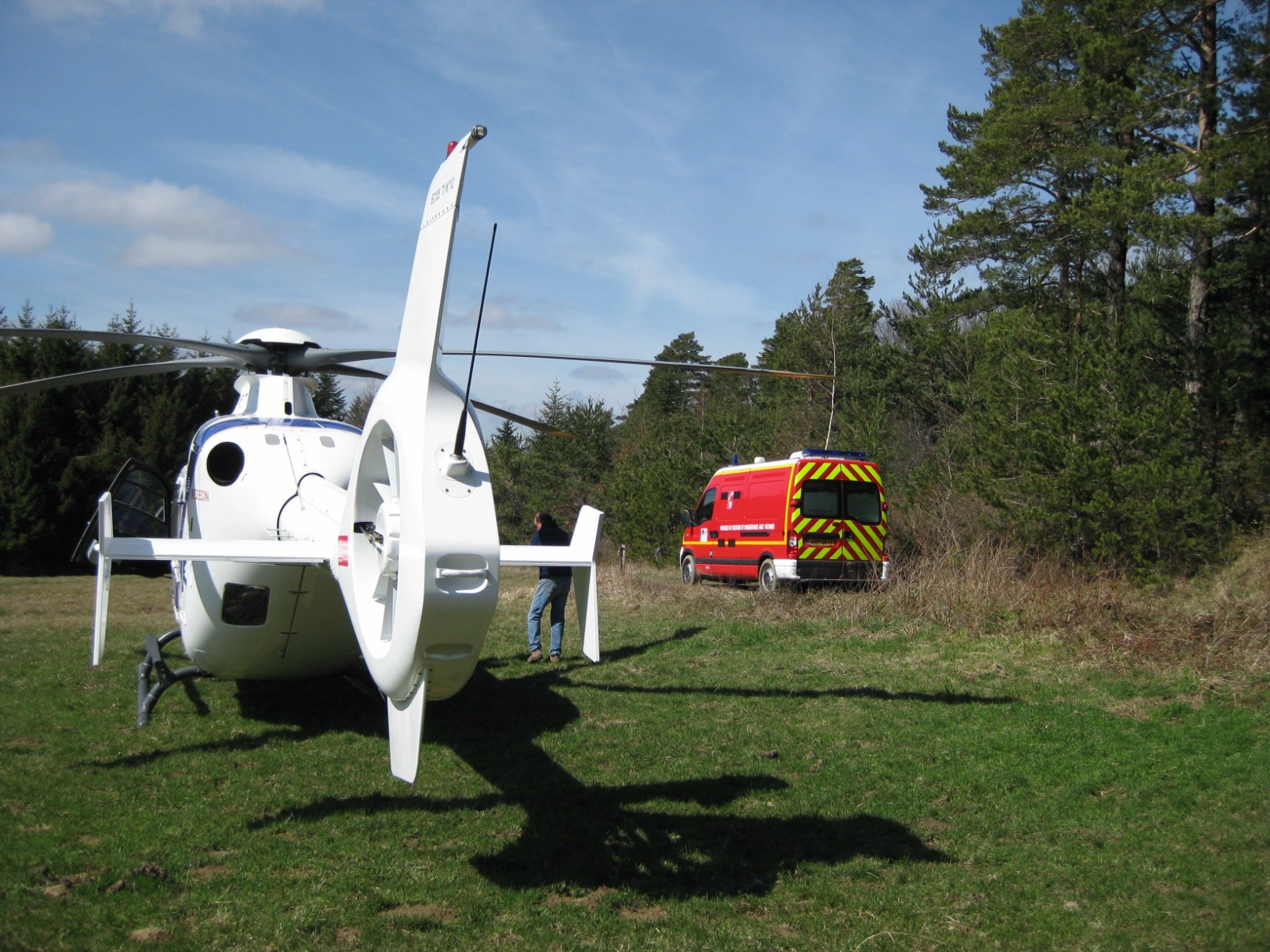
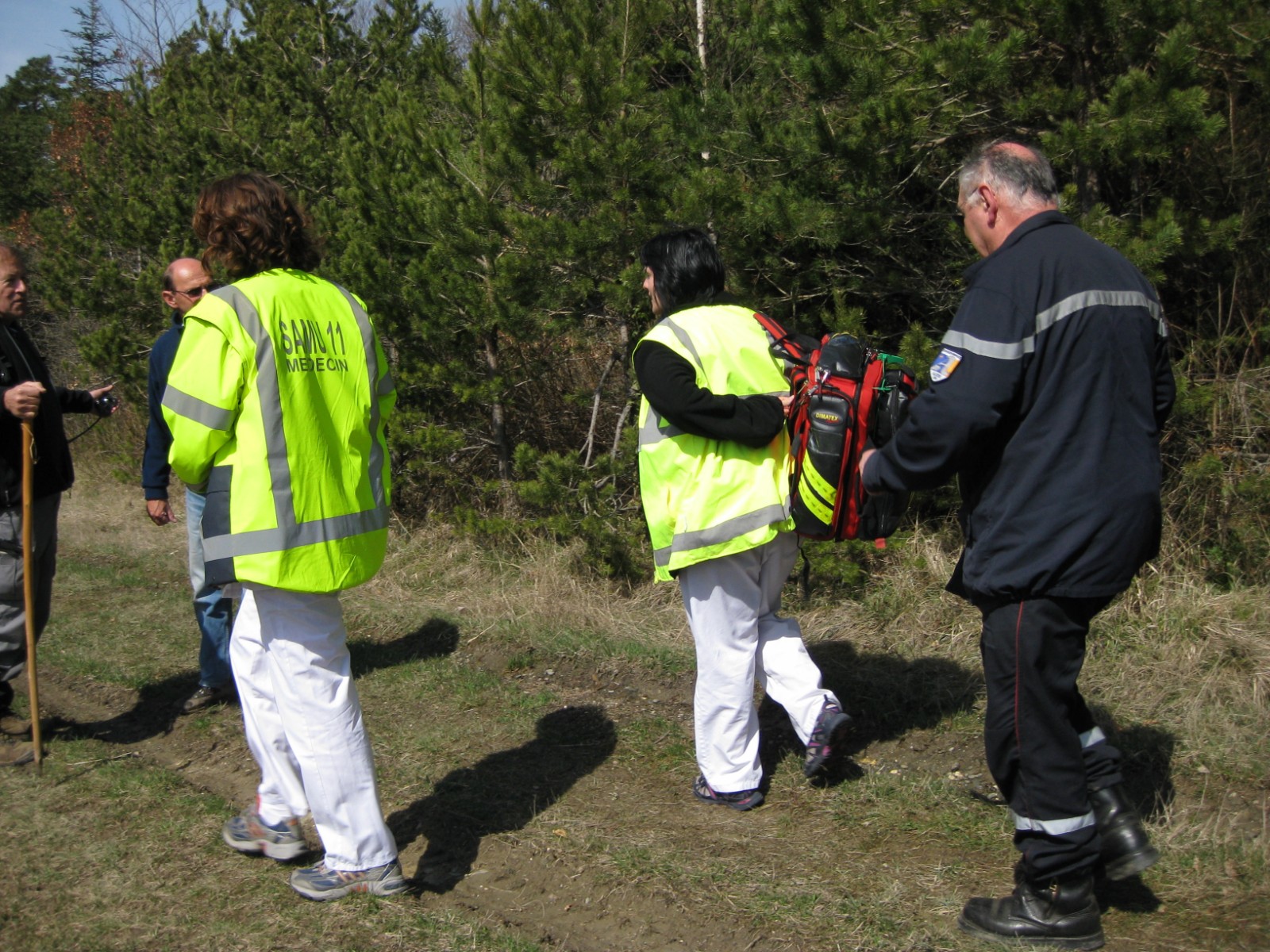
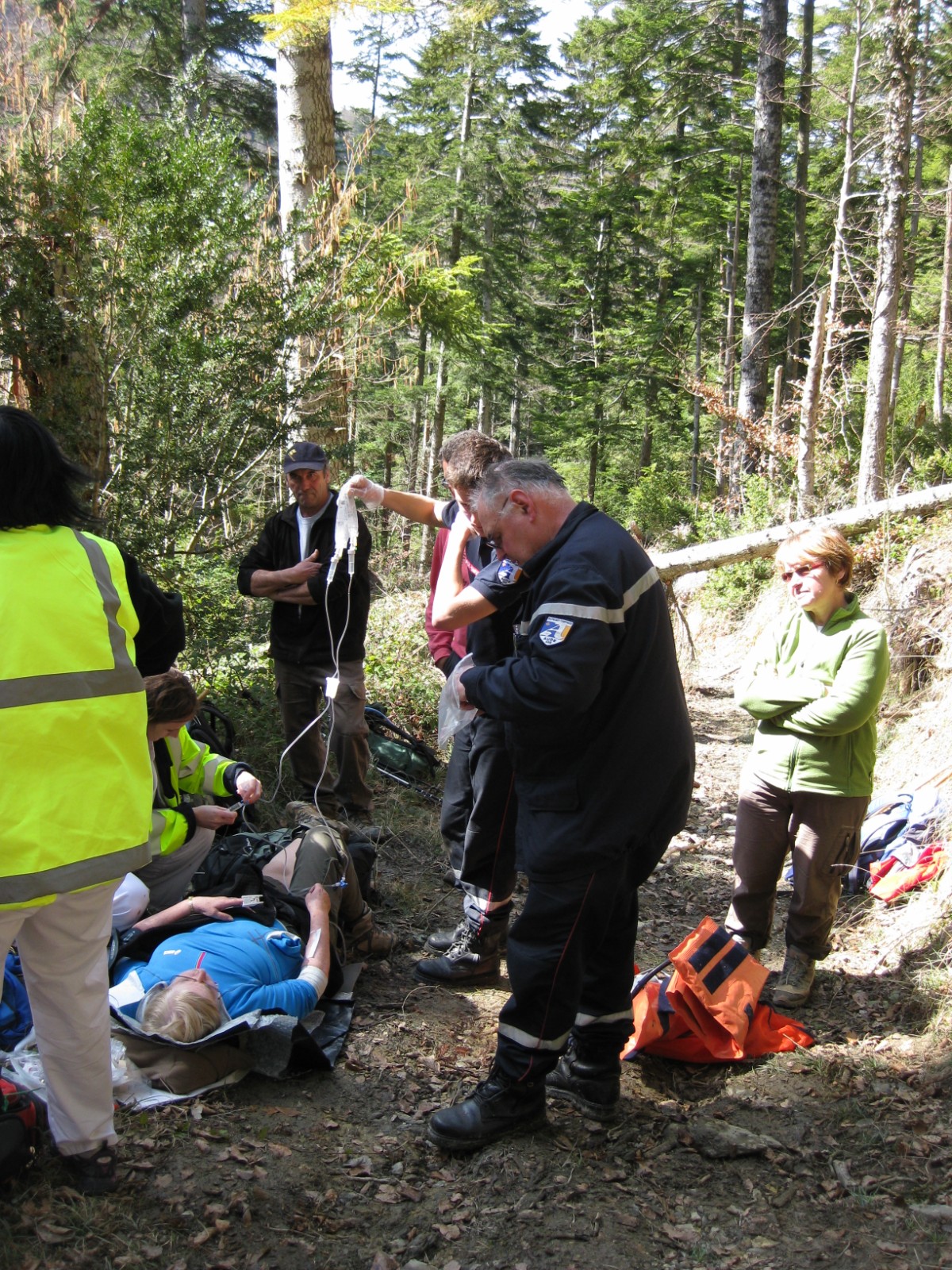
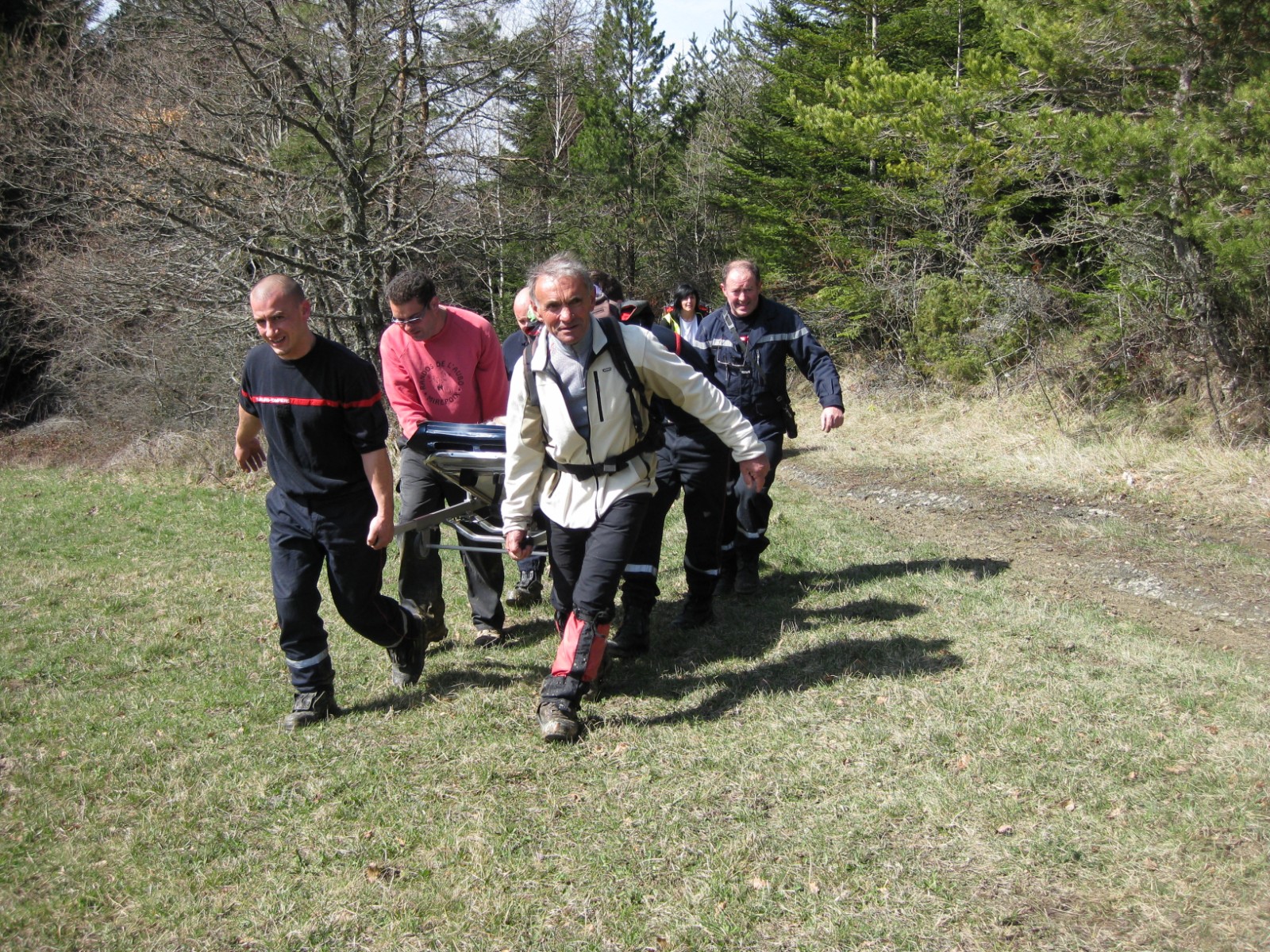
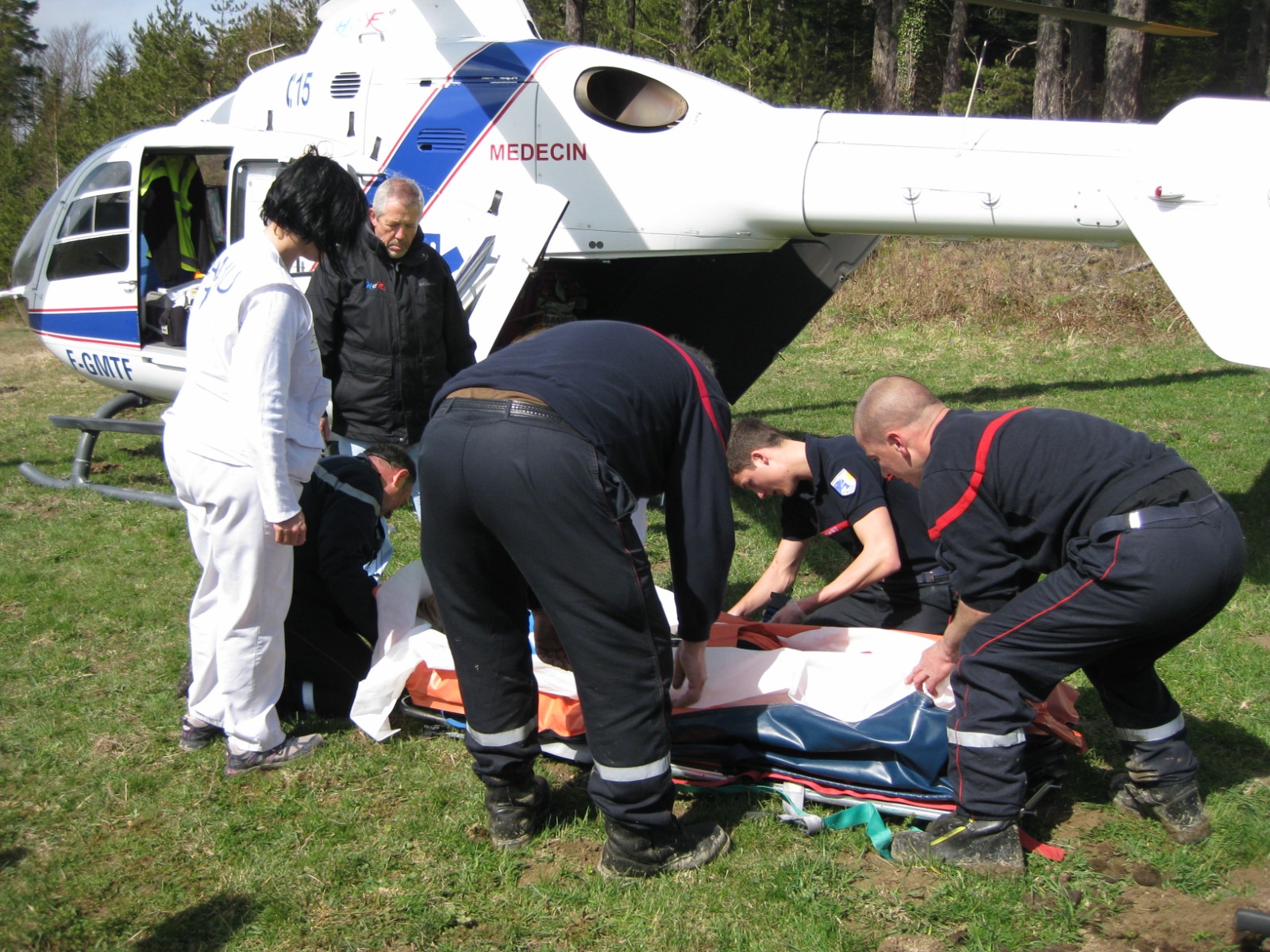
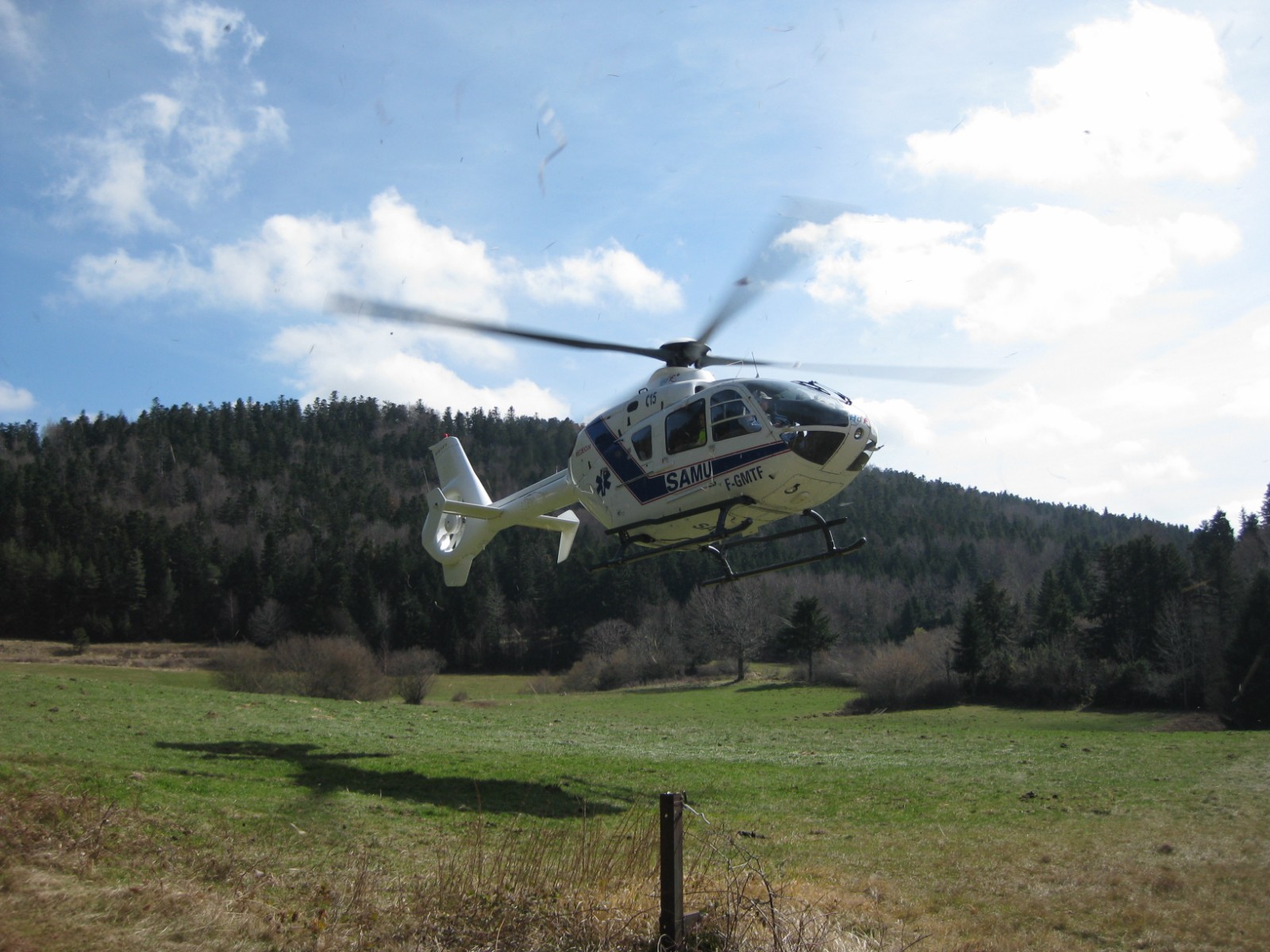
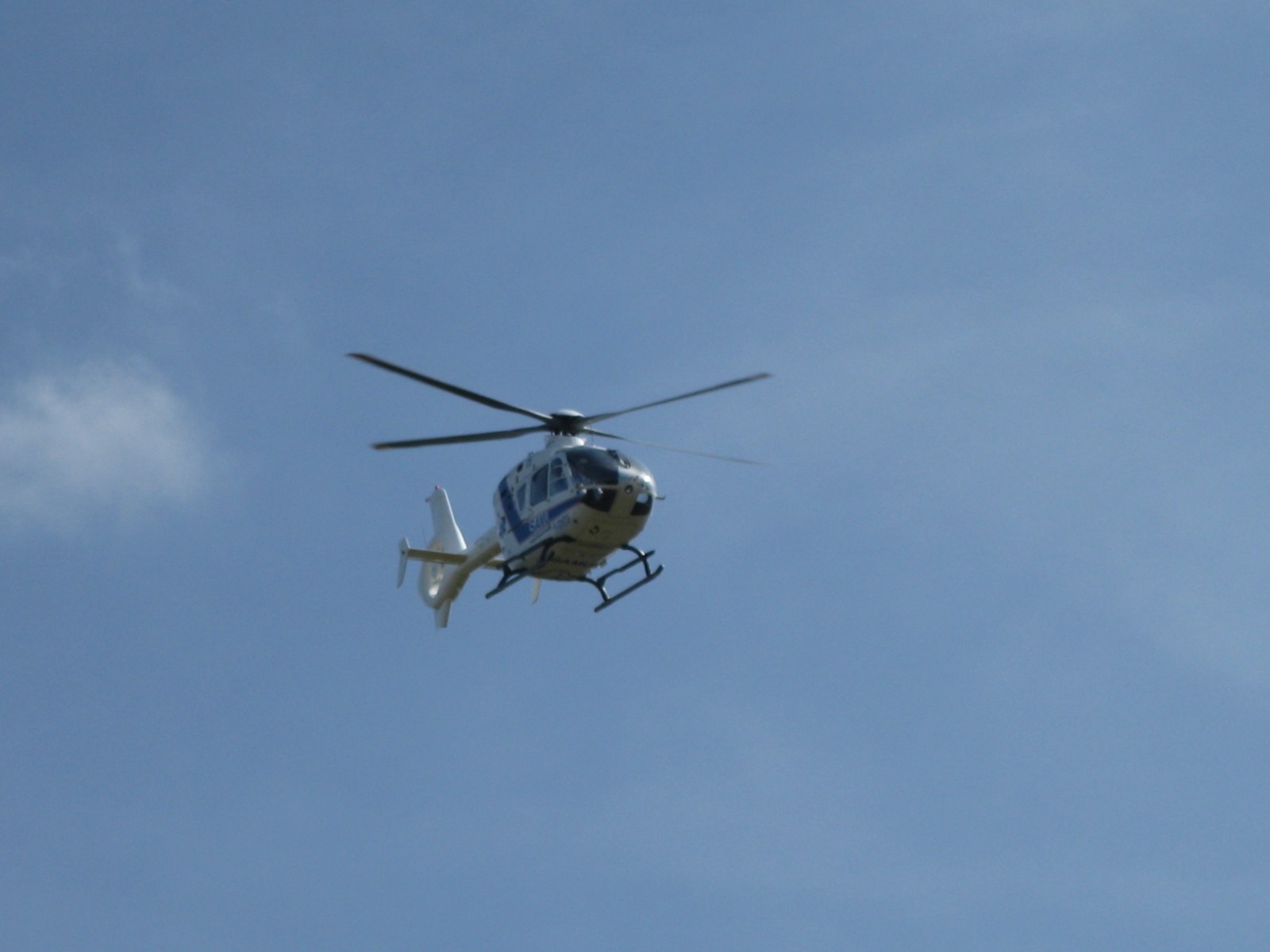
Pretty quickly, it became exciting. We were fairly inaccessible, though not as badly so as we might have been, considering we were almost at the top of a (smallish) mountain: because there was, for the first time that morning, open land nearby. A bright red ambulance service 4×4 came into view, then an ambulance, tossing about on the rutted track. The sapeurs pompiers had to walk down into the woods, carrying all their equipment and a stretcher, to see Micheline, who was now in quite a lot of pain. Then – wow! A helicopter air ambulance hovered overhead, looking for a landing spot.
The pictures show the efficient and organised crew. (11 of them, sapeurs pompiers, nurses, pilot) doing what they had to do in muddy, dirty conditions to get Micheline sedated and sorted and ready to be air-lifted to Carcassonne Hospital. They don’t show the 4×4 being ignominiously towed out of the mud by a local farmer.
Despite our compassion for Micheline and the acute pain and discomfort she was in, we were quietly excited to be part of such a drama, the first apparently, in Rando del’Aubo’s long history of weekend walks. No news from Micheline yet: but she won’t be at work tomorrow.
That was all I wrote in the immediate aftermath of the accident. In fact, Micheline -who worked in a shop – was never fit enough to return to an on-your-feet-all-day job. The French Ramblers’ Association argued for months about whose insurance should pick up the tab for the helicopter call-out. It was all a sorry mess, and I’ve thought twice since then about venturing to out-of-the-way places for a solitary walk.
ExACTly. Worth a read, I think, as are all posts from Travel Between the Pages, a blog which is ‘the intersection between travel, books, and art’. Always interesting, usually thought-provoking, often funny.
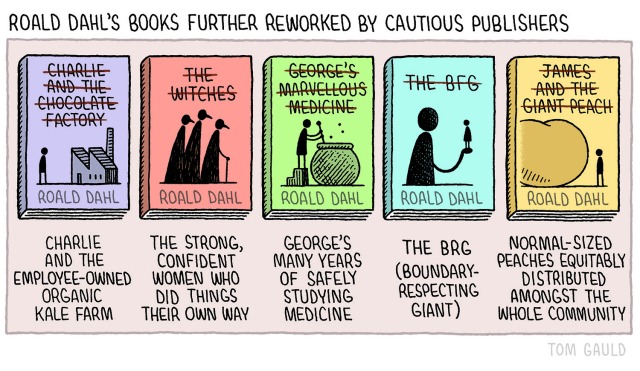
You would have to have been living under a basket to avoid the recent brouhaha over the re-editing of classic books by so-called sensitivity readers and editors. Here in the Colonies we’ve been through this with the books of Dr. Seuss and other popular children’s authors. Now, the UK has gone mad censoring works by Roald dahl and others.
McSweeney’s recently posted a pointed response to this nonsence in an article by Peter Wisniewski aptly titled “FUCK YOU, YOU FAT-HEADED ROALD DAHL-CENSORING FUCKERS.”
Dear Fat-Headed Roald Dahl-Censoring Fuckers,
You’re censors. You’re not editors, and you’re not readers. You’re censors. You are exactly what Orwell warned us about.
So fuck you.
Without the author’s consent, you are changing and omitting words that the author wrote. That makes you a censor. An agent of censorship. Only fascists censor books.
What you’re doing is crazy. See? We said it. Crazy. Crazy. Crazy.



















You must be logged in to post a comment.