Tabariane: new light on the Dark Ages

When I was at school (back in the Dark Ages), we learnt in history that the Romans came after the Greeks.  They left us a legacy of Romance languages, our alphabet, Roman law, neo-Classical architecture, impossibly straight roads and under floor central heating.  As the empire crumbled, so we were told, the continent descended into the Dark Ages.  Barbarians, Vandals, and unpleasantly savage descendants of Asterix the Gaul ravaged Europe, raping, pillaging and generally leaving little time for culture and a settled everyday life.

I think we all knew it was a bit less straightforward than that.  The Frankish Germanic tribes entering the late Roman empire had a very different culture from that developed by the Romans, and it’s been much harder to research systematically because there are few contemporary written records.

This week though, we went to visit a Merovingian site, Tabariane, recently excavated and interpreted near Teilhet, not far from Mirepoix.  The Merovingians were an early Frankish dynasty established by Clovis, and they ruled an area roughly equivalent to much of France and Germany from the 5th to the 8th centuries, and are the kind of tribe that was dismissed as one of those from the very heart of the Dark Ages

It was a burial site we’d come to see.  It has first been discovered in the very early 20th century by Captain Henri Maurel, and had been partly excavated according to the fairly invasive practices of the period.  War and economic upheaval meant the site became first neglected, and then entirely forgotten about until recently.

Recent research lead by Nicolas Portet has meant that the burial ground, now carefully excavated, is now, as it almost certainly was then, a burial garden.  It’s a large site, on a hillside overlooking the site of the now disappeared Merovingian settlement  on the opposite side of the valley.  The 166 tombs seem to have been arranged in ‘clans’: loose arrangements of extended families and friends, over a long period of time.  It seems to have been a burial ground which held a place in the life of the community for many years, rather than being a cemetery developed as a result of tragedy – war or plague say.  Most of the bodies were laid with their heads to the west, their feet to the east.  Originally they were clothed, but little remained apart from metal objects: belt buckles, brooches, jewellery and, with some of the men, weapons.

This is where ideas have changed. Early 20th century archaeologists sent excavated objects to museums far and wide, even to America: modern practice which encourages an area’s ’patrimoine’ (heritage) to remain as far as possible intact did not then exist, but you can find examples of objects found here in the Museum at Mazères, and in Saint Raymond de Toulouse.

Now as then, the tombs are planted with local flowering plants: lavenders, marguerites, herbs.  It’s thought that locals would have visited the grounds with their families, spent time there, as we might in a modern park.  So it was important to both the living and the dead to make it a pleasant, calm place to be.  The burial ground overlooked the village. The village overlooked the burial ground.  Each had an interest in the other.  Each could intercede for the other.

It’s a tranquil, special place, surrounded by meadows and hilly countryside.  A circular walk of some two and a half kilometres , starting and ending in the village of Teilhet gives you a chance to spend a peaceful  hour or two exploring scenery that may not be so very different from the way it was when the Merovingian villagers first laid out their burial ground, some 800 years ago.  Excellent information boards will help you understand a little more about those Merovingian people who made their lives in this still rural area.

While you’re there, make time to enjoy the facade of the 14th century church at Teilhet.  Here are some pictures to whet your appetite.

This visit, guided by Marina Salby, formed part of the summer programme of Pays d’art et d’histoire des Pyrénées Cathares.  It will be repeated on 31st July and 21st August.  Meet outside the church at Teilhet at 9.30 a.m.  Cost: 2 euros.
The comb

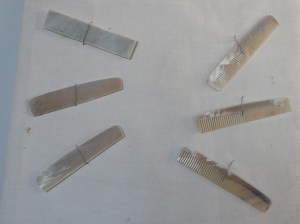
There’s an industry that’s had something of a walk-on part in this part of the Ariège for well over 300 years.  Against all the odds, it’s somehow clinging on.  It’s comb-making.  Specifically, combs made from horn.

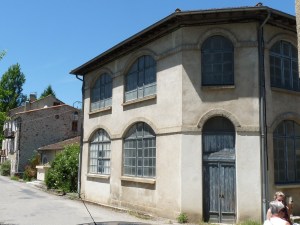
Today, we went to find out more, courtesy of a visit organised by  ‘Pays d’art et d’histoire des Pyrénées Cathares’.  There are two ‘peignes en corne’ factories within just a very few miles of each other, and of our house too.  Each used to be the size of a hamlet, with separate buildings for all the different parts of the fabrication process.  Now, both firms conduct operations each from a single building.  We went to ‘Azema-Bigou’, in Campredon.

Azema-Bigou factory
Azema-Bigou factory

I’d always imagined the industry had developed as part of a waste-not-want-not mentality, using the horns from local sheep and cattle.  Not at all.

Our part of France has always been rather anti-establishment, in religion as in much else.  In the 16th and 17th centuries, when much of Europe was in religious turmoil, Protestants locally were persecuted.  Many fled, some to Switzerland.  And there they learnt a new skill, unknown to them before: comb making.

Following the 1598 Edict of Nantes, assuring greater religious freedom, many Protestants returned to their homes here, and wanted to continue the trade they’d learnt in exile.  But did they use local materials?  They did not.  Local cattle worked hard , ploughing and generally earning their keep.  They ended up with chipped, worn horns.  Over the years, the comb-makers developed markets with ports such as le Havre, Marseilles, London and Liverpool, and imported good quality horn fom Hungary, Turkey, and by the 19th century, Argentina.

Horns awaiting transformation into combs

Although in the early days, the trade was conducted on a domestic scale, with each worker capable of producing 10-15 combs per day, perhaps after a day in the fields, by the 1850’s the process was industrialised – with machinery imported from England.  Men women and children were all employed.  Men earned 2 francs a day, women 1.25, and children 1….. .  No wonder women in particular preferred to be paid for piece work: that way they too might get 2 francs daily.  The busy industry grew and thrived until more or less the second world war when plastic combs started to take over.  The factory of Azema-Bigou, in the hands of the same family for 5 generations, employs three people these days, though in its hey-day there were 180.

But these workers will tell you, as will many local people , that it’s well worth investing in a horn comb.  Like your hair, the comb is rich in keratin, and will treat your hair gently without generating static electricity.  Several of my friends have had the same comb since childhood and would never be happy to replace it with some cheap piece of plastic.

A selection of combs.

Apparently horn has to be soaked for up to a year before it becomes useable, and then it is forced through heavy rollers to make useable sheets.  There are some 15 different processes involved in producing the finished comb.  No wonder it costs rather more than its plastic poor relation.

I can’t tell you very much more.  Unusually, this event was not up to snuff. We were shown no artefacts, heard no tales from former workers in the industry.  So I don’t know what it felt like to work 11 hours a day in an atmosphere where horn dust hung heavy in the air cloaking  lungs and coating every surface in thick grey cushions. I don’t really understand what’s involved in transforming a rough, thick horn into a polished and handsome comb.   But I do know that  the waste and dust swirling round the factory got – and gets – used. The tiny fragments of waste used to be made into filaments in a factory here in Laroque, mixed with horn dust and sold as a fertiliser for vines.  Even now, you can buy bags of horn-waste fertiliser for your garden from the two comb factories.  Waste-not-want-not gets its moment after all.

Postcards from Girona

We had a mid-week break in Girona last week.  Because I needed the dentist.

Despite the general all-round good quality of the French health system (though it’s not what it was), dentistry does not on the whole measure up.  Ask anybody round here to recommend a dentist, and they’ll either say ‘not mine, definitely not mine’, or suggest someone miles and miles away with a weeks long waiting list.

So when my daughter over in Barcelona recommended her dentist in nearby Girona, it seemed too good a chance to miss.  A quick holiday in a town on the ‘to-visit’ list, a chance to see Emily, and a pain-free set of teeth.

The dentist there sorted things out, but said he’d need to see me again.  So we realised we didn’t need to dash round on some frenzied must-see-everything-double-quick self-imposed tour.  We took our time.  We wandered up and down the narrow stairways that make up the ancient Jewish quarter, walked the old city walls, and spent time in the cool shaded Jardins d’Alemanys.  There was time for an early morning coffee, a relaxed meal, a cool beer in shady squares among the narrow back streets.

In its day Girona has been invaded by Romans, Muslims, Franks, enduring over 30 sieges in 800 years.  As Robin Gauldie, travel writer says: ‘It’s like Barcelona in miniature, with all the history, heritage and great food but without the insane traffic’.  We don’t need the excuse of a toothache to go back.  There are churches to visit, museums to explore, gardens to relax in, meals to enjoy.  There are riverside walks, and the countryside beyond.  So much to do and see, but all within walking distance of the ancient city centre.  Roll on my next dental appointment.

To view any of the pictures in a larger format, simply click on the image.

Monks, marble, and a look-alike church

This slideshow requires JavaScript.

Here in Laroque , we have a Commission du Patrimoine, attached to the town council.  It has many enthusiastic and knowledgeable members who seek to preserve, restore and celebrate certain historic buildings, who manage the municipal archives, who research (for instance) the history of the area’s farms and who organise exhibitions.  It has other members who are like me, frankly, free-loaders.  We trot along to meetings but have little expertise to offer.  But we were all in favour of the day out organised last Saturday.

We started off in Caunes-Minervois, a small town in the Aude.  Most of us associate the Minervois with wine production, and we’re not wrong.    I didn’t know though that near Caunes Minervois there are important marble quarries, worked since Roman times.  It seems half the important buildings in Paris sourced their marble there … the Louvre, les Invalides, l’Opéra…. and then there are Fontainebleu and Versailles too.   It rivals Carrara in importance and marble is quarried here still: many colours, but mainly a rather plummy pink.

We came though to visit the Benedictine Abbey.  There’s been an abbey here since 790, and though the Carolingian buildings have long gone, the crypt, with early sarcophagi, remains beneath the present church.  It’s a rotten site  for a church in many ways, prone to an excess of water immediately below ground, so the four Christian martyrs whose relics are venerated here are targets for prayer that drought should not strike.  Have devotees been praying just a little too fervently this year?

The Abbey has had a long and complex religious and political history which you can read about here. We started by visiting the 17th century cloisters, austere and simple, as befits a building used by the Benedictine order. Then there’s another vaulted room in the complex with an interesting feature. Stand in a corner and whisper your confession, and the sound will travel up to the roof, over and down the other side into the ear of the listening priest.  He will be able to offer you absolution by whispering from his corner, in the knowledge that if you are carrying the plague, or some other contagious disease he’s at a safe distance from you.  We all tried it.  It works – the whispering that is.

The abbey became simply a parish church at the time of the French Revolution. From outside, it’s a fine Romanesque and early Gothic building, in a spacious uncluttered setting – the buildings that used to huddle up to it have been removed.  Within, it’s a temple to the local marble, and to that of Carrara: there are even Italian statues owing something to the school of Michelangelo.  Much of the former monastery is now used as space for art exhibitions.

Then it was off to lunch.  Another treat.  Not far from the village is another small  church, Notre Dame du Cros.  It’s in a splendid setting, in a gorge surrounded by craggy rocks.  Stone tables and benches were there beneath the shady plane trees and we had one of those shared picnics the French do so well: home made apéritifs, home cured sausage, home made pies and cakes, home grown fruit, wine…..

And then it was time for the look-alike church.  Still in the Minervois, there’s another village, Puicheric.  Its parish church bears a remarkable resemblance to ours here in Laroque.  Hence our visit.  Puicheric’s church, though, has a more intimate, homely feel.  This turns out to be because during the 19th century, those responsible for the church at Laroque had delusions of grandeur, encouraged by the likes of Viollet-le-Duc who promoted Gothic architecture in buildings where such features had never previously existed.  The roof height was raised, at vast expense, to create a more ‘Gothic’ feel to the building.

Nevertheless, Notre-Dame de Puicheric has a claim to fame as a place of pilgrimage.  Back in 1700 a marble staue of the Madonna was being shipped from Italy along the Canal du Midi, past Puicheric, bound for some fine church in Aquitaine.  Once in Puicheric, the barge could go no further, detained by some irresistible force.  The statue was taken to the church, and there it remains to this day, an object of veneration.

And then there’s the château.  Laroque had a castle once too, and we still have the odd remaining bit of wall.  Simon de Montfort saw that off, as so many other things round here.  Puicheric’s still looks very imposing – from round the back.  From the other side, what you get is a rather splendid chambres d’hôtes.  It had an aristocratic past, though much of the original site was destroyed by our very own Black Prince in 1355.  It housed the nobility until the French Revolution and then passed into the hands of a family with whom it remained until 1990.  Now it’s the home and business of Dominica and Phillippe Gouze, who aim to offer modern hospitality whilst retaining all those elements from the 16th, 17th and 18th centuries and long before that which inform its character.  We were seduced by the garden, the views, the ancient tower with a faded fresco of someone doing something dreadful to a dragon, and by the story-telling powers of our host.

While we were there, we could have seen so much more, as clicking through the links would reveal.  But that will have to be for another day ….  or two ….. or three.

To view any of the pictures in a larger format, simply click on the image.

The house in Laroque, 10 years on

I was going to post some photos of the bathroom, now it’s done.  But I seem to be unable to take good shots – not only of the bathroom, but of any room in the house.  Whether it’s the gloomy weather, or the fact that I have taken on the local failure to offer convincing visual ‘marketing’ of any house advertised courtesy of an estate agent I don’t know.  The fact remains I’m not pleased with a single shot.

Inadequate as they are, however, I’ll post a few, together with a selection of photos taken in the very early days of our ownership.  We bought this house exactly 10 years ago, though we’ve lived here only six.  When you look at the ‘before’ shots, you’ll wonder why we ever bought it.

It was, quite simply, a ‘coup de cœur’.  We loved the old woodwork, the spacious rooms, and the way the house had evolved, higgledy-piggledy, over the years as the needs of its owners changed.

And you may understand why getting to the ‘after’ has taken so very long.  We do have more photos of the really bad old days.  I’ll  dig them out and post them one day soon.  They may horrify you.

But back to the  bathroom again.  It’s maybe 5 years since we enlisted the help of a local plumber to get the ancient cast-iron bath out.  As he chipped and broke tiling in a whole lot of places besides the bathroom, he’s not been asked back.  Getting off tiling that had been cemented to the walls was a whole other saga.  So was straightening the walls.  So was dealing with the fact that the ancient steel pipework was deeply – deeply – embedded in inches of concrete that several friends and two different sets of plumbers, all with heavy-duty drills, failed to excavate.  Continuing to use it was not an option, as it had got lined with decades of detritus, and emptying so much as a washbasin could take an hour or more.  Eventually, we had new piping constructed alongside, and had to box it in.

One way or another, as real life got in the way, there were long pauses between each phase of bathroom construction, and it’s only today we can finally declare it officially open (though in the manner of all such official openings, we’ve actually been using it for some weeks, slightly unfinished).

In among we: refurbished 4 bedrooms and the living room; made a study from a lumber room with rough-plastered walls that had never been used as living space; made a shower room from a nasty corridor housing a museum-piece toilet; refurbished a kitchen; arted up the atelier; knocked down storage huts in the yard and created a ‘relaxing outdoor living environment’, as a certain Harrogate estate agent prefers to call a garden; made the roof terrace another pleasant place to idle away an afternoon or evening; made two storage rooms from the old shop cold rooms; smartened up the garage: re-worked the downstairs washroom – all with or without the great help of friends, neighbours, professionals.

Time for a rest then?  Nope.  Games room next, we think.  Unless it’s time really to get to grips with the atelier.

Cherries gone wrong.

It was my twin grandsons’ birthdays yesterday.  One way for us to celebrate it here is to gather in the very last of the cherry harvest.  In this topsy-turvy year, 14th June marked our first, not our last chance for us to harvest this year’s crop, helping friends in a village just down the road.

Oh, they looked good, those cherries!  The tree was weighed down with luscious ruby fruits.  Max got out a ladder for us to reach the ones way up towards the top, but even before we got to work, we could see that all was not as it seemed.  Many cherries – most cherries – were turning brown and nasty or had already grow a furry coat, even before they’d fully ripened.  As we harvested, we discarded more than we dropped into our buckets.  After we’d done all we could, we only had two small buckets’ worth.

Then we went through our haul again: quality control.  Our two buckets-worth became one.  Christine complained that she couldn’t foresee getting more than a single clafoutis out of this lot.  Normally she makes cherry jam, cherry liqueur, bottled cherries, cherry clafoutis and cherry pies till she’s sick of the sight of them.  And what was worse, those cherries didn’t even taste of much.  Engorged with water, the flavour was diluted and thin somehow.

They gave the lot to us.

This morning, I got our cherries out of the fridge to pick them over before tackling that clafoutis.  Overnight, almost half of them had gone bad.  Saint Nigel, my unfailing kitchen guide, suggested an improvement on the traditional clafoutis recipe, and I followed it.  The recipe was not a success.  The batter was solid and heavy, and complemented by wishy-washy flavourless cherries, it was not a pudding to write home about.

By the way, do you know the French for ‘it’s nothing to write home about‘?  It’s ‘Il ne casse pas trois pattes à un canard‘.  It doesn’t break the three feet of a duck.  In other words, it’s nothing extraordinary, as a three-legged duck would certainly be.

A walk gone wrong

This slideshow requires JavaScript.

Yesterday was gorgeous.  Hot and sunny until long into the evening.  We ate outside and stayed on the roof terrace till 10 o’clock.  Today seemed to promise more of the same.  We should know better.  This year, getting even two days on the trot where the weather is hot and clear all day is asking a bit much.

And so it proved.  Today, our walking group met to share lifts to where our walk was to begin.  We set off in the sunshine, watching our in-car thermometers climb steadily to 27 degrees as we drove ever upwards, beyond Villeneuve d’Olmes, beyond Montferrier, up a road which became narrower and less well maintained, to Frémis, a tiny hamlet.  We parked there, in a flower-spangled meadow offered by a local farmer.  We peeled off our fleeces, applied suncream and set off towards the peak, Coulobre. Sometimes the upward-going was tough and quite a scramble, but we were encouraged by looking across to the still snow-capped tops, and the thought that we’d be having our picnic at the top there,  the Ariège spread below us with views, views and more views.  We met a herd of black Mérens horses sheltering in a copse from the already-hot sun.   A donkey befriended us.  And still we climbed.

Towards midday, walking through the forest, we suddenly realised things were changing.  Didn’t it suddenly feel cooler?  And weren’t those little scraps of mist swirling round those peaks?  Apparently yes.  The mist descended.  The ‘cool’ became ‘chilly’.  With 20 minutes to go to arrive at our lunch spot, Micheline, who had developed a gammy knee, announced she could go no further.  It didn’t take much for us to decide that it was not only friendly to remain with her and have our lunch, it made sense.  The mist was swirling around us, the views up there wouldn’t be up to much, and it was obvious that rain or worse was on its way.

We found logs to sit on, got our fleeces out again, ate our lunch with little ceremony, and scuttled down.  The climb up had taken nearly three hours. Scurrying down took not much more than an hour.  And as we reached Frémis, the rain started.  It’s not stopped since.  And those in-car thermometers on the way home? 15 degrees.

June is the new May: a springtime nosegay

We’ve all had it.  Months and months of horrible weather.  Especially rain.  Even now, when things are slowly picking up here, we expect to have all kinds of weather within a single day.  Beautifully hot skin-warming sun may be followed by lashing winds, summer showers, or deluging  heavy downpours.  Glance up at the sky, and it will be in turn a cloudless azure, or bright blue patched with blowsy puffs of white cumulus.  Or it may be grey, or even black.  If the clouds aren’t coursing lazily across the heavens, they may be tearing across the sky so swiftly that they’ll have disappeared from view if you glance away only for a few moments.  The rivers are still full to overflowing.

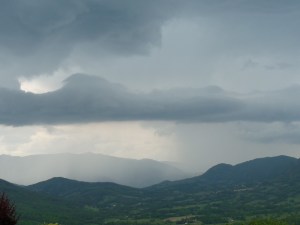
June sky from Roquefixade

Farmers are in a mess.  They’ve only just begun to cut their hay, when normally they’d be onto their second harvest.  Seeds have failed to germinate in the cold and wet.  Often they haven’t been planted at all in the sodden and waterlogged fields.  Preparations to take cattle and sheep up into the highland summer pastures have had to be postponed, with snow still on the ground at higher levels.

At last though, we walkers are once more getting out and about.  We choose our routes with care, because thick sticky mud has made some of our favourite walks unuseable.  Where we can walk though, spring has at last sprung. Familiar paths have become narrow passages edged by massed armies of knee-high grasses, shocking in their vibrant greenness.   And our favourite spring flowers that by now should be sun-shrivelled and long past their best romp across meadows and pastureland, and spread across their favourite sun-warmed stones.  Here are a few that we’ve enjoyed finding  in the last days and weeks.

UPDATE:  After she’d read this post, a kind friend, AnnA, wrote to a botanist friend of hers enlisting help in identifying the flowers I’ve shown.  Here’s some of what she said. Reading from the top, left to right:

2. Globulaire rampante – Globularia repens (Creeping Globularia)

3. Hélianthème – Helianthemum Alpestre (Alpine rock rose)

5.  Perhaps from the Linacée family.  She needs a photo of the leaves.  Watch this space

6.  Céphalanthère à longues feuilles – Cephalanthera longifolia (Sword-leaved Helleborine)

8. Oeillet – Dianthus – (Dianthus).  She needs more info. to help her be more precise.

She’s asked to see more of the leaves, and to be told as well where the flowers were found and at what altitude.  There’s such a lot to it.  I had no idea and am so grateful for all this help.

Fête at Laroque

Montaillou in the 21st century

‘Laroque d’Olmes, below Montaillou, was a small market town which produced cloth.  At the local fair, which in the fourteenth century was held on 16th June, local cloth was sold, together with wood, fish, sheep, pottery and blankets from the Couserans.’  That’s what Emmanuel Le Roy Ladurie says in ‘Montaillou’, his wonderful examination of Catharism in the Ariège village of Montaillou at the turn of the 14th century.

Laroque’s June fair had already been a long-established event by then, and over the years it’s evolved.  Our contemporaries in town remember when it was still a hugely important event in the agricultural calendar, something like the fair that’s still held every year in nearby Tarascon.  There were animals everywhere.  One area was given over to cattle, another to sheep and others to all the usual farmyard creatures.  And at night there was dancing.  Bands belted out dance music on both Place de la Cabanette, and Place de la Republique.  It was quite a party, both for the Laroquais and for villagers from miles around.

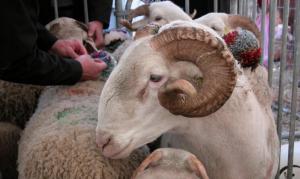
This is the kind of sheep we'd have had at Laroque Fête: our local Tarascon sheep. Photo courtesy of La Dépêche du Midi.
This is the kind of sheep we’d have had at Laroque Fête: our local Tarascon sheep. Photo courtesy of La Dépêche du Midi.

At some point in the fairly distant past, the Fête became associated not with 16th June, but with the Catholic festival of Corpus Christi.  So it’s still called Festo del Corpus, though there are no religious ceremonies.

We love the idea that this fair has an unbroken history going back nearly1000 years. If only we could love the fair itself.

No animals or shepherds now.  It all begins during the week beforehand.  Fairground caravans arrive and make the open ground near the river their home for the week.  In the car park just along from our back garden, municipal workmen clang and clatter all day long, erecting a stage and a marquee for the various performers who’ll be on duty for much of the weekend.  The locals look on, unimpressed.  For scores and scores of us, the weekend means three nights of little sleep as the bands on stage boom their way through a noisy repertoire lasting from early evening, when they start to limber up, to two or three o’clock next morning.  Wander round to watch the dancing on those nights, and you’ll not find many locals.  It’s mainly out-of-towners, and we’ve learnt not to trust them all.  Two years running, our window boxes at the front of our house were stolen: now we remove them for the duration.

We leave town for the Fête.  This year, we only went 7 miles to stay with friends, though often we’ll try to take a short holiday.  Popping back briefly at 11 o’clock on Saturday night, I found the town as busy as Oxford Street in the January Sales, and our bedroom windows vibrating in time to the boom of the bass notes thundering from the stage.  Some years though, there are only a few hardy types twirling around in time to the music.

During the day, there’s the fun fair, majorettes, bands.  But they say the fair’s expensive, and while most people enjoy a stroll round to people-watch and chat to friends, there’s little sense that this event is a focus for the community.

I wouldn’t like Laroque Fête to disappear.  But perhaps it’s time to take stock and look at how it can become again what it once was: a summer event for everyone in town and to a lesser extent the villages beyond.  It seems that too many people at the moment actively avoid it or at best are unenthusiastic and uninvolved. And that’s the way for an event that’s happened every year for many hundreds of years to wither and die: which would be sad.

Blog alert

This isn’t a post from me today.  Not here.  Not really. But there is one from me somewhere.  It’s just a question of looking for it.  You could try HERE

This is what happens when you start blogging.  You start to read other blogs.  If you’re not careful, blog-following could even take over your life, there’s so much stuff being posted: all day, every day.  Other bloggers start reading what you write.  They comment on your posts, you comment on theirs.

This doesn't need a caption - does it?
This doesn’t need a caption – does it?

And that’s where the trouble starts.

About 18 months ago, I noticed a post that struck a chord with me.  As a schoolgirl I must have been scarred for life because a post on a blog now called ‘renée a schuls-jacobson’s blog : because life doesn’t fit in a file folder’ set me thinking about that day when…. oh it doesn’t matter now, but I revealed all when I commented.  And lo, I was invited to be a guest blogger, for one day only…….

….. as one of a series called ‘So wrong’.

Renée says: ‘In 2013, I asked a few of my blogging buddies to share their most embarrassing moments from which they learned. . . something.‘  Oddly, it was quite hard to decide what to write about, but Renée never seems to have a problem choosing material.  She writes because she loves to write, loves her family and friends, loves life, and no subject is off limits: words, family life, Jewish stuff, Tingo Tuesday (Just look it up.  Follow the link).  For her, blogging is a conversation with everyone who reads what she has to say. She puts a lot of energy too into bringing together an eclectic bunch of people as guest-writers, so I’m very flattered to have the chance to join this select club.

Renée always hopes that her readers will leave comments – they often do and she always replies.  As I do. It’s  good to talk, and I enjoy the relationships I’ve made with regular commenters whom I’ve yet to meet.  If you haven’t yet done so…why not join in?

PS.  What you may not say when you read my post on Renée’s blog  is ‘I’ve read the first part of this before’.  Yes.  You have, if you’ve been here for the long haul.  But only the first part.

PPS.  Message from Renée: ‘Hey friends of Margaret! You can click on my name and be magically transported to just the right place!’  She’s right you know…..