I’m used to brick houses. And stone houses. And even houses whose facades have been rendered and painted, as our home in Laroque was. But house paints generally come in a very limited palette. White, of course, and a range of neutral or earthy tones such as ochre. That’s what I thought until I went to Wales, anyway. Now I know differently. Come on a very quick tour with me to see what colour you could paint your home. Click on an image to see it full size: I’m only sorry not to have included an example of my own particular favourite: crushed raspberry.
House with matching car. Note also the purple house next door..
We had such a good time wildlife watching in Wales. At first it was all simple wonder and enjoyment : ‘Look – there’s a…….’. But soon it all got quite competitive. Sarah bought an ‘I-Spy’ book – remember those? It was birds she decided to hunt for, and we all got involved in deciding whether it was guillemots, Manx shearwaters, or simple herring gulls that we’d just seen. And look! There’s a cormorant on that rock over there! And three choughs sitting on a wall! And over in those bushes – surely that’s a willow warbler?
Herring gulls taking a break
This cormorant almost got away before I got my camera out.
Choughs on a rock.
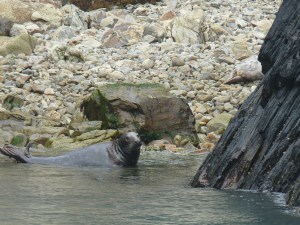
The day that we were in no doubt at all about the quantity of our wildlife sightings was the Sunday when we took a boat trip round Ramsay Island. There were indeed birds (but no puffins: it’s off-season for them): but what we relished seeing in huge numbers were seals, swimming in the coves, basking on the shore, or in the case of the white new-born pups, beached high up on some sheltered spot away from in-coming tides.
Grey seal on a beach at Ramsay Island
Ramsay Island’s a splendid place. These days it’s an RSPB bird reserve, and there were seabirds of course: not so many at the moment as the breeding season is over. Easy to see though where they nested – very precariously – on the rock faces which are heavily stained with guano. Sucked along by powerful tides, we plunged into sea caves, rode close to the shore squeezed between deep rock gorges as the cliffs soared high above us. We’re fairly sure we saw porpoises clipping along at speed just as we were turning for the mainland once more.
Grey seal swimming near our boat.
A beach full of seals.
A seal pup, easily identified by its white spotty coat.
Herring gull on Ramsay Island.
Empty sea bird nursery.
Sea bird settlement on the island
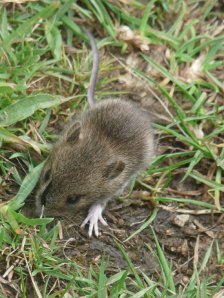
Every time we went walking we came to expect to engage in bird and seal spotting. But on Saturday, as we strode the cliffs of the coastal path, we came across this vole, and his (her?) two companions. The image you can see on your screen is almost certainly larger than the real thing. We were so lucky to have seen such a tiny creature, and so clearly.
One of the voles we spotted on our walk.
A few minutes later, I was the only one to spot a lizard: my first sighting since leaving France.
And then there was the evening when we went for a walk, and found ourselves accompanied by a whole troupe of friendly steers, who wanted nothing more than to follow us home, and to help us along with our map-reading….
We’re being followed…..
Not wildlife exactly: but these young steers were awfully keen to help Sarah and Brian out with the map-reading.
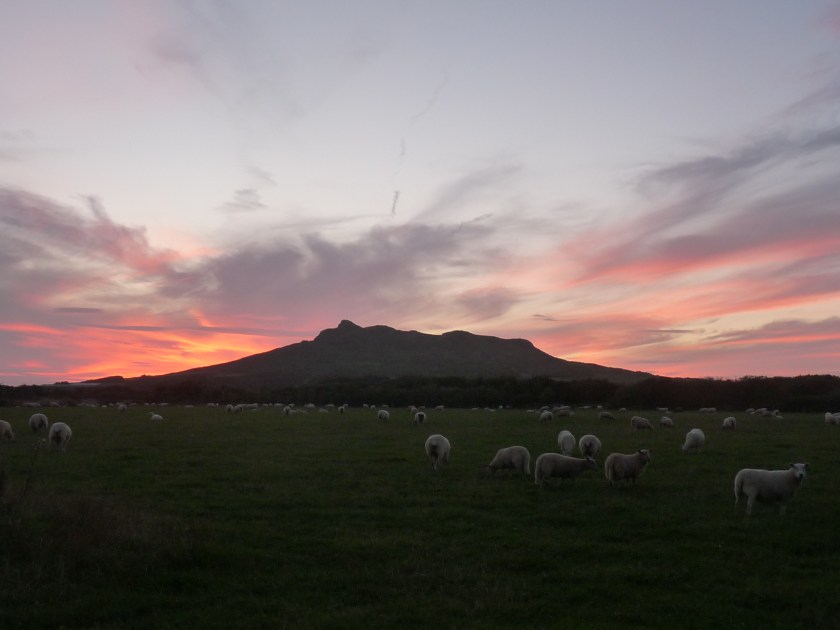
We’ve just come back from a glorious long weekend in Pembrokeshire in South Wales, with son, daughter-in-law and her parents. We were near St. David’s, Britain’s smallest city. Its population is the same as that of Laroque d’Olmes, and in other ways too the area seems to qualify as Ariège-on-Sea. Craggy mountains; fields of sheep and cattle; tiny one-track roads where the only likely traffic is a tractor, or even more likely, a herd of cattle coming home for milking; and long vistas, from the hill tops, of apparently endless countryside. And of course, the sea.
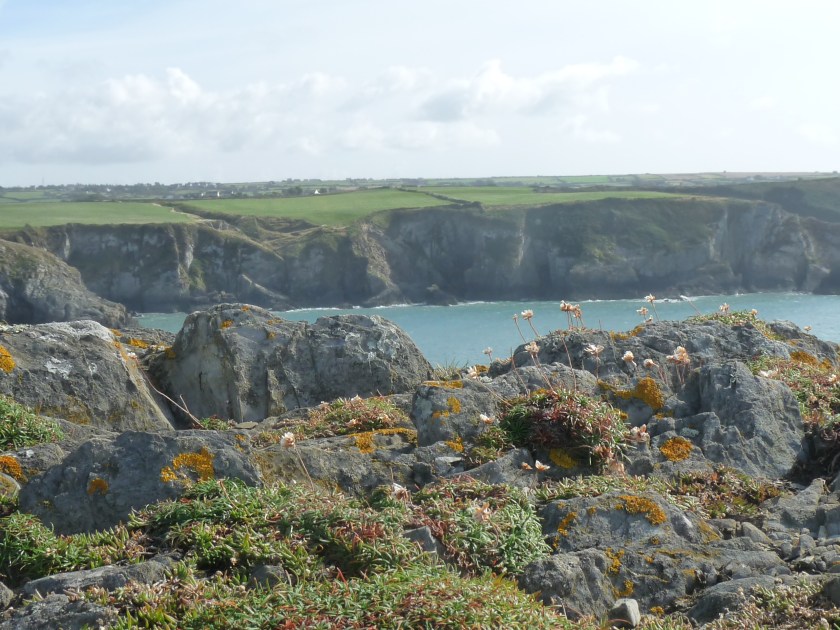
Our objective was to cover a goodish distance along the Pembrokeshire Coast Path. It’s some 299 km long: we managed about 40 km. so we have some distance to go. But what a journey. This scenery must be among the most stunning in the UK. Steep limestone cliffs and bays, volcanic headlands, beaches, inlets and flooded glacial valleys are the home to innumerable seabirds, and at this time of year, seals seeking sheltered nurseries to give birth to and rear their pups.
This slideshow requires JavaScript.
For me, this was the toughest walking since we’d left the Pyrenees. You know where you are there. On the whole, you’re walking up a mountain. Then you come down. Whereas along the coastal path, you’ll be scrambling upwards to reach the top of a high cliff, before descending again, perhaps almost to beach level. Then up again. After that you might swoop down to a cove before marching upwards to the next headland… and so on. Bright sunshine, warm breezes, and bracing sea air cheered us along and kept our energy levels high…. until the evening, when we found ourselves drooping and heading for bed as early as 10 o’clock.
We love a good country show. Farm animals on their best behaviour, sheepdogs out to impress with their skills in rounding up sheep, horses in the ring neatly jumping a clear round, country crafts, tough-guy tractors, food to sample, all in some pretty slice of countryside with the sun (maybe) beating down.
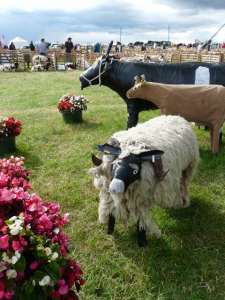
At Wensleydale Show, Leyburn Auction Mart went for animals made from gaffer tape and oddments. So much more biddable.
Since we got back to England, we’ve failed to go to the Great Yorkshire Show in Harrogate – too crowded, and the Ripley Show – way too wet. Would it be third time lucky at the Wensleydale Agricultural Show? Well, yes, we did make it there. And just after we arrived (this was the 23rd August, remember) we found ourselves scurrying for cover to avoid a heavy hail storm, with sharp icy crystals slashing at our faces and battering at the marquees.
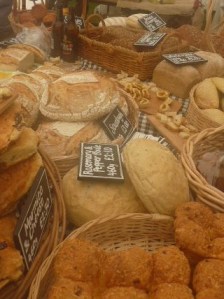
It didn’t matter. The sun soon came out again, but in any case, we spent much of the day inside. We were there to work. Bedale Community Bakery, where we continue to enjoy volunteering every Wednesday, had a stall, and there was bread to sell. Some of the team had worked through the night to get loaf after loaf mixed, kneaded, proved, baked and loaded up for the journey from Bedale to Leyburn and the show. By the time Malcolm and I arrived, some of the team had been there several hours already. And here’s what the stall looked like….
A tiny part of our stall.
We sliced and buttered loaves to provide samples for an eager public who wanted to talk to us and to try before they bought: sourdough; spicy chilli sourdough (soooooo good); cheese and onion bread; another cheesy loaf marbled with Marmite; harvester loaves; wholemeal loaves; bloomers; rosemary and pepper loaves; ‘seedtastic’ spelt; a loaf made using a locally brewed beer; a Mediterranean bread, all made the traditional way, proved long and slowly over several hours. There were spicy vegetable pasties; tomato and onion focaccia; roasted vegetable focaccia; four different types of scone (Jamie and I had made quite a lot of those on Friday, and they were baked off in the small hours of Saturday morning).
Try before you buy.
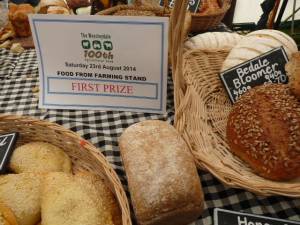
It all paid off. We were in the food marquee, surrounded by other small food businesses offering bread, pies, jams and curds, cakes and biscuits, chocolate, cured meats: all good stuff. But we got first prize in the ‘Food from Farming’ category, for the quality of our products and (buzz word alert) our community engagement.
And here’s the certificate
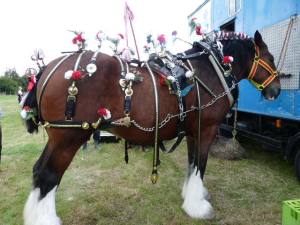
There was almost no time to get away and enjoy the show, but it hardly mattered. Serving on the stall to an appreciative public was all good fun. But here are a few shots from the times I did escape. Here are shire horses, beautifully decorated in the manner traditional for the area. Yorkshire horses, apparently, sport flowers, whereas Lancashire ones wear woollen decorations (very odd, as we had a woollen industry in Yorkshire, whilst Lancashire did cotton).
A Yorkshire shire horse, her 80 year-old owner’s pride and joy.
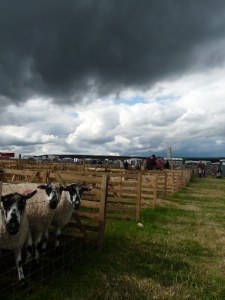
Here are sheep.
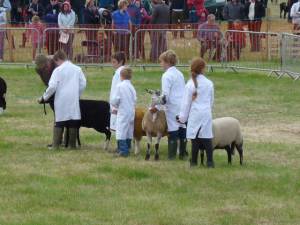
And here are children working sheep. There seemed to be opportunities in every category for smartly-overalled and seriously skilled children to show off their prowess as animal managers: it’s clearly important to encourage the next generation of farmers.
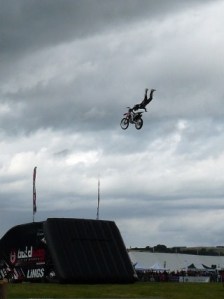
And here, oddly, are stunt bikers. We saw them as we left somewhat before 5.00, every single loaf sold, as the show slowly started packing up for yet another year .
There are quite a few more shows left before the summer’s over. We’ll get one into the diary.
Wednesday, August 20th. The morning air was chilly, just a little damp and drippy. Flowers in the borders hung their heads, their petals shabby and tired. Autumn has arrived. It does seem a little previous.
‘All is safely gathered in/ Ere the winter storms begin’
All the more reason to get out and about, before the days really close in. Ripon Ramblers chose to go to Harewood.
You’ll perhaps have seen Harewood House on TV recently, as that’s where the Tour de France really started from this year, after the Départ fictif from Leeds.* Half way between Leeds and Harrogate, it’s a playground for both towns, with its fine Adam-designed stately home, and extensive grounds designed by Capability Brown. At the time, the 1750s, investment in the slave trade brought immense wealth to the Lascelles family. Their descendents, the Earl and Countess of Harewood live in these fine surroundings built two and a half centuries ago. This stately home is regarded as being among the finest in Britain and is for the most part open to the public.
Our walk took us on a circular path that began outside the grounds, over farmland and with views across the Wharfe Valley. The route across the cow pastures was a bit of a puzzle. Weren’t those mango stones beneath our feet? And melon seeds? And even squashed tomatoes? The smell of rotting fruit wasn’t what we looked for on a country walk. Finally a young woman from a nearby stables helped us out. A local supermarket regularly dumps its surplus fruit at this farm for the cattle to enjoy. Four tons of fruit seemed to us to be remarkably poor stock control on the shop’s part, and we couldn’t help wondering what the cows’ insides made of this exotic diet.
Cow on a mango-hunt.
Far more enjoyable were the autumn fruits that lined our route for much of the day. We gathered blackberries every time we felt hungry or thirsty. We enjoyed the sight of haws turning red, elderberries turning black, and prickly chestnuts swelling and fattening on the trees.
Blackberries waiting to be picked.
Hawthorn berries ripen.
Elderberries too.
We completed our upward yomp, and walked along the ridge which offered a fine panorama across to the Crimple Valley and Harrogate beyond, to Almscliffe Crag, and even Ilkley Moor. Clouds in a dramatically cloudy sky were unloosing light rain into the nearby plain, and the breeze soon pushed the showers our way…..
Look carefully. You’ll see rain falling in the plain below. But not on us.
….and then pushed them on again, so that we could enjoy a rain-free lunchtime picnic with all that view before us.
Lunchtime view over the Crimple Valley.
After lunch, we were in the grounds of Harewood. Not the formal grounds near the house itself, but areas of woodland, pasture, lakes, deer park and farmland. And in the distance we spotted a fake Dales village, only built in 1998. This is Emmerdale, used in filming the long-running soap of the same name. No filming that day, so we were soon on our way, hurrying now before the rain, promised for mid-afternoon, settled in to spoil our walk. We made it – just.
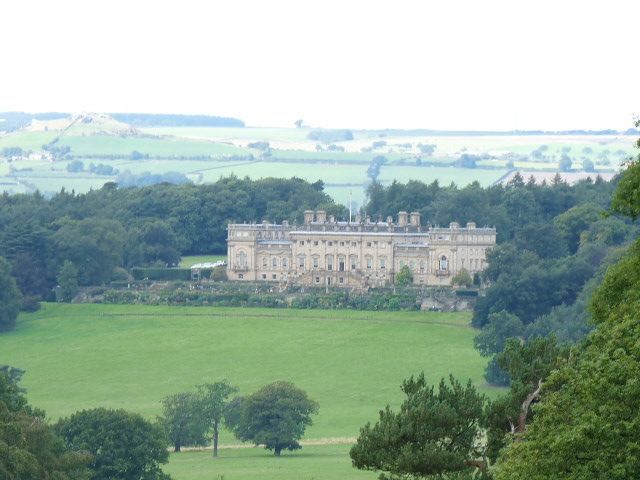
Our best view of Harewood House came at the end of our walk.
* The ‘départ réel’ of the Tour de France from Harewood signified the true beginning of the race. City centre Leeds was no place for cyclists to jockey for position, so riders just tootled out to Harewood on the ‘départ fictif’. Then the action started.
We’ve had quite a weekend. Our vaguely organised daily lives, with plenty of chances to stand and stare, or at least sit down with a cup of coffee and the paper have been shot to pieces by the arrival, for two days only, of our twin nine-year old grandsons, Alex and Ben.
We had a busy Saturday, full of pancakes, playgrounds, and Ripon’s Prison and Police Museum (recommended). But the highlight of the day was Brimham Rocks.
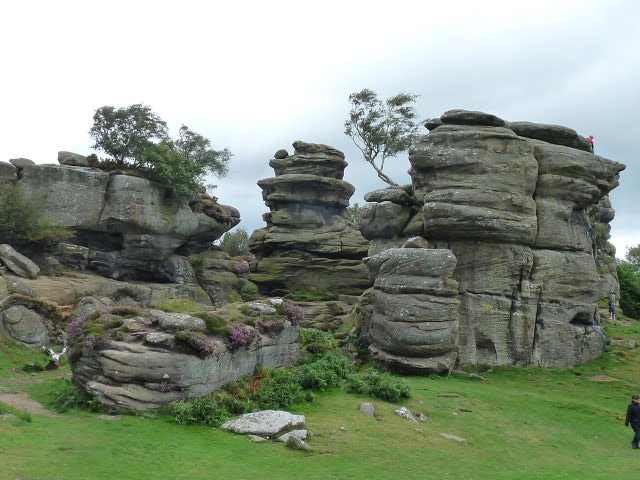
It’s an extraordinary place. There, slap-bang in the middle of the rolling and verdant Yorkshire Dales, is a 30 acre fantastical landscape. Dry-stone walled fields and charming villages are suddenly replaced by an odd collection of weird and wonderful shaped rocks. Brimham Rocks. These are formed from millstone grit: glaciation, wind and rain have eroded them into extraordinary formations, pierced by holes, balancing apparently precariously, or stacked into tottering towers. Geologists study them, rock climbers scramble up them, but above all, families come to let their children become impromptu explorers, mountaineers and adventurers of every kind.
We’ve only chosen quiet times to visit here in the past, but with Alex and Ben, we had no choice, We wanted to take them there, so a brisk and breezy Saturday slap-bang in the middle of the school holidays it was. The car park was overflowing . Oh dear.
But it was fine. The space is big enough to provide room for all. And it was fun to be amongst children from the smallest toddler to the tallest and lankiest of teenagers, all having an equally good time: all exploring, all testing themselves physically, weaving their own adventures.
Alex and Ben take a pause at Brimham Rocks
And besides, we didn’t come home empty-handed. August is bilberry season. Alex and Ben, particularly Ben, rose to the challenge of stripping the small and rather hidden fruits, becoming ever more purple as time passed. Teeth turned blue, hands indelibly stained, fingernails beyond help from any nailbrush: it was so good to see my grandchildren discovering the pleasures of food-for-free. Bilberry pancakes for Sunday breakfast then…..
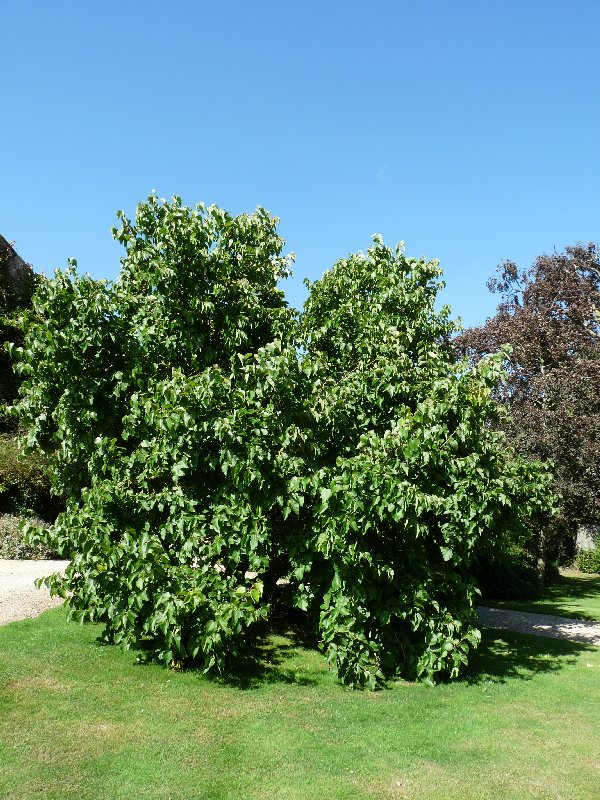
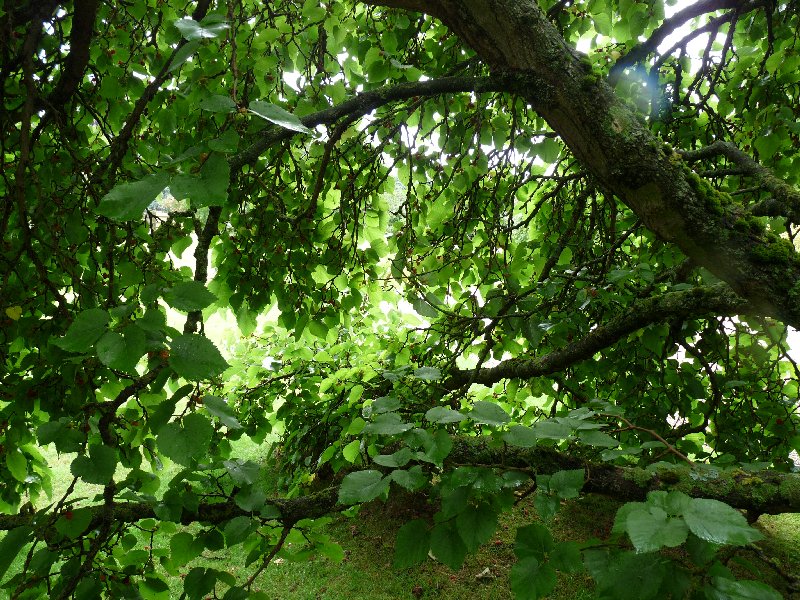
…. the birds, that is. I’m sitting looking out of the study window. There, almost centre front, is the mulberry tree. I can see why it’s secured itself a place in the history of children’s singing rhymes, even though it’s quite certainly a tree and not a bush. Its densely leaved branches curve down to the ground, leaving a perfect den for small people to spend an hour or two hiding away, playing games away from interfering adults.
There it is, our magnificent mulberry tree
And just now, mid-summer, is the time it fruits. I’ve never lived with a mulberry tree on tap before, so I made the usual deal with the birds: ‘You take the high-up berries, I’ll take the low ones. There are plenty to go round.’ They weren’t listening. I’m watching them now, those pesky blackbirds, swooping in to select a not-quite-ripe fruit and flying away to enjoy in private.
OK, it’s not a blackbird, but a crow. They’re thieves too.
Mulberries are in fact quite a curious fruit, the size and shape of a raspberry or blackberry, but with quite a pithy core. It’s quite a challenge to find these relatively small berries growing on a fully-sized tree, hidden among large almost heart-shaped leaves. The majority of the berries fall to the ground (where the birds ignore them, it seems), and this is a crop that can only be picked when black, juicy, and very fully ripe. So fingers and clothes alike get quickly and indelibly stained. Purple is the best colour to wear.
A bough laden with mulberries.
They hide themselves pretty well.
Not quite ripe yet.
All my recipe books tell me to use them in any recipe calling for blackberries or raspberries. I’ve discovered I prefer both those more familiar fruits, but it won’t stop me having a go at using the unexpected haul of free berries. I made a coulis for ice-cream yesterday. What next, I wonder?
Hunt the mulberry. It’s quite a job.
Here we go round the mulberry bush, The mulberry bush, the mulberry bush. Here we go round the mulberry bush, On a cold and frosty morning.
Take a walk through much of rural Nidderdale in North Yorkshire, and almost the only sign of human endeavour that you’ll see is connected with agriculture. Go out into this lightly-populated area, with its apparently nearly barren hillsides, and you’re only likely to meet sheep, with the occasional field of cattle.
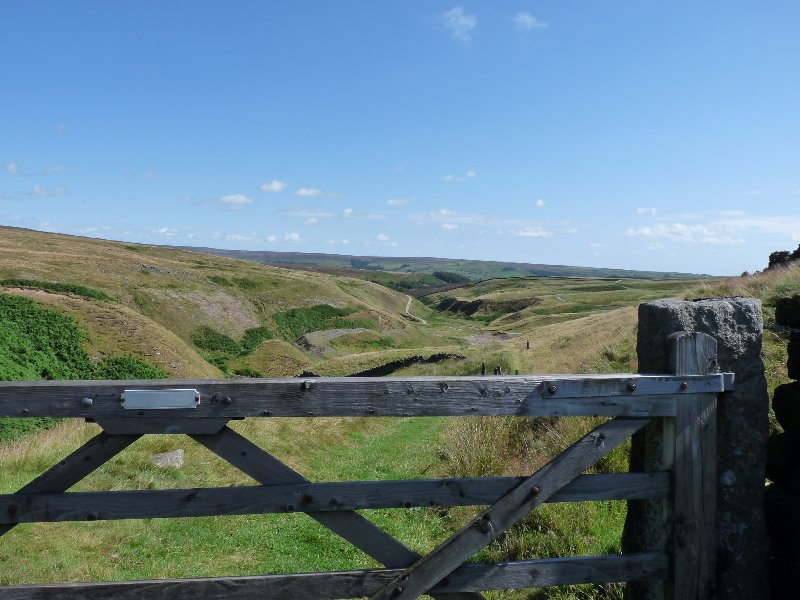
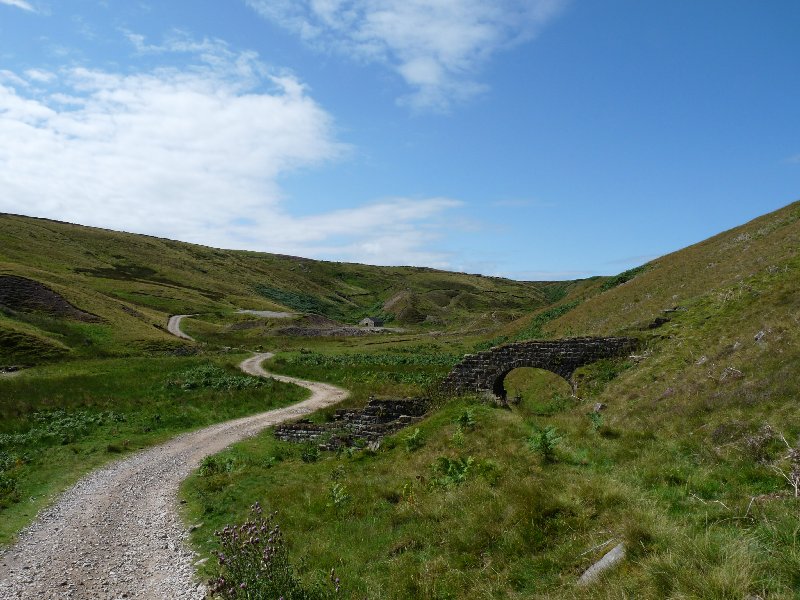
Yesterday, we went to Greenhow. It’s a charming, pretty village more noted these days for being the highest village in Yorkshire: a whole 400 metres or so above sea level. It used to be an industrial power-house. It was here and in the surrounding area that villagers used to mine for lead. And the signs of this ancient industry are still here. We set off on a walk across moorland and valley to investigate.
It’s thought that the Romans were the first to mine lead in the area, and by 1225, the abbots of Fountains and Byland Abbeys were apparently squabbling(!) over rights to mine at nearby ‘Caldestones’. This valuable commodity was transported over, for the time, immense distances. In 1365 for instance, a consignment was sent to the south of England, to Windsor: ‘Two wagons each with ten oxen carrying 24 fothers* of the said lead from Caldstanes in Nidderdale in the county of York by high and rocky mountains and by muddy roads to Boroughbridge’. At which point, the journey perhaps continued on water. Indeed, lead was exported as far afield as Antwerp, Bordeaux and Danzig.
An all-but hidden tunnel.
Peering into it. We were too tall to stand upright.
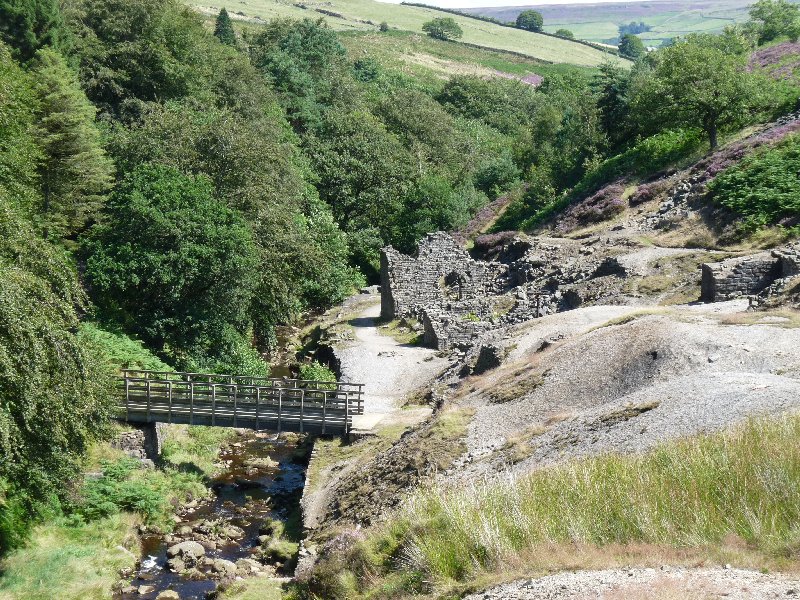
What’s left of an old lead works.
The beginnings of a long journey for that now-smelted lead.
Well, we were on those ‘high and muddy mountains‘, but they didn’t cause us too much trouble. Comfortable walking boots and a bright sunny day probably helped us on our way. What we did see were warrens of carefully constructed and stone-lined tunnels leading to the ancient and now fully-exploited lead seams. We saw, in the small streams now coursing along some of them, how water became a real problem to the miners of those seams. Horse tramways hauled lead , which was smelted on site, off to what passed for major roads at the time. It was obvious to us how very difficult transport must be in this up-hill-and-down-dale area, which even than was not highly populated, with poor transport infra-structure, and unsophisticated wooden carts to carry the goods. Ancient spoil-heaps from now-exhausted seams litter the area.
An old lead-works, spoil heaps, a river and a perfect picnic spot.
And at the end of our journey, we strode up to Coldstones Cut. This is a fine art work, a vantage point from which to see a vast panorama of the Nidderdale Area of Outstanding Natural Beauty and beyond, as well as the last working quarry in the area. These days, it’s all about aggregates and asphalt, but the quarry has a long history of providing lead, then limestone as well as other materials. Andrew Sabin‘s viewing area is part streetscape, part brutal stone-block construction. It’s a magnificent intermediary between an immense and busy industrial landscape, and the gentler and even vaster rural one in which it’s situated.
Even at Coldstones you can’t escape the legacy of the Tour de France.
The quarry: hard to convey a sense of its scale.
That qualifies as a mountain round here.
A view from Coldstones.
That’s Nidderdale.
The monumental viewing area.
…and from another angle….
Nidderdale again.
A final view.
*An old English measurement equalling about 19.5 hundredweight.
As you travel round North Yorkshire, you quickly become aware of its Christian heritage, and realise how many abbeys and monasteries there were, from a variety of religious foundations, for Henry VIII to get his teeth into once he’d laid his plans for the Dissolution of the Monasteries in the 1530s.
Fountains Abbey, as I mentioned in a recent post, is just down the road, and Jervaulx and Rievaulx aren’t far away: there are at least a dozen more. And each of them is ruined, left waste after Henry VIII pensioned off or martyred the abbots, priors, monks and lay brothers, and all the equivalent females too.
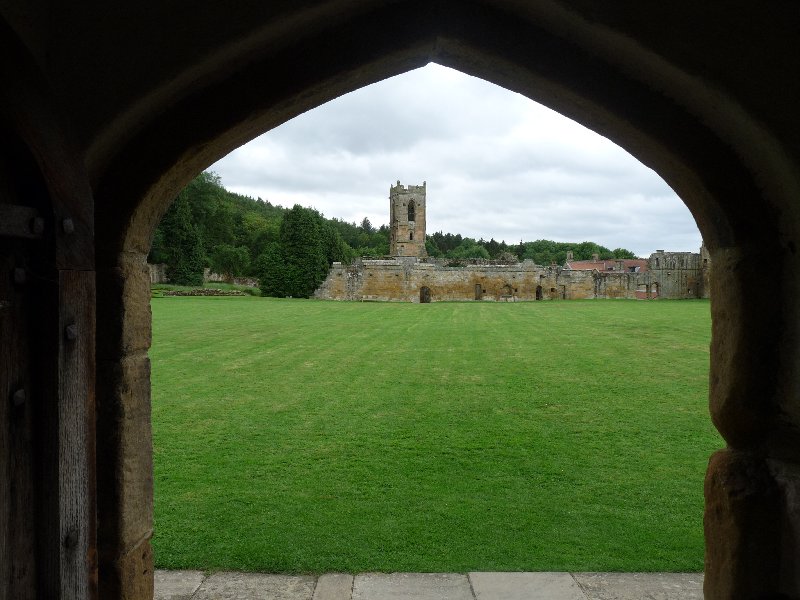
Today we visited Mount Grace Priory near Osmotherly. We’re accustomed to making a tour, when we visit these religious sites, of chapels, refectories, kitchens, cloisters – places where monks or nuns and lay brothers or sisters gathered together in spiritual or physical work for the benefit of their own and perhaps the wider community.
Not so at Mount Grace. This community was a Carthusian foundation. The Carthusians developed their order as a reaction to the lax conditions tolerated by many other religious orders at the time – the late 11th century. Initially centred on Chartreuse near Grenoble, the order founded religious houses throughout Europe, reaching Mount Grace in the later 14th century.
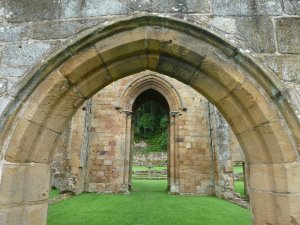
The simple, unadorned architecture of the priory.
Seven years is the time it took to become a full Carthusian monk. Seven years in which to decide whether the full religious life of solitary prayer, contemplation and work was for you. Seven years in which you would only ever see your fellow monks on a Sunday, at Chapter meeting. For the rest of the time you lived completely alone in your own little house which gave onto the large Great Cloister. Here you had a room in which to sleep and pray at the proper appointed times, a small living area with a large hearth, and upstairs, a room where you would work. Perhaps you would weave, or write out or illustrate manuscripts. Sometimes you would grow vegetables or fruit and herbs in your little patch of garden. You might walk or meditate in your very own mini-cloister. Even mealtimes were solitary. Your (vegetarian) food for your twice-daily meals would be pushed through a space in the wall by a lay brother whom you never saw. Bedtime was 6.00 p.m. and there were two extended times of prayer through the night. What you also had, though, extraordinary for medieval times, was a privy regularly flushed from springs in the area, and cold piped running water.
The monk’s bedchamber and personal chapel.
His sitting and dining area. There’s a large hearth here too.
His upstairs workroom, with weaving loom and table.
His privy.
His vegetable garden.
The writing equipment a monk was issued with on arrival at the priory.
The monastery site includes a prison to confine brothers who became disobedient. At a time when mental illness was little understood, surely some must have reacted badly to this life of extreme solitude, and become ‘problems’? Any yet there were always far more men wanting one of the 25 places at this austerely- run yet comfortable priory than could be accommodated.
The lay brothers who did much of the ‘housekeeping’ led similarly solitary lives, as far as their working day permitted. They farmed, made domestic pottery ware, looked after working animals, and the fish ponds: fish were apparently sometimes served as part of a vegetarian diet.
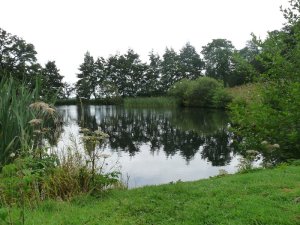
One of the several fishponds.
Naturally women were never permitted on site. Both male and female pilgrims would stay in what is now the Manor House from time to time, as monasteries have always had an obligation to offer shelter to travellers.
Since the Dissolution, the priory and its surroundings have been abandoned and fallen into ruin. The surrounding farmland was sold off, and the Manor House was converted and adapted for family life at various times in both the 17th and 19th centuries. The refitting of the house in the popular Arts and Crafts style at the turn of the 20th century deserves a post of its own.
Mount Grace is a lovely site. Malcolm and I were happy to visit it together, to have the chance to talk to informative and enthusiastic staff, and to wander around at our leisure. Living there for an entire adult life, under strict Carthusian rule? Not a chance.
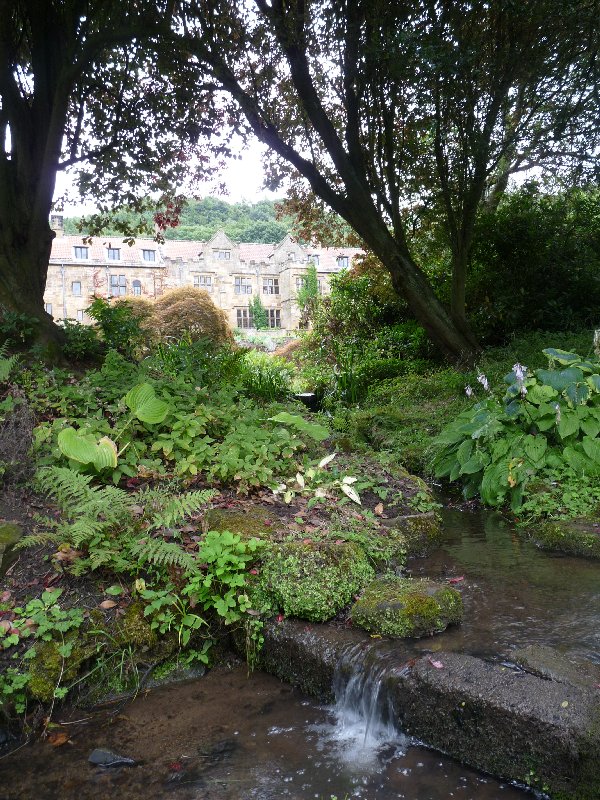
This is the Manor House as it appears today, viewed from the garden and fishponds.
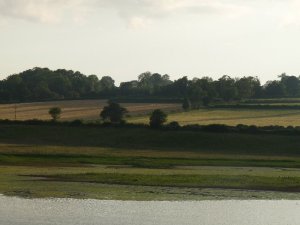
Not far from here, only about two miles as the crow flies, is a nature reserve, Nosterfield Local Nature Reserve. And ‘as the crow flies’ is an appropriate way to measure the journey there, because above all else, it’s a bird reserve. Even more than that, it’s a wetland reserve.
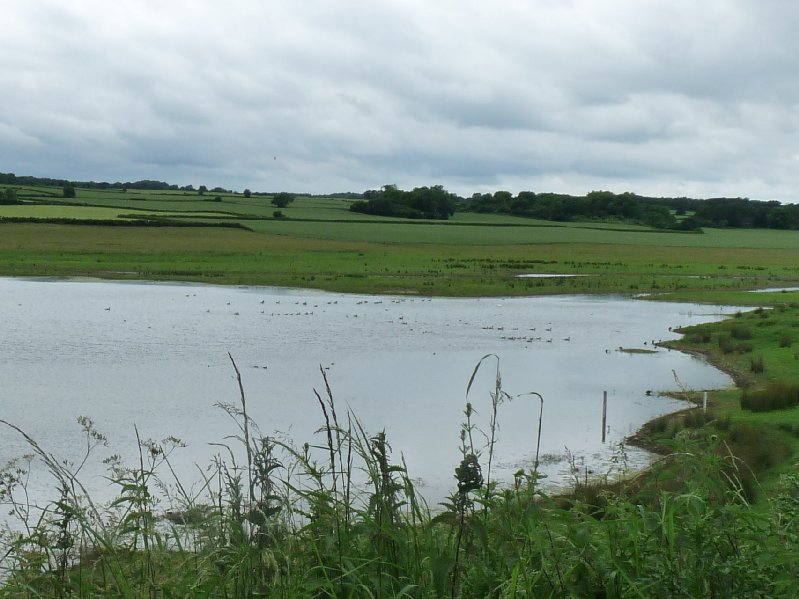
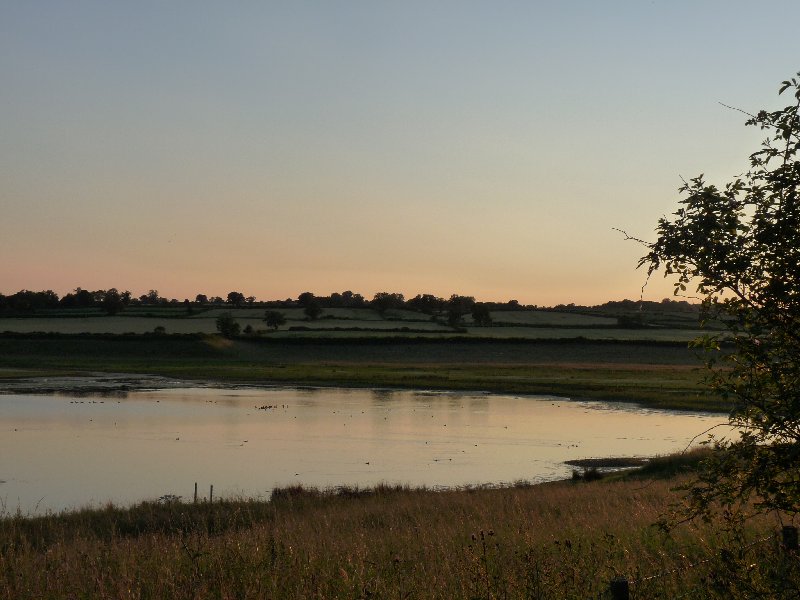
Evening at Nosterfield.
Until the 1990s, this was a landscape quarried for its sand and gravel, exposing the underlying limestone and fluctuating water courses. Even as the land was worked birds flocked here in search of insects. Once the quarries closed, the land proved unsuitable for agriculture: the intermittent flooding saw to that.
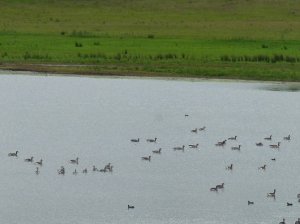
Wildlife took the site over. Wading birds adore the muddy margins and insect-rich grasses. Natives such as lapwing and curlew breed here, whilst many other species, such as sandpipers and godwit drop in as they migrate. Dozens of other species of bird make this their home, holiday destination, or stop-over site. At the moment, harvest time, Canada geese are exploiting the riches of the harvest. If they’re not noisily camping out in the wheat field just behind our house, you can be sure they’ll be at Nosterfield.
Great crested grebe.
Oyster catcher.
Heron
Since 1996, the area has been a nature reserve. A group of local naturalists succeeded in buying the site, having formed the Lower Ure Conservation Trust. They manage the site to exploit its already abundant resources. The fluctuating water levels – up to three metres a year variation is not unknown – means that there is everything from muddy shallows to small shallow pools to deeper sheets of water. There’s something for everyone, if you’re a bird who likes water. Or even if you’re a bird such as a wagtail, linnet or twite, who doesn’t.
The site supports a huge variety of wild flowers and grasses. That means there are insects, butterflies such as common blue, brimstone, wall brown and white-letter hairstreaks and moths too. There are rabbits and hares: while voles and shrews are preyed on by kestrels and barn owls. Summer-grazing cattle and sheep assist in managing the landscape: one way or another, this is a success story.
A busy evening at Nosterfield
We simply aren’t birders. Not yet. But this reserve is doing much to help change all that. There is a series of well-managed hides, and best of all, a comfortable unstaffed information centre, with piles of illustrated leaflets and books to help us identify what we’ve seen. It’s a serene and beautiful place to spend a quiet couple of hours watching the soap opera of bird life unfold, as they feed, raise young, quarrel, swim and wheel about above. We love visiting at different times of day, and look forward to coming throughout the seasons to see how the local bird population changes. By this time next year, we may be able to identify much of what we see. Maybe.























You must be logged in to post a comment.