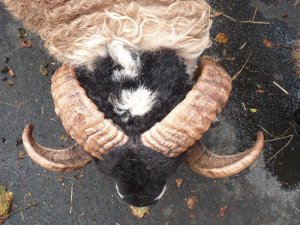
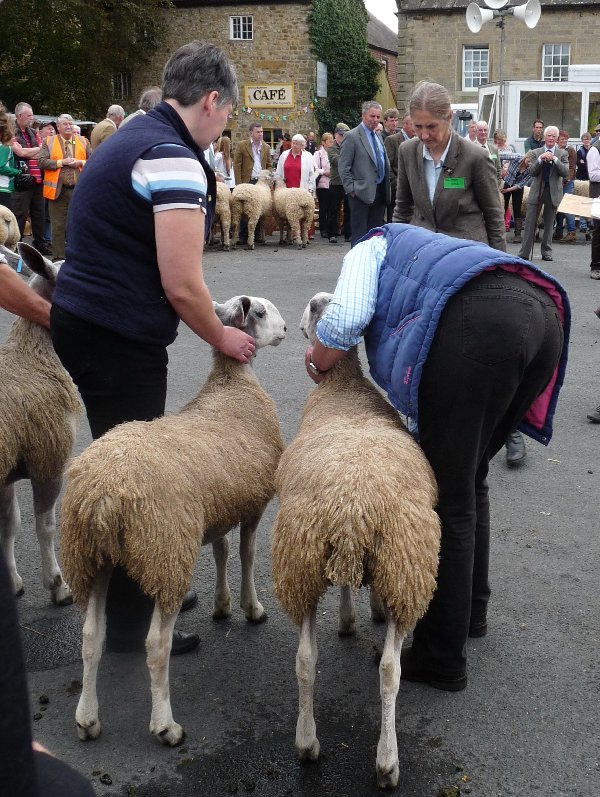
On Saturday we called in, far too briefly, at the annual Masham Sheep Fair. This is the place to go if you believe a sheep looks just like this.
Saturday was the day a whole lot of sheep judging was going on in the market square. Here are a few of the not-at-all identical candidates. And yet they are only a few of the many breeds in England, and in the world. There are 32 distinct breeds commonly seen in different parts of the UK, and many more half-breeds. I was going to identify the ones I’m showing you, but have decided that with one or two exceptions (I know a Swaledale, a Blue-faced Leicester or a Jacobs when I see one), I’d get them wrong. So this is simply a Beauty Pageant for Masham and District sheep.
And if you thought wool was just wool, these pictures may be even more surprising. Who knew that sheep are not simply…. just sheep?
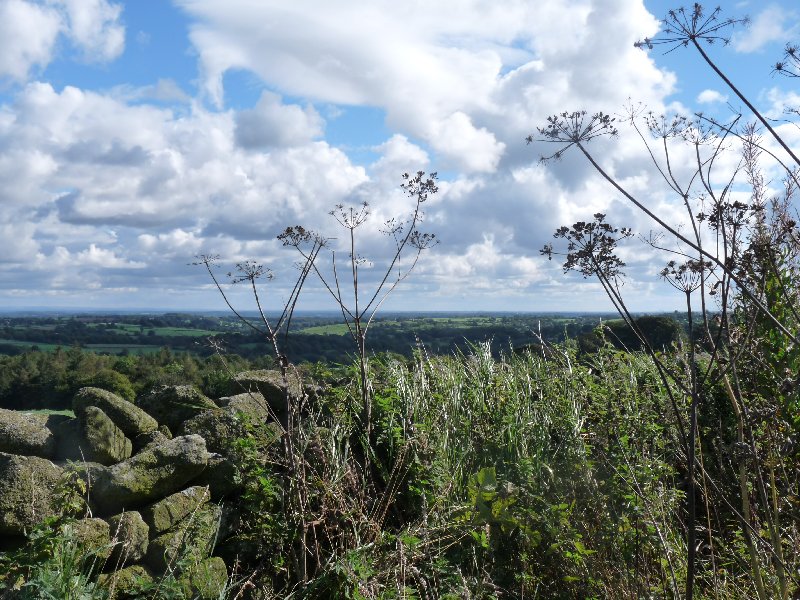
The landscape glimpsed through the skeletons of summer’s cow parsley.
Yesterday’s outing was a gem. We walked in bright late summer sunshine as the trees began changing colour for Autumn. Great views over Nidderdale and a few interesting animal encounters added pleasure to the day. And best of all was the chance to tease Our Leader For The Day – let’s call her Ms. X, to spare her blushes. Within 10 minutes of starting, she’d taken us off-route. A landowner called us off the steep hillside that she was already scaling. ‘It’s private land – but in any case it doesn’t lead anywhere.’ That wasn’t surprising. There was no path.
Never mind. We were enjoying fine panoramas, and a path that led onwards and upwards into ancient woodlands where large rocky outcrops showed us we weren’t at all far from Brimham Rocks. The paths round here were the stamping ground of lay brothers from Fountains Abbey who lived and worked in this area. They would have appreciated the fresh water springs, one of which has a carved stone alongside: ‘Adam’s Ale’, it says.
Here’s fresh water, aka Adam’s ale
The monks of Fountains Abbey had complete control of the Hartwith area from 1180 until the dissolution of the monasteries. It was home for their sheep; a source of wood; and animal fodder; and stone from the glacially deposited millstone grit , which was used to make mill-stones (‘quern-stones’). It was here too that the Abbot of Fountains Abbey had his own private hunting park.
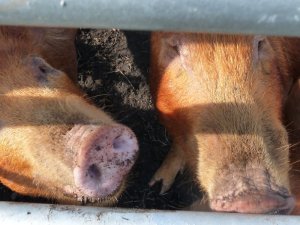
After that we were on National Trust land, and the outer-reaches of the Brimham Rocks estate. Here, the landscape changes for a while to austere and fairly barren moorland. But it was easy walking, and we were entertained by a fine herd of long-snouted ginger Tamworth pigs corralled on the edge of the moor. They were vocal, curious, and keen to eat my gaiters.
Two nosey pigs.
Then we got lost again. Ms. X led us through impenetrable bracken, at the edge of which she promised us a stile. There wasn’t one. We returned through the impenetrable bracken, and found the correct – and easy – path. We passed the handsome Jacobean Brimham Lodge, built on the site of the Abbot’s Hunting Lodge. Those Abbots knew how to choose a good view.
This was a day of many stiles.
Now we were onto areas of pasture-land. These fields have been progressively cleared in the years since the Dissolution of the Monasteries by the landowners who took over monastic lands. We picnicked in a field by a little-used track. Two of us spread ourselves out on the little-used track. We opened our sandwiches. And a large tractor advanced on us – down the little-used track.
Throughout the afternoon, we passed several ponds, probably originally fish ponds for – yes, you’ll have guessed – Fountains Abbey. Ducks escorted us along the roads, geese protested at our presence: it was all very bucolic.
Young pheasants form an advance guard on our walk.
… and then there were ducks…
.. and then two geese, one very much worse for wear.
At last, we reached ancient woodland – Old Spring Woods is known to have existed in prehistoric times. Remains of stone enclosure suggest that at one time, the area was used for grazing stock, but later, hunting became more important. And it was here that Ms. X led us astray for the last time. At the bottom of a long descent she insisted she’d gone wrong. Up the hill we trailed, and all of us had a go at re-interpreting the map in our own way. By popular vote, we all traipsed down the hill again, and found the path we’d needed all along, just there, beyond the woodland gate. And we were nearly home and dry.
But our day wasn’t over yet. Ms. X suggested finishing off the afternoon at an ice cream parlour a couple of miles along the road. It wasn’t her fault that the signs to it on the main road all read ‘Open’. It wasn’t her fault that there was a long and bumpy farm drive down to the café . And it wasn’t her fault that when we got there, the café turned out to be shut. But we blamed her of course, just as we blamed her for every mishap along the way, even though we all had a hand in reading the map.
She knows we don’t mean it. We’d had a Grand Day Out. We’d had a good work-out, a scenic walk full of interest, a fine day out with friends, and a chance to tease Ms. X unmercifully. Thank you, Ms X.
A view across Nidderdale near the end of our journey
A couple of months ago, our friends Sue and Kevin went to see some friends for a meal. Their friends produced a very fine cake, so they asked for the recipe.
A few weeks ago, we went to see our friends Sue and Kevin for a meal. They produced a very fine cake, so we asked for the recipe.
The other evening, our friends Jonet and Richard came round for a meal. We produced a very fine cake, so they asked for the recipe.
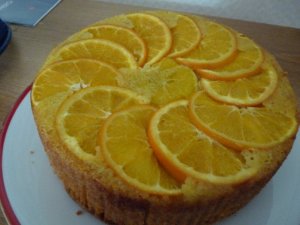
This is the cake. This is the recipe. It’s a little unusual, it’s easy to make, and it works well – as we all discovered – as a pudding. It’s also dairy and gluten-free, which can come in handy too.
Polenta and Olive Oil Orange cake
Ingredients:
2-3 large oranges
300 g. golden caster sugar
250 g. fine ground polenta
200 g. ground almonds
1 1/2 tsp baking powder
Pinch salt
4 eggs, beaten
225 ml. olive oil
zest of 1 orange
Oven 170 degrees centigrade.
Grease and line tin (equivalent of 2 lb. loaf tin, or 20 cm. round tin).
Peel and slice oranges and arrange, overlapping, on base
Combine all dry ingredients.
Beat eggs and add to mixture.
Add the oil and combine all ingredients
Pour the thick batter over oranges.
Place on baking tray and bake 75-90 mins.
Allow to cool before inverting on plate.
The cake works well on its own, but is even better with, say, a handful of raspberries and some Jersey cream.
It was all a bit competitive being a landowner in 18th and 19th century North Yorkshire. You wanted the fine house. You wanted the spacious and gracious gardens, landscaped to be ‘picturesque’: nature celebrated but tamed, rather than strictly-organised and geometric, as in much of the rest of Europe. And you wanted the Folly. You were looking for an extravagant yet decorative building, that displayed to the world your appreciation of classical, Egyptian or Gothic architecture. It was without purpose, it was eccentric, and it was a fake.
But that was entirely the point. A folly was for fun. It might complement the view. It might make a destination for a stroll for your family and guests. It might even be a picnic spot for a wider public looking then, as now, for something nice to do on a sunny Sunday afternoon.
Today, the ‘wider public’ was the Ripon U3A (University of the Third Age) walking group. It was not however, a sunny Sunday, but a dank and drizzly Friday. Our path took us through Colsterdale up the now dismantled track of the narrow-gauge railway built in 1902 to transport materials used in the construction of nearby Leighton reservoir. During WW1, the railway’s destination, Breary Banks, became a training ground for the volunteer soldiers of Leeds Pals. We tramped up the hill as those soldiers-in-training must have done: more suitably clad, certainly, and just as capable of sending the sheep running for cover in the bracken.
Sheep inspecting the troops.
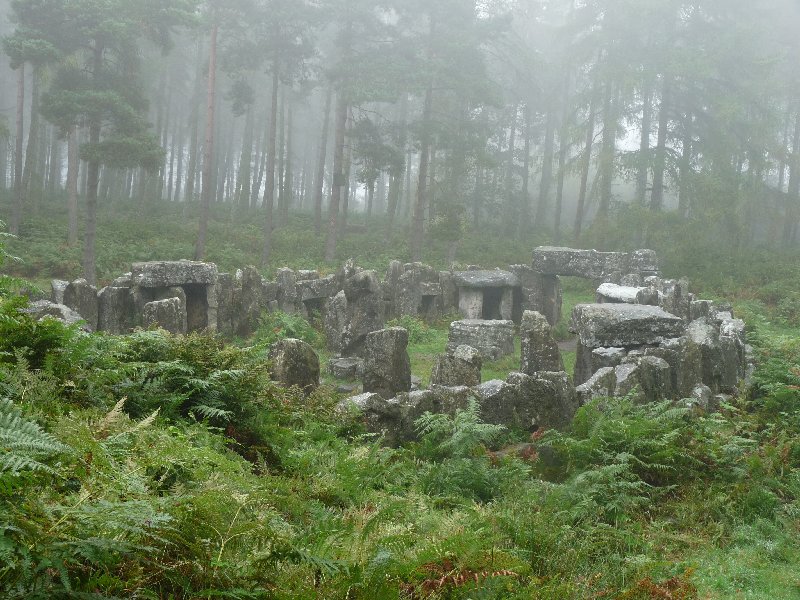
Then we were into woods, and along another path, and found ourselves…… in a clearing, with an oval of standing stones, some of them fashioned into doorways or caves, but all of them contributing to a sort of over-furnished Stonehenge. It’s not North Yorkshire’s answer to Stonehenge however, but William Danby’s folly. William Danby was the owner of the Swinton Estate, on whose lands we were standing. That is, both William Senior, who lived in the latter half of the 18th century, and William Junior, his son. Which of them built the folly is a bit of a mystery. Both of them were probably intrigued by the Druids. Poets and antiquarians at the time saw them as England’s earliest men of learning, the guardians of early belief-systems, and the first English patriots. Some say too that this ‘ancient temple’ was devised as a means of providing employment for men returning from soldiering in the Napoleonic Wars. There’s a story that there was a seven-year job on offer to anyone who would live as a hermit on the site. It’s thought that nobody stayed the course.
Druids Temple
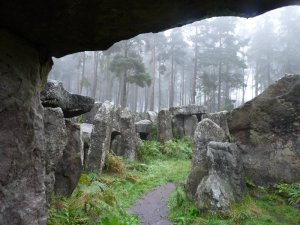
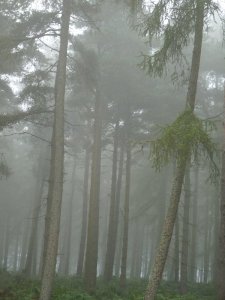
We explored the stones and caves, standing atmospherically on this slightly misty day at the edge of a suitably gloomy forest.
Another view from the temple.
And then we went for coffee and cake at the Bivouac, a marvellously isolated and quirky cafe on a site -with-yurts for serious glampers. Definitely worth a detour. Suitably fortified, we finished our circular walk, and were back at home in time for a late lunch. A healthy walk, a couple of history lessons, a great coffee-stop. What better way to start the weekend?
Here be druids.
I should mention that these photos give quite the wrong impression of our not-at-all miserable day. They were actually taken earlier this week, when the weather was really gloomy, and our French friends were still here.
We’ve just had good friends from Laroque staying for the week. We’ve been obliged to polish up our French, which turned out not to be as hard as we’d feared. And we’ve been doing our best to show-case Yorkshire. We didn’t expect that to be hard, and it wasn’t. But we had fun exploring links between our two home areas, something I’ve talked about before here. Easy enough when you’re walking in the hilly limestone scenery of the Dales, or discussing breeds of sheep, or our former textile and mining industries, or bumbling along single-track roads in the country, with no villages in sight.
But it would be stretching a point to find a meeting point between the land-locked Ariège, and the East Yorkshire coast, surely? Well, as it happens, no. We had a day exploring the coast near Whitby: and I remembered that during the 1800s, Whitby and parts of the Ariège, Laroque d’Olmes included, had a thriving industry in common. Jet.
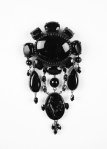
19th century mourning jewellery. Wikimedia Commons.
Back in the mid 19th century, the fashionable French and English alike couldn’t get enough of the gleaming, richly black fossilised wood that came out of local cliffs (Whitby) and river beds (Ariège) to be transformed by local workers into brooches, earrings and lockets. In its hey-day, the industry employed thousands of people engaged in finding and extracting the mineral, carving and polishing it. Queen Victoria ensured its continued popularity in England by wearing jet as mourning jewellery when her beloved Prince Albert died.
We found no jet. So Wikimedia Commons had to help me out.
Its decline as a fashion item matched the decline of readily available sources of the material. Somehow, by 1900, jet had lost its allure, and both areas lost an important source of employment. Jet in the Ariège is consigned to history books and museums. In Whitby, however, there’s something of a revival, and there are once more a few shops selling costume jewellery and other items made of jet.
We never found a single piece, but not for want of trying. Instead, we had a more traditional day at the sea. We ate large plates of fish and chips. We seagull-watched. We paddled on the beach and investigated rock pools. And we ended the day at the higgledy-piggledy and charming settlement of Runswick Bay, clambering up and down the cobbled streets and admiring the quaint cottages with their views across the bay.
Whitby Old Town seen from a ginnel.
The harbour at Whitby.
Fish and chips at the Quayside Fish and Chip Restaurant.
Dog at play on the beach at Whitby.
A young herring gull.
Beach huts at Whitby.
Cottages at Runswick Bay. It’s not raining. The flowers have just been watered.
I’m used to brick houses. And stone houses. And even houses whose facades have been rendered and painted, as our home in Laroque was. But house paints generally come in a very limited palette. White, of course, and a range of neutral or earthy tones such as ochre. That’s what I thought until I went to Wales, anyway. Now I know differently. Come on a very quick tour with me to see what colour you could paint your home. Click on an image to see it full size: I’m only sorry not to have included an example of my own particular favourite: crushed raspberry.
House with matching car. Note also the purple house next door..
We had such a good time wildlife watching in Wales. At first it was all simple wonder and enjoyment : ‘Look – there’s a…….’. But soon it all got quite competitive. Sarah bought an ‘I-Spy’ book – remember those? It was birds she decided to hunt for, and we all got involved in deciding whether it was guillemots, Manx shearwaters, or simple herring gulls that we’d just seen. And look! There’s a cormorant on that rock over there! And three choughs sitting on a wall! And over in those bushes – surely that’s a willow warbler?
Herring gulls taking a break
This cormorant almost got away before I got my camera out.
Choughs on a rock.
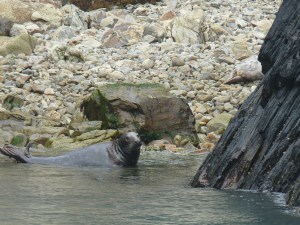
The day that we were in no doubt at all about the quantity of our wildlife sightings was the Sunday when we took a boat trip round Ramsay Island. There were indeed birds (but no puffins: it’s off-season for them): but what we relished seeing in huge numbers were seals, swimming in the coves, basking on the shore, or in the case of the white new-born pups, beached high up on some sheltered spot away from in-coming tides.
Grey seal on a beach at Ramsay Island
Ramsay Island’s a splendid place. These days it’s an RSPB bird reserve, and there were seabirds of course: not so many at the moment as the breeding season is over. Easy to see though where they nested – very precariously – on the rock faces which are heavily stained with guano. Sucked along by powerful tides, we plunged into sea caves, rode close to the shore squeezed between deep rock gorges as the cliffs soared high above us. We’re fairly sure we saw porpoises clipping along at speed just as we were turning for the mainland once more.
Grey seal swimming near our boat.
A beach full of seals.
A seal pup, easily identified by its white spotty coat.
Herring gull on Ramsay Island.
Empty sea bird nursery.
Sea bird settlement on the island
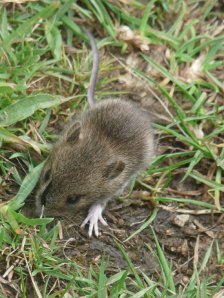
Every time we went walking we came to expect to engage in bird and seal spotting. But on Saturday, as we strode the cliffs of the coastal path, we came across this vole, and his (her?) two companions. The image you can see on your screen is almost certainly larger than the real thing. We were so lucky to have seen such a tiny creature, and so clearly.
One of the voles we spotted on our walk.
A few minutes later, I was the only one to spot a lizard: my first sighting since leaving France.
And then there was the evening when we went for a walk, and found ourselves accompanied by a whole troupe of friendly steers, who wanted nothing more than to follow us home, and to help us along with our map-reading….
We’re being followed…..
Not wildlife exactly: but these young steers were awfully keen to help Sarah and Brian out with the map-reading.
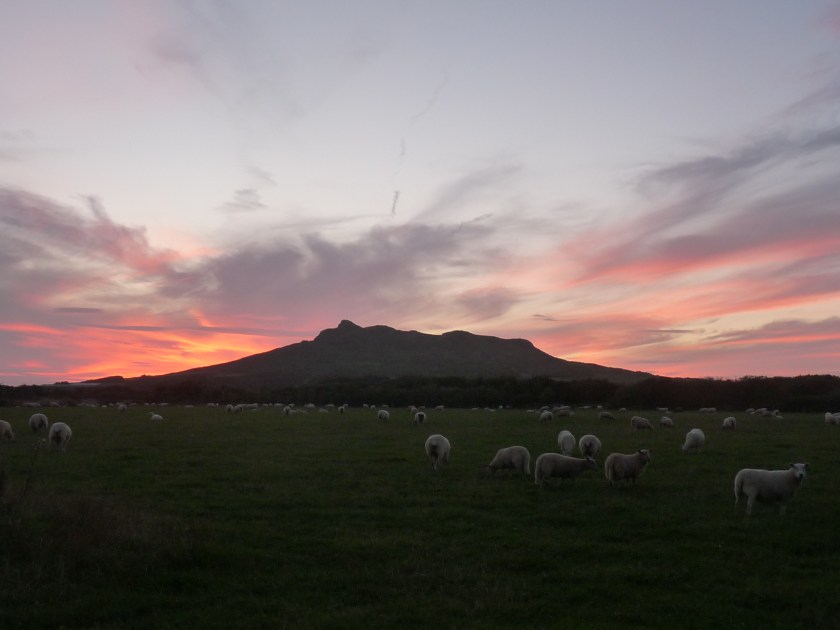
We’ve just come back from a glorious long weekend in Pembrokeshire in South Wales, with son, daughter-in-law and her parents. We were near St. David’s, Britain’s smallest city. Its population is the same as that of Laroque d’Olmes, and in other ways too the area seems to qualify as Ariège-on-Sea. Craggy mountains; fields of sheep and cattle; tiny one-track roads where the only likely traffic is a tractor, or even more likely, a herd of cattle coming home for milking; and long vistas, from the hill tops, of apparently endless countryside. And of course, the sea.
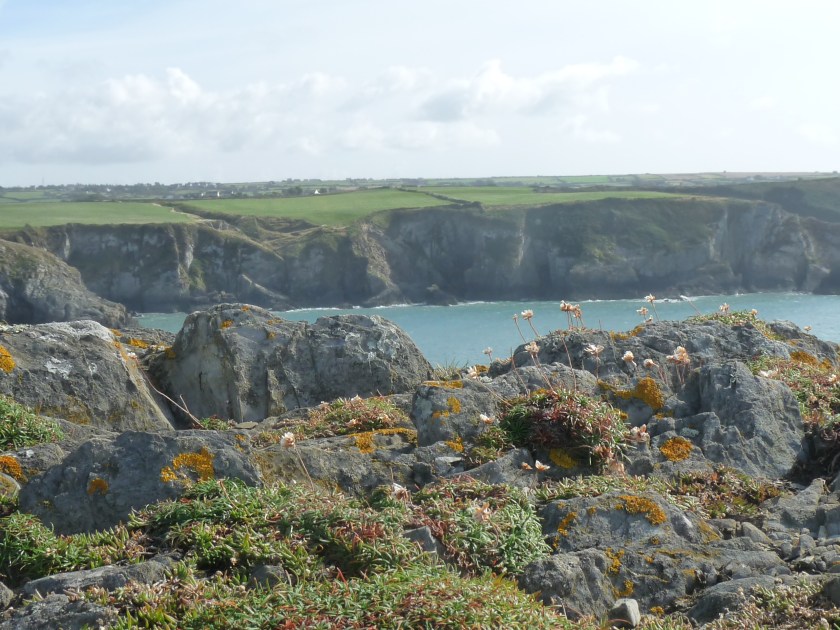
Our objective was to cover a goodish distance along the Pembrokeshire Coast Path. It’s some 299 km long: we managed about 40 km. so we have some distance to go. But what a journey. This scenery must be among the most stunning in the UK. Steep limestone cliffs and bays, volcanic headlands, beaches, inlets and flooded glacial valleys are the home to innumerable seabirds, and at this time of year, seals seeking sheltered nurseries to give birth to and rear their pups.
This slideshow requires JavaScript.
For me, this was the toughest walking since we’d left the Pyrenees. You know where you are there. On the whole, you’re walking up a mountain. Then you come down. Whereas along the coastal path, you’ll be scrambling upwards to reach the top of a high cliff, before descending again, perhaps almost to beach level. Then up again. After that you might swoop down to a cove before marching upwards to the next headland… and so on. Bright sunshine, warm breezes, and bracing sea air cheered us along and kept our energy levels high…. until the evening, when we found ourselves drooping and heading for bed as early as 10 o’clock.
We love a good country show. Farm animals on their best behaviour, sheepdogs out to impress with their skills in rounding up sheep, horses in the ring neatly jumping a clear round, country crafts, tough-guy tractors, food to sample, all in some pretty slice of countryside with the sun (maybe) beating down.
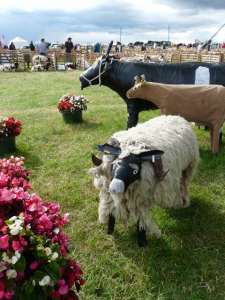
At Wensleydale Show, Leyburn Auction Mart went for animals made from gaffer tape and oddments. So much more biddable.
Since we got back to England, we’ve failed to go to the Great Yorkshire Show in Harrogate – too crowded, and the Ripley Show – way too wet. Would it be third time lucky at the Wensleydale Agricultural Show? Well, yes, we did make it there. And just after we arrived (this was the 23rd August, remember) we found ourselves scurrying for cover to avoid a heavy hail storm, with sharp icy crystals slashing at our faces and battering at the marquees.
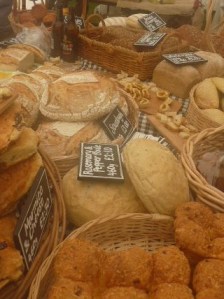
It didn’t matter. The sun soon came out again, but in any case, we spent much of the day inside. We were there to work. Bedale Community Bakery, where we continue to enjoy volunteering every Wednesday, had a stall, and there was bread to sell. Some of the team had worked through the night to get loaf after loaf mixed, kneaded, proved, baked and loaded up for the journey from Bedale to Leyburn and the show. By the time Malcolm and I arrived, some of the team had been there several hours already. And here’s what the stall looked like….
A tiny part of our stall.
We sliced and buttered loaves to provide samples for an eager public who wanted to talk to us and to try before they bought: sourdough; spicy chilli sourdough (soooooo good); cheese and onion bread; another cheesy loaf marbled with Marmite; harvester loaves; wholemeal loaves; bloomers; rosemary and pepper loaves; ‘seedtastic’ spelt; a loaf made using a locally brewed beer; a Mediterranean bread, all made the traditional way, proved long and slowly over several hours. There were spicy vegetable pasties; tomato and onion focaccia; roasted vegetable focaccia; four different types of scone (Jamie and I had made quite a lot of those on Friday, and they were baked off in the small hours of Saturday morning).
Try before you buy.
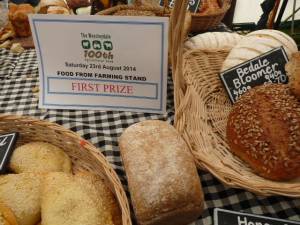
It all paid off. We were in the food marquee, surrounded by other small food businesses offering bread, pies, jams and curds, cakes and biscuits, chocolate, cured meats: all good stuff. But we got first prize in the ‘Food from Farming’ category, for the quality of our products and (buzz word alert) our community engagement.
And here’s the certificate
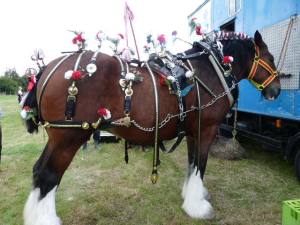
There was almost no time to get away and enjoy the show, but it hardly mattered. Serving on the stall to an appreciative public was all good fun. But here are a few shots from the times I did escape. Here are shire horses, beautifully decorated in the manner traditional for the area. Yorkshire horses, apparently, sport flowers, whereas Lancashire ones wear woollen decorations (very odd, as we had a woollen industry in Yorkshire, whilst Lancashire did cotton).
A Yorkshire shire horse, her 80 year-old owner’s pride and joy.
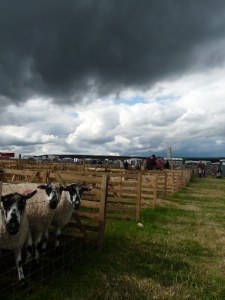
Here are sheep.
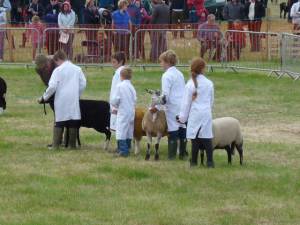
And here are children working sheep. There seemed to be opportunities in every category for smartly-overalled and seriously skilled children to show off their prowess as animal managers: it’s clearly important to encourage the next generation of farmers.
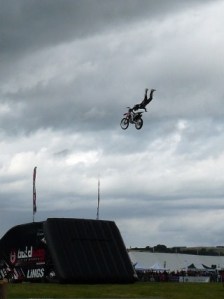
And here, oddly, are stunt bikers. We saw them as we left somewhat before 5.00, every single loaf sold, as the show slowly started packing up for yet another year .
There are quite a few more shows left before the summer’s over. We’ll get one into the diary.
Wednesday, August 20th. The morning air was chilly, just a little damp and drippy. Flowers in the borders hung their heads, their petals shabby and tired. Autumn has arrived. It does seem a little previous.
‘All is safely gathered in/ Ere the winter storms begin’
All the more reason to get out and about, before the days really close in. Ripon Ramblers chose to go to Harewood.
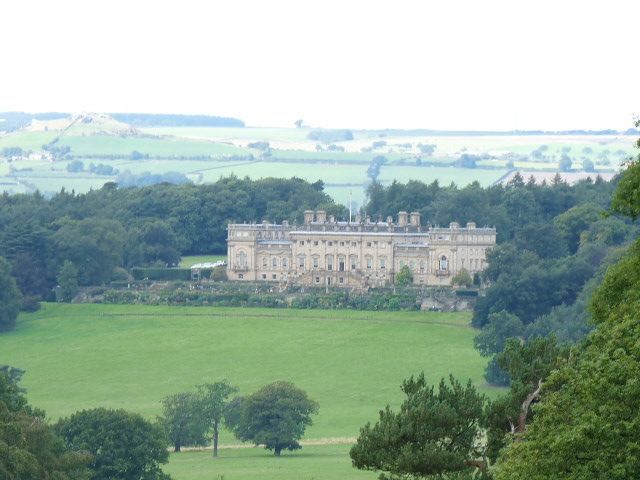
You’ll perhaps have seen Harewood House on TV recently, as that’s where the Tour de France really started from this year, after the Départ fictif from Leeds.* Half way between Leeds and Harrogate, it’s a playground for both towns, with its fine Adam-designed stately home, and extensive grounds designed by Capability Brown. At the time, the 1750s, investment in the slave trade brought immense wealth to the Lascelles family. Their descendents, the Earl and Countess of Harewood live in these fine surroundings built two and a half centuries ago. This stately home is regarded as being among the finest in Britain and is for the most part open to the public.
Our walk took us on a circular path that began outside the grounds, over farmland and with views across the Wharfe Valley. The route across the cow pastures was a bit of a puzzle. Weren’t those mango stones beneath our feet? And melon seeds? And even squashed tomatoes? The smell of rotting fruit wasn’t what we looked for on a country walk. Finally a young woman from a nearby stables helped us out. A local supermarket regularly dumps its surplus fruit at this farm for the cattle to enjoy. Four tons of fruit seemed to us to be remarkably poor stock control on the shop’s part, and we couldn’t help wondering what the cows’ insides made of this exotic diet.
Cow on a mango-hunt.
Far more enjoyable were the autumn fruits that lined our route for much of the day. We gathered blackberries every time we felt hungry or thirsty. We enjoyed the sight of haws turning red, elderberries turning black, and prickly chestnuts swelling and fattening on the trees.
Blackberries waiting to be picked.
Hawthorn berries ripen.
Elderberries too.
We completed our upward yomp, and walked along the ridge which offered a fine panorama across to the Crimple Valley and Harrogate beyond, to Almscliffe Crag, and even Ilkley Moor. Clouds in a dramatically cloudy sky were unloosing light rain into the nearby plain, and the breeze soon pushed the showers our way…..
Look carefully. You’ll see rain falling in the plain below. But not on us.
….and then pushed them on again, so that we could enjoy a rain-free lunchtime picnic with all that view before us.
Lunchtime view over the Crimple Valley.
After lunch, we were in the grounds of Harewood. Not the formal grounds near the house itself, but areas of woodland, pasture, lakes, deer park and farmland. And in the distance we spotted a fake Dales village, only built in 1998. This is Emmerdale, used in filming the long-running soap of the same name. No filming that day, so we were soon on our way, hurrying now before the rain, promised for mid-afternoon, settled in to spoil our walk. We made it – just.
Our best view of Harewood House came at the end of our walk.
* The ‘départ réel’ of the Tour de France from Harewood signified the true beginning of the race. City centre Leeds was no place for cyclists to jockey for position, so riders just tootled out to Harewood on the ‘départ fictif’. Then the action started.













 From Pyrenees to Pennines
You must be logged in to post a comment.