Jarrow Ramblings, part 1

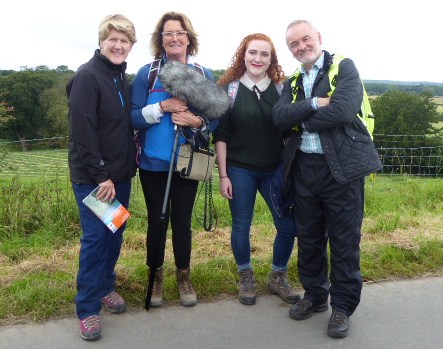
Clare, Lucy, Helen and Robert pose for a group photo. None of us asked for selfies-with-Clare

I came in the other day to find a message on the answer phone.  The BBC.  Clare Balding wanted to talk to me.  Well, not Clare actually.  She’s one of Britain’s favourite broadcasters and a bit busy I dare say.  Her research assistant Lucy finally got hold of me, and asked me if I’d be able to lead Clare and team on a walk from Ripon to Ripley for ‘Ramblings’, a popular programme on BBC R4 about walking.

Why me?  Because I’m Hon. Sec. of Ripon Ramblers, our local walking group, and our details are out there, if you care to look.  Yes, but why ME?  Lucy thought, after our chat, that I’d be OK on the radio.

OK then, why Ripon?  Because, it turns out that in October 1936 the Jarrow Marchers walked from Jarrow, through Ripon to Ripley and beyond, all 280 miles to London.  In October, ‘Ramblings’ plans to broadcast a programme to celebrate its 60th anniversary.

Perhaps you don’t know much about the Jarrow March.  Neither did I.  Not till I met Clare and Lucy, cultural historian Robert Colls, and Helen Antrobus, who’s a real Ellen Wilkinson enthusiast from the People’s Museum in Manchester.  The five us walked and talked our way along our eight mile route from Ripon to Ripley, and we barely noticed the rain which threatened constantly, but only delivered occasional short sharp showers.

This is a blog in two parts.  The first is our country walk, the second about the Jarrow March. But Friday wasn’t in two parts.  Every step we took, we remembered those marchers.  Robert and Helen told us the story.  Together, we drew comparisons between their march and our own hike.

I’d already dutifully planned and  walked a route.  The marchers went entirely on main roads, but if you’ve ever driven on the A61, you’ll know this is no longer a good idea.  Country paths were the way to go.
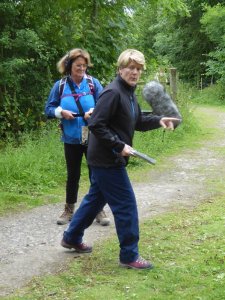
'Do we go this way?' Lucy records Clare getting directions.
‘Do we go this way?’ Lucy records Clare getting directions.

As  we set out together from Ripon, we got our instructions.  Lucy had her furry-muff-on-a-stick.  You’ll have seen those, as reporters rove round town centres talking to likely passers-by about some event that’s happened locally.    When recording, Clare’s always on the right of the person she’s talking to, and Lucy’s  there on the left with her recording gear.  It was slightly odd to walk alongside Clare as she formally introduced to the programme, telling listeners where she was, why she was there, and who we all were.  But soon we forgot about that muff.  We all chatted together easily, about that March, about walking, about each other.  Sometimes we had to repeat what we’d said, in a spontaneous ‘I’ve just thought of this’ kind of way, because some passing noise – RAF jets overhead for instance – had ruined the recording.
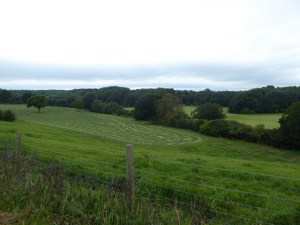
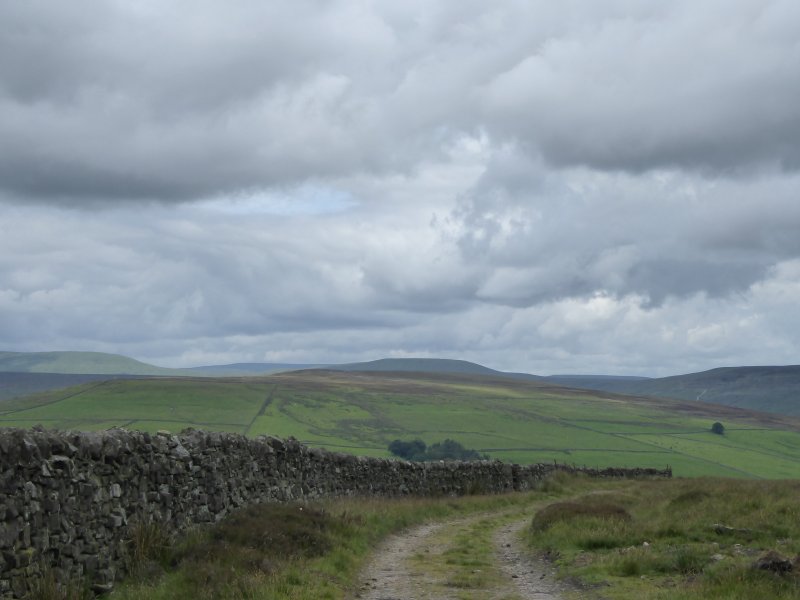
This was the scenery of the early part of the walk.

In many ways our walk was a scam.  The A61 passes through rolling hillsides, productive farmland, cows in the pasture, and pretty villages.  It’s all bucolic England at its best.  Our route presented a more hidden countryside.  Isolated farmhouses with dilapidated barn roofs,  ancient pastures, secret dark, damp woodlands, and tiny rather remote hamlets.
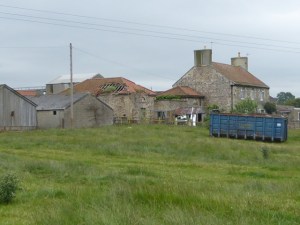
If it survives the cut, you'll hear Clare painting a word-portarit of this farmhouse during the programmme.
If it survives the cut, you’ll hear Clare painting a word-portrait of this farmhouse during the programmme.

At first though, we were on a road.  Badly maintained, rather narrow and with tall hedges it’s a bridle path these days, but it is still tarmacced, and perhaps the kind of highway those marchers would have recognised.  Later, on grass-trodden pathways, we passed Markenfield Hall, a 14th century moated country house.
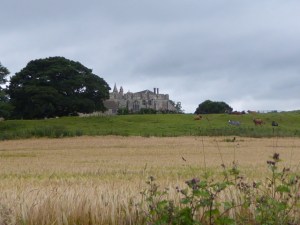
We saw Markenfield Hall nearby as we walked. The Jarrow marchers didn't.
We saw Markenfield Hall nearby as we walked. The Jarrow marchers didn’t.

Those marchers didn’t.  We went through the village of Markington. Apparently the marchers were welcomed here too, though we couldn’t imagine why.  It’s more than a mile or so from the main road and history doesn’t record why exactly they made a detour.  We strode along the edges of barley fields, on woodland paths and across gorsey heath, all without meeting a soul.  Not what the marchers experienced.
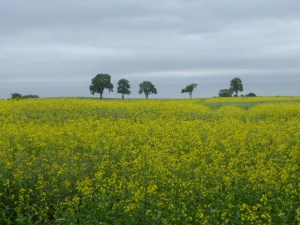
This is farming country.

And we talked.  That’s what I’ll remember most.  The sheer pleasure of walking and talking with a group of people thrust together for the day who quickly found themselves to be friends – just for a day.  Thanks you Clare, Lucy, Robert and Helen for a very special occasion.  It was a real privilege.
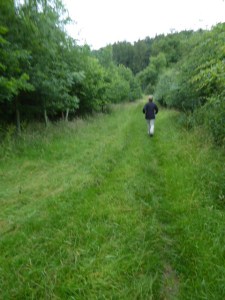
Clare strides away into the woods.

And the Jarrow March?  More about that in my next post.
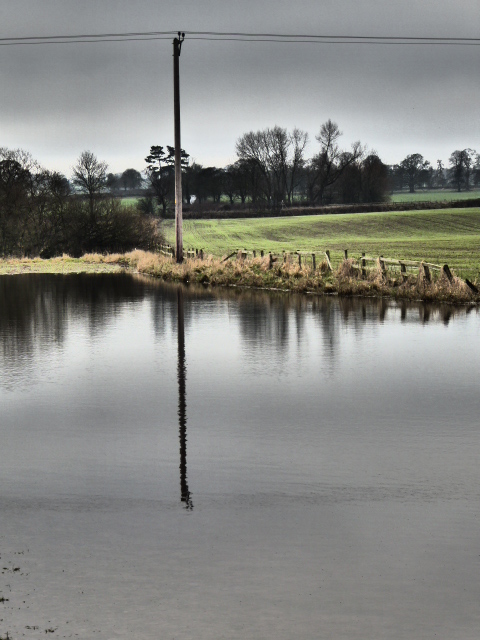
 

What a difference six months make…..

Look.  Here was the scene in the field near our house, in January this year.  Fields and roads flooded, impassable pathways, rocks and earth tumbling into the River Ure.

Near Old Sleningford, January 2016.

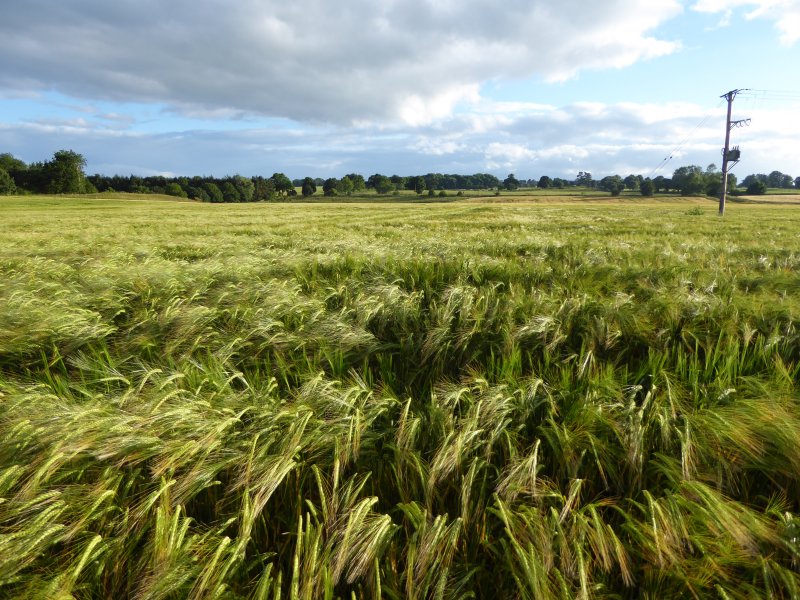
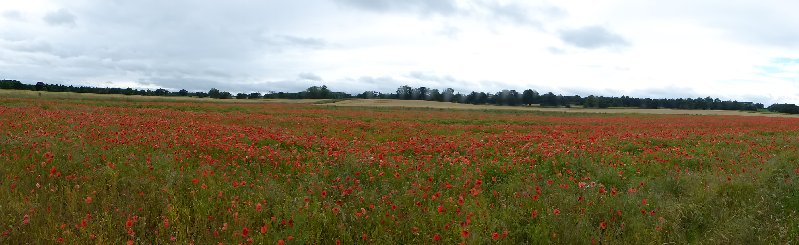
This was the same field yesterday.  Barley, barley everywhere, all fattening up nicely for the harvest.  Nearby, fields of poppies.  Really hopeful, cheery sights on a sunny and blustery day.

The same field, July 2016

Will all our present political crises end so well?  I wish I could feel more optimistic.

PoppyFieldsJuly2016 013

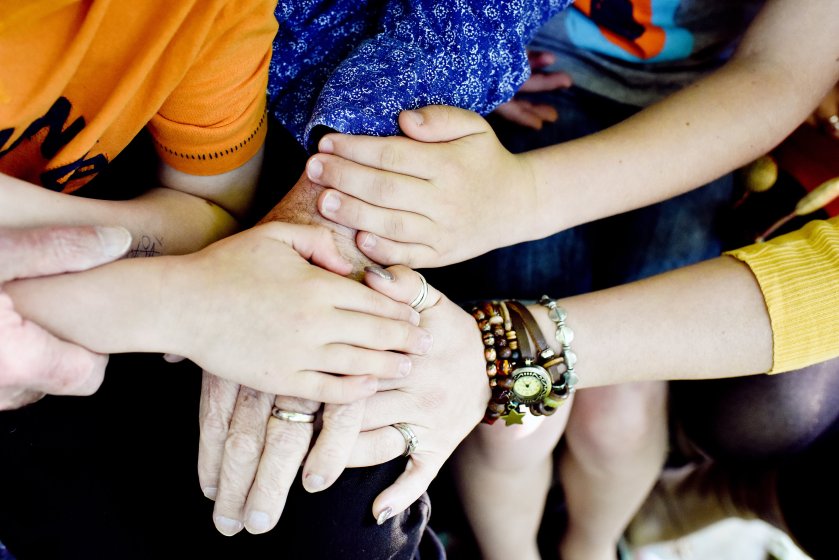
I Wanna Hold Your Hand.

I want to share this post. It says more about raw grief, and about sustained love through good times and bad than anything I have ever read. The writer has asked to remain anonymous. But if you’ve been following my blog for a while, you’ll know very well who wrote it.

See if you can read it without it making you cry. And when you’ve read it, you might want to read some of her other posts. Maybe not all at one sitting though, they’re scarcely escapist reading matter. Oh … and ignore the swearing. The writer has plenty to swear about.

Fanny the Champion of the World's avatarFanny the Champion of the World

gallery-one-89

We went to a party on Saturday night. It’s not the first time we’ve been out, the boys and I (or indeed I on my own,) since D-Day, and although I mainly want to stay at home curled up in a ball, I know it’s A Good Thing to go out and I need to make the effort. We need to socialise, and I’m determined that my hubby doesn’t just slip into obscurity, and become some legendary bloke who we all vaguely remember. No. He has a name, and we use it often. Still, I’m pretty selective about who I feel up to partying with, as the fixed social smile often gets wiped away by tears. For the most part, the small talk I used to be so good at makes me feel a bit nauseous, and I don’t want people to ask how I am because they won’t like the…

View original post 738 more words

Some right Yorkshire place names

LeightonReservoirWalkJune2016 017

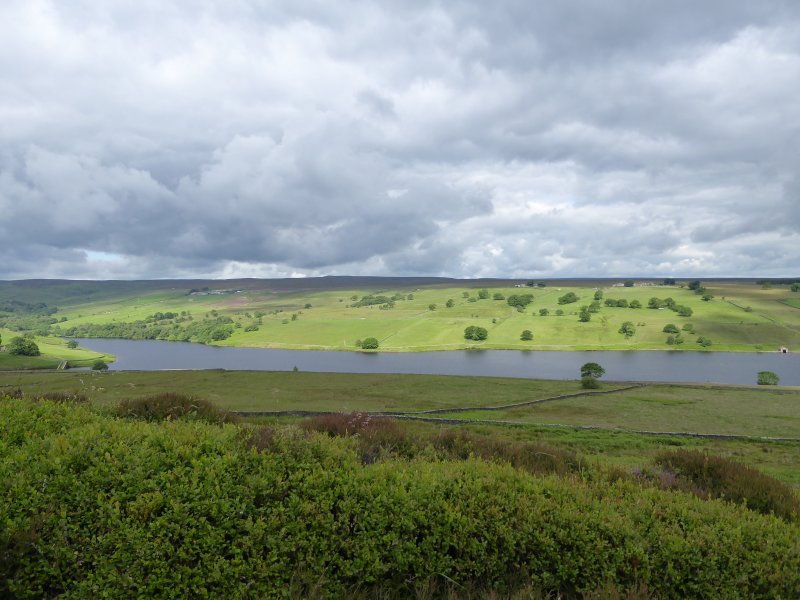
We went for a walk from Leighton Reservoir this week.  It’s in many ways a bleak, bare, sometimes boggy landscape, and this suited our mood in a bleak, bare post-Brexit week.  The view is softened at the edges by the rolling, green, stone wall-skirted Yorkshire Dales which lie beyond the heathery moors.

But look what we found as we consulted our Ordnance Survey map.  These were the places we passed, or could see at a distance:

  • Sourmire Moor
  • Gollinglith
  • Baldcar Head
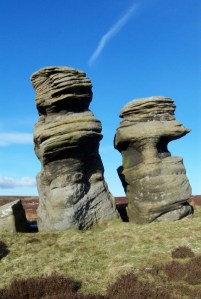
  • Jenny Twigg and her daughter Tib (Two natural stone stacks towering out of this boggy moorland landscape.  We didn’t get as near to them as we’d have liked this time)
  • Grewelthorpe Moor
  • Benjy Guide
  • Sievey Hill
  • Horse Helks
  • Cat Hole

    Jenny Twigg and her daughter Tib (Wikimedia Commons)
    Jenny Twigg and her daughter Tib (Wikimedia Commons)

Really, where else could we be but Yorkshire?

LeightonReservoirWalkJune2016 019


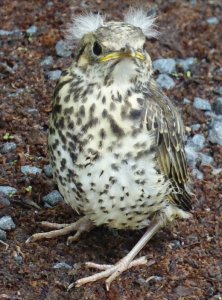
Postscript:  Just at the end we met this little chap, a just-fledged thrush.  We hope he (she?)’s ok, because he just about managed to fly rather stumblingly off to a safer place than the track where we spotted him.

LeightonReservoirWalkJune2016 033


Happy Now?

Nothing else seems to matter at the moment. It’s hard to focus on life outside the post-referendum nightmare, hard to believe that after securing only 52% of the vote (and just 72% of the electorate voted), leaving the EU seems to be universally accepted in the House of Commons – though not out here, not in the wider community I know. Like just about everyone I come across, I’m angry, upset and feeling pretty impotent. Then I read this. It pretty much sums up how I feel. Please read it.

katyboo1's avatarKatyboo1's Weblog

It is day four in the Big Brexit house.

I had hoped after Friday’s absolute catastrophe of a day that the country might somehow magically rally over the weekend. I mean, when you plunge your country into possible ruin on the promise of a golden future that will allow it to rise like a phoenix from the flames, you have a plan, right?

As it turns out, you don’t. The only person that seems to have any plan at all, and be acting on it rather than just spouting meaningless Churchillian rhetoric is Nicola Sturgeon, and I can’t even vote for her.

I was distraught and angry on Friday. I had hoped to feel better by today. Instead I am running on barely controlled rage and getting more enraged by the moment.

Here are a few things I am furious about:

Firstly, leave voters telling me to calm down. I’m sorry…

View original post 1,627 more words

In which Cie Carabosse sets Harrogate aflame

Thursday night was brilliant.  Brilliant in every way.  Apart from anything else, it was an evening of simple joy at being part of an evening’s festivities shared with equal pleasure among both friends and strangers.

The next day we woke up to a Brexit-dominated world, and simple joy has become rather hard to find.

We arrived at Harrogate’s Valley Gardens as dusk fell .  These gardens are among Harrogate’s treasures – 17 acres of lawns, of colourful flowers, of pinewoods, a small lake, of historic buildings such as the Sun Pavillion, all beautifully managed and greatly appreciated by locals and visitors alike.

Normally, by dusk, there’s only the odd dog-walker around.  Thursday was different – Friday and Saturday too.  We spotted  lines of flaming plantpots strung on simple metal frames.  There were smouldering lampshade-like creations. Then we found spherical braziers suspended from stands of mature trees..  There were eccentric bits of machinery, reminiscent of the work of Rowland Emmett, that played with the idea of juxtaposing showers and jets of water with flickering flames and occasional startling fireballs. There were quantities of men’s vests – yes, vests – re-purposed as lampshades suspended over the lake, which became, as darkness fell, an evermore magical and mysterious venue.

Cie Carabosse was in town.  They’re a French street theatre company whose specialist subject is fire in all its forms.  Its members are a playful band of people who aim to transform a space that may have long been familiar into … something else.  Dressed formally in black, rather in the manner of croque-morts (pall-bearers or undertakers),  they wandered round the park, illuminating braziers, attending to some of those hand-cranked machines.  We ambled round too.  Apart from a band of musicians playing atmospherically over in the back corner, there was no event, no ‘happening’.  Everyone enjoyed simply exploring at their own pace, visiting and revisiting this installation, that glade of fires, those vests down at the lakeside, savouring the atmosphere as dusk became black night, as fires grew, damped down, and blazed forth once more.

Cie Carabosse travel all over the world.  They’ll be in London in September as part of the commemoration of the Great Fire of London, 350 years ago.  They’ll be in Seoul, South Korea in October –  so maybe Emily could get to see them.  And they’ll be in the Ariège, in Foix, in December.  One way or another, I hope many of you will have the chance to have your evening set alight by Cie Carabosse before the year is out.

A walk with added history

This was a fine day for a walk, and a fine day to have a few history lessons thrown in

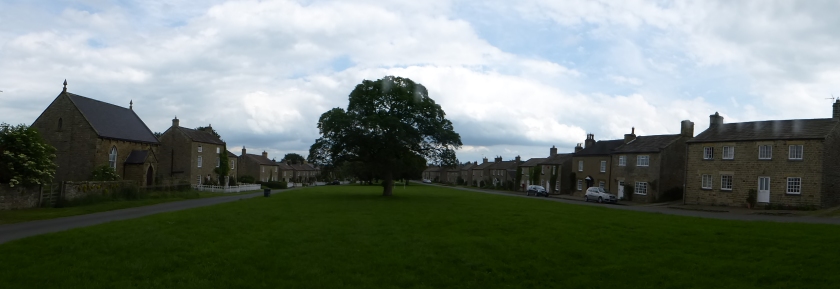
This is what we did.  Here’s our starting point at East Witton, about 15 miles from home. It’s a lovely small village of about 250 people, where most of the houses were built in the early 19th century round the extensive village green.

East Witton
East Witton

We passed through fields with views across the Dales.  We walked along a green lane, through woods, and eventually reached a wooded gorge through which the River Cover runs, and where we crossed over the charming stone bridge known as the Hullo Bridge.  It was quite a climb up the hill on the other side, and we were hoping for glimpses of Braithwaite Hall.  Too many trees in full leaf. We hardly glimpsed it.

It’s built on the site of a grange belonging to Jervaulx Abbey.  After the Dissolution of the Monasteries it continued as a sheep farm, as it had been under the monks.  This is an area where the monks of both Jervaulx and Fountains Abbey extended their influence widely: enormous numbers of sheepall over the region were managed from local granges where the lay brothers who cared for them lived.

The ruins of Middleham Castle.

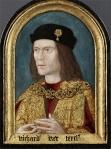
We were nearly in Middleham now.  This is above all a horsey town.  The monks of Jervaulx bred horses, and brought them to the Moor to exercise them.  When the monks eventually went, the horses remained, as did the training tradition .  Middleham these days is home to around 15 racehorse trainers and 500 horses, yet it’s a small town of hardly more than 820 people.  It was too late for us to see the horses out on the Gallops this morning, so instead the first thing we saw was the castle, which dates back to 1190 and was the stronghold of the powerful Neville family from the 14th century.  Richard Plantagenet, later Richard III was sent here as a young man to be trained in arms by Richard Neville, Earl of Warwick, his cousin.

The earliest known portrait of Richard III (Wikimedia Commons)

Warwick had the bad habit of changing sides throughout the Wars of the Roses (1455-1485) depending on whether the Yorkists or Lancastrians had the upper hand.  Eventually he came to a bad end when he was killed by the Yorkist King Edward IV and his younger brother Richard.  Edward gave Middleham Castle, and much else to Richard who lived there with his wife, virtually ruling the North of England, for 11 years.  When Edward died, Richard seized the throne and reigned for only 2 years before dying in August 1485 in the final battle of the Wars of the Roses, the Battle of Bosworth in Leicestershire.  And there his body remained for 517 years, before being exhumed from a car park in Leicester in 2012.

For us, Middleham was the site for a rather good picnic, followed by a visit to a teashop for an indifferent cup of tea, and even more indifferent cake.  But the calories were useful.  There were stiles to cross into fields deep in cut grass, waiting to dry off into hay:  a fine walled track Straight Lane – to walk along before reaching the River Cover, languidly passing over bleached white stones on its way to meet the River Ure.  We briefly touched the road once more as we passed Coverbridge Inn.  This dates from 1684, and was owned by the same family – the Towlers – till 1930.  Local legend has it that when the monks of Jervaulx were forced to disband in 1537 at the Dissolution of the Monasteries, they shared their secret recipe for Wensleydale cheese with the Towlers.  We shall never know.

A final walk along woodland paths, open farmland, fields enclosed by characterful drystone walling and we were back in East Witton.  A grand day.

The Greasy Spoon

As you travel Britain’s main roads, every few miles or so you’ll pass a convenient lay-by with a caravan, a shack, a portakabin – some less-than-permanent structure which has actually been there as long as anyone can remember.  Parked outside it are lorries, vans, cars – all empty, because their drivers are in the Greasy Spoon – that’s what these huts and caravans are affectionately called.

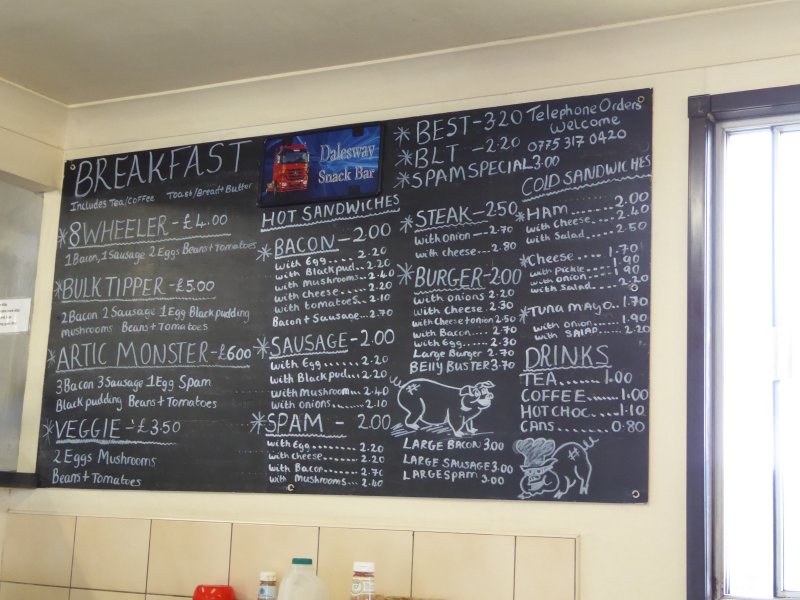
The unchanging menu at the greasy spoon.
The unchanging menu at the Greasy Spoon.

These truckers and travellers have gone in for an all-day breakfast.  The menu’s limited.  All that’s on offer are various combinations of bacon, sausage, eggs – with baked beans, grilled tomatoes, grilled mushrooms or bread on the side.  This is not Fine Dining.  The bread served here is not artisan-crafted from some small bakery using speciality organic stone-ground flour from the mill down the road.  It’s industrial strength pre-sliced pap.  I doubt if the pigs used for the sausages and bacon have truffled around in the woods looking for acorns, or been fed wholesome scraps from the farm. The baked beans come in catering-size cans.

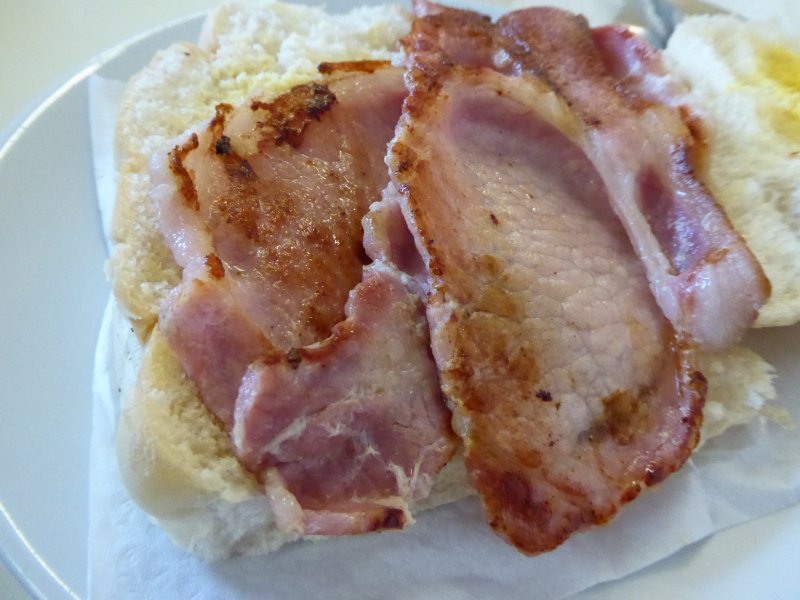
One bacon sarnie.
One bacon sarnie.

But we’ve got into the habit, when the boys stay with us, of having lunch at a particular greasy spoon near Skipton.  What it lacks in finesse it makes up for by offering a really friendly welcome and rock-bottom prices.  We make our order, plonk ourselves down at one of the formica tables, and relish a rib-sticking calorie-fest which will keep our stomachs lined for an afternoon of fresh air and fun at nearby Brimham Rocks.  It comes under the heading of ‘Naughty but Nice.’*

Here we are.  Open dining at the Dalesway caff.  Only it was way too cold.  Everyone was inside that day in the fuggy warmth.
Here’s Alex showing off the open dining area at the Dalesway caff. Only it was way too cold. Everyone was inside that day in the fuggy warmth.

*Salman Rushdie coined this advertising slogan for Fresh Cream Cakes when he was working as a copywriter back in the 1970s.  Warning: Don’t Google this phrase unless you are on the look-out for sex toys or ‘adult-themed materials’.  You have been warned.

Happy birthday, Ma’am

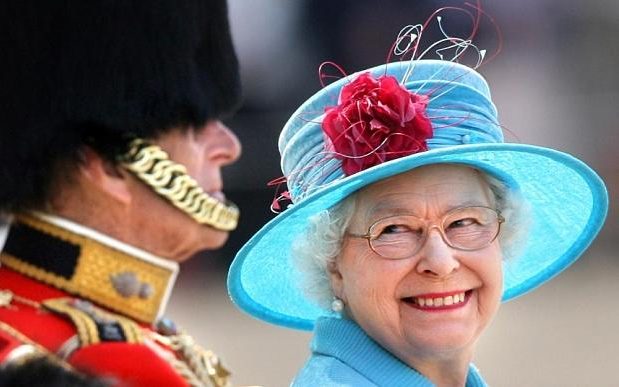
The Queen at the Trooping of the Colour (Daily Telegraph)

I’m neither a Royalist nor a Republican.  I’m pretty indifferent to the lives of the Royal family, though on balance I think they fulfil a useful role in society. Elected Presidents bring little in the way of colour and charm to the kinds of jobs – opening factories and presenting awards – which are their frequent lot.  I don’t begrudge them their large income, because nothing on earth would persuade me that their lives, constantly in the public gaze, are worth living.

Our indifference was a cause of constant bemusement to our French neighbours.  These devout Republicans knew more, via the likes of ‘Hello’ magazine, than I had ever thought to enquire about.  They were astonished that I did not have my finger on the pulse of life in ‘Buckingham’, that I knew little and cared less about Kate and her pregnancy – the Royal story of choice in our final weeks living in France.

But today, the Queen is in the news.  It’s her ‘Official’ birthday, her 90th.  British monarchs have all had two birthdays since the reign of George III in 1748, to enable them to enjoy any celebrations in the summer months.  And today, throughout Britain , communities have welcomed the excuse to get together and party.  The Queen is well liked and respected, the longest reigning monarch in British history, the world’s oldest monarch, and apparently still pretty sprightly and healthy.  That’s worth getting out the bunting, a few bottles of fizz and some home-baked cakes for, surely?

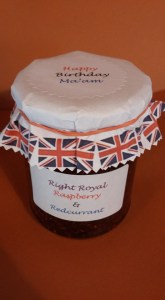
Here’s the Royal Jam prepared by my friend Jonet for their street party in Harrogate.

Jonet's loyal jam.
Jonet’s loyal jam.

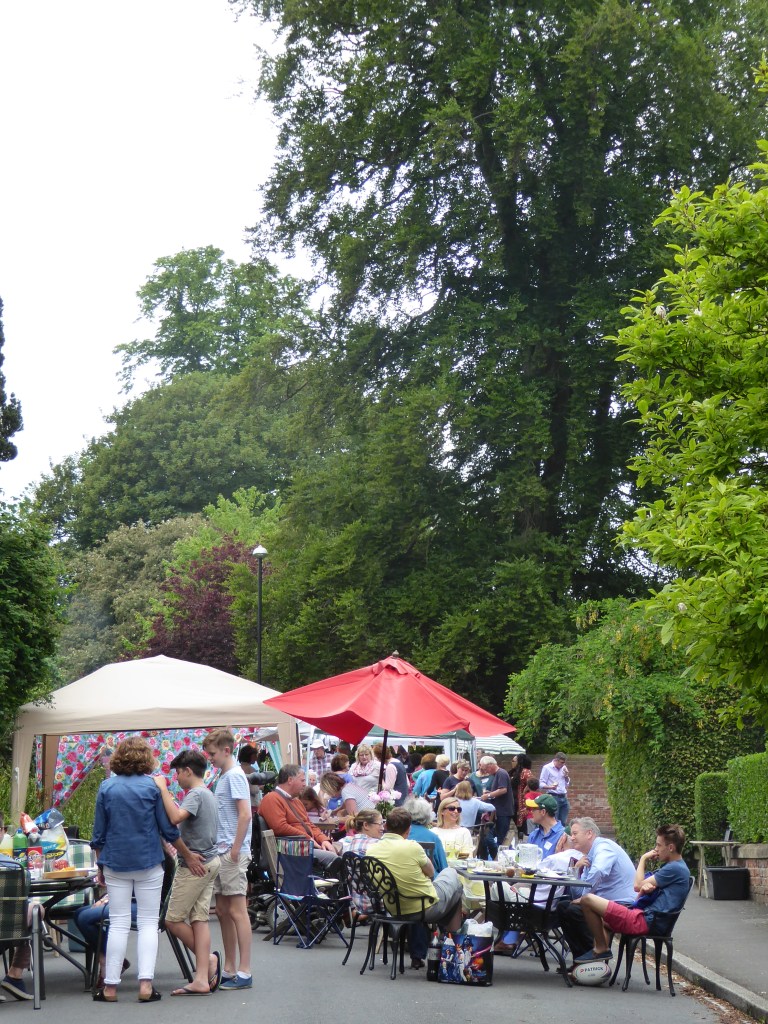
And here’s the party I went to in Ripon.  Three members of our choir live in this particular street, so we all went along and sang to everybody, and ate, and drank  and made merry, and admitted that the date of this particular knees-up had been fixed long before anyone realised it was HMQ’s birthday.

Street party in full swing.

Well, does it matter?  Any excuse for a party.  And since it was a thoroughly English party, the rain arrived, as predicted, at 3.30, just as everyone was being rounded up for rounders on the green.