From Siberia to Sweden

We’ve been back from South Korea for a week now.  We’re jogging back into routine, but the jet-lag won’t go away.  A week on then, I think I should share my final holiday snaps.

These are from the plane.  Much of our long, long eleven hour journey was above thick layers of cloud.  But when we could see down to the ground far below, we were thrilled.  We could barely comprehend the vastness of Siberia.  Mile after mile after mile after mile of forested mountains, dusted with snow.  How could it be that in all these endless miles we saw not a path, not a field, not a settlement?  How could anywhere be so …. uninhabited?

Eventually though, there were settlements.  Straight roads passed between towns that seemed to be all about industry and factories, with large rectangular fields beyond.

Then there was the Volga, immensely wide, lazily spilling itself over plains and valleys, dividing, re-forming, leaving sandy islands in its midst as it meandered northwards.

We travelled over a cottony carpet of white cloud for a very l-o-n-g time.  And emerged over islands round Sweden.  There were coastal villages, isolated farms, fishing boats.  We spied on communities whose ways of life looked as if  they had changed little over the years.   And then it was cloud again, all the way to England.

These are terrible photos.  They’re fine for me as souvenirs of a tantalising journey offering glimpses of lands I’ll never see, and that few others have seen either.  Except distantly, courtesy of a journey in a plane.


A tiger, a monk and his nearly-bride

WP_20161004_13_04_02_Pro_LI.jpgWhen hiking in Korea, it looks as if you need an objective. There and back to see how far it is won’t do.

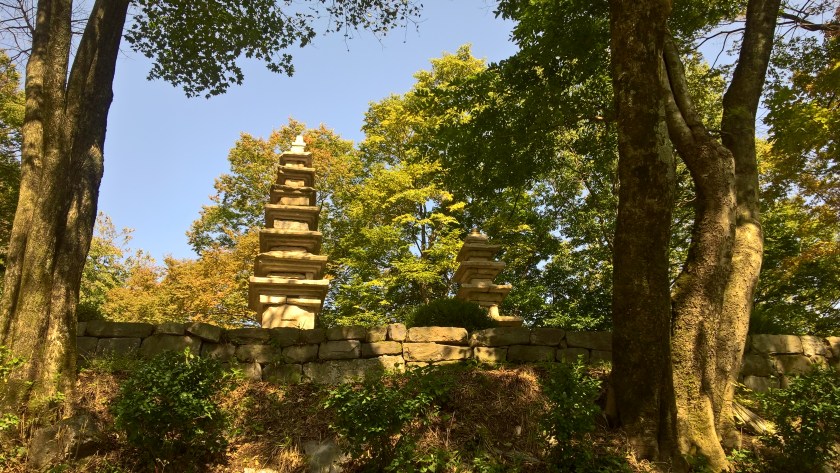
So yesterday we became Korean hikers for the day, and followed upward, ever upwards the path to Nammaetap, the Brother and Sister Pagodas.

This is the story. Back in the days of the Shillas, a monk living in a cave right here in the mountains found a tiger who appeared before him in agony, with a bone in his throat. Of course the monk helped him. Days later, the beast reappeared with a thank you offering. A beautiful girl. The girl said the tiger had snatched her away from her marriage ceremony. The monk sent her home, but too late. The wedding had been cancelled.

The pair agreed to live as brother and sister, and devoted their lives to the service of Buddha. They passed into Nirvana on the same day, and are remembered in these two pagodas, situated high above the temple at Donghak-sa. This is one of the few monasteries in Korea where you will find Buddhist nuns.

Even without the story to entice us upwards, this was a wonderful, tough walk through woodland, along streams, up a steep rocky path to views at the top from those two pagodas.

Blackpool Illuminations meet Gyeryongsan National Park

Here we are, out in the sticks, just outside the boundary of the Gyeryongsan National Park.

Only it turns out we’re not really in the sticks. Down the road are two villages. They mainly exist for tourists, and are edged by hotels.

Not walkers in woolly hats and fleeces though. Instead, visitors lounge around in one of the dozens of coffee bars. The walkers – and there are plenty – just use the public car parks and then yomp straight up a mountain.

This is the scene as the sun goes down. The hotels light up, and stay lit up till six the next morning. There are displays of coloured raindrops or flashing rainbows.

Blackpool illuminations, right here on the edge of Gyeryongsang National Park. Best stay in and shut the blinds.

Malcolm and Margaret’s Excellent Adventure.

We hated Jeonju on sight. High-rise hell. It got no better, so we cut and ran this morning, having booked the only place we could find in Gongju within our price range. Well, just outside Gongju, anyway …

KTX (High-speed train) to Gongju Station. It turned out not to be all that handy. The station’s 20 km.from town. And our hotel’s 30 km. away, in a different direction.

The woman from Tourist Information at the station had clearly had no custom all day. She took our problem to heart. She thought hard. The best she could come up with was a bus (journey time 1.20 minutes), due in a while, then a taxi.

The bus arrived. She ran out to talk to the driver. Success! He would take us beyond the terminus to the bus garage, and from there we could walk.

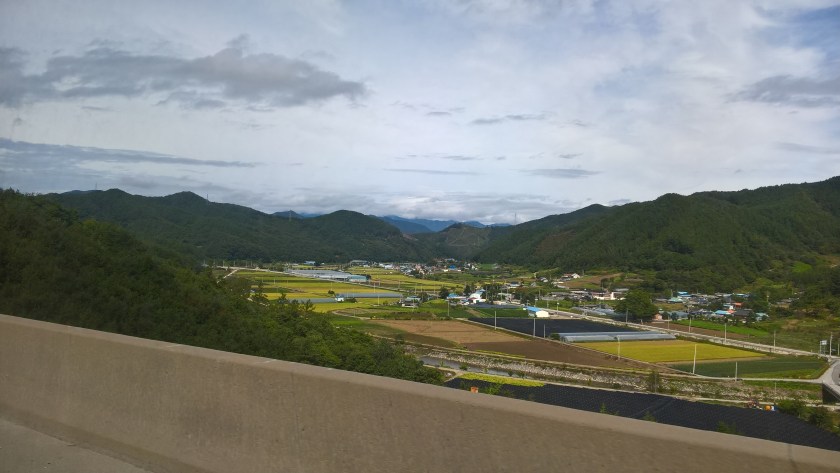
Our bus bumbled along country roads, climbing and climbing into the mountains of the Gyeryongsan National Park. It was beautiful, yet shabby, rather like the Ariège with added paddy fields. We were the only passengers, and entirely happy, looking out at scenes of Korean country life.

Suddenly, the driver stopped the bus. He indicated we should wait and dashed into a rural Police Station. Did he need a pee?

After five minutes, he reappeared, in the company of a police officer, and motioned us to dismount with our luggage. He was smiling cheerfully.

The PC had just a little English, and explained he’d take us to our hotel. And bundling our luggage into his patrol car, that’s exactly what he did.

So here we are, stuck in the mountains for our last three days. Do we feel stuck? Not at all. Our plans may have changed, but in a good way. We found a little restaurant for our evening meal and became quite the centre of attention. Koreans come here a lot for a bit of mountain air. The English? Not so much.

This could be just what we need.

Fast food

You’re busy in town. No time for a nice relaxing lunch. Not enough money anyway. What to do? Here in Korea, it’s easy.

You pop into your nearest mini-mart, perhaps a 7-Eleven. You buy a carton of noodles from the vast choice available – think pot noodles with dozens of flavours to choose between. You buy a mug of coffee that so far is simply a cardboard cup with a sachet included.

You pay. You collect chopsticks, and sit yourself down at a table to get organised. There’s the hot water dispenser. There’s the microwave. Get cooking. Relax! Enjoy your food, your drink. Sit down for a few minutes and count your change.

That lunch – and it wasn’t too bad at all – cost about £1.50.

Something old, something new.

Korea is a fascinating mix of the bang up-to-date and the resolutely traditional. I can only talk about what we’ve seen, but we’ve seen quite a bit.

In the land of Samsung, Hyundai and Kia, almost everyone is semi-permanently attached to their smartphone. Just take a metro journey and watch them all, immersed.

In this same country though, you’ll find dozens of little back street workshops where they’ll try and fix your failed toaster, or put a few stitches in your now just a little saggy bra.

On the one hand there are clever, highly qualified whizz-kids working away in their state-of-the-art studios. On the other there’s a little old lady squatting on the roadside with a handful of vegetables to sell, or an old man with a cart or bike amassing discarded cardboard.

On the one hand, there’s Starbucks, Dominos, MacDonald’s et al. On the other are little family food businesses feeding locals from tiny one room restaurants, street stalls, or places in the market. We all love the tasty traditional food they provide, but will they survive into the next generation? Who would want such a gruelling life for their child? The food sellers of today make sure their children are educated for different choices.

I could go on. High-rise living versus traditional hanok: those traditional homes, till recently the homes of the poorer classes are suddenly desirable again. Here in Gyeongju, new hanoks are going up, built of fine materials – quite state-of-the-art, right next to their shabbier antecedents.

I wonder how Korea will change its habits over the next generation or so?

A day with the Shillas

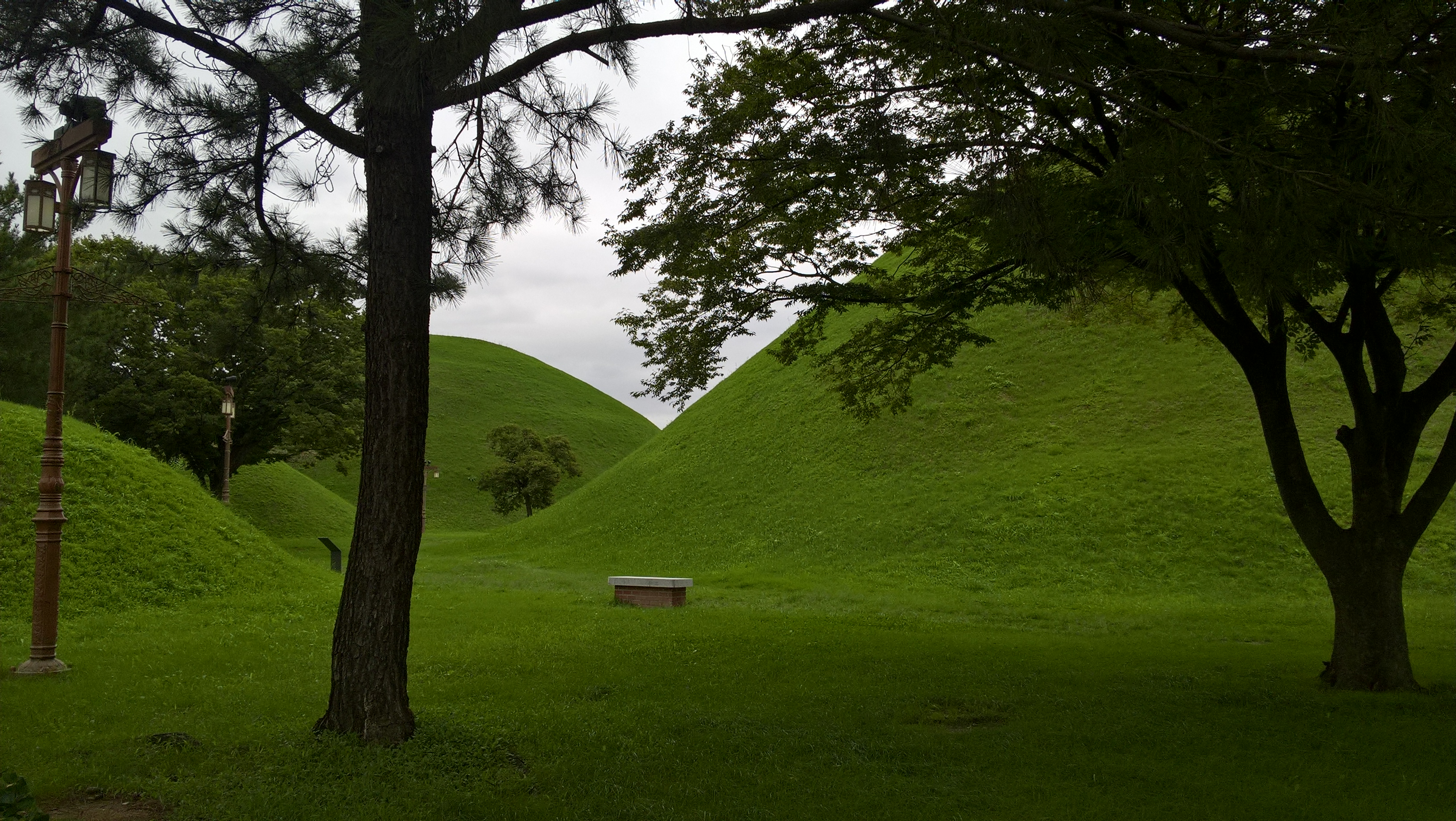
After yesterday’s exploration of what my friend Penny is pleased to call Teletubby land, otherwise known as the burial mounds of the Shilla dynasty, we wanted to know more.

We went to Gyeongju National Museum. We saw the most extraordinary Shilla artefacts, from the Neolithic era right through to the early 10th century, when the dynasty finally ran out of steam.

Such exquisite early tools and pottery. Then, when the Shillas recognised the need to bury their kings by equipping them for the next world, what exquisite jade and fine gold jewellery and ornaments.

How come we learn about the ancient Egyptians, but not about these sophisticated and forward-thinking people? It really is our loss. I want to know more.

The only pictures I’ve got to show at the moment are the gold accessories that a sixth century Shilla monarch would have worn in life, and taken with him to the after-life on his death.

The stimulus of tumuli

If I take just one thing from our visit to Gyeonju, it’ll be this.

The busy town is broken up by expanses of parkland. In these parks are tumuli – large grassy mounds. Some are fairly small, some are enormous. Each one is the burial place of a monarch from the long-enduring Shilla dynasty, which lasted from 57 BC to 935 AD, or one of their family. Like the Egyptian pyramids, these mounds contained fabulous treasures: we’ll go and see some tomorrow.

For us, these mounds are striking enough, even without sight of their treasures. I wonder why they’re so little known outside Korea?