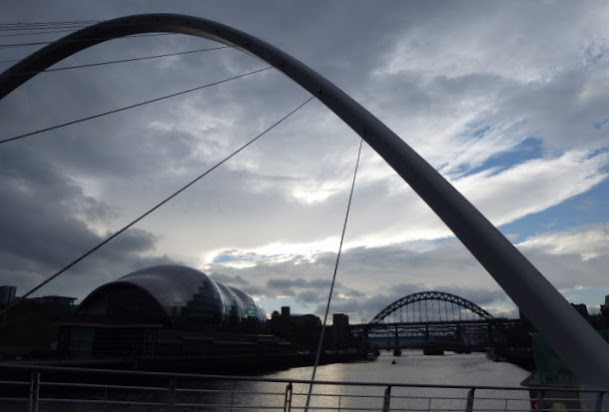
The Millennium Bridge, looking along the Tyne towards the Sage concert hall and the Tyne Bridge.
We were in Newcastle last weekend, and we spent much of our time admiring the fine buildings of the city centre, and mooching about the Quayside. That Millennium Bridge! What a perfect match for its surroundings. It links the proud Victorian architecture of Newcastle with contemporary work housed in the Baltic Centre just on the Gateshead bank of the River Tyne. Its clean soaring parabola provides a perfect complement to the more long established city bridges.
‘The bridges over the Tyne between Newcastle and Gateshead are justifiably famous. They are not merely bridges, but icons for the North East. Over the years the single (Georgian) bridge existing in the early Victorian period has been joined by six others. First the High Level Bridge, giving the river its first railway crossing, then the Swing Bridge (replacing the Georgian bridge), and the first Redheugh Bridge, replaced twice, to be followed by the King Edward Bridge and the most famous of them all, the new Tyne Bridge. After many decades came the Queen Elizabeth Metro Bridge and finally, in 2001, the Gateshead Millennium Bridge opened to provide a stunning pedestrian and cycle link between the redeveloped quaysides on either side of the river. In the space of less than a mile seven bridges link Newcastle with Gateshead.’
If you come for your holidays to Nidderdale in the Yorkshire Dales – and my goodness, I do recommend it – you’ll want to have an afternoon pottering around Pateley Bridge. It’s just won Britain’s Best Village High Street 2016 award.
Pateley Bridge High Street (geograph.co.uk via Wikimedia Commons)
And if you come to Pateley Bridge, you jolly well ought to visit Nidderdale Museum. Tucked behind the High Street near the Primary School and the Parish Church on the site of the former Workhouse, it’s a little treasure trove.
A photo in the museum collection of Pateley Bridge High Street in the very early twentieth century.
This little museum is entirely staffed by volunteers who cherish each donation and display as many as they possibly can in an engaging and informative way. You’ll punctuate your visit with delighted cries of ‘I remember that! My granny had one!’ Or ‘Oooh, I never knew the railway went there. I wonder where the station was?’. You’ll have an animated discussion with a fellow-visitor about being an ink-monitor at school, or about the mangle that was hauled out on washdays when you were a small child.
You’ll also see things that were not part of your own heritage, but which were an important part of Nidderdale’s past. You’ll discover that this pleasant rural area was once an industrial power-house, with textile workers by the score and lead mines dotted over the landscape. You’ll be reminded how very tough day-to-day life was on a Daleside small holding or farm.
Here’s a very quick tour:
We had a Ewbank carpet sweeper at home … and this splendid bed-warmer, simply heated by a light bulb … and a cream-maker.
A Ewbank carpet sweeper.
A 1960s Belling bed warmer. Known in our family as ‘the bomb’.
A 1960s cream maker (milk and butter required) with contemporary beakers.
We had inkwells like this at school, and I spent many painful hours in the company of copy books like these.
But look at this parlour:
I don’t quite remember a room like this.
And this wholly intact cobbler’s shop, transferred to the Museum in its entirety.
I definitely remember a cobbler’s shop like this.
And here’s a glimpse of life on the farm, before labour-saving machinery came along.
Tools both heavy and huge in use on the farm.
We’ll be going again and again. So much to see, to reminisce over, to learn from. This engaging museum is a treasure in its own right.
My visit was one of the perks of being a National Trust volunteer. Brimham Rocks is Fountains Abbey’s nearest neighbour, and staff there organised this trip – thank you! The museum is open at weekends until mid-March, then daily during summer months.
1592 was a terrible year for Korea. The Japanese invaded. They raged through the land destroying all they saw. They burnt ancient temples and state-of-the-art palaces as well as ordinary homes. Little was left.
Imagine an England in which every cultural icon was destroyed in WWII – Buckingham Palace, St. Paul’s Cathedral, York Minster, Salisbury Cathedral, Chatsworth….. that’s the kind of morale-destroying disaster Korea faced in 1592.
Rather than accept these losses, Koreans rolled up their sleeves and built everything again, on the same site, and to the same design. Not just once, but in some cases several times, as a consequence of later invasions and revolts. Unlike our own historic buildings, these structures are made not from stone or brick, but from the wood from monumental long-lived trees with statuesque trunks and mighty branches. These palaces and places of worship are carved to traditional patterns and painted in an accepted range of colours with time-honoured designs and images. To our eyes, these palaces and temples look fairly similar. But once we overheard a group talking – ‘Look, anyone can see that’s twelfth century: not a bit like the 15th century style we were looking at earlier’.
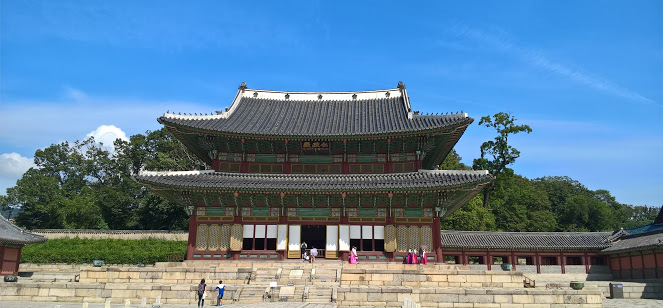
Here’s Seoul’s Changdeokgung Palace. It was first built in 1408 for the Joseon royal dynasty and designed with an extensive natural garden in harmony with the topography of its surroundings. The Japanese burnt it down in 1592. It was rebuilt in 1608, burnt down during a political revolt in 1628, and again by the Chinese Manchu-Qing. Each time it was faithfully restored to its original design. The long Japanese occupation of Korea from 1911 to 1945 saw it heavily damaged yet again: once again it’s been restored, though only about 30% of the original buildings remain.
Against the odds, this palace and its grounds together form a UNESCO World Heritage Site, recognised as a fine example of Far Eastern palace architecture and garden design in harmony with their natural setting. This is a fine and tranquil place.
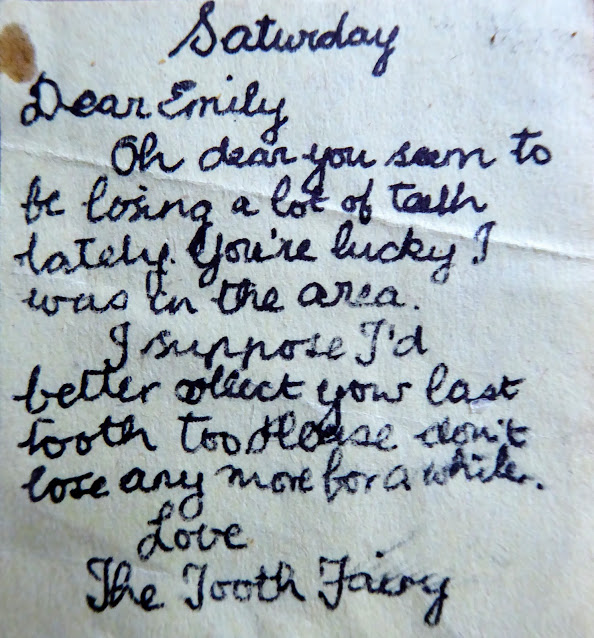
This is much larger than the original, which is about a quarter the size of a Post-it.
I was having A Bit Of A Sort Out the other day. This involved my sitting on the floor surrounded by miscellaneous memorabilia which mean nothing to anybody but me.
Here’s something I found. Back in the days when my children were losing their milk teeth on a regular basis, they expected to be visited in the night by the Tooth Fairy, who’d extract the little tooth from under their pillow and leave money in exchange.
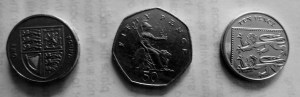
Which would you choose? £1.00? 50 pence? Or 10 pence?
This was a problem in itself. Some Tooth Fairies left £1.00. Others left 50 pence. Our tight-fisted old besom left 10 pence. This wasn’t surprising. My goodness she was tetchy. Every time she visited, she left a note written on some scrap of paper little larger than a postage stamp. She was always moaning. Either she had to come too often, or the tooth hadn’t been left handy enough, or the bedroom door was shut, or something. Nothing was ever good enough.
Underneath her crusty exterior however, she was good-hearted. The expected payment was always delivered.
Thirty years later, Daughter of Tooth Fairy started to visit my grandsons. The first time Ben received a cantankerous note from her, he burst into tears. Daughter of Tooth Fairy was summarily sacked. Will an ill-tempered sprite visit William one day, I wonder, or are fractious fairies no longer part of the Tooth Fairy Team?
It’s easy to feel like the only person out in the landscape. But you’ll have come with a friend or two, if only to haul you upright when, inevitably you fall deep into a drift of snow.
Back in France, in the Ariège, the very best way of getting out into virgin snow and becoming at one with a pure, glittering white winter landscape was take yourself off to the nearest mountain, strap on your snowshoes and walk through the fresh crisp air as if you were the only person in that particular bit of world. It was hard work though, and after the first hour, I’d had enough.
Three years on, and the memory of the pain, sweat and general exhaustion of the entire procedure has faded. I remember instead the vivid sunlit skies and startlingly white and unspoilt snow. And sometimes there were shadows: clear silhouettes mirroring, yet enhancing the world above the glistering mantle.
This week’s WordPress Photo challenge is ‘shadow’. The challenge is now issued on a Wednesday rather than a Friday. I think I’ll now usually respond on Saturday, not Sunday.
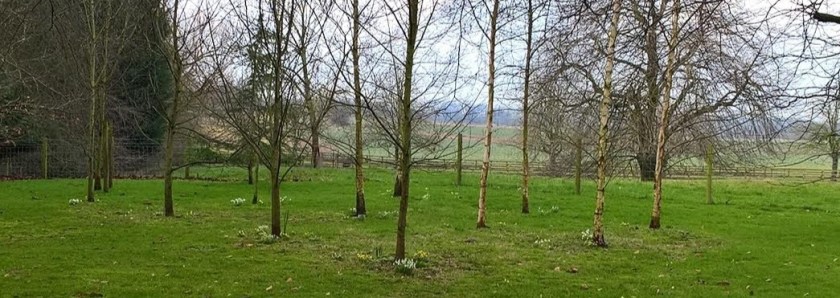
I was out for a convalescent constitutional this afternoon: William had passed A Bug onto me last week, and I’ve been a little delicate. I hadn’t taken my camera with me, only my phone, so these images aren’t the finest. But I don’t care. They’re evidence that spring is on the way. I wish you could hear, as I could, the birds singing as they do only when they too know that short winter days have passed. Yes, spring is springing.
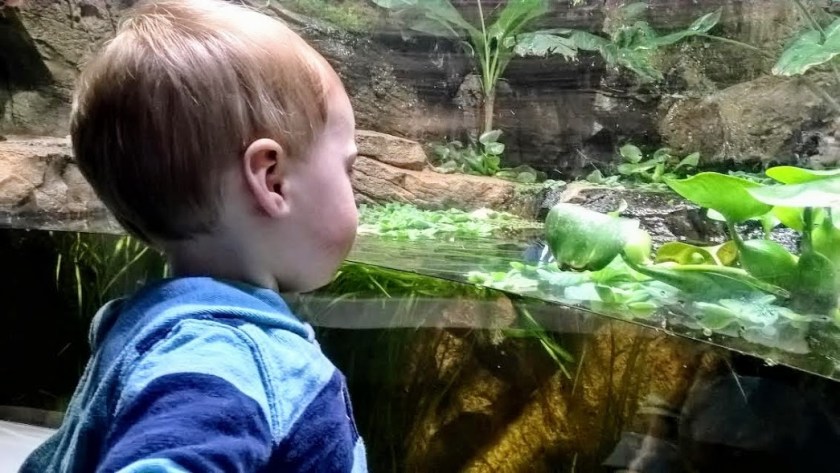
Ten thirty on a damp Wednesday morning. The Horniman Museum was just opening its doors as William and I arrived, and we stomped downstairs to the aquarium.
We were the first arrivals. Here’s William, wholly absorbed in fish, frog and butterfly hunting. This peaceful moment didn’t last long. Within minutes one, two, then three parties of Reception age school children stormed noisily in. The fish continued their solitary swishing round their watery home.
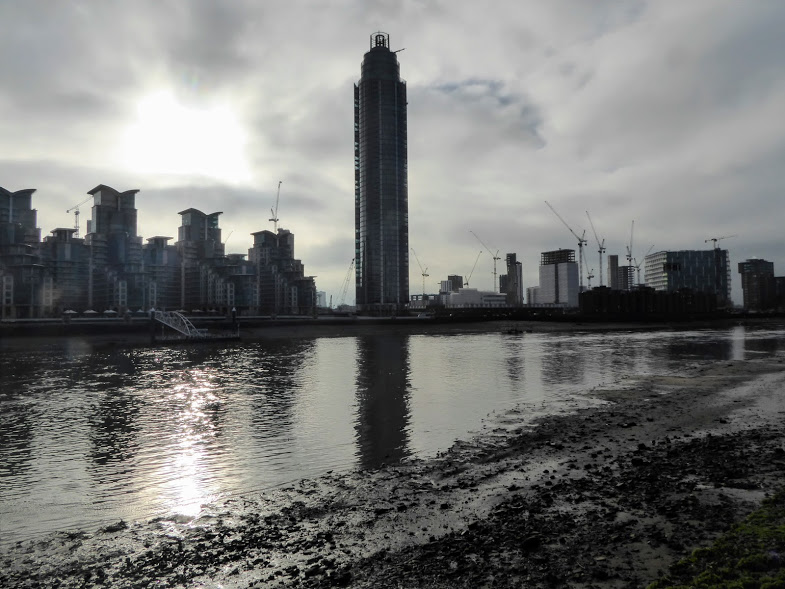
View of the Thames near Vauxhall Bridge and Tate Britain.
I was in London this week, and on Monday had a day all to myself. After a morning at the wonderful Paul Nash exhibition at the Tate Gallery, I mooched around the area where I grew up.
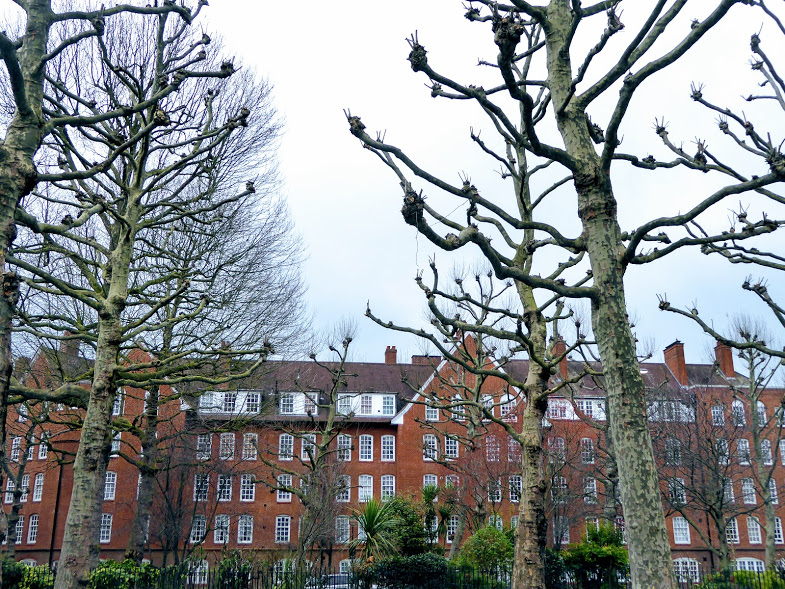
Here, just at the back of Tate Britain, is the Millbank Estate. There was a penitentiary here till 1890, and when it was cleared away, 17 blocks of flats were built as social housing between 1897 and 1902, housing 562 families. They must have seemed palaces to the former slum-dwellers who moved here. Each flat had its own kitchen and scullery, its own toilet. The streets were tree-lined, and there was a communal garden besides. Even now these barracks-like buildings have an air of quality, of being built to last. Sadly, many of these flats are now in the hands of private landlords, who charge their tenants up to four times more than those who are still in the social housing system have to pay.
Millbank Estate.
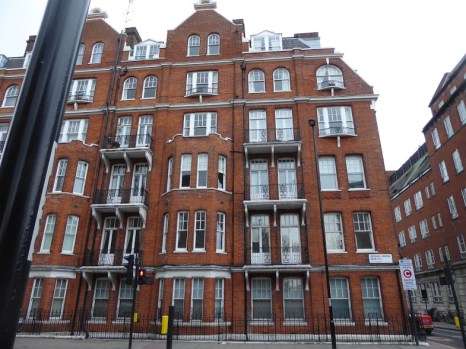
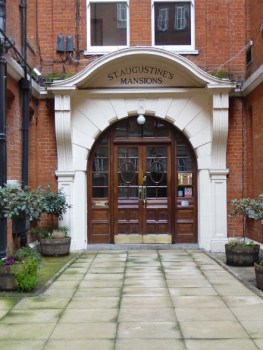
About five minutes walk away are the flats where I lived between about the ages of seven and fifteen, St. Augustine’s Mansions. Those of us who lived there were ordinary types. There was the little old Irish lady in the flat below; the man who worked at Manbre and Garton, the sugar refiners, who once a year would take us and his wife to the wharf-side where he worked to watch the Oxford and Cambridge boat race.
St. Augustine’s Mansions.
There was the Liberal Party activist, who was disappointed when my mother wouldn’t let me take the afternoon off school one day in 1958. Our activist friend hoped I would lay a wreath at the recently relocated monument to Emmeline and Christabel Pankhurst. My mother, an early beneficiary of education for girls, didn’t approve of suffragettes. But later, we’d often go to our friend’s flat on Saturday evenings to watch That Was The Week That Was. I was by then the only child in my class not to have a TV at home.
Entrance to St. Augustine’s Mansions. No handsome trees there then.
Briefly, before he made the comparative Big Time, a singer lived on the ground floor. Was it Billy Fury? I can’t remember.
These ordinary flats are now a gated community. Look on Zoopla, and you’ll find that the larger ones change hands at £1,500,000.
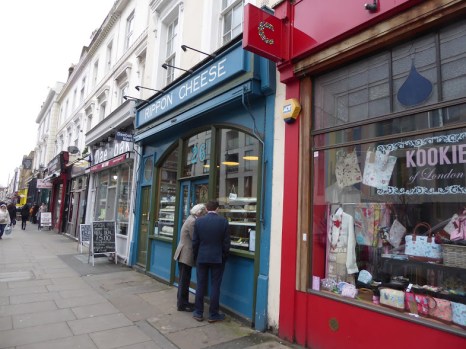
I wandered on to Tachbrook Street. Now, as then, there is a market. Then it sold everything you’d need in a weekly shop. Now it’s street food from every continent, sold to the large local working community at lunch time. I can recommend the sumac chicken from Lebanon.
Local shops sell fine cheeses, fine antiques, and the charity shops have goods with £200 price tags.
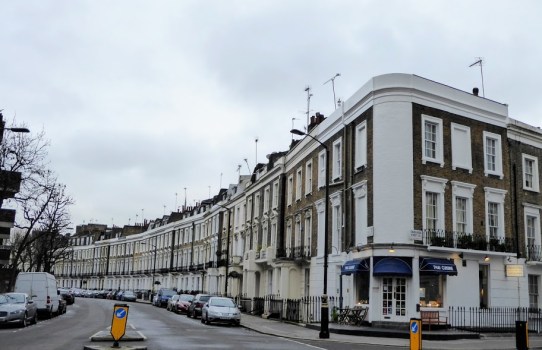
And here is a residential street. There won’t be any local working folk living in these handsome terraces any more. Zoopla again. £1,750,000.
A typical local street near Tachbrook Street.
It’s rather lucky that I neither want nor need to move back into the area.
This week’s WordPress photo challenge is ‘Repurpose’. We’re to submit an image of something of our own that we’ve put to a new use. I couldn’t come up with anything worth a snapshot, even though I’m rather keen on ‘repurposing’.
Instead, I want you to come with me to Thanjavur in Tamil Nadu. I was there almost ten years ago as part of my Indian Adventure. I loved this town. It’s not quite on the tourist trail, as its glorious and extravagantly carved temples remain unpainted. They are not vibrantly painted like those in nearby Madurai, so Madurai gets the foreign visitors.
I stayed* with a young American academic, Gwen, who for seven years had made Thanjavur her home. She whisked me about on her motor bike, introduced me to her Indian friends and neighbours, asked me to run errands for her in the market where nobody spoke English or saw tourists much, and took me to tiny back street shops to buy freshly prepared and sizzling-hot evening meals.
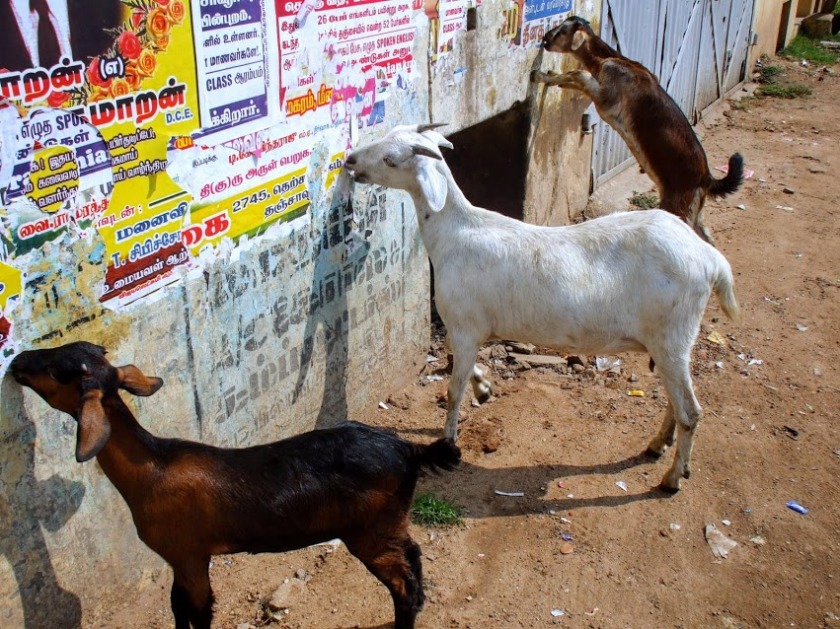
I was by myself though, when early one morning I came upon these goats. They’d found a new use for the adverts pasted on the walls of a house. Look.
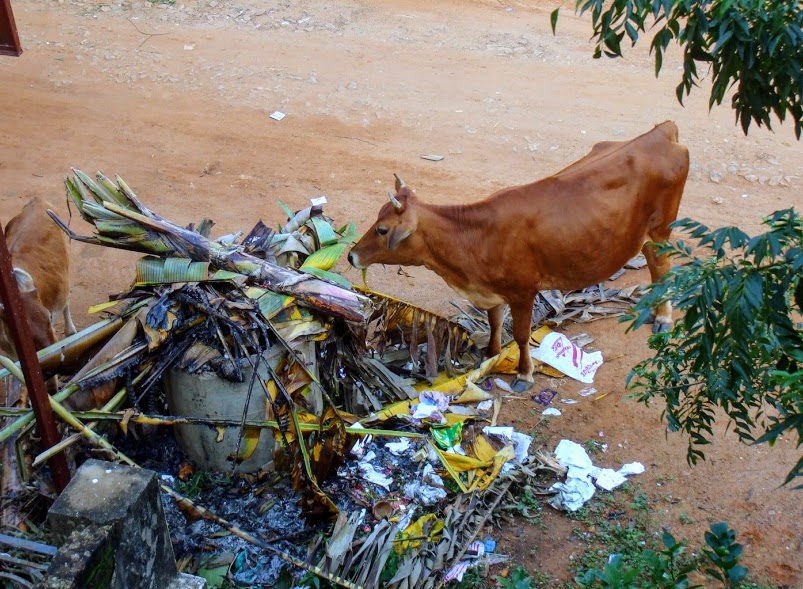
And here’s the cow that was tethered outside Gwen’s window. It’s found an unfortunate use for the pile of rubbish tumbled into a pile on the corner.
View from Gwen’s window
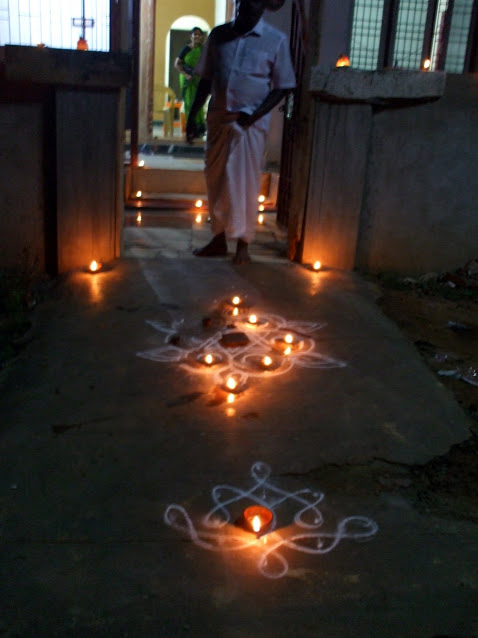
Finally, here’s a different use for a pavement. It’s become a canvas for traditional drawings in fine sand. These designs frame the lights which lit our path homewards every evening during Diwali, the Hindu Festival of Light.
And here are three picture postcards – temple views.
Thanjavur: Breehadeeswara Temple.
Temple elephant, Thanjavur
Thanjavur: Periya Kovil Temple
* via ‘Couchsurfing’, a scheme which matches travellers with locals, who offer beds, local knowledge and friendship.
We’ll all remember 20th January 2017, the day Donald Trump took his oath as President of the United States. No comment.
The 20th January was special within our family too. It was the day my son Thomas celebrated his 40th birthday. Really? How did that happen? Is it forty years since my son kicked and chortled in his pram, his simple world revolving round milk, sleep, fluffy nappies (no disposables then) and besotted parents? Now he’s a besotted parent in his turn. And nobody much remembers that it’s forty years since Jimmy Carter became President of the United States.
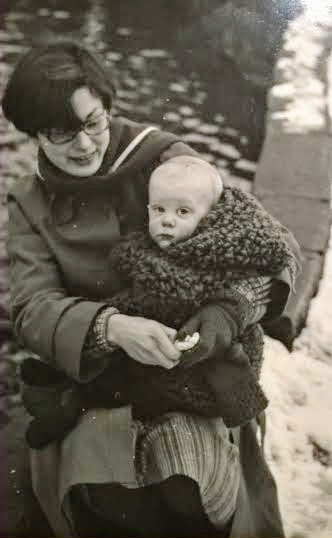
Thomas is no longer newborn here. All those colour photos got so faded. But here he is, nearly a whole year old in his splendid woolly bear coat that I crocheted for him- all by myself.
Unexpectedly, 20th January turned out to be even more special for our family. It was the day that my daughter Elinor, having seen off her husband to cancer nine months ago; having been diagnosed as a cancer sufferer only four months after that; having had one operation that failed to dig it all out; and having had a mastectomy only the week before last was declared cancer free. She’s got preventative chemotherapy and radiotherapy to face still, and breast reconstruction. But she’ll be fine. And that was more than we dared to hope only a few weeks ago.
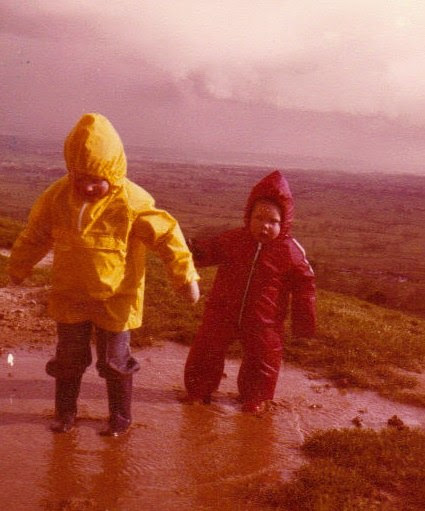
Thomas and Elinor explore Glastonbury Tor, getting on for forty years ago
This makes 20th January a Red Letter Day for this family. Even Donald Trump can’t take that away from us.
Donald Trump was inaugurated in Washington DC. Thomas was born in Wakefield, Yorkshire. Elinor lives in Bolton, Greater Manchester.











 From Pyrenees to Pennines
You must be logged in to post a comment.