O Level Geography for walkers

This time 54 years ago – more or less – I was sitting my O Level in Geography. Among other things, we studied the economic geography of England, interpreting Ordnance Survey maps, and a little elementary geology.
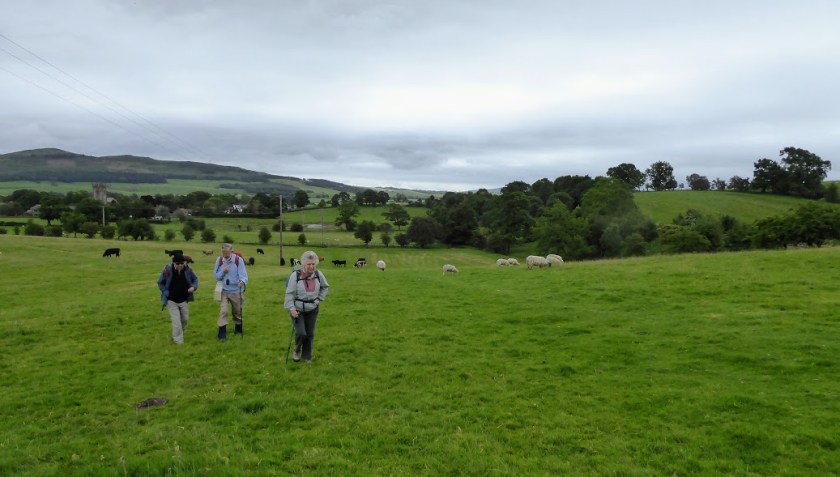
The Pennine Way near Gargrave.

Our walk the other day would have made an excellent field trip.  We were over in West Yorkshire, and our route from Gargrave took in sections of the Pennine Way, and quite a stretch of the Leeds and Liverpool canal.
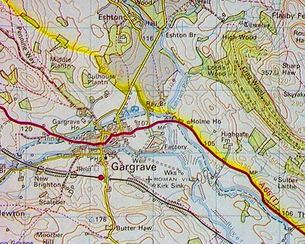
A section of an OS map showing the area round Gargrave (from the BBC website).

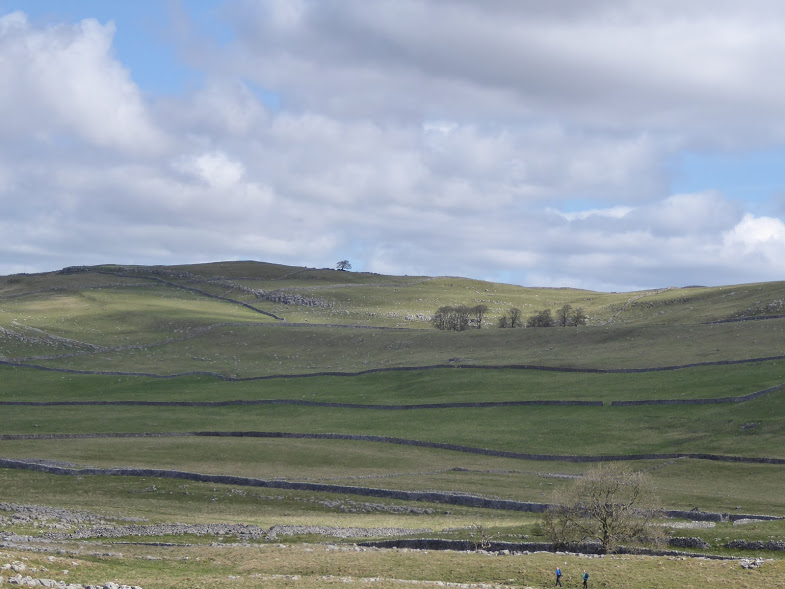
Map-reading wasn’t our problem, because John and Pat were competently leading us onwards.  The hills weren’t a problem, because the slopes were relatively gentle.  They were the drumlins which are a feature of the area.
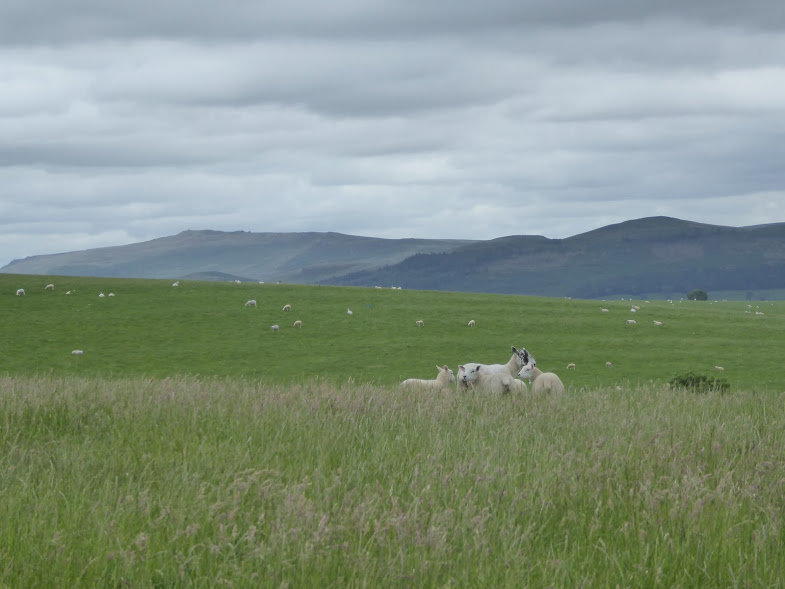
We’re walking over drumlins. The Pennines are over there in the distance.

O Level question: What are drumlins?  Drumlins are elongated hills of glacial deposits. They can be 1 km long and 500 metres wide, often occurring in groups. They would have been part of the debris that was carried along and then accumulated under an ancient glacier. The long axis of the drumlin indicates the direction in which the glacier was moving. The drumlin would have been deposited when the glacier became overloaded with sediment.
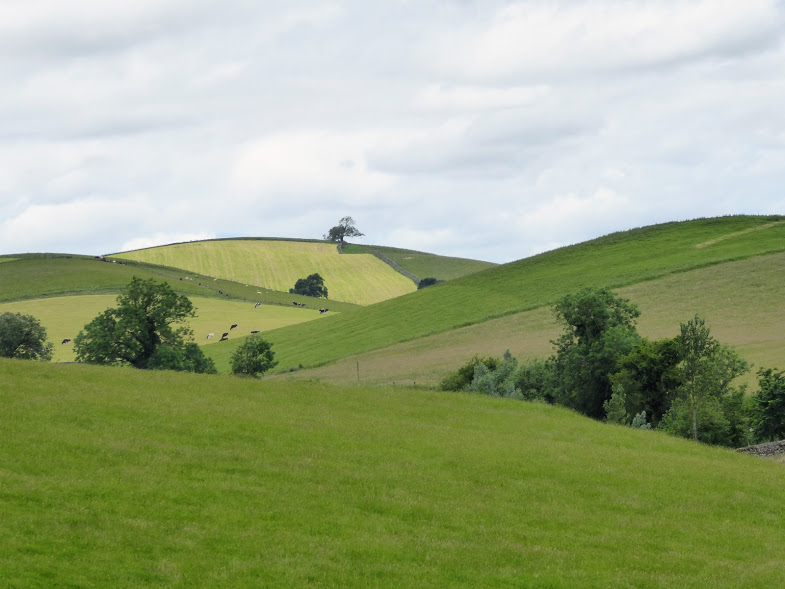
Here are drumlins. Drumlins as farmland.

We walked through fields of cows, fields of sheep, and through woodland, emerging at lunchtime on the banks of the Leeds and Liverpool Canal.

O Level question: What is the Leeds and Liverpool Canal, and why was it built?  The Leeds and Liverpool Canal is a canal in Northern England, linking the cities of Leeds and Liverpool. Over a distance of 127 miles, it crosses the Pennines, and includes 91 locks on the main line.  It was built from 1770, and allowed  textiles to be sent from the woollen towns of Yorkshire for export from Liverpool.  Liverpool also required coal to fuel its manufacturing and shipping industries.
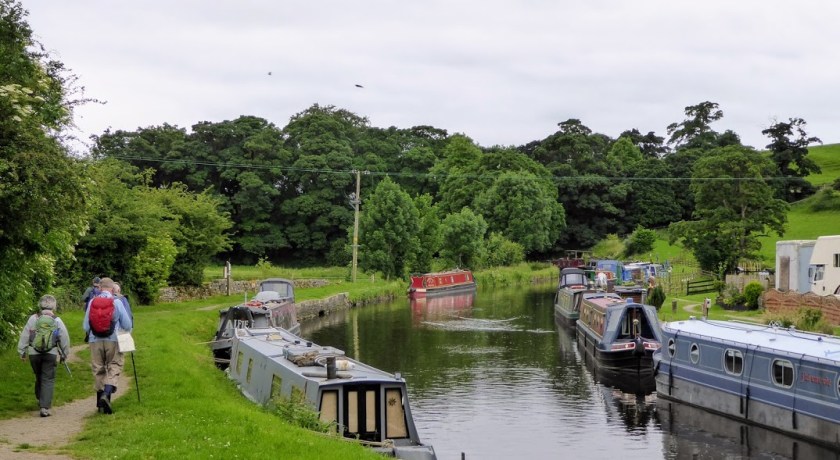
Our first view of the Leeds and Liverpool canal at East Marton.

What an industrial thoroughfare it was then.  Busy, dirty barges and narrow boats piled with goods moved between Yorkshire and Lancashire, where now there are only bucolic scenes and holidaymakers enjoying tranquil holidays slowly wending their way along the canal.

We watched as boats rose or descended through one, two, three, four, five, six locks to reach a different level of the canal.  We marvelled at a section of our route along the canal towpath.  We, and the canal itself, were travelling along a viaduct, and far below us were fields and a river.  I couldn’t organise photographic proof. Soon after, we were back in Gargrave.

So there we have it.  If only I’d done that walk when I was 16.  I would hardly have had to do any geography revision at all.
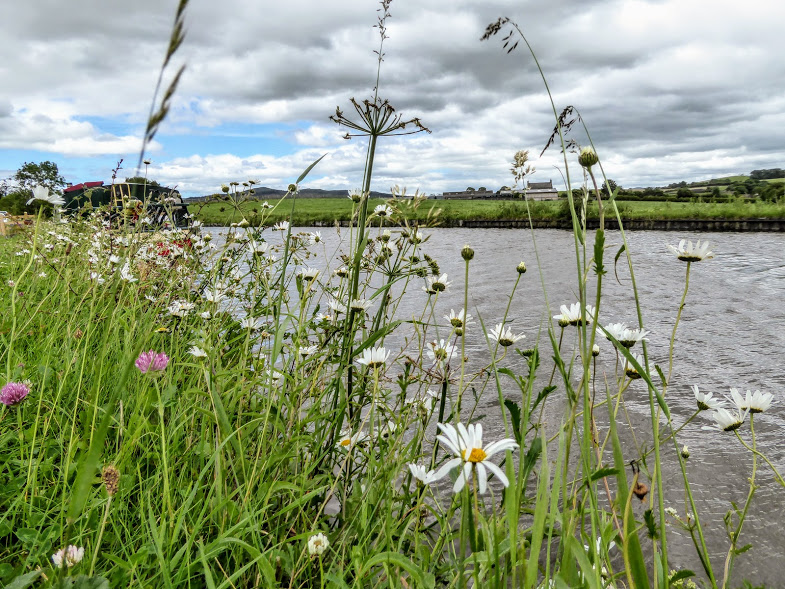
The canal towpath. No longer a scene of industry and commerce.

Snapshot Saturday: One walk, one footpath, one – no eight – skies

It was the summer solstice this week.  It was also, for three days only in the north of England, summer.

So let me whisk you back eighteen months, to a crisp and clear January day when I took myself off to walk for a couple of hours or so, looking upwards rather than at my surroundings.  Skyscape succeeded skyscape. These changing skies perfectly illustrate this week’s WordPress Photo Challenge: transient.

‘Beside the seaside, beside the sea’

Sun, sea, sand.  The basic requirements for a day at the seaside, if you’re nearly two, or even a bit older.

On Monday, I was in London, i/c William.  But at the last moment, Tom got an unexpected day off.  The sun was shining – and how- and London was hot and sticky.  So we packed buckets and spades, towels, sun cream and sunhats …. and set off for Whitstable.

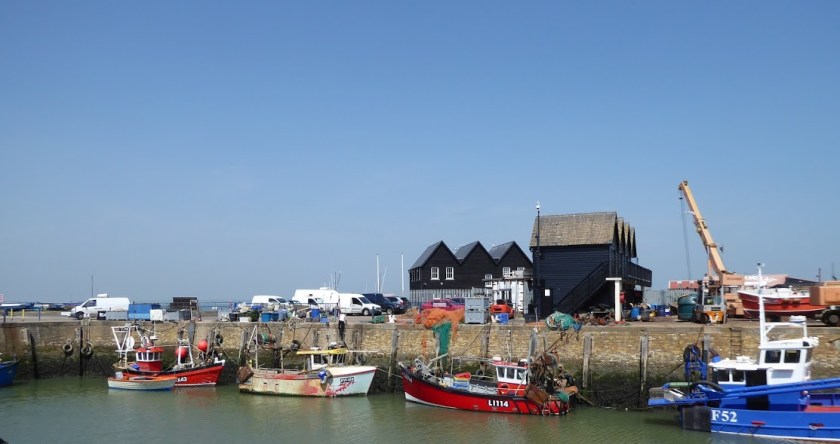
Whitstable: still a busy little fishing port.

It’s a picturesque little town with a harbour, fishing boats and a reputation since Roman times for having jolly fine oysters. It had sun.  It had sea. What it turned out not to have was sand.  Here is the beach.

The beach at Whitstable.

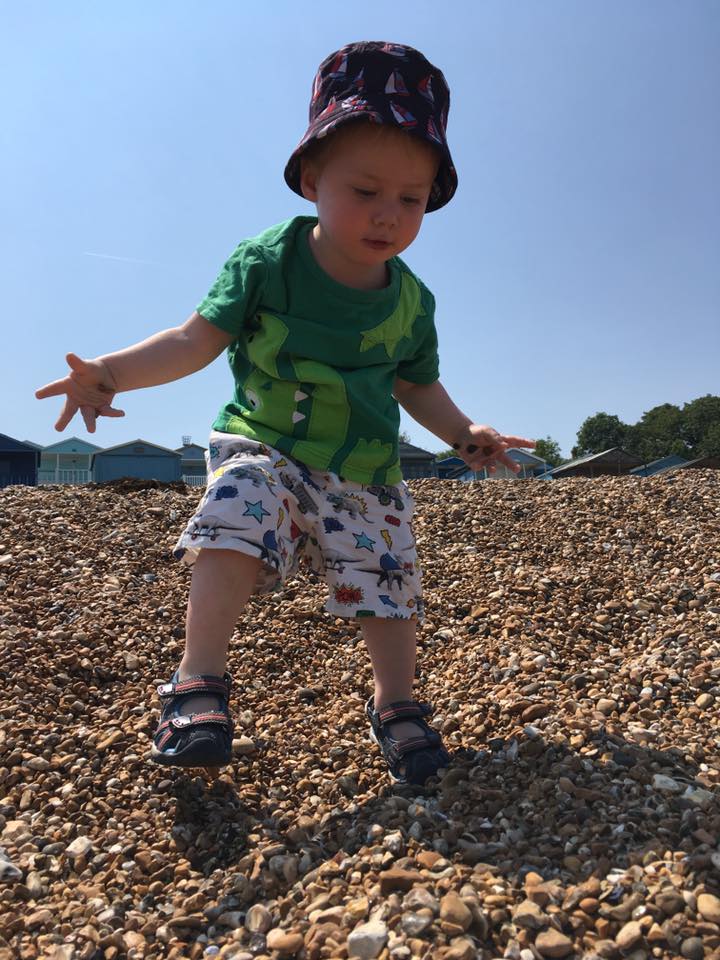
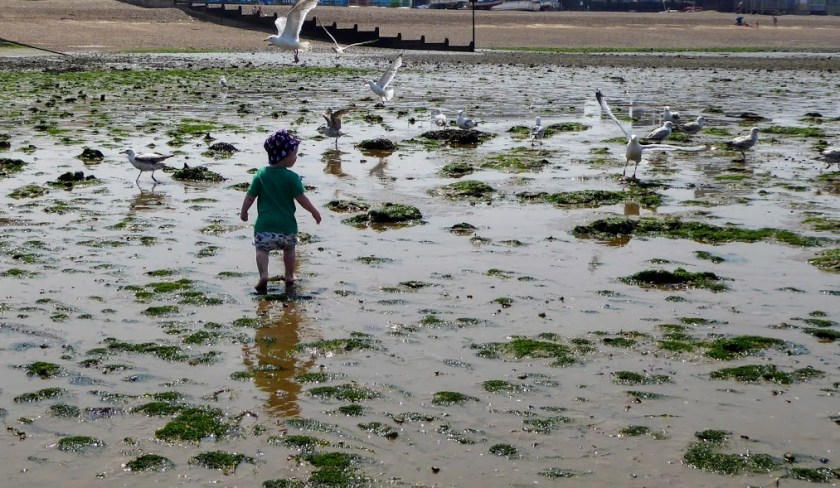
William didn’t mind.  Stones are fun.  Paddling’s fun, even when the stones beneath are jagged and a bit uncomfortable.  Chasing seagulls is fun.  Looking for crabs and tiny fish is fun.

William’s quite happy with stones – Tom took this photo.

We took a break for lunch.  Miraculously, the tide had gone out and a sandy shore line had appeared.  More paddling, this time rather more comfortable.  More fish, crab and seagull hunting.

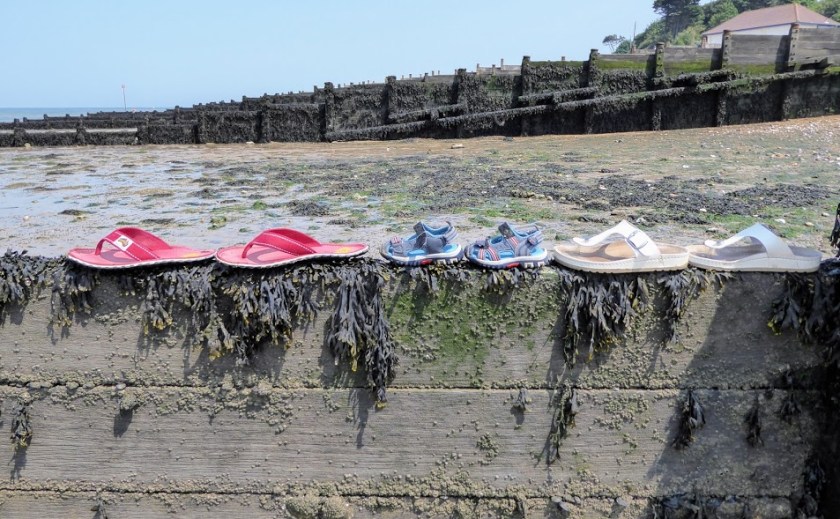
It was sandy enough at low tide for us all to discard our sandals.
Chasing seagulls is fun.

Then we went home.  Guess who went to sleep in the car?


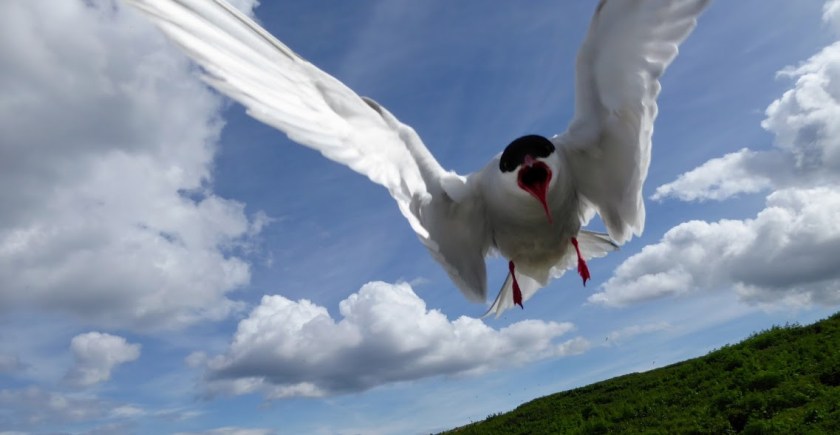
Snapshot Saturday: My focus – an Arctic tern: its focus? Me.

In my mind, I’m still on the Farne Islands.

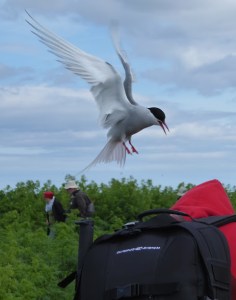
This Arctic tern is directing its focus on me: am I a threat to her (his?) young?

I’m directing my focus on it.  Will it make a good picture?

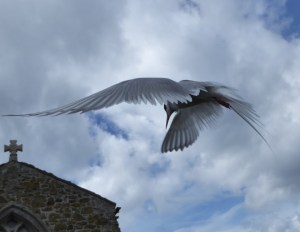
It’s all so quick.  My shot’s a bit out of focus, and the wings are partly out of shot. But the clouds make a pretty decent frame.

So this might work for this week’s WordPress photo challenge: Focus.

In which I am attacked by a tern, charmed by some puffins, and visit a nursery.

Tuesday.  A trip round the Farne Islands.

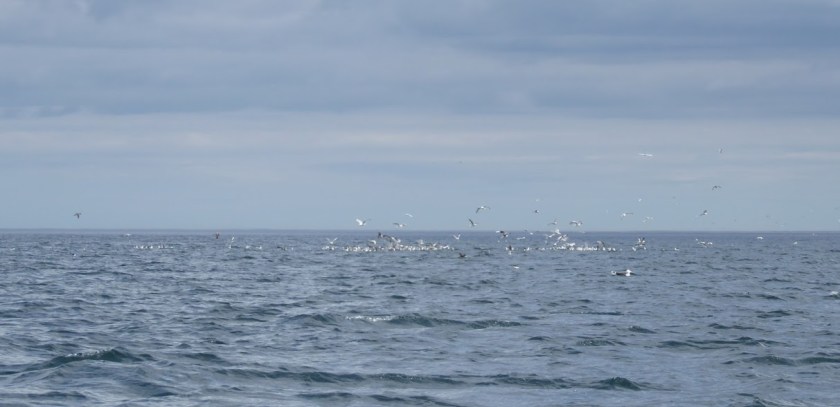
Following the fish, birds feeding off the Farne Islands.

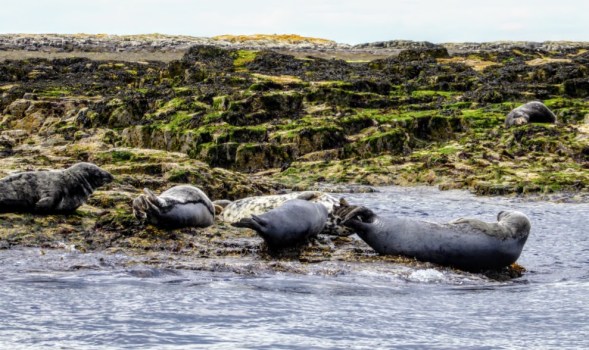
Here’s our journey, courtesy of Billy Shiel’s boat.  We pass one of the most densely populated housing estates in Europe – but despite having to jostle for a tiny space to call home, this community is not socially well-integrated .  Kittiwakes don’t live with puffins.  Cormorants won’t talk to guillemots.  Grey seals loll indolently beneath the cliffs, doing as little as possible till hunger forces them into the sea to hunt.  The stench is intolerable.


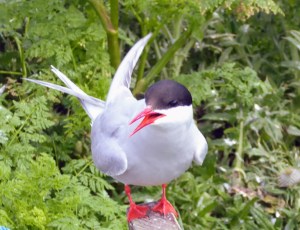
We land on Inner Farne, taking our hats as per instructions.  This is why.  Arctic terns nest all over the island and they have young to protect.  We are the enemy, as they make clear, as they hurtle towards us, piercing our hats and hands with their dagger-like beaks.  I nurse a war-wound on my finger.

A wary arctic tern .
Ready to attack.
Preparing to strike.
Warning me off.

We decide puffins are less bellicose.  They waddle about among the undergrowth, occasionally pottering down into their burrows.


Then it’s time to explore further.  The cliffs are cordoned off, but there, immediately  beyond the fencing are birds in their hundreds, caring for their young.  They’re close enough to touch.  We don’t though.  Being so close we can see every detail of their (usually ramshackle) nests, their plumage, the young unfledged birds, and this is privilege enough.


With thanks to Maureen and Andrew for organising this trip for volunteers at NT Fountains Abbey and Studley Royal, and to the volunteer rangers at NT Farne Islands for managing this special place, despite irreparable damage to their hats.

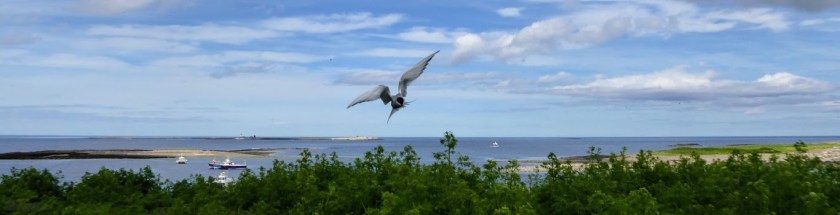
An arctic tern above Inner Farne.

Snapshot Saturday: Keeping the sheep in order

Near Appletreewick (pronounced ‘Aptrick’ locally)

Yorkshire has over 8000 km. of drystone walls.

Constructing these walls is an ancient art which seems in no danger of dying out: younger generations continue to learn the skills needed. Large stones are carefully jigsawed together into 5′ to 7′ high walls.  Here are some instructions:

‘Gather and sort the stone by size in a type that complements and harmonises with the landscape such as limestone, grit stone or sandstone. Make foundations level and about a yard wide. Large stones go at the bottom butting against each other. All other stones must make contact with others and have the weight back into the wall and the face facing.  With each layer of stone fill in void spaces with smaller stones to ‘bind’ the wall. The wall should taper like a flat topped ‘ A’,  this slope is called the batter. ‘Throughs’ are the large heavy stones laid across the wall at intervals for extra strength. Topping stones as the name suggests are the icing on the cake also called coping, cap or comb stonesCheeks or Heads are the end stones. A Cripple hole is a rectangular opening at the base of a wall built to permit the passage of sheep. Also known as a hogg hole, lonky or lunky hole, sheep run, sheep smoose, smout hole, thawl or thirl hole. Smoot hole is to allow Rabbits and Hare to move through or even small streams.’

(From Yorkshire: God’s Own County)


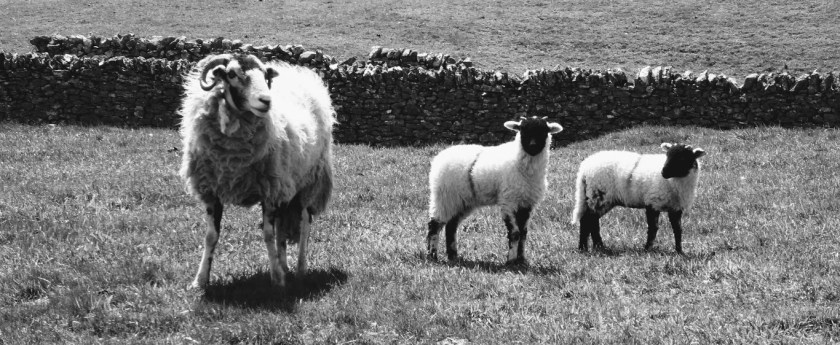
I love these ancient technical terms.  I love the order these walls impose upon the landscape, as they perform their traditional task of dividing fields, and keeping sheep in their place.

Drystone walls marching across the landscape near Grassington.

This week’s WordPress photo challenge is ‘Order’.

Election Day Special

A few months ago, I joined a writing group, a U3A (University of the Third Age) writing group.  It’s turned out to be the best fun.  We’re quite a mixed bunch.  Most of the group write fiction, and a couple have novels on the go.  I don’t.  Paul can turn out a haiku at a moment’s notice, and John’s turning his life story into a hefty memoir.

Imaginative and inventive, Sheila leads us in a range of exercises that are both fun and challenging.  Who know that a discarded shopping list in a supermarket trolley could take our minds in such different directions?

At the beginning of every session, we write.  Just write, maybe using prompts Sheila has devised.  This is what Paul came up with the other week.  What better day to give it a wider audience than UK Election Day 2017?

(Wikimedia Commons, from geograph.org.uk  Walter Baxter)

Dear politician

How deep your pockets?

Empty, though, of words

But filled with promises unfulfilled

And crammed with oily silver

Slipped there from your greasy palm.

And

Who do you have in your pocket, politician?

Surely a hedge-fund manager

And a city banker or two?

Maybe some chums from school;

An expense claim form?

For fake responsibilities

Carried out in fake locations

By numerous fake relations?

Tomorrow’s speech there too?

To massage the masses,

Written in a back room

By the spinners of dreams for the working classes?

I wonder if, at the very bottom of this cache,

Remains, from your possibly innocent youth,

A nugget, a trace, a sliver of the truth?

Paul Finch

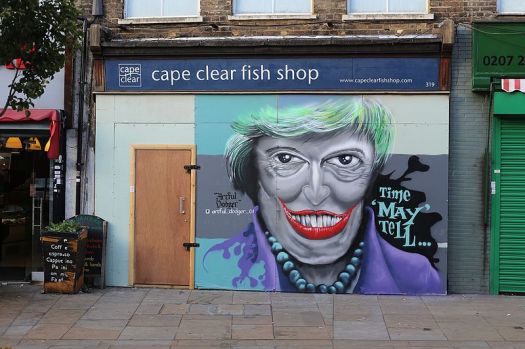
On a shop in Herne Hill, 2016 (Wikimedia Commons, JWS Lubbock).  No prizes for guessing who I’m not voting for.

Happy Birthday, Dear Chemo.

I’ve found this most recent post from my daughter the hardest of all to read, because we’ve seen at first hand the boys’ anger and fear over their mother’s cancer. I doubt if I could have found it in me to reblog her thoughts if we hadn’t been in Bolton this last weekend.

We were there because Ellie wanted to be at her annual professional conference overnight. Voice overs work in the main alone, so theirs is less a conference more a knees-up and a chance to bond. Her colleagues have been unendingly supportive and helpful since Phil’s death, and she spent the weekend being hugged and loved.

Meanwhile, back at the ranch, the boys were doing their own thing. Twin Number One got invited for a sleepover. Twin Number Two wasn’t, but elected to come shopping and bake a cake with me instead. Then he too found himself off playing footie with his mates and being invited to spend the night at a friend’s house.

Suddenly, we were only babysitting the dog, who required a long, energetic and healthy walk on Sunday.

Perhaps it’s the light at the end of the tunnel. Ellie was happy. She had a much needed break. The twins were happy. They had time away from each other, and they could see their mum was OK.

It’s chemotherapy again on Wednesday. But it’s the LAST ONE. However bad it might be, it’s THE LAST ONE. Then there’s radiotherapy, which will tire her out. But that’s the LAST TREATMENT. She’s booked a family holiday for August. Perhaps they can dare to hope that this is the year when cancer finally pushes off and leaves them alone.

Fanny the Champion of the World's avatarFanny the Champion of the World

My relentless positivity is waning. The dark thoughts are setting in, and becoming far harder to shake off than the last few eyelashes which have long been sobbed into a snotty tissue. I have two children who miss their father, but I miss him too, and if it weren’t for them, perhaps I wouldn’t have bothered to fight this at all. In fact, I think I resent the fact that I can’t just say fuck it and join him, wherever he is. Because I do have his beloved children, though, and no family nearby to bring them up, I don’t have a choice. But, Christ, it’s hard – especially when the two children you’re doing it for are not helping you to row upstream, but are standing on the riverbank, chucking rocks at you as you try to do it alone.

They’re eleven. Nearly twelve. And they’re about as much…

View original post 1,846 more words

Snapshot Saturday: rus in urbe*

I’ve been in London this week, spending each day with William, now almost two.

One of the things I love about being with The London Branch is the real connection with nature that’s to be had in Hither Green, part of busy multicultural Lewisham.

We’ve spent happy moments peeking out of the window watching the fox cubs playing and relaxing in the garden next door.

Virtually every day we go to one of the parks near their house. And the day before yesterday, this is what we saw.  A juvenile heron doing what herons have to do.  Fishing.

I saw this heron as a friend, a link with my more rural day-to-day life. You might think that’s a bit of a stretch, but perhaps he, like me, is a fellow country bumpkin among all these townies.

This week’s WordPress Photo Challenge is ‘friend’.

  • ‘country in the city’


The Himalayan Gardens

Even better than the fact that Himalayan gardens exist here, and just eight miles from our house, is the fact that they’re next to the village of Grewelthorpe.  And if that isn’t the best village name in England, I don’t know what is.

All the same, what are Himalayan Gardens, complete with a sculpture park doing in North Yorkshire?

Twenty years ago, Peter and Caroline Roberts bought a twenty acre woodland garden.  It wasn’t up to much really.  Coppiced hazel, an infestation of Japanese knotweed, dense dark Sitka spruce woods.  Its redeeming feature was a drive of rhododendrons, and this gave Peter Roberts his idea.  He looked at other rhododendron collections at Castle Howard, at Bodnant, at Muncaster Castle, and was inspired.

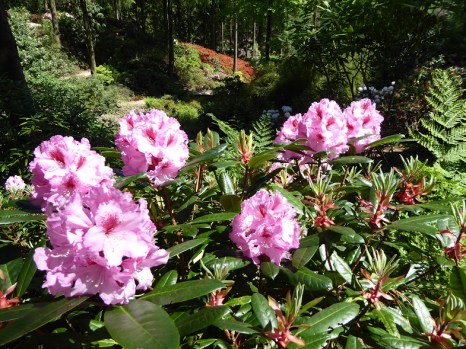
Rhododendrons such as these must have inspired Peter Roberts. Can you spot the drift of red specimens in the background?

Alan Clark, rhododendron guru and Himalayan plant hunter, told him that both site and soil were ideal: ‘I was intrigued by the idea of creating a Himalayan garden from scratch and decided to give it a go!’

Clark helped him with early specimens, Roberts supported plant-hunting trips to the sino-himalayan area … and the gardens began.

You won’t just find rhododendrons and azaleas though.  There are massed plants that you’ll find in many well-stocked British gardens.  There are drifts of narcissus in the spring.  There are carpets of bluebells.  There are several lakes on site.  Word has got round the bird and insect community that this is a fine place to live, and any birdwatcher or entomologist could have a busy time here. As could visitors who enjoy coming across an eclectic mix of sculptures during their walk.

My photos have disappointed me.  They give little impression of the rich feast of colour provided by hillsides covered in an ever-changing pageant of different varieties of rhododendron and azalea.

Nor can you see that this is a work in progress.  Peter and Caroline Roberts are constantly developing the site, planting and extending the collection.  On Saturday, just after our visit, a new arboretum opened.

Go while you can.  This special place is open for two months only every spring, and for a further couple of weeks in the autumn. It’s worth a detour (Susan Rushton, I’m looking at you).

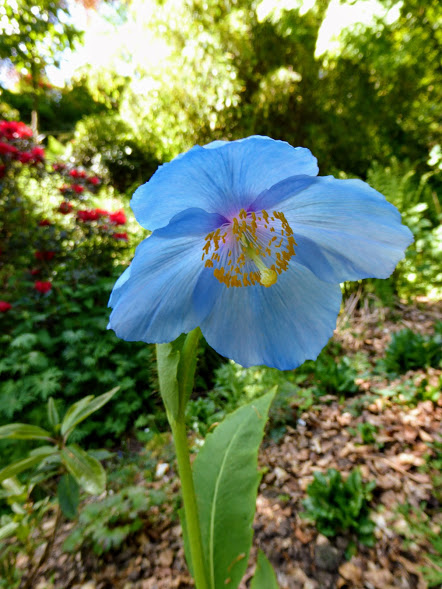
The Himalayan blue poppy makes its striking appearance throughout the gardens