Ragtag Tuesday: Touching the past

Nothing makes me feel older than looking at these three photos does.  They seem to be illustrations from a history book, but they’re not. I can reach out and touch them, because every one of them features my mother.
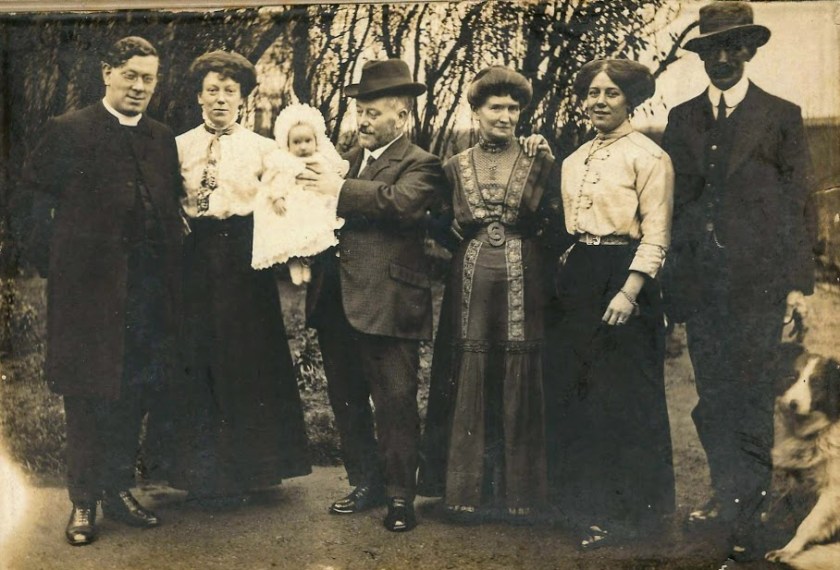
This is her christening.  And here are people I never met: her father Charles, the curate, who died long before I was even thought of.  Her mother Annie, from whom she became estranged. Annie’s mother and father Arthur and Elizabeth Pickard, long long dead.  Her sister Blanche and brother-in-law Jack who took themselves off to live and work in Swansea, so I never met them either: though my mother inherited almost all that Blanche had when she died in 1964.

News of my mother’s birth would have travelled by word-of-mouth or by letter.  I communicate with friends in four continents in an instant, by the click of a mouse or a quick call on Facetime.

When my children were small in the 1980s, we went to an exhibition featuring the future – a fax machine.  We got very over-excited sending drawings to one another down the phone line. Who uses fax machines now? They’re nearly as dead as the fountain pen. But even the telephone barely existed for most people when my mother was born. She lived to see her grandchildren use word processors, computers and mobile phones – but she was happier with what she knew.
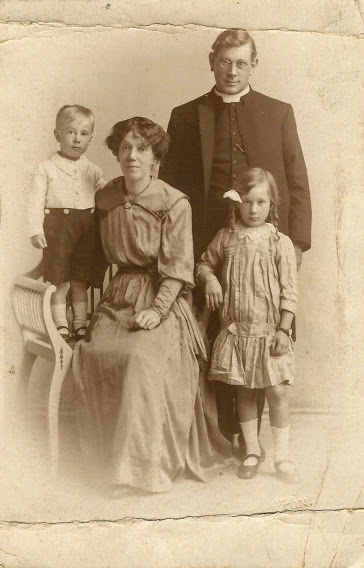
I guess this photo was taken during World War One. Over the last few weeks our attention has been so taken up  by the horrors of trench warfare that it’s hard to imagine that in a small northern coal-mining town, life would have gone on much as usual.  Clergymen and miners were all exempt from conscription. Though my mother remembers food difficulties. It was her job to run to the shop and get a supply of golden syrup, and then to sit fishing the flies before it could be used  in cooking.

I have little grandchildren  of the same kind of age as my mother and her little brother Arthur in this photo (and for those of you who’ve been asking, Zoë is doing well thanks.  She should now be just under a fortnight old, but she’s three months old instead).

Theirs is a world of babygrows, disposable nappies, easy-care T-shirts and jumpers and the constant background whirr of the washing machine. My mother remembered the dampness and drudgery of Monday and its all-day washing as the worst day of the week.

Here’s another from the war years:
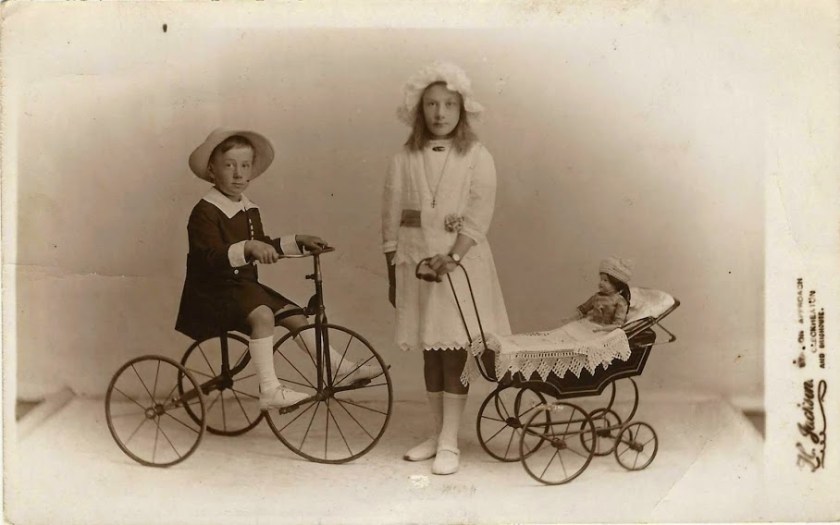
How could life have been so very – well – Edwardian?  Those floor-length clothes for my grandmother in the previous photo! That sailor suit for Arthur and a mob-cap for my mother!  Imagine getting Arthur and Betty along to the photographer’s studio in their Sunday-best, clean, tidy and with immaculate shoes.  These days, family portraits are all about getting out into the countryside with tousled hair then running barefoot through the heather.

I find it unsettling to look at the images.  

I feel strangely unconnected, as though my mother is from some strange unknowable place with which I have no relationship: ‘The past is a foreign country; they do things differently there.’ L.P. Hartley, The Go-Between.

Today’s Ragtag Challenge is ‘past’.

Ripon’s Remembrance Light Show

Projected every evening during Remembrancetide onto the West End of Ripon Cathedral, this twenty-minute light show remembers those, male and female, whose lives were taken from them during WWI.  It’s  dreadful to watch the long, long, long list of names of the fallen, scrolling inexorably upwards.  How could so many young men from this small city have died in those four years of war? We are shown photos from the war years, and the faces of some of those who have died.  John McCrae’s celebrated poem ‘We are the dead‘, illustrated with ranks of graves, and scenes from the ravaged countryside of Flanders completes the spectacle. A tumbling tower of images of blood-red poppies begins and ends this thought-provoking and humbling show.

Click on any image to see it full size.

Fields of mud – seeds of hope

Citizens of Ripon and beyond have been calling into the cathedral as often as they could over the last few weeks.  Not necessarily to view this ancient building, or even to spend quiet moments reflecting.  Perhaps not even to view the poppies which are here, as they are throughout the city centre.

We’ve all been visiting the Fields of Mud  in the Cathedral itself.  Back in early October, that’s all we could see.  A large brown rectangle of damp mud, surrounded by sandbags.  This mud is from Passchendaele, and from a Great War military camp in Ripon. As, over the weeks, the wet earth dried and cracked, five ghostly, battle weary figures slowly emerged on the surface.

This image, exhibited in the Cathedral, is a print projecting the final appearance of the piece.

There are millions of ungerminated poppy seeds lying dormant in that mud.  When the piece is decommissioned later this month, it will be broken up and segments will be made available to the public to create their own memorials.  This work’s legacy can continue indefinitely.

This astonishingly moving and evocative piece is the inspiration of Dan Metcalfe: his farming background has given him an understanding of mud.  It’s disagreeable, destructive and even dangerous, as every WWI tommy well knew. But it also harbours seeds, waiting to flourish and grow when conditions are right .

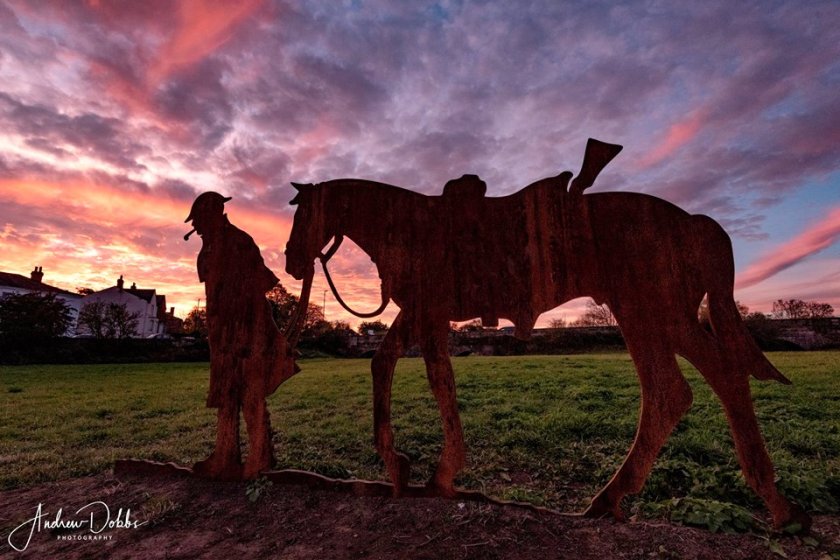
Now the figures are fully visible, as the mud which surrounds them has dried out.  And so we can see that these are the same figures that have appeared round town, near North Bridge and the Cathedral itself, at Hell Wath and Rotary Way: and in nearby Sharow, where the British Legion home for former service personnel used to be.  These soldiers, and a nurse appear as silhouettes, made from rusted metal, and they are trudging home, their backs to the conflict and facing the future.

Ripon city has recently made us keenly aware of the sacrifices  made in the Great War.  But the poppies, the Fields of Mud are not the whole story.  Tomorrow, on Remembrance Day, I’ll show you Ripon’s Remembrance Light Show.

Fred and Old Bones trudging home near North Bridge, Ripon. The soldier’s pipe is turned upside down to keep his baccy dry during the inevitable rain. This brilliant image was captured at sunset by Andrew Dobbs. (https://www.andrewdobbs.photo/)

Click on any image to see it full size.

Ragtag Tuesday: a parcel of deer

If you live near Studley Royal and its deer park, as we do, you’ll be used to deer.  They’re very shy though, and unless you’re there very early, or when poor weather is keeping visitors away, you’ll only get distant views of them.

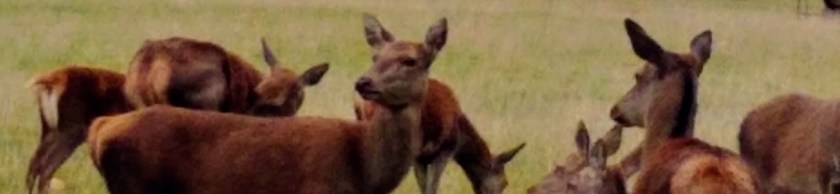
Yesterday though, we were having a walk, a long walk, just outside the park grounds.  Our path had led us upwards, through woodland, and alongside the long stone wall which bounds the estate.  And that’s when we noticed them.  A stag with his harem of does – some twenty or thirty of them.  We stuck our noses over the wall, and watched.  The deer watched us, and concluded that since these faces apparently had no bodies attached, they posed no threat.

The stag – and there was only one – was striding around in an assertive manner, aiming to garner respect.  The deer weren’t bothered either way, and there were no other males to impress.  He realised he was wasting his time, and fell to grazing instead.

I’m still stuck without a camera, so these slightly fuzzy efforts will have to do as a record of a few magic moments shared with a parcel of deer we came across .

Did you know that ‘parcel‘ is a collective noun for deer?  Me neither.  Try these too.

Herd – leash – gang – brace – clash – bevy – rangale – bunch – mob.

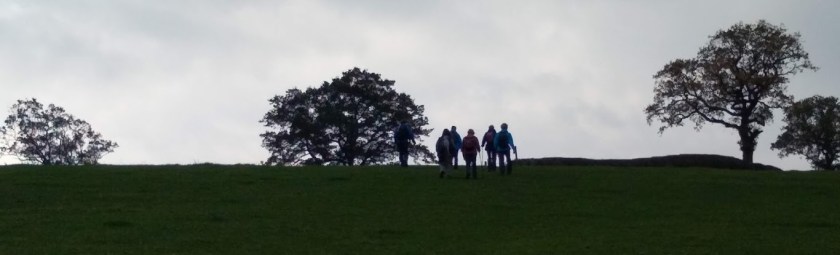
We’ve seen the deer. Now we can continue our walk.

Today’s Ragtag prompt is ‘parcel’.  And as usual, click on any image to view it full size.

Getting in touch with my inner French paysanne

Beatswell Wood.

I was walking back from my friend Claire’s through Beatswell Wood the other day when I noticed it.  A fallen branch.  A nicely rotting fallen branch.  Then smaller branches, conveniently broken into wood-burning-stove like lengths.  My inner French peasant knocked urgently at my brain. ‘You can’t leave those!’ she said, in perfect English. ‘Fuel for free!  Whaddya mean you’ve got no bag?  What are arms for?  Get on with it!’

And it’s true.  No self-respecting French country person – man or woman – would think of leaving for a walk without a just-in-case (‘au cas où’) bag.  Here’s an account of what we used to do in France, especially in autumn.

Yesterday we were better prepared.  We both set forth, equipped with large strong bags, just big enough to collect stove-length pieces of wood, or ones dried out enough to break in two.  A stout thick branch each – to be sawn up later – completed our haul.  Kindling sorted.  A day or two’s heat sorted.  Well, you know what they say about wood, and about how it heats you several times?  We aren’t woodcutters.  But we do gather it, then stack it, then burn it.  That’s three times.  That’s good value.

The path to the woods.

Click on any image to see it full size.

Ragtag Tuesday: Toussaint – the Day of the Dead

No, I’m not talking about the Día de los Muertos, or Day of the Dead, that life-affirming joyous celebration of life that happens in Mexico at this time of year.

I’m remembering our life in France.  I’m remembering how, from early October and for the rest of the month, shops and markets would be crammed with pots and pots of chrysanthemums.  It’s hard to know where they could all have been grown.  Or how they could all find buyers.  The Hard Discount supermarkets would sell them for a euro or two, while high-end florists expected a great deal more.

On All Saints’ Day, November 1st, all these chrysanthemums – white, russet, yellow, mauve, crimson – would suddenly appear in the cemeteries, jostled and packed onto family tombs .  And those cemeteries weren’t just crowded with plants.  Family groups make it their business to visit their deceased relatives in the season of Toussaint.  The day itself is a public holiday, and so those family members who’ve died provide an excuse for a family get-together. Here’s a day when, out of respect, there’s no opportunity to air old grievances or argue over the family silver.

Foreign visitors can make a big mistake when coming to see their French friends at this time of year.  ‘There were such a lot of lovely chrysanthemums in the shops, I couldn’t resist buying a pot for you’.  It doesn’t go down well.  There’s only one place for these flowers once they’ve left the shop.  The graveyard.

What HAS happened to all my photos taken in France of Toussaint chrysanthemums in shops, markets, cemeteries?  Who knows?  I’ve had to rely on Unsplash, a brilliant collection of copyright-free photos, offered by the world’s photographers.

Today’s Ragtag Challenge is ‘Dead’.

‘……the poppies blow, between the crosses, row on row’*

Soon, it will be the eleventh hour of the eleventh day of the eleventh month.  One hundred years since Armistice Day 1918, and the end of World War I.  Since the 1920s, here in Britain and the Commonwealth, the poppies which were so ubiquitous in the Flanders fields of battle have been used as a symbol to commemorate those who died in conflict.

For about a year now, Ripon has been making plans for something rather special – The Ripon Community Poppy Project.

Hand knitted poppies have appeared all over town, specifically a great avenue of them on the route between the Cathedral, past the Market Square and Town Hall and down towards the park – Spa Gardens. Shopkeepers have dressed their windows in commemoration.  All this year, the citizens of Ripon and beyond have been knitting and crocheting dozens of poppies, scores of poppies, hundreds and thousands of poppies. Sadly, not me.  I can’t knit.  Now these poppies are being displayed.  Everywhere.

It’s been an extraordinary project, involving the young, the old, the housebound, all of whom have been united in wanting to have Ripon remember the fallen in a striking yet appropriate way.

And there’s more.  I’ll be posting about ‘Fields of Mud, Seeds of Hope’, and  events at the Cathedral later.  For now, just have a short walk round Ripon with me and enjoy the poppies, as you remember the terrible story of the Great War.

*’In Flanders Fields’ by John McRae.

Click on any image to view full size.

Ragtag Tuesday: Flying the flag

Last time, we had to get to York to catch the coach to London.  This time, York had two coaches stuffed with its own.  Harrogate and Ripon had two, up from zero.  And Leeds had upped its game from two to five.

Coach to London?  Yes, to support the March for the People’s Vote.  You’ll know there were about 700,000 of us.  You’ll know the arguments.  So let’s just talk about a fun day.

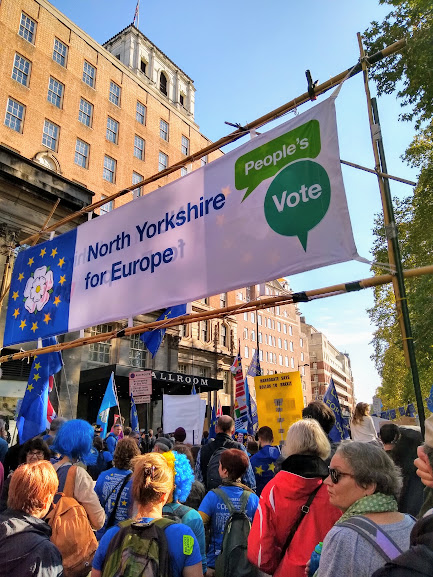
A day in which I could take few photos, because I was on Team North Yorkshire, and often doing duty carrying one end of our banner. We did sing though.  All the Yorkshire marchers who could be found as we passed the Grosvenor Hotel were rounded up for a photo call.  A passing marching band (there were  musicians….)  struck up with ‘On Ilkley Moor baht’at‘ and all right-thinking Yorkshire folk joined in with lots of enthusiasm but little melody.

We talked.  How we talked.  We made common cause with voters from Jeremy Corbyn’s constituency, from Devon, from Northumberland, from Leicestershire – the banners proved that no part of the nation was unrepresented.

And we carried flags.  EU flags, Union Jacks, Yorkshire flags, Italian flags.  Progress was slow.  We snuck off to coffee shops (staffed by Italians) and pubs (staffed by any and every nation) for a quick breather and still easily regained our places.


Have you ever tried to fit 700,000 people into Parliament Square?  No, can’t happen.  In any case, thousands and thousands of us were still marching as the speeches started, as they continued, and after they had finished.  That was disappointing, as last time, I’d been inspired and energised by so many fired up and dynamic contributions.

Instead we got street theatre.  Anarchists on wildly decorated bicycles, a Boris Johnson look-alike, a tricycle.  It was, despite our serious purpose, lots of fun.  And tiring.


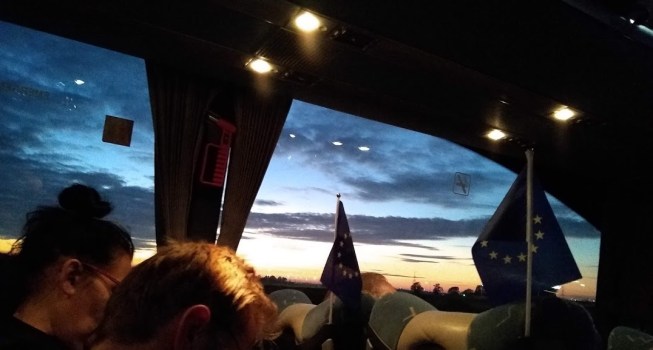
Look.  This is us on the coach home.  Our flags are still in place.

But I’ll end on this story, which makes me in equal measure sad and angry.

On the bus down, a French woman who has lived in the UK for 32 years told us that she no longer feels welcome in the UK, has suffered abuse, and has been told to ‘go home’.  She’d always previously loved Britain’s diversity and felt us to be accepting and tolerant.

And sadly, after two years of this different treatment, she’s decided she and her British husband have had enough and they’re moving to France. Even though she has considered Yorkshire her home for over 30 years.  This is not the first time I’ve heard tales like this.

It’s no secret that I voted Remain.  But nobody, however they voted, seems happy with how things are going.  If you believe that, having been given the chance to vote on continued EU membership, we should now be given the opportunity to vote on the Final Deal (including an option to remain), please write to your MP.  Here’s how.

Click on any image to see it full size.

Today’s Ragtag Challenge is ‘Flag’.

A window of opportunity

I’ve always loved looking at the contributions to Thursday doors, where bloggers from around the world share images of their favourite doors. Somehow, I’ve never got round to joining in.  But looking through my photos for something or other yesterday, I realised that I had the makings of a post about windows. Here it is.

Here’s an image from the last March for Europe in London in June.  I’ll be there again, probably as you read this, marching for a People’s Vote on the Final Deal.  I’m not sure how much I believe in another referendum, but what other hope have we got to turn the tide against the national disaster that is Brexit?

Happier times, happier pictures.  I started off by including images from Europe too.  But I’ll do England today, and maybe travel further afield another time.

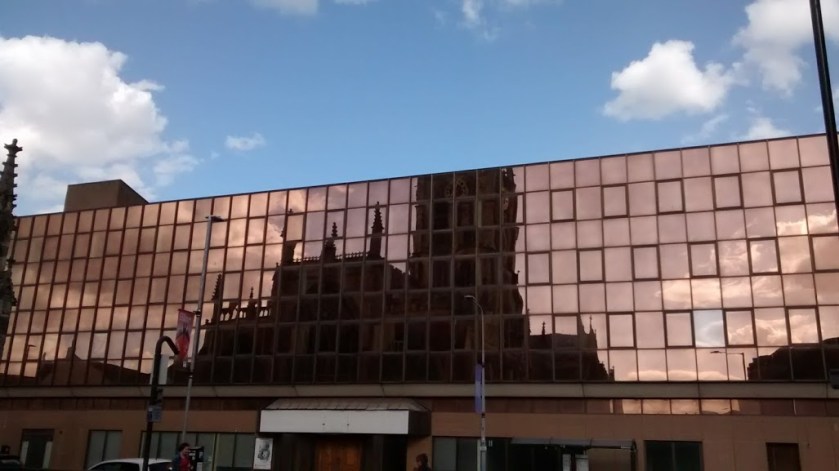
Hull Minster, as seen from the office buildings opposite.

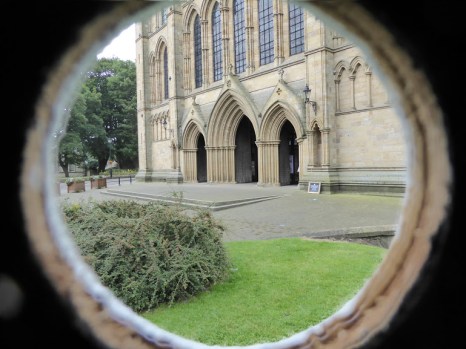
And Ripon Cathedral glimpsed through a camera obscura in early 2017.

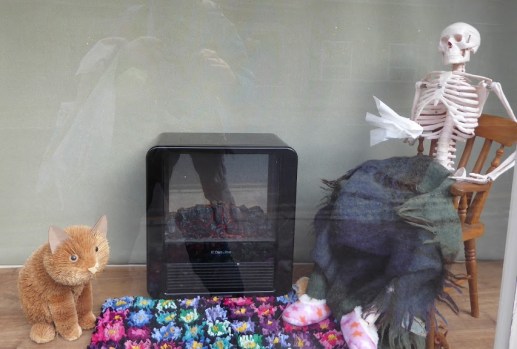
There’s an osteopath in Ripon who always has a delightfully quirky window display.  Here’s winter.

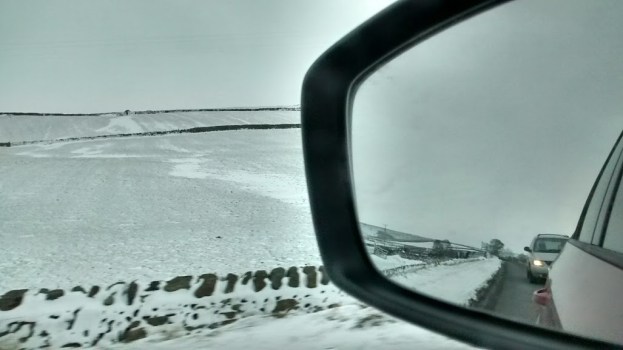
Through the car window, a snowy winter landscape near Kex Gill in Yorkshire.

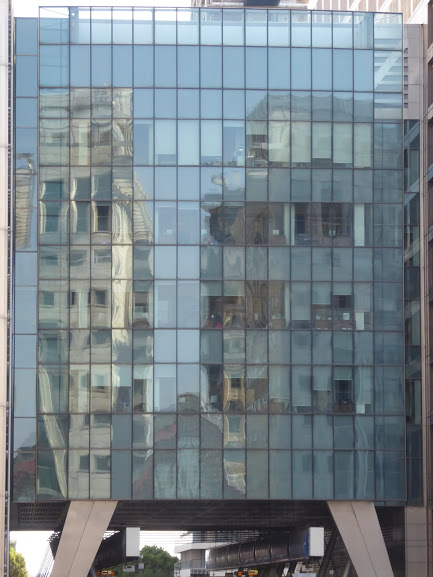
Train windows:  a view of Canary Wharf through the windows of the DLR line.

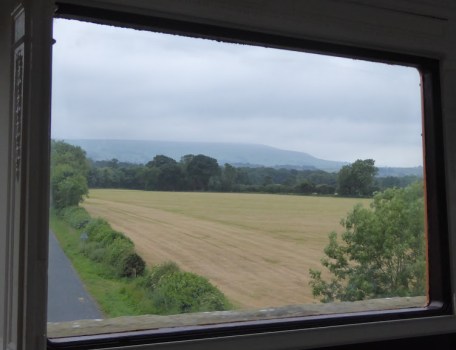
And the more rural landscape from the Wensleydale Railway.

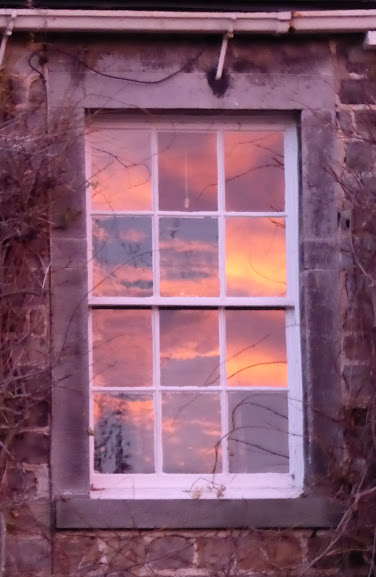
I’ll finish with the photo I found that started me off.  This was the view I took outside our house on Christmas Eve morning last year.