I really don’t like November. It’s dank, dismal, dreary and depressing, despite being my elder daughter’s birthday month (my Bonfire Night baby). I need a project to cheer me up.
I’ve found one. I’ll take at least one photo in the walled garden, every single day throughout the month, come rain, come shine.
Then on Thursday I read Amy’s blog post in which she celebrates the changing season in Yosemite with a glorious gallery of photos. She’s joined Sue’s blogging challenge called, of course, Changing Seasons. That seems to be a perfect peg to hang my photos on.
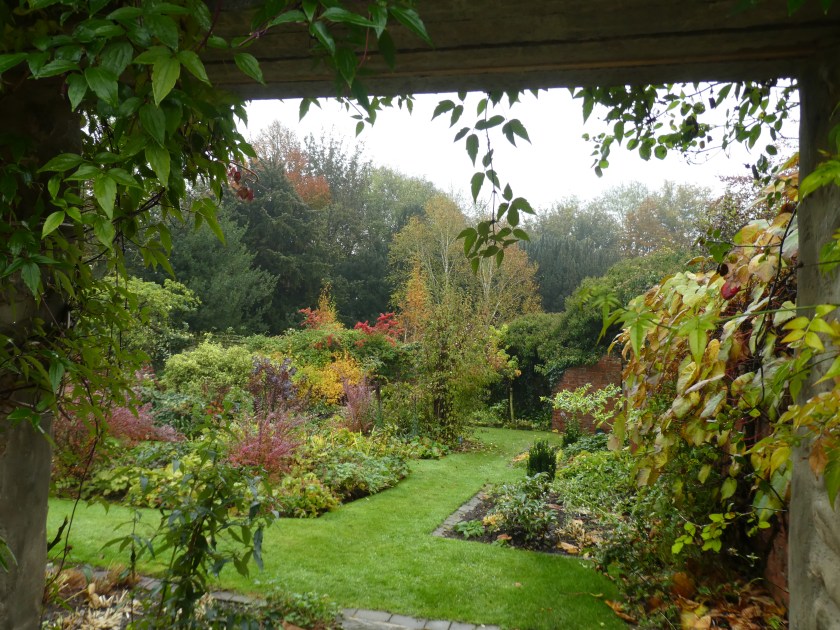
My shots today show the garden on a thoroughly Novemberish sort of Friday: raining, of course. Later on this month, I’ll post again. Whatever the weather, I hope it’ll show that even in November, beginning with the final vestiges of summer, and winter setting in towards the end of the month, that the walled garden is a fine place to be.
After I’d left my new English friends to do solo travelling, my first stop was Thanjavur. I wanted temples in Tamil Nadu, and it seemed to be a toss-up between Thanjavur and Madurai. Thanjavur won, because I suspected it was less on the tourist trail.
Thanjavur and its Chola Temple at sunset.
In case you don’t know, CouchSurfing is an online community in which travellers offer and make use of hospitality offered. It’s based on the premise that this makes travelling more affordable, but more importantly, gives travellers the opportunity to experience the community they’re visiting at first hand, rather than in the somewhat detached way hotels can offer.
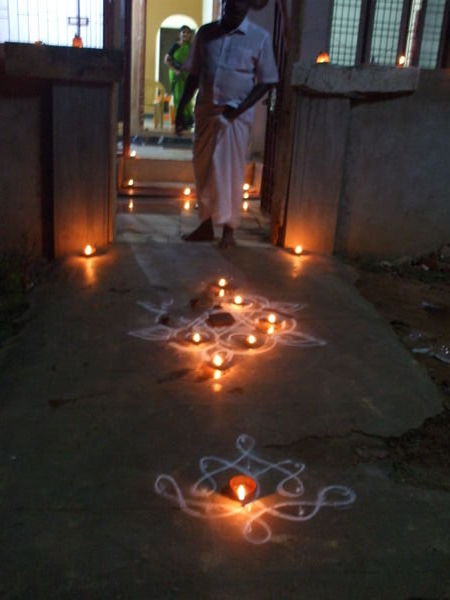
So I stayed with Gwen, an American doing post-graduate research at the University there. We’d exchanged emails over a month or two, and she didn’t feel like a stranger when I met her. She gave me a wonderful welcome and few days with her. Gwen had made it her business to be part of the community she lived in. She’d learnt fluent Tamil, so had good relationships with her neighbours. So while there, I had the chance to mooch round and enjoy with her the rangoli decorations and lights put out at night for a Hindu Festival of Light (not Diwali, yet another one).
Rangoli decorations lit up in the street at night.
I met the neighbours and was invited into their homes. I narrowly avoided a big faux pas with one household: a young couple, both teaching at the university. Invited to sit down, I nearly plonked myself in the nearest vacant place on a sofa. I recovered myself in time and did not sit, after all, next to the husband, but squeezed onto the other sofa, with the women. Gwen said it would have seemed very odd to them if I hadn’t remembered in time. We chatted to another neighbour, a Christian, who explained that she liked to keep the Hindu festivals too, and showed us her Hindu decorations taking their place alongside her pictures of the Pope.
I ran errands for Gwen, and in that way had several language-less conversations in the food market, where everyone was keen to shake my hand, because tourists in Thanjavur don’t generally go and buy half a kilo of carrots.
My friends in the market.
We zipped round on her scooter and bought takeaways. These are known as ‘parcel meals’, and neatly packed up for you in a cotton cloth. We caught local buses together and visited temples. We had meals, served on a square of banana leaf, in local cafés. I wandered round her neighbourhood when she wasn’t there, and saw a small community going about its day-to-day business.
Street scene, Thanjavur
Another street scene, Thanjavur.
Goats eat breakfast in Thanjavur
I was woken in the morning to local sounds: the Muslim Call to Prayer transmitted by loud microphone at, erm, 5.30 a.m. : the church bells ringing a few minutes after that (20 % Muslim and Christian communities here): the street hawkers who kicked in at about 6.45: the day-today noise which seems to begin so early in Indian communities.
View from Gwen’s window. She looks healthy, despite her diet.
And of course it was interesting to talk to Gwen, who knew exactly what I would be finding difficult, and could guess what assumptions I might be making. She gave me the odd Tamil lesson, and more importantly a gesture one (‘Yes’ and ‘No’ are the opposite way round from ours, I learned rather late in the day). She was much the same age as Tom and Ellie, but that didn’t seem to matter – it didn’t to me, anyway.
I’m ashamed not to be giving you an art history lesson involving all those temples. Quite simply, I didn’t label my photos well enough. Instead, I’ll give you a picture-show: From Thanjavur itself; from the small town of Kumbeshwara which has eighteen temples; from the exquisite temple at Kambakonam; and from Dharasuram. Sadly, one of my main memories of Dharasuram was the astonishing pain of trying to walk round the site. One always leaves ones shoes at the entrance to a temple, and the paving stones were fiery hot and burning. As usual, no surface remained unadorned, but studying them in detail proved impossible.
Besides the detail of the sculptures, enjoy the temple elephant giving us a blessing, and the bronze worker busy working at the bazaar within the Nageshwara Shiva temple in Kumbeshwara. Don’t think of these places as simply being lavishly decorated places of worship. They’re living communities, with bazaars, sometimes cattle and elephants. Some, such as the Chola Temple at Thanjavur, have inviting grassy spaces. Bring the family for a picnic!
Chola Temple at Thanjavur.
A blessing from the temple elephant.
Temple detail at Kunbakonam.
Bronze worker in Kumbakonam
Chola Temple, Thanjavur.
Chola Temple, Thanjavur.
Dharasuram.
Dharasuram.
Dharasuram. The pavings were SO HOT on our bare feet!
Kumbakonam
Kumbakonam
Kumbakonam
Kumbeshwara and its water tank.
View of Nageshwara Temple, Kumbakonam
Kumbeshwara Temple, Kumbakonam, the Shiva Temple.
Temple cattle
Temple elephant, Thanjavur
Trompe l’oeuil: Is the cow’s head resting on the elephant, or is it the other way about?
Regular readers will know I’ve got into the habit, once a month or so, of revisiting an old post. And I’m reminded of what October used to mean in France. Blackberrying’s over now in England (the devil spits on the fruit as soon as October kicks in, didn’t you know?), but my inner-Frenchwoman has been squirreling away scavenged apples, pears, mushrooms – even a few unimpressive walnuts. It all reminds me of France, where foraging is a way of life…
‘All is safely gathered in, ere the winter storms begin’ *
Autumn colours mean it’s harvest time for foragers.
I’ve written before about the ‘au cas où’ bag: the carrier you always have with you on a walk, ‘just in case’ something tasty turns up and demands to be taken home and eaten.
Well, at this time of year, it isn’t really a case of ‘au cas où’ . You’re bound to find something. A fortnight ago, for instance, Mal and I went on a country stroll from Lieurac to Neylis. We had with us a rucksack and two large bags, and we came home with just under 5 kilos of walnuts, scavenged from beneath the walnut trees along the path. A walk through the hamlet of Bourlat just above Laroque produced a tidy haul of chestnuts too.
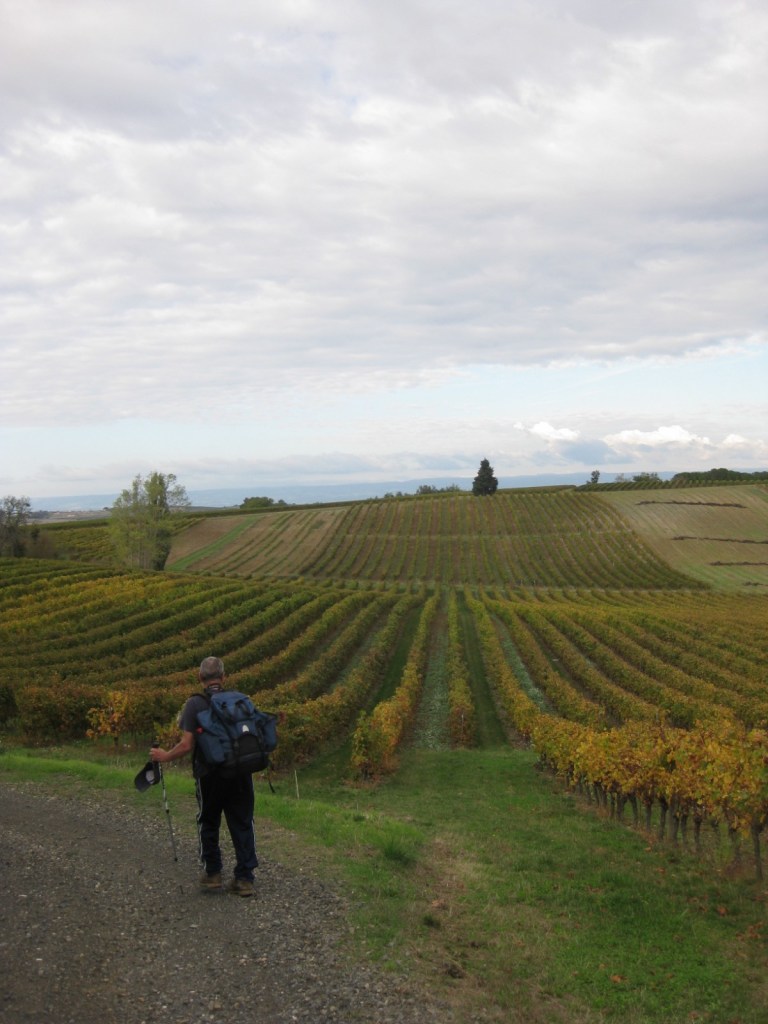
Yesterday, we Laroque walkers were among the vineyards of Belvèze-du-Razès. The grapes had all been harvested in the weeks before, but luckily for us, some bunches remained on the endless rows of vines which lined the paths we walked along. We felt no guilt as we gorged on this fruit all through the morning. The grapes had either been missed at harvest-time, or hadn’t been sufficiently ripe. They were unwanted – but not by us.
The walnuts we’re used to in the Ariège are replaced by almonds over in the Aude. You have to be careful: non-grafted trees produce bitter almonds, not the sweet ones we wanted to find. But most of us returned with a fine haul to inspect later. Some of us found field mushrooms too.
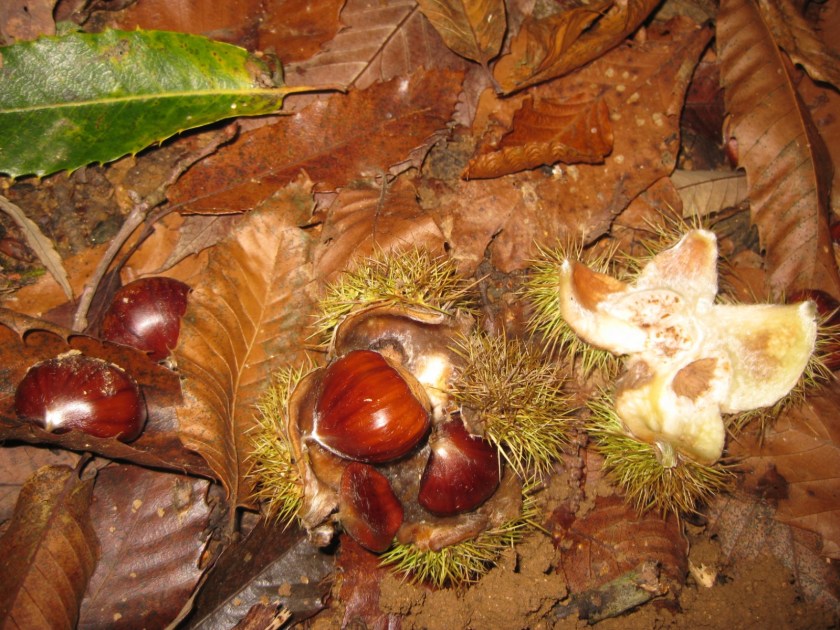
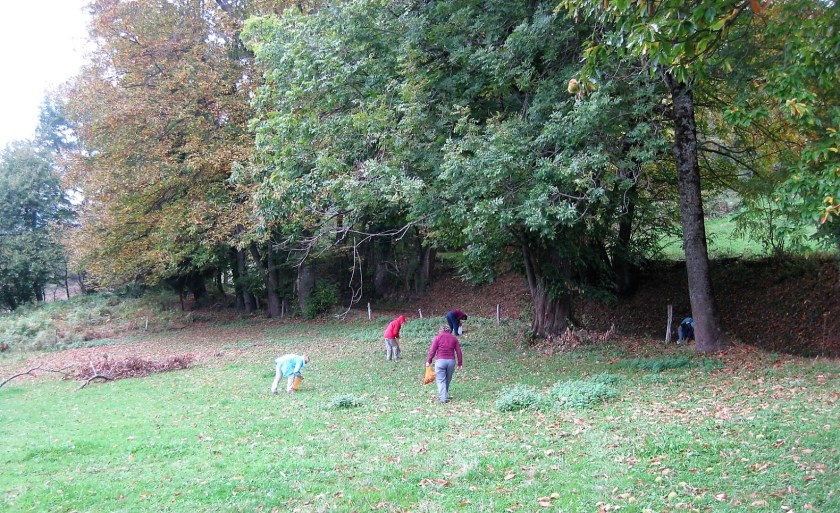
Today, the destination of the Thursday walking group was the gently rising forested and pastoral country outside Foix known as la Barguillère. It’s also known locally as an area richly provided with chestnut trees. Any wild boar with any sense really ought to arrange to spend the autumn there, snuffling and truffling for the rich pickings. We walked for 9 km or so, trying to resist the temptation to stop and gather under every tree we saw. The ground beneath our feet felt nubbly and uneven as we trod our way over thousands of chestnuts, and the trees above threw further fruits down at us, popping and exploding as their prickly casings burst on the downward journey.
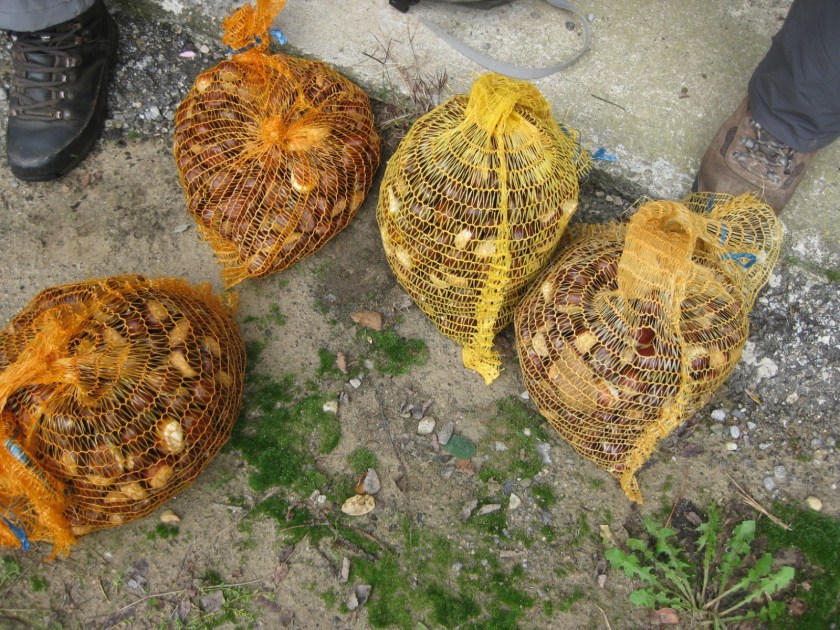
As our hike drew to an end, so did our supply of will-power. We took our bags from our rucksacks and got stuck in. So plentiful are the chestnuts here that you can be as picky as you like. Only the very largest and choicest specimens needed to make it through our rigorous quality control. I was restrained. I gathered a mere 4 kilos. Jacqueline and Martine probably each collected 3 times as much. Some we’ll use, some we’ll give to lucky friends.
Serious business, this scavenging.
Now I’d better settle myself down with a dish of roasted chestnuts at my side, and browse through my collections of recipes to find uses for all this ‘Food for Free’.
Jacqueline, Martine and Maguy’s chestnut haul.
* Two lines from an English hymn sung at Harvest Festival season: ‘Come, ye thankful people, come’
You can’t beat East Asia for power lines. When we arrived in Seoul for our South Korean adventure three years ago, we were stupefied by the skyscrapers, charmed by the traditional hanoks. But what we couldn’t take our eyes from were these.
Are there enough lines here for you Becky? Hey Jude? How about you? It was your post that put me in mind of these beauties.
On Saturday, about a million of us descended on London, all committed Remainers, demanding a Final Say on the Brexit Deal, which even as we marched was being debated in Parliament with as much dissent as usual.
Our own little patch of Yorkshire sent three coaches. Nineteen coaches from Yorkshire altogether. Everyone had their own important reasons for being there.
But the Yorkshire Remain Voice Choir had come to sing. We had permission to commandeer Wellington Place, right next to Trafalgar Square, and sing below the Duke of York Monument. And that’s what we did.
We’d come into being about two years ago in two ways. Over in York for Europe, Martin and Gill were crafting clever lyrics with a view to starting a Remainers’ choir. And in North Yorkshire we began to sing at our street stalls. Arnold conducted a few singers, a tuba, and a guitar. Small beginnings …. but now it’s county-wide, with members from Settle to Sheffield – almost 80 miles apart. Dozens play their parts. Composing lyrics; practising; arranging; securing singing spots; keeping song books up to date; booking coaches.
We have SODEM’s support in London, and an official photographer in Bedford-based Chiara Mc Call. We’ve sung all over Yorkshire, in London, even (thanks to Louise in South Yorkshire) in Brussels. Whenever the going’s got tough, we’ve had North Yorkshire’s Richard S’s boundless enthusiasm and hard work to keep us going. These days, apart from the original small team, we have a Yorkshire band’s worth of brass, and drums and various stringed instruments.
In London on Saturday, we had a large and pretty much captive audience. Slow-motion marchers inevitably listened – enthusiastically – as they passed. Many stopped off specially to listen, applaud and join in too. Demonic Cummings and Boris Johnson, those two splendid images fresh over from Germany, unsurprisingly pushed off towards Trafalgar Square as we began.
Our audience, viewed from the choir (CM)
There are thirty eight songs in our repertoire – all, with one exception, pastiches of well-known numbers. Our signature number is of course:
‘We’ve come from Yorkshire just to say (just to say)
Your Brexit deal is naff…‘(to the tune of ‘On Ilkley Moor’, naturally).
But we can do other folk songs:
‘What shall we do with….‘, not a ‘Drunken Sailor’, but ‘this Rotten Brexit?’
…..drinking songs: ‘I’ve been a Remainer for many’s the year’ rather than the more traditional ‘Wild Rover’.
We can do Old Time Musical: ‘I’m forever European’ (‘I’m foreverBlowing Bubbles’).
Radio Two standards such as ‘Delilah’ ask:
‘Why why why deceive us?
More lies won’t appease us’.
We can reference American traditions:
‘We’ve had quite enough of Brexit it’s a con’. (‘She’ll be coming round the Mountain’)
While ‘The Battle Hymn to the Republic’ becomes ‘Our eyes have seen the threat to all the freedoms we hold dear’.
Hymns too …. ‘Bread of Heaven’, and the Last Night of the Proms (‘Land of Hopeless Tories ‘).
There’s one song in our repertoire that’s not original: ‘Ode to Joy’. It moves many of us to tears every time we sing it.
Brexit or no Brexit (no Brexit please!) we’d like to continue. A pro-Europe Choir and Band for Europe?
Photos and videos labelled ‘CM’ are by our wonderful friend and supporter Chiara McCall. Follow her on Instagram @chichi76.myreflection
I’m looking for lines. Most obviously, they call to mind buildings, railways, pavements, washing lines, power lines: man-made kinds of things. But Mother Nature does lines too, as we observed yesterday at Harlow Carr Gardens in Harrogate. Lines of still-summery oak leaves edged against the sky. Veins, dark against the now-glowing colours of the leaves. A tree trunk reflected into the water as one long sinuous line.
So Becky, here are some more lines for your October Challenge: Lines and Squares.
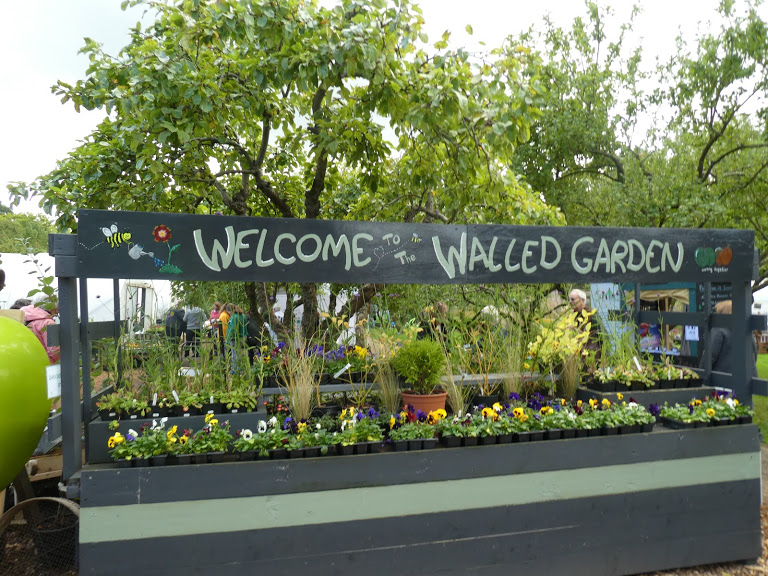
It was Apple Day at Ripon’s Walled Garden on Saturday. We went along.
For me, it was a chance to revisit my childhood. Every Saturday, I’d go shopping with my mother to the Tachbrook Street Market. My favourite stall was the greengrocer’s. I’d try to add to my collection of prettily-decorated tissues used by the citrus fruit growers to wrap their produce. I’d wonder at expensive exotica such as lychees or passion fruit. But really, we’d come to buy.
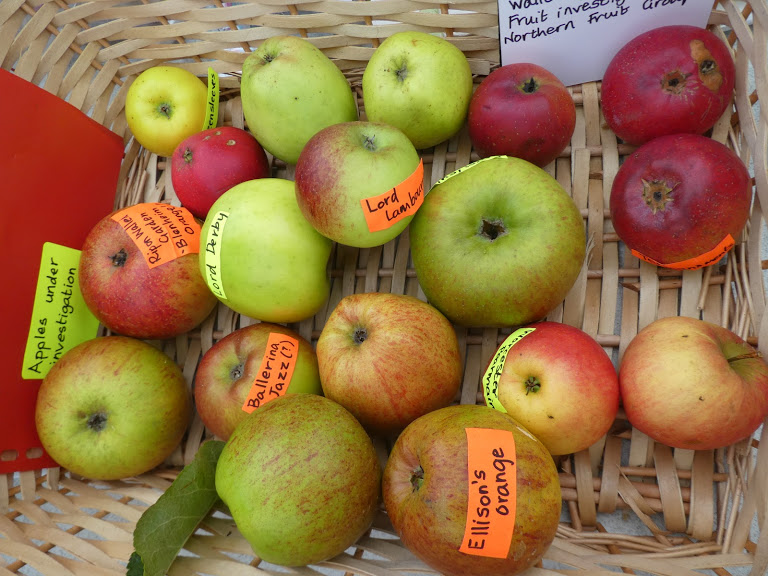
And my mother taught me that apples aren’t simply apples. There was something new to look forward to every month in autumn. The eagerly anticipated first apple of all – the bright red Discovery, quickly followed by Beauty of Bath. The Cox’s Orange Pippin of course, which we had to shake: it wasn’t ripe unless the pips rattled. Blenheim Orange. Laxton’s Supreme. Laxton’s Superb. Worcester Pearmain. Charles Ross. James Grieve. Egremont Russet, which I always associated with Bonfire Night, but which nowadays is already in the shops. Ribston Pippin. Ellison’s Orange. I learnt to love them all: some sharp and juicy; others more mellow, slightly less crisp; white-fleshed; creamy-fleshed; small; large; knobbly; oval; round – such variety.
Many of these have all but disappeared from the shops. It’s all about large, white-fleshed, crisp apples. Jazz, Pink Lady, Granny Smith – even Cox all seem much of a muchness. And half the time, when apple season is at its peak in England, they aren’t even from the UK. Cookers these days are Bramley Seedlings. Excellent of course, but where are the Lord Derbys, the Newton Wonders, the Grenadiers?
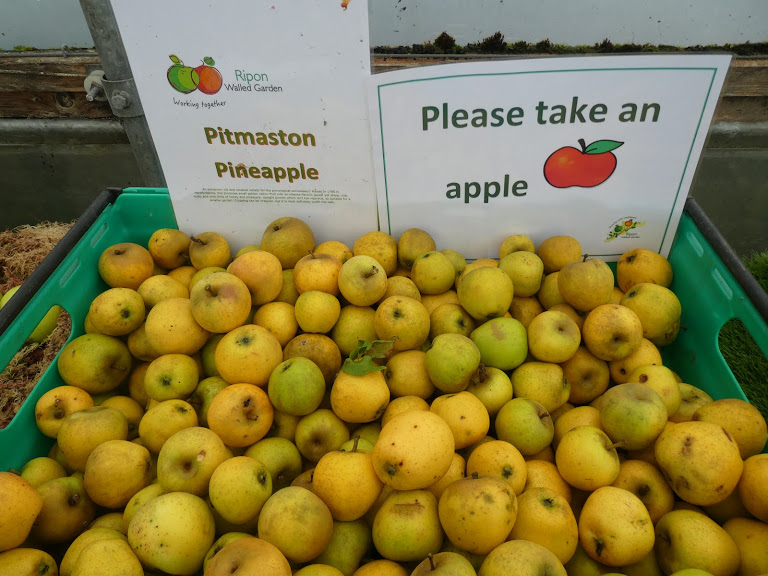
In places like Ripon’s Walled Garden, that’s where. Look at my Rogue’s Gallery of all the varieties they still grow.
This display below piqued my interest. I recently read Tracey Chevalier’s At the Edge of the Orchard, a partly-true story which begins in Ohio in Pioneering days. A bit-part in the tale is played by an apple variety, Pitmaston Pineapple, that had been carefully brought over from Herefordshire. I’d never preciously heard of them, but … they’re still grown in Ripon. I tasted one. The so-called pineapple taste eluded me … but I was still glad to have eaten a little bit of history.
Ripon Walled Garden is Ripon’s best kept secret. It’s a a charity supporting young people and adults with learning difficulties to learn horticultural and catering skills in a sheltered environment. Come here for a delectable tea-and-cake moment or a light meal, made using their fresh garden produce: sit at a table in the shade of the old apple trees in the well-tended and colourful garden. You’ll go home refreshed and happy.
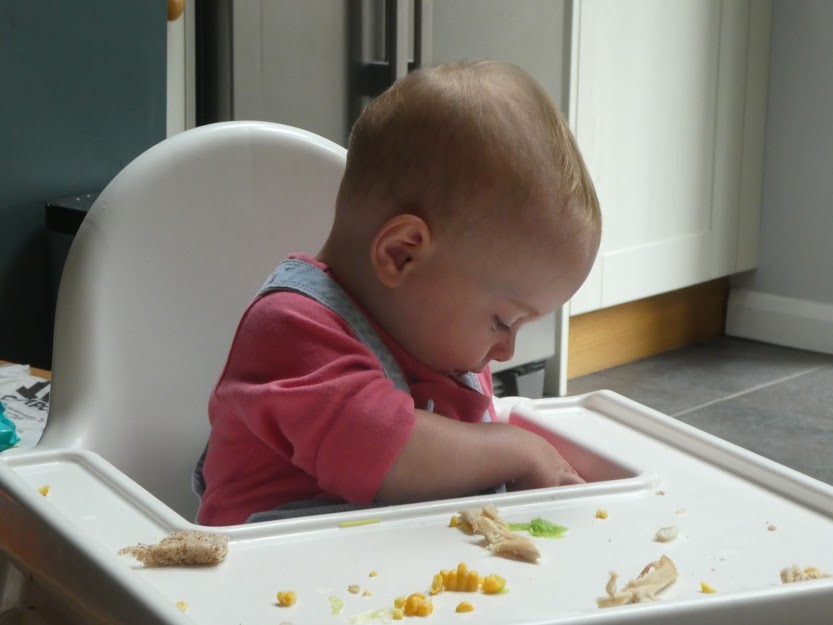
Catching a baby in an unselfconscious moment is a bit of a cop out. Zoë doesn’t care. It’s far more important to squirrel away a few choice morsels in case she’s hungry later, rather than pose for the perfect shot.
Nearly forty years ago, we lived in Sheffield, next-door-but-one to Bryan. He was and is a carpenter. His wood never came from the woodyard though. It was always scavenged. You’d find him investigating skips or nosing through derelict buildings. Not for him IKEA generation pine and MDF. No, Bryan looked for weathered oak, warm-toned cedar, maple, cherry, iroko. He’d pick up a walnut floorboard or a broken mahogany cupboard door. He’d squirrel away a fragment of marquetry or a shard of polished ebony. Who knew when they’d come in handy? Everything was carefully organised next to his workshop: it might wait years and months for its moment of glory, but every piece of wood would find a use … one day.
He wanted projects he could put his personal stamp on – no identical sets of anything for him. And he liked to try things out and experiment. So he made a deal with us. We’d get the dining table we wanted if he could try a few techniques that might or might not work. No money would change hands. In exchange for being guinea pigs, we would get a table – for free – that might fall apart within the year.
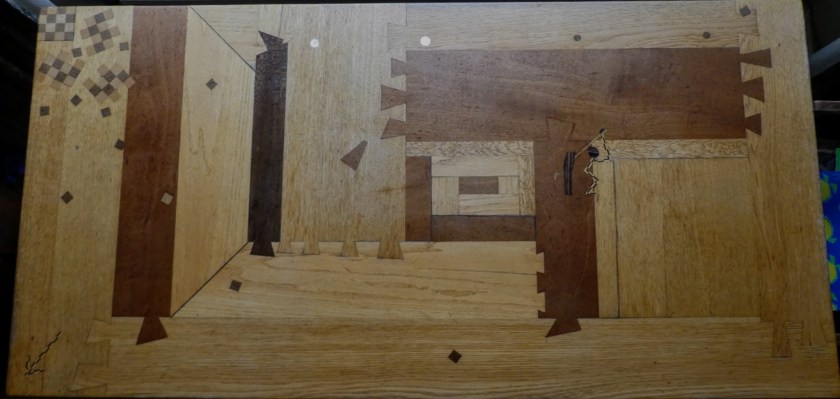
This table was horribly difficult to photograph. Standing unsteadily on chairs hardly seemed to help.
Forty years on, we’re still using it. We still enjoy the almost-game-of-chess to be played on its surface. We fondle the dome of wood rising gently along one side. We smile as we remember the small marquetry lines that punctuate one of the legs: they show the knee heights of Thomas, then four, and Ellie, then two. We invent tales about the stick-man water carrier and enjoy the pretty mother-of-pearl buttons embossed into the surface. Look at the legs. Each is different – one made from pillars of the checker-board assembly scattered on the surface.
The stick man.
The exploded chess board.
That sensual polished nipple of wood along one side.
Tom’s leg height.
Another detail from the side.
… and another ….
… and another …
One of the table legs.
A small detail.
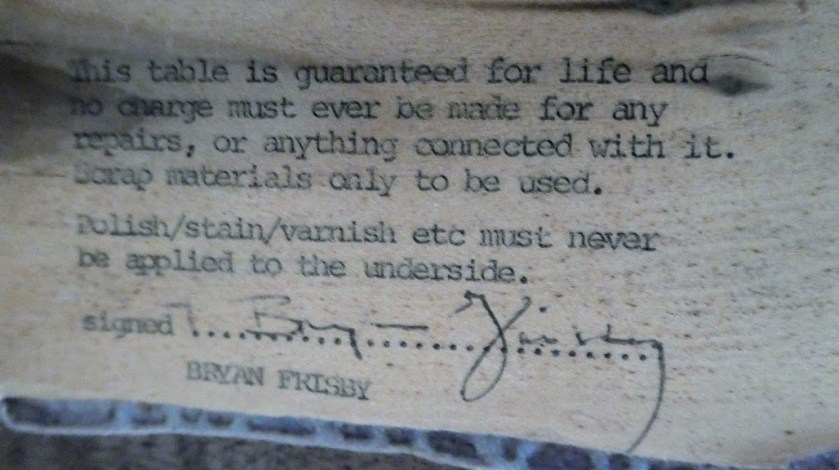
Crawl underneath. The table is dedicated to everyone in the family. There’s a further notice: this one.
We’ve called in one 10,000 meal service, as promised on the dedication notice. Sadly, Bryan now lives in Wales, and we have moved north from the Sheffield street where we once all lived. Bryan and I each have a different partner now, and we’ve rather lost touch. But that table ensures that he’s never forgotten. And when I go, will it have to be chopped in three? Each of my children wants it. Perhaps it’ll be a Judgement of Solomon moment for them.
























You must be logged in to post a comment.