Pay-As-You-Feel, Eat a Good Meal

Let’s begin at the beginning.  A couple of years ago, Alison and her husband were in Saltaire, looking for a late lunch.  They found it at the Saltaire Canteen, and soon realised it was no ordinary café.  Here, the ingredients used were all past their sell-by dates, and had been intercepted from landfill.  They’d been transformed into appetising meals, mainly by volunteers, and customers were encouraged to pay what they thought was fair, or what they could afford.

‘We could do that in Ripon’, thought Alison.

Actually, that’s not the beginning of the story.  We need to go back to December 2013, when The Real Junk Food Project opened its doors in Armley, Leeds,  as a café offering meals made from food destined for the tip.  People ‘paid’ for their meals with money, by offering skills or even food.

It was the brainchild of Adam Smith, who had a Road to Damascus moment on a pig farm in Australia, where the pigs were eating discarded food he’d have been happy to put on his plate.  Back in England,  The Real Junk Food Project was born, firstly as a café: then as an ever-expanding movement helping others develop their own models; as a Sharehouse sourcing and distributing waste food for those cafes; pay-as-you-feel supermarkets of discarded food; Freegan boxes of intercepted food designed for families; for distribution in a school setting (breakfast clubs, or for families in need for instance); even outside catering.  I’d like to get married all over again for the pleasure of having a Junk Food catering team deliver the party!  You can see why Alison needed to talk to Adam.

She found a co-conspirator in her friend Janet, and between them they located premises at Community House, equipment, cookware, crockery, cutlery, napkins… everything you need to feed the masses.  I’ve dismissed that task in a sentence, but I don’t underestimate the achievement.  They found volunteers too.  I wasn’t in at the beginning, but I’m part of the team now, and I wouldn’t miss my stints for anything.

A year ago, the café opened.  It’s on Thursdays, Ripon’s Market Day.  People start to drop in from 11 o’clock for a coffee, maybe a cake.  From 11.30 they’re eager for lunch.  Seating is at refectory-style tables, so whether you come with a friend, family, or on your own, you’ll be sitting with others and soon be talking to those around you.

Look!  Here are a few sample menus.

The cooks for the day will have been to Wetherby the day before to collect supplies, considered the random collection of ingredients and devised and cooked a varied and tasty menu to suit everyone: there are always vegetarian and vegan choices.  There’s nearly always a soup or two, and good old fashioned nursery puddings are hugely in demand.

The volunteers have been in since 10 o’clock, setting tables, chalking up the menu, getting everything ready.  At 11.30, they become waitresses and waiters: taking orders, collecting and serving the food to the diners, taking turns to wash up, and finding time to chat and be welcoming.  Newcomers become regulars: regulars become friends. We have office workers; young families; elderly people who welcome a hot meal in friendly company; visitors to the city …

At the end, people put what they feel in a box by the door.  The point is to save food from landfill, not to make money, so those who can’t pay don’t need to feel embarrassed.  Some offer services instead – there were some electricians in one week ….  There are costs of course – notably the rent: so far donations have kept us in the clear.  Any profits are re-invested in improved services.

Then, for the volunteers, it’s time to wash up, tidy up, put things away, swab the kitchen floor, pack away the tables and chairs, vacuum … and finally go home for a rest and a nice cup of tea.

Wholemeal has become a real asset to Ripon community life. And look at the food that’s been intercepted from landfill!  Win-win.  Thank you, Alison.  Thank you, Janet, thank you Adam … and everyone else who’s made it possible.

Radio York transmitted its whole morning show from Wholemeal last Thursday.  Anyone who’s super-interested can listen here, on BBC Sounds.

A Line of Trees

I don’t know about you, but I need a break from the world and its vicissitudes.  And I’ve got just the thing.  One of our favourite walks, near Masham, near home.  It offers wetlands with waterbirds, calming pastures of sheep, woodland, a stretch along the riverside – all available in a four mile stroll.

This month, Jude of Travel Words invites us to consider Pattern.  This walk has plenty, starting with the skeins of geese often to be seen designing sinuous flight lines across the sky.

Marfield Wetlands.
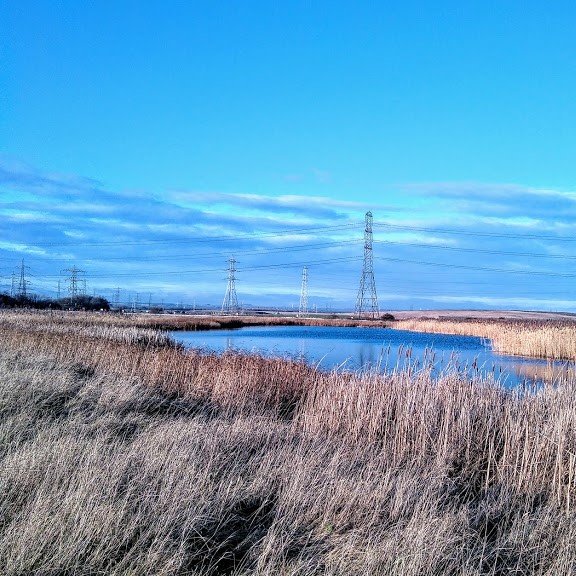
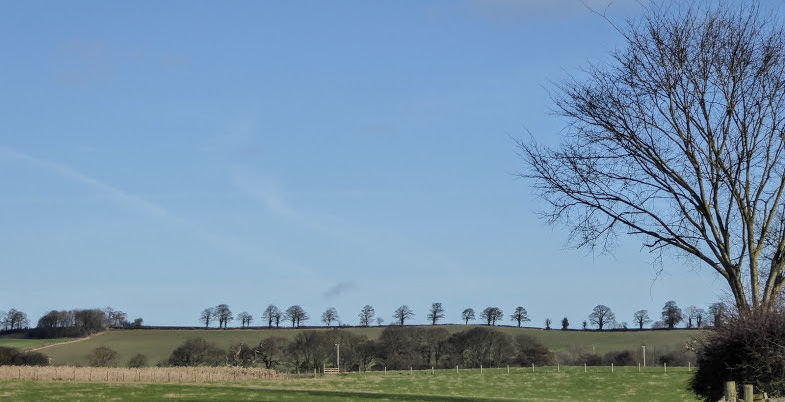
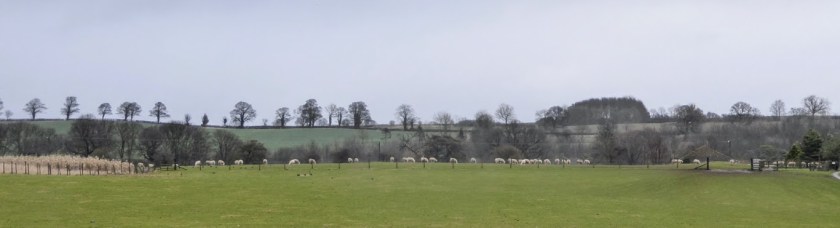
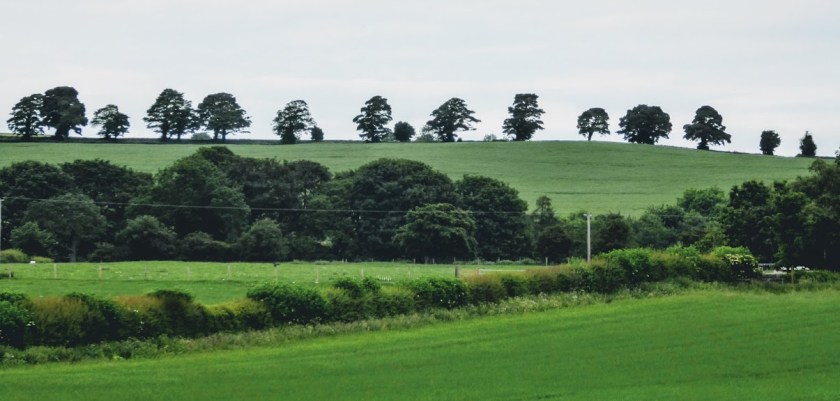
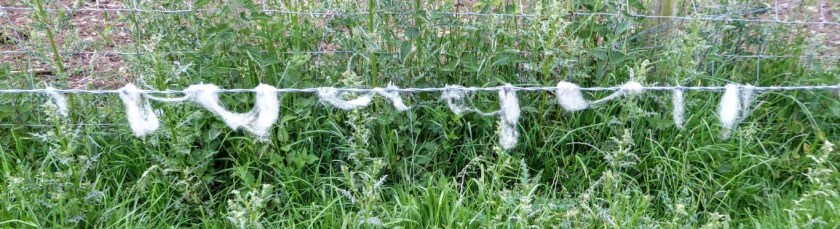
I’m going to show you a particular line of trees that I’m fond of, towards the end of the walk.  A repeated pattern, tree after tree after tree.  Sometimes, especially in high summer, these are enough to fill my mental screen.  At other times, I notice the pattern echoed.  A line of sheep, maybe.  A different line – of fencing.  Even – and I never manage to catch this in the same shot – a line of snagged sheep’s wool caught on nearby barbed wire.

Stark winter trees.  Fencing edges the nearby field.
Winter again.  I like the shadowy trees lower down echoing the crisper line above.
Another much longer view of those trees. With sheep below following the same horizontal line. It’s still winter.
That line again. It’s summer now, and other stands of trees draw the eye down to the lower edge of the shot.
Sheep again. They just left their wool behind.

I’ve chosen in many cases to echo the linear nature of the pattern by a spot of judicious cropping.

There.  Did you forget the headlines just for a few moments?

Thank EU for Being Here: Part 2

We turned up early – though not half as early as some – to help get things ready and to join a short choir rehearsal.

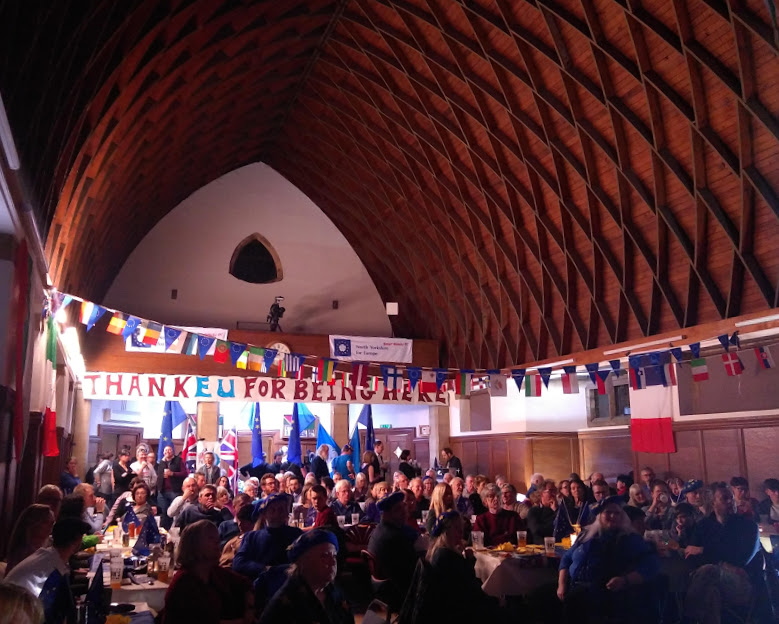
This was January 31st, Britain’s last day in the EU, and the occasion for North Yorkshire for Europe’s ‘Thank EU for being here’ party: a celebration for EU citizens who’ve made their homes here.

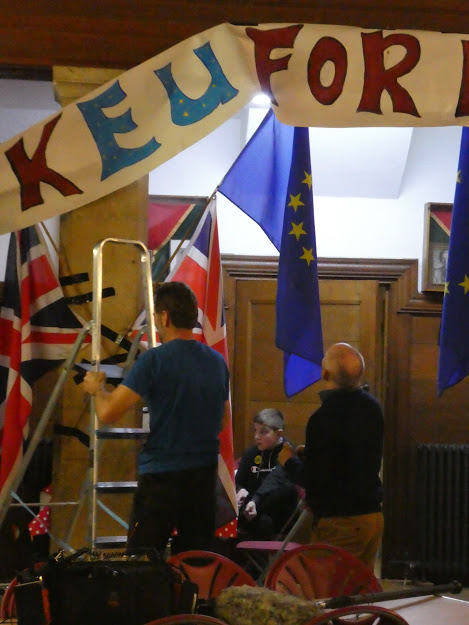
Richard Sadler, our energetic ideas-and-Chair-man, organises the banner.

There were tables and chairs in place, enough for about 120 people.  There was Richard up a stepladder wrestling to get the home made (thank you Phil) banner up.  And there were the cameras and reporters.  BBC Look North were already busy interviewing and ITV News at Ten was due too.  But look!  Isn’t that Nick Robinson from the Today programme?  Yes.  He stayed and listened to the choir rehearse, and did a few short interviews, which were transmitted on Saturday’s programme at about 8.15.

Nick Robinson talks to Richard Sadler.

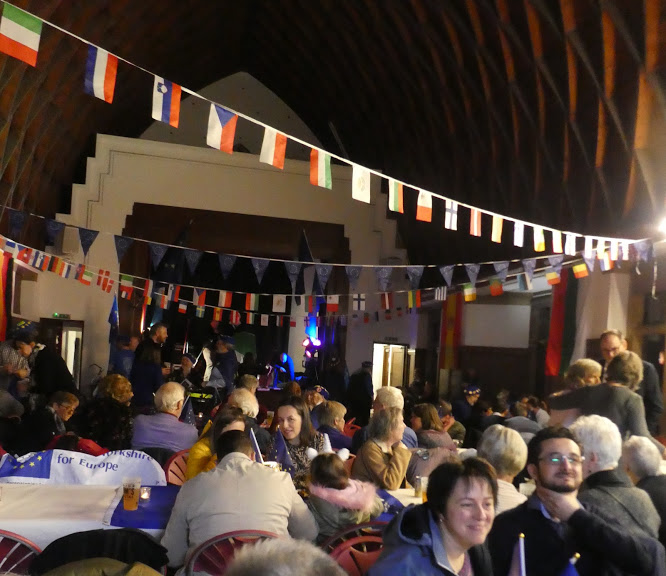
Then it was 7.30.  People started arriving – slowly at first, then in a busy queue.  A Polish nurse who’d been part of the team when Malcolm was in hospital came, with two Spanish friends.  As we sat down, we found ourselves with, apart from them, Italian and Ukranian guests.  I chatted to a French woman.  We heard German, Dutch.  We puzzled over quiz sheets.  Where ever in Europe had all these pictures been taken?  There was music from our very own The Raisers.
Getting to know each other.

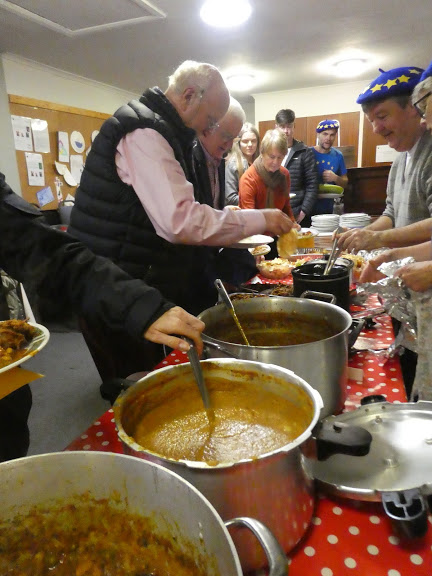
Supper was only partly European.  There were pizzas.  But besides them were vats of Indian vegetarian curries, breads and sweetmeats.  Feeding us all took quite a while, but gave the chance for lots of talking and getting to know one another.

Form an orderly queue.

Speeches of course.  You’ve got to have speeches: but they were short, and though full of regret, positive and forward-looking.

And the choir sang.  No longer the Remain Voice Choir, we’ve become the Reunion Chorus. Some of our old favourites have been brought up to date (‘Brexit is a form of Madness’ – you may know it as ‘Bread of Heaven’); and others are new (‘Europeans all are we..’‘Bobby Shaftoe’).

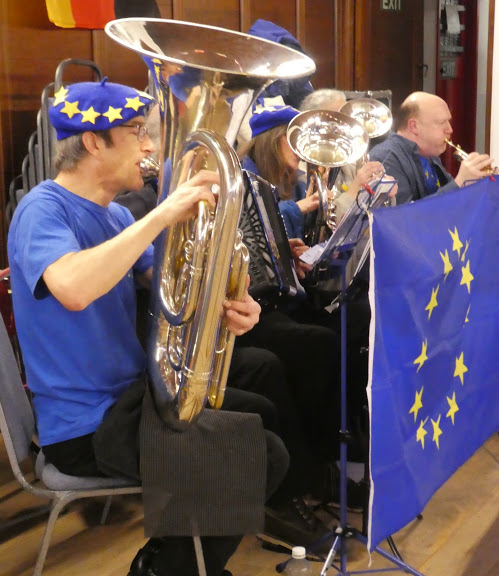
Here are some of the band. As I was singing, I haven’t got any of the choir. I think Nick Robinson has.

The hands of the clock kept turning.  It was getting late. We stopped out chatter.  At exactly 11.00 o’clock, we stood up for a minute’s silence: reflective, saddened, angry.  And then the choir and everyone in the room joined in singing Ode to Joy.  After which, many of us turned to our neighbour for a comforting hug as we wept for what we had lost.

The evening was over.  But not our movement.  We’ve made new friendships in Yorkshire and beyond.  One day, we’re sure, Britain will be part of the EU once more.


Car Light Through the Soapsuds

I thought I couldn’t let January end without a final entry for Becky’s Squares: January Light.  So here we are at the car wash.


Frankly, though, I’m not really in the mood.  Not the day that the UK leaves the EU.  I’m looking forward to this evening though, when North Yorkshire for Europe is holding two parties, one in York, and one in Harrogate, where we’ll be.  The group’s invited EU nationals who’ve made their home in Yorkshire, so we can say ‘Thank EU 4 being here‘. We’ve already been mentioned on the Today programme, and …. well, we’ll just have to see.

An Everyday Story of Country Folk revisited

January. It’s almost at an end and I haven’t revisited a post from France yet this month. I’ve picked this one. We’re living in a village community here in England, yet it’s hard to imagine someone from here with memories similar to those of Paul, the subject of this post. Let’s have a history lesson from .

…. January 29th 2012

An Everyday History of Country Folk

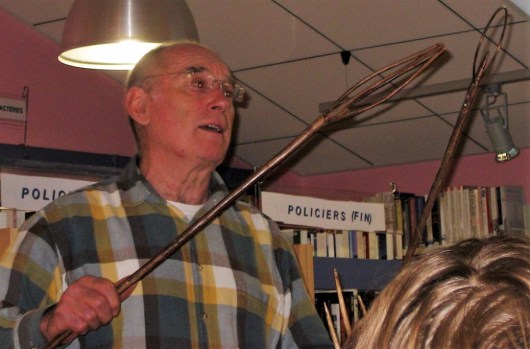
Yesterday afternoon was fascinating. We went to Belesta library for a talk by Paul Garrigues, a local historian who collects old wooden artefacts. He gave us an insight into a way of life which only finally drew to a close about 30 years ago.

He’s pretty much my age, but his childhood was spent around ox-drawn farm machinery, distaffs and a host of things that formed no part of my rural infancy. Now that most Ariègeois farms look pretty much like anywhere else’s, with tractors, silos and irrigation systems, it’s rather hard to believe.

Paul’s childhood was spent in the next village to here, Aigues Vives. Later, he met and married a young woman from a tiny community in the Couserans, a part of the Département to the west of here. He was surprised to find how different the tools in his wife’s village often were. Besides that, the villagers spoke Gascon, rather than the Occitan traditional in our part of the area.

His interest began. He started to collect mainly wooden artefacts: agricultural items, kitchen tools, playthings. To him these things tell a story of rural life here as it was lived over many centuries.

First of all, he showed us a simple wooden torch, looking something like a charred rounders bat. Items just like this were in use – almost daily – since man first populated the area in Stone Are times, right up until the First World War, and in a few cases, beyond.

Next, a distaff. This item too remained unchanged almost from those early days until the early years of last century. Any female over the age of about 8 living over the last 1000 years and more, whether rich or poor, would have recognised it. Spinning would have been a constant part of her daily routine, whether she was managing a fine estate, or supervising a few sheep on the mountainside. And do you know what? Constantly licking your finger and thumb as you handled the wool made your mouth dry, so beside you, you might have a little wooden box, filled with snuff, to help your saliva to flow: he showed us samples.

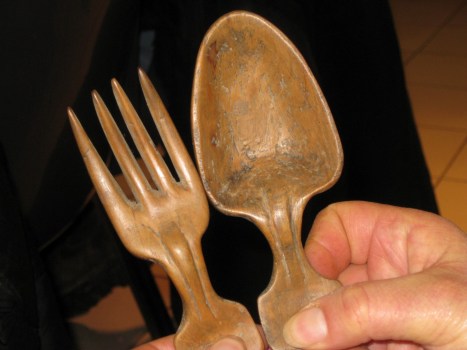
We saw long wooden balloon whisks and three-pronged forks used to stir the great vats of millas (a sort of porridge made from cornmeal) beloved of the Ariègeois, wooden spoons and forks, large wooden bowls.

A couple of millas stirrers.

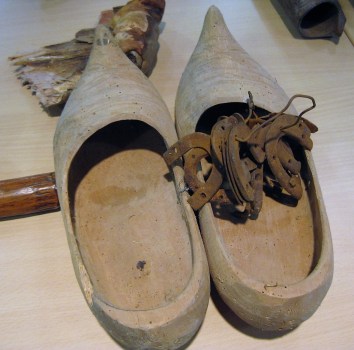
He showed us wooden clogs.

Wooden clogs with metal horseshoe-style heel strengtheners.

We saw wooden roof tiles. All these things are made from unplaned wood, so the implements can follow the natural grain of the wood and be strong and sturdy.

From the Couserans he had savage long thick knives, looking like swords in their wooden or leather scabbards. Their design was directly descended from the instruments of war the Gascons often saw in their battle-rich past, but in fact they were more recently used to cut rough grass, crops, and the long straw required for thatching.

There were other differences between that part of the area and ours. Here, terracing was a feature of upland farms, and it was male beasts who worked the land. There, the farmers worked directly on the steep slopes: the cows who ploughed the land (it was female animals who did the work there) had to have specially designed wooden yokes so that they weren’t strangled as one worked at a higher level than her work-mate.

A yoke. For safety reasons, it can quickly be divided in two.

But it wasn’t all hard labour. Anyone who’s ever been to a bowling alley would recognize the bowls and skittles he showed us (made from wood, naturally). They were a big feature of life round Biert in the Couserans, but inter-village tournaments were rare. They all played to different rules, which tended to make contests rather difficult. But it was over here, in nearby Le Sautel, that a game was bought to a sudden end at the end of the 19thcentury.

Wooden skittle and bowl. Confiscated from the church at le Sautel?

One Sunday, the women went obediently to Mass, and as usual, the men played with their bowls outside, getting argumentative and noisy as the morning wore on. Eventually, the priest in church could take no more. He stormed out through the church porch, confiscated the bowls, and hid them in the sacristy. Evidently completely unchastened, the men simply produced other bowls when it came to their next match.

Paul’s keen that we should regard these tools and artefacts as living objects, part of a traditional way of life extending back hundreds, sometimes thousands of years. He doesn’t want them consigned to the cemetery of history. If you live round here in some old-style village or town house, you’re almost certain to find quite of few of the things he talked about in your outhouse or attic. Perhaps I should have another look.

Wooden fork and spoon. A good strong shape. The short handles ensure a long and useful life.

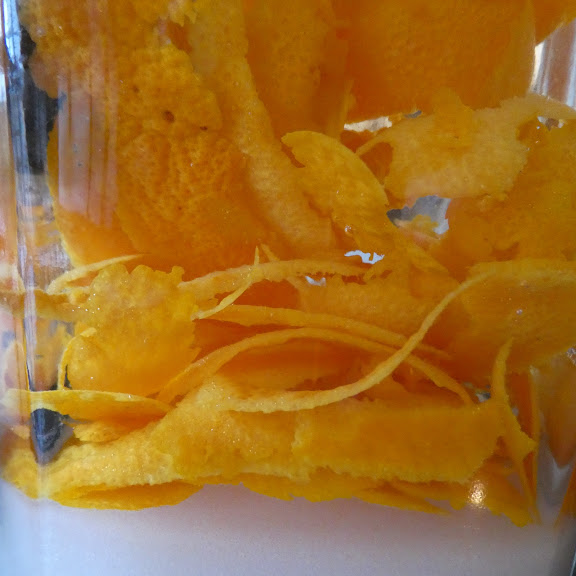
Light-headed? Blame the Gin….

… because it’s Seville orange season, and time to make next Christmas’s supply of Seville Orange Gin, that perfect winter warmer after a day walking in the bright frosty air.

January Squares, # January Light

PS.  Several of you have asked for a recipe.  There are any number on the internet, but they are all similar to this one from The Cottage Smallholder.  I saw a different recipe that suggested cardamom, so I have used this instead of cloves.  And I only used 150 g. sugar.  Also.  Three years?  Not a chance.  We’ll be drinking ours at Christmas.

Highlights of a Bird-free Bird Reserve

RSPB Saltholme.

We had to go to Middlesbrough for an appointment the other day, so we thought we’d stay and explore.

Middlesbrough is what’s known as a ‘post-industrial town’.  Once, its steel and other heavy industry and its port brought wealth (to some), employment, and attendant grime and looming industrial architecture.  Now, it’s reliant on newer technologies, engineering and the presence of  the university developed in the 1990s from the older Polytechnic.

But its landscape is still an industrial one, as is that of the surrounding towns: Billingham, Stockton, Redcar.  Could it be true that the RSPB had developed a Nature Reserve here, on its outskirts?

It could.  RSPB Saltholme.  Though it was hard to believe, as we navigated along roads edged by towering chimneys, great metal hangars, clattering unseen machinery.

But in the end, there it was, among the industrial flatlands – wetlands actually, punctuated by shallow lakes and pools.  We’d arrived.

Light-providing pylons stride purposefully across the landscape behind the reserve.

But the birds had left.  How silly of us not to remember.  At our local nature reserve, Nosterfield, the birds regularly knock off at lunchtime, only reappearing towards dusk.  Who knows where they go?

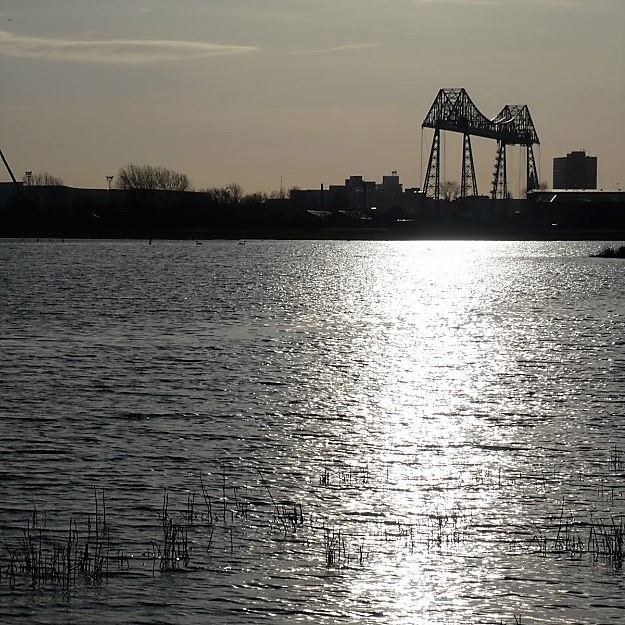
Sunlight plays across the bird-free water. There’s the Tees Transporter Bridge dominating the skyline.

Never mind.  We enjoyed a peaceful walk.  We got a moment of drama when flocks of birds DID appear, swirling and swooping above the lake.  It was quite likely that they were taking evasive action from a resident peregrine falcon hunting for a meal.  Drama over, they disappeared once more.

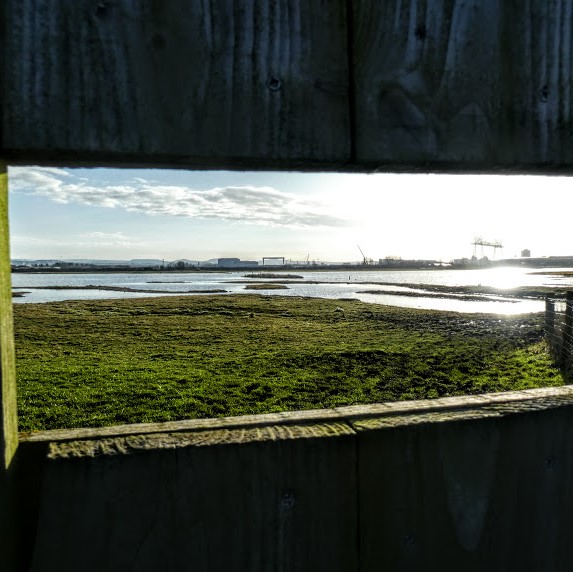
We enjoyed our time in this peaceful oasis.  We explored trails that ended in well-equipped hides.

Sky-light, lake-light from the hides.

We studied noticeboards with information about what better-informed visitors had spotted that very day.  We passed fields with the inevitable large numbers of greylag  geese. And towards the end, we were rewarded with just a few sightings: some shelducks feeding; a shoveler or two;  a few swans and a very distant heron.

But we enjoyed our afternoon. A near-empty wetland, with its unusual backdrop of an industrial past and present, and the never-out-of-sight Tees Transporter Bridge made for a fine afternoon’s walking … and there was even a café.

Camera-shy shelducks.

This multi-tasking post is for Six Word Saturday, January Light (January Squares), and Jo’s Monday Walk.

The Consolations of Winter

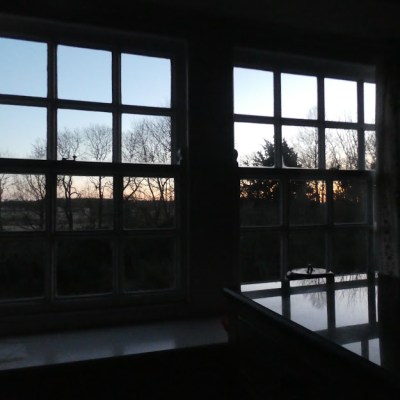
Winter’s not all bad.  The day begins well for us.  Winter light. If we push breakfast just a little bit later than usual – just before 8 o’clock say – we can watch the sun rise, and the sky lighten and brighten in Neapolitan ice-cream colours as we sit near the kitchen window and chomp through our cereal.

Go outside in the daylight, and we can enjoy the snowdrops, and watch green shoots thrusting through the soil.

The trees are handsome, statuesque as they thrust their naked branches skyward.

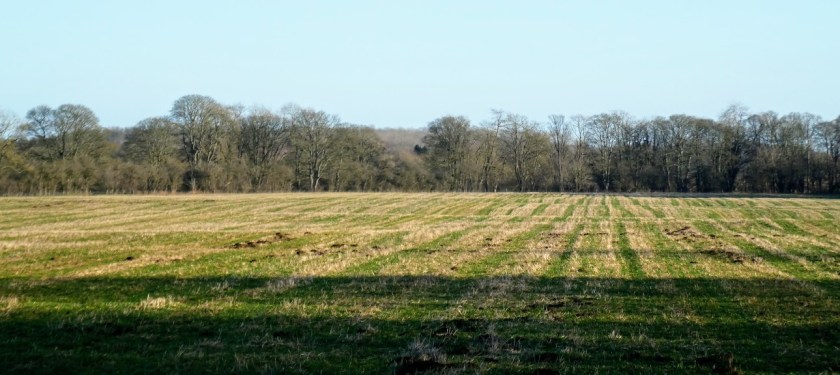
Long shadows reach across the fields in the thin, clear January light.


And back in the house … there’s still some Christmas cake left in the tin.


#January Light

Spanish Views from Spanish Windows

This is my last post about Spain for a while, and it includes images from previous visits too. Browsing through my collection, I see that windows feature – a lot.

Views through, of, and reflected from windows; views through spaces that serve as windows; and finally, views of things outside windows (washing lines!) that have me imagining the lives lived behind them . You’ll see all of these here – mainly, but not exclusively from Barcelona.

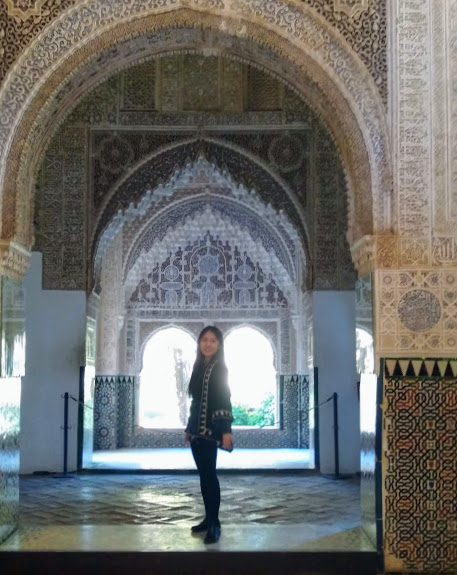
But let’s start in Granada, at the Alhambra. This young woman was impossible to get out of shot, as she had to take a selfie from every angle. In the end, I decided to put her centre stage.

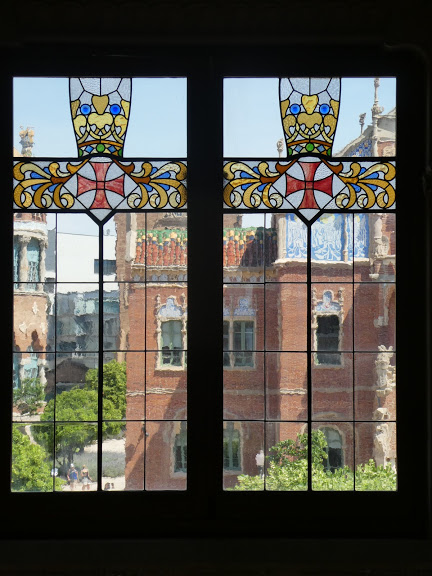
A real view from a real window: our go-to tourist attraction in Barcelona: the Modernista Hospital de Sant Pau.

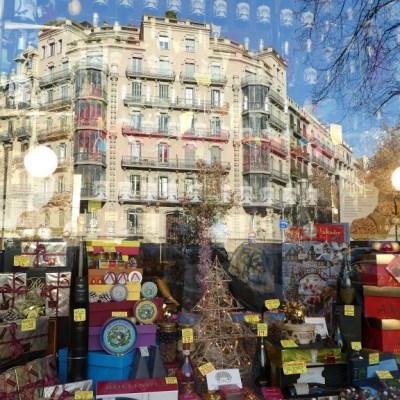
I’m a sucker for reflecting windows. This high-end grocery store in Barcelona offered those reflections in bright light, as well as showing the goods on offer inside (this one’s for you, Becky)

More windows where it’s the reflections providing the views.

And now it’s time for those washing lines.

Two contrasting views through not-a-window: in a garden in the Jewish quarter, Córdoba: and at El Clot-Aragó station, Barcelona.

Finally – this isn’t a view through a window at all. But who could resist viewing this window in Barcelona?

An entry for Lens Artist Challenge #79: ‘A window with a view’,

and #January Light.