This is not the week to get out and about with my camera looking for Unusual Points of View for Jude’s Challenge. Here’s why: *
The view from the bedroom window.
She’d like us to shoot something often photographed, but choose a less usual point of view. I thought I’d combine it with a mini-break for us all.
Let’s go to Bamberg. The old town there, a UNESCO World Heritage site, largely built on the rivers Regnitz and Main, between the 11th and 19th centuries can easily keep you busy and charmed for several days. You can visit the main sites here.
But we have a job to do – Jude’s challenge.
This week's assignment - take a picture of a frequently photographed subject like a flower or a person's face from an unusual POV. How can you create an out-of-the-ordinary shot?
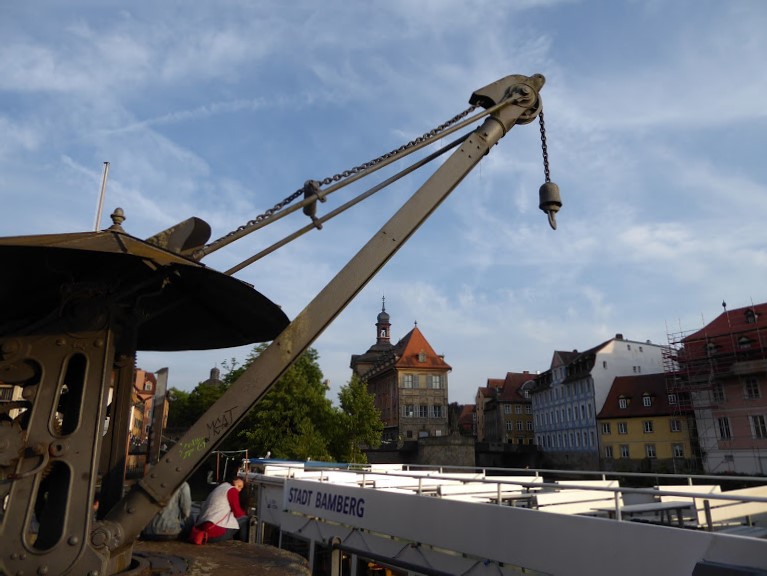
We’ll wander along the river to get a different view of the much photographed Old Town Hall.
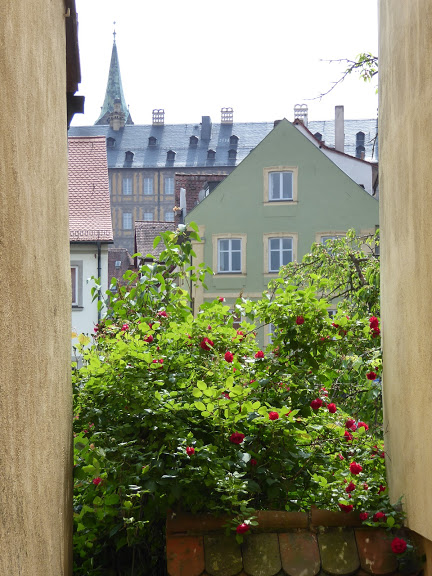
A view of the Old Town Hall from the riverside of the Old Town.Another view of the Old Town, seen from the comfort of a bar.
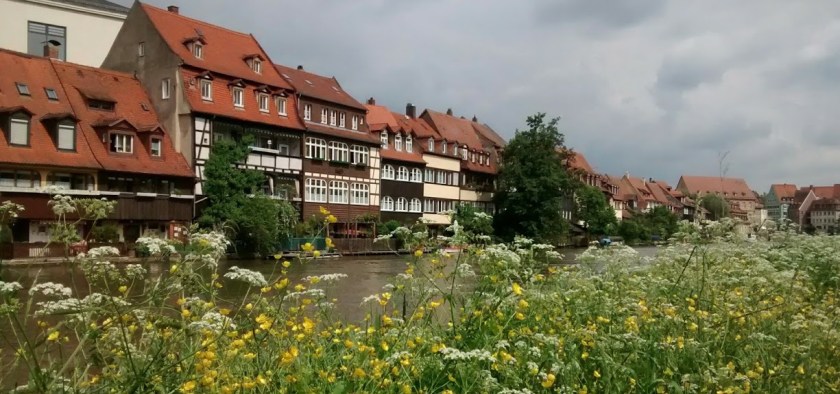
Little Venice, seen from the opposite bank of the river.
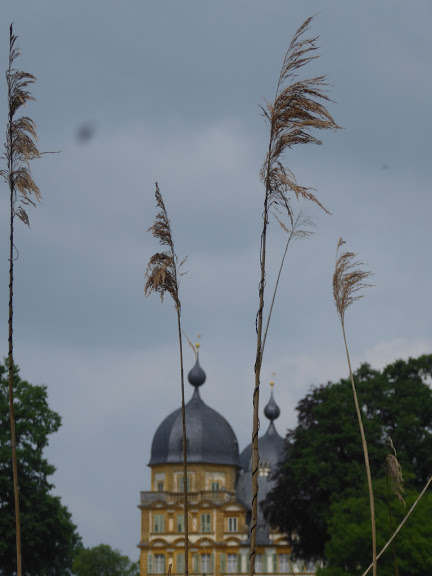
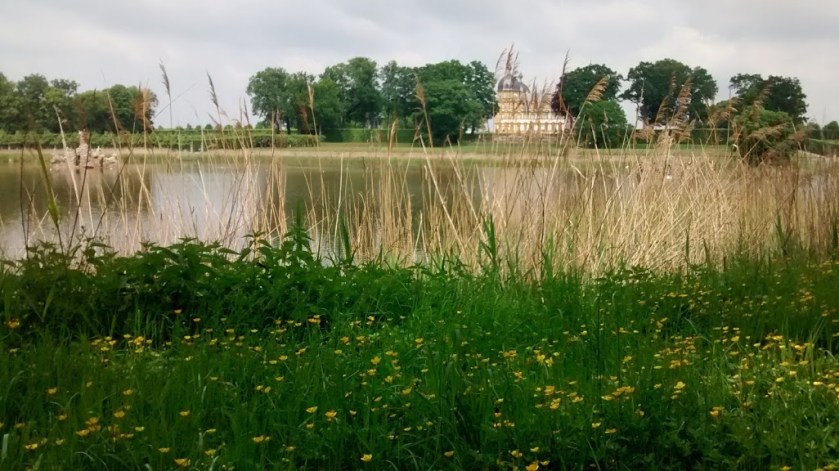
In the afternoon, we’ll go out of town and take a trip toSchloss Seehof. It was built as a palace and hunting lodge for one of the Prince-Bishops of Bamberg between 1684 and 1695. I wanted to capture the idea of this stylish palace being very much a place-in-the-country.
A view from the parkland.Some of the parkland has become a nature reserve, with ponds and wetland. That’s the side of the palace I wanted to show here.
A short trip, I’m afraid. But with travelling being so difficult nowadays, short, sweet and virtual is probably the way forward.
I was casting around wondering what to post for this week’s Lens-Artists Challenge, Labour of Love. And I remembered a wonderful experience I had when I lived in France, when I was part of a small team invited to cook an English school dinner for a local primary school. Truly, the experience was a Labour of Love, as it was for the charismatic school cook, each and every day. My memories of this special day are entirely positive and happy.
September 26th 2012
‘School dinners, school dinners….
‘School dinners, school dinners.
Iron beans, iron beans.
Sloppy semolina, sloppy semolina –
I feel sick, get a bowl quick.’*
Do you remember this cheery ditty from your days eating school dinners? Only if you’re British, I suppose. And most right-thinking French men women and children would be quite prepared to believe that all English food is just like that.
Not the mayor of Villeneuve d’Olmes, where Découverte de Terres Lointaineshas taken its Yorkshire exhibition this week. Back at the planning stage, he’d told us about their school caterer, M. Feliu, who uses almost entirely organic or local ingredients, and who likes to introduce the children to the cooking of other countries every time the excuse arises.
We met M. Feliu at La Freychède. We worked together to produce a menu (Cheap. Tempting to the young French palate. Three courses that work with the kitchen facilities to hand. Conforming to nutritional standards).
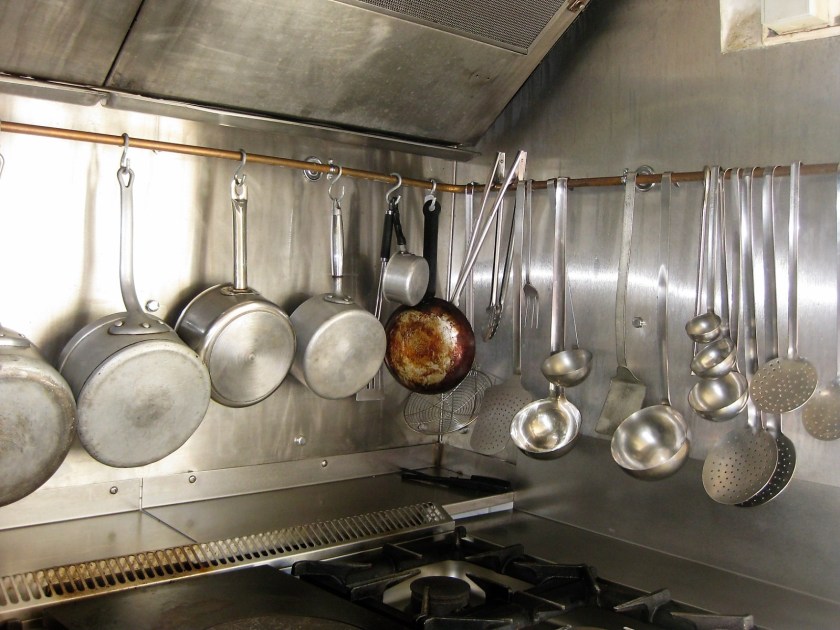
The school kitchen.
This is what we came up with:
Crudités with beetroot chutney
Macaroni cheese with green salad
Blackberry and apple Betty with custard.
Yesterday was the day. I turned up at 10.00 with my English friend and colleague Susie to find the work almost done. All we had left was to churn out batons of carrot, black radish and cucumber for the first course, which was not, let’s face it, Awfully British. But it had to fit in with other considerations as above.
M. Feliu in full chef’s garb.
Me, in what passes for full chef’s garb.
Susie, ditto. I can’t remember what the face-mask was for in pre-Covid times.
11.00: The prepared and cooked food was heaved into insulated containers, and transported by van to one of the local schools.
Catering-sized ovens.
Catering sized macaroni cheese.
Delivery-time.
11.30. Ditto with van number 2. This batch was sent off to Villeneuve d’Olmes, with me following.
12.00. Children arrived at the canteen. One of the helpers, Pascale, spoke good English. ‘What’s your name?’ she’d say to each child in English. When she had her reply, they could go in, and sit down at one of the circular tables, tinies in one room, and juniors in another. I joined a table of lively 7 year olds.
Part of the week’s menu.
The dining room awaits …
The children file in.
One of the staff told me the rules that the children expect to follow:
Take turns to serve the dishes of food to everyone at table.
Wait till everyone’s served before beginning to eat.
Try everything.
You can have the portion size you choose. Once it’s on your plate though, you have to eat it.
Everyone accepts this and we all sat together, eating and chatting. The children chomped their way through all the crudités, they even enjoyed the chutney, whose sweet and sour taste is not an automatic choice round here.
Once cleared away, bread appeared on the table – this is France after all.
Raw veg go down just fine.
It wouldn’t be France without bread on the table …
… or salad.
Two more children served the macaroni cheese and the salad. Most of us came back for seconds.
We sang ‘Happy Birthday’ – in English – to a birthday girl.
I gave an impromptu talk on the food on offer.
The blackberry and apple Betty was served. Yum! How could it fail? Gently cooked fruit with a crunchy crust of soft breadcrumbs crisped in golden syrup and butter, with obligatory custard, of course.
Then the children cleared their tables, stacking dirty plates and glasses neatly for washing up, before going off to play.
Macaroni cheese….
,,, and apple betty with custard.
I was so impressed. The children here learn that the midday meal is so much more than a pit-stop. The expectations, reinforced daily, are that this is a moment to spend with friends, a time to share, to think about the needs of others, and to appreciate the food on offer. The occasion lasted well over an hour.
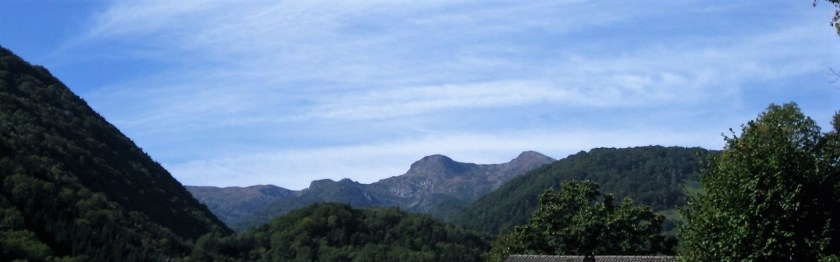
The view from the kitchen door.Another view from Villeneuve.
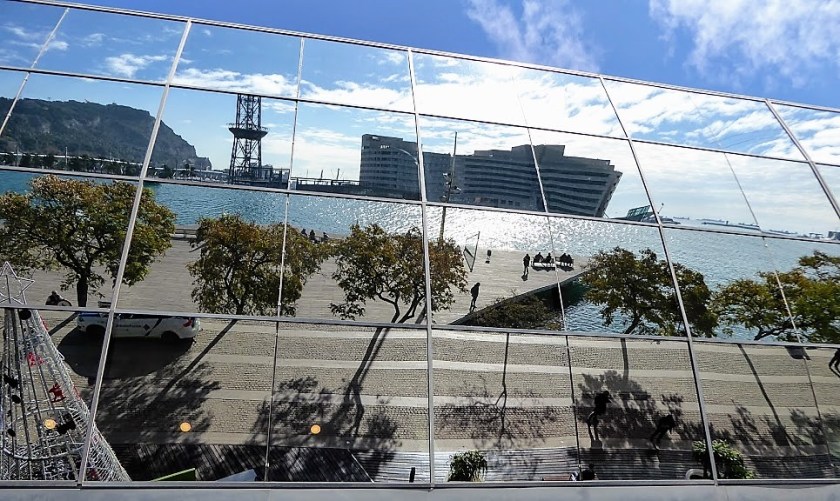
I’ve woken up feeling unaccountably gloomy this morning. Is it the fine but insistent rain? Is it the spike in Covid figures that seems to presage what this winter may be like? I don’t know, but Positivity seem to be called for, and a Virtual Day Out in the Sun.
Let’s go to the seafront in Barcelona, and have a look at a very up-beat window with varied viewpoints.
When I first joined Six Degrees of Separation last month, I was quite delighted at how far my chain of books stretched from the original. This time, I’ve gone on a changed journey. Each of my books links together. And yet they are all so different. Have a look.
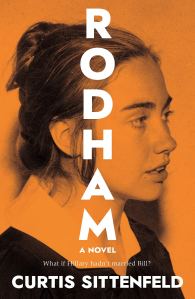
I haven’t yet read Rodham. I’m a huge fan of Sittenfeld’s writing, but the reviews for this latest book, featuring Hillary Clinton, are very mixed. Kate, who hosts Six Degreeswasn’t all that keen. This bookis a re-imagining of a life, that of a known individual, so that’s my starting point.
Here’s another re-imagining, this time from Greek mythology: Circe, by Madeline Miller. Immortal Circe tells her story through the hundreds of years of her life. She’s known Prometheus; Daedalus and Icarus; Ariadne and the Minotaur; Jason of Golden Fleece fame, and most importantly, Odysseus, and has stories about all of them. Over the years – the centuries – she develops her skills as a witch, We witness her growing independence; her satisfactions as she develops her spells; her joys and loneliness. She takes lovers as they come her way, but never abandons herself to them: until Odysseus .. and Telemachus …
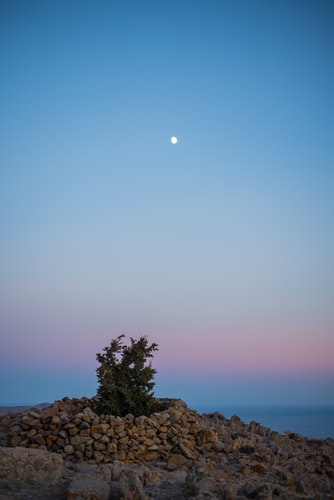
Might Circe have thought this view familiar? Skala Eressos, Lesvos, Greece, Image from Unsplash (Tania Mousinho)
Next is another strong, independent woman: A real one, telling her own story: Stories of the Sahara. The writer Sanmao was a Chinese/Taiwanese woman married to a Spaniard, who realised her obsession to live in the Sahara desert. She was feisty, opinionated, driven, and made it her business to get to know the locals and understand their lives in a way no tourist can.
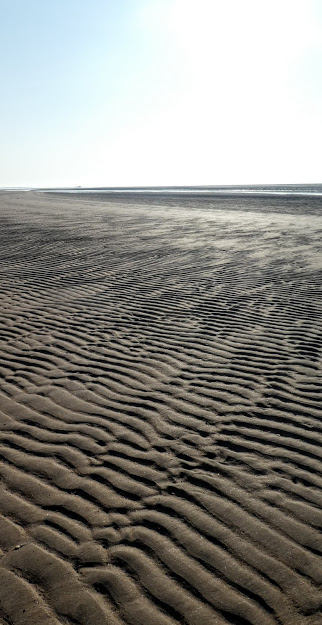
Sand, but not Saharan sand. This is the beach at Alnmouth, Northumberland UK.
It dawned on me that there’s a theme developing here. These are all stories of women, by women. So let’s stick with it, and look at another independent woman’s story: Raynor Winn’s The Salt Path. It’s the account of a long distance walk undertaken by Ray and her husband when everything that possibly could go wrong in their lives had gone wrong. They’d lost their home, their livelihoods, and in her husband’s case, his health. In one sense they walked away from their problems, spending a year living rough and walking England’s South West Coastal Path. It became their journey towards a new life.
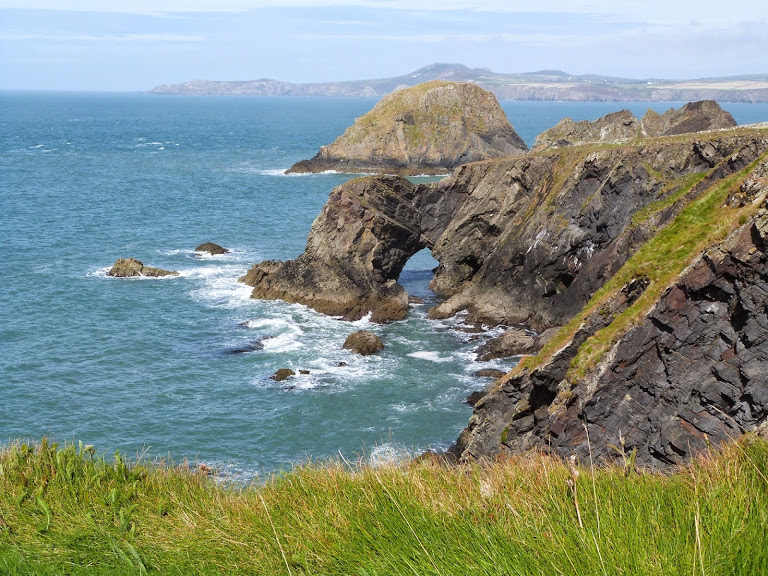
This isn’t Cornwall, but Pembrokeshire. However, it is a coastal path with many similarities to that pounded along by Raynor and her husband.
More strong women, more sea, more difficult times: the diving fisherwomen – haenyo – of Jeju Island, South Korea. The Island of Sea Women by Lisa See tells an involving story following the story of two women whose lives develop through their membership of the haenyo culture, as they live through a twentieth century defined in Korea by occupation, internal conflict, deprivation and rapid change.
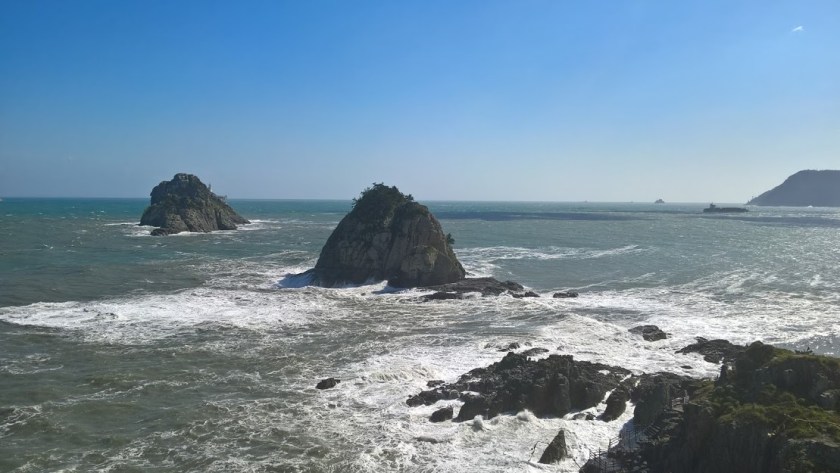
This isn’t Jeju Island, but it is South Korea: Igidae, near Busan, and a similar coastline.
Over to Russia. Zuleikha by Guzel Yakhina. This story, with a young uneducated Tatar woman at its heart, does much to bring to life the gulags and their unhappy part in Soviet history. Zuleikha is the young wife of a prosperous young farmer. After his murder she’s taken prisoner and survives an apparently endless train journey and real physical, emotional and economic hardship, into a previously unpopulated part of Siberia where against the odds, she builds a life.
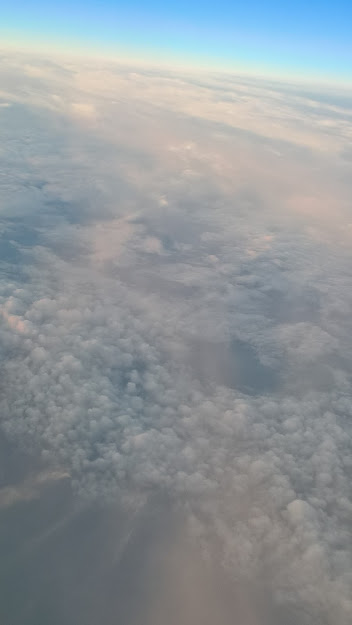
On our way home from South Korea, we flew over Siberia, still an astonishingly unpopulated region.
Gina’s life is very different. She’s a spoiled, headstrong, privileged 14 year old Hungarian who for her own protection during WWII is sent away to a puritanical isolated boarding school where she has some hard lessons to learn. But what has Abigail, a classical statue in the school’s grounds, and who will receive messages from the pupils got to teach her? Read Abigail by Magda Szabó to find out.
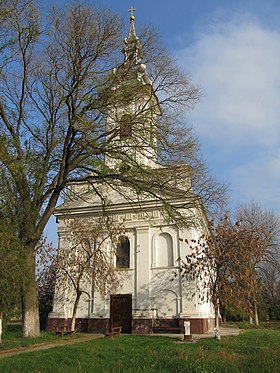
The church at Arkod, the town where Gina’s boarding school is situated (Wikimedia Commons).
We’ve been to three continents and six countries, gone back in time and remained in the present. We’ve met rich women, poor women, privileged women, and those who often feel without hope. Here’s a chain with six strong links.
Way back in what we no longer call the Dark Ages, this part of the world – north east England – was overrun by Vikings. They came, they saw, they settled. They left their mark on the language: villages such as Thirn, Thrintoft, Skeldale, Kirkby, Slingsby, Ainsty all betray their Norse ancestry. Vikings have a reputation for ravaging and plundering, but in fact many of them and their families made their lives here.
The scenery won’t have been so tidily organised back then.
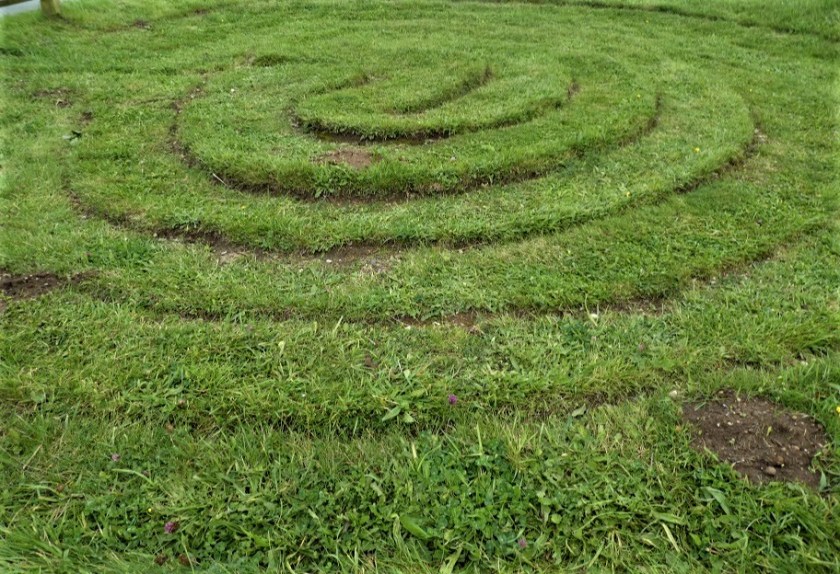
And settlers need some down-time in among the hard work of clearing and working the land and looking after stock: pursuits like this forerunner of the board game, which was played throughout what is now Scandinavia. We found one while walking the Howardian Hills last weekend. It looks like a maze, and it’s called City of Troy.
City of Troy, near Dalby, Sheriff Hutton.
It’s one of only eight still left in England, and this one is the smallest- barely bigger than a large picnic blanket. There used to be one near Ripon apparently, but it was ploughed up in 1827. Nobody any longer knows how to play this game. Why City of Troy? Well, it’s thought that it refers to the walls of that city, which were apparently built in such a way as to prevent unwanted intruders finding their way out. I’m astonished by the idea that the average Norseman (or woman) was up to speed with Ancient Greek history and myth, but what do I know?
A close up view.
It’s related though to labyrinths found all over Europe. Every ancient culture: Greek, Roman, Egyptian, Indian, Native American – had their own take on this one-way-in and one-way-out puzzle. The labyrinth made its way into mediaeval churches. There was even one in the cathedral local to us in France, in Mirepoix.
The labyrinth in Mirepoix Cathedral.
To Christians of those days, it may have been a symbol of wholeness, and an aid to reflection and prayer. That spiral path within a circle may represent a meandering path, leading us to our very centre, then back out into the world.
The maze game probably doesn’t run so deep. But what its rules were, and when and how it was played, out on a hillside some distance from any known settlement is a mystery that will almost certainly never be solved.
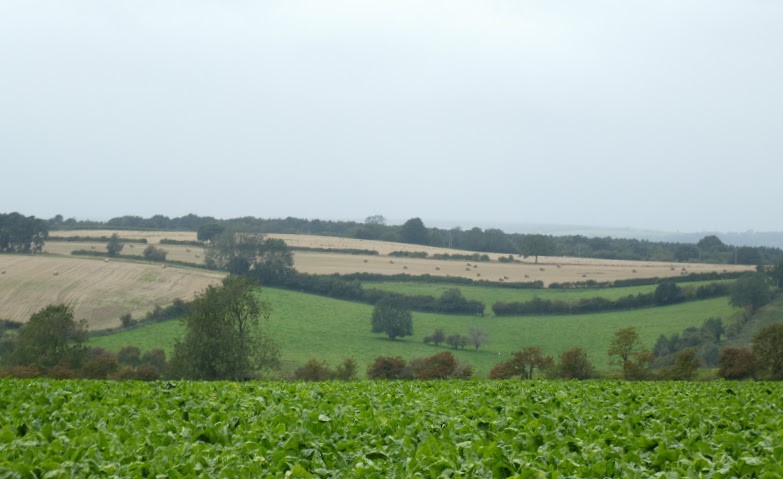
Early morning mistiness: looking across to the Howardian Hills.
We’ve just come back from a weekend in the Howardian Hills – that slice of Yorkshire that includes Castle Howard, where that iconic TV series Brideshead Revisited was filmed in the 1980s.
For farmers, it’s a wealthy little corner of the county, with fertile fields offering a steady income in return for careful husbandry. Well-constructed farm gates at the end of tidy tracks are handsomely buttressed by smart stone gate posts. Crops stand to attention and weeds show their faces only at field margins. Agricultural labourers are no longer tenants in those postcard-perfect villages.
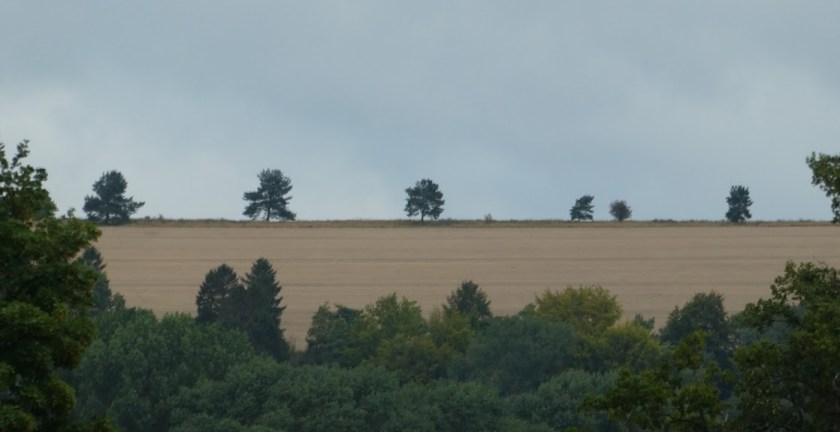
Trees neatly marching across a hill crest.
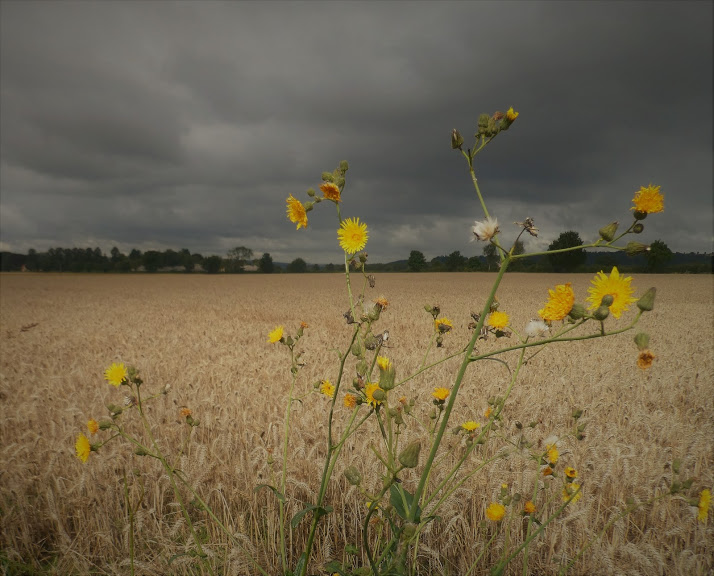
Our late August break was not accompanied by late summer weather. Although it didn’t rain, skies remained sulky and black. Wind bustled and gusted fiercely against our faces. The temperature hovered at 11 degrees all weekend. Perfect for this week’s Photo Challenge, for which brightly luminous blue skies contrasting with the golden hues of harvest simply Would Not Do.
This month's final assignment - Experiment with using two or three Complementary colours. Try to make one or two colours the focus of the image, and use the other colour to enhance the overall image.
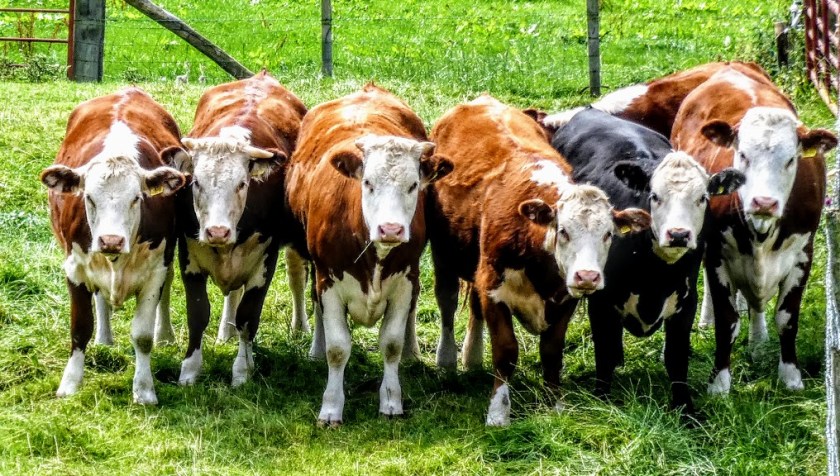
I’ve taken images from fields, from distant vistas, and from the one abandoned ruined grange we came across, where farm animals still grazed in the grassy yard. I’ve played around with colour contrast: aiming to make my results what my eyes thought they saw, rather than what my camera knew it saw.
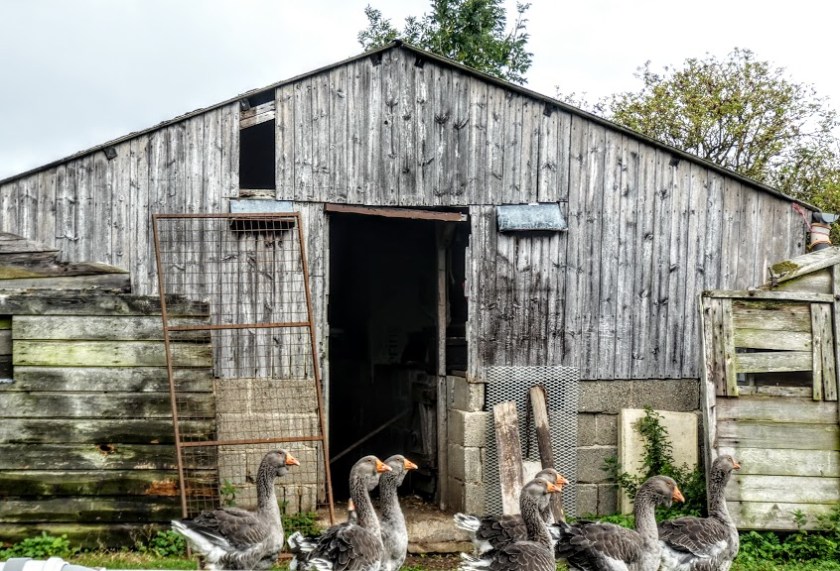
This is what my eyes, not the camera saw.I liked the only splash of colour here: those orange beaks.
It’s got to the point where we could almost put chilli on our breakfast cereal. Jalapeño, Scotch bonnet, bird’s eye, habanero, chipotle, cayenne: all have become everyday objects in our home.
Our love affair with the chilli began in France. This is odd, because the French, on the whole, do not do spicy foods. ‘Are you trying to kill me?’ Henri howled, clutching his throat, when we put before him one day the mildest of all mild kormas.
But on a smallholding near us, a chilli enthusiast, Jean-Phillipe Turpin was busy. He grew mild chillies, medium-hot chillies, and chillies so hot they were off the Scoville scale. We came to call him ‘Mr. Chilli’.
Mr. Chilli at Mirepoix market.
He came to sell his wares every week in summer and autumn at two local markets. Fresh chillies, strings of dried chillies, powdered chillies, chilli plants. We became regular customers, as did other English, from far and wide. The French? Not so much.
Back in England, we still buy different chillies, every week. The dozens of varieties purveyed by Mr. Chilli rarely come our way. The ones we do have are everyday objects in our house. As are jars of spicy pastes and potions.
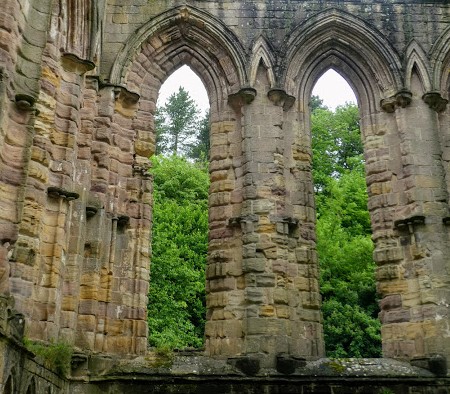
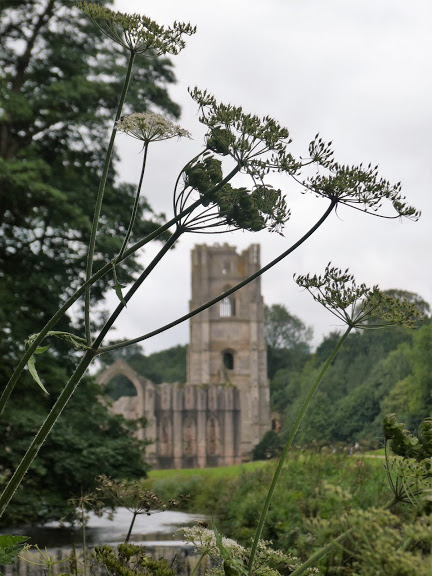
I’m back volunteering at Fountains Abbey, and every time I’m there, I’ll spend time in the ruined Abbey itself. I’ll gaze up at the voids which were once windows. Any stone tracery has long disappeared, revealing views of the sky and trees beyond. And I wonder what the monks saw, during their long hours of worship – eight sessions a day, the first at 2.00 a.m., when the night was charcoal-black and only smoky tallow candles lit the space? The ascetic Cistercians had no statuary in their churches, little stained glass, so the monks probably glimpsed a barely-to-be-discerned landscape beyond, through water-greenish, slightly uneven glass.
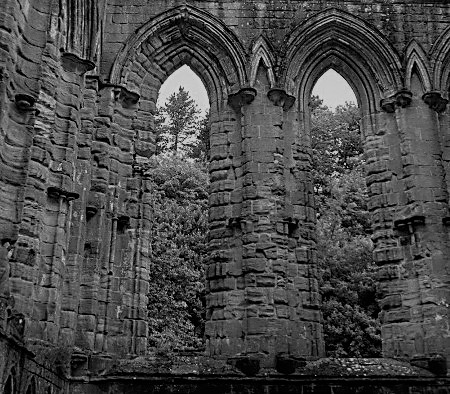
In her challenge this week, Jude has invited us to compare the same scene in colour, and in black and white. I thought it would be interesting to do this in a building in which colour plays little part. Surely there would be little difference? Well, apparently there is. I find the black and white version a little too austere for my tastes. What do you think?
And here’s a view of the Abbey with Huby’s Tower, which was completed a mere 13 years before Henry VIII brought the Fountains Abbey community to an end in 1539 during the Dissolution of the Monasteries. I’ve tried to show it more as it might have looked then, set in a wilder landscape than the manicured parkland we see today. And when it came to the monochrome version – well, there’s black and white, and black and white. Again, there are choices here ….
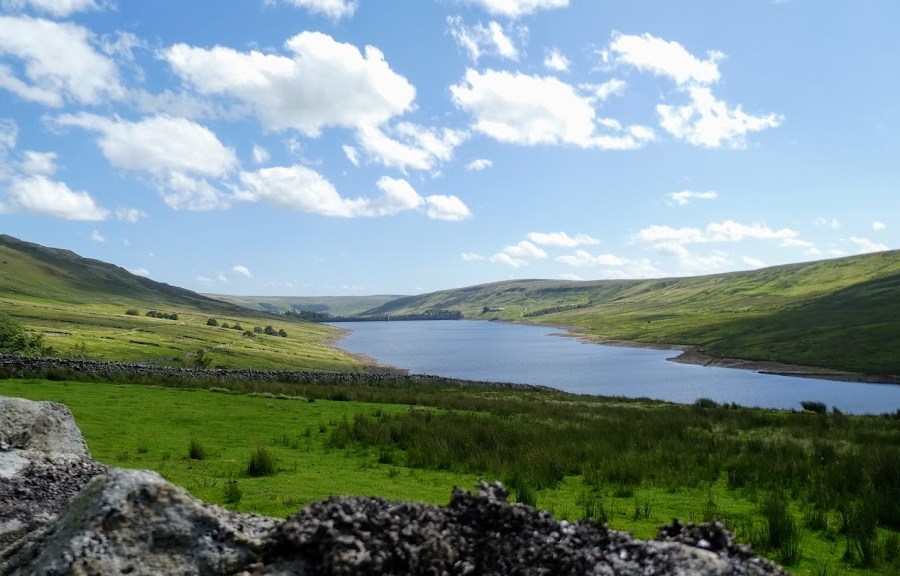
I love bleak. Typically rolling English countryside is lovely. And you can’t beat a verdant Daleside vista, criss-crossed with dry stone walls dividing its pastureland, its river along the valley floor edged with trees. But here in Yorkshire, every now and then, I have to have my fix of bleak.
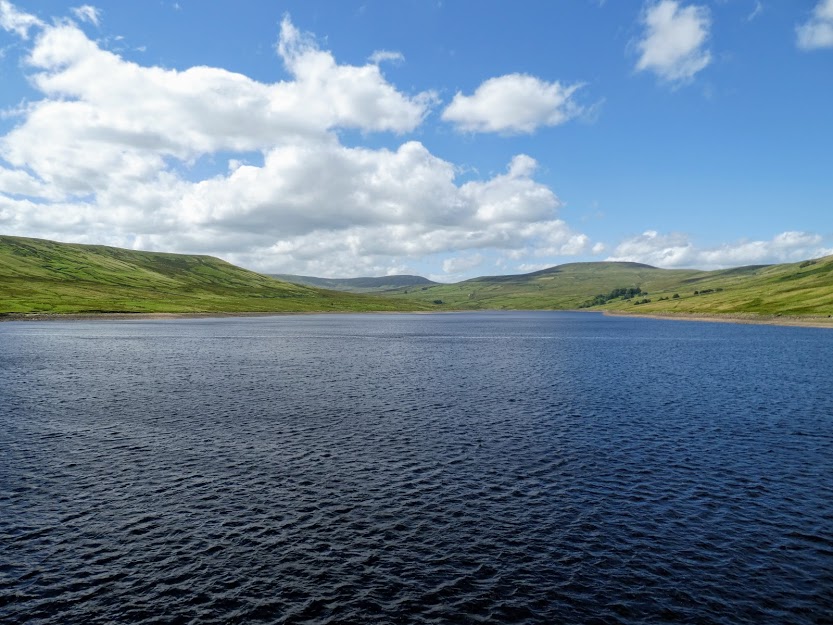
And one way to do this is to go over to Angram and Scar House reservoirs, both constructed in Nidderdale during the inter-war years last century, to provide water for the citizens of Bradford. Here are slopes, sculpted by long-gone streams and the often savage weather. These hillsides are covered in thin, tussocky grass – and not much else. Few trees. Few buildings – the odd hunting lodge or barn. But there are sheep, and birdlife too. One of our memories of walking here was once seeing a small meadow pipit struggling to feed ‘her’ baby, a cuckoo fledgling three times her size.
My friend Sandra and I went there this week. The day was perfect. Not too hot and not too cold. Briskly breezy. And as we arrived , the reservoir was as blue as we’ve ever seen it, almost cobalt in its intensity. We planned to walk our way round both reservoirs.
Scar House Reservoir
Which way though? Clockwise? Anti-clockwise? Sandra counselled clockwise, and Sandra won. That way, we’d get a slightly boring bit of track over and done with. We’d get the wind-in-our-faces over and done with. And most importantly, we’d get the squishier, less managed paths of Angram Reservoir over and done with.
It’s rained a lot lately, so walking round Angram involves some wet pathways. Not muddy, just paddleable. Juncus grass lining the route offered the odd springboard to drier grassy ground. But with water to right of us, bald barren hillside to left of us , the route is easy to see. And each reservoir terminates in a stout dam, each worthy of walk in its own right, and in Angram’s case, with water tumbling to its sister reservoir below.
Scar House Dam.
Angram Dam
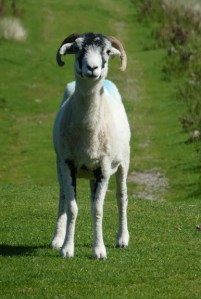
Finally we left our wet pathways behind, and joined the springier drier turf pathways of Scar House Reservoir where sheep kept us company.
But even though we knew from the car park that we weren’t alone, we felt that this particular expanse of hillside, sky and water was ours and only ours for the six and a half mile walk in the middle of nowhere.















 From Pyrenees to Pennines
You must be logged in to post a comment.